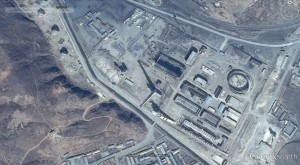
Pictured above is the new plant. Learn more about it on this new article at 38 North.

Institute for Far Eastern Studies (IFES)
Coinciding with the promotion of the nation’s economic development zones (EDZs), North Korea has recently decided to adopt three new regulations, including the “Democratic People’s Republic of Korea’s Operation Regulation of Economic Development Zone Management,” which opens up high-level positions in management organizations to foreigners within the various EDZs around the nation.
The three new regulations, including the “DPRK Operation Regulation of EDZ Management,” “DPRK EDZ Establishment Regulation” and the “DPRK EDZ Company Establishment Operation Regulation” were obtained and reported by the Maeil Business Newspaper on November 4, 2014 and were said to be adopted by the Standing Committee of the Supreme People’s Assembly just two days later on November 6.
In May 2013, North Korea established the legislative basis for the creation of central-level EDZs (special economic zones, SEZs) and provincial-level economic development zones, and in October, the State Economic Development Board had its status elevated to the State Economic Development Committee and was given total control over business in EDZs. Then, on November 21, the Sinuiju Special Economic Zone (SEZ) was announced alongside thirteen other provincial-level EDZs. The following year, in June 2014, the Wonsan-Mt. Kumgang International Tourist Zone was announced, followed by the July announcement about the designation of six additional economic development zones, including the Unjong Cutting-Edge Technological Development Zone.
It appears that these three new EDZ-related regulations are specific internal regulations in order to better implement the “Law on Economic Development Zones.” According to the first new regulation, the establishment of EDZs will “coincide with the state’s economic development strategy” and will have their establishment agendas written by the “Central Special Economic Zone Guidance Agency.” EDZs are said to be “advantageous to overseas economic cooperation and exchange,” and it was stipulated that EDZs are to be established in “areas of concentrated population,” as well as in “certain remote areas.”
With regards to the regulation on the operation of management agencies in EDZs, it was reported that “management operation at EDZs will be conducted by the EDZ’s Management Operation Association or Management Office (hereafter Management Agency).” Specifically, the regulation states, “Members of the Management Agency may be a person from [the DPRK] or another country who has extensive business experience and who possesses expert knowledge in their field,” showing that foreigners may now be entrusted with high-level positions such as chairman in North Korea’s economic development zones.
Furthermore, it was decided that “foreign and/or domestic experts may be invited to work full time or part time in their appropriate department according to the needs of the Management Agency,” stipulating that foreign experts outside of EDZ managerial positions may also be invited.
In terms of the regulation on the establishment and operation of corporations in EDZs, it was decided that “foreign corporations, individuals, economic organizations and overseas Koreans may invest in EDZs and establish and operate companies through joint ventures or individually.” The regulation also states, “Investment and economic activities are limited only to those who give knowledge to and promote the nation’s safety, the health of the people, a wholesome, socially moral lifestyle and environmental protection, and are prohibited to those who are lagging behind in terms of economic technology.” Instead, the regulation promotes the establishment of companies in the “infrastructure construction and cutting-edge technology sectors,” and has clearly stated that they will receive preferential treatment in the form of tax cuts, favorable land use conditions and other benefits.
Additionally, while the regulation did say that “companies must primarily employ labor from [the DPRK],” it held the door open for foreigners by saying that “a portion of management personnel, specific types of occupational experts and technicians may be employed from other countries.” The regulation also set specific standards for penalties should a company create problems. Businesses caught operating without a business registration or license will face charges between ten and fifteen thousand Euro, businesses who fail to report changes in their company registration will face fines between two thousand and five thousand Euro, and business founders who are caught pocketing investment money without lawful justification will suffer fines between ten and twenty thousand Euro.
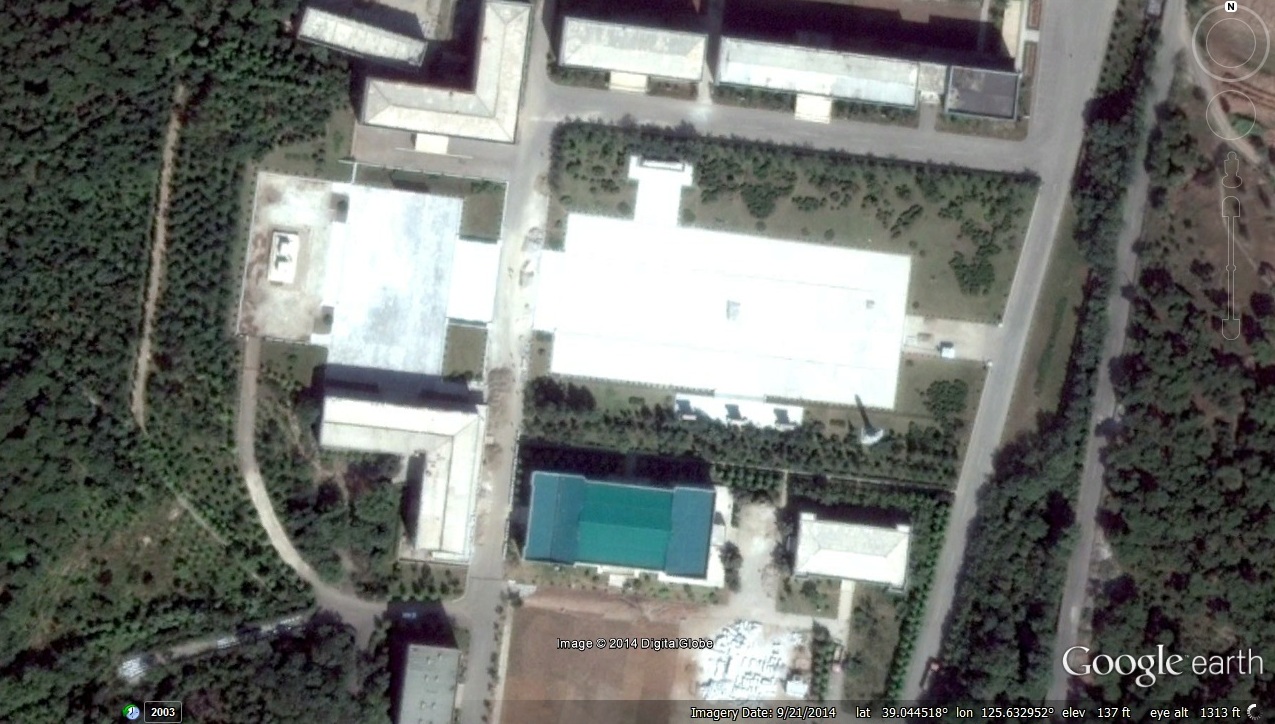
Pictured above: Security University of the DPRK (formerly “University of KPA Unit 10215″) in Mangyongdae District (39.044446°, 125.633676°)
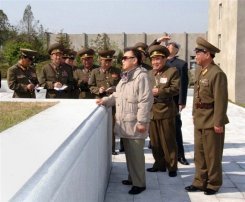
KCNA has announced the unveiling of new statues of Kim Il-sung and Kim Jong-il at the “Security University of the DPRK”. The bases for these new statues can be seen in the satellite imagery, but the statues themselves can be seen in the official photos below:
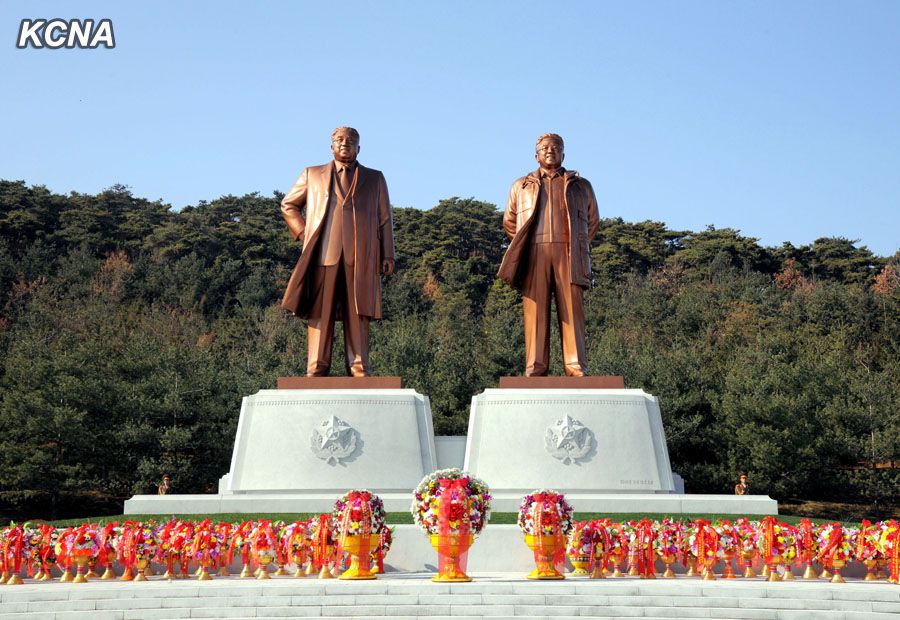
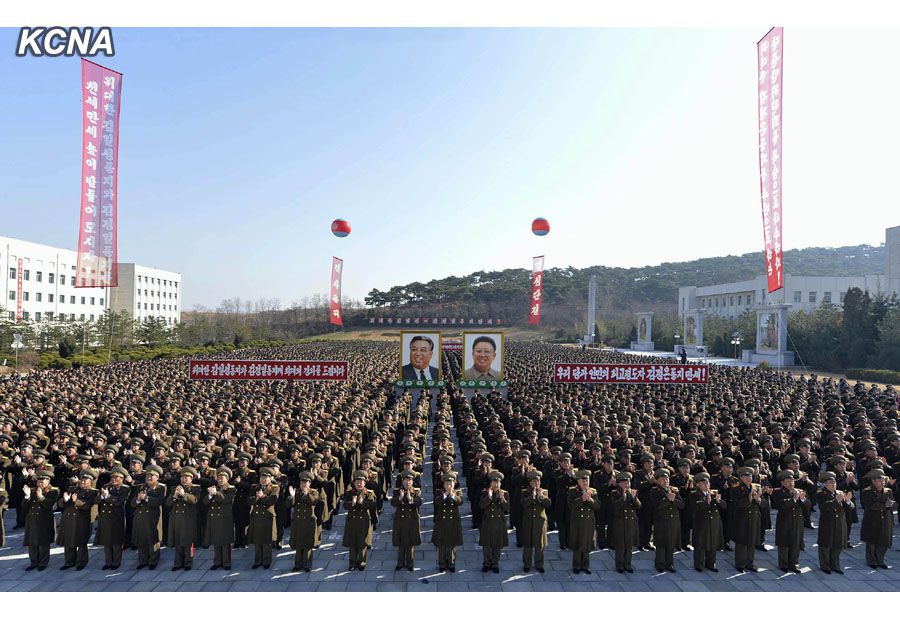
According to the article:
Present there were Kim Ki Nam, Choe Thae Bok, Pak To Chun, Kim Won Hong, Jo Yon Jun, and commanding officers of the Ministry of State Security, officials of security organs at various levels and teachers, students and employees of the university and their families and officials and those of meritorious services of units which contributed to erecting the statues.
Kim Jong-il last visited this facility on May 5, 2009. Kim Jong-un has yet to make an official visit.
According to Yonhap:
Hyundai Asan Corp., the company that pioneered inter-Korean commercial ties, said Tuesday that its loss from the suspension of its North Korea tour programs is estimated at nearly 1 trillion won (US$909 million) over the past six years.
The company said on the eve of the 16th anniversary of starting the tours to Mount Kumgang on North Korea’s east coast that it has also been forced to reduce its workforce by up to 73 percent.
Before visits were stopped, the company employed 1,084 people to handle tours to Mount Kumgang and the city of Kaesong, but the staff has been slashed to just 285. Kaesong was the capital of the Goryeo Dynasty (918-1392).
The estimate is based on the assumption that some 300,000 tourists would have visited the scenic mountain and seaside resort on an annual basis if the ban was not placed. For Kaesong, Hyundai Asan said the loss in earnings was calculated on the premise that some 100,000 people would have visited the city per year.
Seoul banned all tourists from visiting the isolated country after a North Korean guard shot a South Korean visitor dead in July 2008 at Mount Kumgang. South Korea said the North must formally apologize for the mishap and assure that the tragedy will not occur in the future.
Tourists first started visiting the mountains in November 1998 and by 2008, over 1.93 million made the trip to the North.
“The halt in tourism to the mountain resort has cost the company 809.4 billion won, while losses brought on by a ban on tourism to the ancient city of Kaesong on the west coast, has ballooned to 125.2 billion won with the total reaching 934.7 billion won,” the company said. They added that if tours do not resume soon, the loss in earnings will reach the 1 trillion won mark.
The halt in tourism is particularly painful because the company, part of the larger Hyundai Group, invested 226.8 billion won in various facility investments and US$486.69 million to acquire land and operational rights from Pyongyang.
Hyundai Asan said that despite troubles, it has a plan in place that can restart tours in two months, with its top executives still hoping that cross-border relations will improve so operations can resume.
Read the full story here:
Hyundai Asan faces 1 tln won loss on N. Korea tour suspension
Yonhap
2014-11-18
Institute for Far Eastern Studies (IFES)
The DPRK leader Kim Jong Un recently emphasized the work of national heritage protection through the announcement of Nojak. In the DPRK vernacular, Nojak means the immortal writing of the highest leaders, Kim Il Sung and Kim Jong Il.
In October 30, DPRK’s Chosun Central News Agency reported that on October 24, the First Chairman Kim Jong Un made a statement on “National Heritage Protection Work as a Patriotic Business that Brings Honor to the Heritage and History of Our Nation,” together with members of the Workers’ Party Central Committee, in celebration of the 20th anniversary (October 29) of field guidance at the tomb of Tangun in Pyongyang by Eternal Chairman Kim Jong Il.
During the discourse, First Chairman Kim Jong Un stressed that “it is our strong will to flourish as a powerful nation which has inherited a glorious culture with a long history of being a universally civilized country.”
He went on to say, “by well managing the preservation of the remains and relics of the old capital city of Pyongyang and Kaesong, further interest should be turned in preserving the remains that have meaning as a national treasure in other suburban areas.” He also pointed out that “we need to fight hard the tendency of Dadaism, which refuses the superiority of one’s country and not managing the preservation of relics, which leads to the phenomenon of damaging them.”
He also added, “It is important to preserve the original form and not destroy the ecological environment of the scenic spots” and also stressed that “it is important to set up a thorough countermeasure so that the scenic spot will not be destroyed or polluted because of wastewater and factory pollution, pests and underground development of resources, and forest fires.”
Kim Jung Un also said “parts of the city and districts have not turned their interest in managing the preservation of historical remains; therefore, precious historical relics have been stolen or destroyed.” He further pointed out that “there has been cases where the ecological environment had been destroyed and the scenic beauty had vanished at the scenic spot.”
“Cabinet, relevant ministries and central organizations should turn their interest to historical remains and museums where maintenance and construction should be focused at these scenic spots so that facilities, materials, and funds that are demanded can be supported with responsibility.” He also proposed a solution: “through tourism and observation of historical remains and scenic spots, a portion of money that had been earned should be turned into the fund for protecting the ethnic heritage so that it can be managed autonomously.”
He went on to stress that “at the Guidance Bureau for the Preservation of National Heritage, in order to designate the natural heritage and historical monuments of the people at the UNESCO World Heritage, exchange business with other countries and the UN has been underway, especially in strengthening academic exchanges related to national cultural heritage, and especially with the compatriots of the South and overseas.”
Furthermore, he stated that the “Complex of Koguryo Tombs and historical relics at Kaesong City had been designated as a World Heritage; however, there needs to be continuous work in finding more of our country’s outstanding material heritage, non-material heritage, and natural heritage to be registered at the UNESCO World Heritage.”
In the discourse, Kim Jung Un stated that “national heritage work is a patriotic business which can lift up the country and a way to hold on to the tradition and history of the country.” He added that the “principle of identity, principle of history and scientific history are the basic principles that need to be consistently followed in order to develop and protect the national cultural heritage.”
The recent talk that has constantly stressed national heritage protection work by the Kim Jung Un regime can be seen as a move to infuse pride in the people for the history and culture of the country and to strengthen the solidarity of the people.
From October 28, 2014-March 28, 2015:
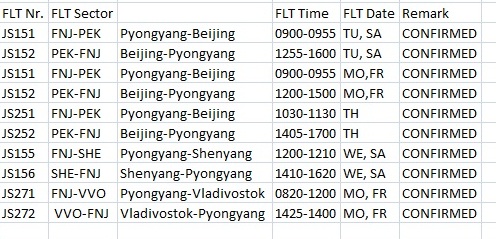
According to the Institute for Far Eastern Studies (IFES):
North Korea, which has been focusing its efforts on increasing energy production, is currently paying close attention to micro hydropower systems. Micro hydropower is a type of hydroelectric power system which can effectively harness industrial water and/or hydroelectric resources from water and sewage systems to produce electricity.
A November 2, 2014 article published in the North Korea Workers’ Party’s official newspaper, the Rodong Sinmun, reported on the advantages and efficiency of micro hydropower, of which it claims North Korea has implemented and is currently using. The harnessing of industrial and sewer system water was once a mere point of interest for North Korea; but according to the newspaper article, a variety of micro hydropower equipment has since been installed and is currently generating up to 100kW of power for the nation.
The newspaper explained, “Industrial waste water used for cooling or cleaning in factories has a fixed height and pressure, and can be used as a water power resource to produce electricity due to its stable quantity and flow rate. . . . In water and sewage systems, catchment areas and sewage purification plants have freefalling water which can be used as a water power resource, and in air conditioning systems, the circulating cooling water can also be potentially utilized.”
The article also praised micro hydropower systems for their low initial investment cost and operation fees.
According to the Rodong Sinmun, construction costs for the levees used in a hydroelectric power plant can account for over fifty percent of the total construction costs of the system. But, because micro hydropower systems can be installed and connected directly to existing pipes, costs are reduced dramatically, and the low-flow, low-pressure nature of the micro hydropower system allows for additional savings on materials such as waterwheels and generators.
The costs of installing a micro hydropower system may be double that of a diesel-powered generator, but when taking the cost of fuel into account, micro hydropower systems are said to be much more economical in the long term.
The newspaper also reported about one micro hydropower facility which even utilizes the piping and freefalling water from their service-water purifier. According to the article, the system produces enough electricity to power the water purification and also net a 55kW energy surplus.
According to Yonhap:
A U.S. charity group said Tuesday it has agreed with North Korea to expand its medical aid program in the impoverished nation.
Under the deal, the Washington-based Eugene Bell Foundation will construct three new wards at tuberculosis (TB) treatment centers in Pyongyang.
It is the fruit of a three-week trip to the communist nation by a group of 13 officials from the foundation.
“The number of patients at those treatment centers has grown as the activity of our foundation is increasingly known,” a foundation official said. “Every treatment center suffers a severe lack of wards.”
The foundation has long provided medical humanitarian assistance to North Korea, especially for multidrug-resistant tuberculosis.
In a new program, it is sending 770 million won (US$750,000) worth of TB medication to the North.
Read the full story here:
U.S. charity group to expand medical aid program in N. Korea
Yonhap
2014-11-11
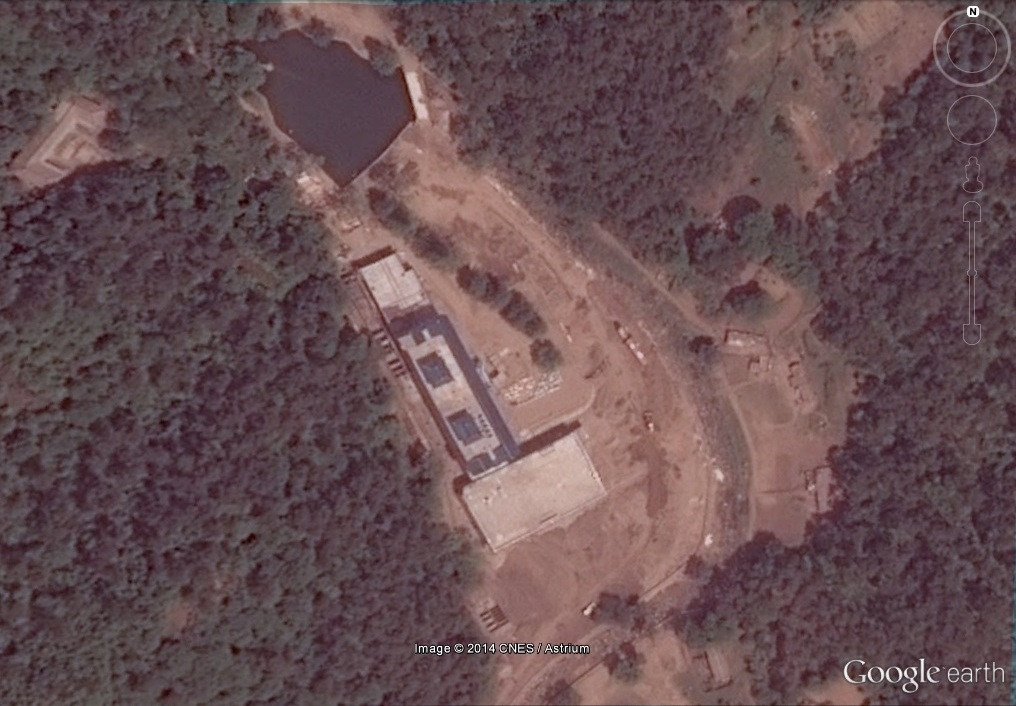
Pictured Above (Google Earth): The new Tongrim Waterfall hotel
UPDATE 2 (2014-11-11): Koryo Tours announces that westerners will be able to visit Tongrim as well:
For anyone looking for an exciting opportunity to travel in one of the least-seen parts of the least-seen nation in the world Koryo Tours is proud to offer the option to visit the city of Sinuiju, and take a drive down to the city of Dongrim – newly open to western tourists after years of our hard work pushing for access.
We have two options available for tours to this area; a day trip from the Chinese border city of Dandong, or an overnight extension to one of our regular DPRK trips as an extension to any tour that leaves the country by train – both on group and independent tours.
These areas were opened to western tourists due to the hard work of Koryo Tours’ staff in negotiating with the local and national authorities in the DPRK for access to these areas – know that if you join one of these trips, or any of our tours, you’re travelling with the company that made it all possible, we’d be glad to have you along with us!
You can now visit Sinuiju, Dongrim, and stay overnight either if you finish your tour in the DPRK by train travelling from Pyongyang up to Sinuiju on the Chinese border – this is a 24 hour extension that offers a great way to see some sites in North Pyongan province; a rarely seen part of North Korea.
UPDATE 1 (2014-10-16): DPRK opens Tongnim-jun to Chinese tourists. According to the Global Times:
The Democratic People’s Republic of Korea (DPRK) opened its city of Tongnim-jun to Chinese tourists on Thursday, in the latest sign of the reclusive country developing its tourism sector.
Tongnim-jun is in Sinuiju, an area which borders northeast China’s Liaoning Province.
Under an agreement signed by tourist agencies of the two countries, Chinese group tourists can visit Tongnim-jun for two days from Dandong City in Liaoning.
The Dandong branch of the China International Travel Service has built a four-star hotel in the area with an investment of 30 million yuan (4.88 million US dollars).
Chinese group tourists can visit a number of DPRK cities, including its capital Pyongyang, Rason, Namyang, Chongjin and Mount Kumgang, by bus or by train.
The two countries are considering opening self-drive tours for Chinese tourists from Dandong, according to You Zejun, head of the municipal tourism commission.
The DPRK is working to develop its burgeoning tourism sector. It has approved several new travel programs and simplified entry applications to woo Chinese tourists.
In April, a train service from Ji’an City of Jilin Province was launched to link with Pyongyang, Kaesong and Panmunjom in the DPRK, making it the second city after Dandong with such services.
ORIGINAL POST (2013-1-11): According to Sina English:
The Democratic People’s Republic of Korea said it will open a village famous for a scenic waterfall in the northern part of the country to Chinese tourists from July.
The report by the China News Service said the tourist department of China’s Dandong city government will begin a two-day travel program on the route linking the Chinese city of Dandong to the North’s Donglim County, about 40 kilometers southeast of the border city of Sinuiju.
The news outlet said the Chinese travel department has been operating a one-day Dandong-Sinuiju travel route.
A four-star hotel is under construction as well as other amenities for travelers in the DPRK village in the North Pyongang Province, according to the report.The village is most famous for its Donglim waterfall, a popular tourism location. The area near the waterfall is also well known for its scenic landscape.
The media report added that when the North opens the route in July, about 100 tourists will likely sign up for the tour program every day, whose two-day itinerary will cost about 1,000 Chinese yuan (US$160.9).
China’s tourist industry estimated that about 10,000 Chinese people visited the North on the Dandong-Sinuiju tour program in 2012.
Read the full story here:
DPRK to open waterfall village to Chinese tourists
Sina English
2013-1-11
UPDATE 1 (2014-11-11): Yonhap has now published some more realistic numbers of North Koreans working in China:
The number of North Koreans going to China to find work rose an average 20 percent annually in the last three years, reaching a record 93,000 in 2013, a report by a local international traders association said Tuesday.
These North Koreans are usually paid barely more than half what Chinese workers get, according to the findings by the Korea International Trade Association (KITA).
The report said the rate of workers’ increase is more than twice as high as the 9.1 percent in overall rise of migrant workers entering China in the same period.
For 2014, 44,000 North Koreans have arrived in the world’s second largest economy to find jobs, roughly on par with figures from the year before.
KITA said the number of North Korean workers entering China constitutes 47.8 percent of North Koreans visiting the neighboring country as a whole. Last year some 207,000 North Korean nationals entered China, up sharply from 116,000 in 2010.
“The increase seems to be a win-win arrangement for both sides since workers send back money, which is an easy way for the cash-strapped communist country to get hard currency, while China benefits from cheap labor,” the trade association said.
North Korean workers are usually paid 260,000-280,000 won (US$238-256) per month, which is much less than 440,000-530,000 won that businesses pay Chinese citizens.
In particular, KITA said that agreements signed between Pyongyang and Liaoning, Jilin and Heilongjiang provinces and other regional authorities in the North Korea-China border areas in 2012 is effectively fueling the influx of cheap workers.
The agency said South Korean companies, however, that have set up operations in China are barred from using North Korean workers due to opposition from Pyongyang.
“There is a need to get North Korea to lift its ban on allowing its workers who can benefit these firms to be employed by a South Korean company,” a KITA official said. He said in the long term, it may be feasible to use North Korean workers, with their cheap labor costs, to allow South Korean firms to make inroads into China’s domestic consumer market.
Read the full story here:
Influx of N. Korean workers into China jumps 20 pct annually in 3 years
Yonhap
2014-11-11
ORIGINAL POST (2014-10-14): According to Yonhap:
About 7,000 North Koreans are estimated to be working in China’s border cities with the North, bringing hard foreign currency to the cash-strapped regime, a senior South Korean diplomat said Tuesday.
“We have estimated that there are around 2,500 North Korean workers in Dandong and some 4,500 North Korean workers in Yanbian Korean Autonomous Prefecture,” said Shin Bong-sup, consul general at the South Korean Consulate in the northeastern Chinese city of Shenyang.
Dandong is a Chinese border city where more than 70 percent of bilateral trade between North Korea and China is conducted. Yanbian, home to ethnic Koreans in China, also borders North Korea.
Shin gave the estimated number of North Korean workers in the Chinese border cities during an annual parliamentary audit in Beijing.
This number is much lower than I would have expected. In 2012, Yonhap reported that there were 4,000 North Koreans in Kuwait. Additionally, two stories in 2012 (see here and here) put the number of workers at 20,000-40,000.
However a recent report in the Daily NK indicates that cross-border family visits (which often involve significant business activity) are also on the decline this year.
Read the full Yonhap story here:
About 7,000 N. Koreans work in Chinese border cities: diplomat
Yonhap
2014-10-14
