N. Korean workers asked to leave Czech Republic by end of year: report

June 9th, 2007

Yonhap
6/9/2007

About 200 North Korean workers employed by companies in the Czech Republic have been asked to leave the country by the end of this year, as the East European nation refused to extend their work visas, a U.S. broadcaster reported Saturday.

Radio Free Asia (RFA), quoting the Czech News Agency, said the Czech government decided to replace the North Korean manual workers with laborers from Vietnam and Mongolia, following a U.N. resolution against the North over its nuclear weapons program.

The Czech Republic’s decision also seems to be related to suspicion that wages earned by overseas North Korean workers were exploited by the North Korean leadership in Pyongyang, said the report. Some 200 other North Korean workers were already forced to return home last year for similar reasons, it added.

According to the RFA, Czech government officials confirmed that some North Korean workers had asked for their wages to be sent to “one specific account.”

The U.S. government has frequently called for countries not to hire North Korean workers, arguing their wages are being diverted to the government.

“Because the North Korean government takes a major portion of workers’ salaries, these arrangements provide material support for a rogue government, its nuclear ambitions, and its human-rights atrocities,” Jay Lefkowitz, a U.S. presidential envoy for North Korean Human Rights, said in an opinion piece in the Wall Street Journal earlier this year.

Share

U.S. Alleges North Korea Is Misusing Aid for Poor

June 9th, 2007

Washington Post
Glenn Kessler and Colum Lynch
6/9/2007

Probe Says U.N. Money Was Spent on Property Overseas

About $3 million in United Nations money intended to help impoverished North Koreans was diverted by the Pyongyang government toward the purchase of property in France, the United Kingdom and Canada, according to a confidential State Department account of witness reports and internal business records. Millions more, the department reported, went to a North Korean institution linked to a bank alleged to handle arms deals.

The U.N. Development Program (UNDP) in North Korea spent about $3 million a year over the past decade to promote the country’s economic growth, foreign trade and investment. It halted operations in March after the United States alleged that the agency engaged in improper hiring and financial practices. A preliminary U.N. audit, released last week, confirmed that it violated its own guidelines by hiring local workers who were selected by the North Korean government and paying them in foreign currency.

A separate State Department investigation suggests that some of the agency’s money enriched the North Korean government. The U.S. ambassador to the United Nations, Zalmay Khalilzad, presented UNDP Administrator Kemal Dervis with new allegations regarding the North Korea programs Wednesday, a UNDP spokesman confirmed.

“At first glance, the allegations do not correspond with our own records, which we have scrutinized extremely closely in the past six months,” spokesman David Morrison said.

The U.S. probe, headed by Mark Wallace, a deputy ambassador, also found that the UNDP procured for North Korea equipment that could be used in a weapons program. Such “dual use” equipment included global-positioning system equipment, computers and computer accessories, and a device known as a mass spectrometer, used to determine the isotopic composition of elements.

Morrison said the UNDP purchased the computers, GPS equipment and spectrometer to enable the forecasting of weather patterns in flood- and drought-prone areas of the country. He noted that the 10 GPS devices cost $65,000 and the mass spectrometer cost $6,000.

“UNDP takes these allegations very seriously and has asked the U.S. Mission to provide all available documentation to substantiate the allegations and to facilitate UNDP’s own immediate review of them,” Morrison said.

Ric Grenell, a spokesman for the U.S. Mission to the United Nations, said the information presented to Dervis “indicates an apparent misuse and diversion of UNDP funds, business dealings with certain suspect entities affiliated with [North Korea], UNDP’s procurement of potential dual-use equipment and information related to the further use of counterfeit U.S. currency in” North Korea. He said Dervis indicated that he is “committed to investigating the matter” and providing answers.

The State Department has not made public any documents to back up its interpretation, and Khalilzad has declined to release details of the department’s investigation. Some congressional staff members have received confidential briefings on the findings.

The revelations come at a sensitive moment, as the Bush administration has been working closely with other countries, particularly Russia, to arrange a transfer of $24 million in tainted North Korean money to facilitate an agreement to shut down North Korea’s nuclear reactor.

The U.S. probe discovered that the UNDP purchased for the North Korean government 29 books for an arms control and disarmament project, including one titled “The Psychology of Nuclear Proliferation.” Morrison said the books were purchased in December and delivered last month. “In hindsight, better judgment could have been used in the selection and delivery of these books,” he said.

The State Department and the UNDP are in sharp dispute over some of the figures in the transactions. Such quarrels have been frequent between State and the UNDP, with tempers subsiding when documentation emerges to challenge the rhetoric.

According to the State Department, the UNDP transferred more than $7 million between 2001 and 2005 to a North Korean government entity, the National Coordination Committee for UNDP. Morrison said the figure is much lower — a few hundred thousand.

During 2001 and 2002, the UNDP also transferred more than $8 million of other agencies’ funds to the North Korean government, the State Department said. Pyongyang then transferred at least $2.8 million of the UNDP funds to North Korean diplomatic missions in Europe and New York to “cover buildings and houses,” including purchasing buildings in France, the United Kingdom and Canada, the probe found.

The UNDP said the national government received $2.2 million. The agency has no means to determine how North Korea financed its purchase of expensive houses, Morrison said, but he said the UNDP has verified that its money was used to fund its programs.

The State Department also alleged that the UNDP paid nearly $2.7 million for “goods and equipment” to a North Korean financial institution that is linked to Tanchon Commercial Bank (also known as Changgwang Credit Bank). President Bush designated that institution in 2005 as the main North Korean financial agent for sales of ballistic missiles and parts used in the assembly of weapons and missiles.

A UNDP official said the State Department has cited to the agency two financial institutions linked to Tanchon — Zang Lok and the International Financial and Trade Company. The U.N. audit found one payment, for $22,000, sent via Zang Lok in 2004 and none for International Finance.

Share

Overview of the Inter-Korean Exchanges & Cooperation for April 2007

June 9th, 2007

South Korean Ministry of Unification

Exchange of People
Visits to North Korea

During the month of April, the total number of accomplishments for visits to North Korea was 3,281, an increase of 99% from 1,648 in the previous month. It included 3,136 for economic exchanges, 60 for social and cultural exchanges, 81 for humanitarian aid and 4 for family reunion.

The number increased by 222% from 1,019 in April 2006.

The total number of actual visits made during this period was 13,250 an increase of 40% from 9,894 in the previous month. It included 9,886 for economic exchanges, 1,411 for social and cultural exchanges, 1,807 for humanitarian aid and 146 for family reunion.

The number increased by 39.5% from 9,495 during the same period last year.

The total number of Mt. Geumgang tourists during April was 17,805 in 30 trips altogether, an increase of 1.1% from 17,610 in previous month and a 35% decrease from 27,404 during the same period last year.

Contacts with North Koreans

During the month of April, the total number of the accomplishments for inter-Korean contacts was 72, a decrease of 17.2% from 87 in the previous month. It included 46 for economic exchanges, 23 for social and cultural exchanges, 1 for humanitarian aid and 2 for family reunion.

The number increased by 111.8% from 34 during the same period last year.

The total number of actual contacts made during this period was 229, an increase of 1.3% from 226 in the previous month, It included 69 for economic exchanges, 151 for social and cultural exchanges, 2 for humanitarian aid and 7 for family reunion.

The number increased by 218% from 72 during the same period last year.

In April, a total of 178 North Koreans visited to South Korea, including 72 for participating in ITF(International Taekwondo Federation) founding ceremony of Seoul chapter, 72 for Inter- Korean Worker’s Unification Convention on May Day, 32 flight attendants of Koryeo Air.

Inter-Korean Trade

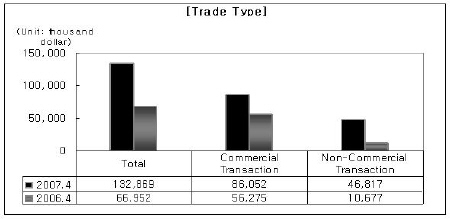
The total volume of inter-Korean trade during April 2007 was $132,869 thousand, showing an 98.5% increase from $66,952 thousand during the same month last year(a 28.8% increase from $103,151 thousand during the previous month).

Trade Type

The total amount of Commercial Transaction were $86,052 thousand (64.8%), showing an 52.9% increase from $56,275 thousand(84.1%) during the same month last year.

The total amount of Non-Commercial Transaction were $46,817 thousand(35.2%), showing an 338.5% increase from $10,677 thousand(15.9%) during the same month last year.

table 1.bmp

Import & Export Status

Import from North Korea totalled $46,028 thousand, an 51.5% increase from $30,388 thousand during the same month last year(a 21.5% decrease from $58,637 thousand during the previous month).

  • Composition by Items (Unit : %)

Agricultural and aquatic products    21
Minerals                                       19.6
Textile products                            28.5
Steel and metal products               18.1
Livlihood supp                              4.5

Export to North Korea totalled $86,841 thousand, an 137.5% increase from $36,564 thousand during the same month last year(a 95.1% increase from $44,514 thousand during the previous month).Composition by Items (Unit : %)

Agricultural and aquatic products 48.7
Textile products 8.8
Steel and metal products 7.9
Machineries 16
Electric and products 7.5

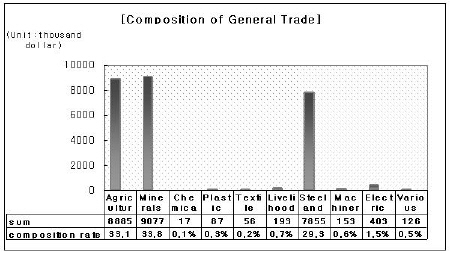
The total volume of General Trade during April 2007 was $26,850 thousand ,a 61.9% increase from $16,589 thousand during the same month last year(a 23.9% decrease from $35,265 thousand in the previous month).The volume of import in General Trade was $25,450 thousand, export was $1,400 thousand and had 94.8%, 5.2% each other.

The composition rate by items had a great part of Minerals(33.8%), Agricultural and Aquatic Products(33.1%), Steel and Metal products(29.3%), Electric and Electronic Products(1.5%)

table 2.bmp

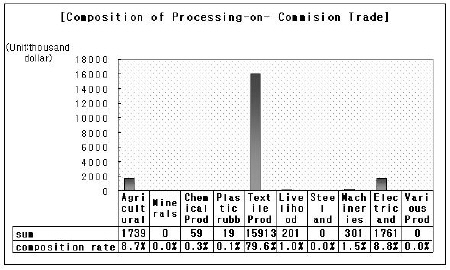
The total volume of Processing-on-Commission Trade during April 2007 was $19,992 thousand, a 38.8% increase from $14,402 thousand during the same month last year.(a 15.4% decrease from $23,629 thousand in the previous month)

The volume of import in Processing-on-Commission Trade was $14,063 thousand, export was $5,929 thousand and had 70.3%, 29.7% each other.

The composition rate by items had a great part of Textiles(79.6%), Electric and Electronic Products(8.8%), Agricultural and Aquatic Products(8.7%)

table 3.bmp

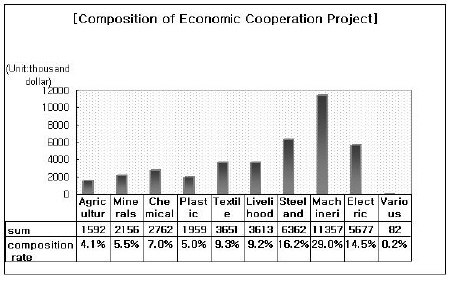
The total volume of Economic Cooperation Project during April 2007 was $39,210 thousand, a 55.1% increase from $25,284 thousand during the same month last year(a 12.4% increase from $34,881 thousand in the previous month).

The volume of import in Economic Cooperation Project was $6,513 thousand, export was $32,697 thousand and had 16.6%, 83.4% each other.

The composition rate by items had a great part of Machineries(29.0%), Steel and Metal Products(16.2%), Electric and Electronic Products(14.5%), Livelihood supplies(9.2%)

table 4.bmp

The total volume of Aid to N.K. during April 2007 was $46,815 thousand, a 338.5% increase from $10,677 thousand during the same month last year(a 399.5% increase from $9,373 thousand in the previous month).

The volume of export was $46,815 thousand.

The composition rate by items had a great part of Chemical Products(84.7%), Machineries(8.3%), Plastic rubber and Leather(2.3%), Agricultural and Aquatic Products(1.2%).

Humanitarian Projects

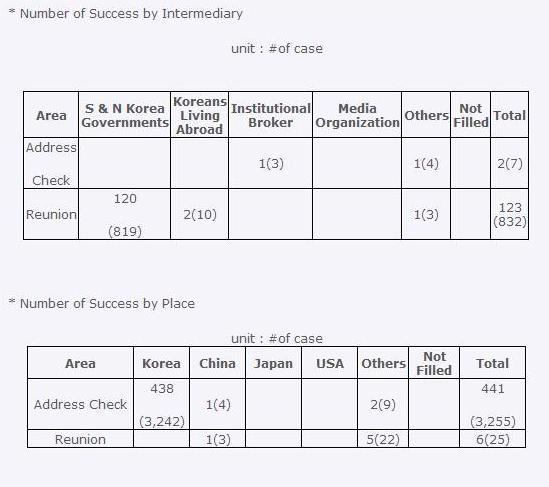
A. Separated Families

Exchange: # of casses(#of people)

Application for contact 9(14)
Address check 2(7)
Reunion 6(25)
Exchange of letters 36

table 7.JPG

Share

Tobacco company pulls out of North Korea

June 8th, 2007

The Guardian
Julia Kollewe
6/8/2007

British American Tobacco is pulling out of North Korea, but insisted the move had nothing to do with political pressure.

The world’s second largest cigarette group, whose brands include Lucky Strike, Kent and Dunhill, said it had agreed to sell its 60% share in Taesong BAT, its joint venture in Pyongyang with the Korea Sogyong Chonyonmul Trading Operation, a state-owned company.

BAT is selling the stake to SUTL, a Singapore-based trading group that invests in business ventures in South East Asia. The price has not been agreed yet but will be small in relation to the group. The sale is expected to be completed later this year.

Read their press release here.

Share

Huge Tidal Wave Slammed North Pyongan Beach

June 8th, 2007

Daily NK
Han Young Jin
6/8/2007

On March 7th a tidal wave hit Soehan Bay on the West Sea, which is bounded by Cholsan, Yongcheon and Sunchon in North Pyongan, leaving 2 thousand flood casualties and around 1 hundred dead. Many were gathering sea shells, according to several sources in North Korea who said the news was released late on instructions to cover up the damage.

Flooded regions include Dosan-ri and Bosan-ri in Yongchoen, Okok-ri in Cholsan, Shinmee Island in Sunchon, with the worst suffering in Dosan-ri in Yongchoen. The damage done by the giant wave came in a flash and was worsened by the lack of weather forecasting and early warning systems.

North Korean authority has not informed the outside world of the tidal wave. However, the South Korean government reportedly has been apprised.

Receiving information from a people’s unit chairperson, a source in Yongcheon said that “people in Dosan-ri and Bosan-ri in Yongcheon make living by collecting sea shells, and around 70 households were affected.” Another source said that the dead included fishermen fishing in the coastal sea of Cholsan, women, and students collecting seashells.

Collecting seashells in North Korea is done by boarding a boat on a coastal sea as the tide rises. When it ebbs, people get off the boat and collect seashells on the foreshore. As the tide rises again, they need to get back on the boat. This practice caused the death toll to rise. The dead included young students who began school in March, who were helping their parents in other cities make a living.

After the incident, the local social safety agency began an investigation and delivered the order not to speak about it. Information would flow through the chairpersons of people’s units. North Korean authority usually broadcasts such news over its central broadcasting network, organizing rescue units from the whole country.

The chairpersons of the people’s units investigated the missing persons and compensated the families of victims with Chinese color television sets, according to the source. A source in Dandung, China said the incident was not reported there as no bodies or boat debris had been found.

Share

1.5 Million Tourists Visit Mt. Geumgang

June 7th, 2007

Korea Times
Ryu Jin
6/7/2007

More than 1.5 million tourists have so far visited Mt. Geumgang in North Korea since the tour was launched about a decade ago, Hyundai Asan said Thursday.

Since the launch in November 1998, the accumulated number of tourists to Mt. Geumgang reached 500,000 in November 2002, 1 million in June 2005 and then 1.5 million in June this year, according to the South Korean operator of the inter-Korean tourism project.

Company officials hailed the latest achievement, which came just after the start of a new tour program to inner Mt. Geumgang, better known as “Naegeumgang’’ in Korean, early this month.

“We will hold a weekend concert this Saturday at the multi-purpose cultural center in the resort complex of Onjeong-ri,’’ a Hyndai Asan spokesman said. “Famous pop singers and bands, including Nam Jin, and rock band No Brain will be there.’’

As part of efforts to promote the Mt. Geumgang tour program, Hyundai Asan has held various cultural events in recent months including concerts and previews of films.

Mt. Geumgang, which has long held both aesthetic and spiritual allure for Koreans, can be divided into three parts: Naegeumgang (inner, western part), Oegeumgang (outer, eastern part) and Haegeumgang (seashore part).

Since the first tour to Oegeumgang in 1998, an increasing number of visitors have made the trip to the resort area. Most were South Koreans; fewer than 8,000 visitors came from 48 other countries.

But the inter-Korean tourism business has often been affected by the security situation on the Korean Peninsula. For example, it ran into difficulties when North Korea conducted a nuclear test in October last year.

Amid the heightened tension, the number of tourists plummeted to some 240,000 last year, putting a damper on Hyundai Asan’s target of securing more than 400,000 visitors annually.

On June 1, the company started a new tour program, which allows visitors to taste the elegance of the inner part of the 12,000-peak auspicious mountain. Hyundai Asan CEO Yoon Man-joon expressed his ambition during a pilot tour late last month where some 150 dignitaries and media took part.

“We set the target at 400,000 again this year. About 15 to 20 percent of the tourists are expected to visit Naegeumgang this year,’’ Yoon said. “I hope the launch of the Naegeumgang tour will give us an opportunity for a second leap toward successful Mt. Geumgang tour business.’’

Hyundai Asan officials said about 100,000 people have made the trip to the mountain by the end of May. They expect that the figure could reach the target as the high-demand season — from June to October — is approaching.

Each group for the two-night, three-day Naegeumgang tour will be made up of up to 150 visitors and the departure days are every Monday, Wednesday and Friday.

On the first day, the visitors would check in at the hotel and enjoy the North Korean acrobatics show and dine on unique North Korean food for supper. On the second day, they would explore the beauty of Naegeumgang, followed by a brief trip to Oegeumgang on the last day.

Yoon said the company would also try to revamp tour programs to draw more younger visitors as part of its new marketing strategy for the existing tour to the outer side of the mountain, Oegeumgang.

“We will continue to host various cultural events, including concerts and cinema previews, to meet expectations of customers in various age groups,’’ said a company spokesman. “These efforts will also help the company advance to two million visitors.’’

Share

North Korea needs a dose of soft power

June 6th, 2007

Asia Times
Andrei Lankov
6/5/2007

It is clear that the current Western approach to dealing with North Korea is not working. Some people in Washington obviously still believe that financial or other sanctions will push the North Korean regime to the corner and press Pyongyang into relinquishing its nuclear program. But this is very unlikely.

First, neither China nor Russia is willing to participate in the sanctions regime wholeheartedly. Neither country is happy about a nuclear North Korea, but they see its collapse as an even greater evil. However, without their participation, no sanctions regime can succeed. More important, South Korea, still technically an ally of the United States, is even less willing to drive Pyongyang to the corner. And finally, even if sanctions have some effect, the only palpable results will be more dead farmers. The regime survived far greater challenges a decade ago when it had no backers whatsoever.

So what can be done? In the short run, not much. Like it or not, Pyongyang will remain nuclear. There might be some compromises, such as freezing existing nuclear facilities, but in general there is no way to press North Korean leaders into abandoning their nuclear weapons.

This is not good news, since it means that the threat will remain. Earlier experience has clearly demonstrated that every time North Korean leaders run into trouble, they use blackmail tactics, and they usually work. In all probability, there will be more provocations in the future. Since Pyongyang’s leaders believe (perhaps with good reason) that Chinese-style economic reforms might bring about the collapse of their regime, they have not the slightest inclination to start reforming themselves.

This leaves them with few options other a policy aimed at extracting aid from the outside world, and regular blackmail is one of the usual tools of this approach. Thus the threat persists unless the regime or, at least, its nature is changed, but how can this goal be achieved if pressure from outside is so patently inefficient? The answer is pressure from within, by nurturing pro-democracy and pro-reform forces within North Korean society (and also pro-reform thoughts within the brains of individuals).

Of all assorted “rogue regimes”, North Korea is probably most vulnerable to this soft approach. On one hand, unlike the bosses of the assorted fundamentalist regimes, North Korea’s leaders have never claimed that their followers will be rewarded in the afterlife; they do not talk, for example, about the pleasures of otherworldly sex with 72 virgins.

Their claim to legitimacy is based on their alleged ability to deliver better lives to Koreans here and now, and Pyongyang’s rulers have failed in this regard in the most spectacular way. The existence of another Korea makes the use of nationalistic slogans somewhat problematic as well.

North Korea’s leaders cannot really say, “We have to be poor to protect our independence from those encroaching foreigners,” since the existence of the dirty-rich South vividly demonstrates that under a reasonably rational government, Koreans can be both rich and independent (and also free).

This leaves Pyongyang with no choice but to seal the borders as tight as no other communist regime has ever done before, on assumption that the common folk should not know that they live a complete lie. This self-imposed information isolation is the major condition for the regime’s survival, and breaking such a wall of ignorance should be seen as the major target for any long-term efforts directed at bringing change to North Korea.

The power of soft measures is often underestimated, not least because such policies are cheap, slow and not as spectacular as commando raids or even economic embargoes. However, their efficiency is remarkable.

In this regard, it makes sense to remember a story from the relatively recent past. In 1958, an academic-exchange agreement was signed between the Soviet Union and the United States. Back then the diehard enemies of the Soviet system were not exactly happy about this step, which, they insisted, was yet another sign of shameful appeasement.

They said this agreement would merely provide the Soviets with another opportunity to send spies to steal US secrets. Alternatively, the skeptics insisted, the Soviets would send diehard ideologues who would use their US experience as a tool in the propaganda war. And, the critics continued, this would be done on American taxpayers’ money.

The first group of exchange students was small and included, as skeptics feared, exactly the people they did not want to welcome on to US soil. There were merely four Soviet students who were selected by Moscow to enter Columbia University for one year of studies in 1958. One of them, as we know now, was a promising KGB operative whose job was indeed to spy on the Americans. He was good at his job and later made a brilliant career in Soviet foreign intelligence.

His fellow student was a young but promising veteran of the then-still-recent World War II. After studies in the US, he moved to the Communist Party central bureaucracy, where in a decade he became the first deputy head of the propaganda department – in essence, a second in command among Soviet professional ideologues.

Well, skeptics seemed to have been proved right – until the 1980s, that is. The KGB operative’s name was Oleg Kalugin, and he was to become the first KGB officer openly to challenge the organization from within. His fellow student, Alexandr Yakovlev, a Communist Party Central Committee secretary, became the closest associate of Mikhail Gorbachev and made a remarkable contribution to the collapse of the communist regime in Moscow (some people even insist that it was Yakovlev rather than Gorbachev himself who could be described as the real architect of perestroika.)

Eventually, both men said it was their experiences in the United States that changed the way they saw the world, even if they were prudent enough to keep their mouths shut and say what they were expected to say. So two of the four carefully selected Soviet students of 1958 eventually became the top leaders of perestroika.

There is no reason to believe that measures that worked in the Soviet case would be less effective in North Korea. Academic exchanges are especially important, since the policy toward North Korea should pursue two different but interconnected purposes. The first is to promote transformation of the regime or perhaps even to bring down one of the world’s most murderous dictatorships. However, it is also time to start thinking about what will happen next, after Kim Jong-il and his cohorts vanish from the scene.

The post-Kim reconstruction of North Korean will be painful, expensive and probably lengthy. Right now North Korea is some 20 times a poor as the South, and the gap in education between two countries is yawning. With the exception of a handful of military engineers, a typical North Korean technician has never used a computer.

North Korean economists learn a grossly simplified version of 1950s Soviet official economics, and North Korean doctors have never heard about even the most common drugs used elsewhere. This means that in the case of a regime collapse, the North Koreans would be merely cheap labor for the South Korean conglomerates – a situation bound to produce tensions and hostility between the two societies. A North Korean who in 20 years’ time will look for a decent job should be made employable, and the best way to ensure this is to start thinking about his or her education right now.

Academic exchanges with North Korea would have dual or even triple purposes. First, they would bring explosive information into the country, hastening domestic changes (probably, but not necessary, changes of a revolutionary nature). Second, they would assist North Korean economic development, thus beginning to bridge the gap between the two Koreas even while the North was still under Kim Jong-il’s regime. Third, they would contribute to more efficient and less painful reconstruction of post-Kim North Korea.

Of course, all these scholarship programs should be paid for by the recipient countries. North Koreans have no money for such exchanges (and to paraphrase a remark by North Korea expert Aidan Foster-Carter, North Korean leaders are people who never do anything as vulgar as paying). But all three targets are clearly in the interest of the world community, and anyway the monies involved would be quite small.

North Korea’s leaders are no fools. They understand that such exchanges are dangerous, and they do not want future Korean Yakovlevs and Kalugins to emerge. Back in 1959-60 they even decided to recall their students from the Soviet Union and other countries of the Communist Bloc and did not send their young people to study anywhere but in Mao Zedong’s China until the late 1970s. In other words, for two decades Pyongyang’s leaders believed that those countries were way too liberal as an environment for their students.

However, they also understand that without exchanges they cannot survive in the longer run. Even now, Pyongyang is doing its best to increase exchanges with China, sending numerous students there.

Another important factor is endemic corruption. There is no doubt that nearly all students who will go overseas will be scions of the Pyongyang aristocrats, the hereditary elite that has been ruling the country for decades. A high-level official might understand that sending a young North Korean overseas is potentially dangerous. But if the person in question is likely to be his nephew, he will probably choose to forget about the ideological threats.

Of course, no sane North Korean leader would ever agree to send students to the US or to South Korea. However, there are many countries that are far more acceptable for them. The Australian National University a few years ago had a course for North Korean postgraduate students who studied modern economics and financial management. Australia or Canada or New Zealand might be good places for such programs.

While English-language education is preferable, since English is the language of international communication in East Asia, there is a place for European countries as well, especially smaller ones, whose names do not sound too offensive to the Pyongyang bureaucrats – such as Switzerland or Hungary or Austria.

Such programs should be sponsored by those countries whose stakes are the highest, such as the US, Japan and South Korea, but smaller and more distant countries also should consider sponsoring such an undertaking. This is not a waste of money, nor even a good-looking humanitarian gesture for its own sake. As history has shown many times, former students tend to be sympathetic to the country where they once studied, and they normally keep some connections there.

North Korea has great potential, and when things start moving, those graduates are likely to be catapulted to high places, since people with modern education are so few in North Korea. This means countries that consider small investments in scholarships for North Koreans will eventually get large benefits through important connections and sympathies that their business people, engineers and scholars will find in some important offices of post-Kim North Korea.

Scholarships for North Korean students are not the only form of academic exchanges. North Korean scientists and scholars should be invited to Western universities, and books and digital materials should be donated to major North Korean libraries in large numbers. Of course, only selected people with special clearances are allowed to read non-technical Western publications in North Korea, but they are exactly the people who will matter when things start moving.

It is well known that students and academics who come back from longtime overseas trips are routinely submitted to rigorous ideological retraining upon their return to North Korea. But does it help? Unlikely. If anything, heavy doses of obviously nonsensical propaganda make a great contrast with what they have learned and seen, thus putting North Korean society in an even less favorable light.

Of course, they will not say anything improper when they come back home, but they will see that there are other ways of life, they will see how impoverished, bleak and hyper-controlled their lives are, and they will think how to change this. Sooner or later, these people will become a catalyst for transformation – and their skills will help to ease the pains of the post-Kim revival of North Korea.

Share

Statement of UNDP on DPRK activity audit

June 6th, 2007

UNDP welcomes the preliminary report (DPRK-prelimauditreport-20070601.pdf) of UN Board of Auditors (UNBOA) on the operations of UNDP and other UN agencies in DPRK.  UNDP has cooperated fully with the audit process and will continue to do so. 

UNDP operated in DPRK at the express wish of its Executive Board.  Member states encouraged UNDP to assist the country to engage progressively with the norms and standards of the global community. 

The operating environment was very difficult.  In recent years UNDP tightened control mechanisms and conducted frequent audits (1999, 2001 and 2004).  These audits did not lead to any suggestion that UNDP funding was being diverted to purposes other than those for which it was intended. 

UNDP is encouraged that the UNBOA preliminary report confirms:

– That UNDP operated a relatively modest programme in DPRK ($2-3 million per year – far less than “$100s of millions” alleged in press reports)
– That UNDP international staff could – and did – regularly visit project sites to verify how UNDP funding was being used

The preliminary report also highlights specific aspects of the difficult operating environment in DPRK, including staffing and foreign currency arrangements not in line with worldwide practice.  UNDP notes that:

– The Executive Board knew of UNDP’s staffing practices in DPRK, which date back 27 years
– Similar staffing and foreign currency practices were followed by all UN agencies, international NGOs and foreign diplomatic missions in DPRK, including past and current members of UNDP’s Executive Board
– UNDP was not able to follow worldwide practice, but no UNDP regulations or rules were broken
– Following requests by some Board members, UNDP notified DPRK that it was changing its staffing and currency practices.  The proposed changes were formally endorsed by the Executive Board in January 2007
– UNDP suspended operations in the country on 2 March 2007 when DPRK failed to meet the operational changes endorsed and mandated by the Board.
– UNDP took the lead in asking the DPRK government to conform to international practice before the Board’s decision  

The report highlights areas in which UNDP rules or procedures could be strengthened.  UNDP is committed to addressing these areas.

UNDP will be transmitting a formal management response to the ACABQ shortly.  UNDP would welcome a continuation of the audit process, including a visit by the UNBOA to DPRK.  UNDP looks forward to the final audit report.

Share

Despite Nuclear Tests North Korea-China Trade Continues to Rise

June 5th, 2007

Daily NK
Kim Yong Hun
6/5/2007

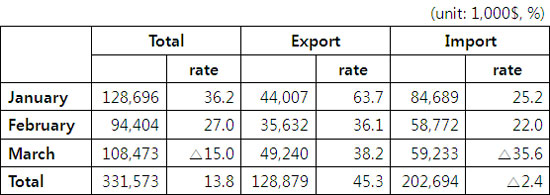
table 5.jpg

Despite the nuclear test last October, trade between North Korea and China has increased steadily. Rather, signs of North Korea’s economic dependence on China is becoming more obvious.

According to statistics recently released by the Ministry of Unification, “2007 1st Quarter, North Korea’s trade status with China,” trade between the two countries recorded $330mn, a 13.8% increase compared to 2006. While North Korea exported $130mn worth of commodities, an increase of 45% compared to the previous year, imports equaled a total of $200mn, a small decrease of 2.4%.

Last year, trade between both North Korea and China totaled $1,699.6mn recording the highest amount of trade ever in history and even this figure had risen 7.5% compared to the year before.

Analysts argue that North Korea’s economic dependence on China is increasing as a result of sanctions implemented by the international community and delay of the February 13 Agreement.

Even until last year, the trade deficit had increased to $764.17mn, an increase of 29.9% compared to 2005. However, in the first quarter of 2007, the trade deficit seems to have taken a major plummet of 61.3% down to $74mn.

North Korea’s main trade commodities are fuel based including coal and minerals, accounting for $45mn (49% increase to 2006) of exports to China, and 34.7% of total exports. In detail, $33mn of minerals, $12mn of medicine, $7.7mn of steel and $6.2mn of fisheries are exported also.

On the other hand, goods imported into North Korea are again fuel based including petroleum and crude oil and account for $31mn (42.5% decrease to 2006) of imports. Further, machinery equates to $17mn of imports, electric appliances $16mn and filaments $11mn.

In the report, the Ministry of Unification indicated North Korea’s major export to China as coal and minerals and analyzed, “This is the result of China’s increased demands for economic growth.”

The Ministry reported, “The majority of imported goods are energy, electric appliances and machinery” and added, “Demand for these light industry goods have increased from an expansion in North Korea’s consumer market. Imports have risen as a result of materials necessary for industrialization.”

According to a report recently released by the U.S. Congressional Research Service (CRS) “North Korea’s Economy,” the amount of trade that occurred between the U.S. and North Korea barely reached $3,000 in 2006, the lowest figure ever recorded since 1990. The only items exported to North Korea were books and newspapers and no imports were received by the U.S, revealed the CRS.

Furthermore, 2006 recorded an all time low of $130mn trade between Japan and North Korea, undoubtedly a reflection of Japan’s strong implementation of economic sanctions on North Korea. Since 1995, Japan has been supporting North Korea with a total of 1.2mn tons of food aid but suspended the aid relief in late 2004 following the issue of Japanese abductees.

Russia’s exports of minerals and coal to North Korea surged dramatically in 2003 and in 2006, total trade with North Korea recorded $220mn. Hence, Russia became now one of the big three trading partners of North Korea with China, South Korea, the CRS reported.

Share

N. Korea’s food situation not as bad as expected: agricultural scholar

June 5th, 2007

Yonhap
7/6/2005

North Korea’s food situation is stabilizing and is not as bad as expected in rural areas, a South Korean agricultural scholar who just returned from Pyongyang said Tuesday.

In an interview with Yonhap News Agency, Kwon Tae-jin, senior scholar of the state-run Korea Rural Economic Institute, said, “The peak of food shortage usually comes in June, but I didn’t feel it probably because North Korea released food rations.”

Kwon visited Pyongyang, Chongju in North Pyongan Province, Hamhung in South Hamgyong Province and Paechon in South Hwanghae Province, along with officials of World Vision, an international relief agency, May 25-31.

In March, North Korean officials indicated that North Korea faced a shortfall of 1 million metric tons of food and asked the World Food Program (WFP) to expand its assistance.

Jean-Pierre DeMargerie, head of the WFP’s office in North Korea, said that the situation is not as bad as it was in the 1990s when about one million North Koreans are estimated to have died of hunger, but the food situation has again “started to deteriorate because of June and August flooding of critical cropland and major reductions in WFP and bilateral food assistance.”

Kwon said North Korea would have little difficulty planting rice seedlings this year as reservoirs are full of water in most plains, and tractors and rice-planting machines can work at full capacity.

“In some areas the food situation might be worsening, but agricultural production has stabilized. They seem to be focusing on diversifying their sources of income by planting some cash crops,” he said.

A weak harvest in 2006, disastrous summer flooding and a 75 percent fall in donor assistance dealt severe blows to the impoverished nation, according to WFP officials.

South Korea resumed shipments of fertilizer and emergency aid to the North, but it plans to withhold rice aid as an inducement for North Korea to fulfill its promise to shut down its main nuclear reactor as part of the landmark February 13 agreement.

South Korea suspended its food and fertilizer aid to North Korea after the North conducted missile tests in July. Resumption of the aid was blocked due to the North’s nuclear bomb test in October.

According to a recent think tank report, North Korea could run short of up to one third of the food it needs this year if South Korea and other countries withhold aid.

Data from the WFP and South Korea’s Unification Ministry show that the North will need between 5.24 million tons and 6.47 million tons of food this year. Depending on the weather, the availability of fertilizer and other factors, the communist state may only be able to produce 4.3 million tons of food by itself, the report said.

Share