Pfizer CEO to visit N. Korean hospital Thursday

June 12th, 2007

Yohnap
6/12/2007

The chief executive officer of the world’s largest drugmaker, Pfizer Inc., plans to visit a hospital in North Korea this week, the company’s South Korean subsidiary said Tuesday.

Jeff Kindler, along with around 40 Pfizer officials, is scheduled to visit the Kaesong Hospital in the inter-Korean industrial park in Kaesong on Thursday, Pfizer Pharmaceutical Korea said in a statement.

The chief executive officer was to arrive in South Korea later in the day for a three-day visit. He is to meet with local health officials and sign a memorandum of understanding with the Health Ministry during his visit.

During his first trip to South Korea, Kindler also plans to visit local research centers, including the state-run Korea Research Institute of Bioscience and Biotechnology, to discuss possible joint projects for development of new drugs, the statement added.

The New York-based company manufactures the world’s No. 1 selling blood cholesterol drug Lipitor and the well-known erectile dysfunction drug Viagra. Kindler took the helm of the company in February.

Share

Plastic Surgery Popular, Breast Augmentations a Trend

June 12th, 2007

Daily NK
Kim Young Jin
6/12/2007

Recently, it has been reported that businesses in charge of facial plastic surgery and skin maintenance are becoming more popular among the wealthy class.

Through a survey DailyNK conducted on actual living conditions in the Northeast region of North Korea, it was discovered that massage rooms, steam baths, beauty-related enterprises (plastic surgery and skincare maintenance) are the main thriving businesses.

Beauty-related businesses such as these prevail in relatively large-sized cities, such as Chongjin in North Hamkyung, Hamheung in South Hamkyung, and Wonsan in Kangwon. This trend seems to follow the up and coming wealthy class who have risen through doing business in North Korea.

Skin maintenance and plastic surgery which has caused a stir among the women in Shinuiju and Pyongyang have spread to inland countrysides within the last several years.

Double eye-lid surgery, eyebrow tattoos, and others can be simply performed by a plastic surgeon doctor or beauty operation specialists, so it has been widely popular among young women.

The cost of plastic surgery, in the case of double eye-lid surgery, was 500 North Korean won per one-eye in 2004, but the asking price has been 1,500 won since 2006. The North Korean exchange rate was recently 2,980 won per dollar.

In addition to double eye-lid surgery, breast augmentation has been spreading to a portion of upper-class women. The popularity of the breast enlargement surgeries demonstrates an encouragement of beauty among North Korean upper-class women.

◆ “Massages” a rage, centered on large-scale cities = Chinese-style health massages cost around 10,000 (US$3.4) North Korean won per hour and for an additional 2~30,000 won, on-the-spot sex with a female masseuse is possible.

This survey, based on the latter half of May, took place by focusing on the price of commodities in five cities, such as Kim Chaek and Chongjin City in North Hamkyung, Danchun and Hamheung in South Hamkyung, and Wonsan Kangwon.

The results of the survey showed that the region with the highest standard of living in the Northeast region is Wonsan City of Kangwon. The reason why Wonsan has a relatively high standard of living is that it has been a central place of trade with Japan.

If North Korea and China’s trade can be represented by Shinuiju, then Wonsan has played that role with trade with Japan. However, it has recently been severely targeted by the suspension in North Korea and Japan’s trade.

Wonsan’s upper-class restaurants are known to show aggressive service by shouting “Welcome” when guests come in, by decorating the interior of restaurants, and by adopting a Chinese-style waiter and waitress system.

In addition, Japanese secondhand goods have been highly traded in Wonsan. Electronic rice cookers, sewing machine, fans, TVs and other Japanese thrift goods are commonly traded and have more reasonable prices than the other regions.

Newly released 2-3 person electronic rice cookers are around 13~150,000 won, fans around 7~80,000 won, used gas stoves around 15~200,000 (approx. US$50.34~67.10), used TVs around 20~250,000 won, and flat-screen TVs over 350,000 (approx. US$117.50) won.

The supply of electricity is not an issue, so it is provided 24 hours long and electricity is better-supplied than in Hamheung.

Further, the “105 factory (furniture production factory)” in Wonsan produces furniture which is delivered to the Central Party and the quality, compared with the cost, is supposed to be the best in North Korea.

Industrial goods in Chungjin are relatively economical, but Chinese-made color TVs and flat-screen newly-released TVs are sold for 20~250,000 and 350,000 won, respectively. Used bicycles imported from Japan is sold for 10~150,000 won.

In Chongjin, the number of taxis have risen lately, but because of the expensive cost, not too many people take advantage of it. Going 4km costs around 5,000 won. Taxis that are operating are either Chinese used taxis or imported cars which are past the expiration date.

◆ The price of rice narrowly rises = In Hamheung, the cost of taxis is supposed to be slightly higher than Chongjin. There are not too many people who ride taxis, so the rate is doubled beyond the center of cities and in remote places.

The cost of penicillin has risen significantly in Chongjin, with the spread of the measles, the scarlet fever, and other infectious diseases since last winter. Chinese penicillin is hard to acquire due to its reputation for having poor quality and North Korean penicillin is sold at Jangmadang (market) for 500 won per one.

The cities considered to have low standards of living are Kim Chaek of North Hamkyung and Danchun in South Hamkyung. The size of the jangmadang (market) is smaller than in other regions and there is a limit in the variety of goods. Steam baths or massage places do not even exist. The price of medical goods are also supposed to be exorbitant.

The specialty of Kim Chaek City is its low cost of nails. The Sungjin Steel Works Complex in Kim Chaek produces nail by melting steel and sells them, which is sold for 2,200 won~2,500 won per kg in Hoiryeong, at 1,200 won in Kim Chaek. However, not only is the weight heavy and is difficult to package, but the usage by civilians is not very high, so the incidence of sale to other provinces is low.

In Danchun, the price of fruit is very expensive, so it is not sold by the kilogram unit, but is sold individually. One medium-size apple is sold for up to 800 won.

On one hand, the price of rice in North Korea’s northeast region showed a narrow upward tendency in the latter half of May at the end of the spring shortage season. Corn, the staple of low-income civilians, did not show a huge change.

Share

North Korea gives glimpse of rural life

June 11th, 2007

Associated Press
Burt Herman
6/11/2007

North Korea is peeling back its self-imposed veil of isolation, allowing tourists a rare glimpse of the hardscrabble rural life en route to a new hiking trail that opened this month at the South Korean-run Diamond Mountain resort.

The new trail is also aimed at drumming up more business for the tourism venture run by a subsidiary of        South Korea’s Hyundai conglomerate, which saw a plunge in visitors last year after North Korea’s missile and nuclear tests. And drawing more tourists will mean more money for the communist nation’s impoverished economy.

The Diamond Mountain tourism project began in 1998 and has drawn 1.5 million guests as the only part of North Korea that can be easily visited by foreign tourists. The mountain is located just north of the border between the two Koreas near the east coast.

It’s one of two landmark projects — the other is a joint North-South industrial zone in the North Korean border town of Kaesong — that are hailed as models for reunification.

The new tour brings visitors to a part of the mountain previously off-limits to outsiders: inner Diamond Mountain, which features gentle waterfalls and Buddhas carved in stone.

But the highlight of the trip is a two-hour drive each way around the mountain to get to the trailhead through villages nestled in valleys displaying a panorama of North Korean daily life under leader Kim Jong Il.

Crossing through a tunnel to start the journey, a military outpost greets travelers with a slogan proclaiming, “We will fight forever for Kim Jong Il.”

Paved roads give way to dirt, rolling through a countryside where the tour buses are the only vehicles as far as the eye can see. Bicycles are the only form of transportation that North Korean families can afford.

They wade through rice paddies to plant seedlings, while oxen pull plows through the mud for other crops, such as corn and beans.

Terraced fields also stretch across hillsides, an attempt to squeeze every inch of food out of the earth in a country where famine is believed to have killed as many as 2 million people starting in the 1990s.

Workers at collective farms erect red flags as a sign of devotion to Kim and his late father, founding leader Kim Il Sung. Children play in a schoolyard wearing the red kerchiefs of the youth wing of the ruling Korean Workers’ Party.

Fresh construction on homes and buildings is a sign of development, although the structures are made of simple clay bricks.

South Korean visitors wave from the bus, but no North Koreans respond to the first outsiders they are seeing in more than a half-century. A group of children scurry behind a wall and other people squat in the dirt, backs to the road. At nearly every intersection, soldiers armed with pistols clutch small red flags, ready to signal an alarm if anything goes awry.

Kim Jeong-ho, president of the Gangwon Development Research Institute, who was leading a delegation of experts on the tour, said the villages reminded him of South Korean rural life in the 1950s and 1960s.

“The way they farm is sort of primitive, they will always have shortages of food,” said Kim Suk-choong, an agricultural economy researcher at the institute.

Although the scenes appear genuine, there’s still a Potemkin Village feeling that confronts visitors to North Korea. All curtains are drawn at a row of squat apartment blocks next to the road, with every window featuring the same artificial red flowers.

North Korean guides gush with minutiae about the mountain, but they are hesitant to discuss village life. Taking photos from moving vehicles is banned.

“It’s important to create a sense of unity between the two Koreas,” Pak Un Ju, a North Korean guide, said of the new tour. “Everybody is entitled to enjoy this mountain, whether South Korean or North Korean.”

The North Koreans were also upbeat about last month’s tests of restored railways between the Koreas, including a line heading to the resort. Tourists initially were only allowed to travel here by ship, but have arrived at Diamond Mountain via reconnected roads since 2003.

“They took the ships first, then they came by road and next will be trains,” said Um Yong Sil, another North Korean guide. She also displayed knowledge of U.S. geography, asking an American journalist how Diamond Mountain compared to the Grand Canyon.

The new openness is an indication of the apparent ease North Korea has over the project and realization that it will not rattle the country’s regime, said resort manager Yoo Da-jong.

The project has also meant about $1.6 billion in investment in the North by South Korea’s Hyundai Asan.

Some 1,000 North Koreans work at the resort, receiving a $50 monthly salary and another $7.50 in social costs paid directly to the North. North Korea also receives about $300 in fees from each visitor.

But profits have been elusive for Hyundai and last year only 280,000 visitors came, short of an expected 400,000. Part of the decline was caused by an end to tour subsidies from the South Korean government after North Korea’s Oct. 9 nuclear test.

Other attractions to lure tourists include a new concert series, with the premiere event this month featuring Nam Jin, known as South Korea’s Elvis Presley. The resort is expanding its duty-free stores, offering such items as an $18,600 Rolex watch — worth nearly 27 years salary for a North Korean worker.

Resort operators hope tourists will ignore the political stalemate and come to experience a taste of a future, undivided Korea.

“This area is for reunification and for natural beauty,” Yoo said. “If you get rid of the political things from your mind, then you can appreciate all these good things.”

Share

Mt. Baekdu’s 3 Generals Worth a Mere $2.50?

June 11th, 2007

Daily NK
Han Young Jin
6/11/2007

Recently, portraits of Kim Il Sung, Kim Jong Il and Kim Jong Sook (Kim Jong Il’s mother) wearing military clothing are being sold at North Korea’s black market, Jangmadang.

“Good Friends” a North Korea support organization, published a newsletter which informed that a portrait of the “3 Generals portrait” was being sold for 7,500 North Korean won (approx. US$2.50) at Jangmadang.

The sale of the “3 Generals portrait” is actually prohibited. Then, how did portraits of the “3 Generals” end up on the black market? Is this a sign that the value of Kim Il Sung, Kim Jong Il and Kim Jong Sook has plummeted to rock bottom? No way.

In the past, this portrait of “Baekdu Mountains 3 Great Heroes” or otherwise known as the “3 Generals,” was distributed to North Korea’s elite class. However, as the power of money slowly took a stance in North Korea, the “3 Generals” somehow managed to appear in the markets.

People purchasing the portraits are not the elite class. If a person visits the home and sees this portrait hung, they may get the impression that the household was closely related to the elite class. In other words, the home looks as if it has value or is important, hence the demand at the markets.

The sale of Kim Il Sung, Kim Jong Il and Kim Jong Sook portraits in North Korea is a political offense. If a person is caught selling any portraits, they may end up in a political concentration camp.

However, as people thrive off trade and the value of money spreads throughout the nation, life continues abundantly as long as you don’t get caught. The fact that this item has appeared at Jangmadang just goes to show how much trade as prospered in North Korea.

Further, the source and owners of the portraits are the elite and with a little investigation one can unveil the corruption that is occurring amongst the upper class. As a result, as long as you do not spread rumors about the National Safety Agency and affiliated persons, authorities let you go unnoticed.

The painting is a family portrait with Kim Il Sung dressed as a Chief general on the left, Kim Jong Il dressed in a general’s outfit in the middle and then on the right, Kim Jong Sook dressed in a guerilla uniform.

The “3 Generals’ portrait” first appeared in 1997 about the time of Kim Jong Il’s 55th birthday. At first, the painting was distributed to officers of power including elite officials, generals, courts and the national security and safety agency. The portrait was not presented to average households and hence the “3 Generals” gained its elite status. “We have the 3 Generals in our home” children would say bragging to others.

Nonetheless, this portrait began to be sold on the markets illegally from 1997. This was a time where people died of starvation and Kim Jong Il went around proclaiming “Military First Politics.” Distributing the “3 Generals’ portrait” was all a part of Kim Jong Il’s propaganda for “Military First Politics.”

In the beginning, administrative officers bribed authorities with alcohol and cigarettes in exchange for the portraits. Factory managers would even exchange the goods in the factories and hang the portraits in their own homes. It was not too difficult to obtain the painting if you were closely affiliated to persons with any sort of power including the authorities, military or the government.

Since then, it was common to see the portraits in the homes of the rich. This portrait worth 3,000won in `97 has now escalade to 7,500won following the July 1st economic measure in 2002.

Sale of the portraits began at the place of manufacture Mansudae Art Institution (the national art academy, which is mainly creating works related to Kim Il Sung and Kim Jong Il). The moment rations were suspended, workers at Mansudae Art Institution began to produce extra portraits and badges of Kim Il Sung, and as a means of survival traded these portraits in exchange for food. With ties to relatives in the country, manufacturers sold portraits of the 3 Generals through the back door.

In additional to this, it is common practice that badges of Kim Il Sung and Kim Jong Il are sold on the black market. There are many badges which vary according to class from badges in the shape of a flag (used by overseas North Koreans) to badges made for authorities and a special badge that was manufactured after Kim Il Sung’s death.

One badge, sold for 1,000won

At first the badges were distributed to elite officials and upper class and then slowly, more and more average citizens tried to obtain one. For example, in the mid-90’s it was rare to see the ‘couple badge’ in the country that it sold for 1,000~1,500won (approx. US$0.3~0.5) each. Accordingly, the cost of the badges has also been affected by market prices.

Dealers who sell the badges appear at the black markets wearing a black jacket. The portraits are hidden beneath the jacket and buyers haggle with the dealer for a good price.

However, not everyone likes the “3 Generals portraits.” A defector who recently entered South Korea said, “Only people who can afford the pictures are interested in buying the “3 Generals portraits.” Otherwise, the average commoner doesn’t care.”

Nevertheless, what would happen if Kim Jong Il found out that the portrait of the “3 Generals portraits” were being sold on the black market? Furthermore, what would happen if he found out that the portraits were being sold for a mere $2.50? He would most probably make an order to close Jangmadang.

If not for the living and trade of average commoners, it would be best for Kim Jong Il not to know this fact. It would be better for Kim Jong Il to be ignorant of this rather humiliating truth.

Share

Buddhist Ceremony

June 11th, 2007

China Daily
6/8/2007

praying.jpg

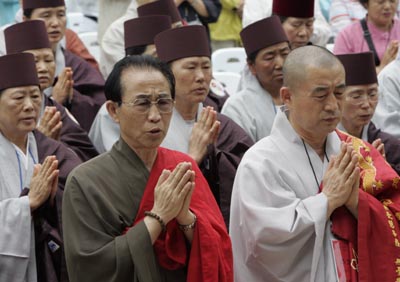
South Korean monk Joo Jeong-san (R), head of the Chontaejong, a branch of Buddhism, and Sim Sang-jin (L front), vice chairman of North Korea’s Buddhist Alliance, participate in a Buddhist ceremony celebrating the third anniversary of restoration of the Ryongtong temple, which was established in 1027, in Kaesong, North Korea, about 70 km (45 miles) northwest of Seoul June 8, 2007.


Pilgrimage, with U.S. dollars, to North Korea temple
Boston Globe
Jack Kim
6/11/2007

In a rare nod to religion, communist North Korea has welcomed 500 Buddhist monks and followers from the South to a temple dating from the 11th century when Kaesong was capital of a unified peninsula.

The visit offered an unusual glimpse of the hermit state where references to the divine, at least in the official media, are normally limited to Kim Il-sung, who became the reclusive state’s eternal president on his death in 1994, and Kim Jong-il, his son and the current leader.

North Korean officials were quick to stress that this month’s nine-hour visit to the picturesque Ryongtong temple on the outskirts of Kaesong was strictly religious fare.

“We are opening the door wide open for pilgrimages to answer the wish of Buddhist believers in the South,” Ri Chang-dok, from the North’s Council of National Reconciliation, told a small group of reporters traveling with the Buddhists.

The pilgrimage marking the restoration of the temple was the first in a series that will see more than 2,000 South Korean Buddhists travel across the heavily fortified border that has divided Korea for more than half a century.

“There won’t be any sightseeing,” Ri insisted.

North Korea watchers and critics say the hardline Pyongyang government persecutes religious followers and the only practices tolerated are carefully choreographed displays for outsiders.

FREEDOM OF RELIGION

Not so, the Council’s vice-chairman, Jong Tok-gi, told Reuters after a Buddhist service at Ryongtong.

“We have freedom of religion.”

But when a North Korean Buddhist leader spoke at the service, his words had the clear ring of politics and Pyongyang’s official obsession with one day ending the divide on the Korean peninsula.

“I have no doubt that if we make this pilgrimage a regular event and allow South Korean believers to come to the temple, North-South cooperation will deepen and that will open a shortcut to the unification of the fatherland,” said Sim Sang-jin, vice-chairman of the North’s Korea Buddhists Federation.

The North Korean Buddhists, with full heads of hair and colorful costumes looked anything but the typical monks of the South with their shaven heads and austere grey robes.

Despite Ri’s assurances that this was a strictly spiritual affair, the visitors’ buses made several stops at tourist sites in the cash-strapped state to give them the chance to buy souvenirs.

“Have you bought anything? Come on, go and buy something,” a North Korean guide urged his visitors, pointing to stalls where young women in traditional costume offered local goods ranging from mushrooms and fake Viagra to books of teachings by the country’s father-and-son leaders — all for U.S. dollars.

“We’re not going to hide anything,” said another guide, who declined to give his name, as the buses maneuvered their way through Kaesong’s residential streets where disheveled locals flashed startled looks at the gleaming vehicles.

“We have the discipline, the intelligence and the will (to make ties with the South work),” he said. All that was needed was for the wealthy South to deliver on its commitments to invest in the North.

ANCIENT CAPITAL

The birthplace of the small Chontae Buddhist sect, Ryongtong was raised from the rubble of a 17th century fire in 2005 at a cost of 5 billion won ($5.4 million) donated by its South Korean chapter.

“Kaesong was the seat of the Goryeo dynasty (918-1392) for 500 years,” said Ju Jung-san, a senior monk from the South. “It should now be the place of national love to lay the ground for unification.”

With such high aims, an indignant Ri dismissed criticism from some in the South that charging each visitor 170,000 won for the relatively short trip was excessive.

“I fail to understand just who these people are who are talking about money when what we have here is a pilgrimage to such a holy temple, the Ryongtong Temple.”

Share

S. Korea to complete fertilizer aid to N. Korea late this month

June 11th, 2007

Yonhap
6/11/2007

South Korea will complete shipments of 300,000 tons of fertilizer aid to North Korea late this month, the Unification Minister said Monday.

“As of last week, 233,800 tons of fertilizer had been shipped to North Korea. By June 20, the planned shipments will be completed,” said a ministry official on the usual condition of anonymity.

South Korea resumed shipments of fertilizer and other emergency aid to the North in late March, but it withheld rice aid as an inducement for North Korea to fulfill its promise to shut down its main nuclear reactor as part of the landmark February 13 agreement.

South Korea suspended its food and fertilizer aid to North Korea after the North conducted missile tests in July. Resumption of the aid was blocked due to the North’s nuclear bomb test in October.

According to a recent think tank report, North Korea could run short of up to one third of the food it needs this year if South Korea and other countries withhold aid.

Data from the World Food Program and the Unification Ministry show that the North will need between 5.24 million tons and 6.47 million tons of food this year. Depending on the weather, the availability of fertilizer and other factors, the communist state may only be able to produce 4.3 million tons of food by itself, the report said.

Share

Favorite Movies

June 10th, 2007

Korea Times
Andrei Lankov
6/10/2007

“I love foreign movies! They are free of ideology!” I’ve heard this comment more than once from North Koreans. What they mean is not that foreign movies do not have any ideological messages (something quite impossible, every movie has some message, even if the more subtle are usually not noticed by the audience). They mean that foreign movies are free from the overt boring propaganda statements which play such a prominent role in North Korean cinema production.

Revolutionary enthusiasm and the unremitting cruelty of the enemy _ the U.S. imperialists and their South Korean puppets _ have been the major topic of North Korean cinema for many decades. Of course, movie-goers are used to these ideological messages and somehow manage to filter them out, concentrating their attention on the depiction of ‘real life’ with its problems of relationships and families. Nonetheless, foreign movies are especially welcomed by the public, since their ideological content is less pronounced.

Once upon a time, in the 1940s and 1950s, foreign movies constituted the bulk of films screened in North Korean theaters. Most of those movies came from the Soviet Union, with an occasional film from another “fraternal country”. However, in the early 1960s, the split between Moscow and Pyongyang led to a nearly complete halt of those exchanges. The East European Communist regimes began to liberalize themselves, while an unabashed Stalinist nationalism (a.k.a juche) reigned supreme in the North, making its leaders suspicious of all exchanges with external regimes, including the communist states. The cultural exports of the increasingly liberal Soviet Union came to be perceived as a source of dangerous revisionism

Only in the 1980s were foreign movies re-introduced to the North, accompanied by films from India, China, and other “non-imperialist” countries. Soon it became clear that as far as box-office success is concerned, those films fared much better than the local productions.

No North Korean statistics have been released so far, but it seems that one of the greatest box-office successes in North Korean history was the ‘Pirates of the Twentieth Century’, a remarkably silly 1979 Soviet action movie about brave Russian sailors who use their martial arts skills to teach a lesson or two to those naughty pirates somewhere in the Pacific. The story line is utterly implausible, the acting ludicrous, but the martial arts and special effects are never far from the screen, and even semi-nudity is present (well, I am not sure if that episode survived the scissors of the North Korean censors).

The movie was a tremendous hit in the USSR where, in the early 1980s, to the great dismay of the high-brow audience, it was seen by one third of all Soviet movie-goers. Judging by available reports, the ‘Pirates of the Twentieth Century’ was even more successful in the North where it, in fact, became the first widely seen martial arts movie.

In an improbable twist, this genre, usually seen as quintessentially Chinese, was introduced to the North via Russia. Soon there were some North Korean copies around, where the goodies were smashing either the US Imperialists (‘Order No. 027,’ a story about North Korean commandos during the Korean War) or evil feudal landlords (‘Hong Kil-dong,’ a Korean version of the Robin Hood tale).

On more sophisticated note, Pyongyang movie buffs enjoy the romantic comedies by Russian director Riazanov, also a major hit with the Russian middle-brow audience (to which the present author proudly belongs himself!). The love stories, with a light touch of social satire, portray the middle classes of the late Soviet era.

Other Soviet hits were the intellectual spy thrillers based on novels by the prolific Yulian Semenov. The authorities love those films since they have a “correct” ideological message (the brave KGB agents dwarf the intrigues of the CIA or Gestapo). The common people like the same movies because they exhibit a level of sophistication impermissible in North Korean cinema. Semenov’s CIA agents, and even the Gestapo thugs, are by no means the one-dimensional “wolf-like Yankees” of the North Korean films.

Indian movies are popular as well. While nearly unknown in the West, the numerous studios of Bombay/Mumbai (“Bollywood”) churn out an astonishing amount of musicals and melodramas, to be enjoyed across South Asia and in some parts of the former Communist bloc. These movies are sugary, hyper-sentimental, with one-dimensional characters, predictable storylines, primitive dialogue, and no acting worthy of the name.

But they also have a lot of singing and dancing numbers, as well as stunningly beautiful sets and scenery. It’s escapism in its purest form, and this is probably what people north of the 38th really want. Perhaps, even the heavy doses of syrup in the storyline appeal to the North Korean public who, for decades, have subsisted on a diet of ideologically wholesome movies where the major emotion was love for the Leader (and, perhaps, hatred towards one’s enemies).

People are tired of the ideological messages _ especially if those messages are presented in a crude way. It seems that not only movie producers, hardly happy about ideology themselves, but even their supervisors are beginning to realize this in the most recent decade. The system is getting more and shallow, based on assumptions few people actually believe. But that is another story…

Share

25 pct of Kaesong-made goods exported this year, ministry says

June 10th, 2007

Yonhap
6/10/2007

Products made in an inter-Korean industrial park in the first four months of the year were valued at US$48.1 million, about 24 percent of which, or $11.3 million worth of products, were exported, South Korea’s unification ministry said Sunday.

Last year’s comparable figure during the cited period was 18.4 percent, or $2.3 million, according to the ministry.

The industrial complex, located in the North Korean border city of Kaesong, is one of two flagship projects the South operates with the North in the spirit of reconciliation that developed following the historic inter-Korean summit in 2000.

Over 13,000 North Korean workers are currently employed by 22 South Korean companies there. They produce garments, utensils and other labor-intensive goods.

The biggest importer of Kaesong-made goods was the European Union (EU), followed by China, Russia and Australia.

The ministry did not give figures on how many goods made in the industrial park the countries imported.

Share

To be or not to be the N.K. foreign minister

June 10th, 2007

Korea Herald
Lee Joo-Hee
6/11/2007

Following the death of former foreign minister of North Korea Paek Nam-sun this January, eyes and ears are open to who would succeed him.

While in most countries, being named the next foreign minister would be a coveted honor, it was the opposite in North Korea.

Kang Sok-ju, the first vice foreign minister, indeed, has tried with all his means not to be named the new foreign minister, according to sources familiar with the North Korean system.

“North Korea designated Kang as the successor of late Paek, but he somehow dodged the actual appointment citing his illness, possibly arthritis,” a source was quoted as saying by Yonhap News.

Instead, former ambassador to Russia Pak Ui-chun was named to the seat on May 18 after it was vacant for four months.

Whether it was possible for Kang to “dodge” the appointment remains unconfirmed, the situation is quite understandable considering how North Korea bestows actual authority on the No. 2 man while the more public figure takes on the official top seat. Kang, seeking to remain in a position of real power, may have wanted to stay where he is.

The clearest example of this power ranking system is Kim Yong-nam, who, as head of the Presidium of the Supreme People’s Assembly, is the formal president of North Korea. North Korea is, however, ruled by Kim Jong-il, whose official title is the chairman of the National Defense Commission.

“We deem that Kang believed becoming a foreign minister could mean going on all the official and open duties but being distanced from being one of the close confidantes of Kim Jong-il,” the source was quoted as saying.

Kim Jong-il, with intense interest in relations with the United States, reportedly has talked directly with Kang instead of the foreign minister to discuss pending issues since the 1990s.

A possible threat to Kang’s status could now be North Korea’s chief nuclear negotiator Kim Kye-gwan, according to sources quoted by Yonhap. Kim Kye-gwan was reportedly a candidate to succeed Kang if Kang was to be named the foreign minister.

Kim Kye-gwan earned the trust of the communist leader by successfully negotiating the lift of the freeze of North Korean funds at Banco Delta Asia in Macau, the sources said.

He was recently allowed to move into “the club,” a luxurious villa compound located in Pyongyang for some 30 households in which Kim Jong-il’s close confidantes reside.

Share

The People’s Republic of Chippenham, a little slice of North Korea just off the M4

June 9th, 2007

The Guardian
H/T DPRK Studies
Steven Morris
6/9/2007

At first sight they seem unlikely bedfellows. One is a friendly market town in Wiltshire where the Tories and Liberal Democrats vie for political control; the other is a secretive dictatorship that George Bush has branded part of an “axis of evil”.

But the burghers of Chippenham were yesterday coming to terms with the idea of their town being invaded – in a benevolent way – by the North Koreans.

Chippenham is one of many towns and cities across the UK hoping to cash in on the 2012 Olympics by hosting one of the teams as it prepares for the games.

Realising it could not hope to attract a country such as the USA or Australia, Chippenham sent off brochures to smaller sporting nations such as Ukraine, Slovakia, Armenia and some African states.

The first to reply was the Democratic People’s Republic of Korea. An embassy official wrote that it was very interested and a North Korean photographer turned up earlier this week to take pictures of the town. The only catch so far is that the embassy has wondered if Chippenham would care to pay for its athletes to stay there. The town rather thought it would be the other way round.

Sandie Webb, leader of the consortium working to attract a team and the chairman of Chippenham Town FC, said: “It was a bit cheeky of them. We’ve written back asking them exactly what they would need and how many athletes they would bring. But it sounds like they are serious.

“I’ve been stopped by people in the street asking me about the political situation. I’ve told them all that’s up to people on the global level. If they are allowed to compete in the Olympic Games then they need a place to stay and what better place than Chippenham?”

The town is proud of its sporting facilities. It has a leisure centre, happily called the Olympiad, where North Korea’s judo and taekwondo experts could train. There is a good gym down the road at Melksham while cycling, archery and running could take place at Stanley Park in the town.

Very good equestrian facilities are not far away and training could even take place at Chippenham Town’s Hardenhuish Park, though with seating for 150 it hardly compares with North Korea’s May Day stadium, which holds a thousand times that number.

Of course, North Korea is not the biggest prize. Cities and towns across the UK and further afield are hoping for a multimillion pound Olympic windfall by attracting one of the teams. Birmingham is close to sealing a deal with the USA that could benefit the city by £10m or more. Sheffield and Manchester, both proud of their facilities, are also hoping to attract big teams.

Loughborough, Bath and Millfield, all renowned sporting centres, are vying for the honour of hosting Team GB but are hoping to secure a sporting giant if they miss out on the home nation.

Bristol has signed a deal with Kenya not only to host its pre-games camp but to organise a series of sporting, educational and cultural exchange programmes. Large stretches of the south coast are bound to enjoy boom times as competitors taking part in the sailing events, which are to be based at Weymouth and Portland in Dorset, prepare for British conditions.

The battle to attract teams has also spread to continental Europe: Australia has agreed to train at a lakeside centre at the foot of the Italian Alps.

Smaller UK towns are also in the hunt. Councillors in Tewkesbury, Gloucestershire, have spoken about setting up a base should a nearby RAF base close down, while local politicians in Hertfordshire will this month discuss plans by Malaysia’s national sports institute to create a training camp for its athletes at the Malaysian Rubber Board’s research centre in Hertford.

The Chippenham consortium, made up of local businesses and public bodies, worked out its targets by discarding the big teams such as the US and the European nations who will stay at home to train.

They then studied the medal tables to work out which teams could benefit from their facilities and wrote off to 28. They included Japan among their targets partly because so many of its countrypeople visit the Cotswolds.

Chippenham town clerk Laurie Brown said he was sure the town would welcome the North Koreans if they do come. “People in the north-east still talk with fondness of the North Koreans who came there during the 1966 World Cup. We would be trying to bond with whichever country comes.”

From Kim to Eddie Cochran: How they compare

Pyongyang (population 3 million)

· Legendarily inaccessible, the North Korean capital has direct flights to and from Beijing and occasionally Russia

· Foreigners are not generally allowed to use public transport and face restrictions on interaction with the local population

· 50,000 members of the ruling elite live in a luxury compound in central Pyongyang while most of the city’s population relies on food aid. In winter the temperature routinely falls to -13C

· Attractions include the Juche Tap, a tower lit at night which is the only constant source of light in the city

Chippenham (population 40,000)

· Sited on the river Avon, the market town was the site of a royal residence during the Middle Ages and appears in Domesday Book as a crown manor

· It is 4 miles south of the M4, giving easy access to Bristol, Swindon, south Wales and London. Once known as Little Bath because honey-coloured stone was used for its public buildings

· Lacock Abbey, close by, became Hogwarts school in the first two Harry Potter films. The town holds an annual festival in honour of rock ‘n’ roll singer Eddie Cochran, who died in 1960 after a car crash in Chippenham.

Share
