Inter-Korean trade up by 300%

June 19th, 2007

Joong Ang Daily
Hwang Young-jin
6/19/2007

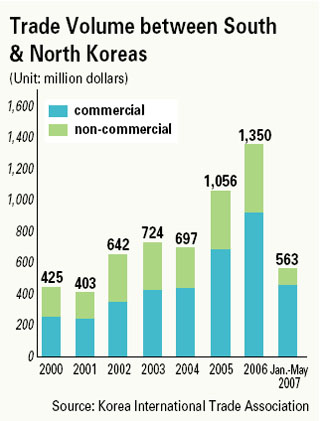
graph.jpgTrade volume between North and South Koreas has increased more than threefold since the historical June 15 Declaration in 2000.

With an average increase of 24.3 percent, annually, the total amount will reach $1.7 billion by the end of the year, according to the report on inter-Korean Trade from the Korea International Trade Association, also known as KITA.

Annual trade volume in 2000 was $425 million, which increased to $1.3 billion last year. Trade volume so far this year until May has already reached $563 million, which is a 31.3 percent increase year-on-year.

Besides the overall growth, what is healthy about the trade quality is that commercial trade accounts for almost 70 percent of the total trade. That figure was below 60 in 2000, according to the report. Non-commercial trade refers to aid including items such as rice, clothing and fuel. In other words, they are products that were sent to North Korea free of charge.

“The success of the Kaesong Industrial Complex is the biggest reason [for the rise],” said Roh Sung-ho, head of the Inter-Korean trade support team at KITA. “We are accepting bids for additional space at the Kaesong complex, and three times more companies bid than there are lots available.”

With more and more companies establishing factories in Kaesong, more material is exported from the South, and more manufactured goods return, said Roh.

The value of goods leaving South Korea was higher than the value of goods returning. However, about 30 percent of those goods were aid and were given free of charge. When that is taken into account, the North made more money from its exports to the South than the South made in exports to the North.

This allows the North to record a profit in trade account books.

“The nuclear incident last year, didn’t affect inter-Korean trade. There might be minor falls, but I expect trade volume between the two Koreas to increase for the time being,” Roh said.

Share

N.Korea’s Kang Sok-ju Appointed to NDC

June 18th, 2007

Choson Ilbo (Hat Tip DPRK Studies)
6/18/2007

North Korea’s First Vice Foreign Minister Kang Sok-ju, who is in responsible for Pyongyang’s diplomatic affairs including the nuclear issue, was in May made a member of the ruling National Defense Commission (NDC) led by dictator Kim Jong-il, Russian sources said Sunday.

The sources said Kim appointed Kang to the leadership body to strengthen his power base, with the move seen as ensuring the NDC holds sway over the military as well as domestic and foreign affairs.

Kang has served as the First Vice Foreign Minister since 1986 and is known as the only foreign ministry official who can directly advise Kim. He was a signer of the 1994 Geneva Accords between the U.S. and North Korea and the leader of Pyongyang’s representatives in the six-nation talks. Kang recently visited Moscow for treatment of a cataract.

The sources also said that General Lee Myung-soo, who was the North Korean military’s director of operations, has been made an organizer in the NDC.

The NDC currently consists of the country’s nine most powerful leaders, including Kim who serves as the body’s head, Vice Marshal Cho Myong Rok, who is Kim’s special envoy, Vice Marshal Kim Young-choon, General Rhee Yong-mu, General Kim Il-cheol and Secretary Chun Byung-ho.

Share

Japanese court orders seizure of pro-N. Korean group

June 18th, 2007

Yonhap
6/18/2007

A Japanese court Monday allowed the seizure of the headquarters of a pro-North Korean organization based in Japan because of its failure to repay its debts, a news report said.

In its ruling, the Tokyo District Court ordered the General Association of Korean Residents in Japan, better known here as “Chongryon,” to repay 62.7 billion yen to a government debt-collection body, the Kyodo News Agency reported.

Resolution and Collection Corp. (RCC) is expected to start procedures to confiscate the organization’s building, as it claims that the debt was part of loans extended by now-defunct credit unions associated with the group.

The RCC, which took over the non-performing loans from the credit unions, claimed that Chongryon is bound to pay the 62.7 billion yen (US$508 million) as the money was effectively purported to be handed over to Chongryon under the arrangements of the credit associations.

In connection with the suit, an investment advisory firm headed by the former chief of the Public Security Intelligence Agency, Shigetake Ogata, tried in vain to purchase the Chongryon head office for 3.5 billion yen (US$28.4 million) in an effort to prevent the premises from being seized.

Chongryon acknowledged the existence of the loans, but failed to reach an out-of-court settlement with the RCC.

Chongryon argued that the RCC, a public organization, had no right to demand that Chongryon pay the loans at face value, since the RCC had acquired the debts at very low prices.

“There is a purpose in depriving Chongryon of the headquarters’ premises and leading it to dissolution,” Chongryon said. “It offends public order and morality.”

Share

Pyongyang Makes an Appearance

June 17th, 2007

Korea Times
Andrei Lankov
6/17/2007

Keeping up appearances: this is how the official North Korean policy in regard to the city of Pyongyang, the cradle of revolution, can be best summed up. Being a Pyongyang dweller is a great privilege in itself. Until things began to fall apart in the mid-1990s, this meant that your food rations would consist largely of rice (not barley and corn, as in the countryside) and that your children would be entitled to a small glass of milk in school. But you also had to follow the rules, and participate in the grandiose symbolic performance that Pyongyang actually was _ and to an extent still is.

Many laws which dealt with the daily life of Pyongyang’s residents essentially served the purposes of presentation. Take, for example, the case of Pyongyang bikes. East Asia has a well-deserved reputation as a cyclists’ paradise. Nonetheless, North Korea used to be different. Until the early 1990s bicycles were outlawed in Pyongyang. Obviously, the North Korean authorities saw bicycles as decisively low-tech _ and hence inappropriate for the “capital of revolution.’’

Foreigners were not exempt from this charade. When in the mid-1970s a visiting Norwegian diplomat brought his bike to Pyongyang, he stirred up a diplomatic controversy. After painful negotiations he was granted permission to ride his bike… on weekends only.

Another example is a strict dress code imposed on the female dwellers of Pyongyang and some other cities. Women are not supposed to wear trousers outside their work. Actually, police turn a blind eye to such inappropriately dressed women in winter. Older halmoni also can walk in trousers with impunity _ at least if they do not stray outside their neighborhood. But for other women in summer time, skirts are obligatory, and until the late 1990s an attempt to walk the street in trousers would result in a fine and a probable report to police.

There are other restrictions as well: a certain tradition or institution may not be outlawed but should not be mentioned in the press. A phenomenon could exist in the real world, but it is not permitted to enter the world carefully constructed by Pyongyang propaganda.

My favorite example is the pram. North Korean women carry their children like women in East Asia have done for centuries: on their backs. This is probably a very good way: at least, Russian Koreans, arguably the most de-Koreanized of all overseas Korean communities, still sometimes follow this custom after some 150 years of their life in Russia. Perhaps, it makes sense: a baby feels so comfortable on a mother’s back!

But the North Korean authorities decided that this age-old habit of carrying children on the back should not be too widely advertised. Hence, you cannot find pictures of women carrying kids on their back. Instead, on the glossy pages of the North Korean propaganda monthlies, readers frequently encounter pictures of impossibly happy mothers who are moving their children about in prams. In real life one has to spend several weeks in Pyongyang before chancing on a pram-pushing lady. The politically incorrect tradition of carrying children on the back should not be mentioned in official publications or depicted in visual arts (unless they employed as a reference to the bad old days before the coming of the Kim dynasty).

Nowadays, the rules have been somewhat relaxed, but back in the 1970s or 1980s a foreigner took some risk by taking a picture of a mother with a baby on her back. There were chances that, if spotted, the film would be removed from the camera and exposed to the light.

The same fate could easily befall somebody who dared take pictures of Korean women moving heavy loads on their heads. Such scenes are increasingly rare in Seoul these days, but in Pyongyang this is still a commonplace sight. Nonetheless, in the ideal world of the official propaganda, Korean women do not carry large weight in such an archaic way, and no media is allowed to break the censorship of such subversive information.

Actually, I think that there are good reasons why the North Korean officials are afraid of such scenes. They likely know little about Edward Said’s writings on “Orientalism’’: after all, Leninist regimes were always very suspicious about non-Leninist brands of leftist ideology, so people like Gramsci, Althusser, or Said were never much loved in Moscow, Beijing, or Pyongyang. But they obviously grasped some of Said’s “Orientalist’’ ideas instinctively. For most Western readers, pictures of women with children on their backs or of old ladies moving heavy loads on the top of their heads do hint at “exoticism’’ and also, by implication, “underdevelopment’’. And the North Korean state does not want to present itself as underdeveloped.

But all these efforts to impress the world appear quite strange when we remember how small the target audience actually was. North Koreans knew the truth anyway, and foreigners in Pyongyang were very few in number. In most cases their positions and experiences made them very skeptical of all these propaganda exercises. But the North Korean officials tried hard nonetheless.

Share

North Korea Gets $25 Million Frozen by U.S. Probe

June 15th, 2007

Washington Post, A17
Glenn Kessler
6/15/2007

North Korea took possession yesterday of about $25 million in funds previously frozen by a Treasury Department investigation, potentially clearing the way for Pyongyang to fulfill its commitment to shut down an aging nuclear reactor.

An impasse over transferring the money had stalled an agreement announced in February that the Bush administration had hailed as a first step toward ending North Korea’s nuclear activities.

Under that agreement, which angered President Bush’s conservative supporters, the United States was supposed to end the Treasury investigation within a month and North Korea was to shutter its reactor at Yongbyon by April 14. But North Korea refused to take that step until it received money caught up in the investigation.

The reactor had been frozen under a 1994 deal with the Clinton administration, but in 2002 Pyongyang restarted it after a dispute with the Bush administration. Experts estimate that North Korea — which conducted its first nuclear test in October 2006 — has obtained enough plutonium from the reactor for as many as 12 nuclear weapons.

Late this year or in early 2008, North Korea would need to produce fresh fuel to keep the reactor going, says a recent report by the Institute for Science and International Security.

The Treasury Department had targeted Banco Delta Asia, in the Chinese special administrative region Macau, alleging it was involved in money-laundering for North Korea. But the Treasury’s action had wider repercussions, essentially convincing banks around the world not to do business with North Korean firms.

Though the Treasury Department agreed to allow the return of money tainted by illicit activities, no bank was willing to transfer the money without explicit assurances that the Treasury would take no regulatory action. North Korea could have withdrawn the money in cash, but many experts suspected Pyongyang demanded a wire transfer to signal to financial institutions that it was once again part of the financial system.

U.S. officials trying to save the deal desperately searched for a willing bank, but each time an arrangement seemed possible, complications arose. Finally, after Russia indicated that one of its banks could help, the Treasury arranged for the Federal Reserve Bank of New York to transfer the money to a dormant North Korea account at a Russian bank that operates in the Far East, near the border with North Korea.

“Basically all of it has been transferred,” the Macau government said in a statement yesterday. “For Macao, this incident has come to a conclusion.”

When the Treasury ended the Banco Delta Asia investigation in March, it formally ordered a broad range of U.S. financial institutions to stop doing business with BDA. But that order did not include the banks’ regulator — the Federal Reserve system — which allowed the New York Fed to handle yesterday’s transaction without requiring an exemption from the Treasury.

Still, a group of Republican lawmakers this week asked the Government Accountability Office to examine whether the transaction complies with money-laundering and counterfeiting laws.

N Korea fund transfer ‘under way’
BBC

6/14/2007

The transfer of North Korea’s funds from a bank in Macau – a key issue in nuclear disarmament talks – appears to be under way.

A Macau finance minister reportedly said $20m of Pyongyang’s $25m (£12.7m) had left a blacklisted bank in Macau.

The money was earlier reported to be going to a North Korean bank account in Russia, via the US Federal Reserve.

North Korea insists it must access its funds before abiding by a deal to begin shutting its nuclear facilities.

Q&A: North Korean money in Macau
BBC
6/12/2007

In February North Korea agreed to a timeline for giving up its main nuclear site by April – in return for badly-needed fuel and the return of $25m from a bank in Macau.

But the money has yet to be transferred, and the site remains open.

Now, though, the Russians are offering to step in and get the money to Pyongyang, which could remove a key sticking point in neutralising North Korea’s nuclear capability.

How has such a small amount of money become such a sticking point?

The money is, in a sense, only the visible part of a broader problem.

Dozens of North Korean government departments do their international business through a bank in Macau called Banco Delta Asia.

But in September 2005, the US Treasury accused BDA of being a conduit for laundering money for Pyongyang, triggering severe limits on the bank’s dealings with US financial institutions – and a freeze on $25m of North Korean money in the bank’s accounts.

According to the Treasury, BDA was a “willing pawn” of North Korea, helping process as much as $500m a year in dirty money without asking awkward questions.

The move sent relations between Washington, DC and Pyongyang – frosty at the best of times – into the deep freeze.

Between then and now, the $25m became a tool for the US to achieve a deal on North Korea’s ambitions for nuclear weapons – and an excuse for North Korea to stall.

So has a deal been reached now?

Yes, in February this year. North Korea pledged to give up its nuclear reprocessing activities in exchange for thousands of tonnes of fuel.

At the same time, the $25m would be unfrozen, and could – in theory – head back to North Korea.

But the money has yet to leave Macau, because at the same time the US Treasury cut BDA off altogether from the US banking system.

This ultimate sanction, in banking terms, was made under section 311 of the USA Patriot Act – passed shortly after the 11 September 2001 attacks on New York. Effectively, it bars any financial institution from having anything to do with BDA, if they want to do business with or in America.

Understandably, therefore, attempts to find a way of wiring the money back to North Korea have failed.

Banks in China and Vietnam have been approached and have refused to get involved.

One US bank – Wachovia – has been asked by the US State Department to consider helping out, but it points out that it will need assurances that it is not in breach of section 311 before it can do anything.

What is Russia offering to do?

Russia is one of the partners in the six-way talks over denuclearisation of North Korea, and – given that it shares a border with North Korea – has a powerful interest in moving discussions along.

Early in June, Russian officials suggested that a Russian bank might step in to get the frozen $25m from Macau to Pyongyang – directly or via intermediaries.

The US Treasury has now acknowledged the possibility of Russian assistance.

But Russia is likely to require cast-iron assurances that US sanctions against banks which carry out transactions with North Korea will not apply.

One possibility would be for the money to go first via the New York branch of the US central bank, the Federal Reserve, and then on to Russia’s own central bank before being paid into Moscow’s Far East Commercial Bank, where North Korea has a long-unused account.

But what does a country like North Korea need money-laundering services for?

North Korea, in practical terms, is flat broke.

Its trade is minimal, its agriculture is suffering, and its contact with the outside world is severely limited.

But according to the US Treasury, not to mention many experts elsewhere in intelligence and financial crime, Pyongyang has for the past two decades made up for its lack of legitimate trade by taking an unhealthy interest in faking US banknotes, smuggling counterfeit tobacco products and even the narcotics trade.

Much of the proceeds, the US claims, have been laundered through BDA, which has also facilitated huge bulk cash shipments back to Pyongyang – as well as large trades in precious metals.

BDA, it should be said, has always strongly denied the allegations, insisting its business with North Korea is above board.

Why does the US not just send the money back itself?

In theory, the US could have provided a bank with the reassurance it needs to get involved, although that has yet to happen – and could, in any case, be legally tricky. “Difficult, yes; impossible, no,” was how the State Department’s spokesman described it.

Similarly, reports have suggested that since 2001 there has been a conduit for fund transfers between the State Department’s credit union and the Foreign Trade Bank in Pyongyang.

But as far as the Treasury is concerned, the ball is now in Macau’s court. It is up to the regulators there to work out how to get the money back to North Korea – and in the meantime the section 311 rule stays in force.

In any case, after years of playing hardball with North Korea, the last thing the current US administration wants is look as if it is doing things Pyongyang’s way.

Can’t North Korea get it back any other way?

It could – for instance, through a direct withdrawal from BDA back to Pyongyang.

Alternatively, if the US is right that bulk cash shipments have been going on for years illicitly, perhaps the technique could be used for above-board purposes.

But as far as North Korea is concerned, that kind of deal is unacceptable.

It seems that the authorities in Pyongyang want the transfer to pass through the international financial system, so as to send a signal that handling North Korean money does not mean instant ostracism.

Not only that; keeping the matter rumbling on means more time to extract concessions – and, some experts fear, to keep reprocessing nuclear material.
Share

S. Korea set to ship US$20 million in food aid to N. Korea via WFP

June 14th, 2007

Yonhap
6/14/2007

South Korea will take steps to send food aid worth some $20 million to North Korea at the request of a United Nations food agency, the country’s point man on the North said Thursday.

“This is totally different in nature from the provision of rice to the North in the form of a loan,” Unification Minister Lee Jae-joung said in a press briefing, conscious of mounting criticism of what it appears to be the government’s sudden about-face in food aid to the North.

South Korea will consult with the World Food Program (WFP) to determine the proposed list and amount of food aid items, which include 24,000 tons of corn, 12,000 tons of bean, 5,000 tons of wheat, 2,000 tons of flour and 1,000 tons of powdered milk, Lee said. It will be the first time since 2004 that South Korea will provide food aid to the North via the WFP.

South Korea resumed shipments of fertilizer and other emergency aid to the North in late March, but withheld the loan of 400,000 tons of rice as an inducement for North Korea to start its nuclear dismantlement under a landmark February 13 agreement.

Besides, the South also decided to send 10,500 tons of rice to the North soon as part of a promise made last year to help the North recover from flood damage, Lee said. “I think it is right to push for this in consideration of cooperation with the North,”

South Korea suspended all types of food and fertilizer aid to North Korea after the North conducted missile tests in July. Resumption of the aid was stymied due to the North’s nuclear bomb test in October, but the two sides agreed to put all inter-Korean projects back on track in early March. Emergency rice aid for flood relief has also been put on hold in tandem with the suspension of the rice loan.

A weak harvest in 2006, disastrous summer flooding and a 75 percent fall in donor assistance have dealt severe blows to the impoverished nation, according to WFP officials.

According to a recent think tank report, North Korea could run short of up to one third of the food it needs this year if South Korea and other countries withhold aid.

Data from the WFP and the Unification Ministry show that the North will need between 5.24 million tons and 6.47 million tons of food this year. Depending on the weather, the availability of fertilizer and other factors, the communist state may only be able to produce 4.3 million tons of food by itself, the report said.

Share

Kim Jong Il Received PTCA, Not Surgery

June 14th, 2007

Daily NK
Yang Jung A
6/21/2007

Kim Jong Il underwent a Percuteneous Transarterial Coronary Angioplasty (PTCA) performed by German doctors in mid-May.

An inside Japanese source well acquainted with North Korea reported by telephone on the 20th that Kim Jong Il received medical treatment from doctors of the Berlin Heart Center in mid-May and was back at work a day later.

This source said that North Korean authority asked the German doctors to closely examine Kim Jong Il’s health and perform surgery if necessary. The examination revealed a myocardial infarction, but no other serious heart condition.

According to the doctors, Kim’s health was not bad except for kidney hypertrophy and some symptoms of diabetes. After examination he received the relatively simple PTCA treatment instead of surgery.

PTCA expands a narrow artery by inflating a tiny balloon. The balloon is introduced into the artery through catheter. It is an effective treatment for coronary artery diseases without the use of thoracotomy, and results in high success rates and few complications. Patients need just a couple of days’ rest. Dr. Jung Yong Suk, a heart specialist at the Sunrin Hospital in Handong University, explained to the Daily NK that “PTCA is a medical treatment for coronary arteries supplying blood into the heart. If Kim Jong Il required the procedure, he may have some problem in his coronary arteries, but it is uncertain if it is a stricture of the heart or myocardial infarction.”

The Japanese source said that the “German doctors promised to keep Kim Jong Il’s procedure a secret and to coordinate a faked story with North Korea authority.” Therefore, the spokesperson of Berlin Heat Center revealed that 6 members of the center stayed in Pyongyang from May 11th to the 19th, treating only three laborers, a nurse, and a scientist.

A North Korea expert speculated that Kim Jong Il might be addressing health concerns prior to the year end South Korean Presidential Election and further nuclear negotiations. Many groundless reports have circulated regarding possible Kim Jong Il heart surgery. A Japanese magazine, Shukan Gendai, claimed that Kim Jong Il received coronary artery bypass surgery for myocardial infarction.

Original claim:
Kim Jong-il had artery surgery in May
Korea Herald

6/14/2007

North Korean leader Kim Jong-il was operated on by a team of German doctors last month to open a blocked artery, a person connected to the Kim regime said.

While doctors from German Heart Institute Berlin arrived in Pyongyang prepared to perform major surgery on Kim, they found only one clogged artery, the person said. The 65-year-old Kim, who suffers from diabetes and high blood pressure, recovered well from the surgery, said the person, who asked that his name not be used because North Korea wanted the operation kept secret.

The person said while other members of North Korea’s elite go abroad for medical treatment, only Kim is important enough to have a team brought into the country. Barbara Nickolaus, a spokeswoman for the institute in Berlin, confirmed that the doctors had been in Pyongyang, and said they were there to treat three workers, a nurse and a scientist.

Kim’s health has been the subject of repeated recent speculation. Chosun Ilbo, South Korea’s biggest daily newspaper, said late last month that South Korean and U.S. intelligence agencies were checking reports Kim was suffering from heart, kidney or liver disease.

The Japanese weekly magazine Shukan Gendai said on June 8 a team of six doctors from Berlin was in Pyongyang from May 11 to 19 and conducted heart-bypass surgery on Kim.

The North’s official Korea Central News Agency said Kim visited factories in North Pyeongan Province near the border with China and spoke with workers on June 7, or less than three weeks after the German doctors left North Korea.

NK Daily, a Seoul online news organization staffed by defectors from North Korea, reported on June 11 it had confirmed the report with an “inside source” in North Korea who said the apparently vigorous Kim’s June 7 schedule lasted until 1 a.m.

Since the 1970s, when he was unofficially designated as successor to his father, Kim Il Sung, Kim Jong-il’s health has been the subject of speculation.

“Kim does have diabetes and high blood pressure,” said C. Kenneth Quinones, a retired U.S. State Department Korea specialist who teaches at Japan’s Akita International University. “But there is no firm evidence that either has worsened recently.”

Kim, who has three sons in their 20s and 30s, hasn’t publicly said whether one of them or someone else will be his successor in the world’s only communist dynasty.

U.S. Concern

“The State Department is concerned about his health, at least until he publicly designates an heir,” Quinones said.

Kim’s failure to keep to his usual quota of appearances, such as visits to work units to deliver what the official Korea Central News Agency calls “on-the-spot guidance,” often triggers speculation.

Given North Korea’s nuclear program, all reports about Kim’s health have to be taken seriously, said Michael Breen, author of “Kim Jong-il: North Korea’s Dear Leader,” a biography.

“One day the reports will be true,” Breen said. “So we can never ignore them.”

Chosun Ilbo reported in May that Kim had been on official activities 23 times between Jan. 1 and May 27, half the number reported during the same period in 2006.

At an April 25 military parade, Kim’s eyeglass lenses were different from his usual sunglasses, leading to speculation his diabetes had worsened, making his eyes more sensitive to sunlight, the newspaper said. That was a “false alarm,” Quinones said. He said Kim was actually wearing “transition” lenses that turn darker according to the sun’s brightness.

South Korea’s National Intelligence Service concluded Kim’s health probably wasn’t in serious decline, according to a person who spoke with service agents.

At the April parade in Pyongyang, South Korean agents watched Kim review troops for two hours with no signs of fatigue, a sign his health isn’t fragile, said the person, who asked not to be named because of the sensitivity of the information.

Chain-Smoker

Kim is a former chain-smoker whose lifestyle — including a reported fondness for cognac and delicacies — may contribute to his diabetes and high blood pressure. His father died, reportedly of cardiovascular disease, at 82 in 1994.

Questions about the younger Kim’s health were heightened during a long disappearance in the late 1970s, prompting speculation he was dead or seriously incapacitated from injuries in a car accident caused by people opposed to a hereditary succession.

After his formal elevation to succeed his father in 1980, the official media portrayed him as a tireless worker for the people’s welfare even at the risk of his own health.

Kim looked pale and thin at the ceremony designating him as successor, causing North Koreans to write critical letters to officials for failing to take care of his health, official media reported at the time.

Kenji Fujimoto, a Japanese chef who served Kim at his Pyongyang palace, said in a pseudonymous book he wrote about the experience that the North Korean leader would complain about the medicine he had to take.

In the book, “The Private Life of Kim Jong-il,” Fujimoto quoted Kim as saying, “Do I have to keep taking these pills every day until I die?” (Bloomberg)

Share

Emperor Hotel Casino Re-opens

June 14th, 2007

Daily NK
Han Yong Jin
6/14/2007

[NKeconWatch: Lots of pictures in original article]

The Emperor Hotel and Casino in Rajin-Sunbong has re-opened. It had earlier been a source of Chinese authority concern over remote gambling as the casino attempted to attract foreign tourists.

The North Korean regime designated Rajin and Sunbong as a special free economics and trade zone in December, 1991 and encouraged foreign businesses to locate there. Hong Kong’s Emperor Group opened a five star hotel with 100 guest rooms and a casino in July, 2000.

However, Cai Haowen, a superintendent at the Transportation Ministry in Yanbian-Zhou, embezzled approximately $425,000 of public funds and threw away all the money for gambling in the Emperor Hotel Casino, causing the Chinese government to close the hotel’s casino on January 11st, 2004.

Chinese bloggers who have visited the hotel released photos through a Chinese portal site, sina.com.

Bao Yong visited the Emperor in April and noted that the hotel is 50 km from Huichun, China, and the only tourists were Chinese. North Koreans were not permitted and there was no evidence of Russians. There were just Chinese cars with license plates from Liaoning, Heilongjiang, and, predominantly, Yanbian in the parking lot.

He said that “the strict hotel and casino management seemed more like agents or gangsters than managers, who were everywhere, creepily scrutinizing gamblers’ movement and attitudes.” They prevented him from taking photos inside the casino.

Share

“North Korea Must Increase Transparency to Enlarge International Aid.”

June 14th, 2007

Daily NK
6/14/2007

At the North and South Korea’s agricultural cooperation-related symposium sponsored by World Vision, in commemoration of the opening of the North Korea Agricultural Research Institute (Chief Park Hyo Geun), the Senior Researcher of Korea Rural Economic Institute Agricultural Researcher Kwon Tae Jin emphasized, “North Korea’s action, while ignoring the reality of aid organizations, of requesting or intervening in aid for development is an action which ignores international norms and processes.”

Researcher Kwon did acknowledge the necessity of change from an emergency aid form to aid for development.

However, he insisted, “If it is doubtful whether or not North Korea, while requesting a conversion to aid for development, is truly prepared to receive development aid, then the propriety of such aid and transparently showing the goal and content in addition to the process and means of monitoring as well as institutional equipping for evaluating the results should take place.”

Researcher Kwon pointed out that support to North Korea has played a positive role in preserving supply and demand of food provisions and the open and reform of North Korea, but the problem of not providing sufficient information to patrons and the failure to promise transparency has been exposed.

Further, regarding support for North Korea, he maintained that our government has caused tension by pursuing aid projects while failing to solidify the chemistry of citizens and choosing means of pursuing projects sporadically according to political reasoning.

On one hand, Researcher Park Hyo Geun pointed out, “The principal issue of North Korean agriculture is that the poor are not able to escape the cycle of poverty. The weakening of productivity of labor is sustaining the cycle of poverty of the destitute.”

Chief Park pressed, “When the February 13 agreement is actualized and the North Korean nuclear issue becomes resolved, domestic support for North Korea will increase epochally. The influence that support for North Korea will have on South Korea’s agricultural industry should greatly be considered.”

Share

Kaesong is target of U.S. FTA letter

June 13th, 2007

Joong Ang Daily
6/13/2007

A U.S. congressman on Monday demanded changes to a tentative free trade agreement with South Korea, which he said could allow the Asian trading partner to export North Korea-made goods to the United States.

Rep. Sander Levin (D-Michigan) sent a letter to U.S. Trade Representative Susan Schwab raising questions about a draft FTA annex that deals with “outward processing zones” on the Korean Peninsula.

South Korea and the U.S. had maneuvered around the sensitive issue of the inter-Korean joint economic venture, the Kaesong Industrial Complex, by agreeing to discuss in the future whether to include products from such “zones” in their FTA.

Kaesong houses a manufacturing complex where South Korean capital is combined with North Korean cheap labor to produce price-competitive goods. Seoul strongly pushed to have Kaesong covered by the FTA, but the U.S. balked at the idea of importing products made in a country with such a poor human rights record.

Levin, who has already vowed opposition to the FTA, citing unsatisfactory provisions in the auto sector, said Annex 22-C on the zones applies labor standards different from those agreed on between the Congress and the U.S. administration.

The annex directs the committee to examine the standards with “due reference to the situation prevailing elsewhere in the local economy and the relevant international norms.”

“To apply any lesser or different standard for goods from North Korea,” Levin wrote, “would be wholly inconsistent with… basic international labor standards.”

Share

