N. Korea urges Japan to participate in energy assistance

July 8th, 2007

Korea Herald
7/8/2007

Japan should refrain from its hostile policy toward North Korea and actively take part in a six-party actions plan to achieve a nuclear-free Korean Peninsula, a pro-North Korean newspaper in Japan said Saturday.

Chosun Sinbo, a pro-North Korean newspaper published in Tokyo, said on Saturday that Japan should be out of the six-party discussions if it continues to avoid the energy assistance program.

Japan, a member of six-party nuclear disarmament talks, is at odds with North Korea over about a dozen Japanese citizens kidnapped by North Korean agents decades ago. Japan refuses to provide any economic aid to the North until the kidnapping issue is resolved.

Under a deal adopted on Feb. 13, North Korea is to receive 1 million tons of heavy fuel oil in exchange for shutting down its key weapons-related nuclear facilities. South Korea is responsible for the first shipment of 50,000 tons.

Share

Famine: A Disaster Waiting to Happen

July 8th, 2007

Korea Times
Andrei Lankov
7/8/2007

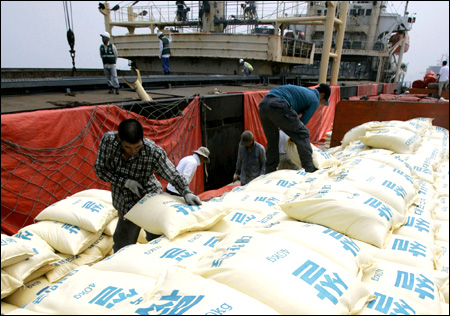
aid.jpgNowadays, the severity of famine appears to be a thing of the past _ at least outside Africa. Indeed, modern technology makes it possible to feed crowded cities almost effortlessly. Thus, any reports of famine nowadays can be argued to be the direct result of mismanagement and deliberate political decisions. The recent North Korean famine of 1996-2000 vividly demonstrates this and supports such a theory.

Stalinist agriculture has never been very efficient. The lack of incentive makes it sluggish and wasteful. However, in some cases, the heavy investments in machinery and fertilizers did, in fact, help to overcome some of the deficiencies created by the inept social system.

This was the case in North Korea. In the late 1950s all North Korean farmers were herded into the so-called “agricultural co-operatives.’’ While less restrictive than the “people’s communes’’ in Mao’s China, they imposed a harsher control than Stalin’s “kolkhozs.’’

The North Korean government invested heavily in agriculture. Its efforts produced a remarkably energy-intensive agricultural system. Electric pumps were running huge irrigation projects; chemical fertilizers and tractors were used on a grand scale. In attempts to reclaim arable land, steep hills were made into terrace fields. These fields, endorsed by Kim Il-sung himself, remained the poster image of North Korean agriculture until the mid-1990s.

Initially these efforts seemingly paid off. In the 1980s North Korea produced some 5-6 million tons of grain (largely, rice and maize) a year. Its population never enjoyed anything like the present-day South Korean abundance: meat or fruits were rare delicacies. Nonetheless, the 6 million tons of grain was sufficient to feed the country’s population. This was done through the rationing system. Depending on one’s position in the complicated hierarchy of social groups, daily rations varied from 500 to 900 grams per adult _ sufficient to provide enough calories.

But in 1991 the situation changed. The much trumpeted “self-reliance’’ of North Korea proved to be a complete fake. The Soviet decision to discontinue sales of oil and other goods at hugely discounted prices wrought havoc in the country’s economy. The agricultural sector was especially vulnerable, since without the heavy input of energy and resources it stood no chance of survival. Tractors required diesel oil, which was not forthcoming, and electric pumps could not operate when power stations were idle due to a shortage of spare parts.

In 1992-1993 the North Korean media began to argue the benefits of having only two meals a day as opposed to the traditional three, claiming the latter was unhealthy and excessive. By 1994, people in some remote areas could not get food for days at a time. They were issued the usual rationing coupons, but no foodstuffs were available in the shops. Rations were also cut. These were signs of things to come.

However, the North Korean government did not follow the example of China or Vietnam, where the return to private agriculture led to an instant revival in food production. In the early 1990s the Pyongyang leaders saw how the reformist Communist governments of East Europe had been wiped out, and they considered any reform potentially dangerous to their own survival. Thus, no reform was undertaken, and in the years 1992-1995 agricultural production continued its free fall.

And then the real catastrophe came. In July and August 1995 unusually heavy rains led to disastrous floods. The North Korean authorities blamed the floods for all subsequent developments. In the aftermath of the disaster, they even decided to break with the decades-old tradition of covering or playing down all the problems of their country. Pyongyang stated that some 5.4 million people had been displaced by the 1995 floods (the subsequent U.N. survey indicated that the actual figure was much smaller _ probably, by an order of ten). Politically, this was understandable: if the country was hit by a natural disaster of unprecedented proportions, the authorities were not to be held responsible!

There is, however, good reason to doubt these statements. After all, the Korean Peninsular is small, but impact of the very same floods on the South was negligible. However, the contribution of the flood to the disaster is undeniable. The already strained power grid was destroyed, and entire irrigation systems were wiped out. Most of the terrace fields, the pride of the “juche agriculture,’’ were simply washed away.

In 1996, the country harvested some 3 million tons of grain _ just above half the pre-crisis level. This meant famine. It was to last for four years and take between half million and one million lives.

Share

UN denies firing ‘whistleblower’

July 7th, 2007

BBC
7/7/2007

A UN agency has denied firing an employee after the man questioned alleged financial irregularities at its North Korean operations.

Artjon Shkurtaj asked for protection as a whistleblower after losing his job in the United Nations Development Programme (UNDP) in North Korea.

Mr Shkurtaj said he found fake US bills in an office safe and local staff were paid in euros, and not local currency.

The UNDP denied any wrongdoing, and keeping improper accounts.

UN audit

The agency has been accused by the US administration of handing over cash to the North Korean regime without proper accounting or paperwork, the BBC’s Laura Trevelyan said from New York.

The implication is the UN allowed millions of dollars to go to the North Korean government instead of going to programmes to help people in poverty, our correspondent said.

The UN carried out an audit in June and said that while there had been breaches of rules, there had been no systematic diversion of UN money to North Korean authorities.

“UNDP has invited the individual to submit all relevant information to the UNDP office charged with undertaking internal inquiries, but he has so far declined to do so,” a spokesman from the agency said.

UN deputy spokeswoman Marie Okabe said the UN Ethics Office was looking into Mr Shkurtaj’s appeal for whistleblower status.

Share

Campsite to Open in Mt. Geumgang Resort Complex

July 6th, 2007

Korea Times
Ryu Jin
7/6/2007

A campground in the Mt. Geumgang resort complex in North Korea will be open again for the hot summer season from July 10 to Aug. 25, according to Hyundai Asan, the South Korean operator of the tour program.

Visitors can spend two nights and three days on the Geumgang-san Beach in the scenic resort area at 180,000 won ($195) for an adult, which includes breakfasts and trips to the mountain area.

Seated at the lower edges of the mountain, the sandy beach stretches some 1.2 kilometers along the East Coast and can accommodate various sizes of tents for a combined number of about 250 to 300 campers per night.

Groups of visitors can sit around a campfire in the night after enjoying various daytime water activities such as motorboat, jet-sking and rock-climbing with additional fees. A pass for all the aquatic rides cost $25 per adult ($20 for a group of more than 30).

Mt. Geumgang, which has long held both aesthetic and spiritual allure for Koreans, can be divided into three parts: Naegeumgang (inner, western part), Oegeumgang (outer, eastern part) and Haegeumgang (seashore part).

Since the first tour to Mt. Geumgang in 1998, a growing number of visitors have made the trip from the South to the resort area. Hyundai Asan said the cumulative number of tourists exceeded 1.5 million in early June, after it began the new Naegeumgang tour.

The Geumgang-san Beach was open to South Korean visitors from 2002 and the campground has been available since 2005. Last year, however, it didn’t draw many visitors from the South due to the rainy spell as well as the political situation in the aftermath of North Korea’s missile tests.

“We expect a larger number of visitors would go camping in the Mt. Geumgang resort complex this year since inter-Korean ties are relatively good,’’ a Hyundai Asan spokesman said.

But he added cooking would be banned in the campground this year. “Campers were able to use portable burners for instant noodles last year,’’ he said. “However, cooking won’t be allowed this year for environmental and safety reasons. Visitors can use restaurants for lunch and dinner.’’

Usual prices for Mt. Geumgang are set from 420,000 won to 450,000 won including two nights hotel stay. But those for the camping tour are relatively lower though it also includes climbing the mountain.

Share

Construction of S. Korean-funded elementary school in Pyongyang to begin next month

July 5th, 2007

Yonhap
7/5/2007

The construction of a Pyongyang elementary school, funded by South Korean citizens, is to begin next month, officials said Thursday.

The project of reconstructing one of the four elementary schools in Pyongyang is being carried out at the North’s request, an official of the South Gyeongsang provincial government said.

“We have successfully collected contributions of a total amount of 987,000,000 won (US$1,070,500) from people of the province for building a Pyongyang elementary school,” the official said. “We are going to send the building materials soon to start the construction next month. We are aiming to complete it by the end of the year.”

South Gyeongsang Province has been cooperating with North Korea, especially in the agricultural area.

Governor Kim Tae-ho went to North Korea in April and took part in the ground-breaking ceremony for the school.

Share

North Korea’s Up-and-Coming Upper Class Do Not Want Regime Change

July 5th, 2007

Daily NK
Kim Song A
7/5/2007

“In North Korea, the up and coming wealthy class is increasing with each day. They will try to preserve the military regime to keep their property.”

A Russian expert analyzed that while a majority of North Korean citizens are barely sustaining their livelihoods and are suffering from extremely grim realities of life, the rich who are eating and living well are consistently rising and will become the main foundation for the maintenance of North Korea’s military-first ideology and political power.

Sergey Kurbanov, a Korean Studies Research Head at Russia’s University of Petersburg, participated in a seminar held by Seoul University’s Reunification Research Institute on the 4th. “In North Korea, in the minds of “socialist capitalists” which is what the up and coming wealthy class are called, socialist ideology already does not exist.”

Kurbanov pointed out the reality of their living situation, “I have seen students going to China from North Korea and as soon as they arrive in China, they take off their red tie. When they return to the North, they do not even touch the in-flight meals, saying they are no good.”

The newly rising wealthy class who have amassed their money from North Korea’s and China’s trade, etc., despite the fact their confidence in political power has already dissipated, resist regime change because their gains from the Kim Jong Il regime is significant.”

Kurbanov said related to North Korea’s plan for a successor, “As Kim Il Sung remains an eternal Leader, Kim Jong Il will also remain as an eternal general. Even if there is no successor, they will ensure that the regime will work well.”

He said, “Whether it is Kim Jong Il’s son or somebody else is not important. To whomever Kim Jong Il hands the rights of a successor, that power cannot surpass Kim Il Sung nor Kim Jong Il.”

On one hand, Kurbanov upheld regarding North Korea’s military politics, “Historically, this has risen due to the threat received from the Han and Tang Dynasties in China,” and the reign of the military was for the protection of the regime.

He said, “The reason why North Korea has stressed “sovereignty and the juche” is that historically, their mentality of fear is strong regarding threat from the outside. In order to prevent this, the individual, no matter what kind of a difficulty he is going through, can make a sacrifice.”

From such a perspective, he stipulated, “North Korea is not socialist, but a traditional society wearing socialist clothing.”

He emphasized, “Kim Jong Il received the seat of power as a military leader and the Military-first politics is the background for which Kim Jong Il is legally a North Korean leader.”

Share

Drugs in Steam Baths, Even Prostitution Taking Place

July 5th, 2007

Daily NK
Kim Min Se
7/5/2007

A counselor of Korean Association against Drug Abuse, Lee Mee Young said, “Drugs are a snare of destruction which give huge suffering to addicts themselves, families, relatives, and neighbors.”

Such drug addicts are rapidly increasing in North Korea. Misuse of drugs with the spread to average civilians as well as the newly rich upper class has become very serious.

Situation #1. Handle drugs due to stress.

Hong Mun Hwa (pseudonym), who became wealthy all of a sudden by acquiring a large sum of money from North and Chinese trade in Chongjin, was a man who was faithful to his family. Three years ago, Mr. Hong started backsliding when he put his hands on Philopon (called “ice” in North Korea).

Jung Myung Ki (pseudonym), brother-in-law of Mr. Hong, said, “Ever since he started touching drugs, his business also became ruined. Mr. Hong was not able to keep appointments and his eye for business became totally went downhill. He turned into a stupid person.”

The story Mr. Jung revealed was this.

“I realized that my brother-in-law was addicted to drugs when I rode together with him a year ago from Chongjin to Shinuiju. Of course, I knew that most people who have money do drugs, but I was frankly quite surprised that a good person such as my brother-in-law became addicted. He ultimately died from a heart attack due to drugs. I even hid the fact from his wife that he was addicted to drugs until after his death.”

However, Mr. Hong, who started drugs at his first try, was gradually dissatisfied with Philopon alone, so started trying “pills” (heroine). According to Mr. Jung, Mr. Hong, in the course of the trade car ride from Chongjin to Shinujui, took Philopon at 5~8 hour increments.

Mr. Hong died from heart attack at the beginning of June in Shinujui, saying, “I will try to make up for lost sleep” and took a large quantity of “pills.”

Situation #2: Taking drugs in private steam baths…even prostitution

The evil influence of drugs in Hamheung, relayed by North Korean civilian Kim Myung Gil (pseudonym), who came to China from Hamheung to visit relatives, is even more shocking. Hamheung is the mass production center of Philopon.

Mr. Kim said, “People who are selling Philopon by trade and are making a living is increasing in Hamheung. The mother of a middle school classmate sold Philopon and even though she initially earned money, the mother and my friend both became addicted later. Not only my peer, but there are many cases where families had to scatter and sell their houses due to drug addiction.”

According to Mr. Kim, the steam bath business is currently booming in Hamheung.

In the steam bath, electricity comes on for 24 hours. Electricity is transferred via a power cable which is connected by giving a bribe to the power distribution plant. Mostly, there are private baths or rooms in the steam baths, and inhalation and prostitution are supposed to take place here. If one gives money to the steam bath operators, then they provide Philopon and even bring a female prostitute.

He said, “One does not have to show his or her citizen card when entering the steam bath and do not need to leave their names, so it is an ideal place for delinquent men and women to do drugs.”

The inspection unit haphazardly handles situation while taking bribes…decrees repeat, “Absolutely Executions”

The current North Korean government has not come up with a way regarding the civilians’ drug sales and taking dosages. Occasionally, the Party issues the decree and inspection unit to prevent drug sales and usage, but they have not been able to exterminate drug deals.

Mr. Kim said, “The Party issued the order last year to capture drug offenders and carry into execution, but even they sweep matters under the table upon receiving bribes.”

He added, “If inspection occurs because drug smugglers earn such a significant amount of money, then the dealers give 3,000~5,000 dollars worth of money at one time. Even if inspection units have come down from the Party, people are easily won over if they receive such a large sum of money.”

Kim Jung Ae (pseudony), Korean-Chinese businesswoman who goes to Pyongyang and Shinuijui often said North Korea’s drug offense regulations cannot be known.”

Mr. Kim said, “In China, a rule exists which decrees drug sales or possessions over 20g to be punishable by death. However, North Korea does not seem to have a regulation about the exact number of grams of possessions or sales which are punishable.”

He explained, “In order to control drugs, punishment has to differ for one-time usage, two-time usage and above, and the amount of grams of possessions or sales. However, because North Korea repeats every time it announces a decree, “A person who makes or sells drugs is punishable by death,” “we cannot kill all drug takers and proper regulation cannot even be carried out.”

Mr. Kim lamented, “If detailed laws regarding the North Korean government’s strong will for regulation is not made, the evil influence of the citizens’ drug use cannot help but to increase at a fast speed.”

Share

Koreas to hold talks on cooperation in light industry sector

July 4th, 2007

Yonhap
Sohn Suk-joo
7/4/2007

South and North Korea will hold new round of working-level talks this week to discuss ways to cooperate in light industry and natural resource exploration, the Unification Ministry said Wednesday.

The two-day talks slated to be held in the North Korean border city of Kaesong on Thursday come as North Korea moves to take initial steps to shut down its main nuclear facilities.

In April, South Korea reconfirmed the agreement to supply industrial materials worth US$80 million to the North starting in June to help revive its sagging light industry in return for the right to develp natural resources in the North.

Under the deal, North Korea will allow a team of South Korean experts to conduct an on-site survey of three zinc and magnesite deposits in its mountainous northeastern region for 12 days beginning June 25. In return, the South will ship 5 million tons of polyester fabrics worth $800,000 to the North on June 27.

But the schedule has been postponed as the two sides failed to thrash out differences on the price and list of industrial materials the South is to provide the North in exchange for the right to develop natural resources in the communist country. The North called for more than the South had earmarked for in the shipment, according to South Korean officials.

In 2005, South Korea agreed to offer industrial raw materials to the North to help it produce clothing, footwear and soap starting in 2006. In return, the North was to provide the South with minerals, such as zinc and magnesite, after mines were developed with South Korean investments guaranteed by Pyongyang.

But the economic accord was not implemented, as North Korea abruptly cancelled the scheduled test runs of inter-Korean cross-border trains in May last year, apparently under pressure from its powerful military. The two Koreas carried out the test run of trains across their heavily armed border in mid May.

Share

Kim Yun-kyu Resumes N. Korean Business

July 3rd, 2007

Korea Times
Yoon Won-sup
7/3/2007

Kim Yun-kyu, who stepped down as vice president of Hyundai Asan, South Korea’s operator of inter-Korean business and tourism, due to illegal use of corporate funds in October 2005, is resuming work with North Korea.

Kim set up his own company for North Korean business last year, dubbed Acheon Global Corp., which imported 531 kilograms of caviar from North Korea via the East Coast train on June 21, and entered the Gaeseong Industrial Complex, according to the Unification Ministry.

The importing of the caviar is Acheon’s first business transaction with North Korea, which was finalized by Kim’s aide Yuk Jae-hee, vice president of Acheon and former executive of Hyundai, during Yuk’s visit to Mt. Geumgang in North Korea June 18 to 20.

Kim will visit Mt. Geumgang Thursday, the first time since his resignation, to discuss additional imports with North Korean government officials. His North Korean counterpart is a business association in charge of fisheries.

Kim is reportedly seeking to bring North Korean sand to the South. Accordingly, he visited Gaeseong June 19, and Yuk plans to visit Gaeseong soon for further discussion on sand importing.

However, the two CEOs of Acheon are not likely to meet senior North Korean government officials, though they previously have met with and will, again, meet with working-level officials on inter-Korean affairs, in Gaeseong and Mt. Geumgang.

“Kim got approval from North Korea to visit the country for trade of agricultural and fishery projects, and the discussion has been conducted according to the purpose of his visit to North Korea,” a South Korean government official said on condition of anonymity.

Kim already discussed imports of North Korean fisheries and sand to the South and the establishment of an office in Gaeseong, with Choi Seung-chul, vice chairman of Asia Pacific Peace Committee of North Korea.

In line with Kim’s plan, Acheon signed a contract with the Korea Land Corp. to rent 1,400 square meters of land in the Gaeseong complex.

A building is to be set up there to accommodate restaurants, coffeehouses and other facilities for workers in Gaeseong, but it is not yet decided what kind of facilities will be built by Acheon. A permanent office of Acheon also is likely to be set up in Gaeseong.

Some observers say Kim’s resumed activity may lead to competition with Hyundai Asan regarding inter-Korean business, but the dominant opinion is that the chance is slim for the time being.

Kim led the inter-Korean business with Mt. Geumgang tourism and Gaeseong complex under the confidence of late Hyundai Group founder Chung Ju-yung and his late son Mong-hun, former president of Hyundai Asan. Now Hyun Jung-eun, widow of Chung Mong-hun, leads Hyundai Asan.

Share

Purchase Popular Jangmadang Goods at State-Operated Stores

July 3rd, 2007

Daily NK
Yang Jung A
7/3/2007

A North Korean insider source relayed on the 2nd that citizens’ complaints have been rising because the North Korean government recently gave guidelines to sell a portion of products which have been selling with popularity at the jangmadang (markets) only at state-operated stores.

This source, who resides in North Pyongan, revealed in a phone conversation with DailyNK, “Recently, plastic floors have been popular, so “plastic sales” is earning a lot of money. However, government authorities have mandated that the commerce office directly oversee plastic floors and that they be sold at state-operated stores.”

The insider relayed, “Families above middle-class have been showing a lot of interest in acquiring furniture. Besides floors, drawers on which TV can be placed and cabinets displaying wines and others are very popular.”

Previously, floors made of paper covered the floors of houses, but since North Korean civilians’ standard of living started rising recently, Chinese-made plastic floors decorated in flowers is drawing popularity.

He said, “Rumor has been leaking that pork (1,700 North Korean won per kg), the price for which has declined recently, is also directly managed by the commerce office, along with plastic floors.” “Besides this, the complaints of merchants have been rising since rumor starting circulating that the list of items to be overseen by the office will increase.”

He added, “Would they want to do any business given that individual sales are discouraged and turned over to national control when sales go even remotely well? There are grievances due to the fact that earning a livelihood through jangmadang sales is not even allowed, on top of the lack of provisions.”

Further, he said, “Regulations regarding people engaging in “Chapan-Jangsa (sales by trucks)” using privately-owned buses or trucks exceeding eight tons have begun. If one is caught, the vehicles become registered as national property and the vehicle owner receives a salary from the country instead.”

“Chapan Jangsa” refers to carrying out wholesale while ferrying the load on trucks. The “plastic floor” and “Chapan Jangsa,” along with what is popularly known as “ice (drug) sales” are counted are the top three business that brings in the most amount of money.

“The complaints of people are high, but the scope of regulation is wide-ranging, so there are people who think that the inspections will stop after several times.”

Even guideline to prevent wearing of wedding dresses

He also said, “Since October 2006, there were even guidelines to prevent wearing of wedding dresses at weddings. Not only wedding dresses, but wearing white gloves were also prohibited.”

In North Korea, wearing wedding dresses at weddings became a trend seven to eight years ago. Nowadays, many civilians are known to wear them. Even if they do not wear wedding dresses, North Korea’s general wedding culture is donning flowers on the chest part of dresses and on the head and putting on white gloves.

Additionally, the insider relayed, “The size of the flower of the groomsmen and the bridesmaids should not be bigger than the groom’s and the bride’s. The flower of the groom and the bride is fixed at 7cm and the flower of the groomsmen and bridesmaids fixed at 5cm. In the case with those who go against the orders and get their pictures taken after marriage, the photo volunteer in charge’s volunteer card (employment permit) can be revoked.”

Share
