Natural Medicines Produced in DPRK

July 25th, 2007

KCNA
7/25/2007

The world medical circles call for producing natural medicines today when various synthetic medicines are rampant.

The Unphasan Pharmaceutical Institute of the DPRK has developed and perfected natural medicines efficacious for the diseases such as arteriosclerosis, hyperlipemia, diabetes, obesity, hyperuricemia, hepatitis and pancreatitis which should be treated for a long time. Now the medicines are being applied to clinical treatment.

Director of the institute Sonu Su Yong told KCNA that the research team has developed medicines with natural substances as their main raw material and they are made an effective use in the treatment of diseases.

He went on to say:

To prevent the break of immune systems by anticancer agent, antituberclosis agent and other medicines, the team has made immune activator-Immunoton injection from fish skin. The injection is efficacious for the treatment and prevention of diseases including the acute and chronic hepatitis and pancreatitis.

Discle is potent for hyperlipemia. It, which has no side effect and prevents the disease from returning, is more effective than Symbastatin.

High-Ins is made of various natural substances. It improves insulin selectivity. It is good for the treatment of diabetes.

Health food Defatty is potent for simplex obesity which has not high lipid in blood. Among the newly developed medicines are health food Lipohepa for liver, health food Kumsanjong for hyperuricemia, health food Chitosan for hyperlipemia and osteoarthrosis and combined enzyme health food Dipansin for the digestive diseases. They are all patented medicines made by the institute with natural medical stuffs.

Share

North Korea’s living exports

July 25th, 2007

Asia Times
Bertil Lintner
7/25/2007

It has been known since the early 1990s that North Korea exports manpower to eastern Russian logging sites. But two remarkable incidents over the past years reveal that the foreign-currency-strapped nation also sends laborers to other, somewhat less expected places in the world.

When North Korea won a soccer game over Japan at the Asian Games in the Qatari capital Doha last December, its cheerleaders became so excited that they rushed on to the field and carried the players on their shoulders around the grounds. They could do that, because the North Korean cheerleaders were not, as cheerleaders usually are, young, petite women. They were all male – sturdy, middle-aged construction workers who belonged to the contingents of laborers that the North Korean government is sending to work in the Middle East.

Then, in January, the managing director of an unnamed construction firm was found slashed to death, and one of his workers hanged, in a building in the East Malaysian riverside town of Sibu, on the fringes of the jungles of Sarawak. The businessman was identified as Ri Won-gil, 52, and the worker as Kim Kwong-ryun, 47 – both North Koreans. Their company had “been doing contract work here for years”, the Malaysian Star newspaper reported, although it was not clear what kind of work that was.

As many as 70,000 North Koreans are currently working in various countries, Kim Tae-san, a defector who testified last year on North Korean migrant labor to the European Parliament, told US-financed Radio Free Asia (RFA) this year. Other estimates are considerably lower, but it is evident that labor export is becoming an important source of income for the government in Pyongyang.

Today, North Korean workers are found not only in Russia, Malaysia and Qatar but in Dubai, Mongolia, the Czech Republic, Poland, Bulgaria, Libya, Saudi Arabia and possibly also some African countries. Many are dispatched through labor agencies based in China, and most of their salaries end up in the coffers in Pyongyang. As North Korea does not publish any economic statistics, it is not known exactly how much it earns from exporting labor to other countries, but is it believed by North Korea-watchers to be bringing in millions of US dollars annually.

In addition, tens of thousands of North Koreans are working illegally in China, and sending money home to their relatives. This may not directly benefit the Pyongyang regime, but it helps alleviate poverty in the country, and therefore stifle possible social unrest on the level that actually hit the North Korea during the great famine in the early and mid-1990s. On a more organized level, trusted citizens are sent by Pyongyang to work in North Korean-run restaurants not only in China – Beijing and Shanghai – but also in Russia, Cambodia, Thailand and Laos. Profits from those enterprises are, naturally, sent to Pyongyang, or to support the activities of North Korean diplomatic missions in those respective countries.

Russia, or the erstwhile Soviet Union, is the oldest destination for North Korean labor, and it probably began when in 1967 Soviet secretary general Leonid Brezhnev and North Korea’s Kim Il-sung reached an agreement to bring manpower to sparsely populated eastern Russia. In September 1996, Amnesty International stated in its “Democratic People’s Republic of Korea/Russian Federation: Pursuit, Intimidation and Abuse of North Korean Refugees and Workers”, one of the earliest reports on the subject: “North Korea brought in the manpower and ran the logging sites, while the Soviet Union provided the natural resources. The profit, reportedly many million dollars over the years, was split between the two countries.” Some of the income was also reportedly used to pay off North Korea’s debt to Russia.

Today, according to Moscow’s Ministry of Economics, 90% of North Korea’s “exports” to Russia consist of workers. An estimated 2,500 North Koreans are to be found in Primorye, or the maritime region adjacent to the Sea of Japan, and almost all of them work at construction sites in Vladivostok and Nakhodka. According to local sources, they sleep in dormitories and eat together under portraits of the late Kim Il-sung and his son, current ruler Kim Jong-il.

Political classes are held every week under strict supervision of members of the ruling Korean Workers’ Party. The supervisors, who belong to North Korea’s security police, also collect their salaries from the Russian construction companies that have hired them, and give the workers only food and some pocket money. The bulk of their incomes are sent back to Pyongyang, or used to buy computers and other electronic equipment for North Korea’s small but burgeoning information-technology industry.

Many more North Koreans – the exact figure is not known but is believed to be at least 10,000 – work under similar conditions in logging camps in Khabarovsky krai (region) and Amursky oblast (province). The main camps in Khabarovsky krai are around Chegmodyn and Alonka in the Verkhnebureinsky region, in the wilderness some 680 kilometers north of Khabarovsk. In Amursky oblast, logging camps with North Korean workers are found in the north along the Yuktali, Yukcha and Gilyui rivers, and along the Arkhara River in the southeast. Fenced off with barbed wire, these camps are in extremely remote areas from which it is almost impossible to escape.

Some Russian logging firms – now all privately owned since the collapse of the Soviet Union and its communist system in 1991 – pay in cash, while others reportedly let the North Koreans keep 40% of the timber they fell as payment. Those logs are sent to North Korea by train, and resold to China, or used in North Korea itself, which has almost no forests left and therefore no timber.

According to Lyudmila Erokhina of the Vladivostok State University of Economics and Services, North Korean workers are preferred in the Russian Far East because they work hard and never complain: “They were brought up as law-abiding citizens in a strictly controlled society.” On the other hand, Chinese and Vietnamese guest workers in the Russian Far East are known to have raised demands for better working conditions, and are alleged by many Russians to be engaged in sometimes dubious local businesses, often in black or gray areas.

The good behavior of North Korean workers and their willingness to put up with harsh conditions may have been selling points when in more recent years Pyongyang began sending laborers to the Middle East, where they, according to RFA, mostly perform “low-skilled labor, such as plastering and bricklaying. The North Korean workers receive meager wages, even lower than the Nepalese workers, who have been known to receive the lowest pay of all foreign laborers” in, for instance, Qatar.

“The entire wage received by North Korean workers goes to the North Korean authorities. In order to make some money they can keep, they have to moonlight,” RFA quoted a South Korean resident in Qatar as saying. Thousands of North Korean construction workers are reported to be living under similar conditions in the United Arab Emirates and Saudi Arabia.

In the Czech Republic, hundreds of North Koreans, mostly women, work in factories producing auto parts, or as seamstresses in the garment industry. According to the US State Department’s 2006 Trafficking in Persons Report, the North Korean regime “provides contract labor for private industry in the Czech Republic. There are allegations that this labor is exploitative, specifically that the DPRK [Democratic People’s Republic of Korea] government keeps most of the wages paid to the North Korean workers and that workers’ movement is controlled by DPRK government ‘minders’.”

Since the formerly communist Czech Republic joined the European Union in 2004, it has been compelled to investigate the conditions of North Korean workers in country. But according to the US report, the Czech government “to date … has not confirmed that they enjoy freedom of movement away from DPRK government ‘minders’ and are not subject to other coercive practices, such as the collection of a majority of the workers’ salaries by DPRK officials”.

Soon, however, the North Koreans in the Czech Republic may be going home because of international pressure. No new work permits will be issued to them, and those who have permits will not have them renewed, which means that by the end of this year there will be no more North Korean workers in that country. The main problem from the Czech government’s point of view is that, since it joined the EU, tens of thousands of its own workers have left to seek higher wages in western Europe, so foreign labor is badly needed. And who could be better than hard-working, compliant North Koreans?

But if they are no longer wanted in the Czech Republic, there are many other countries willing to hire North Koreans – and, as long as Pyongyang needs foreign currency, the export of labor is also likely to continue.

Share

N Korea ‘bans smoking for leader’

July 24th, 2007

BBC
7/24/2007

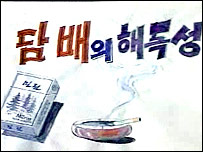
smoking.jpgThe North Korean capital, Pyongyang, has reportedly become the latest city to impose a smoking ban.

However, rather than being for the good of the general public, it is all about the country’s leader Kim Jong-il.

The move comes after doctors advised Mr Kim to stop smoking and drinking after a recent heart operation, reports say.

“Kim’s home, office and all other places he goes to have been designated as non-smoking areas,” a former South Korean lawmaker said.

“A Chinese diplomat who has close relations with the North Koreans told me by telephone that doctors had asked Chairman Kim Jong-il to quit smoking and drinking,” Jang Sung-Min, an associate of former South Korean president Kim Dae-Jung, told the French news agency AFP.

“Even the highest-ranking officials are going outdoors to smoke,” he said.

Former chain-smoker

Mr Kim, 65, has reduced his official activities this year, and a month-long disappearance from public view in May prompted rumours of failing health.

A team of German doctors visited Pyongyang in May, sparking speculation among some foreign and local news media that Mr Kim might have had a heart operation. This has never been confirmed.

While accurate information is hard to obtain, several accounts portray Mr Kim as a former chain-smoker and a heavy drinker with an appetite for fine dining.

Such rumours are hard to confirm because of the highly secretive nature of his regime.

Share

Lease of North Korean Embassy in Germany

July 24th, 2007

Daily NK
Yang Jung A
7/24/2007

The North Korean Embassy in Berlin has leased its premises of the building in order to pay for its expenses, the Sankei Shimbun reported on the 24th.

According to the newspaper, an 5 stories building, 8160㎡ in area was leased out by the North Korean Embassy to a total of 15 companies including a design company and psychology association.

The North Korean Embassy did not publicize any external advertisements. However, a Germany affiliate is apparently conducting all the paperwork at an office located at the entrance of the building, the newspaper informed.

During the Cold War, North Korea constructed a large scale embassy in Berlin for propaganda and ostentation like other socialist blocs at the time.

However, with the fall of East Germany and the amalgamation with West Germany, the majority of socialist forces receded including the North Korean embassy. Now there are only a dozen or so employees working at the embassy and 70% of the building vacant.

The area is on lease for 8 Euros per ㎡ which is considerably cheaper than other locations in the busy area of Brandenburg Gate which costs at least $10~15 Euros.

Share

North Korea Concentrates Energy on Regulating Citizens during Provincial Elections

July 24th, 2007

Daily NK
Kim Young Jin
7/24/2007

The North Korean government, with the approaching Provincial People’s Assembly delegate elections on the 29th of this month, stepped-up one level the management of citizens and regulation of cell phones.

Kang Ki Ok (pseudonym), a civilian of Hyesan in Yangkang Provicne, said in a phone conversation with the reporter on the 20th, “Nowadays, I am afraid to turn on my cell phone. The People Safety agents and the National Security agents inspect us with fury in their eyes. People who use cell phones during the election season are punished, so there are people who bury their phones by putting them into jars.”

The North Korean government, when the People’s Assembly election season comes around every four or five years, concentrates on regulating the society by observing the movement of citizens and examining the registration cards.

The members of the elections preparations committee, composed of National Security agents, chairmen of People’s Units, and head officials of each provincial unit, are ordered to strictly investigate illegal acts occurring in their regions and to control them. Illegal acts are punished at the end of the elections.

According to Mr. Kang, the outflow of information has been secured at the border region with the upcoming delegate elections, so concentrated cell phone regulation were carried out. Further, the control of the border has been toughened recently, so the escape fee has skyrocked to the North Korean currency of 1 million won (approx. US$1,075).

Another source relayed, “Safeguarding Kim Il Sung, Kim Jong Il statues and research offices have been toughened by inspection units composed of each organ and enterprise farming laborers. Further, they are making sure that historic places and vestiges of battle are not destroyed.”

This source said, “Youth Leagues have also organized inspection units and are regulating unemployed persons and are strictly making sure that juveniles do not watch South Korean dramas and listen to illegal CDs and South Korean songs.”

On one hand, related to election preparation, each city, district, and county candidates were posted at the election site and citizens over 17 have gone into preparations such as conducting voter registrations through the election committee.

The source also relayed that the People’s Safety Agency have actively stepped up inspections by summoning civilians who have gone out to foreign sites to catch clam and mine gold for survival.

When the movement of the North Korean authorities to strengthen the solidarity of the regime was presented through this election, the citizens, in fear of being punished as trial cases, have produced a cautious atmosphere.”

At the time of the Supreme People’s Assembly elections in 2003, when thefts or acts of violence occurred, perpetrators were stringently punished regardless of whether or not they were members of the Workers’ Party. Further, in the case that teenagers got into fist fights, the parents were disciplined and jointly held responsible.

Mr. Kim, who defected in 2006, said, “At the time of the 1991 provincial elections, in the province where we were living, teenagers got into a fist fight. One of the gangs who started the fight accused the opponent of “stirring a political event destroying elections” and went to the parents and got compensation for damages by threatening them.”

Share

DPRK Emphasizes Training International Financial Experts

July 23rd, 2007

Institute for Far Eastern Studies (IFES)
NK Brief No. 07-7-23-1
7/23/2007

North Korea is calling for training for financial specialists in order to protect against the pitfalls of credit transactions and currency exchanges. In a recently acquired copy of the latest issue of the North’s economic journal, “Economy Research”(2007, no.2), ‘bank risk’, the term applied to the hazard of potential losses, was explained in detail, stating, “In order to strengthen the improvements made in foreign currency trading, an important issue is that banks, such as the Trade Bank, dealing with overseas debts identify and thoroughly resolve potential threats.”

It is especially exceptional that the North Korean journal fully introduced the bank risk involved in financial transactions within a market-based economic system. This issue also reported on the events of May 20, when movement toward a resolution to the issue of frozen DPRK accounts in the Delta Banco Asia took place.

The journal divided ‘bank risk’ into three categories, ‘finance risk’, ‘credit risk’, and ‘management risk’. Finance risk was defined as, “the risk that a variety of changes within capitalist financial markets could carry with them adverse effects”. Further on, finance risk was divided into ‘foreign exchange risk’ caused by fluctuations in exchange rates, and ‘interest risk’ driven by changing interest rates.

In addition, “Economy Research” also carried pieces on rational management of the banking management system, subjective evaluation of bank risk, and establishing a strategy for preventing bank risk. “The outcome of [strategy for] prevention of bank risk rests entirely on the quality, skill, and roles of workers responsible for bank administration.”

The journal also stressed that even though quality information resources and materials on financial data are available, “if the quality and skill of workers in the banking sector cannot be raised,” then bank risk cannot be understood, analyzed, or evaluated, and an appropriate strategy cannot be implemented. “When workers constantly improve their quality and turn their attention to preventing bank risk…then an appropriate strategy can be set up.”

In one article, training in international financial transactions was called for, with the journal printing, “Even though today’s workers know how to use modern information resources and include financial experts with foreign language skills, they need to be well versed in the changing modern banking sector and international financial transactions.” From the 2002 “Foreign Investor Banking Law’ to last year’s ‘Commercial Banking Law’, established to stimulate private-sector financial transactions, North Korea continues to tweak its financial system. 

Share

‘Daean’ System and Economic Reforms

July 22nd, 2007

Korea Times
Andrei Lankov
7/22/2007

When the North Korean leaders began their rather limited and controversial economic reforms in 2002, one aspect of the reform package did not attract particular attention overseas. It was declared that the CEO of a state-run factory would henceforth manage its activity directly. To Western ears, this sounded rather unremarkable, but North Koreans instantly understood that this meant the abolition of the Daean system. For decades this system was lauded as a unique invention of Kim Il-sung’s managerial genius _ and now it was over.

The system was introduced in the early 1960s, after some earlier experiments. The Daean Heavy Equipment Factory, not far from Pyongyang, served as the major testing ground, and it was the place where, in December 1961, Kim Il-sung gave his August approval to the system.

The Daean system was unusual indeed. The management of a factory was to be conducted in a collegial manner by the “factory management committee”. This committee was presided over, however, not by the company CEO, but by its party secretary. Taking into consideration that most North Korean committees are hardly anything but advisory bodies for their chairpersons, this meant that the daily management of a factory was to be done by its party secretary.

This was a break with the then established communist tradition. In fellow communist countries, the situation was different: while at the national level the party’s primacy was undisputed, it seldom bothered itself with micro-management of daily production. Typically for a communist country, a party secretary at factory level was a sort of priest-like figure, dealing with political education and moral guidance of the personnel rather than with the management of production.

Why did the North Koreans make such a break with tradition? First of all, we must not exaggerate the significance of this break: after all, it did not really matter whether a particular CEO was officially considered a “director” or a “party secretary”. Their background would be roughly the same nonetheless.

However, the introduction of the Daean system had some symbolic meaning. Since the ruling Party was meant to symbolize the “politics,” such that the promotion of its local representative was supposed to drive home the primacy of “politics” over everything else.

Indeed, the North Korean drive to industrialize in the 1950s and 1960s was achieved with a remarkable disregard for the economic incentives, and even rudimentary use of the market economy. In this regard, North Korea once again “out-Stalined” Stalin himself. In the USSR, large premiums and other material benefits were reserved for the most efficient workers. In Kim’s North Korea _ like Mao’s China _ the workers were supposed to work hard largely because of their ideological devotion. A popular slogan insisted: “We must sacrifice ourselves for the sake of the country!” People were required to work long hours, give up their days off, and ignore safety requirements for the sake of an increase in output. The party was responsible for encouraging this _ and thus its representative became the top supervisor under the Daean system.

It is easy to blame Pyongyang for its disregard of human lives and sufferings. However, did it have a choice? Perhaps, but not likely. In the impoverished North Korea of the 1950s, precious few resources were available, and these had to be saved for the most important use. Human lives were cheap and plentiful, while machinery was scarce and expensive. Thus, the choice was made, and then carefully wrapped up in fine-sounding rhetoric.

To an extent, the North Koreans themselves were ready to risk their lives in this mad rush for industrialization. They believed that a few years of frantic effort would create an affluent, successful, and powerful Korea. And many people were indeed willing to give their lives for such a goal _ a minority, perhaps, but a significant one. This enthusiasm soon worn out, but around 1960 it was quite real.

For a while it appeared as if the strategy worked. The North Korean economy in 1955-1970 was growing at the breathtaking speed of 19% a year. Then it was the North, not the South that broke the world’s records pertaining to economic growth.

However, the success proved to be short-lived. By the late 1960s the first signs of stagnation appeared, and by 1980 the Northern economy was lagging hopelessly behind that of the South. Why did it happen? That is another story altogether.

Share

U.N. relief agency considers stepping up food aid to N. Korea: report

July 21st, 2007

Yonhap
7/21/2007

A U.N. relief official said North Korea currently receives only a small portion of the food aid it needs and his agency is considering stepping up aid to feed almost 2 million more people, a U.S. government-funded radio station reported Saturday.

In an interview reaching here Saturday through the Korean version of the VOA’s Web site, Robin Lodge, a spokesperson for the World Food Program (WFP), said international relief agencies, including the Office of Food for Peace, recently gathered in Rome, Italy and discussed the possibility of sending the communist state additional food that could feed 1.9 million people there.

Lodge was also quoted by the U.S.-funded broadcaster as saying North Korea currently receives from his agency only about 10 percent of what it needs to feed the 7 million believed to be suffering from starvation.

North Korea does not release any official data on its food situation but many outsiders believe that more than 2 million people died when famine swept through the country in the late 1990s.

Good Friends, a Seoul-based relief group dedicated to North Korea, said in its latest weekly newsletter on Wednesday that a growing number of North Koreans died of starvation or hunger-caused diseases recently, especially in remote areas.

“Famine-driven deaths began to occur across North Korea in late June,” the report said. “In some cities and counties in the provinces of North Pyongan, Ryanggang, Jagang and South and North Hamkyong, the number of deaths is on the increase daily.”

The reports contradict widespread reports that the North’s food situation has improved significantly in recent years.

On Friday, Seoul started sending 50,000 tons of rice aid to North Korea overland as part of its promised loan of 400,000 tons of rice aid.

Over the next five weeks, the South is to deliver 30,000 tons of rice to the North via a road passing through the border town of Kaesong, while another 20,000 tons will be transported across a paved road on the east coast. South Korea is delivering 350,000 tons of rice to the communist country by sea.

South Korea resumed shipping rice aid to North Korea in late June after more than a one-year hiatus, as the North shut down its nuclear facilities in the first step toward eventual nuclear dismantlement.

Share

FBI Holds Korean American for Spying on N.Korea

July 20th, 2007

Choson Ilbo (hat tip One Free Korea)
7/20/2007
 
A Korean American businessman has been arrested by the U.S. Federal Bureau of Investigation on charges of hiding his activities as a spy for the South Korean government, AP reported Thursday. According to court documents obtained by the wire agency, Park Il-woo, also known as Steve Park, was a legal resident in the U.S. for the past 20 years and conducted business with North Korea. Park provided information he obtained from his frequent trips to North Korea to the South Korean government in return for payments.

U.S. law requires anyone acting as an agent of a foreign government to register with the U.S. government and disclose the nature of the activity. The FBI met with Park three times to ask about his activities between 2005 and 2007. But each time, Park denied his contacts with or knowledge of certain South Korean officials. Park was expected to appear in court Thursday afternoon.

PR Newswire
7/19/2007

To: NATIONAL EDITORS

Contact: Yusill Scribner of the Office of United States Attorney Michael J. Garcia, Southern District of New York, +1-212-637-2600

NEW YORK, July 19 /PRNewswire-USNewswire/ — Park Il Woo, a/k/a “Steve Park,” was arrested today on charges that he repeatedly lied to FBI agents about his activities in the United States on behalf of the Republic of Korea (commonly known as South Korea), from 2005 to the present, announced Michael J. Garcia, the U.S. Attorney for the Southern District of New York, and Mark J. Mershon, Assistant Director-in-Charge of the New York Office of the Federal Bureau of Investigation (FBI).

Agents also executed a search warrant at Park’s Manhattan residence simultaneous to the arrest. According to the complaint and search warrant affidavit, incorporated by reference in the complaint:

Park, 58, a lawful permanent resident of the United States, engaged in conduct in the United States on behalf of the South Korea by, among other things, obtaining information from officials of another foreign government and providing that information to South Korean officials in exchange for payment.

For example, during a recorded telephone call, Park relayed to a South Korean official working in Manhattan that officials of the other foreign government had asked Park to help them obtain certain items, including insecticides and anesthetics. However, the complaint alleges, on three occasions in 2005 and 2007, Park gave false information to FBI agents regarding his contacts with or knowledge of certain South Korean officials.

For example, on March 20, 2007, FBI agents showed Park photographs of certain South Korean officials working in Manhattan, and Park stated that he did not know two of the officials. Park then drove directly from that FBI interview to a restaurant in New Jersey, where he met with one of the South Korean officials he claimed not to know.

Park is scheduled to appear this afternoon before U.S. Magistrate Judge Ronald L. Ellis in Manhattan federal court. Mr. Garcia praised the efforts of the FBI for their efforts in this continuing investigation.

Assistant U.S. Attorneys Jennifer G. Rodgers and Stephen A. Miller are handling the prosecution.

The charges and allegations contained in the complaint and documents incorporated by reference are merely accusations, and the defendant is presumed innocent unless and until proven guilty.

SOURCE U.S. Department of Justice

Share

No Changes to the Cost of Rice And Corn at Jangmadang

July 20th, 2007

Daily NK
Kim Min Se
7/20/2007

A newsletter published on the 18th by “Good Friends” a North Korean aid organization claimed that “On average 10 people die of starvation throughout North Korea.”

However well informed North Korea defectors and North Korean tradesmen who travel to China refute the organization’s claim and argue, “It would be difficult for that to happen.”

The organization published in its newsletter, “Since the end of June, starvation has been occurring in each province throughout North Korea” and informed, “The number of people dying in North Pyongan, Yangkang, Jagang, South and North Hamkyung continues to rise everyday.” 

In particular, Good Friends stated, “In South and North Hamkyung, about 10 people are dying of starvation in each city and province” and “On the whole, the people dying are aged 40~65 years.”

“Though the cause behind the deaths is different for each person, most of the complications are related to malnutrition” informed Good Friends. They added, “A mass famine has not yet begun, however authorities and people feel the threat of the situation” stressing the urgency of North Korea’s food crisis. 

An affiliate of Good Friends said, “Presently, only 20,000 tons of South Korea’s food aid is offered (to North Korea)” and commented, “This rate of aid is too slow in saving the lives of the dying people.” 

However, there are criticisms against this claim. Some argue that Good Friends had excessively inflated North Korea’s food crisis. 

Choi Young Il (pseudonym) questioned this claim by Good Friends after a telephone conversation with his family in North Korea on the 16th. He said, “Even up to two days ago, I spoke to my family on the phone but they didn’t mention anything about a food crisis.” 

Moreover, Choi said, “Alleging that about 10 people on average are dying in the cities and province of South and North Hamkyung is no different to saying that nearly 400 people are dying throughout the whole region of South and North Hamkyung every day” and added, “In that case, this is similar to the early period of mass starvation in the early 90s.” 

“Only looking at North Hamkyung, most of the people living in the border regions live off illegal trade through China and though they may not be living well, I was aware that they got by without having to eat porridge” Choi said and remarked, “I don’t believe the claim that 10 people are dying of starvation every day.” 

On the same day, Hwang Myung Kil (pseudonym) a North Korean citizen who came to Yanji to visit his relatives in China said in a telephone conversation with a reporter, “I cannot believe the rumor that people are starving to death around the border areas of the Tumen River” and commented, “I haven’t even heard stories of more people starving to death in the mines and they live in masses around Musan.”

Hwang said, “Even amongst the people in Musan, there are only a small number of people who live off corn for three meals a day… Nowadays, people look for quality rather than quantity.” Further, he said “Though life is tough, people have found their own way of survival. It’s not to the point of starvation.”

If according to Good Friends, 10 people are dying on average due to starvation, this situation would indicate signs similar to the mass starvation in the early 90s. However, the cost of rice claimed by Good Friends clashes with their claim. 

When North Korea faced their mass crisis in the mid-90s, the cost of corn rose dramatically. In October 1995, 1kg of corn cost 16won, but this doubled to 30won. However, there has not been much change to the cost of food in North Korea.

According to a recent survey by the DailyNK on the cost of goods in North Korea’s Jangmadang (markets), 1kg of corn rice at Hoiryeong markets sells for 450won and 1kg of rice produced in North Korea costs 900won. 

More importantly is the cost of cigarettes. A packet of Sunbong, a North Korean brand of cigarettes sells for 1,000won and “Cat” cigarettes for 1,300won. The cost of a kilo of rice is still cheaper than a packet of cigarettes. 

If North Korea’s starvation was on the brink of a massive food shortage, then it is expected that the cost of rice and corn would escalate dramatically as an onset to the crisis. 

On the other hand, Kim Il Joo (pseudonym) a Chinese tradesman and expert on North Korean markets said, “I can’t say that North Korea’s food situation is smooth, but I don’t think it will get any worse than this.” Kim said “Now you can eat new potatoes and soon new corn will be available on the markets” and added, “Then, I think we will be able to get through another year.”  

Deaths from hunger rise across N. Korea: civic group
Yonhap

7/18/2007

A growing number of people have died of starvation across North Korea since late last month, a South Korean civic group working to defend rights of North Koreans said Wednesday.

“Famine-driven deaths began to occur across North Korea in late June,” Good Friends said in a commentary carried in its weekly newsletter. “In some cities and counties in the provinces of North Pyongan, Ranggang, Jagang and South and North Hamkyong, the number of deaths is on the increase daily.”

In North Hamkyong Province, a daily average of ten people, mostly those aged between 40 and 65, died of starvation, the group added.

“The leading cause of death varied for each case, but most people are dying of famine-driven malnutrition and its complications,” the commentary said.

The price of rice rose steadily this month, with North Korea facing a crisis of massive deaths from hunger, it said.

The group then called on the Seoul government and the international community to send more emergency food aid to help North Koreans, especially through the just-reconnected cross-border railways.

In mid-May, the two Koreas conducted the historic test of the railways, reconnected for the first time since the 1950-53 Korean War. But it remains unclear when regular train service might start.

Share
