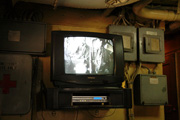
Taedonggang Brewery…

March 10th, 2008

Reuters has a write up of my favorite North Korean beverage, Taedonggang Beer:

North Korea’s quest to produce decent beer began in earnest in 2000 when it started talks with Britain’s Ushers brewery about acquiring its Trowbridge, Wiltshire plant that had ceased operations.

The North Koreans took apart the brewery that had been producing country ales for about 180 years, shipped it piece by piece to Pyongyang and reassembled it under the banner of its Taedonggang Beer Factory.

By April 2002, it was up and running. In June 2002, the North’s leader Kim Jong-il, known for his fondness of expensive brandy and wines, went on a brewery tour.

“Watching good quality beer coming out in an uninterrupted flow for a long while, he noted with great pleasure that it has now become possible to supply more fresh beer to people in all seasons,” North Korea’s official KCNA news agency said.

Taedonggang beer, named for a river that runs through Pyongyang, is a full-bodied lager a little on the sweet side, with a slightly bitter aftertaste.

Still not the choice of locals:

Taedonggang is one of several brews in North Korea and it has quickly become the top brand, according to foreigners living in the reclusive country.

Park Myung-jin, of distributor Vintage Korea which used to sell the beer in the South, said the North’s leader Kim wanted a showpiece brewery.

“They used the best quality material without thinking of the production cost,” Park said. He stopped selling the beer in the South in 2007 due largely to a sudden price hike.

The North taps into overseas markets for ingredients, Park said. It has abundant supplies of fresh water because its hobbled factories do not produce enough to cause pollution problems.

Beer is not the drink of choice for most North Koreans, who prefer cheaper rice-based liquor that packs a big punch.

Dont expect to see it in your local pub:

But do not expect to see Taedonggang or any North Korean beer invading overseas markets any time soon.

North Korea may have solved the riddle of making a robust beer but it has not completely solved the problem of bottling it.

The brewery has occasional trouble sealing bottles properly and the glass it uses is fragile.

The transport system in North Korea is also a mess, making it unlikely that the beer can become one of the few legitimate exports from a country shunned by the developed world for its defiant pursuit of nuclear weapons and a human rights record cited by the United States as one of the world’s worst.

The full article can be found here:
North Korean beer: great taste, low proliferation risk
Reuters
Jon Herskovitz
3/9/2008

Share

Pueblo television upgrade

March 9th, 2008

I have just been watching the VICE Guide to North Korea on VBS.tv.  I am not easily impressed with footage filmed in North Korea because, frankly, I have seen a lot of it.  Still, every now and then you catch something fairly obscure which makes the time spent watching it worthwhile. 

The guys who filmed the video had the same guide as me, Mr. Lee, which means they were traveling under the auspices of the Committee for Cultural Relations with Foreign Countries.  They have also gotten other journalists in as well (See here). Note to all the journalists out there.

Another thing I noticed was that the DPRK has made investments in upgrading their tourism facilities…even on the USS Pueblo.

pueblo2.jpg pueblo.JPG

In 2004, the Pueblo propaganda movie was shown on a traditional cathode television.  In 2007 it seems they have upgraded to a flat screen.  The ‘paean‘ of television technology.

Share

1946 Land Reform and early DPRK state…

March 9th, 2008

Dr. Lankov publishes some great information on the relationship between the early DPRK state and the Soviet Union…

[F]rom the very start the land reform program in North Korea was planned by the Soviet military authorities, and Kim Il-sung simply signed the documents, which had been prepared for him by the Russian officers.

This fact is well-known, since Russian papers on the land reform issue were declassified and published in South Korea almost a decade ago.

and… 

[E]ven a cursory look through the available documents clearly indicates: in 1945-1950, the North Korean regime operated under the complete control of the Soviet supervisors. Who drafted the above-mentioned land reform law? The Soviet advisers. Who edited and, after some deliberation, confirmed the North Korean Constitution? Stalin himself. Who arrested all the major opponents of the emerging Communist regime? The Soviet military police. Where were they sent to do their time? To prison camps in Siberia, of course!

The available papers leave no doubt that even the relatively mundane actions of the North Korean government needed approval from Moscow. The Soviet Politburo, the supreme council of the state, approved the agenda of the North Korean rubber-stamping parliament and even “gave permission” to stage a parade in 1948. The much-trumpeted conference of the politicians from the North and South in the spring of 1948 was another Soviet idea, even if the leftist historians now love to depict it as yet another expression of Pyongyang’s will to negotiate based on its alleged national feelings. The most important speeches to be delivered by the North Korean leaders had to be pre-read and approved in the Soviet Embassy.

My favorite story in this regard happened in December 1946, when the first elections for the North were being prepared. On Dec. 16, the Soviet Colonel-General Terentii Shtykov discussed the composition of the North Korean proto-parliament with two other Soviet generals. The generals (no Koreans were present) decided that the Assembly would consist of 231 members. They did not forget to distribute the places among the various parties, decided how many women would become members, and the social composition of the legislature. If we have a look at the actual composition of the Assembly, we can see that these instructions were followed with only minor deviations.

Read the full story here:
Southern Biases About North Korea
Korea Times
Andrei Lankov
3/9/2008

Share

Sunday speculation: The end of ‘Songun’?

March 9th, 2008

The Daily NK reports that preparations for Kim Jong il’s successor government are ushering in an end to Songun:

North Korea has embarked on a rehabilitation of the Chosun (North Korea) Workers’ Party’s authority, meaning a return to party-centered politics from military-oriented politics, various inside sources suggest. The move could be related Kim Jong Il’s choice of successor.

In late February, a number of sources told the Daily NK through telephone interviews that instructions came down from the Party to each province on February 1st to “pay more respect to the local party apparatus than to the armed forces.”

Various sources said, “The rumours say that the instructions are intended for everyone (resident of Hoeryong)”, “Foreign currency-earning workers were given a mass lecture on this subject in mid-February (resident of Chongjin)”, and “People welcomed the command, hoping for less harassment from the army (resident of Hyesan)”.

Wat is happening in the government?

Last October, Kim Jong Il reappointed his brother-in-law and closest advisor, Jang Sung Taek, to the Director of the Administration Department, which has the responsibility for the National Security Agency, the People’s Safety Agency, and the Prosecutors’ Office. More recently, the Guidance Department undertook a large-scale inspection of the United Front Department, which signals an attempt to strengthen the Party.

The Guidance Department of the Party is the department tasked with leading and inspecting the Party apparatus. It also resides at the core of the North Korean power structure and is under Kim Jong Il’s direct control, so its involvement demonstrates the gravity of this investigation.

Sohn Kwang Ju, the chief editor of Daily NK and an expert on Kim Jong Il, suggested that, “Kim Jong Il, thinking that North Korea has already achieved military strength through the possession of nuclear weapons, is now starting to reconstruct the Party-centered order and revive the Party’s authority.”

Will it work?

Hwang Jang Yop, President of the Committee for the Democratization of North Korea and the former North Korean Foreign Secretary, gave a similar analysis. According to him, “Kim Jong Il, sooner or later, will strengthen the Party’s authority, especially that of the Guidance Department because the Vice-Director position of the Guidance Department should eventually be taken by one of Kim’s sons.”

Nevertheless, many experts expect difficulty for Kim Jong Il in his effort to strengthen the authority of the Party.

Han Ki Hong, the president of the Network for North Korean Democracy and Human Rights, said that “Kim Jong Il has been running his country under the abnormal system of the Military-First policy for over a decade. Throughout that time, the Party’s authority totally collapsed and the armed forces’ power and authority has increased beyond control, and this is irrevocable.”

The full article can be read here:
Possible Shift from the Army to the Party in 10 years
Daily NK
Choi Choel Hee & Lee Sung Jin
3/5/2008

Share

South Korea launches reforestation campaign in North

March 6th, 2008

Anyone who has spent time visiting North Korea on Google Earth will have noticed the acute shortage of trees.  I am not alone in this observation.  Dr. Lankov recently reported that South Korean tourists to Kaesong also sense this.

Donating trees to the North might sound like a particularly harmless form of aid–all the symbolism of inter-Korean cooperation without the messy politics of monitoring food aid or investment.  But the reality is far more pragmatic:

[H]elping North Korea to plant more trees is one of President Lee’s campaign pledges.

He said the South will send seedlings to the North but no details were given as to whether or when the two Koreas will meet for the forestry project.

The spokesman said when the Kyoto Protocol takes effect, the South can buy the right to emit CO2 from North Korea.(Korea Times)

The South Korean government is not alone in hoping to make money off increasing North Korea’s stock of trees.   Singaporean entrepreneur Richard Savage started a tree farm in the DPRK back in 2002:

Richard Savage kneels in the rich brown earth of a field on the outskirts of Pyongyang and reverentially spreads out the broad, green leaf of a young paulownia tree. The saplings have been in the ground for only a month but already they are a meter high; the first harvest could take place in just five years. Eyes shaded by his black cowboy hat, the Singaporean native gazes down the rows of juvenile trees, each worth thousands of dollars at maturity, with a satisfied grin. The experimental lumber crop has survived the harsh North Korean winter and is flourishing in the loamy soil. “The paulownia loves this,” he says. Glancing at another leafy plant, a new hybrid, he confides, “We’re going to let the Dear Leader name it.” (Time)

UPDATE 2002 (Via Werner Koidl):

The IHT wrote on Oct. 27th, 2006:
“Richard Savage, executive director of Maxgro, a company based in Singapore, is probably one of the most ambitious foreigners in North Korea. He is developing a hardwood plantation on 1,500 hectares, or 3,700 acres, manufactures Snow Pine cigarettes for the local market and is building an eight-story financial center in Pyongyang in a joint venture with the government and other investors.”

Even the North Korean government, though, has noticed that the forests are not as dense as they used to be.  Bradley Martin reported in Bloomberg that Kim Jong il has been pushing a reforestation program for some time:

North Korea’s deforestation program dates back to a 1961 speech by Kim Il Sung. In a mostly mountainous country, he proclaimed, “it is necessary to obtain more land through the remaking of nature.” Not only tidelands but “hills throughout the country and plateaus” should be “brought under the plough,” he said.

“The hills and mountains still had trees, and I never heard of floods,” said Hiroko Saito, a Japanese woman who moved with her Korean husband to North Korea in 1961. Her husband joined one of Kim’s vast mountain work teams in the early 1970s, said Saito, now 66 and back in Japan.

Following Kim’s death in 1994 — just before a flood-linked famine gripped the nation — his son and successor Kim Jong Il continued the sacrifice of forest cover until 2000, when he began encouraging reforestation. But the shift hasn’t reversed the damage, and some analysts warn that another famine, close to the scale of the 1990s disaster that may have killed millions of people, might occur as soon as next year.

The government’s agricultural policies launched a cycle of events that lead to greater and greater numbers of trees being culled.  Clearing the forests contributed to seasonal flooding.  The floods exacerbated the food shortage, and pushed people to adopt coping mechanisms to meet their minimum caloric intake for survival.  These coping mechanisms take a toll on what remains of the forests–which exacerbates the flooding.  Repeat annually. This  cycle of destruction has seemingly frustrated Mr. Kim’s plans to bring back the forests:

“For the past few years, I have been telling you to work hard afforestation and have encouraged you at every opportunity.”

“However, an forestation has not met the criteria of authorities and is not going according to plan.”

What Kim Jong Il is trying to say is that, “The reason afforestation is not working is because of the people’s reckless slash-and-burn cultivation, as well as the inefficiency of officers unable to block it.”

After the food crisis in ’95, people uprooted vines and trees to suffice their underfed diets, as well as cultivating illegal farms for food. Further, to save themselves from freezing to death, people used trees as firewood.(Daily NK)

Spontaneous coping mechanisms aside, efforts at increasing forrest cover might prove more difficult than the government expects.  Even if it resolves the food shortage (which does not seem likely in the near term), it has seemingly lost control of its technocrats who have no problem selling DPRK lumber overseas:

…Oh Moon-hyuk, branch manager of the Ruengra 888 trading company in Yunsa, North Hamkyung Province, was executed after being implicated in the smuggling of timber. The trading company was responsible for the export of timber, and operates under the control of the Party’s accounting bureau. The inside contact stated that because of this incident, North Korean authorities carried out further inspections, leading in October of last year to the dismissal of one official receiving vice-minister pay, and the broadening of the inspections nationwide. (Institute for Far Eastern Studies)

The full articles can be found here:
S. Korea to Help N. Korea Plant More Trees
Korea Times
Kim Yon-se
3/5/2008

Kims’ Clear-Cutting of Korean Forests Risks Triggering Famine
Bloomberg
Bradley Martin
Hideko Takayama
11/21/2007

Cause of Barren Mountains: Imperialism-Natural Disaster-Officers
Daily NK
Han Young Jin
3/16/2007

Institute for Far Eastern Studies (IFES)
NK Bfrief No. 08-2-5-2
2/5/2008

Light from the North?
Time
Donald MacIntyre
8/11/2002

Share

Russian auto plant KamAZ in DPRK

March 6th, 2008

A couple of days ago, we had an interesting exchange in the comments that I want to make sure readers have an opportiunity to see:
———————–

Werner Koidl Says: 
 
In that Asia Times report Dr. Petrov wrote:
“… Last year the Russian auto plant KamAZ opened its first assembly line in North Korea, specializing in the production of medium-size trucks named “Taebaeksan-96″. …”

I would be interested in more details about that KAMAZ truck assembly line in North Korea ! Where ?, joint venture ?, size ?
———————–

Leonid Petrov Says: 
 
Concerning the “Taebaeksan 96″ truck assembling plant, the KamAZ set it up last year (2007 or Juche 96) in the town of Pyeongseong. The terms of this deal with NK were really “friendly” and last year KamAZ was having no or very little profit. The production volume last year was very limited (45 or 48 trucks). However, it’s just the beginning of such cooperation.

There is one technician-representative from KamAZ who manages the assembling process. He stays in Pot’onggang HTL and commutes to Pyeongseong. Many North Korean drivers and technicians seem to be technically ignorant (i.e. not knowing how to change the engine oil, etc.), so they need a new technological culture to be introduced. Russians train them well and the North Koreans are grateful.
———————–

Gag Halfrunt Says:

Now that explains the brochure for the Taebaeksan 96 I’d noticed on the Korean Friendship Association’s exports page. I was wondering how anyone could be making money from sticking badges on KamAZes and trying to sell them on. In any case, the export potential for the Taebaeksan 96 must be close to zero, since anyone outside the DPRK who wants a KamAZ can buy one assembled by KamAZ itself.

Trying to drum up interest in the DPRK as an investment destination, the KFA say, “All business made directly with the government, state-owned companies. No middle agents.” This is amusing, because, on the Pyeonghwa car brochure on the KFA website, they’ve sneakily deleted Pyeonghwa’s own contact details and replaced them with the KFA’s email and web addresses. I think this qualifies them a “middle agent” standing between Pyeonghwa and any potential export customers…
———————–

Werner Koidl Says:
 
The link “brochure for the Taebaeksan 96″ given by Gag Halfrunt seems to indicate that the KamAZ Taebaeksan-96 is assembled in a joint venture with Ryongwang [Ryongbong] Trading Company of North Korea. Ryongwang Trading is also the joint venture partner of Pyeonghwa Motors (Unification Church) to assemble the “Whiparam” in Nampo. And Ryongwang Trading company is also business partner of “Kohas” company from Switzerland. And because of its connections to Ryongwang this Swiss company got in troubles with the US administration.

Share

Germans break ground in Kaesong

March 6th, 2008

According to Business Week German auto parts manufacturer, Prettl, became the first non-Korean firm to start building a plant inside a joint inter-Korean factory complex in North Korea–breaking ground Wednesday.  Kim Min-kyung with the Kaesong Industrial District Management Committee claims the factory will be open in December and employ 550 North Koreans.

Other facts:

Two Chinese companies also signed contracts last year to run factories in the area but have not started construction, Kim said.

A total of 69 South Korean companies are currently operating in the zone, employing some 23,220 North Korean laborers, according to the management committee.

The full article can be found here:
German firm breaks ground in North Korea
Business Week
3/5/2008

Share

DPRK remains on US list of state terror sponsors

March 4th, 2008

Blurb from the Choson Ilbo:

The U.S. State Department in March every year releases a country report on global terrorism and state sponsors of terrorism in the previous year. The U.S. had considered striking North Korea from the list of state sponsors of terrorism early this year. But North Korea has missed a deadline to make a full declaration of its nuclear programs and stockpiles, as agreed on in six-nation talks.

Share

Stratgeic alliances in North East Asia: Railways, ports, and energy

March 4th, 2008

Writing in today’s Asia Times, Dr. Leonid Petrov analyses the complexity of Russia, Rok, DPRK, and Chinese relations:

Russia and North Korea:

Territorial claims, in one form or another, involve almost all countries adjacent in this region with the exception of Russia and Korea. The Joint Russian Federation-DPRK Commission for the Demarcation of State Borders has recently completed its work by documenting and marking the 17-kilometer frontier. This strip of uninhabited and swampy land in the mouth of the Tumannaya (Tuman-gang) River plays an exceptionally important geopolitical role. It not only provides the two countries with land access to each other, but also prevents Chinese access to the East Sea (Sea of Japan).

China and North Korea: 

Here, some 50km north of the small port that forms the core of North’s Rajin-Seonbong Special Economic Zone, the interests of Russia and China are now at stake. Russia is rapidly repairing the railroad track, and China (in a similarly speedy manner) is constructing a new automobile highway, both leading from their respective borders to the port of Rajin. Russia, investing at least 1.75 billion rubles (US$72 million) into this project, seeks to strongly connect Rajin (and the rest of northern Korea) to its Trans-Siberian Railroad. China, in turn, hopes to divert the growing cargo traffic to its own territory, offering the efficient network of railroads for delivery of South Korean and Japanese goods to Central Asian and European markets. What position will the government of North Korea take in this clash of ambitions?

Russia and South Korea (energy and trade):

In 2007, the volume of the export of “black gold” from Russia to South Korea reached 38.13 million barrels (2.7 times more than in the previous year). The relative proximity of the Russian oil and gas fields is an attractive factor for Korean companies who actively search for alternatives to Middle East oil suppliers. This year South Korea will for the first time start importing natural gas from Russia. The expected volume of delivery during 2008 is 1.5 million tons (or 5.1% of South Korea’s annual demand).

and

Trade relations between Russia and Korea are steadily growing. According to customs statistics, last year Russia recorded the sharpest increase of South Korean imports (56.2% more than in 2006). Due to the inflow of “petro-dollars” the new class of nouveaux riches in Russia began actively buying Korean automobiles, cell phones, television sets and LCD monitors. South Korea exported to Russia goods worth US$8.1 billion (including $3.296 billion of automobiles, $859 million of mobile phone equipment, motor vehicles and spare parts worth $659 million). As for trade with North Korea, in 2006 Russia occupied third place after China and South Korea and absorbed 9% of the total $3.18 billion spent by the North on imports.

More on Russia/South Korea energy talk here. 

The whole article deserves reading here:
Russia lays new tracks in Korean ties
Asia Times
Leonid Petrov
3/5/2008

Share

DPRK 2007 trade statistics from KIEP

March 4th, 2008

The Daily NK covers the release of KIEP’s analysis of North Korea’s external trade in 2007.  I cannot find the report in English, so I have to take the Daily NK’s word for it–insert caveat here.

Here are the highlights:

  • The estimated total value of North Korea’s foreign trade decreased from US$2.996 billion 2006 to US$2.7 billion in 2007.

  • China occupies 70% of the trade volume, up from 56.7 in 2006 (a startling increase).

  • Trade with Japan fell to US$900,000, a decrease of 92% from 2006 (so it appears that some Chinese are getting rich from international trade restrictions).

  • Trade with Thailand fell 42.4% since the nuclear test.

  • Trade with the EU fell by 53.2% since the nuclear test.

To be honest I do not trust these numbers, so if someone comes across the KIEP report in English, please send it to me.

According to the Daily NK, the KIEP report is called: “Economic Prospect of North Korea in 2008” by Cho Myung Chul and Hong Ihk Pyo

The full story can be read here:
North Korea’s Economic Prospect for 2008
Daily NK
Yang Jung A
3/3/2008

Share