What comes after Sunshine?

August 27th, 2008

The policy of mutual benefits and common prosperity

It doesn’t have the same ring as “Sunshine Policy,” and the acronym PMBCP is too long, but this is the English name of South Korean President Lee Myung-bak’s policy towards the DPRK. 

According to Yonhap:

We decided to fix an English name for the policy because there have been many different translated versions,” Kim Ho-nyoun, spokesman for the Unification Ministry, the top Seoul office on North Korea, told reporters.

He said the name was chosen because it best suits the government’s policy of pursuing a relationship of co-existence and co-prosperity with the North beyond the current phase of reconciliation.

The government aims at a firmer inter-Korean reconciliation than its two liberal predecessors, seeking to bring tangible benefits not only to the North but to the South as well, officials said.

President Lee Myung-bak pledged during his election campaign to help the North triple its per capita gross national income to US$3,000 if it abandons its nuclear programs and opens itself to the world.

The so-called “Vision 3,000” program is now part of Lee’s broader North Korea policy, officials said.

The goal of tripling the DPRK’s per capita GNI (GNP) to $3,000 is based on the assumption that the DPRK’s current per capita income is close to $1,000, which is a wild over statement.  Some more realistic assesments put it as low as $368 per yearHere is a wrap up of the DPRK’s most recent economic stats from the Bank of Korea.

Read the full article here:
Gov’t sets official English name for N.K. policy
Yonhap
Shim Sun-ah
8/26/2008

Share

DPRK aid and policy changes

August 26th, 2008

Andrei Lankov writes in the Korea Times that South Korea’s threats to reduce tourism levels to Kaesong, as well as support for the Kaesong Industrial Zone, are misguided.  His reasoning is as follows:

North Korea is a very peculiar society, where the elite are almost entirely free from the pressures experienced by those below them. When sanctions are applied to such a regime, they seldom have a direct bearing on the elite and their lifestyle.

Sanctions usually work in an indirect way, by punishing the population which then might either rebel against the government or vote it out of power. Neither rebellion nor elections are possible in North Korea (well, elections are happening there, as everybody knows, with the approval rate of the government candidates standing at a world record high of 100 percent). As a result of sanctions the populace will die without protesting, while the elite will survive and stay in control, even if for a while they will have ride their beloved Mercedes limousines less frequently.

The only way to bring changes to North Korea is to create forces which will be able to challenge the government. This might lead to a revolution, but one cannot completely rule out that the regime will start giving in if sufficiently pressed from within.

In addition to Lankov’s point above, sanctions can perversely benefit those in power who control and profit from black market activity (at higher prices).   Additionally, politically sophisticated leaders exploit the consequences of foreign-imposed sanctions to restrict domestic freedoms and political opposition. 

Bossuyt (Adverse Consequences of Economic Sanctions) shows even the most optimistic accounts of sanctions point to only a third having partial success.  Others find a mere 2% success rate among authoritarian regimes.  So sanctions have a poor track record of inducing positive policy changes, particularly in North Korea. 

So why are the Kaesong and Kumgang projects worthwhile?  Though not all that economical, Lankov argues that these aid projects create alternate channels for information to permeate the hearts and minds of the isolated North Korean people, and that shattering the North’s monopoly on information is key to promoting change within the DPRK:

…in order to facilitate North Korea’s transformation, more truth about the outside world needs to be imported. The survival of the North Korean regime now critically depends on a few important myths, and each myth is patently false and hence very vulnerable.

When the North Korean propaganda-mongers are talking to the North Korean public, they have to hide how poor their country actually is, and they also have to lie about the great respect Kim and his regime enjoys worldwide, especially in South Korea. An increase in contact with the outside world is the best way to undermine these falsities.

The inconvenient truth regarding South Korea’s huge economic advantage will start to surface soon. It will probably take more time before it will dawn on the North Koreans that their Seoul guests are not exactly full of love and respect for the Pyongyang dynasty, either.

There is plenty of journalistic evidence that many North Koreans already know the South is “rich”—although they might not have any idea what that actually means. Still, of all the Hyundai projects in the DPRK, I believe the Kaesong Industrial Zone is probably the most helpful for the South in the long term.  None of Hyundai’s other projects do all that much to improve the human capital of the DPRK people, and when things eventually change, it is important for the RoK to have a population of constituents in the DPRK who have some job and management skills and familiarity with the South’s culture to ease the transition.

Comments welcome.

Read the full article here:
Sanctions Harden Lives of Ordinary North Koreans
Korea Times
Andrei Lankov
8/20/2008

Share

DPRK 2008 Olympics round-up

August 25th, 2008

Well the Olympics have wrapped up, and the DPRK made headlines for several notable reasons:

1.  The Chinese government made things harder for the North Koreans living in China

2. Two DPRK athletes test positive for doping.  This results in Kim Jong Su being stripped of his silver and bronze medals in shooting.

3.  If these medals had not been taken away, the DPRK would have seen their most succesful Olympic showing ever.  Still, their medal count has been relatively impressive: 2 golds, 1 silver, and 3 bronze.  Mostly in weightlifting and Judo.

4.  Despite these results, the victories are not being touted back in Pyongyang.  According to Bloomberg:

At home, few Olympic events are shown live on television and press reports barely mention the reclusive nation’s haul of seven six medals, including two golds — the second-best in history.

Delivering news of a first gold medal since 1996, the national news agency, KCNA, carried a three-sentence report listing the weights that Pak Hyon Suk lifted for the title.

“She thus came first in the 63kg category final competition,” the story concluded.

Hardly the splurge of propaganda that might be expected in a state that misses few chances of self-promotion to a population experiencing its worst food shortages in a decade. The lack of Olympic hype is a deliberate exercise in keeping people from looking beyond their borders, said Mike Breen, author of “Kim Jong Il: North Korea’s Dear Leader.”

5.  North Korea’s Olympic sponsors made the news.  Turns out the DPRK’s athletes need to learn to thank their sponsors on camera, not “you know who:”

“When I was about to do the third (lift), I kept in my mind that the Dear Leader would be watching,” Pak said after her Aug. 12 win. “That thought was real encouragement to me and that is how I was able to lift the last weight.”

She stopped short of emulating Cha Kum Chol’s celebration at the world weightlifting championships in Thailand in September. Then, the 56-kilogram winner burst into a rendition of “If you didn’t exist, we wouldn’t exist” — a eulogy to Kim Jong Il — at a news conference.

“A lot of people give much pleasure to the Dear Leader and I’m happy to be one of them,” Cha said in Chiang Mai. (Bloomberg)

6. The DPRK’s Olympic athletes spent most of the time confined to the Olympic Village. According to a reporter with the Oregonian:

There are 63 athletes from the Democratic People’s Republic of Korea staying in a private compound inside the Olympic Village.

Literally.

Staying.

Inside.

The athletes get to go outside when they practice, or when they compete in the 11 sports they’ve come here to win medals in. But that’s about it. And I know this because I went to the Water Cube on Tuesday and talked with North Korean synchronized swimmers Kim Yong Mi and Wang Ok Gyong.

Well, I talked with an interpreter who spoke English and Mandarin. And he talked with a second interpreter who spoke Mandarin and Korean. And the five of us huddled at one end of the swim complex, against a steel rail that blocked off the back door, understanding each other, one clumsy sentence at a time.

Kim and Wang finished 15th in the preliminaries and didn’t qualify for today’s finals, which means they’ll probably be back in communist North Korea by the time you read this. There will be no trip to the Great Wall. No shopping excursion to the Silk Market. There will be no tours, or temples, or taking the subway.

The Forbidden City?

Forbidden.

Said Wang: “We’re not allowed to see places of interest.”

North Korean athletes are not allowed to mingle with athletes from other nations inside the village. And they refused to talk with reporters after their performance on Tuesday until their coach — a woman named Jong Ae Ryu — gave her blessing. It’s protocol, and the whole contingent hurried off after a few minutes and polite explanation that they didn’t come to Beijing to be tourists or make friends.

“No mixing with others,” Jong said.

Read more here:
North Korea Heads for Best Olympics; Don’t Say It in Pyongyang
Bloomberg
Grant Clark and Heejin Koo
8/21/2008

A lonely Olympics experience
The Oregonian
John Canzano
8/19/1008

Share

Inter Korea trade and exchange

August 24th, 2008

Last week, the Choson Ilbo reported on trade, tourism and other exchanges between the two Koreas:

The number of [South Korean] tourists to North Korea plunged more than 60 percent last month following the shooting death of a South Korean tourist at Mt. Kumgang resort.

The Unification Ministry says the number dropped to about 21,000, almost a 20 percent decrease from July of last year. The resort was closed after the shooting.

The amount of trade between the Koreas also dropped 1.5 percent from last year.

Although commercial transactions at the jointly-operated Kaesong Industrial Complex in the North increased more than 28 percent year on year, non-commercial transactions, such as aid to the North, plunged more than 80 percent.

Read more here:
Tourism to N. Korea Drops 60% in July
Choson Ilbo
8/18/2008

Share

DPRK and Myanmar trade: Guns and rubber

August 24th, 2008

Myanmar severed diplomatic relations with the DPRK after North Korean agents attempted to assassinate South Korea  president Chun Doo Hwan on his October 1983 visit to Rangoon.

Diplomatic relations between the two countries were restored in April 2007.  Shortly after, North Korea was accused of selling rocket launchers to Myanmar’s SPDC (Orwellian acronym for: State Peace and Development Council)–formerly known as SLORC (State Law and Order Restoration Council).

Now the AFP reports that trade has expanded into natural resources, with which Myanmar is abundantly blessed:

Military-run Myanmar is to begin exporting rubber to North Korea, in a further warming of relations between the reclusive governments of the two countries, a weekly newspaper reported Tuesday.

“They will start by importing at least 10,000 tonnes within the first year,” Khaing Myint of the Myanmar Rubber Planters and Producers Association was quoted as saying by the Myanmar Times.

“We are extremely pleased to add another client nation to our export destinations for our rubber. We expect the first batch to be delivered in October,” Khaing Myint reportedly said.

Read the full article here:
Myanmar to begin rubber exports to North Korea
AFP
8/19/2008

Share

New York Times reports on Kaesong Zone

August 24th, 2008

Although the article did not offer much new or probing analysis, there were a few data points that I thought it was important to highlight: 

Despite its isolation and prisonlike feel, the Kaesong Industrial Park is booming with construction. The park’s operator, a South Korean developer, Hyundai Asan, hopes to expand it into a minicity over the next 12 years, with high-rise apartments and hotels, an artificial lake and three golf courses.

By that time, the company hopes there will be about 2,000 factories here employing 350,000 North Koreans and producing $20 billion worth of goods a year.

That compares with a manufacturing output of only $366 million in the first half of this year, according to South Korea’s unification ministry.

In the six months through June, the flow of goods in and out of the industrial park accounted for 42 percent of the $881 million in trade between the two Koreas, the ministry said.

and

[…] 72 smaller South Korean companies have already built factories here, looking to tap the North’s supply of low-cost, Korean-speaking labor. So far, only one foreign company has come [–German auto parts maker Prettl Group is building a factory. Two Chinese companies will begin operations soon[, b]ut most companies here continue to be smaller South Korean firms, producing low-tech goods, from frying pans to running shoes, largely for domestic consumption.] (NKeconWatch combined two different paragraphs here)

The piecemeal brand of change is seen in the experiences of SJ Tech, a South Korean maker of car and cellphone parts that built a $4 million factory here four years ago. The company’s first North Korean employees had never even seen a keyboard, much less a computer, said Yoo Chang-geun, SJ Tech’s president. SJ Tech has spent so much time teaching them things like machinery operation and management concepts that Mr. Yoo jokingly calls his factory “North Korea’s first business school.”

But the North Koreans were eager learners, sketching keyboards on paper to teach themselves typing. Now, SJ Tech’s 430 North Korean employees have learned enough to run the factory without South Korean supervisors.

In a telling sign, they have also changed their haircuts to look more like their South Korean colleagues.

Andrei Lankov seems optimistic on the project’s political goals, stating “When North and South Koreans can interact on a daily basis, it is a chance for the North Koreans to see with their eyes that their own propaganda doesn’t make sense.”

A few described how the South Korean-run industrial park was improving lives by paying its workers the equivalent of about $60 a month, three times the average salary in the rest of Kaesong. […]

The South Korean government, which spent more than $150 million subsidizing the park, provides low-interest loans and insurance to companies to offset the risks of investing in the unstable and still hostile North.

Mr. Yoo of SJ Tech said his North Korean employees’ monthly salaries of $75, in contrast to the $2,000 he pays South Koreans, made investing in North Korea entirely worthwhile, despite any risks.

The article seems to take worker compensation claims at face value, but in reality Kaesong workers do not take home their allotted wages.  The DPRK government keeps most of them in taxes and administrative fees.  However, other non-monetary benefits make the jobs highly envied among North Korean workers.  Rumor has it that North Korean workers pay hefty bribes to get these jobs. 

Read the full article here:
Big Dreams for North Korean Industrial Park
New York Times
Martin Fackler
8/20/2008

Share

Prices, deaths rise as grain stores run low

August 24th, 2008

Institute for Far Eastern Studies (IFES)
NK Brief No. 08-22-1
8/22/2008

As the international community’s food aid to North Korea falls short of North Korean citizens’ expectations, previously falling rice prices have begun to rise again in August, according to ‘Good Friends’, a South Korean organization working for human rights in the DPRK.

In a recent issue (no. 189) of the group’s newsletter, “North Korea Today”, it was reported that “the amount of outside food [North Korean] authorities had promised did not come in, and at the same time, the rumor that not even smuggled rice from China had been able to come in since August spread among traders, raising the price 200-300 [DPRK] Won per day” for a kilogram of rice.

Last May, the price of rice had risen to 4000 won per kilogram, but began to fall as news of food aid from the United States emerged, bottoming out at 2300-2400 won last month. It has now risen back to between 2900-3050 won.

The newsletter reports that the reason prices are climbing is that in June, North Korean authorities were spreading the word that plenty of food would be coming in from the United States and other overseas donors, but in July, when expectations were not met, concern grew that supplies would run out. This led traders to horde stocks, driving prices up.

According to a North Korean document acquired by ‘Good Friends’ titled “Statistics on 2008 Lean Season Farmer Starvation”, as many as twenty to thirty people per farm died of hunger during the spring lean season (April-June). The document listed the cause of death simply ‘death from disease’, with no reference to what particular disease had befallen the victims, but ‘Good Friends’ reports that North Korean medical officials are saying the cause of death was malnutrition.

It also reports that at the Taesungri Farm, visited on several occasions by both Kim Il Sung and Kim Jong Il, poor harvests last year meant that the government was only able to provide two months worth of rations, leading to an increase in deaths during the lean season. In July, as small amounts of the year’s first crop began to be distributed, there were no deaths, but as August rolled around, people again began to die one or two at a time.

Share

Light blogging this week

August 19th, 2008

I am returning to graduate school to upgrade my MA in economics to a PhD.  Since this is my last week at work, time is tight.  I am already behind in posting and will not be able to pick up the slack until next week (August 25th).

Share

The DPRK’s “tallest flagpole in the world”

August 18th, 2008

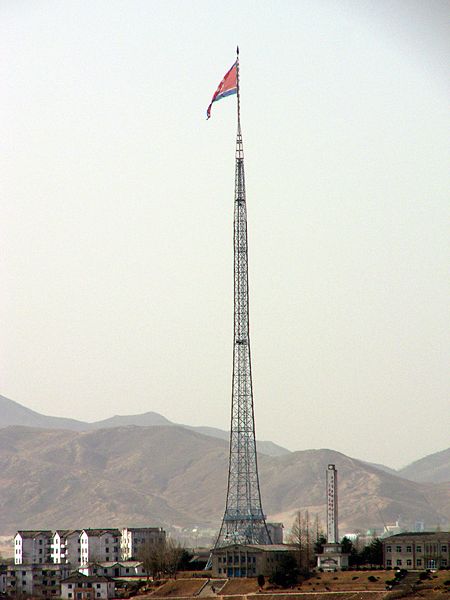
dprk-flagpole.jpgVisitors to either side of Korea’s DMZ will be familiar with the DPRK’s 160 meter (525 ft) flagpole in Kijong-dong. Wikipedia, citing a CNN report, claims the flag pole is the tallest in the world.  I was pretty sure of this fact as well, but according to Guinness, I was wrong.

The top 4 “unsupported” flag poles are: 1. Turkmenistan: 436 feet 2. Aqaba, Jordan: 431 feet 3. Amman, Jordan: 416 feet (126 meters) 4. United Arab Emirates: 404 feet (123.1 meters). The DPRK’s omission from this list is due to the fact that its flag pole technically sits on top of a tower, making it a “supported” structure—the equivalent of building a small flagpole on a tall building.

The DPRK might scoff at this subtlety, but even if one was to give them the benefit of the doubt, the victory would be short-lived.  According to a recent story in the Wall Street Journal, David Chambers of Trident Support Corporation is erecting a 532 foot flag pole, a full 7 feet taller than the DPRK’s, in Azerbaijan’s capital, Baku.

(Hat tip to Daniel Rothschild)

To learn more, read the very interesting and humorous article below:
Flagpole Builder Hits New Heights In Central Asia
Wall Street Journal, Page A1
Chip Cummins
8/16/2008

Share

China Hongxing sponsors 2008 DPRK Olympic team

August 18th, 2008

UPDATE 3 (2010-6-3): China Hongxing bid to sponsor the DPRK’s 2010 World Cup football team, but was beat out by Italian firm Legea.

UPDATE 2 (2008-8-14): The Wall Street Journal did a follow up story on China Hongxing:

During the Opening Ceremonies, for instance, the North Koreans refused to wear Erke’s logo for fear it would compete with their country’s Communist red-starred flag.

and…

The North Korean sponsorship cost Erke $2 million to $3 million, said Wu Rongzhao, deputy chief executive at China Hongxing Sports, which owns Erke. The Singapore-listed Hongxing reported net profit of $59 million for fiscal 2007.

Yet Erke’s sponsorship of the North Korea team has been “a very painful process,” said Mr. Wu.

Erke had to scrub plans for a marketing event timed to the Games’ opening because of red tape and bureaucracy, said a person familiar with the matter. For instance, Pyongyang’s Olympic officials would communicate only by email, not by phone.

Nor are North Korean athletes a sports marketer’s dream. Most are conditioned to be self-effacing and to credit their victories to the North Korean regime and its leader, Kim Jong Il. Weightlifter Pak Hyon Suk, who won North Korea’s first gold in Beijing on Tuesday — wearing Erke — said her victory was the “the best present for the president, for the people, for the country and for myself,” according to Xinhua, China’s state-run news agency.

UPDATE 1 (2008-7-28): Reuters follows up with China Hongxing:

Hoping to achieve what Michael Jordan did for Nike, a little-known Chinese sportswear brand is banking on the North Korean Olympic team for publicity.

“[The Chinese] tend to watch the North Koreans compete in the events that the Chinese are also strong in, so sponsoring North Korea will get a lot more eyeballs,” [Jenny Yeo, company spokesperson] said.

North Korean athletes in the Beijing Games will be sporting a stylized swan logo from China Hongxing’s “Erke” brand, which means “you conquer” in Mandarin.

China Hongxing will be kitting out the team with leotards, soccer boots and the red windbreakers the athletes will wear to the August 8 opening ceremony. Erke will be selling some of this sportswear in China and expects buyers seeking novelty value.

ORIGINAL POST (2007-7-25): Since China’s star Olympic athletes have signed endorsement contracts with western sports apparel firms, their Chinese competitors have looked to the DPRK to help them cash in on the ’08 Olympics (and beyond).

China Hongxing Sports Limited is one such companies, and they have issued a press release here (PDF) announcing their deal with the DPRK Olympic team and the women’s football team.

Slate has more on the retail strategy:

Chinese companies can’t compete with the world powers when it comes to locking up megastars. Olympic gold-medalist hurdler Liu Xiang, who will likely emerge as the biggest Chinese star of the Beijing games, has a deal with Nike. One of China’s leading sports-marketing consultants told me that every starter on the national basketball team has a deal with a foreign brand. Yi Jianlian, whom the Milwaukee Bucks selected with the sixth pick of the NBA draft, had a Nike contract by the time he was 16.

At the same time, Chinese shoe companies’ Billy Beane-like quest for hidden value has led to a few questionable decisions. Most sneaker companies would shy away from sponsoring the North Korean Olympic team. At the 2004 Summer Games in Athens, the DPRK won a grand total of five medals, none of them gold. Besides, the Hermit Kingdom doesn’t exactly conjure up the kind of brand associations most shoe companies are looking for. But Erke’s [China Hongxing] sponsorship of North Korea has a simple explanation. North Korea’s strongest sports include gymnastics, table tennis, and diving, all of which draw huge support and TV audiences in China.

Read the full stories here:
Chinese Companies Sponsor Countries Others Won’t Touch
Wall Street Journal, Page A14
Mei Fong
8/14/2008

North Korea’s Olympic outfitter hopes for publicity gold
Reuters
Melanie Lee
7/29/2008

Female Weightlifters, Spanish Basketball Stars, and Kim Jong-il
Slate
Jacob Leibenluft
7/25/2007

Share