Christian group smuggling radios into DPRK

November 12th, 2008

Individuals and organizations who smuggle radios into the DPRK, whether for personal gain or for altruistic reasons, do not to attract attention to themselves.  This makes it difficult to determine just how many foreign-made radios can be operated, and by whom, in the DPRK.

This week, however, Christian broadcaster Trans World Radio announced that it will distribute 3,400 radios in the DPRK this year alone:

International Christian broadcaster Trans World Radio (TWR) confirmed Friday, November 7, that it has secretly distributed thousands of radio receivers in North Korea, one of the world’s most isolated Communist nations. 

“TWR already delivered 3,100 radio’s in recent months and the plan is to increase that number to 3,400 by the end of this year,”  said TWR-Netherlands from its headquarters in the Dutch town of Barneveld. “Radio is the only way for North Koreans to hear the Gospel.  However receivers sold in the country are only tuned to the state-run network,” TWR added.

TWR said it has set up a transmitter in the region to reach the people of North Korea with Christian programming and encourage underground churches. “Most Christians in North Korea are not able to share their faith with other believers openly, and are forced to worship in secret.”?

Who knows how many of these radios will end up in actual use, but this is just one organization in one year.  Is it plausible to believe that over 10,000 radios are smuggled into the DPRK in a year? Are there reasons to doubt or qualify these numbers?  Why would they announce this if it was true?

Source:
Christian Broadcaster Smuggles Radio’s To North Korea   
Bos News Life
Eric Leijenaar
11/7/2008

Share

PyongSu Joint Venture Company

November 9th, 2008

From Wikipedia:

PyongSu Joint Venture Company, Limited is a pharmaceutical company jointly founded in 2002 by Pyongyang Pharmaceutical Company in North Korea and a company headquartered in Hong Kong which is a market leader in pharmaceuticals distribution and contract manufacturing in Asia. The corporate headquarters of PyongSu are in the Songyo district in Pyongyang. PyongSu started trial production in 2004 and, as of 2005, engaged in manufacturing mainly painkillers and antibiotics. At the end of 2006 the foreign-invested stake was sold to another investor. Felix Abt, the 3rd managing director (or president) managed to avoid the closure of the company by turning the heavily loss-making operation into a profit-making one. PyongSu became the first North Korean pharmaceutical factory to reach GMP (a universally recognized quality standard in the pharmaceutical industry as defined by the WHO), repeatedly inspected and confirmed by the WHO. It also became the first ever North Korean company to participate in tender competitions and to win contracts against foreign competitors from China, India, Germany and elsewhere. With an increasing cash-flow generated by itself, the company has even become able to buy and profitably operate pharmacies and other sales outlets in the country. Towards the end of 2008 managing director Felix Abt explained that the company now enjoys 1) a portfolio of products made by itself including an anti-helmintic and an anti-hypertensive drug that meets the patients’ needs well 2) a good reputation as a quality and service-minded company in the DPR Korea and the recognition as the “model company” of the domestic pharmaceutical industry. 3) a good market penetration thanks to wholesaling (that includes a variety of complementary products at affordable prices imported directly from reliable GMP-manufacturers) and its own profitable retail outlets (i.e. pharmacies) and 4) a healthy growth (including a high amount of orders on hand for 2009), sustainability and profitability.

Click here to read a recent interview by Mr. Abt in Interview Blog.

Share

South Korean priest to operate mission out of Pongyang hemp factory

November 9th, 2008

Sometimes the headlines write themselves.

According to the Union of Catholic Asian News (excerpt):

For the first time in almost 60 years, a Catholic priest will stay in North Korea, and look after the welfare of local workers.

Franciscan Father Paul Kim Kwon-soon says he will stay in Pyongyang, probably beginning in late November, and serve as a “social worker” for factory workers in the first joint North-South business venture.

Returning to South Korea from a visit, Father Kim told UCA News on Nov. 4 that North Korea is allowing him to run a newly built welfare center in Pyongyang that houses a soup kitchen, a free clinic and a public bath, even though “they know I am a Catholic priest.” As a visitor, he will have to renew his visa every two months.

According to Father Kim, the three-story welfare center he will manage is within the factory premises and will provide the workers with services such as medical checkups, meals and haircuts. It will have the capacity to offer free meals to up to 1,500 workers a day.

“I can say that the center will be a turning point in the humanitarian aid to the North,” the priest noted. “We only could send aid materials” in the past, he pointed out, whereas he can now bring aid materials to the North and provide direct service.

Saebyol General agreed last February to establish the center after three years of “great efforts” on the part of his Order of Friars Minor, Father Kim explained.

During the four-day visit to the North, Bishop Lazzaro You Heung-sik of Daejeon presided at the opening ceremony of the center on Oct. 30, the priest reported.

On Nov. 1 Bishop You, former president of Caritas Corea, the Korean bishops’ social service organization, celebrated a Mass at Changchung Church, the only Catholic church in North Korea, to thank God for opening the center. About 50 South Korean Catholics including eight priests and four Religious took part. No North Korean Catholics attended.

Father Michael Lee Chang-jun, secretary of Caritas Corea, accompanied Bishop You. He told UCA News on Nov. 5 that he wished “the center could provide its service not only for the workers, but other North Korean people in the neighborhood.”

Cecilia Lee Seung-jung, North Korea program manager for Caritas Internationalis, the worldwide confederation of Caritas organizations, earlier called the agreement on the center a significant development. She pointed out that inter-Korean exchanges have been limited since the current government in Seoul assumed office last February.

Records of South Korea’s Unification Ministry show aid to North Korea from the South Korean government and civil groups amounting to US$63.6 million from January to September 2008, while in 2007 it totaled US$304.6 million.

According to Church sources, North Korea maintains that 3,000 Catholics in North Korea practice their faith at “home worship places” across the country, with no residing priest or nun. Between 1949 and 1950 all priests and nuns who remained in the North were executed or disappeared.

It is very interesting that the mission will be operated out of a South/North joint venture company rather than North Korea’s Changchung Cathedral in eastern Pyongyang.  There are countless reasons why concerned parties believe this to be a superior arrangement.

To learn more about Pyongyang’s new hemp factory, click here.

To read the full story mentioned ablove, click below:
Catholic Priest To Work In North For Social Welfare
Union of Catholic Asian News
11/6/2008

Share

Jang Song Taek rumored to be in control

November 9th, 2008

This seems speculative to me, however, the Daily Telegraph (London) is reporting that Kim Jong il’s brother in law, Jang Song Taek, is operating as the de facto decision-maker in the DPRK:

“Chang Sung Taek is now in control and is leading North Korea,” said Choi Jin Wook, of the (South Korean] government-affiliated Korea Institute for National Unification in Seoul. “Other important figures consulted him, even when Kim Jong Il was OK. He will keep Kim Jong Il’s policy line even if he dies.”

Apart from his family connection to Mr Kim, Mr Chang is a cosmopolitan among North Korean cadres whose career bounced back from the brink of disaster just two years ago.

According to South Korea’s ministry of unification, he was educated at an elite school in Pyongyang, and married Mr Kim’s younger sister, Kim Kyong Hui, after studying in Moscow for three years.

He rose through the hierarchy to become head of the most powerful bureau of the Korean Workers’ Party’s, the “organisation and guidance department”. His older brother was the army general responsible for the defence of the capital itself.

In 2002, two years after a historic summit meeting between North and South, he led a delegation of senior officials on an unprecedented tour of South Korean industrial sites.

The most senior North Korean defector to the South, the former chief ideologue, Hwang Jang Yop, spoke of him as a potential successor to Mr Kim after a coup, and said that he was especially close to Kim Jong Nam, the dictator’s eldest son.

Perhaps because of his growing influence, Mr Chang was abruptly purged in 2004, and sent into internal exile. He reappeared in 2006 and last year a new and powerful post was created for him: head of the Party’s “administrative department”, in charge of the courts, the prosecutors, and the police – including those responsible for internal spying.

And in related news, it appears that the French doctor contacted by Kim Jong Nam (Kim Jong il’s eldest acknowledged son) did in fact visit Pyongyang, although he denies seeing Kim Jong il:

Japanese television identified a French brain surgeon who had recently visited Pyongyang – although he denied having treated Mr Kim. The Government has angrily denied that anything is wrong with him, and has released several photographs of him attending public events, none of which have quelled the growing consensus that he is ill.

If all this is true, and that is a big “if”, then this would seem to indicate that Jang and the Workers Party are set to lead the country when Kim finally reaches a stage where he is unable to make decisions.  

Read more here:
North Korea ‘is being run by Kim Jong Il’s brother-in-law’
Daily Telegraph
Richard Lloyd Parry
11/8/2008

Share

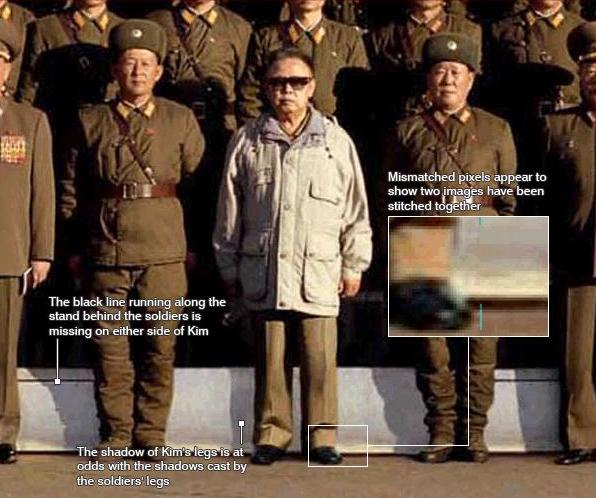
(UPDATED) Images of Kim Jong il likely faked

November 7th, 2008

UPDATE 2: Hany Farid, professor of computer science at Dartmouth College and author of a June Scientific American article on detecting fake images, argues the photos could be legit in a recent article in Scientific American:

“The BBC pointed to, I think, three or four things that they thought were indicative of tampering. And in the full-resolution image you can see that they’re completely wrong.” (Farid reviewed the photograph at the request of the Associated Press.)

One alleged manipulation was between the shadow cast by Kim’s legs and the shadows cast by the soldiers flanking him—a discrepancy that Farid says can be resolved by accounting for a curvature of the background surface. “If you look closely at the back baseboard, which all the men are standing at, it’s actually curved,” he says. “So what [the news agencies] are assuming is that that backboard is straight. If that backboard is straight and there’s only one light source, they’re right, it’s hard to explain that difference in the shadow.”

But assuming a curvature, the men would naturally cast different shadows. Farid calculates that only a few inches of background difference would suffice: “the sun is at such a grazing angle, so small differences make huge variations in the length of the shadow.”

The BBC also pointed to “apparently mismatched pixels” around Kim’s legs. But Farid says that the BBC “did this thing that is very dangerous, which is they zoom and they say, ‘Oh look, it’s a splice line around his feet,'” indicating that the leader may have been edited in. The problem with such an approach, he says, “is that’s all JPEG compression artifacts, and if you actually do the same thing to anyone else’s feet you see exactly the same artifacts.” Image compression uses a sort of digital shorthand to reduce the size of the files, throwing out certain nuances in favor of approximations that can be somewhat choppy. “What that means is there’s a quite a bit of color artifacts when you zoom in like that. So you completely expect those types of thing.”

“Quantitatively, I ran a number of forensics tools, and there’s no cloning, there’s no color-filtering artifacts, the lighting is completely consistent, you can explain the shadows,” Farid says. “The image was edited, as all images are, because they all get cropped and contrast-enhanced, but other than that, there was just no signs of tampering anywhere.” 

UPDATE 1: In the comments, Neil points to the KFA explanation for the vanishing black line—that it is a “white board” which serves as a place marker where KJI is supposed to stand.  See photos here, here, and here.  This claim, however, does not address the “shadow” and “pixel” evidence. 

According to the Straits Times (Singapore):

Seoul’s main spy agency, the National Intelligence Service (NIS), said yesterday that it believed the latest North Korean photo was real.

‘The possibility of Mr Kim’s photo being forged seems very low,’ said an NIS spokesman, refusing to elaborate.

The South’s unification ministry spokesman Kim Ho Nyoun also said he had no evidence to suggest that the photo had been forged.

ORIGINAL POST: In an attempt to quell speculation that Kim Jong il is suffering from poor health, the North Korean government has released a series of photographs showing the Dear Leader is fit and in control. 

Unfortunately, in true North Korean fashion, the level of competence on display has merely increased speculation that “something is rotten in the Kingdom of Denmark.”

Case1:
kimiswell1.jpg

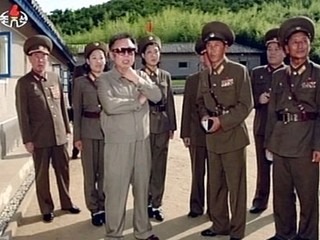
Image 1: October 11, KCNA television broadcast of Kim Jong il inspecting a military unit.  Although this effort was likely aimed at quieting rumors among a domestic audience, internationally it met skepticism because Kim is wearing his “summer” clothes and the foliage in the background is too green for the season.  As a result many concluded that this footage was shot before August 2008.

Case 2:
kimiswell2.jpg

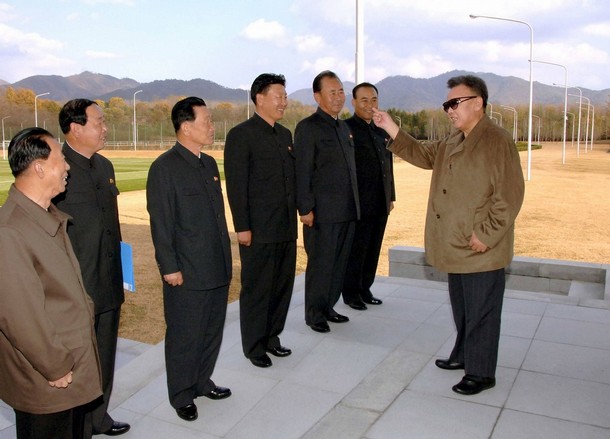
Image 2: November 2, KCNA announces Kim Jong il talks to officials at a stadium where he watched a soccer match between military teams Mankyongbong and Jebi.  KCNA did not state expressly the date the picture was taken.

Although the background and clothing seem to indicate the correct season, I was skeptical of this photo because of previous research I had done on Kim’s penchant for football—he doesn’t seem to have one.  If this story was true, it would be the second match Kim has attended since 1996—the first also being after he allegedly suffered health problems.

The authors of several web pages, however, paid closer attention to the photograph itself and noticed a strange lack of shadows, indicating that the photo was doctored.  

Case 3:
kimiswell3a1.jpg

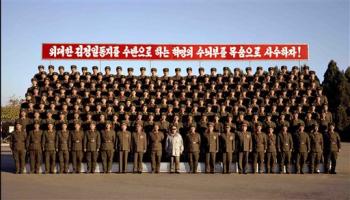
Image 3: November 5, Korea News Service in Tokyo shows Kim Jong Il posing with officers and soldiers with the (north) Korean People’s Army Unit 2200.

The BBC, however, reports that this photo is also doctored:
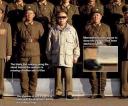
kimiswell3c.JPG

Quoting from the article:

The image, released on Wednesday, appeared to show Mr Kim in good health while inspecting two military units.

But an analysis by the UK’s Times newspaper highlighted incongruities around the leader’s legs, and the BBC found what look like mismatched pixels.

In the photo, the shadow cast by Mr Kim’s calves runs in a different direction to the shadow cast by the soldiers on either side of him, the Times pointed out. In addition, a black line running along the stand on which the soldiers are positioned mysteriously vanishes on either side of Mr Kim – suggesting his picture may have been superimposed onto the image.

Such a suspicion was reinforced when a BBC designer examined a close-up, and discovered apparently mismatched pixels to the right of Mr Kim’s legs.

[Accordng to Aiden Foster-Carter,] North Korean authorities will now face renewed pressure to prove Mr Kim is alive and not incapacitated.

“If they want to stop speculation, they have to produce him – as long as they don’t, we will still wonder.”

Read more in the following articles:
‘Fake photo’ revives Kim rumours
BBC
11/7/2008

Kim Jong Il: digital trickery or an amazing recovery from a stroke?
Times of London
Richard Lloyd Parry
11/7/2008

Did North Korea fake photos of Kim Jong-il?
Scientific American
11/10/2008
John Matson

Share

DPRK to tighten market restrictions in 2009

November 6th, 2008

According to Yonhap (hat tip to Oliver):

North Korean authorities are clamping down on private markets that have cropped up across the country, citing concerns that such business activities can compromise centralized control, a local civic group said Thursday.

Good Friends claimed in its recent newsletter that the government will allow private markets to operate only once a month beginning in 2009. Markets operate on the first, 11th and 21st days of the month at present.

In North Korea’s capital and largest city of Pyongyang, such measures have been implemented since October, said Good Friends.

The Seoul-based relief group said North Korean authorities expressed concerns that merchants who make a living by selling goods at these markets could contest or circumvent decisions and rules made by the state.

The markets have become an integral part of the local landscape, as they are used by many people to supplement their meager state rations.

Quoting an anonymous North Korean official, the group said the government’s ultimate goal is to shut down the markets altogether.

Although I am sure North Korea’s leadership does not enjoy competing against thousands of their uppity subjects (entrepreneurs) in the production of consumer goods and services, the scale of the DPRK’s marketization over the last decade is simply too large and ingrained in the social fabric to be eliminated now.  Preventing entrepreneurs from emerging into a powerful political force (and making sure they pay their “taxes”) while maintaining control of the economy’s “commanding heights” seems a more likely policy direction for the North Korean government at this point.

As an aside, I have located dozens of North Korea’s markets (including the largest in Pyongsong) on Google Earth (Download here).

Link to the full article below:
N. Korea clamps down on private markets
Yonhap
11/6/2008

Share

Bicycle business growing in North Korea

November 4th, 2008

Institute for Far Eastern Studies (IFES)
NK Brief No. 08-11-3-1
11/3/2008

The Daily NK has reported that the use of bicycles for business and transportation around the city of Pyongyang is becoming more and more commonplace, with 7 out of 10 households owning a bike, despite the fact that the cost of a bicycle in the capital city has doubled in the last twelve months alone.

According to North Korean defectors, until the early part of the 21st century, bicycles were the most sought-after purchases, with only 30~40 percent of families able to buy them.

According to a source in Pyongyang, “If you go to a [market] these days, you’d see that people who sell or purchase goods mostly use bicycles,” adding, “With the exception of those houses with extremely difficult situations, most households have a bike.”

The source explained that the growing use of bicycles is not due to improvements in the lives of the people, but rather, due to a shift in mentality. In the past, someone wishing to purchase a bike would first have to save up money for it, while today they think they can borrow the money, even at high interest rates, and then repay the loan through business profits.

The Daily NK explains, “With the ubiquity of [market] trading and the increase in business competition, bicycles have become must-have items.”

In Sinuiju, as well, bicycles have become a necessity for traders. A source there reported, “In farmlands that are distant from the [market], bicycles are an important means of linking to city markets. The merchants can triple or quadruple their profit, compared with those that don’t own bicycles.”

Most traders with bicycles take orders from those living in farming villages, fill the orders in city markets, then barter the items in the villages for vegetables and grains which they then turn around and sell in markets for a profit. Competition is stiff as traders follow price differences between the markets in order to squeeze out even a 100 won profit.

Read two recent stories on North Korea’s bicycle culture here:
70% of Households Use Bikes
Daily NK
Jung Kwon Ho
10/30/2008

People’s Safety Agency Targeting Women Cyclists
Daily NK
Jung Kwon Ho
11/6/2008

Share

What is the DPRK’s strategy for international economic integration?

November 4th, 2008

Although removal from the US list of state sponsors of terror carries little economic significance for the DPRK, its government has made this one of its top policy priorities.  Now that this has been accomplished, we must ask what the DPRK’s next move is in terms of international economic integration.  Will they push for removal of more economically-significant legal barriers which isolate them, to a large degree, from global markets (indicating reform is an important policy goal), or will we continue to see mixed signals and muddle-through policies (indicating a desire to maintain the status quo)? 

We cannot answer this question without knowing the DPRK’s overall strategy.  Today, however, a North Korean academic quoted in the Japanese media acknowledges that de-listing changes little economically, and signals that we should not expect to see much change in the DPRK’s economic environment:

Ri Gi Song, professor at North Korea’s Academy of Social Sciences, told Kyodo News in an interview that other international sanctions are still in place and “there should be no illusions” about the country’s trade environment.

“The delisting from the terror list is expected to have a certain level of beneficial impact, but this does not mean that all (international) economic restrictions have been taken away,” he said.

Ri also said Japan’s sanctions against North Korea have not had a major impact on the country’s economy but are hurting Korean residents of Japan who do business with North Korea.

“There is little impact from these restrictions on the economic development of the country, but I think there is an impact on businessmen of Chongryon,” he said, referring to the pro-Pyongyang General Association of Korean Residents in Japan.

“The Korean residents of Japan cannot come and go as they please,” Ri said.

Japan’s sanctions include a ban on port calls by North Korean vessels including a cargo-passenger ferry that provided a major means of transportation for Koreans in Japan traveling to North Korea. The sanctions also ban imports from North Korea and exports of luxury goods to the country.

The sanctions were first imposed in 2006 in the wake of an impasse in the issue of past abductions of Japanese nationals by North Korea. The sanctions are subject to review every six months and were extended in October for the fourth time.

Ri said he does not think North Korea’s centrally planned economy will be affected by the current global financial turmoil that began with the U.S. subprime mortgage meltdown.

“I don’t think it will have a direct impact on our economy, as our economy is not part of the capitalist market mechanism,” he said. (Kyodo – link requires subscription)

As an aside, Mr. [Dr.?] Ri might be surprised to learn just how exposed his country is to the “capitalist market mechanism”.

(Hat tip to Oliver for the article)

The full article can be read here:
N Korea Trade To Gain From U.S. Terror Delisting: N Korea Expert
Kyodo (subscription required)
11/4/2008

Share

Famine in North Korea Redux?

November 3rd, 2008

Peterson Institute Working Paper
WP 08 – October 2008
Stephan Haggard and Marcus Noland

Read the paper here

Abstract: In the 1990s, 600,000 to 1 million North Koreans, or about 3 to 5 percent of the precrisis population, perished in one of the worst famines of the 20th century. North Korea is once again poised on the brink of famine. Although the renewed provision of aid is likely to avert a disaster on the scale of the 1990s, hunger-related deaths are already occurring and a dynamic has been set in motion that will carry the crisis into 2009. North Korea is a complex humanitarian emergency characterized by highly imperfect information. This paper triangulates quantity and price evidence with direct observation to assess food insecurity in North Korea and its causes. We critique the widely cited UN figures and present original data on grain quantities and prices. These data demonstrate that for the first time since the 1990s famine, the aggregate grain balance has gone into deficit. Prices have also risen steeply. The reemergence of pathologies from the famine era is documented through direct observation. Although exogenous shocks have played a role, foreign and domestic policy choices have been key.

Keywords: Famine, North Korea
JEL codes: Q1, O1, P2

Share

Pyonghwa Motors Update

November 2nd, 2008

The Asia Sentinel offers an update on Pyonghwa Motors’ production and sales numbers:

Does it make economic sense to build or invest in a car factory for a country with 23 million people but fewer than 30,000 vehicles, a city where cars are so scarce that in the warmer months, traffic ladies swinging their stop signs act in place of electric lights, where hardly anybody knows how to drive? And why is Sun Mymung Moon, owner of an international business empire and a virulent anti-communist, investing in North Korea?

Pyeonghwa Motors invested around US$55 million to build the factory on a one-time rice paddy near the port city of Nampo, about 50 kilometers southwest of Pyongyang. In 2003, the JoongAng Daily quoted an executive from the Seoul-based Pyeonghwa, saying he expected the factory, with capacity to build 20,000 cars a year, to eventually turn a profit. However, a spokesman based in Seoul says Pyeonghwa has produced only 2,000 cars and pickup trucks in their first five years of operation.

How many cars have they actually sold? For North Korea, any statistics, much less accurate ones, are “very difficult to come by,” said Erik van Ingen Schenau, an Asian car analyst and author of the book “Automobiles Made in North Korea.” He quotes a French newspaper article that claims the factory sold around 400 vehicles, including SUVs, pickups, and sedans, in 2006.  He estimates the factory sold anyone from 400 to 1000 cars in 2007 and 2008, including the cars they exported to Mekong Auto, a Vietnam-based Moon company, and including the vehicles that they produced with the Shenyang-based China Brilliance. 

The Pyeonghwa factory produces cars with names such as Whistle, Cuckoo, and Three Thousand Li, which refers to the national territory of Korea, both North and South peppering the empty streets of Pyongyang, “You see these cars a lot, especially the Cuckoo,” said Simon Cockerell, general manager of Koryo Tours, one of the few western tour companies licensed to operate in North Korea. 

“It took drivers some getting used to because they were used to driving Japanese cars, with steering wheels on the right,” Cockerell said. 

Like most items produced in North Korea, the Pyeonghwa vehicles are not known for their quality. “They are probably nearly all hand-assembled, and based on a model from a factory in China that does not have a good reputation,” van Ingen Schenau said. “They make cars that no one is interested and in that they cannot export to Japan or South Korea. Maybe it is a prestige item to have a car factory in the country, but it does not seem to have worked out at the moment.”

The Whistle, based on the Fiat Siena, is one of the Pyeonghwa vehicles featured on billboards. It sits on a field next to a superimposed image of the Pyongyang Arch of Triumph. Built to commemorate Kim Il Sung and the Korean nation’s resistance to the Japanese occupation, the arch stands 60 meters tall, more than 10 meters taller than its model, the Arc de Triomphe in Paris. A boy stands next to the car one hand holding a trophy, while waving a hand, a smile on his face and a medal around his neck.  The billboard reads: “Whistle. A Strong and Beautiful Automobile.”

It is important to remember the target audience of the billboard. It is not only for the few thousand European tourists who visit the country for six days at a time, or the few hundred businessmen and embassy staff who live in one of the few foreigner hotels isolated from the city. The billboards also exist for the residents of Pyongyang, to show them that their country, despite the harm done to it by the entire capitalist world, is still able to go its own way and produce a strong and handsome car.

The full article can be found here:
North Korea in the Slow Lane
Asia Sentinel
Isaac Stone Fish  
10/31/2008

Share