(UPDATED)Financial crisis hits DPRK

November 2nd, 2008

Although many would assume that North Korea’s economic isolation would insulate it from recent global financial instability, this does not appear to be the case.  According to the Wall Street Journal:

North Korea does little trade with the rest of the world — about $2 billion annually — and now it’s being hurt by lower prices paid by its biggest trading partner, China, according to report from a South Korean institute that specializes in North Korea research.

In recent weeks, the Chinese companies that buy North Korean ores and minerals like zinc, which are some of its biggest exports, have slashed the prices they’re willing to pay. That’s forced some North Korean mining firms to halt production and even produced a drop in the smuggling of ore and scrap, trade that’s illegal in the North but is believed to play an important role in supporting the impoverished country.

Lim Eul-chul, a professor at the Seoul-based Institute for Far Eastern Studies who wrote the report issued Thursday, said he learned about the commodity-trade problems from North Koreans doing business in China

“Chinese companies that are affected by global trends don’t want to pay as much as they used to for North Korean raw materials or resources,” Mr. Lim said. “Thus, North Korean merchants can’t make profits from trade.”

The price pressure exerted by Chinese traders on North Korean companies is in line with the broader drop in commodity prices in recent months. But it has imposed new burdens on North Korea in what is shaping up to be a terrible year there.

Official North Korean media have published reports saying the global financial crisis will ruin the U.S. and other industrial powers. But in the report, the Institute for Far Eastern Studies said “North Korean people are becoming very anxious over the possibility of the international economic crisis having a long-term impact.”

Below is the IFES report mentioned in the Wall Street Journal:

Global Financial Crisis hits DPRK economy by way of China 
NK Brief No. 08-10-29-1
10/29/2008

Contacts within North Korea are reporting that the North Korean people are becoming very anxious over the possibility of the international economic crisis having a long term impact as not only exports have dropped, but even cross-border smuggling is taking a hit.

Recently, as Chinese traders have more than halved the price of North Korea’s main export goods such as minerals and scrap iron, North Korea’s markets and even construction industry have felt the blow.

As North Korean state-run media outlets report the current financial crisis as the ruin of the United States and other capitalist world powers, they report as if North Korea were completed unaffected by it. On the 20th, the Rodong Sinmun emphasized that the the U.S.’ financial management system was ‘like a candle in the wind.’

However, it has been leaked that since last week, businesses in North Korea have been shutting their doors as a result of the financial crisis. In particular, the value of the North Korean Won has dropped sharply against the Chinese Yuan, and combined with Chinese traders’ reluctance to purchase North Korean goods and calls to lower prices, very little business is being conducted. This has led mines in Hyesan to halt exports of lead and zinc, and with the drop in legitimate exports, of course smuggling has dropped of, as well.

Furthermore, as raw materials from China are not being supplied, construction projects in the North are also grinding to a halt. 

(UPDATE) Barbara Demick reports in the Los Angeles Times:

Despite efforts to keep North Korea’s extreme poverty out of view, a glance around the countryside shows a population in distress. At the root of the problem is a chronic food shortage, the result of inflation, strained relations with neighboring countries and flooding in previous years.

Aid agencies say the level of hunger is not at the point it was in the 1990s, when it was defined as a famine, although they have found a few cases of children suffering from kwashiorkor, the swollen belly syndrome associated with malnutrition. Mostly what they are seeing is a kind of collective listlessness — the kind shown by the people on the streets of Nampo.

“Teachers report that children lack energy and are lagging in social and cognitive development,” reported a group of five U.S. humanitarian agencies in a summer assessment of the food situation. “Workers are unable to put in full days and take longer to complete tasks — which has implications for the success of the early and main harvests.”

Hospitals complained to aid workers of rising infant mortality and declining birth weights. They also said they were seeing 20% to 40% more patients with digestive disorders caused largely by poor nutrition.

The U.N. World Food Program reached similar conclusions. In a recent survey of 375 households, more than 70% were found to be supplementing their diet with weeds and grasses foraged from the countryside. Such wild foods are difficult to digest, especially for children and the elderly. The survey also determined that most adults had started skipping lunch, reducing their diet to two meals a day.

These are some of the same signs that augured the mid-1990s famine, which killed as many as 2 million people, 10% of the population.

“The current situation hasn’t reached the famine proportions that it did during the 1990s. Our hope and goal is to keep it from going over the precipice,” said Nancy Lindborg, president of Mercy Corps, one of the U.S. aid organizations working in North Korea. “You have a number of factors that have conspired to create a really tough food situation.”

In Pyongyang, the capital, residence in which is reserved for the most politically loyal North Koreans, plenty of food is available on sale. A grocery inside the Rakwon Department Store carries Froot Loops and frozen beef. At open-air markets, you can find mangoes, kiwis and pineapples

But the products are far too expensive for most North Koreans, whose official salaries are less than $1 a month — 60 to 75 cents monthly for the workers surveyed by the World Food Program. And the farther you get from Pyongyang, the poorer are the people.

Nampo is 25 miles southwest of the capital, on the Yellow Sea. It used to be a thriving port city, but nowadays its harbor is used mostly for shipments of humanitarian aid. On a weekday morning, many people sit along the sidewalk watching the few cars pass by. They appear to be unemployed or homeless.

North Koreans say that the food situation is improving and that a good harvest is expected this autumn, as a result of improved weather conditions. The last two years were disastrous because of heavy flooding.

“There was a problem before, but it is getting better. We expect a bumper harvest,” said Choe Jong Hun, an official of the Committee for Cultural Relations With Foreign Countries.

North Korea experts, however, are skeptical. “One good harvest is not really going to alter the picture,” said Stephan Haggard, a UC San Diego professor who has written widely on the North Korean famine.

The World Food Program and the U.S. aid organizations are providing food for the most vulnerable, including children and pregnant women. A U.S. ship carrying more than 27,000 tons of bulk corn and soy is slated to arrive in Nampo within days.

International agencies have been trying to raise money to expand their food aid to the general population. Many urban North Koreans are dependent on food rations, which have dwindled to 150 grams a day, or a little more than 5 ounces.

Even in Pyongyang, one can see signs of scarcity behind the facade of what is supposed to be a showcase capital. Foreign residents say they have seen homeless children in the last few months — a notable sight in a totalitarian country where nobody is supposed to wander away from their legal residence. (Los Angeles Times)

Read the full Wall Street Journal articles below:
North Korea Feels Effects of the Crisis
Wall Street Journal
Evan Ramstad and Sungha Park
10/31/2008

North Korean facade of self-sufficiency can’t hide signs of hunger
Los Angeles Times
Barbara Demick
11/2/2008

Share

Organizational Loyalty on Display

October 31st, 2008

Daily NK
Jeong Jae Sung
10/31/2008

North Korean youth and women’s organizations have been holding meetings to elicit a vow of loyalty to Kim Jong Il since mid-August, when he disappeared from public view.

Meanwhile, North Korean media report that Kim Jong Il mails letters and gifts frequently in order to prevent a potentially unstable social situation caused by rumors of his serious illness. These loyalty vow meetings are also a tool by which to emphasize solidarity with the current political system.

Chosun (North Korea) Central News Agency reported on Friday that the Primary Organization Chairmen’s meeting of the Union of Democratic Women was held on the 30th in the People’s Palace of Culture, Pyongyang, at which Party Secretary Kim Jung Rin was present and a further “oath statement” to Kim Jong Il was selected.

The News Agency described the meeting thus, “Chairwoman of the Union of Democratic Women Roh Sung Sil reported their activities, after which they evaluated sub-organizational achievements as led by the leadership of the Party and discussed the duties of the primary organizations’ chairwomen and ways to raise their results.”

The Union of Democratic Women consists of around 200,000 women between 31 and 55 years old who do not have jobs. Women who meet these registration conditions have to affiliate with the Union.

On the 28th, a North Korean representative youth organization, the Kim Il Sung Socialist Youth League, held its 38th Assembly in order to discuss a way to enact Kim Jong Il’s instruction, “The youths should take the role of vanguard and storm troopers in the hardest fields, to establish a great and strong country,” according to the News Agency.

The Kim Il Sung Socialist Youth League was founded on January 17, 1946 and today consists of around five million students, workers and soldiers between 14 and 30. Its role is to act as a rearguard for the Party.

Vice Chairman of the General Federation of Korean Trade Unions, the largest workers’ organization, Kim Sung Cheol said in late September through the Chosun Central News Agency (KCNA) that “The core of the spirit of the thousands of soldiers and people is to firmly support the Leader, so we should put pressure on members to strengthen their spirits.” 

Share

The Short Happy Life of the Ryugyong Hotel

October 31st, 2008

Parallax Journal of International Perspectives
Volume V, No. 1, (Fall 2008)
Michael Madden

Download the PDF here: maddenarticle.pdf

Abstract: Called the “Worst building in the history of mankind” by Esquire Magazine, North Korea’s Ryugyong Hotel is one of the twenty tallest buildings in the world, despite being little more than a desolate concrete shell.  How the building came to be constructed and who constructed it becomes a small cultural history lesson on the secretive communist state.

About the author: Michael Madden studied writing with Stratis Haviaras and LArry Heinenmann, and spent several years under the tutelage of Christopher Ricks.  He is currently working on a satellite map of Pyongyang juring Japan’s annexation of the Korean Penninsula from 1910 to 1945.  Mr. Madden is a member of the association of Literary Scholars and Critics.  He works with the Office of the Dean, College of Arts and Sciences, at Suffolk University in Boston, Massachusetts.

Share

Pyongyang Hemp Textiles Co.

October 30th, 2008

UPDATE: A Catholic Priest will be operating a mission out of the factory.  Read more about this here. 

ORIGINAL POST: Yes, you read the title correctly.  Billed by Yonhap as the first inter-Korean joint venture in Pyongyang:

Pyongyang Hemp Textiles is a cooperative effort between the South’s Andong Hemp Textiles and the North’s Saebyol General Trading Co., with a total investment of US$30 million shared equally by the two sides, according to the officials.

Around 1,000 North Koreans will be working for the textiles and logistics firm, which is built on 47,000 square meters of land in Pyongyang, they said.

…The opening ceremony for the joint venture was delayed for close to two months due to deteriorating inter-Korean relations, which worsened after a South Korean woman was shot to death while traveling the communist country in early July. Pyongyang refused to apologize for the shooting, and denied requests from Seoul to cooperate in a fact-finding mission into the death.

If anyone has any idea where this company is located on Google Earth, please let me know. 

According to Wikipedia, which is not an authoritative source:

Industrial Hemp is produced in many countries around the world. Major producers include Canada, France, and China. The United States is the only industrialized nation to continue to ban industrial hemp. While the Hemp is imported to the United States more than to any other country, the United States Government does not distinguish between marijuana and non-psychoactive Cannabis used for industrial and commercial purposes.

Share

DPRK appoints new minister of forestry

October 30th, 2008

According to Yonhap:

North Korea has recently promoted its vice forestry minister, Kim Kwang-yong, to the post of minister, according to the country’s state media on Wednesday.

Radio Pyongyang referred to Kim as forestry minister, rather than his previous title of vice minister, while carrying his comments on a recently broadcast statement from North Korean leader Kim Jong-il.

Little is known about the new minister. He visited Russia a year ago while leading the ministry’s delegation as vice minister, according to North Korean media reports.

Kim’s predecessor, Sok Kun-su, was reportedly named to the post in October 2004.

On October 18, KCNA published the following story (this is the only mention of his name in KCNA online archives):

Delegation of Ministry of Forestry Leaves for Russia

Pyongyang, October 18 (KCNA) — A delegation of the DPRK Ministry of Forestry headed by Vice-Minister Kim Kwang Yong left Pyongyang Thursday to participate in the 12th meeting of the forestry sub-committee of the inter-governmental committee for cooperation in trade, economy and science and technology between the DPRK and Russia to be held in Russia.

Many North Korea watchers will remember that North Korean laborers are felling forests in Siberia (background here and here).  It looks like these business ventures are now part of Mr. Kim’s portfolio.

Read the full article here:
N. Korea names new forestry minister
Yonhap
10/29/2008

Share

South Korea eases DPRK investment regulation

October 30th, 2008

The South Korean government seems to have made some significant changes to the way business is to be conducted between themselves and the North.  It seems regulations have been eased on South Korean companies seeking permission to operate in the North—and some new subsidies have been put on the table.

From the Korea Times:

The government Tuesday abolished a system under which companies here must receive a permit to do business in North Korea.

As a result, companies which have been seeking to operate in the reclusive state would see simplified procedures when they start inter-Korean projects.

The Cabinet approved revisions of the law governing trade and cooperation between South and North Korea.

Under the previous licensing system, a permit for both companies and projects were necessary.

But now, companies have to get approval for their projects only and inter-Korean cooperation programs designated by a presidential decree can proceed without the approval.

If firms get the license in a dishonest way, the government can cancel it.

In a bid to diversify trade between the two Koreas, the revision allows services and intangible things as well as goods to be exchanged.

The government also approved a revision bill to encourage foreign investors to invest in inter-Korean trade.

It says that foreigners who invest $10 million or more can get some incentives such as cash grants.

The legislation on South-North cooperation was introduced in 1990 to support exchanges and cooperation between the two Koreas.

The Ministry of Unification has a committee under itself to coordinate related policies and make a decision on important inter-Korean cooperation issues.

To promote economic, cultural and social exchange projects, a permit from the minister has been required.

If caught violating the law, the person will be sentenced to up to three years imprisonment or fined up to 10 million won ($6,770).

Read the full article here:
Inter-Korean Business Procedures Simplified
Korea Times
Kim Sue-young
10/28/2008

Share

Washington screening of “Crossing the Line”

October 28th, 2008

Nick Bonner, head of Koryo Tours and producer of three DPRK documentaries, will be in Washington Wednesday for a screening of his most recent film, Crossing the Line, at John’ s Hopkins University.  (NkeconWatch: I will be attending and I hope to see you there)

Event details:
Wednesday, October 29th at 6:00pm
Opening Reception at 5:30pm
Kenney Auditorium at Johns Hopkins University
1740 Massachusetts Ave., NW
Washington, D.C. 20036

Click here to register

You may order a copy of the film here

About the film
In 1962, a U.S. soldier guarding the DMZ deserted his unit, walked across the most heavily fortified border on earth and defected to North Korea. Crossing the Line, a documentary directed by Daniel Gordon and co-produced by Nicholas Bonner, goes inside North Korea to tell James Joseph Dresnok’s story for the first time. Allowed unprecedented access by North Korean authorities, the filmmakers reveal the full story of his defection, as well as the political intrigue and personal passions that have kept him behind the Cold War’s last frontier ever since.

Share

(UPDATE) North Hamgyong by rail

October 27th, 2008

(UPDATE) These adventurers set up a couple of blogs to catalogue their trip.
1. Approaching Russia/Korea border
2. Entering North Korea at Tumangang
3. By train across North Korea (1/2)
4. By train across North Korea (2/2)
5. Pyongyang-Myohyangsan


railimage.jpg

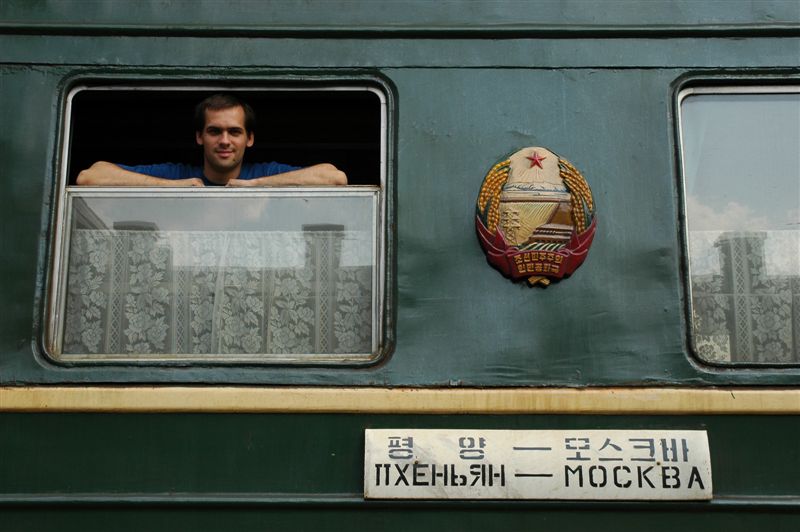
I just finished reading an incredibe DPRK travel account by two Swiss and Austrain rail enthusiasts who recently traveled the Trans-Siberian Railway from Europe to Pyongyang.  If you are interested in Russia and/or the DPRK you need to treat yourself to their pictures and travel journals as much of their material has not been published in the West.

I have included links to their trip from Ussuriyisk and Khasan to Pyongyang below, with some selected comments from their diary:

1. From Ussuriysk to Khasan (Russia):
http://www.railroadforums.com/forum/showthread.php?t=25908

Selected comments:

Trains over the border were not listed, but I knew that there is not only the twice-monthly sleeping car Moscow – Pyongyang, but also a twice-weekly cross-border passenger train Khasan – Tumangan.

I asked him [a Russian border agent], whether and how often he met foreigners here. He said, that he has been working here for about one year and that we were the 1st foreigners (except North Koreans, of course), he met.

The answer was that usually only Russian and Korean citizen cross the border, but that there have been a few third country citizen here, but they didn’t remember when that was the last time…

They also said, that among the passengers of the sleeping car to Pyongyang there are usually not even Russian citizen. Russian citizen crossing the border only go to the so called “Rajin-Sonbong Special Economic zone”, setup by the North Korean administration in cooperation with China and Russia

2. From Khasan to Tumangang Station (DPRK border)
http://www.railroadforums.com/forum/showthread.php?t=25971

3. From Tumangang Station to Pyongyang part 1:
http://www.railroadforums.com/forum/showthread.php?t=25993

Selected Comments:

(North Korea uses normal gauge – 1435mm)

We then talked about other things. They said that they had studied in Pyongyang and now have to serve at the army here in Tumangan. 

One of them told us, that he had seen the Hollywood-movie “Titanic” in the cinema in Pyongyang (I have also read before, that Titanic was shown in North Korean cinemas) and both said that they were glad to practice their language skills together with us. And one of them said, that he also wished to travel around the world like we did and see foreign countries… I hope in future it will be possible for him.

And of course the mobile-phones were of special interest, as they are forbidden in North Korea. The “translator” said, that they would be sealed and that we must open the envelope only when we leave the country. The sealing was quite simple: The customs official asked me for some of paper (obviously they didn’t have their own…) and I gave him two empty DIN-A4-sheets, in which he enwraped the mobile phones and which he closed with a yellow tape, which he then stamped several times…

They told us, that they now have to take the books, the laptop, the camera and the USB-sticks with them for some further inspection by a specialist, and that we would receive our belongings later.

They asked us to put all this items into the two smaller backpack (both of us had a big and a small backpack). Then they took the backpacks and left the sleeping-car.

They also provided the following information:

At http://www.logistics.ru/9/7/i77_6557p0.htm you can find a Russian article about the history of this border crossing point.

The line on the Russian side from Baranovskiy to Khasan was built between 1938 and 1951. The first bridge over the border was a wooden railway bridge opened in 1952. In 1954, when cross-border freight traffic offically started, 4400 tons of freight were transported over the border. That number rose to 12.000 tons in 1955.
In 1959 the new bridge, which still exists today, was opened.
The peak in freight traffic was in 1988 with 4.795.000 tons (USSR > DPRK: 4.070.000 tons, DPRK > USSR 725.000 tons). The numbers show, that the USSR ecenomically supported the DPRK and due to the political and economical changes in the former USSR the mostly unidirectional trade between the two countries decreased after 1988:

1988 – 4.795.000
1990 – 3.526.000
1993 – 2.306.000
1994 – 761.000
1999 – 230.000
2002 – 68.000

Only after 2002 a slight increase is noticeable, in 2004 106.000 tons were transported. However, the infrastrucuture was overdimensioned, and it has therefore been reduced: Several tracks at Khasan station were removed, as well as 3 of 14 passing-tracks between Baranovskiy and Khasan.

Passenger traffic was opened in 1958 and 10582 passengers crossed the border during the first year. Till 1988 this number rose to 21.000/42.000 passengers (I’m not sure, does “vozroslo na 200%” mean “rose to 200%” or “rose by 200%”?).

The new station building in Khasan was opened in 1989 and it was suitable to handle up to 500 international passengers per day. However, also passenger traffic is now lower than it was at it’s best times. During the 1st 6 months of 2005 5315 passengers crossed the border.

4. From Tumangang to Pyongyang part 2:
http://www.railroadforums.com/forum/showthread.php?t=25993
Selected comments:

Considering the number of other trains we met, one cannot say that railway traffic in North Korea is in total disorder and in it’s last throes. Trains are running and during our trip from Tumangan to Pyongyang there were obviously no problems with electricity supply for the catenary. Only once we stopped for 5 minutes in the middle of nowhere, but that might have been caused also by something else. However, the tracks are in bad condition, that causes the delay.

Freight trains where quite rare and relatively short (passing tracks at stations have usually a length of 400-500 meters according to Google Earth, so freight traffic inside North Korea might indeed be very low. And we saw less factories than expected considering our experiences in other former Socialist states. The main economic activity in North Korea seemed to be still agriculture.

Share

DPRK censors RoK newspapers in the Kaesong Zone

October 27th, 2008

According to Yonhap:

North Korea has begun to more harshly censor South Korean newspapers subscribed to by firms operating in the inter-Korean Kaesong industrial complex, apparently to prevent workers there from reading reports on their leader Kim Jong-il’s health, officials said Monday.

“The North began to allow South Korean dailies to pass through customs only after cutting out articles critical of the country as of Oct. 20,” a Unification Ministry official told reporters on condition of anonymity.

About 30 copies of nine different papers cross the inter-Korean border every day for delivery to the Kaesong Industrial District Management Committee in the complex, a civilian administrative body of South Korean firms there, according to the official.

The North is strictly enforcing customs regulations barring the entry of overseas publications critical of Pyongyang, the official said.

It is not known exactly what types of articles have been censored by the North, but officials say the measure could be related to recent reports that Kim is ailing.

South Koreans are forbidden to carry the newspapers when they leave the office, but some have received warnings from North Korean authorities for violating the rule, according to the Unification Ministry official.

Read the full article here:
N. Korea intensifies control of S. Korean dailies sent to Kaesong
Yonhap
Shim Sun-ah
10/27/2008

Share

Friday fun: a DPRK passport

October 24th, 2008

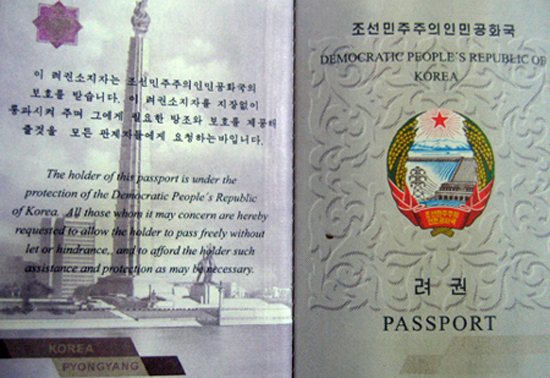
A recent traveler to the DPRK managed to get a picture of the inside of a DPRK passport—sadly not the biographical page, but interesting nonetheless:

dprk-passport.jpg

Click on image for larger view

Share