Rason news from Germany

July 8th, 2010

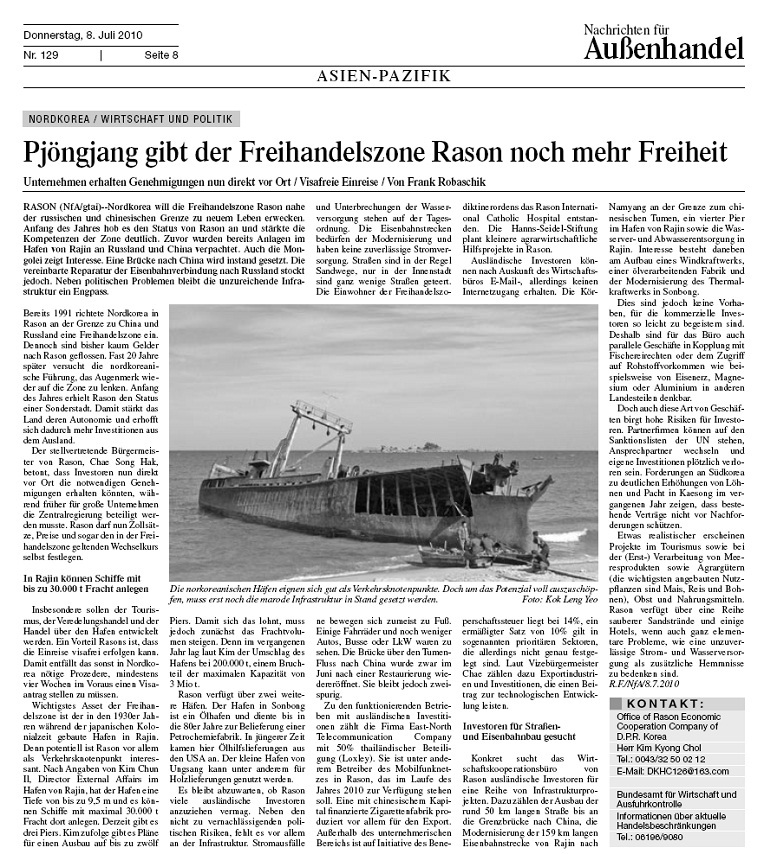
A (much appreciated) reader in Germany sent me an interesting article from the German publication Nachrichten fuer Aussenhandel (News for Foreign Trade), which is a government-sposored daily paper promoting foreign trade. 

The full article is available in German below, but in summary, the Vice Major of Rason, Mr. Chae Song Hak has started an initiative to promote the Rason free trade zone. The zone can be reached visa free and investors can obtain all required permits locally within the zone—without having to involve the central Government in Pyongyang.  Rason also, independently sets duty rates and local prices (I suppose for labour as well as for utility- and other local services) as well as applicable exchange rates within the zone.

If there are any German readers who care to provide a bit more informaiton about this article, I would appreciate it. 

Click image below for full story (in German and in JPG format):

rason-news-for-foreign-trade.jpg

Share

June 2010 DPRK Business Monthly

July 8th, 2010

Long time DPRK watcher Paul White has published the latest issue of DPRK Business Monthly. 

You can download the PDF here.

Here are the topics covered:
Offshore NK Oil Probe On Track
China to Boost Cooperation with NK
DPRK Has IT Outsourcing Potential
Introduction to Nosotek
Choson Exchange Students to Visit DPRK
UNICEF Plans US$130 Million for NK
ROK Aid Groups Urge Seoul to Lift Ban
Inter-Korean Trade Shrinks in May
Some ROK Companies Allowed to Send Money to NK
NK Embracing CNC Machine Tool Era
DPRK Economy Contracts 0.9%: BOK
North Korea Moving Into Internet World
Environmental Protection High Priority: KCNA
More Efficient Sterilizer for Seeds
Pyongyang Has Over 150 Pubs
New Beverage Multiplies Brain Cells
NK Promoting Rice Wine Exports
NK Researchers Develop “Stone Paper”

Share

Nomura: More ‘Bad Behavior’ from N. Korea Possible before G20 Summit

July 8th, 2010

According to Yonhap:

North Korea could take more provocative acts before the November summit of the Group of 20 nations in South Korea if history is any indication, a Japanese investment bank said on June 4.

Nomura International warned that North Korea may display more “bad behavior” similar to the March sinking of South Korea’s 1,200-ton corvette Cheonan, of which North Korea stands accused.

“Experts are wondering whether North Korea’s bad behavior… may be no coincidence,” said Alastair Newton and Kwon Young-sun, two Nomura economists, explaining that North Korea has done similar acts when South Korea hosted global events.

North Korean agents bombed a Korean Air jet in mid-air 10 months before the 1988 Seoul Olympics, killing all 115 passengers and crew members on board, while naval ships of the two Koreas clashed in the Yellow Sea in 2002, the year South Korea co-hosted the World Cup event with Japan.

“Especially given the domestic stresses and strains from which North Korea appears to be suffering at present, we should be braced for the possibility of more of the same — and, possibly, worse — for some time to come,” the economists said in a 40-page report titled “North Korea: Through a Glass Darkly.”

The economists expected that tensions on the Korean Peninsula will ease somewhat shortly, but were skeptical whether there will be practical progress in the global efforts to denuclearize the secretive regime.

“If the six-party talks resume — and we believe they may as China in particular looks to keep Pyongyang in check without risking regime collapse — we are doubtful that North Korea will be prepared to make or deliver on meaningful concessions in response to the demands of the international community,” the report said.

Nomura said it sees a low probability of North Korea’s imminent collapse, especially in the run-up to Kim Jong-il’s succession and the 100th anniversary of the birth of Kim Il-sung, the leader’s father and the founder of the regime, in 2012.

At the same time, the bank doubted the political status quo in Pyongyang is sustainable for more than a short period.

While placing a relatively low probability on the reunification of the two Koreas in the foreseeable future, the Nomura report said the cost of the reunification will be heavy and burdensome.

In order to reduce the possible costs, the Nomura economists suggested of adopting “less ambitious and more realistic” methods — such as the “one country, two systems” model used by China and Hong Kong.

You can download the Nomura report here (PDF).

Additional reports and statistics on the DPRK economy can be found here.

Congressional Research Service (CRS) reports can be found here.

Other unrelated studies can be found on this post as well.

Share

Aidan Foster-Carter offers DPRK current events summary…

July 8th, 2010

In the East Asia Forum:

June 2010 saw two major anniversaries on the Korean peninsula. On June 25 sixty years ago the Korean People’s Army (KPA) invaded the South launching a bitter three-year war. North Korea still denies culpability, claiming it was repelling a Southern invasion; despite overwhelming evidence, now backed by Soviet archives, that it was the aggressor. No less mendaciously Pyongyang nonetheless celebrates the July 27, 1953 Armistice which ended open hostilities as a ‘brilliant victory in the Fatherland Liberation War’ — even though this left the North bombed and napalmed to ruination.

China still formally backs the North’s version, but this year some brave soul decided to take seriously the late Deng Xiaoping’s instruction to ‘Seek truth from facts.’ The International Herald Leader, an affiliate of Xinhua news agency let the cat out of the bag. It featured interviews with Chinese historians telling the true story, and a timeline stating that ‘The North Korean military crossed the parallel on June 25 1950 and Seoul was taken in four days.’ Naturally, the article rapidly vanished from the web. But many Chinese now are openly critical of the DPRK, and embarrassed that Beijing continues to toe Pyongyang’s line.

North Korea itself sticks to the old tunes. On June 22 the Korean Central News Agency (KCNA) reported what it headlined as ‘Revenge-vowing Meetings.’

Youth and students and agricultural workers gathered in Susan-ri… and in Sinchon … Tuesday to vow to take revenge upon the U.S. imperialists on the occasion of the ‘June 25, the day of the struggle against the U.S. imperialists’.

The reporters and speakers at the meetings recalled that the U.S. imperialists brutally destroyed cities, villages, factories and farms and killed innocent civilians…denouncing the Yankees as a herd of wolves in human skin and the Koreans’ sworn-enemy with whom they cannot live under the same sky…

They bitterly condemned the U.S. imperialists and the Lee group of traitors for totally negating the historic June 15 North-South Joint….

If the U.S. imperialists intrude into the DPRK even an inch, all the servicepersons and people will mercilessly wipe out the aggressors.

Rhetoric like the above is clearly intended to fan the flames of hatred.

A further KCNA item on June 24 purported to list the ‘Tremendous Damage Done to DPRK by US.’ The KCNA, with unusual precision, computed a total of nearly 65 trillion dollars for human and material losses inflicted from 1945 up to the present. Considering the state of US public finances, Kim Jong-il should not expect a cheque any time soon. There is also a degree of inflation; last time KCNA published such an exercise, in November 2003, the bill was a mere US$ 43 trillion. One can only wonder what is the point of such grandstanding.

So savage a mood has torpedoed a second anniversary; one which should have been happier. On June 13 2000 South Korea’s then president, the veteran democrat Kim Dae-jung flew to Pyongyang for the first ever inter-Korean summit with the North’s leader, Kim Jong-il. On June 15 they signed a North-South Joint Declaration; Kim Dae-jung was awarded that year’s Nobel Peace Prize. Thus began a decade of unprecedented North-South cooperation, albeit patchy and one-sided. This ‘sunshine’ policy was ended by South Korea’s current president, Lee Myung-bak, who insists that the North must give up its nuclear weapons first if it wants better ties with the South. That sounds fine in theory, but few expect it will ever happen.

North Korea made much of the June 15 anniversary, even while excoriating the ‘traitor’ Lee Myung-bak for trampling on it. Pyongyang warmly welcomed a South Korean radical priest, Han Song-ryeol, who made the trip illegally to mark the occasion.

South Korea by contrast played up the war anniversary more than the inter-Korean one. Lee Myung-bak used this occasion to once again call on the North to admit that it sank the ROK corvette Cheonan on March 26, and to apologise.

Will the Cheonan go unpunished?
Nevertheless, it looks increasingly like Pyongyang has got away with it. June brought Lee Myung-bak little joy on the issue, at home or abroad. Local elections in South Korea on June 2 saw his ruling Grand National Party (GNP) rebuffed. Many voters saw Lee’s tough first reactions, which roiled global markets, as adding to rather than reducing risk.

Abroad too Lee has met obstacles. Assured of firm US and other Western support he is struggling to convince Russia and China. That was predictable: for Beijing and Moscow, unwillingness to paint Pyongyang into a corner was always going to trump the facts. A Russian naval team visited Seoul to inspect the Cheonan wreckage, including DPRK torpedo parts, but is not expected to report until July. In this light the ROK government will be relieved that the G-8 summit in Canada on June 25 issued a strong statement on the Cheonan – after energetic lobbying by Japan’s new prime minister Naoto Kan, which will get his relations with Lee Myung-bak off to a good start. Connoisseurs of diplomatic wordplay noted that while the G-8 condemned the attack, noted that an international team had blamed it on Pyongyang, and called on the DPRK to avoid any attacks against the ROK, it did not quite join up all those dots; doubtless at Moscow’s behest. Lee may lobby similarly when he arrives for the ensuing G-20 summit; although since South Korea chairs the group and will host its next jamboree in Seoul in November, it may look bad if he were perceived as acting in too particularist a way.

Earlier, on June 4 South Korea formally referred the Cheonan incident to the UN Security Council (UNSC). On June 14 both Korean states briefed the UNSC, with the North as ever denying all responsibility and urging the Council not to consider the matter. No official response is expected until July. With Russia and China likely to abstain at best, whatever the Security Council eventually comes up with looks set to be a damp squib. South Korea has already said it will not seek further sanctions, on top of those already in force under earlier UNSC resolutions from 2006 and 2009 after the North’s two nuclear tests. But it would like a clear, resounding condemnation, preferably in the form of a resolution.

Looking ahead, it is not too soon to wonder how the two Koreas will get past Cheonan. Record numbers of DPRK workers at the Kaesong Industrial Zone (KIZ) – 44,000 as of June, according to the ROK unification ministry (MOU) – are seen in Seoul as a sign that at some level Pyongyang remains committed to this joint venture at least.

A big event in September
Meanwhile North Korea looks more preoccupied with the succession issue than in reaching out to South Korea.

On June 26 KCNA reported that ‘the Political Bureau of the WPK [Workers’ Party of Korea] Central Committee decides to convene early in September … a conference of the WPK for electing its highest leading body reflecting the new requirements of the WPK.’

Though nominally it is North Korea’s ruling communist party, and still an important tool of control at lower echelons, the WPK has seen its topmost organs atrophy under Kim Jong-il. Neither the rarely mentioned Politburo nor the Central Committee (CC) is known to have met at all in the 16 years since Kim Il-sung died. Kim Jong-il has favoured the army, ruling through the NDC and informally via a kitchen cabinet of trusted cronies. The dear leader is also of course secretary-general of the WPK, but he acquired that post irregularly: by acclamation at a series of local Party meetings, rather than being duly elected by the CC.

Hence while the precise nature of September’s meeting remains vague, like its exact date, it looks like a long overdue effort to restore a measure of due process to the Party. If this is in fact a full formal WPK congress, it would be the first since the Sixth Congress thirty years ago in October 1980. It was then that Kim Jong-il, hitherto veiled behind coded references to a mysterious ‘Party Centre’, was finally revealed in the flesh. The speculation is that this new meeting similarly will finally give the world a glimpse of the enigmatic Kim Jong-eun.

While all rumours emanating from Seoul should be treated carefully it’s hard not to link this news with reports that Kim Jong-il’s health is worsening. There are claims that on some aides including his son are duping him with Potemkin factories to hide from him how dire the economy really is. An already tardy succession can clearly brook no further delay, or else regime stability and continuity may be gravely imperilled.

The economy shrank again last year
If Kim Jong-il wants to know how his economy is really doing, he could look at the latest estimates from the enemy.

The (southern) Bank of Korea (BOK) published its latest estimates, covering 2009, on June 24, just in time for Seoul to crow about them as it marked the Korean War anniversary. By this reckoning North Korea’s real annual gross domestic product (GDP) shrank by 0.9 per cent last year. Unlike most other countries this had little to do with the global financial crisis. Rather it reflected local conditions, natural and man-made.

The gaps just get wider
The result is a huge and ever widening gap. North Korea’s gross national income (GNI) in 2009 was a mere 2.7 per cent of the South’s. BOK cites Northern GNI in 2009 was US$22.4 billion, compared to US$837 billion for the South. True, the South has over twice as many people. But the average North Korean per capita income too is a minute fraction of the South’s, with the ROK topping US$17,000 while the DPRK’s is a paltry US960. (Some experts, including a former unification minister, think even this is too high and posit a figure nearer US$300, putting North Korea among the poorest nations on earth.)

With trade figures the gap is even wider. This year inter-Korean trade will fall, since Seoul has banned most of it (except the Kaesong zone, which accounts for over half) as punishment for the Cheonan. Peanuts to the South, this has been crucial for the North: South Korea is its largest market, taking almost half of its meagre total exports. Last year inter-Korean trade like DPRK trade overall fell slightly, from US$1.82 to US$1.68 billion. Yet Northern exports crept up, from US$932 to 934 million.

In 2009 North Korea’s real trade totals were just under US$2 billion in exports and US$3.1 billion in imports. They are still dwarfed by South Korea’s respective figures of US$364 and US$324 billion – and this in a bad year for the South, due to the downturn.

Every year the gap widens further, yet still Kim Jong-il refuses economic reform. It is hard to fathom a mind-set which can inflict such disaster and tragedy on a once proud land and people – and whose idea of a way out of its self-dug hole is to fire a sneaky torpedo.

Good losers
It was left to North Korea’s footballers to remind the world that their country does not lack for talent and virtue. As one would expect, North Korea were a disciplined team. They kept to themselves and avoided the press – with one striking exception, Jong Tae-se. Born in Japan to a South Korean father and a pro-North Korean mother, and having attended schools run by Chongryun – the organisation of pro-North Koreans in Japan – he elected to play for the DPRK; although he still holds ROK nationality, lives in Japan and plays in the J-League for Kawasaki Frontale.

A young man whose talk is as uninhibited as his style of play, Jong cried when the DPRK anthem was played before the Brazil match. Yet his love for his adopted homeland is not uncritical. ‘Everybody thinks about our country as being closed and mysterious, so we have to change that,’ he told AFP. ‘We can change for the better if we are more open with the way we talk to people and it would make a better team.’

It would make a better country too. If North Korea’s fate must rest in the hands of an untried youth, better it were the warm-hearted and wised-up Jong Tae-se than Kim Jong-eun.

Read the full story here:
North Korea: Unhappy anniversaries
East Asia Forum
Aidan Foster-Carter
7/6/2010

Share

Market prices stable

July 8th, 2010

According to the Daily NK:

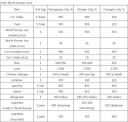
Food price in North Korea at the end of spring held steady against food prices in March, and worries about an impending famine proved unfounded.

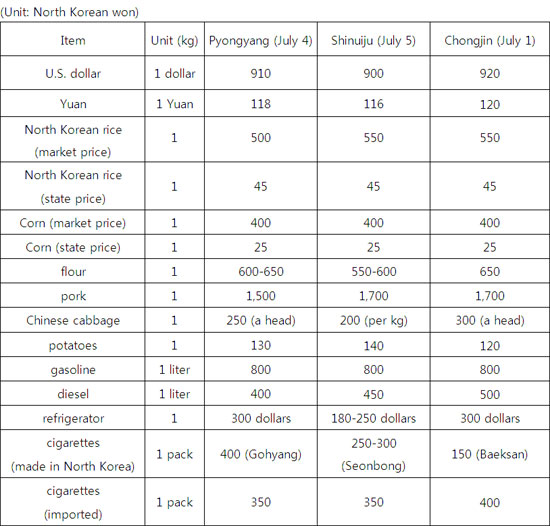
The Daily NK has looked at market food prices in Pyongyang, Shinuiju, and Chongjin over the first week of July. Everywhere, rice cost about 500 won while corn cost about 400 won. Compared to food prices in March, during the period when food is traditionally in the shortest supply, rice prices were much the same, whereas corn prices had risen by 50 percent.

A source inside North Korea explained, “Since the redenomination, some people have dropped from ‘middle income’ to ‘poor.’ As a result, demand for corn has increased, and that is the reason why corn prices have gone up. Some people still eat rice; however, many of those who used to eat rice are now feeding their families on corn.”

“Because of the planting battle, market hours were made shorter, but the market is running smoothly and food prices are stabilizing.”

However, the source conceded that the food security of senior citizens with no family support and homeless children seems to be very bad. The source said some of these people are indeed dying of malnutrition and disease, though not outright starvation.

So, while the food supply situation in North Korea is not in unusually poor shape, it seems that the aftereffects of last year’s redenomination are still taking effect,

Corn prices have increased by almost 100 won on average in the last month, and flour prices have also increased by about 200 won.

However, the price of fuels such as gasoline and diesel either remained the same or decreased slightly. Gasoline remains at 900 won, which is a hundred won less than it was in May. Diesel remains at 400 won, which is 200 hundred won less than it was.

Since last year, North Korea has been pursuing various construction projects as part of its goal of building a strong and prosperous state by 2012. It is possible that fuel heading for construction sites is finding its way into the markets.

Here is the data in JPG format!

2010-7-7-dnk-food-data.jpg

Read the full story here:
Market Prices Holding Firm
Daily NK
http://www.dailynk.com/english/read.php?cataId=nk01500&num=6568
Yang Jung A
7/7/2010
 

Share

Burma-North Korea Ties: Escalating Over Two Decades

July 7th, 2010

According to the Irrawaddy:

A recent New York Times op-ed article by Aung Lynn Htut, formerly a high-ranking Burmese military intelligence officer who defected in 2005 while he served as an attaché at the Burmese embassy in Washington, shed new light on the history of the still murky relationship between Burma and North Korea, two of the world’s most isolated, secretive and oppressive regimes.

Burma broke diplomatic relations with North Korea in 1983, when North Korean agents attempted to assassinate the South Korean president on Burmese soil. But according to Aung Lynn Htut, shortly after current junta-chief Snr-Gen Than Shwe assumed power in 1992, he surreptitiously moved to renew ties with Pyongyang.

“Than Shwe secretly made contact with Pyongyang. Posing as South Korean businessmen, North Korean weapon experts began arriving in Burma. I remember these visitors. They were given special treatment at the Rangoon airport,” Aung Lynn Htut said in his June 18 article.

The junta kept its renewed ties with North Korea secret for more than a decade because it was working to establish relationships with Japanese and South Korean businesses, Aung Lynn Htut said. By 2006, however, “the junta’s generals felt either desperate or confident enough to publicly resume diplomatic relations with North Korea.” 

In November 2008, the junta’s No 3, Gen Shwe Mann, visited North Korea and signed a memorandum of understanding, officially formalizing military cooperation between Burma and North Korea. Photographs showed him touring secret tunnel complexes built into the sides of mountains thought to store and protect jet aircraft, missiles, tanks and nuclear and chemical weapons.

According to Aung Lynn Htut, Lt-Gen Tin Aye, the No.5 in the Burma armed forces and the chief of Military Ordnance, is now the main liaison in the relationship with Pyongyang. Tin Aye has often traveled to North Korea as well as attended ceremonies at the North Korean embassy in Rangoon.

In September 2009, The New Light of Myanmar reported that Tin Aye went to the anniversary celebration of the Democratic People’s Republic of Korea (DPRK), held in a hotel in Rangoon. In February, Tin Aye, along with other senior officials, attended the birthday event of the Dear Leader of North Korea at the embassy.

Flights and ships from North Korea to Burma have been carrying more than just Burmese generals. Analysts, including Burma military expert Andrew Selth, say that for years Burma and North Korea have used a barter system whereby Burma exchanges primary products for North Korean military technologies.

In June 2009, a North Korean ship, the Kang Nam I, was diverted from going to Burma after being trailed by the US navy. Then in April, another North Korean ship, the Chong Gen, docked in Burma carrying suspicious cargo, allegedly in violation of the UN Security Council Resolution 1874, which restricts North Korea from arms deals and from trading in technology that could be used for nuclear weapons.

In May, the seven-member UN panel monitoring the implementation of sanctions against North Korea said in a report that Pyongyang is involved in banned nuclear and ballistic activities in Iran, Syria and Burma with the aid of front companies around the world.

According to the UN report, a North Korean company, Namchongang Trading, which is known to be associated with illicit procurement for Burma’s nuclear and military program and is on the US sanctions list, was involved in suspicious activities in Burma.

The report also noted three individuals were arrested in Japan in 2009 for attempting to illegally export a magnetometer—a dual-use instrument that can be employed in making missile control system magnets and gas centrifuge magnets—to Burma via Malaysia allegedly under the direction of another company known to be associated with illicit procurement for North Korea’s nuclear and military programs.

The UN experts also said that the Korea Kwangson Banking Corporation has handled several transactions involving millions of dollars directly related to deals between Burma and the Korea Mining Development Trading Corporation.
 
With this string of events and the suspicions surrounding them as a dramatic lead in, on June 4, Al Jazeera aired a news documentary prepared by the Democratic Voice of Burma (DVB) which was written by Robert Kelley, a nuclear scientist and former director of the International Atomic Energy Agency (IAEA). The DVB report claimed that the ruling military junta in Burma is “mining uranium, converting it to uranium compounds for reactors and bombs, and is trying to build a reactor and/or an enrichment plant that could only be useful for a bomb.”

The IAEA wrote to Burma’s agency representative, Tin Win, on June 14 and asked whether the information provided in the DVB report was true. Burma, which is a member of the IAEA, a party to the Nuclear Non-Proliferation Treaty and a signatory to the Southeast Asia Nuclear-Weapon-Free Zone Treaty, responded with a letter stating that the DVB report allegations are “groundless and unfounded.”

“No activity related to uranium conversion, enrichment, reactor construction or operation has been carried out in the past, is ongoing or is planned for the future in Myanmar [Burma],” the letter said.

The letter also noted that Burma is a signatory of the Nuclear Non-Proliferation Treaty and the agency’s so-called safeguards agreement. “As stated in the safeguards agreement, Myanmar will notify the agency if it plans to carry out any nuclear activities,” the letter said.

The regime, however, has not signed the IAEA’s Additional Protocol, meaning that the agency has no power to set up an inspection of Burma’s nuclear facilities under the existing mechanism known as the Small Quantities Protocol.

Previously, on June 11, Burma’s state radio and television news had reported the Foreign Ministry’s denial of the allegations in the DVB report. The denial claimed that anti-government groups in collusion with the media had launched the allegations with the goal of “hindering Burma’s democratic process and to tarnish the political image of the government.”

The Foreign Ministry denial also addressed Nyapyidaw’s relationship with Pyongyang. “Following the re-establishment of diplomatic relations, Myanmar [Burma] and the DPRK, as independent sovereign states, have been engaging in promoting trade and cooperation between the two countries in the same way Myanmar is dealing with others,” the ministry said in its statement.

The regime did acknowledge that the Chong Gen docked at Thilawa Port near Rangoon in April. But the statement said the North Korean vessel was involved in importing cement from North Korea and exporting rice from Burma.

But in an article for Asia Times online, Burma analyst Bertil Linter noted that, “if carrying only innocuous civilian goods, as the statement maintains, there would seemingly have been no reason for authorities to cut electricity around the area when the Chong Gen, a North Korean ship flying the Mongolian flag of convenience, docked on the outskirts of Yangon.”

“According to intelligence sources, security was tight as military personnel offloaded heavy material, including Korean-made air defense radars. The ship left the port with a return cargo of rice and sugar, which could mean that it was, at least in part, a barter deal. On January 31 this year, another North Korean ship, the Yang M V Han A, reportedly delivered missile components also at Yangon’s Thilawa port,” Linter said.

Strategypage.com, a military affairs website covering armed forces worldwide, said, “Indications are that the North Korean ship that delivered a mysterious cargo four months ago, was carrying air defense radars (which are now being placed on hills up north) and ballistic missile manufacturing equipment. Dozens of North Korean technicians have entered the country in the last few months, and have been seen working at a military facility outside Mandalay. It’s unclear what this is for. Burma has no external enemies, and ballistic missiles are of no use against internal opposition.”

In his Asia Times online story, Lintner noted that on June 24, the DVB reported that a new radar and missile base had been completed near Mohnyin in Myanmar’s northern Kachin State, and he reported that work on similar radar and missile bases has been reported from Kengtung in eastern Shan State,160 kilometers north of the Thai border town of Mae Sai.

“Since Myanmar is not known to have imported radars and missile components from any country other than North Korea, the installations would appear to be one of the first visible outcomes of a decade of military cooperation,” Lintner said.

Lintner also reported that Western intelligence sources know that 30 to 40 North Korean missile technicians are currently working at a facility near Minhla on the Irrawaddy River in Magwe Division, and that some of the technicians may have arrived overland by bus from China to give the appearance of being Chinese tourists. 

North Korea has also issued adamant denials with respect to allegations regarding its relationship with Burma.

According to the Korean Central News Agency (KCNA), on June 21 Pyongyang said, “The US is now making much fuss, floating the sheer fiction that the DPRK is helping Myanmar [Burma] in its nuclear development.”

The KCNA often highlights the close relationship between North Korea and Burma.

On June 20, the Pyongyang news agency reported that ex-Col Than Tun, deputy chairman of the Union of Myanmar Economic Holding Ltd., sent a statement cheering Kim Jong Il’s 46th anniversary at the Central Committee of the ruling Workers’ Party of Korea.

On April 18, Korean state-run- media reported that Than Tun also issued a statement cheering the 17th anniversary of Kim Jong Il’s chairing of North Korea’s National Defense Commission.

“Kim Jong Il’s field inspection of KPA [Korean People’s Army] units served as a main source that helped bolster [North Korea’s] self-reliant defense capability in every way,” the statement noted.

Military sources said the Union of Myanmar Economic Holding Ltd, managed by the junta, is responsible for purchasing imported weapons for Burma’s armed forces, including transferring money to overseas banks such as Korea Kwangson Banking Corporation.

Meanwhile, in addition to its escalating relationship with North Korea, the Burmese military regime has recently boosted ties with Iran, which according to the UN report is also allegedly receiving nuclear and missile technologies from North Korea.

In recent years, Burmese and Iranian officials visited their counterparts homeland for the purported purpose of improving economic ties. Observers, however, said Than Shwe has made a tactical decision to develop relationships with other “pariah states,” particularly enemies of the US, to relieve Western pressure on his regime.

Iranian Deputy Foreign Minister Mohammad Ali Fathollahi met Burmese Foreign Minister Nyan Win and Minister of Energy Lun Thi during his trip to Burma on June 15-17.

“The two sides reiterated their desire to further expand the ties of friendship and economic cooperation and to increase cooperation in the regional international forums such as [the] United Nations and Non-Aligned Movement,” The New Light of Myanmar reported on June 18.

Fathollahi’s visit came three months after Maung Myint’s visit to Iran on March 8-11, when he met Iranian Foreign Minister Manochehr Mottaki and Deputy Minister of Petroleum H. Noghrehkar Shirazi.

Read the full story below:
Burma-North Korea Ties: Escalating Over Two Decades
Irrawaddy
Wai Moe
7/7/2010

Share

10 North Koreans presumably killed in Kaesong bus accident

July 7th, 2010

According to Yonhap:

Ten North Korean workers presumably died and about 40 others were injured last week when two buses carrying them collided with each other at the communist state’s border industrial complex joint run by South Korean firms, officials here said Wednesday.

The collision took place Friday evening at an intersection at the Kaesong industrial park where about 120 South Korean firms employ 42,000 North Koreans to produce labor-intensive goods.

Citing South Korean witnesses, police in the South Korean border city of Paju said that a commuter bus hit another on the side amid heavy rains but no South Koreans were aboard the buses.

“The case was reported by South Korean workers traveling to and from the Kaesong complex,” a police official said, declining to be identified. “The exact number of casualties and how the accident happened have not been ascertained.”

An official at the Unification Ministry, which handles inter-Korean matters, said North Korean authorities blockaded the area after the collision, making it difficult to determine casualties.

“The North would not let us know about the accident,” he said, also declining to be identified.

The factory park is the last remaining symbol of reconciliation between the two Koreas, which remain technically at war after the 1950-53 Korean War ended in a truce rather than a peace treaty.

Its fate has increasingly hung in the balance this year as tensions rise along the inter-Korean border over the deadly March 26 sinking of a South Korean warship off the west coast.

Read the full story here:
10 N. Koreans presumed killed in bus collision at joint factory park with S. Korea
Yonhap
7/7/2010

Share

KDI sees continuing economic contraction in DPRK

July 6th, 2010

According to the AFP:

North Korea’s economy is expected to continue shrinking this year after South Korea cut off most trade in protest at the sinking of a warship, a report said Tuesday.

“The North is very likely to see its economy shrink this year,” said the report from South Korea’s state-run Korea Development Institute (KDI), without estimating a figure.

“Our outlook is based on a forecast that its external trade will likely post a setback.”

The communist state’s economy contracted 0.9 percent in 2009, according to an earlier report from the South’s central bank.

The South in May announced a ban on most trade after a multinational investigation concluded that a North Korean torpedo sank the warship in March with the loss of 46 lives.

The KDI said at the time the ban would cost the impoverished North hundreds of millions of dollars a year, noting that Pyongyang posted a 333 million dollar trade surplus with its neighbour last year.

The South’s central bank says the North’s economy shrank 1.1 percent in 2006 and contracted by 2.3 percent in 2007, but grew 3.1 percent in 2008 until contracting again last year.

A further shrinkage this year could spark an economic crisis, Tuesday’s report said.

“North Korea’s economy could be hurled into a very precarious situation,” it said.

“As experienced by the nation in the mid-1990s, a crisis could more likely be prompted by consecutive contractions for a relatively long period of time, rather than a one-off steep economic downturn.”

The North’s economy fell deep into trouble in the 1990s after the break-up of the Soviet Union and the loss of its crucial aid.

The country suffered famine in the 1990s which killed hundreds of thousands and it still grapples with severe food shortages.

Since 2005 the regime has been reasserting its grip on the economy, with controls or outright bans on private markets.

A currency revaluation last November, designed to flush out entrepreneurs’ savings, backfired disastrously. It fuelled food shortages as market trading dried up and sparked rare outbreaks of unrest.

The North was forced to suspend its campaign against free markets.

The United Nations in June last year tightened sanctions following the North’s missile launches and nuclear test earlier in the year.

Read the full story here:
N.Korea economy to shrink on trade cutoff: report
AFP
7/5/2010

Share

China-DPRK trade rises

July 6th, 2010

According to Yonhap:

Trade between North Korea and China in the January-May period increased 18 percent compared to last year, a sign that Pyongyang continues to expand economic ties with Beijing amid soured relations with Seoul, figures showed Tuesday.

North Korea imported US$727.2 million worth of goods from China and exported $256.4 million in the five-month period this year, according to figures recently released by Chinese customs authorities and obtained by Yonhap News Agency.

Read the full story here:
Trade between N. Korea, China rises, signaling closer economic ties
Yonhap
Sam Kim
7/6/2010

Share

Donor fatigue…

July 6th, 2010

According to Kang Hyun-kyong in the Korea Times:

As a veteran aid worker, Wolfgang Gerstner was weary of a vicious circle of escalating tensions between South and North Korea after the latter was found to be responsible for the sinking of the warship Cheonan on March 26.

According to the German consultant working for international aid group Caritas Germany, North Korea’s bellicose acts have led those outside the country who have tried to help it to harden their attitudes.

This has resulted in a decrease of donations, causing children there to live without vaccinations for example.

Gerstner, 53, went on to say that children and ordinary people living in the impoverished North, whose living standards couldn’t be worse, suffer the unintended consequences of the regime-led provocations.

“It is difficult for people living outside North Korea to separate ordinary people living in the North from the regime,” Gerstner, who oversees Caritas’s humanitarian aid program to North Korea (the CI-DPRK program), said last Thursday in an interview with The Korea Times at a hotel in Seoul.

Caritas relies on donations from individual and corporate members to sustain their humanitarian aid to less developed nations in Africa, Asia, and Latin America.

The aid organization also receives funds from the German government and Catholic churches here in Korea for the vaccination campaign for North Korean children.

North Korea is one of the nations where the rate of child mortality is alarmingly high.

According to United Nations Children’s Fund (UNICEF), 55 of every 1,000 children in North Korea die before they turn five.

Child mortality can be largely preventable if young children are vaccinated.

The North issuing a threat, however, is a stumbling block to the international effort to save children there.

When recipient governments make threats, it is natural for people living outside those nations to harden their view toward them, making donors or potential donors rethink their contribution.

“I don’t have the exact figure regarding the loss in donations after the provocation, but it certainly does have an effect on the amount,” Gerstner said.

“Escalating tensions make it difficult for aid workers like me to convince our donors to contribute to humanitarian assistance for the people there.”

Catastrophic security

The German aid worker sat down with the reporter days after wrapping up his recent visit to North Korea from June 8 to 12 this year for the regular vaccination program.

During the four-day field trip, Gerstner and August Stich, a medical advisor working with the Medical Mission Hospital Wuerzberg in Germany, visited the Sadong Tuberculosis Center, the new national laboratory at the Pyongyang Tuberculosis Hospital.

The two-man delegation also met with officials from the North Korean Ministry of Public Health and experts in medical institutes in Pyongyang and in the neighborhood of the North’s capital.

They made the June visit after about 500,000 North Korean children aged from seven to 16 years old were vaccinated in three rounds from February to April, thanks to the Caritas program.

Since March 2007 when he was first called upon to handle the CI-DPRK program, Gerstner has been to the North approximately 20 times for talks with his North Korean counterpart — the Ministry of Public Health.

His most recent trip came at a time when tension on the Korean Peninsula has shown little sign of subsiding after a multinational investigation team concluded last month that a North Korean torpedo was responsible for taking the lives of 46 sailors.

The North has denied it.

In an attempt to teach North Korea a lesson that any criminal acts will invite punishment, South Korea referred the Cheonan case to the U.N. Security Council (UNSC) in early June, calling for retaliatory measures against the North for the unacceptable act.

North Korea has claiming it is “innocent” and further threatened to take “counter-measures” if the UNSC sides with the multinational team over the probe results and comes up with punitive measures against it.

The two Koreas’ engaging in a game of chicken in the wake of the sinking of the ship has led to international media headlines featuring the peninsula on the verge of a war.

A vicious circle

The security standoff has spillover effect on humanitarian assistance to the North.

Disappointed, individual and corporate donors have become skeptical about contributing money or goods for the improvement of living conditions in the North.

Lesley-Anne Knight, secretary general of Caritas, expressed her concern over the unintended consequences of rising tensions last Tuesday during a news conference held in Seoul.

“This tension, of course, makes it much more difficult for us as humanitarian actors to maintain a neutral and impartial interest at the international level for North Korea,” Knight said.

“When there is a bellicose act, when people start to feel concerned about conflict escalating, international attention and the sympathy perhaps of the international humanitarian community for the plights of the (North) Korean people tends to diminish, tends to wane.”

Knight went on to say that “that is the extreme concern for us.”

Caritas, which has spent a total of $33 million on humanitarian aid and development in North Korea since 1995, called for a continuation of assistance.

The reaction came weeks after the South Korean government’s halt of assistance to the North in retaliation for its torpedo attack on the ship.

“(Humanitarian assistance) is absolutely essential for us. The situation of the majority of the North Korean people is that most of them are struggling to get their daily basic needs. Most specifically, food and health,” Knight said.

‘N. Korean kids are brave’

In his previous visits to the North in March, Gerstner had opportunities of taking a closer look at the facilities of clinics, institutes, and primary and secondary schools, while monitoring the North’s implementation of Caritas’s vaccination programs.

“Compared with South Korean hospitals and their amenities, hospitals in the North are less modern. Doctors there have to rely more on traditional medicine as they don’t have necessary facilities and medicine,” he said.

He called North Korean children “very brave.”

“It happens in other countries that school age children cry when they wait for their turns in line for taking vaccination shots. But North Korean children never cried even when they took the shots,” he said.

Previously, Gerstner was involved in several emergency relief programs in Africa, Latin America and the former East Germany. He helped organize rehabilitation programs in the local community.

Gerstner said North Korean teachers and children were “friendly and open-minded” when meeting with him, although they never spoke.

He said the most difficult part when implementing the aid program to North Korea was access to information and communication.

“For planning, we need information and have to communicate with our counterpart. The ministry has no email account, making it more difficult for us to execute the program,” he said.

Read the full article here:
Donors turn their back on N. Korea for provocation, putting kids at risk
Korea Times
Kang Hyun-kyung
6/28/2010

Share