Kaesong exports to ROK remain constant

July 20th, 2010

According to Yonhap:

The volume of goods brought into South Korea from a joint factory park in North Korea has remained unchanged despite Seoul’s trade ban slapped on Pyongyang in May in retaliation for its deadly attack on a South Korean warship, the government here said Tuesday.

The volume of products transported from the Kaesong industrial park stood at 6,953 tons in June, compared to 7,004 tons a month earlier when South Korea banned trade with North Korea and cut the number of South Korean workers staying in the North Korean border town, the Unification Ministry said in a release.

“There has been little difference in the amount of manufactured products brought in since the May 24 measures,” which the South imposed after a multinational investigation found the North responsible for the March sinking of the Cheonan, it said.

Ministry spokesman Chun Hae-sung said currency conversions for the data were not immediately available.

North Korea has denied any responsibility for the attack in the Yellow Sea that left 46 sailors dead. About 121 South Korean firms operate in Kaesong, employing 44,000 North Korean workers — the last remaining major symbol of detente between the divided countries.

According to the ministry that handles cross-border affairs, the amount of goods brought into South Korea for the first half of this year nearly doubled compared to the same period last year. The figures signaled the Kaesong factory park continued to grow even though the relations between the Koreas have soured since 2008.

But many of the Kaesong companies have complained of falling orders and are seeking rescue funds, arguing the deteriorating political relations are increasingly becoming a liability for their businesses.

Read the full story here:
Influx of goods from inter-Korean factory park stays consistent: gov’t
Yonhap
Sam Kim
7/20/2010

Share

Lost Korean War battalion awaits US MIA decision

July 20th, 2010

According to the Associated Press:

Trapped by two Chinese divisions, troops of the 8th U.S. Cavalry Regiment were left to die in far northern Korea, abandoned by the U.S. command in a Korean War episode viewed as one of the most troubling in American military history.

Sixty years later those fallen soldiers, the lost battalion of Unsan, are stranded anew.

North Korea is offering fresh clues to their remains. American teams are ready to re-enter the north to dig for them. But for five years the U.S. government has refused to work with North Korea to recover the men of Unsan and others among more than 8,000 U.S. missing in action from the 1950-53 war.

Now, under pressure from MIA family groups, the Obama administration is said to be moving slowly to reverse the Bush administration’s suspension of the joint recovery program, a step taken in 2005 as the North Korean nuclear crisis dragged on.

“If I had a direct line in to the president, I would say, `Please reinstitute this program. There are families that need closure,'” said Ruth Davis, 61, of Palestine, Texas, whose uncle, Sgt. 1st Class Benny Don Rogers, has been listed as MIA since Chinese attackers overran his company — I Company, 8th Cavalry — at Unsan in late 1950.

It was one of Rogers’ I Company comrades, Pfc. Philip W. Ackley of Hillsboro, New Hampshire, whose identifying dog tag appeared in a photo the North Koreans handed over at Korea’s Panmunjom truce village in January of this 60th year since the war started. The North Koreans also delivered photos of remains, a stark reminder that Unsan’s dead still wait to come home.

The U.S. “has developed the humanitarian issue into a political problem,” complained a North Korean statement urging resumption of the MIA search project, which earned hard currency for the Pyongyang government.

The devastating losses at Unsan, in early November 1950, came as China intervened to fend off a final North Korean defeat. In a last letter home, dated Oct. 30, Rogers told his parents, “It is a lot better over here, but it’s not over yet.”

The U.S. command had ignored intelligence reports that China’s army was moving south, and Rogers and the 8th Cavalry had been sent too far north, just 80 kilometers (50 miles) from China, where they stumbled into a closing enemy vise.

Higher headquarters rejected requests for a pullback, then refused to send artillery forward to support a rescue effort. Finally, it ordered the rescue force withdrawn.

Two of the 8th Cavalry’s three battalions managed to escape, with heavy losses. But only small bands from the five companies of the doomed 3rd Battalion made it out as waves of Chinese infantry attacked their 200-meter-wide (200-yard-wide) defense perimeter.

The 8th Cavalry’s abandonment at Unsan became an infamous chapter in Army annals — “one of the most shameful and little-known incidents in U.S. military history,” wrote Korean War historian Jack J. Gifford.

Some 600 of the 3rd Battalion’s 800 men were lost, about half believed killed and half captured, many of whom died in Chinese-run prison camps.

The U.S. and North Korea established the MIA search in 1996 after lengthy negotiations. Over nine years, working across North Korea, the joint teams recovered 229 sets of remains believed to be those of Americans, including 14 subsequently identified as 3rd Battalion men.

But an estimated 260 U.S. dead are still unaccounted for at Unsan, among almost 4,600 U.S. MIAs in North Korea, the Pentagon’s Defense POW/MIA Office says.

When then-Defense Secretary Donald H. Rumsfeld suspended the program in 2005, officials cited what they said were concerns about the security of American personnel working on the territory of a longtime U.S. adversary.

Richard Lawless, the former Pentagon official who recommended the move, defends it today, telling The Associated Press it was a “prudent decision” because the U.S. field teams “were potential high-value hostages as the North Korean nuclear crisis deepened.”

The MIA support groups rejected that rationale, saying they suspected President George W. Bush’s administration instead wanted to break the lone working link with North Korea and pressure Pyongyang in the nuclear showdown.

“This safety aspect from the Pentagon sounds like so much hogwash,” said former 3rd Battalion sergeant Robert J. Earl, 82, of Federal Way, Washington. Earl was not at Unsan, having been wounded earlier, and for years he has sought information on his 8th Cavalry mortar platoon, all of whom may have perished.

Stepping up their lobbying in Washington last year, the MIA families appear to have made headway with the new administration.

“I’m in touch with everyone there, and they all support restoring the program,” said Frank Metersky, 77, a Marine veteran of the war and longtime MIA campaigner.

Larry Greer, spokesman for the Defense POW/MIA Office, said officials are “evaluating” a possible resumption. Other administration officials have pointedly referred to the recovery program as a humanitarian mission unrelated to political considerations. But the recent furor over North Korea’s alleged torpedoing of a South Korean warship “has stopped everything in its tracks for now,” Metersky said.

Nevertheless, U.S. specialists sound ready.

“We are prepared to resume operations in (North Korea) and will request access to the Unsan area,” the Joint POW/MIA Accounting Command in Hawaii, home to the field teams, said in its latest annual report.

Its forensic experts, meanwhile, continue the laborious work of DNA identification of remains returned years ago, like those of Master Sgt. Roy Earl Head of the 7th Infantry Division, finally identified, brought home and buried June 5 in a family cemetery in Grit Hill, Virginia.

“It’s remarkable, after 59 years,” said brother David Head, 71, of Kingsport, Tennessee.

All his life he thought daily about Roy, he said. His mind turned sympathetically to others.

“There are still a lot more families out there who might not ever find out, or get the closure we will get,” Head said.

I know where Unsan is, but if there is anyone who can tell me specifically where US soldiers are believed to be buried, I would like to tag these locations on Google Earth.

Read the full story here:
Lost Korean War battalion awaits US MIA decision
Associated Press
Charles Hanley
7/19/2010

Share

Asian football chief meets with DPRK official

July 20th, 2010

According to Yonhap:

Asian football chief Mohamed Bin Hammam met with a North Korean official in Pyongyang on Monday, the second and last day of his two-day trip to the country, the North’s media said.

“Yang Hyong-sop, vice-president of the Presidium of the Supreme People’s Assembly of the DPRK, met and had a talk with Mohamed Hammam Saad Al-Abdulla, chairman of the Asian Football Confederation (AFC), and his party at the Mansudae Assembly Hall on Monday,” said the North’s Korean Central News Agency (KCNA) in a brief dispatch.

The AFC chief, also an executive member in FIFA, arrived in North Korea on Sunday to launch FIFA’s “Goal Project,” which helps underdeveloped countries build football fields and other sport facilities, according to the Web site of the AFC.

According to the AFC, Hammam planned wide-ranging talks with the president of North Korea’s football governing body and sports minister, before flying to China on Monday.

North Korea, which lost all three group matches in South Africa at its first World Cup in 44 years, was offered free World Cup footage in line with FIFA’s policy to promote football in poor countries.

In a separate report later on Monday, the KCNA also said that a new training camp with 60 beds has been built for the North’s national football team under the FIFA Goal Project.

The report said the camp, with a floor space of more than 2,100 square meters, has bedrooms, dining halls, bath rooms, a swimming pool and a video room, adding the opening ceremony took place on Monday with the attendance of Hammam and North Korean officials.

If anyone knows where this facility is, please let me know.

There are a couple of nicely rebuilt football fields here and here, but I do not know if they are part of this particular camp.

Read the full story below:
AFC chief meets with N. Korean official
Yonhap
7/19/2010

Share

Group sues North Korea for 1972 terror attack (and wins)

July 18th, 2010

UPDATE (Oct, 3, 2010): The Los Angeles Times has also picked up this story:

Plaintiffs’ attorney Nitsana Darshan-Leitner was in her Jerusalem office in July when she got news of the Puerto Rican court’s verdict.

A judge there had just issued a $378-million civil judgment for her clients: the families of 17 Puerto Rican missionaries killed by Japanese Red Army militants at an Israeli airport in 1972.

Yet her euphoria was tempered by pragmatic reality: She would have to try to collect the judgment from a defiant North Korea, which the judge ruled had decades ago given training and support to the assailants.

Over the years, Darshan-Leitner has collected more than $72 million in judgments against Iran and the Palestinian Authority. But cash-strapped, isolationist North Korea had already ignored her legal motions and none of its officials showed up for even a day in court.

Legal judgments against Kim Jong Il and his Democratic People’s Republic of Korea in several civil cases have added up to more than $500 million. But not a dime has been collected.

The regime in “Pyongyang is secretive and they’re poor,” said Darshan-Leitner, director of the Israel Law Center, which pursues lawsuits against nations accused of sponsoring terrorism. “Since they don’t export many things, you have to look hard for the money.”

North Korea has for years been an elusive legal target. In 1988, it was added to Washington’s list of nations that sponsor terrorism. But U.S. law at the time precluded suits against foreign countries.

That changed in 1996 when Congress amended the Foreign Sovereign Immunities Act, allowing plaintiffs to pursue in court governments identified as state sponsors of terrorism. In 2008, then-President George W. Bush removed North Korea from the list after it agreed to allow international inspection of its nuclear facilities, closing the door on further lawsuits against Pyongyang.

But in the 12-year window of opportunity, some attorneys were successful in suing North Korea. In 2008, Washington-based attorney Richard Streeter won a $65.8-million judgment in a District of Columbia federal court on behalf of several crewmen of the U.S. Navy intelligence ship Pueblo, who had been held captive for 11 months by Pyongyang in 1968.

Silent for decades, the plaintiffs contacted Streeter in 2006 after his success in helping to collect on a judgment against Iran for a case involving the murder of a U.S. Navy diver by hijackers in 1985.

On Oct. 10, 2008, the day before North Korea was removed from the terrorism list, Darshan-Leitner filed suit against the regime on behalf of the family of Kim Dong Shik. The Chicago minister was kidnapped by North Korean agents in 2000 while on a trip to China and presumably died in a North Korean prison camp. The case is still pending.

Armed with her judgment in the Puerto Rico case, Darshan-Leitner is on the hunt for North Korean money and property worldwide and is looking into reports of $32 million in regime assets frozen by the U.S. government.

For his part, Streeter has filed motions against banks nationwide to disclose the names and balances on frozen accounts and has petitioned the U.S. government in court for more leads. He’s also preparing to take the search outside the country.

Plaintiffs’ attorneys are reluctant to give specifics of their search for fear of alerting target nations. In a case against Iran, Darshan-Leitner found banks in Germany and Italy where assets were being held, but by the time she filed motions, Tehran had withdrawn them, she said.

“We have some leads, but we can’t say in what countries — bank accounts that belong to the North Korean government and the Central Bank of North Korea,” she said. “When we confirm the money is there, we will approach lawyers in those countries to go to court and try to collect.”

In another case against the Iranian government, Darshan-Leitner filed motions in a Texas court to collect on funds from the sale of a seized Lubbock home once owned by the shah of Iran. She is also attempting to seize Persian antiquities kept at the University of Chicago as a way to collect on a judgment against the current government of Iran, she said.

In their collection efforts, lawyers often run up against the U.S. government.

“The U.S. State Department doesn’t like these cases,” said David Strachman, a Rhode Island attorney who has collected on judgments against foreign countries. “They take the position that private litigation by victims interferes with their closely held prerogative of international relations. In many cases, they come in as the 1,000-pound gorilla to try and stop us.”

The State Department declined to comment, but an official familiar with such cases says the agency has no written policy on citizens trying to collect judgments against foreign countries.

Still, one expert called such pursuits “a new and evolving area” that have prompted State Department interference.

“They don’t want to set a precedent,” said Jeffrey Addicott, director of the Center for Terrorism Law at St. Mary’s University’s School of Law in San Antonio. “Their argument is that if we seize assets of another nation to distribute to victims, what’s to stop them from fabricating cases to seize U.S. assets abroad?”

Darshan-Leitner hopes that Kim Jong Il’s regime might one day follow the lead of Libyan leader Moammar Kadafi, who, after years of resistance settled hundreds of millions of dollars worth of judgments over his nation’s involvement in the 1988 bombing of Pan Am Flight 103 over Lockerbie, Scotland.

“Nobody pays attention unless these nations are held accountable,” said Han Kim, the son of the Chicago minister abducted by North Korea.

Meanwhile, plaintiffs’ lawyers continue their hunt for North Korean assets.

“I don’t know whether we’ll ever be successful. That’s the sad part,” said Streeter. He said he charged each of four plaintiffs a $5,000 retainer but will receive no more until a judgment is collected.

“But I want to see some of that money that Kim Jong Il is using to buy his yachts and his Courvoisier as payment to my clients,” he said. “I’ll take it in Courvoisier. I don’t care.”

Read the full story here:
Plaintiffs’ attorneys hunt for North Korea’s money
Los Angeles Times
John M. Glionna
10/3/2010

UPDATE (July 18, 2010): Being a lawyer, Joshua does a great job finding and posting posting legal documents related to the DPRK at One Free Korea.  Most recently he posted a civil ruling which finds the DPRK liable for an airport attack in Israel. According to Joshua:

North Korea was held liable for its role in supporting the Popular Front for the Liberation of Palestine and the Japanese Red Army, which planned the attack together in North Korea. North Korea did not contest the suit. The award consisted of $78 million in compensatory damages awarded to the estates and surviving relatives of the victims, and $300 million in punitive damages.

You can read the ruling here (PDF).

Joshua has posted information from other civil litigation cases here.

The Washington Times did a story.

ORIGINAL POST (Dec 2, 2009): According to the WorldTribune.com:

Families of victims have filed suit against North Korea on charges of supporting a major attack by the Japanese Red Army in Israel.

The group, Shurat HaDin, has filed a suit in a U.S. district court in San Juan, Puerto Rico for the families of the victims of the 1972 attack.

During the assault on Lod Airport, 26 people were killed and 80 others were injured by attackers alleged to have been trained by North Korea. The attack was attributed to the Japanese Red Army and the Popular Front for the Liberation of Palestine.

“This will be the first time North Korea is being held to account in a U.S. court for its support of terrorism over many decades,” Shurat HaDin said on Dec. 1.

According to Shurat HaDin‘s web page:

The case arises from a lawsuit brought by the families of victims of the 1972 terror attack at the Lod Airport in Israel in which 26 people were killed and 80 injured. The complaint alleges that the government of North Korea trained and financed the terrorists who perpetrated the heinous massacre.

The families are represented by Shurat HaDin director Nitsana Darshan-Leitner, the Osen Law group, attorney Robert Tolchin of New York and attorney Manuel San Juan of Puerto Rico.

In May 1972, terrorists from the Japanese Red Army (JRA), working in league with the Popular Front for the Liberation of Palestine (PFLP), placed automatic weapons, ammunition, and grenades in their check-in luggage on a flight from Italy to Israel. When their bags emerged in Tel-Aviv at the arrivals hall, they took out the weapons and opened fire in every direction mowing down passengers, flight crew members and airport workers. They also attempted to blow up airplanes on the ground using hand grenades. Two of the three attackers were killed, and a third, Kozo Akumoto, was captured, tried, and sentenced to prison in Israel.

Most of the victims were Catholic pilgrims from Puerto Rico who had come to visit the Holy Land for the first time.

North Korea was behind the attack. As the trial will show incontrovertibly, in the months leading up to the massacre the leaders of the JRA and PFLP met each other and with North Korean officials, who provided funding, intelligence, training, and other material support for the terrorists. The attack was part of the JRA’s declared strategy of taking their anti-Western violence and plans of communist revoultion to other parts of the world, beginning with Israel—a strategy approved by the North Korean government.

This will be the first time North Korea is being held to account in a U.S. court for its support of terrorism over many decades. It is widely known that one of the world’s most oppressive regimes is also a consistent support of terrorism, including providing weaponry, training bases, and funding for Palestinian terrorist organizations. They were also responsible for building an enormous underground bunker system for Hezbollah that dramatically increased the terrorist group’s fighting capacity in the 2006 Lebanon War.  For this reason, the U.S. State Department put North Korea on its official list of states that sponsor terror in 1988—a fact that makes it possible for American victims to sue the North Korean government and collect against their assets in a U.S. court. Although North Korea was removed from the list late in 2008 for political reasons, the current lawsuit was filed on behalf of the Puerto Rican families before the deadline for filing lawsuits, as were two other lawsuits Shurat HaDin currently has pending against North Korea.

The trial will begin on December 3 in the U.S. Federal Court in San Juan, Puerto Rico.

A copy of the complaint can be found here.

Share

China launches anti-drug smuggling boats on Yalu river

July 18th, 2010

By Michael Rank

China has launched a fleet of patrol boats to combat drug trafficking on the North Korean border, a Chinese website reports.

The report shows pictures of the four boats, which are being deployed on a stretch of the Yalu river known as Badaojiang八道江, but gives few details.

The only drug named in the report is opium, which North Korea is reported to produce in large quantities. It says officers warn local people not to become engaged in drug smuggling by showing them pictures of opium and other banned substances.

“The creation of the anti-drugs speedboat force is not just a foundation in the people’s war against drugs, it also increases our strength in banning drugs on the river border and will be a force for us in building a harmonious border and in contributing to a drugs-free border,” an official from the new force is quoted as saying.

A separate Chinese newspaper report names a methamphetamine (known as magu 麻古) as another of the main drugs smuggled between North Korea and China, and says a haul of 13,775 magu pills, seized in winter 2004, was the largest amount of drugs ever confiscated by Dandong border guards. It says smuggling reached a peak in the years 2000-2006 and gives little information about the current situation, probably because this is politically too sensitive.

But it does mention the killing of three Chinese smugglers by North Korean border guards in June, and says the dead men were members of a gang led by a man known as Sun Laoer who controls much of the smuggling on one particular stretch of the Yalu. One man was injured in the incident, for which China demanded an apology. North Korea said it was “an accident”, while according to a Chinese television report the North Koreans suspected the smugglers of being South Korean spies.

The Chinese newspaper report says the main goods smuggled between China and North Korea are drugs, scrap metal, cigarettes, DVDs, chemicals and secondhand cars.

The most notorious gang was led by an individual called Jiang Weijia, who specialised in smuggling cigarettes and oil products from North Korea into China. Between June and December 1999 Jiang smuggled 45.8 million yuan worth of cigarettes. The gang was finally smashed in 2003.

The article in Southern Weekend, one of China’s more adventurous newspapers, also mentions human trafficking across the border. It says that “in 1996 you could exchange 50 jin [25 kg] of rice for a Korean daughter-in-law” and adds that the women had to pretend to be deaf and dumb since if they opened their mouths and were found to be from North Korea they would be sent straight back.

It notes that “world opinion suspects that North Korean government departments are covertly involved in smuggling on the Chinese-North Korean border, the reason being that in a country where power is highly concentrated, it would otherwise be almost impossible for large-scale smuggling to take place on the Yalu river border. But despite such suspicions, there is no complete proof.”

The report recalls how in the 1990s North Koreans, in the wake of the famine, would exchange scrap copper for rice at a rate of one kg of metal for one kg of rice and that many North Korean factories were stripped bare of all their metal fittings.

It also recalls how in the 1960s North Korea was richer than China, which suffered through years of Mao-induced famine, and people from Dandong would cross the Yalu at night in search of food.

“This shouldn’t be called smuggling, should it. People were bartering for food in order to survive,” it quotes one man as saying. It quotes another man as saying the border was largely unguarded until recently and when he was a boy (in the 1990s apparently) he would cross the frozen river in winter and North Korean guards would give him sweets.

The report says border trade with North Korea stopped during the Korean war, was revived in 1958 and faded during the Cultural Revolution of the late 1960s and 70s. It was officially revived in September 1981 with an agreement between China’s Liaoning province and North Korea’s Pyeong’an Bakdo. Most of the trade from the early 1980s consisted of China bartering oil for fish.

The article says China-Korean smuggling goes back centuries, and in the 1930s an area of Dandong near the river called Shahezi 沙河子 was a famous smuggling centre under the Japanese. It also says a Qing dynasty customs office has been restored in Jiuliancheng 九连城, some 20 km from Dandong, and the area remains a smuggling centre.

North Korea has been widely reported to be a significant producer of illicit drugs. The CIA World Factbook notes  that for years, from the 1970s into the 2000s, citizens of North Korea, many of them diplomats, were apprehended abroad while trafficking in narcotics and police investigations in Taiwan and Japan in recent years have linked North Korea to large illicit shipments of heroin and methamphetamine, including an attempt by the North Korean merchant ship Pong Su to deliver 150 kg of heroin to Australia in April 2003.

In 2004 the Jamestown Foundation published a report by a North Korean defector who says he “learned of and witnessed first-hand the drug trafficking activities of the North Korean regime” when he worked for the North Korean National Security Agency from 1983 until 1998.

Share

First real estate auction held in Kaesong Industrial Complex

July 18th, 2010

Institute for Far Eastern Studies (IFES)
NK Brief No.10-07-15-3
2010-07-15

A real estate auction was held in the Kaesong Industrial Complex for the first time since the joint inter-Korean project was launched. According to the Kaesong Industrial District Development Committee, factory plots (20,472.7 ㎡) in the stage-1 area of the KIC were being auctioned off on July 12. A government source stated, “Land in the KIC has been sold before, but this is the first I know of land rights being auctioned off.”

The company currently on the plot was awarded land rights and permission to build a factory after signing a contract with the North Korean Central Special Development Guidance Bureau. The land rights being auctioned off run until April 12, 2054. It is not known why the land rights are being auctioned off, but it appears that the company currently holding rights to the plot have some financial difficulties, forcing them to sell.

The rights are estimated to be worth more than 1.37 billion won, and the auction is set to close on the 23rd of July. The sale is being handled by the Kaesong Industrial District Management Committee. The committee is handling the sale in accordance with the rules set forth on May 10 by the KIC real estate management office. These rules established a seven-member committee of lawyers and other specialists to handle the auction and sale of real estate within the industrial complex.

After the sinking of the ROK warship Cheonan, Seoul authorized more flexible management of South Korean workers in the KIC in order to help companies avoid financial losses in the complex. The government also increased the amount of the inter-Korean cooperation fund from 50 trillion to 60 trillion won in order to ease financial concerns of South Korean companies operating joint ventures, and announced that loans to 183 companies involved in processing-on-commission, as well as 530 other trading companies, would be made at 2 percent.

This move by the government highlights the fact that South Korean companies in the KIC continue to tread on rocky financial footing, despite the announcement by the Ministry of Unification that emergency management stability funds would be made available.

Following the sinking of the Cheonan, the number of South Korea workers in the KIC on any given weekday was reduced from more than 1000 to around 500, and this has caused companies to produce less, have higher costs, and see lower buyer interest. While Seoul tries to keep the industrial complex open, it is also looking into the laws on the Mount Keumgang tourism project, seeking ways to aggressively assist companies involved in the joint scheme.

Share

Bronze Kim Jong il statue unveiled

July 18th, 2010

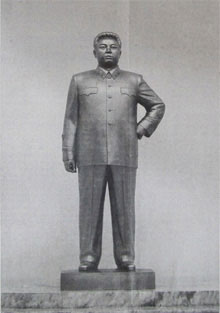
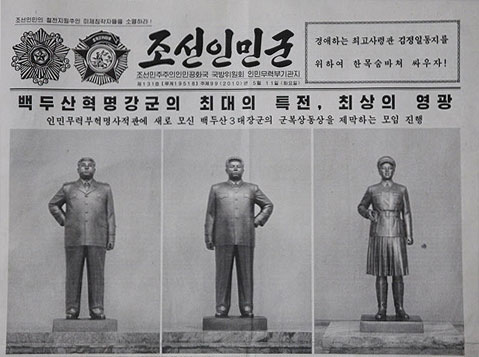
First of all, here are the images (from the Daily NK web page):

3-stars-of-paektu.jpg  kim-jong-il-bronze-statue.jpg

The Daily NK also offers the following commentary:

A statue of Kim Jong Il has been revealed in a North Korean newspaper obtained by Open Radio for North Korea.

Open Radio managed to obtain a copy of the May 11th, 2010 “Chosun People’s Army,” the North Korean military’s own publication. That day, the publication ran a banner headline, “The greatest privilege and highest honor of the Mt Baekdu revolutionary army.”

“There has been an unveiling ceremony of statues of the ‘Three Mt. Baekdu Generals’ (Kim Il Sung, Kim Jong Il and Kim Jong Suk) dressed in military uniform at the Revolutionary History Museum of the Ministry of the People’s Armed Forces,” the front page article explained.

The report added that Chief of Staff of the Chosun People’s Army Lee Young Ho and First Vice-Director of the General Political Department of the People’s Army Kim Jung Kak took part in the ceremony.

Kim Jung Kak emphasized in his speech at the ceremony that the statue of Kim Jong Il is the first dressed in military attire, claiming, “It is the luckiest and most honorable thing in the world for the Chosun People’s Army to have this, the first statue of its highest commander dressed in military uniform.”

On the subject of the relative lack of Kim Jong Il statues, Cheong Young Tae, a researcher with the Korea Institute for National Unification, explained to The Daily NK today, “Kim Jong Il inherited the family’s ruling legitimacy by making his father the eternal ‘Suryeong’ (supreme leader). It seems, then, that the process of justifying and enhancing the legitimacy of the revolution now includes setting Kim up as the second ‘Suryeong’ in order to hand over power to the next generation.”

But while statues of Kim are rather rare, they do exist. Open Radio cited a defector as saying, “I’ve seen a Kim Jong Il statue at Kim Jong Il Political Military University in Pyongyang. However, most people do not know about it.”

“I think that is natural, because it is the only university which is named after Kim Jong Il. There is no Kim Jong Il statue in any other province or in official buildings, though” he added.

Additionally, a 2008 report asserted that a gold statue of Kim Jong Il can be found “in the area in front of the National Security Agency office building at the foot of Mt. Amee in Daesung district, Pyongyang.” This one, the report asserted, was erected on Kim Jong Il’s 46th birthday in 1988, but no photos exist to corroborate the claim.

Another, white plaster statue of Kim can be found at the International Friendship Exhibition at Mt. Myohang, north of Pyongyang, this one a stalwart on the North Korean tourist trail.

Additional information:

1.  An image of the Kim Jong-il statue at Myohyangsan can be seen here (link).  Scroll down until you see it.

2.  The Kim Jong il statue reminds me of the Laurent Kabila statue in Kinshasa (both made by the Mansudae Art Studio).

Share

UN to provide $5m to DPRK operations

July 18th, 2010

According to the Associated Press:

The U.N. humanitarian chief has released $42 million to help people suffering from hunger, disease and conflict in nine countries from Congo and Yemen to North Korea and Nepal.

John Holmes said Friday the United Nations has received insufficient funds from donors to meet humanitarian needs in the nine countries.

The money, from an emergency fund to help the United Nations respond quickly to humanitarian emergencies, will be given to U.N. humanitarian agencies and the International Organization for Migration. Through them, funds will go to humanitarian and other nongovernmental organizations to cover funding gaps.

According to the U.N. Office for the Coordination of Humanitarian Affairs, humanitarian actors in Chad and Congo will receive $8 million apiece, agencies in Yemen will receive $7 million, the humanitarian team in North Korea will get $5 million, humanitarian agencies in the Central African Republic, Djibouti, Eritrea and the Republic of Congo will each receive $3 million, and the U.N. team in Nepal will get $2 million.

The General Assembly revamped the Central Emergency Response Fund in December 2005 after world leaders decided to make up to $500 million available so the U.N. could act speedily to help people caught in conflicts, natural disasters and other emergencies instead of waiting for donors to respond to appeals for aid.

Since then, more than 116 countries and dozens of private sector donors have contributed nearly $2 billion to the fund, OCHA said, and it has disbursed more than $1.7 billion to help millions of victims of natural disaster and conflict in more than 76 countries and territories.

OCHA said nearly $415 million has been pledged for the fund for 2010.

Read the full story here:
UN gives $42 million to underfunded humanitarian crises in nine countries
Associated Press
7/17/2010

Share

DPRK agent now RoK pastor

July 18th, 2010

An interesting story in the Los Angeles Times:

He looks more like a graying clergyman than the boogeyman of thousands of South Korean childhoods.

But Kim Shin-jo is both.

The 69-year-old may preside over a Protestant church in this picturesque community where the Han River bends among mountain peaks. But he is also the reluctant grandfather of North Korean spies, a reminder of a cloak-and-dagger world that refuses to be dispatched to the history books on this divided peninsula.

On a recent day, Kim read a news story about the sentencing of two North Korean military spies. Such stories stir bitter memories of the night in 1968 when Kim and 30 other heavily armed North Korean commandos slipped into Seoul  on a mission to assassinate then-President Park Chung-hee.

For the infiltrators, the operation ended in disaster. Cornered outside the presidential residence, they waged a deadly, days-long gun battle with South Korean police and military forces. Although nearly all of the North’s commandos were killed, Kim was captured. Interrogated for months about his spy career, he was eventually released and later became a South Korean citizen, marrying and having a family.

Years in a free society have exposed the fallacy of North Korea’s argument that the South is an agonized wasteland that must be recolonized. Still, Kim feels pity for these newest Northern moles.

“I know they must be punished — we have a rule of law here,” he says. “Still, I’m a human being. I feel sorry for them.”

As the recent U.S. arrest of nearly a dozen Russian agents illustrates, international espionage still exists decades after the Cold War — especially on the Korean peninsula, where North and South are still technically at war.

Without money for high-priced satellites, a cash-starved North Korea relies on a more practical resource.

“It’s hardly believable, but in this high-tech age, North Korea still relies heavily on humans as information gatherers,” said Lee Dong-bok, a former member of South Korean intelligence and a senior associate at the Center for Strategic and International Studies.

Kim, whose parents were executed when he pursued citizenship here, still faces derision over his sinister mission of long ago. He’s not a man of God, some say, but a would-be assassin. He remains haunted for surviving when others didn’t.

“Sometimes,” he says, “I think it would have been better if I had died that day.”

*

The operation code names were Cuckoo and Skylark.

At 27, Kim was chosen from among tens of thousands of North Korean agents to form the elite 124th Special Forces Unit. Their task: Cross the heavily mined DMZ and execute the South Korean president, taking pictures to verify the kill.

The 31 commandos were divided into six teams. As an army lieutenant, Kim led a squad whose role was to take out the bodyguards at the presidential mansion, known as the Blue House.

“I felt gratified to be part of the revolution to emancipate South Korea,” Kim recalls. “We thought the president there was a stooge, an American collaborator. I hated him.”

The unit set off at 8:30 p.m. on Jan. 17, 1968, dressed in South Korean army uniforms. Moving by darkness, hiding during the day, they snipped barbed wire and marched south through the mountains.

One night, they ran into a group of farmers gathering wood. Instead of killing them, they warned the villagers not to report them. The civilians immediately contacted authorities, who launched a manhunt for the infiltrators.

Still, Kim and his teams made it to within 200 yards of the Blue House before being stopped by a suspicious South Korean soldier who demanded their identification.

The commandos opened fire, setting off a series of deadly street battles. Eventually, 35 South Koreans were killed and 64 wounded — soldiers, policemen and civilians, including a 15-year-old boy, who was among the victims of a grenade thrown at a loaded bus.

Insisting that he made a point not to kill civilians, Kim says that he scattered from the rest and never fired his gun. Instead, he fled south into the woods, where he was captured within hours.

Two days later, Kim was trotted out in handcuffs on live television. Asked about his mission, the unrepentant prisoner gave an answer that still haunts many older South Koreans: “I came down to cut Park Chung-hee’s throat,” he declared.

But his revolutionary spirit would not last — thanks to a South Korean army general who headed Kim’s interrogation. Over months of patient reasoning, the officer broke through Kim’s defenses. The two eventually became close.

“He told me, ‘We have a problem with the North Korean regime, not you,’ ” Kim recalls. “He was my father’s age and treated me as his son. He said, ‘I was a young soldier too once. As a commander, I will never kill you. But I will forgive you.’ ”

*

After four decades, the South Korean government recently opened a trail that leads south toward the capital from the North Korean border. It is the path the commandos took on their fatal mission. For years, the winding path has been known as the Kim Shin-jo Route, after a man whose name for many is as recognizable as any former president.

Officials called on Kim to act as a tour guide on the trail’s opening day. He could have refused, he says. But he realized that in order to come to terms with this painful national incident, South Koreans needed to see him in the role of the everyman, to see that he was no longer their boogeyman.

All day, people pointed at him. Those old enough often spoke with scorn. Kim, they swore, was the reason many South Koreans fled their homeland in the early 1970s, fearful of another war with the North. Because of Kim, many of the older generation who remained behind lived in perpetual fear.

“Wherever I go, I get the comments,” says Kim, who became a Protestant clergyman in 1997, finding solace in his faith. “It will happen as long as I am alive. People will point and accuse me.”

Every Jan. 21, Kim memorializes the day of the attack. The day once brought what Kim calls “indescribable pain.” But his wife has taught him to think differently.

“My family tells me that as of Jan. 21, 1968, I was dead,” he says. “On that day, I started a second life. I’m really 69, an old man. But they joke that I’m only 42. And that day that once caused me so much grief should be celebrated as my birthday.”

Read the full story here:
The face of South Korea’s boogeyman
Los Angeles Times
http://www.latimes.com/news/nationworld/world/la-fg-korea-spy-20100718,0,7204441.story?page=1
John M. Glionna
7/18/2010

Share

Pyongyang’s boundaries reduced

July 17th, 2010

According to the Asahi Shimbun:

The long-term effects of continued food shortages have apparently reached the city limits of North Korea’s capital.

According to news agency Radiopress, which monitors North Korea, the physical size of Pyongyang’s administrative district has been recently reduced by more than one-third.

It said Radio Pyongyang and other state-run domestic media have recently introduced the counties of Kangnam-gun, Junghwa-gun and Sangwon-gun as well as the Sungho district as being under the jurisdiction of neighboring Hwanghae-bukdo province. The counties and the district previously belonged to Pyongyang.

South Korean human rights groups see this as an attempt to trim the capital’s population to better manage continuous food shortages.

Pyongyang, now believed to have a population of between 2 million and 2.5 million, is used as a showcase for foreign visitors. The capital city is home to a number of high-ranking officials of the Korean Workers’ Party, and gets privileged treatment for food and other necessities compared with other areas.

A South Korean humanitarian support group on Monday quoted a Korean Workers’ Party official on its website as saying, “The decision was made in response to food shortages.”

A source close to North Korea said the reduction might be designed to lessen the city’s food and infrastructure needs.

Read the full story here:
Pyongyang now more than one-third smaller; food shortage issues suspected
Asahi Shimbun
7/17/2010

Share