Archive for the ‘Tourism’ Category

Air Koryo and DPRK tourism update

Friday, April 18th, 2008

This morning the International Herald Tribune published an interesting AP story on Air Koryo, North Korea’s state airline.

As has been mentioned before, Air Koryo recently began upgrading its fleet–but guess who will seemingly be on the first flight? 

The airline also has taken delivery of its first new jet in years. South Korea’s Yonhap news agency, quoting diplomatic sources in China, reported Thursday that North Korea’s reclusive leader Kim Jong Il was likely to fly to Vietnam and China on the new plane next week.

Kim is widely believed to shun air travel. His previous trips abroad by luxurious special train were shrouded in secrecy and reports speculating on his destinations beforehand were not always accurate.

And although the economy at large is not doing so well, Air Koryo business is brisk. 

“The golden days are now[.]  They’re busier than ever,” says Nick Bonner of Koryo Tours. (paragraph edited)

In 1998, his Koryo Tours — which despite being similarly named for an ancient Korean dynasty is unrelated to the airline — escorted just 98 tourists to North Korea. The number doubled to 200 in 2006 and last year jumped to a still minuscule 1,100. Some of his customers also get into the country by train, a much longer trip.

Bonner said a roundtrip ticket on Air Koryo between Beijing and Pyongyang costs 2,550 Chinese yuan (US$365; €230) for economy and 4,340 yuan (US$621; €390) for business class.

What are Air Koryo’s most recent routes:

Air Koryo now has just three regularly scheduled international routes. Domestic service is said to be virtually nonexistent.

It flies roundtrip three times a week between Pyongyang and Beijing and twice a week to the northeastern Chinese city of Shenyang, an important source of trade for North Korea.

The other is return service once a week to Vladivostok. A flight to Khabarovsk, another city in the Russian Far East, stopped in 2005. The airline also had flew to Bangkok and Macau in recent years.

About the fleet upgrade: 

Perhaps illustrative of Air Koryo’s improving fortunes, in December it acquired a twin-engine Tu-204-300 jet manufactured by Russia’s OAO Tupolev, adding to its fleet of other Tupolev, Antonov and Ilyushin jets and turboprops.

Tupolev mentions the deal on its Web site, though did not disclose financial terms when asked.

A non-North Korean with intimate knowledge of the airline, who refused to be identified, confirmed the deal, adding North Korean pilots were receiving training in Russia with the craft set to begin operations at the end of April.

Although the article insinuates that economics are largely behind the fleet upgrade, a little nudging by China certainly did not hurt.  China gave Air Koryo a deadline to meet Beijing safety standards.  But despite China’s concern for air safety, Air Koryo still has one of the best records in the business:

Though concerns about safety have been raised — Air Koryo is banned from flying in the European Union — the carrier has apparently had just one major accident, a crash in West Africa in 1983 when the airline was known under a different name.

The plane, an Ilyushin 62 carrying 23 people, was en route to Conakry, the capital of Guinea, on an “international non-scheduled passenger” flight, when it went down in the Fouta Djall mountains, according to the Aviation Safety Network Web site. All aboard perished.

Air Koryo made its first flight to South Korea in August of 2000 to ferry 100 separated family members for temporary reunions with long-lost relatives in the South. The airline has made occasional flights to South Korea for special purposes as relations have warmed in recent years.

The article does not mention the other (minor) mishap in 2006:

On August 15, 2006 aircraft from Air Koryo (Tupolev 154B-2) on an international scheduled passenger flight from Beijing, China (Beijing Capital Airport) to Pyongyang, North Korea (Sunan International Airport) experienced a runway mishap (exited runway) during landing rollout after landing in bad weather at Sunan International Airport. No injuries were reported and damage to plane was minor. (Wikipedia)

Read the full article here:
North Korea’s quirky Air Koryo survives and, increasingly, appears to thrive
International Herald Tribune (AP)
4/18/2008

Share

Muted birthday celebration

Tuesday, April 15th, 2008

Rumors of food shortages in North Korea seem to be popping up everywhere (even on this website), so now any change in Pyongyang’s standard operating procedure is interpreted in the media as a direct result of this condition.  Changes in regime behavior might be related to food shortages, but then again, we are talking about the DPRK, and we don’t really know how or why many decisions are made.

The latest North Korean “Kremlinology” comes from Yonhap:

With neither foreign artists singing in praise of Kim, who is dubbed the “Sun of mankind” by the communist state, nor the standard massive gymnastic display performed by about 100,000 people on show, North Koreans started the two-day holiday in a low-key manner.

The North traditionally spends a lot on celebrating one of the nation’s biggest holidays on a grand scale, inviting many foreign musicians and art groups to perform in the “April Friendship Art Festival” that marks the birthday of the nation’s founder and unveiling large public monuments.

Pyongyang, however, has scaled down the previously annual event to a biennual in what analysts said is a measure to save badly needed foreign currency because of worsening hardships facing the country.

and as for Arirang…

The Koryo Tours website claims that Arirang will take place from August to the end of September.  This could change, but it is 2-4 weeks shorter than the last couple of years (although those were interrupted by floods!).

Read the full story here:
N. Korea marks late leader’s birthday amid economic hardship
Yonhap
Shim Sun-ah
4/15/2008

Share

Koryo Tours quarterly update published

Wednesday, April 9th, 2008

Koryo Tours, run by Nick Bonner, Simon Cockerell, and Hannah Barraclough, has published its quarterly report.  Read it here.

Inside, readers will learn about the upcoming year in North Korean tourism (Americans likely allowed in for Arirang in the fall) as well as other information on the NY Phil’s performance in Pyongyang and the World Cup qualifier in Shanghai. 

Share

Air China finally lands in Pyongyang

Monday, March 31st, 2008

According to Reuters, Air China on Monday launched service to North Korea, making it the world’s only foreign airline to fly regularly to Pyongyang.

The Beijing-Pyongyang flight route was postponed by three months after Air China said preparatory work took longer than expected.

Air China will fly the return trip three times per week, making Pyongyang a Star Alliance destination, the airline grouping led by Singapore Airlines, Lufthansa and United Airlines.

Air China said previously that it saw the financial potential in the route, primarily from the Chinese tourist business.

I predicted that Air China would primarily service Chinese customers, with Westerners sticking with Air Koryo, the North Korean airline. In separate conversations with Koryo Tours and Walter Keats both tour operators expressed a preference for Air Koryo because of its flexibility and unique atmosphere, neither of which Air China can easily match. 

The time-warp effect travelers feel when boarding an Air Koryo flight, however, might be soon diminished.  Largely at the insistence of Beijing, Air Koryo has recently updated its fleet to meet international safety standards.  Although the stewardesses appearance and speaker announcement welcoming arrivals to the land of “juche paradise” will likely remain the same, the 1950’s era deco interior will certainly take on a more conventional feel. 

Source material here:
Air China launches flights to North Korea
Reuters
Simon Rabinovitch
3/31/2008

Share

Pueblo television upgrade

Sunday, March 9th, 2008

I have just been watching the VICE Guide to North Korea on VBS.tv.  I am not easily impressed with footage filmed in North Korea because, frankly, I have seen a lot of it.  Still, every now and then you catch something fairly obscure which makes the time spent watching it worthwhile. 

The guys who filmed the video had the same guide as me, Mr. Lee, which means they were traveling under the auspices of the Committee for Cultural Relations with Foreign Countries.  They have also gotten other journalists in as well (See here). Note to all the journalists out there.

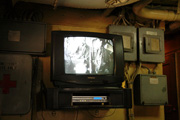
Another thing I noticed was that the DPRK has made investments in upgrading their tourism facilities…even on the USS Pueblo.

pueblo2.jpg pueblo.JPG

In 2004, the Pueblo propaganda movie was shown on a traditional cathode television.  In 2007 it seems they have upgraded to a flat screen.  The ‘paean‘ of television technology.

Share

Tourism boost to North in works – and this is good

Wednesday, February 6th, 2008

Yesterday the Jong Ang Daily reported that Hyundai Asan hopes to draw more tourists to the DPRK this fall, but their forecasting record is not exactly stellar:

The number of tourists to Mount Kumgang tallied 350,000 last year. The North Korean tour unit of Hyundai Asan hopes to pull the number of visitors up to 430,000 this year, 10,000 of whom would head to Kaesong, which began tours in December, and 15,000 of whom would visit Mount Paektu, with tours slated to start in May.

Hyundai Asan had marked annual losses from 1999 until it made profits in 2005. Its 2007 profits totaled 10 billion won.

Today, Andrei Lankov, writing in the Asia Times, chimes in on his experiences with the new Kaesong Tour and gives a rationale for western participation in such activities:

The Kaesong tour is the first project which gives the average South Korean, Mr Kim or Ms Pak, an opportunity to see a semblance of North Korean life. Hitherto, only a handful of South Koreans, most of them government officials, have been able to visit North Korean cities. Now, for the first time in 60-odd years, a very limited opportunity is open for an anybody who is willing to pay a fee.

Of course, North Korean authorities went to extraordinary lengths to prevent any interaction between locals and visitors. The list of prohibited items is quite impressive. Tourists cannot take any kind of printed material, computers and computer equipment, mobile phones, radios and video cameras, universal serial bus and other memory devices. The old film cameras are banned as well. Only digital cameras are allowed into the North, since at the border check point North Korean police officials check every single picture taken by every single tourist.

Despit the limitations, Lankov still feels that these types of exchanges are ultimately worthwhile…

The extraordinary security measures undertaken by the North Korean authorities ensure that only a very limited number of northerners are allowed to approach the visitors. Nonetheless, the tours are a major event.

Every single day, a small city is invaded by an impressive motorcade: 10 large imposing buses, half a dozen jeeps and other vehicles – incidentally, produced in South Korea. The preparations are thorough and, one might suspect, seriously disrupt the city’s routine. The North Koreans can see, albeit from the distance, the visitors – their dress, their height, their behavior. The South Koreans can immediately see how poor the North is. It seems that North Koreans, being necessarily street-smart, also instantly feel the South Korean prosperity.

The waitresses, girls in small stalls and even a handful of genuine guides (not the plaincloth intelligence operatives) who can see the visitors will also notice a lot. Even the willingness of the guests to spend a dollar on a cup of instant coffee or a few cookies is an important sign to them – after all, the average monthly salary in Kaesong is about $4. Those South Korean guests definitely do not look like impoverished victims of evil US imperialism. For a while it will be possible to explain away their extravagant behavior by insisting that those people come from the exploitive elite. But the longer the tours continue, the more difficult the task will become.

So why did the North decide to open Kaesong in the first place? It seems that the major reason is the easy currency income the project brings to Pyongyang. Every visitor pays 180,000 won ($190) – a hefty sum for a one-day bus trip. Out of this amount, 100,000 won goes to the North Korean authorities. All investment into necessary infrastructure is done by Hyundai Asan, so for the North this is easy money. Since 17,000 visitors joined the tours during the first two months of its operations, annual earnings could be in excess of $10 million.

At the same time, they might believe that the Kaesong area has become ideologically contaminated anyway. The Kaesong industrial park is located just a few kilometers from the city. In this facility, some 15,000 North Korean workers are employed in factories owned and run by South Korean capital, largely small businesses which are in desperate need of “cheap labor”.

These workers interact with South Koreans regularly, and they also see life inside the industrial park, which presents a remarkable contrast with their native towns or villages: well-paved roads, trees planted everywhere, modern buildings and round-the-clock supply of water and electricity. Even traffic lights, famously absent from North Korea, are present in this de-facto South Korean enclave.

So why did the North decide to open Kaesong in the first place? It seems that the major reason is the easy currency income the project brings to Pyongyang. Every visitor pays 180,000 won ($190) – a hefty sum for a one-day bus trip. Out of this amount, 100,000 won goes to the North Korean authorities. All investment into necessary infrastructure is done by Hyundai Asan, so for the North this is easy money. Since 17,000 visitors joined the tours during the first two months of its operations, annual earnings could be in excess of $10 million.

The only way to promote change, evolutionary or revolutionary, is to bring North Koreans into contact with the outside world. The North Korean dictator and his elite might see partial exchanges as an easy way to earn money, which is necessary for them to maintain their caviar and cognac lifestyle. In the short term they are probably right. But in the long term, the exchanges will make breaches in the once monolith wall of information blockade. Sooner or later, those breaches will become decisive.

The full articles can be found here:
Tourism boost to North in works
Joong ang Daily
Moon So-young
2/6/2008

A breach in North Korea’s iron curtain
Asia Times
Andrei Lankov
2/7/2008

Share

Air China to (eventually) Fly to Pyongyang

Wednesday, January 2nd, 2008

UPDATE: Surprise–it has been delayed:

Air China delays Pyongyang route for three months
Reuters

1/2/08

Air China has postponed Wednesday’s opening of a new route to the North Korean capital, Pyongyang, until March, citing operational reasons, but denied the decision was linked to politics.

Hat tip Michael Rank

Original Story:

Air China to Fly to Pyongyang
CARNOC.com
(hat tip to Werner in Vienna, Aus.)
Simon Li   
11/06/2007

On Nov. 5, Air China announced that the airline will launch Beijing-Pyongyang route on Jan. 2, 2008. This new service means that the airline’s international operations (including Hong Kong SAR and Macau SAR) will be increased to 72 routes.

Full flight schedule of Beijing-Pyongyang service as below:

Flight No.:  CA121
Route:  Beijing – Pyongyang
Days of Operation: Wed, Fri, Sun
Aircraft Type:  B737
Dep. Time: 14:00
Arr. Time:  17:00

Flight No.: CA122
Route:   Pyongyang – Beijing
Days of Operation: Wed, Fri, Sun
Aircraft Type:  B737
Dep. Time:  18:00
Arr. Time:   19:00

(NKeconwatch: Notice how this does not conflict with air Koryo’s Tuesday/Saturday schedule.  I predict that if this goes through, we will see greater volumes of Chinese tourists take the Air China flights, and western tourists will still demand the “unique atmosphere” of air Koryo–they might even pay more for it!)

Share

Hyundai Asan to Post $10 Mil. in Operating Profit

Friday, December 28th, 2007

Korea Times
Ryu Jin
12/28/3007

Hyundai Asan, the South Korean operator of various cross-border economic projects with North Korea such as Mt. Geumgang tourism program, said Friday that its operating profit this year is estimated to exceed 10 billion won (roughly $10.6 million).

“We saw a great upturn for our profits this year thanks to an increase in the number of tourists to Mt. Geumgang,’’ a ranking company official said. “According to our tentative calculation, the operating profit is expected to surpass 10 billion won.’’

Hyundai Asan, which began another tour program to North Korea’s border city of Gaeseong this year, expects that the company’s annual sales will reach 300 billion won this year, a notable increase from 220 billion won last year.

According to the firm, some 350,000 people crossed the border to the North to visit the mountain resort on the eastern part of the peninsula, up from last year’s 240,000, largely thanks to the launch of a new route up the inner part of the mountain in June.

Company officials anticipate that the tours will further prosper next year, as it plans to start a fresh tour program to Mt. Baekdu on the border between China and North Korea next May.

Founded in February 1992, Hyundai Asan has suffered losses for a long time. But its large-scale investment in the poverty-stricken Stalinist state is paying off at last. In 2005, the company went into the black with 5.7 billion won in operating profit for the first time.

Share

N. Korean airline to be used to ferry S. Korean tourists to Mt. Paektu

Sunday, December 16th, 2007

Yonhap
12/16/2007

North Korea’s state-run airline is likely to be used to ferry South Korean tourists to the North’s Mount Paektu, a government official said Sunday.

The official, who declined to be identified, said Air Koryo planes may be used to carry tourists, owing to concerns about safety related to Samjiyeon Airport, about 30 kilometers southeast of the mountain.

He did not elaborate on the nature of safety concerns, but said it may be inappropriate for South Korean flag carriers like Korean Air and Asiana to use the airport.

Tours to the 2,744-meter-high mountain, held sacred by many Koreans, are the result of the summit meeting between South Korean President Roh Moo-hyun and North Korean leader Kim Jong-il in early October.

He added that flights would probably use Seoul’s Gimpo International Airport, fly over Gangwon Province, head out into the East Sea before turning north toward Mount Paektu, on the North Korea-Chinese border.

The official said Gimpo has been selected as it can easily handle greater numbers of people than provincial air terminals, and the high level of airport security that can be maintained.

Hyundai Asan, which is responsible for organizing tours to North Korea, said direct flights linking Gimpo and Mount Paektu should begin in May, 2008.

The company currently organizes tours to Mount Geumgang on the east coast, and the historic city of Kaesong just north of the demilitarized zone separating the two Koreas on the west coast.

Share

N. Korean leader boosts Mount Paektu inter-Korean tourism project: report

Saturday, December 8th, 2007

Yonhap
12/8/2007

North Korean leader Kim Jong-il has given warm encouragement to local workers developing Mount Paektu, the highest point on the peninsula that will be opened to South Korean tourists next year, the North’s broadcaster said Saturday.

South and North Korea agreed to open a direct flight route between Seoul and the North’s Mount Paektu during their second summit in October. The inter-Korean tour, set to start in May, is organized by South Korea’s Hyundai Group.

Kim “expressed his gratitude to officials and workers who have wholeheartedly supported the development of the Mount Paektu area,” the Korean Central Broadcasting Station, monitored in Seoul, said, naming technicians, researchers and factory workers involved in the project.

Hyun Jeong-eun, chairwoman of the Hyundai Group, agreed with North Korea during her visit to Pyongyang in early November to start in May sightseeing tours of the North’s 2,744-meter mountain, located on its border with China. A group of South Korean government officials and researchers have conducted an on-site inspection.

Mount Paektu will be the third inter-Korean tourism project organized by Hyundai Asan, a unit of the Hyundai Group in charge of North Korea business. North Korea opened its border city of Kaesong to South Korean tourists early this week, following the launch of a tourism program to the North’s east coast mountain of Geumgang nine years ago.

The Mount Paektu and Kaesong tour projects are part of agreements South Korean President Roh Moo-hyun and North Korean leader Kim Jong-il reached during their summit that sought to boost economic cooperation and reduce tension.

Share