According to a recent update from Koryo Tours, this year’s mass games have been extended through October 10th, which is the 63rd Party Founding Day.
This might be the last time for Americans to visit Pyongyang until 2012.

According to a recent update from Koryo Tours, this year’s mass games have been extended through October 10th, which is the 63rd Party Founding Day.
This might be the last time for Americans to visit Pyongyang until 2012.
Jerry Guo, a Yale University economics student who recently traveled to Pyongyang, wrote some interesting articles this week detailing his illicit adventures into Pyongyang’s Central Market (pictures below).
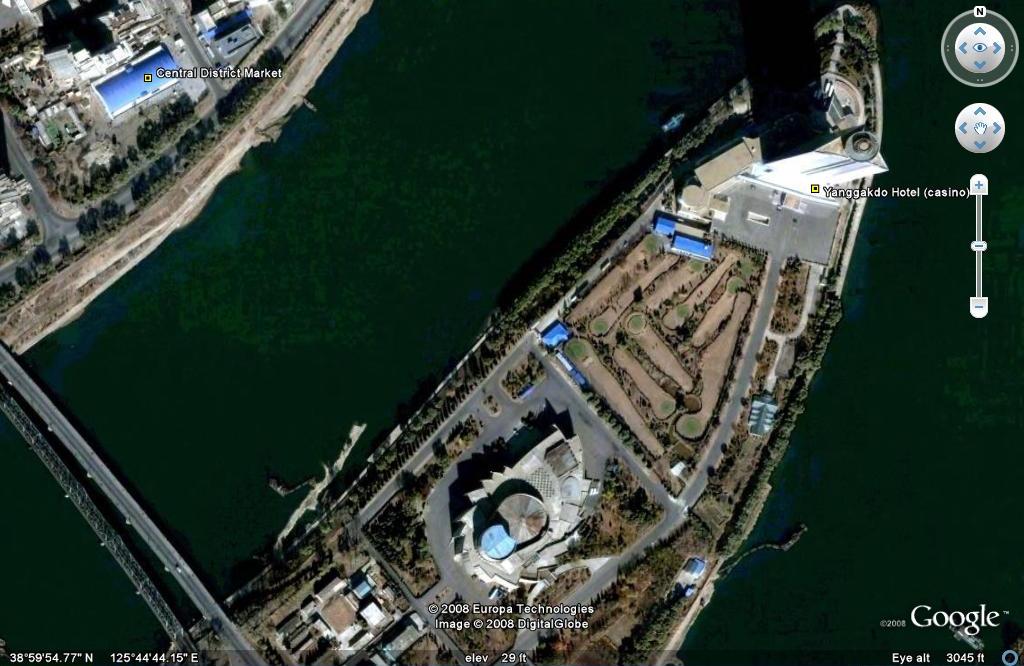
Pyongyang’s Central Market is located along the shore of the Taedong River and is visible from the Yanggakdo Hotel. Unlike the larger Tongil Market located on the south side of town, the Central Market does not receive tourists or foreign visitors—and given the location, its customers would probably prefer to keep it that way. So in a sense, an impromptu stroll to the Central Market offers every visitor to the DPRK exactly what they are looking for: a spontaneous glimpse at every-day life in Pyongyang.
According to Guo, that is exactly what he received:
But I wanted to catch a real glimpse of Pyongyang nightlife, so late one afternoon, I sneaked off unsupervised and hit the city streets. And much to my surprise, I didn’t see a single People’s Army cadet goose-step past me with those missile-launchers-on-wheels that appear on the nightly news. What I did witness: a mother buying a soda for her daughter from a sidewalk snack cart; two older women sitting on a bench, gossiping and eating pears; businessmen coming out of the subway, sans Bluetooth headsets; a grimacing teenage boy getting a haircut at a salon. (Washington Post)
Eventually he meandered into the Central District Market:
I had found myself in the North Korean version of Macy’s, but here, every day is the Friday after Thanksgiving. There were delicate blouses and dresses for around 15,000 won (roughly $4 at black market exchange rates), all sorts of fruit — thought to be nearly impossible to find in this mountainous hermit kingdom — and enough varieties of mystery meats to make my high school cafeteria green with envy.
…and he took some pictures (These pictures belong to Mr. Guo, and I thank him for letting me post them):
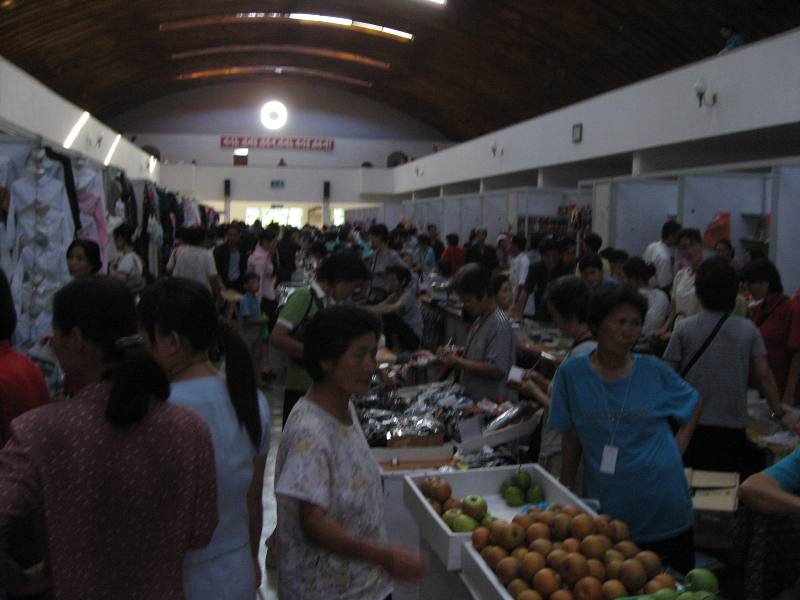
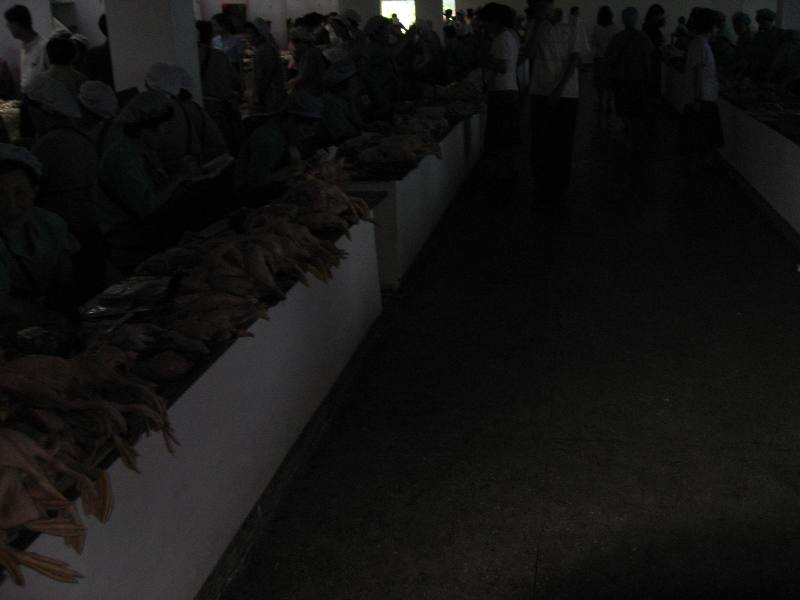
Above: Fruits and chickens for sale
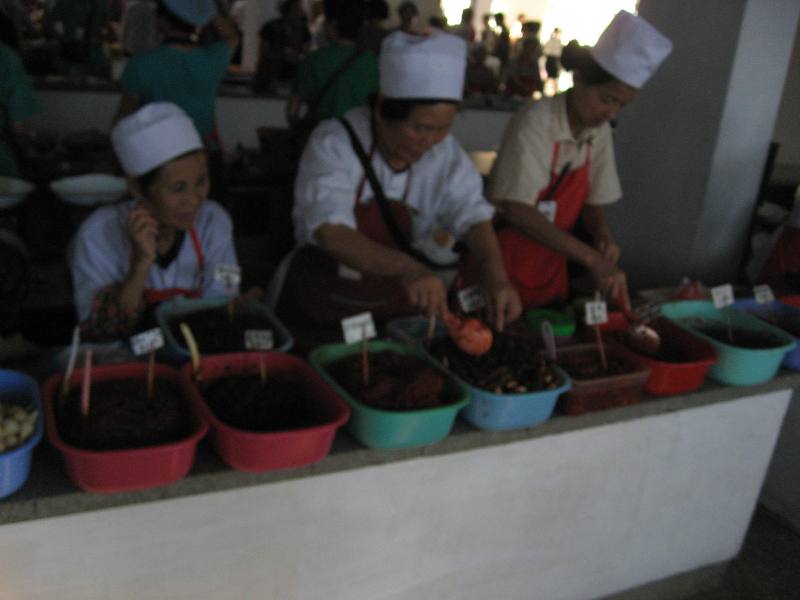
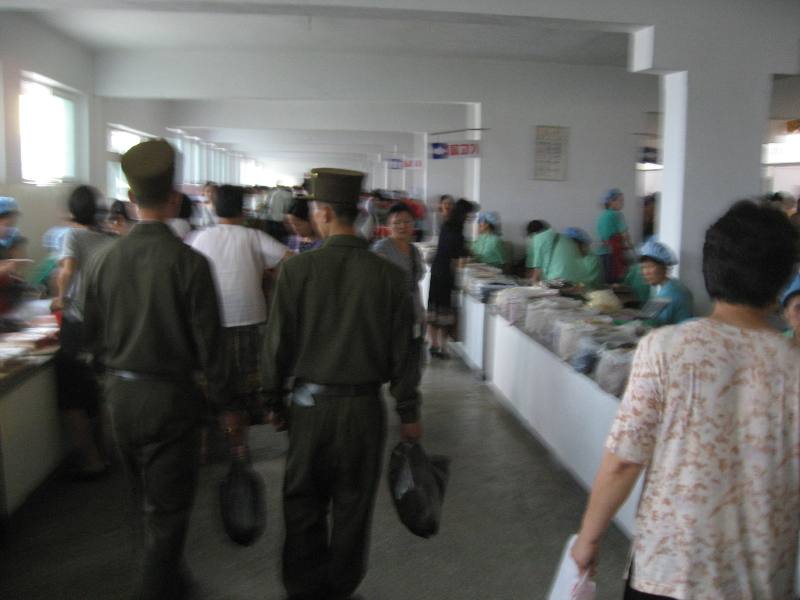
Above: Side dishes/Sauces and clothing for sale
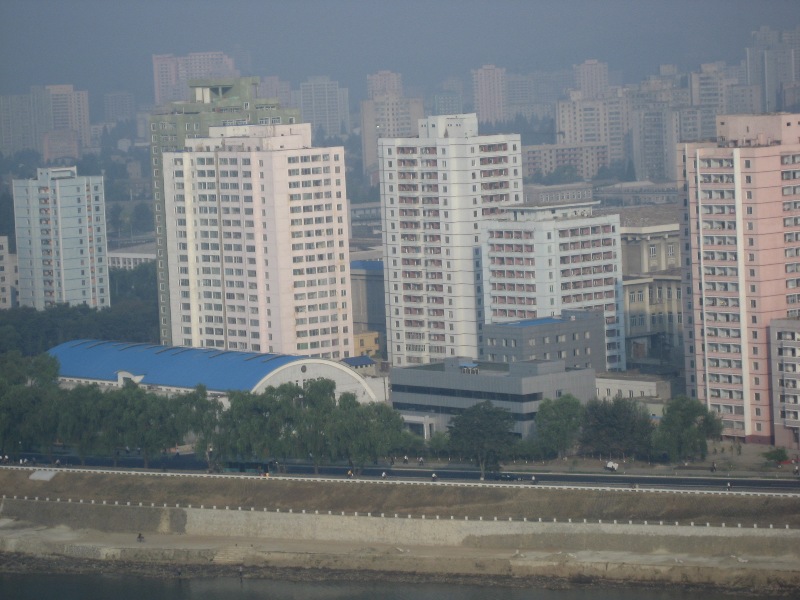
Above: View of the Central Market from the Yanggakdo Hotel
Taking these pictures, however, ushered in an unpleasant afternoon:
No one paid much attention to me, until I stopped to snap a few photos. Then a group of stocky women in pink dresses magically appeared. They half-wrestled me to a second-floor office while blowing fiercely on blue whistles, as if to announce, “Look at me! My first American spy!” For the next six hours, I was questioned and scrutinized by a procession of Public Safety Bureau officers, their rank identifiable by the quality of their outfits: the first wore an undershirt, the last what seemed to be a custom Italian suit.[…]
Eventually, they forced me to write a hyperbolic but harmless self-criticism, describing myself as “an American student,” “an incompetent trouble-maker” and “a genuine lover of the Korean people.” Then they booted me back to my five-star hotel.
Mr. Guo’s adventures have been chronicled in the following publications and they are well worth checking out:
My Excellent North Korean Adventure
Washington Post
Jerry Guo
9/14/2008; Page B02
A writer journeys into North Korea with Chinese tourists
Christian Science Monitor
Jerry Guo
9/16/2008
Yale Senior Enjoys Uncensored Day in N. Korea
National Public Radio
9/15/2008
And a caveat for future visitors: Although I personally appreciate knowing this type of information about the DPRK, I do not recommend other tourists take this course of action for numerous reasons!
Iason Athanasiadis, an Istanbul-based writer and photographer, recently visited the DPRK to see the Arirang performance. He wrote about his trip in The National. Below are some highlights:
Tourism:
Often referred to as the world’s final frontier, North Korea accepts just under 2000 Western tourists every year and offers residency to a handful of foreign businessmen. Barely 100 Western foreigners live in Pyongyang, including diplomats and businessmen.
Doing Business in Pyongyang:
Waiting to have my bags X-rayed I bumped into a European permanent resident, a cheerful trader who imported computer parts from China into North Korea. Once a month, he said, he travels to Shenyang to stock up on monitors, laptops and motherboards. In North Korea, he “donates or sells them at no profit”. His hope is that, when North Korea opens up, he will be well-positioned to profit handsomely from the new economy. Since he didn’t come across as a staunch advocate of Communist ideals, I assumed he was reaping some additional profit from his sojourn in Pyongyang, about which he remained modest.
He described Pyongyang as like any other large city, but with cleaner air. Entry into North Koreans’ houses is banned, as is leaving the city for the countryside without permission and an escort. Romantic relations with North Korean women are similarly prohibited. The only locals who would come to his parties are business associates. Looking through the windows, he talked about the small, unmarked jet parked in the runway that he thought contained American nuclear inspectors.
“They’re very intelligent, thinking people,” the European businessman said of the North Koreans. “They are all independent thinkers. But they’re also split personalities, they compartmentalise their thoughts. Even I’ve brainwashed myself when I’m here. I self-censor.”
Later, he sent me an e-mail quoting a Cold War-era Sting song titled Russians whose refrain runs “We share the same biology; Regardless of ideology.” “You give a smile, they give a smile and the world is in peace,” he wrote. “And I can tell you: the Koreans do love their children.”
Perspective:
The lack of perspective in their cloistered lives became clearer at night, when the guides invited me into the hotel bar to review the pictures I had taken during the day. How were these men, who had never set foot in the West, supposed to judge what did or did not depict North Korea in a negative light? Innocuous pictures – like one of men squatting on the pavement with a portrait of the Great Leader in the distant background – were deleted, while photos that showed what any outsider would immediately recognise as rampant poverty and societal breakdown barely caught their eye.
Pyongyang:
The night before the opening performance of the Games, I sat in my room, listening to the sounds of Pyongyang slumbering. The DPRK is subject to a permanent curfew. A central switch turns off lights inside apartments shortly after the day’s last radio broadcast. That night, the only light came from the May Day stadium, where last-moment preparations continued for Arirang’s opening night. The only sounds coming through the open window were of bricks tumbling on some distant construction site. Some lights winked in the dark buildings. A parade ground drill rhythm wafted from the stadium. Then, all sounds stopped, aside from the breeze, an occasional ship’s horn, and the repetitive monotone of metal striking metal, as if some lone Stakhanovite worker was still out in the darkness and the silence, fulfilling another quota-surpassing day. At 3am, long after all sound had subsided, an amplified voice started up, slicing the night with slogans.
You can read the full article here:
The mass ornament
Iasson Athanasiadis
The Naitonal
9/5/2008
I have seen plenty of Chinese tourists in the DPRK, all gambling in Stanley Ho’s casino in the basement of the Yangakdo Hotel, but apparently China has eased regulations on traveling to the DPRK.
According to Reuters:
China has officially recognized North Korea as a tourist destination for Chinese tour groups, the Xinhua News agency said on Tuesday, quoting Chinese tourism authorities.
North Korean tourism agencies will also be allowed to open representative offices in the northeastern Chinese city of Shenyang, it said.
Chinese individuals were allowed to travel to North Korea on tourism visas as recently as four years ago, but regulations were subsequently changed. However, Chinese tourists have continued to visit North Korea in small groups.
China is the main trading partner with North Korea, whose closed economy faces the risk of famine in the next 14 months following several years of poor harvests.
In 2009, the two countries will celebrate their 60th year of mutual diplomatic recognition.
Read the full article here:
China designates North Korea a tourist destination
Reuters
Lucy Hornby
9/2/2008
According to the Choson ilbo:
Following a request from the North in July 2005, the Unification Ministry and the Korea Tourism Organization bought 8,000 tons of asphalt pitch and subsidiary materials with about W4.9 billion from the Inter-Korean Cooperation Fund to repair Mt. Baekdu runway.
But inspection by the KTO in December 2005 showed construction to be shoddy because an insufficient amount of asphalt had been used. The Unification Ministry and the KTO bought another 8,000 tons of asphalt pitch and other materials with W4.4 billion from the fund in January 2006 and delivered them to the North.
But an inspection in 2007 by the Korea Expressway Corporation found that the paving was no different from that in December 2005, and that 3,497 tons of asphalt pitch had not been used to repair the runway, the BAI said.
The BAI presumes that W2 billion worth of aid materials were diverted illegally for other purposes.
And how did the South Korean’s respond?
The [Board of Audit and Inspection] said agencies including the Unification Ministry “made no preparations to deal with shoddy construction or illegal diversion of the fund.” They took “no action even when a senior North Korean cabinet counselor publicly said in 2006 the North would use a shipment to Nampo Port out of the aid materials to pave the runway of Sunan International Airport in Pyongyang” rather than Mt. Baekdu Airport.
As discussed before (here and here), South Korean development efforts (as conducted via the Ministry of Unification) have been poorly administered. There is little transparency and less accountability for poor decision making and results. Given this institutional environment, we can predict that resources will continue to be frequently diverted.
An alternative, and I believe more effective, economic development strategy which South Korea could adopt towards the DPRK is simply to end MoU structural development programs and allow South Korean businessmen to directly negotiate business opportunities with North Korean counterparts (as the Chinese, European, and others currently undertake). In this way, business persons risk their own capital and they are fully incentivized to make sure their efforts are properly administred. Even if some graft is necessary to get things done, at least it does not come from the South Korean Treasury.
Comments welcome.
Read the full article here:
N.Korea Diverted W2 Billion in Aid: BAI
Choson ilbo
8/26/2008
Last week, the Choson Ilbo reported on trade, tourism and other exchanges between the two Koreas:
The number of [South Korean] tourists to North Korea plunged more than 60 percent last month following the shooting death of a South Korean tourist at Mt. Kumgang resort.
The Unification Ministry says the number dropped to about 21,000, almost a 20 percent decrease from July of last year. The resort was closed after the shooting.
The amount of trade between the Koreas also dropped 1.5 percent from last year.
Although commercial transactions at the jointly-operated Kaesong Industrial Complex in the North increased more than 28 percent year on year, non-commercial transactions, such as aid to the North, plunged more than 80 percent.
Read more here:
Tourism to N. Korea Drops 60% in July
Choson Ilbo
8/18/2008
The most authoritative map of North Korea on Google Earth
Download it here
 This map covers North Korea’s agriculture, aviation, cultural locations, markets, manufacturing facilities, railroad, energy infrastructure, politics, sports venues, military establishments, religious facilities, leisure destinations, and national parks. It is continually expanding and undergoing revisions. This is the eleventh version.
Additions include: Mt. Paegun’s Ryonghung Temple and resort homes, Pyongyang’s Chongryu Restaurant, Swiss Development Agency (former UNDP office), Iranian Embassy, White Tiger Art Studio, KITC Store, Kumgangsan Store, Pyongyang Fried Chicken Restaurant, Kilju’s Pulp Factory (Paper), Kim Chaek Steel Mill, Chongjin Munitions Factory, Poogin Coal Mine, Ryongwun-ri cooperative farm, Thonggun Pavilion (Uiju), Chinju Temple (Yongbyon), Kim il Sung Revolutionary Museum (Pyongsong), Hamhung Zoo, Rajin electrified perimeter fence, Pyongsong market (North Korea’s largest), Sakju Recreation Center, Hoeryong Maternity Hospital, Sariwon Suwon reservoir (alleged site of US massacre), Sinpyong Resting Place, 700 Ridges Pavilion, Academy of Science, Hamhung Museum of the Revolutionary Activities of Comrade Kim Il Sung, South Hamgyong House of Culture, Hamhung Royal Villa, Pork Chop Hill, and Pyongyang’s Olympic torch route. Additional thanks go to Martyn Williams for expanding the electricity grid, particularly in Samjiyon, and various others who have contributed time improving this project since its launch.
Disclaimer: I cannot vouch for the authenticity of many locations since I have not seen or been to them, but great efforts have been made to check for authenticity. These efforts include pouring over books, maps, conducting interviews, and keeping up with other peoples’ discoveries. In many cases, I have posted sources, though not for all. This is a thorough compilation of lots of material, but I will leave it up to the reader to make up their own minds as to what they see. I cannot catch everything and I welcome contributions. Additionally, this file is getting large and may take some time to load.
Excerpt from the Choson Ilbo:
Asan said Thursday it paid US$675,250 to North Korea to cover costs accrued by 10,380 South Korean tourists who visited the mountain resort on July 1-11, until the tours halted after a South Korean tourist was shot and killed by a North Korean soldier at Mt. Kumgang.
Asan sends the payment at the end of each month, at the rate of $30 per person for a one day tour, $48 for two days or $80 for three days. Later this month, Asan will pay a further $928,560 to the North to cover the cost of trips to another tourist destination, Kaesong City. The cumulative payments Asan made to the North for the first six months of the year amounts to $10.7 million for the Mt. Kumgang tour, and $5.1 million for the Kaesong tour.
Read the full story here:
Asan Pays N.Korea for July Tours
Choson Ilbo
08/08/08
I received a Koryo Tours email update this morning about the status of future Mass Games performances:
We have just been told by our partners in the DPRK that there is a chance there will be no mass games next year – possibly not even until 2012 which is the next big anniversary (Juche 100 – the 100th birthday of Kim Il Sung!!!). For Americans this year’s mass games may be the last opportunity to visit the country.
Nothing has been set in stone but we wanted to give you all pre-warning. This year there are 2 different performances – ARIRANG and PROSPER THE MOTHERLAND! – the latter has never been seen before so it really is a once-in-a-lifetime opportunity.
Historically the Mass Games are performed on special anniversary holidays (those in years divisible by 5 or 10). Since 2005 (60th anniversary of victory over Japanese imperialism) they have been held annually. This change could mark a return to the original schedule.
You can subscribe to the Koryo Tours email list here.
Koryo Tours has tremendous access to the DPRK and they are pursuing several interesting projects. Check out their newsletter here. Of special note, there will be two different mass games performances this summer/autumn. From the newsletter:
As before the big news though in terms of tourism in DPRK is the Mass Games event – this year for the first time two different performances have been arranged with the classic Arirang show being performed on Mon, Wed, Fri and Sat, and the brand new, not-yet-seen (even by the critics!) Prosper the Motherland! taking place on Tuesdays and Thursdays. Both of these shows feature the full complement of 100,000 performers in the May Day Stadium and both will run to approx 90 minutes offering anyone who s there the chance to witness what is simply the greatest show on Earth, some information on the events can be found here. The Olympics will pale in comparison… a double dose of Mass Games will undoubtedly be vastly superior to the sight of amateur athletes running around in circles and throwing things!
Also, Nick Bonner is producing a new (non-documentary) film in North Korea. The plot, according to the newsletter:
Comrade Kim goes Flying – we are in development with our new romantic comedy feature film…to be filmed in Pyongyang with Korean cast and crew….more about this later – but a coal miner dreams of flying on the trapeze until she is thwarted by the strong man….
UPDATE: Here is an interview with KT’s Simon Cockerell on Interview Blog.
