Archive for the ‘Statistics’ Category

UN WFP / UNICEF launch DPRK program

Sunday, May 1st, 2011

UPDATE 1 (2011-5-3): The Korea Herald offers some more information on the mission:

The World Food Program will increase its personnel residing in North Korea to tighten monitoring of the distribution of donated food, a U.S.-funded radio station reported Tuesday.

The plan comes as the U.N. agency prepares to launch an emergency operation to help feed 3.5 million starving North Koreans by providing 310,000 tons of food within the next year.

The WFP plans to keep 59 agents in the North, an increase from the previous 10. Up to 60 percent of these agents will be tasked with checking whether the food goes to ordinary people rather than the military in the impoverished state, according to the Voice of America.

Pyongyang’s reclusive Kim Jong-il regime has often refused to let outsiders monitor its food distribution process, triggering suspicions that most of the outside aid is being used to feed its army and political elite.

Apparently getting more desperate for outside assistance, the North has agreed to let the WFP agents monitor its food situations in some 400 regions every month, the U.N. body said.

South Korea and the U.S., which remain lukewarm toward resuming full-scale food aid to Pyongyang, suspect that the Kim regime may be stockpiling rice to prepare for potential war or to release on the 100th anniversary of its late founder Kim Il-sung next year.

While the WFP has been calling on the international community to donate 434,000 tons of food to feed starving North Koreans, the two traditional allies also question the accuracy of the assessment made based on Pyongyang’s own statistics on its harvest and rationing.

Among the newly dispatched agents, 12 can speak fluent Korean, the U.S. radio station said, quoting WFP officials.

A total of seven offices, including one in the capital Pyongyang, will open during the emergency operation period, with food being distributed in eight provinces and 109 districts in the North, it added.

In a recent statement, the WFP had stressed that the aid operation in the authoritarian single-party state “will include the highest standards of monitoring and control to ensure that food gets to where it is needed.”

ORIGINAL POST (2011-5-1): According to the UN press release:

The United Nations World Food Programme (WFP) and the UN Children’s Fund (UNICEF) today announced plans to introduce emergency operations in the Democratic People’s Republic of Korea (DPRK) to feed an estimated 3.5 million people in desperate need after crop losses and a particularly bitter winter.

Women and children will be the focus of the one-year WFP operation, which follows an assessment by several aid agencies of food security inside the DPRK, according to a press release issued by the agency. The operation is expected to cost just over $200 million.

UNICEF has launched a $20 million appeal to fund assistance programmes in the five DPRK provinces with the highest rates of malnutrition and in other counties with similar problems.

Although WFP said overall rates of acute malnutrition have not yet reached crisis levels, it warned that the situation could deteriorate rapidly if there is any further reduction in the food intake of those in need.

Many families have already resorted to cutting out the size or number of meals each day, and Government-supplied rations provide only about half of a person’s daily food needs.

“We face a critical window to get supplies into the country and reach the millions who are already hungry,” said Amir Abdulla, WFP’s Deputy Executive Director and Chief Operating Officer.

“Our primary concern is for those who are most vulnerable to shocks in the food supply – children, mothers, the elderly and large families.”

WFP spokesperson Emilia Casella told reporters in Geneva that the assessment found that the severe winter this year had damaged a large proportion of the seed potato stocks needed to plant the next crop.

The vegetable harvest late last year was also down 44 per cent on the expected volume, she said.

Under the operation WFP will provide cereals and the ingredients for the local production of such foods as corn-soy milk, rice-milk blend and high-nutrient biscuits through a public distribution system.

International staff working for the agency will make more than 400 visits each month to provincial markets and distribution points during the operation, and will only have to give 24 hours’ notice to local authorities.

The operation will continue through the harvest expected in October, with specialized nutritious products expected to be distributed then. WFP aims to procure food from neighbouring countries so that it can be distributed as fast as possible.

“WFP has worked in the DPRK for 15 years and we will be drawing on all that experience and expertise to ensure this operation provides vital, timely food and nutrition to those who cannot support themselves through these difficult months,” Mr. Abdulla noted.

UNICEF’s assistance programme will tackle behavioural and structural issues, such as hygiene, infant feeding practices, water and sanitation, as well as direct nutritional needs, agency spokesperson Marixie Mercado said.

Its operation will target more than 400,000 young children and an estimated 165,000 pregnant or lactating women, regarded as among the most vulnerable groups in the current crisis.

Ms. Mercado said the programme will also aim to help children living permanently in institutions as they do not have extended families from which to draw support.

A survey carried out in 2009 found that 32 per cent of DPRK children were stunted, with even higher rates in some rural areas.

Additionally, Greta Van Susteren (Fox News) has announced that she is returning to the DPRK soon.  She always travels with Samaritan’s Purse, so they will probably be launching a program in the DPRK as well. (SMALL UPDATE: Samaritan’s Purse announced they are launching a program)  Wouln’t it be nice if they got get to see Jun, the American detained in the DPRK–reportedly for clandestine evangelism.

The South Korean and US governments have hesitated in providing food aid this spring but they seem to be allowing limited private aid.

There is some debate as to how severe the food shortage is and what should/could be done about it.  Articles from all sides of the debate are cataloged here.

Share

Inter-Korean mining projects suspended

Monday, April 25th, 2011

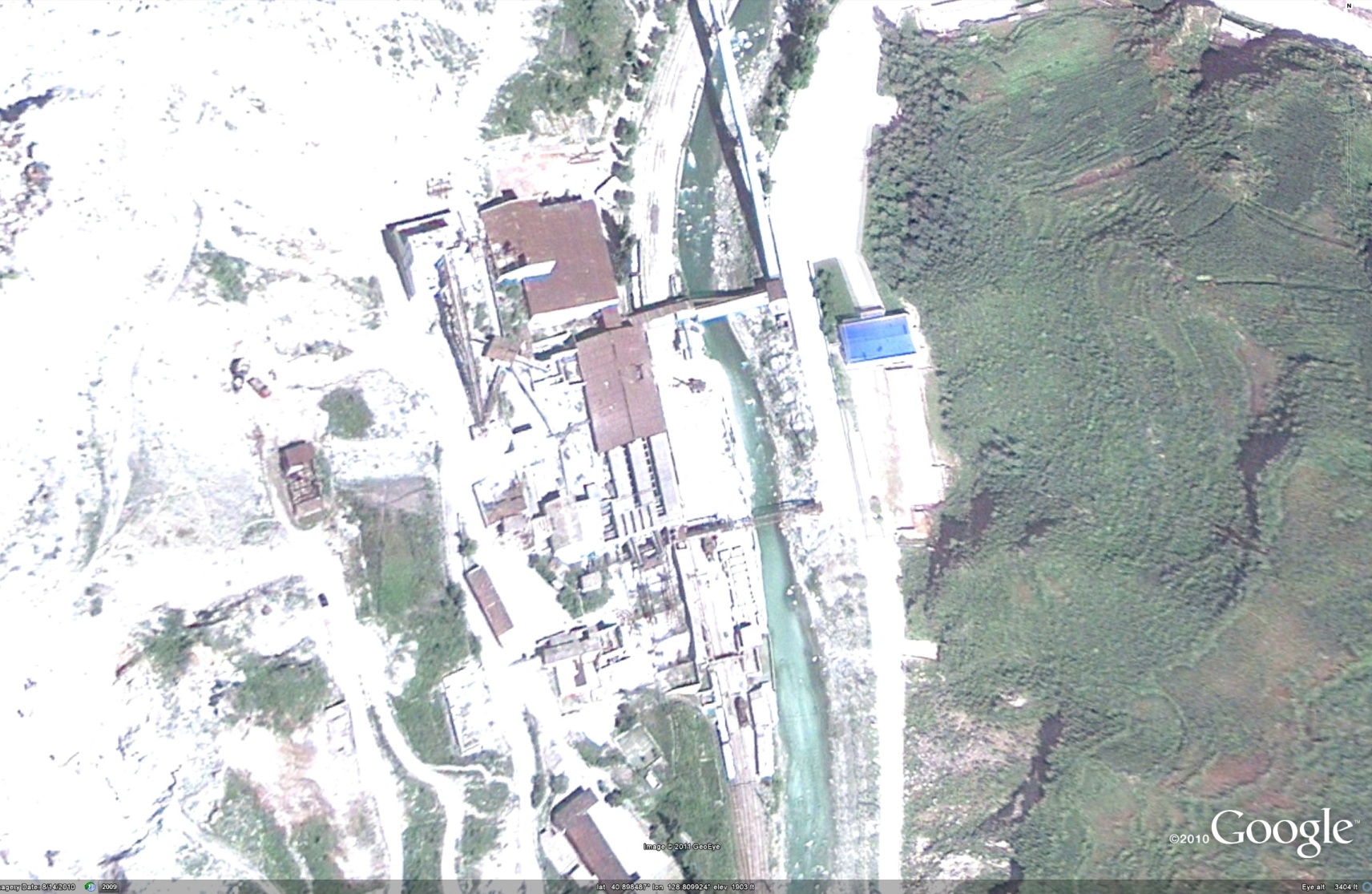
Pictured above on Google Earth: Ryongyang Mine Ore Dressing Plant (Pre-renovation)

According to the Hankyoreh:

“We invested a lot of money, and now we cannot even find out the present status.”

Korea Resources Corporation (KORES) President Kim Shin-jong let out a deep sigh as he explained about the development status of the Hwangnam graphite mines in North Korea at a forum held by the corporation on Apr. 15. The event was organized amid a sense of profound concern, with a number of North Korean mineral resources development efforts running aground amid worsening inter-Korean relations.

According to accounts Sunday from officials with the Ministry of Unification and KORES, South Korea is currently involved in a total of ten North Korean coal mine development efforts. Investment for seven of these comes from the government, including the ministry and KORES, while the other three involve private sector investments. None of them has followed their original schedule since the Lee Myung-bak administration came into office.

The most representative case is that of the Hwangnam graphite mines. This was the first North Korean resource development effort undertaken as an inter-Korean economic cooperation venture, and progress was quick enough that the graphite produced there was being imported into the South right up until the Lee administration came into office. Now, the situation has changed completely.

A company official conveyed the situation by saying, “Since 2008, the Hwangnam Coal Mine has been forgotten completely.”

The situation is the same for the Komdok, Ryongyang, and Taehung coal mines in the area of Tanchon, South Hamgyong Province, an effort spearhead directly by the Unification Ministry.

An official with the ministry said, “We had already finished the third feasibility examination by February 2008, but since then there has been no further progress as inter-Korean relations have worsened.”

The Ryongyang mine contains large deposits of the rare metal magnesite, a material South Korea does not produce.

Exploration has also been effectively halted at the Ayang mine in Sinwon County, South Hwanghae Province, where KORES completed an on-site investigation following the signing of a September 2007 memorandum of understanding on mineral development with North Korea, and the Pungchon mine in Yonan County, South Hwanghae Province, where the first inter-Korean joint drilling effort was undertaken in October 2008.

The situation has been particularly severe for the privately invested projects.

An official with one company engaged in a fertilizer effort said, “We carried out three rounds of working-level discussions in North Korea and China regarding the mining of apatite, but all of them have been suspended since the current administration took office.”

“If these projects had just gone ahead properly, we would not have had to buy apatite at high prices from faraway places like Nauru,” the official lamented.

Apatite, one of the key ingredients in fertilizer, is one of the mineral resources for which South Korea depends entirely on imports.

With South Korea’s development projects in North Korea at a standstill, China’s have taken flight. According to KORES figures, Chinese exports of North Korean military, which stood at the $300 million level in 2005, showed a sharp rate of annual increase to reach more than $900 million in 2010. In the space of five years, the amount of North Korean minerals purchased by China rose more than threefold. Industry observers are calling the situation “hoarding” of North Korean minerals by China. Government authorities are known to have determined that even strategic minerals listed as forbidden for overseas export, including uranium, have been going into China since late last year.

The problem is that the situation is becoming more severe as time passes. Because North Korea’s mineral transportation infrastructure of highways and ports is still deficient, the focus has been on developing minerals in areas near the North Korean-Chinese border, but there is a strong chance that China will extend its reach further into the country going ahead.

“China wants to seize North Korea’s mineral resource industry through expanded infrastructure cooperation with North Korea,” said Jeong U-jin, head of the natural resource strategy office at the Energy Development Institute.

Many observers are saying that thawing inter-Korean relations is an urgent priority if South Korea is to take full advantage of the value of North Korean mineral resources. Noting that the potential value of North Korean mineral resources is as much as 7 quadrillion won, a KORES official said, “Suffice it to say that as improvements in inter-Korean relations get put off, North Korean resources will all head overseas.”

According to the North Koreans, production at the mines is up nonetheless!

Read the full story here:
Inter-Korean coal mine projects suspended during Lee administration
Hankyoreh
Ki Kyung-rok
4/25/2011

Share

DPRK seafood still available in ROK

Monday, April 25th, 2011

Accordign to the Choson Ilbo:

Clams and other seafood from North Korea are openly being sold in the South despite a ban on all trade with the North after the sinking of the Navy corvette Cheonan last year. Insiders say that is because customers prize North Korean fisheries products.

Some 30 vendors in the Garak Market and 20 in the Noryangjin Fisheries Wholesale Market sell shellfish from North Korea, including large clams and scallops. “We have openly labeled shellfish that come from North Korea because customers think they taste better,” a vendor said. “They’re between W1,000 to W3,000 cheaper than domestic ones but the quality is good” (US$1=W1,081).

North Korean shellfish have been brought into the South labeled as Chinese since the end of March. “Before the sinking of the Cheonan, North Korean shellfish was directly imported” labeled as North Korean, an official at the Seoul Agricultural and Marine Products Corporation said. “But since the ban on North Korean imports they’ve been imported through Chinese traders.”

According to the National Fisheries Research and Development Institute, demand for fish and shellfish from North Korea is rising in the South because customers shun Japanese seafood products due to concerns over radioactive contamination, while there are suspicions over the quality of Chinese products.

You can read the Choson Ilbo piece here:
N.Korean Shellfish Sold Openly Despite Ban
Choson Ilbo
4/25/2011

Share

Two new DPRK publications

Wednesday, April 20th, 2011

First: Joe Bermudez has published the latest version of KPA Journal (Vol. 2, No. 2, March 2011).

Articles in this issue include: KPN Deploys New Version of sang-o Class Coastal Submarine, The Korean People’s Air Force in 1953, The Hydrometeorological Service, Han-gang Bridges.

Download the latest issue here (PDF).


Second: Democratic People’s Republic of Korea: Multiple Indicator Cluster Survey 2009
Final Report December 2010

The Democratic People’s Republic of Korea (DPR Korea) Multiple Indicator Cluster Survey (MICS) was carried out in 2009 by the Central Bureau of Statistics (CBS) in collaboration with the Institute of Children’s Nutrition. Financial and technical support was provided by the United Nations Children’s Fund (UNICEF).

MICS is an international household survey programme developed by UNICEF. The DPR Korea MICS was conducted as part of the fourth global round of MICS (MICS4). MICS provides up-to-date information on the situation of children and women and measures key indicators that allow countries to monitor progress towards the Millennium Development Goals (MDGs) and other internationally agreed-upon commitments. Additional information on the global MICS project may be obtained from www.childinfo.org.

DPR Korea Multiple Indicator Cluster Survey 2009, Final Report, CBS, Pyongyang, DPR Korea, 2010.

Download the report here (PDF). It has been added to my “Economic Statistics Page“.

Share

DPRK 2011 foot and mouth disease outbreak

Wednesday, April 20th, 2011

UPDATE 6 (2011-4-20): The DPRK is experiencing a new wave of foot and mouth outbreaks.  According to Yonhap:

A new outbreak of foot-and-mouth disease (FMD) occurred in four counties in North Korea last month and infected nearly 300 pigs and cows, a news report said Wednesday.

A total of 141 out of 298 animals died after being infected with the disease, the Voice of America said, citing a North Korean report submitted to the World Organization for Animal Health (OIE) on Monday. The news report said Pyongyang quarantined the infected areas in an apparent attempt to stem the spread of the disease.

The North confirmed its first case of the disease in December, and the virus has since spread to six other cities and provinces, Seoul’s Agriculture Minister Yoo Jeong-bok said in February.

Last month, the World Organization for Animal Health said North Korea urgently needed around US$1 million worth of equipment and vaccines to help stem outbreaks of the deadly disease.

The disease does not pose a direct health threat to humans, but affects cows, sheep, goats and other cloven-hoofed animals, causing blisters on the nose, mouth, hooves and teats.

North Korea has 577,000 heads of cattle, 2.2 million pigs and 3.5 million goats, according to the OIE.

The OIE data mentioned in the above Yonhap story can be found here.

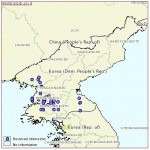
The OIE provides the map below as well as details about the outbreaks:
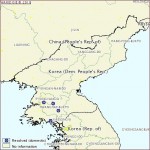
Three of the four cases take place in North Hwanghae:

Sinphyong county, Myongri district (2011-3-21)

Sangwon county, Rodong-ri (2011-3-16)

Hwangju county, Ryongchon-ri (2011-4-4)

The final case is in Singyo-ri, Kumgang County, Kangwon Province. It reportedly took place on 2011-4-6.

The data is also available here.

UPDATE 5 (2011-3-24): UN FAO Press Release:

North Korea: FAO says urgent vaccine and equipment needed to contain Foot-and-Mouth Disease

Capacity of national veterinary services to manage animal disease must also be strengthened

24 March 2010, Rome/Paris – Around a million dollars of equipment and vaccines are urgently required to help stem outbreaks of deadly Foot-and-Mouth disease (FMD) in North Korea, followed by a more prolonged and concerted effort to modernize veterinary services in the country.

A joint FAO and World Organization for Animal Health (OIE) mission travelled to North Korea at the government’s request between 27 February and 8 March. The mission found that the country’s capacity and that of veterinary services to detect and contain FMD outbreaks need significant strengthening — in particular as regards implementing best-practices in biosecurity measures and improving laboratory infrastructure and capacity.

Outbreaks of Type-O FMD have been reported in diverse locations in eight of North Korea’s 13 provinces. To bring the situation under control, the team recommended the following steps:

  • Thorough surveillance to locate and map disease clusters
  • Protecting unaffected farms through movement controls and biosecurity measures
  • Adequate sampling in order to correctly identify the virus strain or strains involved
  • Improving biosecurity measures to prevent further spread of the disease
  • The strategic use of the appropriate vaccines to contain and isolate disease clusters

FAO estimates around $1 million is required immediately for training, supplies and infrastructure, vaccine acquisition and the setting up of monitoring, reporting and response systems.

The FAO-OIE mission visited several collective farms as well as the national veterinary laboratory and various animal health field stations.

Virus identification

FAO and OIE provided guidance to North Korean veterinary authorities on taking and handling of FMD samples — new samples will be collected by North Korea and sent to an international reference laboratory for testing.

Only by accurately typing the virus or viruses involved in the outbreaks will it be possible to identify the most effective vaccine to use against it.

Food security bulwark

FMD does not pose a direct health threat to humans, but affected animals become too weak to be used to plough the soil or reap harvests, suffer significant weight loss, and produce less milk. Many animals are dying from the disease.

Farm animals are crucial to food security in North Korea. Cows and oxen are primarily used for dairy production and are a key source of draft power in agricultural production. Goats and pigs, also susceptible to FMD, are important source of dairy products and meat.

Current North Korea’s livestock population consists of 577,000 head of cattle, 2.2 million pigs and 3.5 million goats.

FMD affects cattle, buffaloes, sheep, goats, swine and other cloven-hoofed animals. It is highly contagious and spreads through mucus, saliva or body fluids that can contaminate materials such as clothing, crates, truck beds, and hay and be transmitted to other animals.

UPDATE 4 (2011-3-22): Pork prices rising with FMD meat on sale.  According to the Daily NK:

With North Korea seemingly unable to bring an outbreak of foot-and-mouth disease centered on the Pyongyang region under control, inside sources have revealed that the price of good pork in the markets is skyrocketing as a result of diminishing supplies, while infected meat is being sold on the quiet for lower prices.

Speaking with The Daily NK on the 22nd, a source from North Pyongan Province explained, “Pork is right now selling for 6,000 won per kilo in the market. The price, which was 2,600 won in the market last December, is climbing all the time, and now is at the point where the average person has no chance of being able to buy it.”

According to sources, the situation is similar in Nampo, where pork was selling for 3,500 won in December, but had reached 6,500 won by February. In Sariwon in North Hwanghae Province, the price had hit 5,000 won by the end of February.

The news of an emerging foot-and-mouth disease problem in North Korea first emerged through sources earlier this year, but the authorities only confirmed it officially and reported control measures via Chosun Central News Agency on February 10th.

According to an official report submitted by the North Korean authorities to the World Organization for Animal Health (OIE) at around the same time, the outbreak had by then spread to 48 places across much of south and central North Korea, with 15 of those places falling within the Pyongyang administrative region.

The report outlined how North Korea first attempted to combat the outbreak with an indigenously produced vaccine, but this was of limited use. It also noted that official North Korean policy is to bury those animals that die from the disease and quarantine those that are infected.

However, inside sources say that in reality people are digging up buried animals in order to sell the meat in the market at a lower price.

The North Pyongan Province source explained, “Meat infected with foot-and-mouth disease is being sold in the market tacitly; the price of it is somewhat lower. The work of burying pigs with foot-and-mouth disease is being done, he said, but it is said that animals continue to be dug up and are sometimes being sold in the market.”

The source gave the example of a pig farm in Pyongsung, where 6 people dug up previously buried pigs last December to sell in Pyongsung Market. They were selling the meat for 2,000 won/kg, he said, but were caught by the authorities.

The source also revealed that on December 30th, 2010, 500 pigs were buried near Pyongyang, but two days later had disappeared, while in Sinuiju it is said that “If it is buried in the daytime, people say that by that very evening it will appear in the market.”

Of course, the fact is that the North Korean authorities are unable to put in place an efficacious policy to combat the outbreak of foot-and-mouth disease or the selling on of infected meat, not least because persons caught for selling infected meat can simply navigate their way out of trouble and go back to their activities.

UPDATE 3 (2011-3-2): A UN FAO team is in the DPRK to inspect the foot-and-mouth outbreak.  According to the Joongang Ilbo:

An official at the FAO was quoted by RFA as saying that the scale and variety of the aid would be determined after discussions with North Korean government officials. The exact itinerary of the group was not released.

The UN food agency also said that along with the team that arrived in North Korea last month, additional officials, including an expert on contagious diseases, would be sent to the area.

The South Korean government has said that it has been monitoring the development of the outbreak. However, the South Korean Ministry of Unification said after North Korea’s official report on the disease that Pyongyang has not made any requests for aid nor did Seoul have plans to offer any assistance.

North Korea announced on Feb. 10 that over 10,000 pigs and cattle had been infected with FMD, prompting North Korean officials to alert the UN of the outbreak.

The North struggled with FMD cases in 2007 and 2008, which led to the culling of thousands of pigs and cattle. During those episodes, the FAO and the South Korean government provided aid.

UPDATE 2 (2011-2-27): The Daily NK reports that the OIE report shows animals are not being culled:

Unlike in 2007, when North Korea reacted swiftly to an outbreak of the disease by culling animals, this time the authorities appear to have reacted poorly despite the fact that the disease has now been found at more than 48 locations in Pyongyang City and Pyongan, Hwanghae and Kangwon Provinces.

According to an OiE report derived from the letter, in which the North finally confirmed the rumored outbreak after a month of silence, Pyongyang has apparently tried to address the situation using a combination of disinfection measures and a domestically produced vaccine, but this has met with little success.

“Given the number of livestock which have died of foot-and-mouth disease, it is uncertain just how far the infection has spread,” Korea Rural Economic Institute Vice-President Kwon Tae Jin explained to The Daily NK. “The small number of infected heads of cattle reported by North Korea is also difficult to accept at face value.”

“If the North Korean authorities have not destroyed the infected cows and pigs in the hope that they will recover, then it is a serious problem. It means we have no idea how far the disease has spread,” Kwon added.

15 of the existing locations in which the disease has so far been detected are in Pyongyang and surrounding areas. In order to combat the spread of the disease to other regions, the authorities are said to have implemented across-the-board restrictions on movement into and out of the city.

However, news of the disease has still not been reported officially, and domestic sources have told The Daily NK that they have not heard anything about it to date.

UPDATE 1 (2011-2-18): DPRK report (below) shows extensive damage from foot-and-mouth disease.  According to Yonhap:

North Korea has reported to a global animal health agency that it had suffered a total of 48 outbreaks of foot-and-mouth disease (FMD) since Christmas last year.

The impoverished communist state made the report to the Paris-based World Organization for Animal Health (OIE) on Feb. 8, saying about half of 17,522 “susceptible” pigs had died from the disease.

Only 3 percent of 1,403 cows suspected of being infected had died from the disease, according to the report posted on the OIE Web site, while none of the 165 susceptible goats had died.

At the time the report was filed, no livestock were yet culled as a preventive measure, according to the report created by Ri Kyong-gun, a quarantine director for the Ministry of Agriculture. A map of outbreaks showed the disease had spread out over almost half of North Korea.

“Vaccination has been applied with a locally developed vaccine but was not effective to control the disease,” the report said, adding that the origin of the outbreak remains “unknown or inconclusive.”

North Korea has banned the inflow of pork and beef from South Korea since late last year for fear that the disease — rampant south of the heavily armed border — may spread there.

Despite the measure, the North, which suffers serious food shortages, reported the outbreak to the United Nation’s Food and Agriculture Organization earlier this year.

The country said in the OIE report that it has restricted movement and conducted “disinfection of infected premises and establishments” to fight the spread of the animal disease.

In 2007, North Korea suffered similar outbreaks, prompting South Korea to dispatch a team of animal health experts amid a mood of reconciliation.

FMD is highly contagious and affects cloven-hoofed animals like cattle, pigs, deer, goats and sheep. The disease causes blisters on the mouth and feet of livestock and leads to death. It is rarely transmitted to humans.

ORIGINAL POST (2011-2-18): Below is a map and list of reported foot and mouth disease outbreaks in the DPRK:
The World Organisation for Animal Health (OIE) has reported 48 outbreaks of foot and mouth disease (FMD) in Democratic People’s Republic of Korea.

The outbreaks are located in:

–Kangwon (Anbyon, Kimhwa, Phangyo, Phyonggang)
–Kumgang
–Pyongyang (Sadong, Ryokpo, Rakrang, Kangdong, Mangyongdae)
–Nampho (Nampho and Kangso)
–North Hwanghae (Kangnam, Sangwon, Hwangju, Yonsan, Sinphyong, Suan, Songrim)
–North Pyongan (Thaechon, Pakchon)
–South Hwanghae (Chongdan)
–South Pyongan (Anju, Phyongwon)

The OIE posted a report developed from an official letter sent by the DPRK dated 7 February 2011 and received on 8 February 2011.  You can see the OIE report here.

Share

DPRK owes ROK appx $1billion

Wednesday, April 20th, 2011

According to the Choson Ilbo:

North Korea owes South Korea more than W1 trillion in terms of food and other loans, it emerged Tuesday (US$1=W1,092). The North has to start repaying the debt from June next year, but given its economic difficulties and strained inter-Korean relations it is unlikely that Seoul will see a penny.

According to the Unification Ministry, the Kim Dae-jung and Roh Moo-hyun administrations gave the North 2.4 million tons of rice and 200,000 tons of corn from 2000 to 2007 on condition of repayment over a period of 20 years with a 10-year grace period at a 1 percent annual interest. The loans amount to US$720.04 million, with the interest reaching $155.28 million.

The South Korean government also spent W585.2 billion from the Inter-Korean Cooperation Fund to re-link cross-border railways and roads from 2002 to 2008. Of the total, W149.4 billion worth of materials and equipment for construction on the North Korean side are also loans to be repaid on the same conditions.

Besides, Seoul lent the North $80 million worth of raw materials for production of textile, footwear, and soap in 2007 and 2008. At the time, the North paid back 3 percent of the loan with 1,005 tons of zinc ingots worth $2.4 million, leaving a $77.6 million balance.

All told, the principal on these loans amounts to W1.02 trillion and the total debt including interest to over W1.2 trillion.

The first repayment of $5.83 million for the food loans provided between October 2000 and March 2001 is due on June 7 next year.

A ministry official said, “The amount has already been included in next year’s revenue plan, on the assumption that it will be paid back. If the North fails to pay, it will be deemed outstanding balance.”

Aside from the food and economic loans, the South also lent the North W1.37 trillion through the Korean Peninsula Energy Development Organization from 1998 to 2006 for the construction of a light-water nuclear reactor. The money was raised by issuing government bonds. The total amount of all loans adds up to W2.25 trillion, if the accrued interest of W877.2 billion is counted.

But since the KEDO project was scrapped in 2006, there is no way for the South to get the money back. It seems likely that the total amount will be handled as “irredeemable government bonds” that have to be made up for with tax money.

Read the full story here:
Pyongyang Owes Seoul Huge Amounts of Money
Choson Ilbo
2011-4-20

Share

Inter-Korean trade half of DPRK-PRC trade in 2010

Tuesday, March 22nd, 2011

According to Yonhap:

North Korea’s trade with South Korea fell to about half of its trade with China in 2010 amid worsened political relations between the divided Koreas, a trade body said Wednesday.

The two Koreas exchanged US$1.91 billion worth of goods last year, up 14 percent from 2009, according to the Korea International Trade Association (KITA).

However, trade between the North and China jumped 32 percent on-year to slightly over $3.46 billion, indicating Pyongyang’s growing economic dependence on its communist ally.

The proportion of inter-Korean trade to North Korea-China trade reached its peak of 91 percent in 2007 when then-South Korean President Roh Moo-hyun held a historic summit with North Korean leader Kim Jong-il, the second summit between the Koreas.

The rate dropped to 65 percent in 2008, 64 percent in 2009 and 55 percent last year, KITA said.

When only considering the amount, inter-Korean trade reached its highest level last year, but only because of increased output at a joint industrial complex of the two Koreas in the North’s border town of Kaesong.

Economic exchanges between the two Koreas at Kaesong jumped 53.4 percent on-year to over $1.44 billion in 2010 while the amount of the actual trading of goods between the countries plunged 54 percent from a year earlier to $117.8 million, according to KITA.

“The gap between the amount of South-North trade and that of North-China trade will further widen unless the tension between the South and North is quickly removed, as economic cooperation between the North and China is fast increasing,” said Shim Nam-seop, a KITA official in charge of inter-Korean trade.

Once again Yonhap fails to mention the name of the report or to provide a link. Its not that hard guys.

It is late (and I am jet lagged) so I am not going to bother fighting the KITA web page for the report this evening.

Read the full story here:
Inter-Korean trade falls to half of North-China trade in 2010
Yonhap
3/23/2011

Share

DPRK-EU trade grows in 2010

Tuesday, March 22nd, 2011

According to KBS:

The Voice of America says that North Korea’s exports to the European Union more than doubled year-on-year in 2010 as the communist country exported petroleum products worth 55 million euros to the Netherlands in the first half of last year.

Quoting data from Eurostat, the statistic agency of the EU, the broadcaster said that North Korea’s exports to the EU surged from 50 million euros in 2009 to over one hundred million euros last year.

However, the North’s imports from the EU inched up only about two million euros from 70 million euros in 2009 to 72 million euros in 2010.

I am pretty swamped at the moment.  I did a quick search for the original data source with no success. If you have any idea where to find it, please let me know.

Read the full story here:
NK’s Exports to EU Doubled in 2010
KBS
3-22-2011

Share

Statistics Korea: DPRK population tops 24.1m in 2010

Tuesday, March 22nd, 2011

According to Yonhap (3/22/2011):

North Korea’s population is estimated to have increased slightly in 2010 from a year earlier, despite its hardships stemming from a chronic food shortage, a report said Tuesday.

The communist country’s population came to an estimated 24.19 million last year, compared with 24.06 million the previous year, according to the report by Statistics Korea, South Korea’s statistical agency. The estimate is based on an analysis of the results of North Korea’s census.

The agency said overall living conditions in North Korea don’t seem to have improved in the past decade with the average life expectancy remaining below the level in the early 1990s.

According to the report, the average North Korean man and woman had a life expectancy of 64.1 years and 71.0 years, respectively, in 2008. Comparable figures were 67.0 years and 74.1 years each in 1993.

About 70 percent of the population over 16 or 12.19 million people were engaged in economic activities, with 36.0 percent working in the agricultural sector. This was followed by 23.7 percent engaged in manufacturing and 20.3 percent in public service areas.

Despite a relatively high percentage of population engaged in economic activities, only 7.3 percent of people over 60 worked, a sign that most North Koreans retire early.

Of the population, 60.6 percent lived in cities in 2008, up from just 40.6 percent in 1960, with the average man and woman getting married at 29.0 years and 25.5 years each.

Despite more people living in urban areas, coal and wood remained the main sources of heating, the report said.

Here is the Statistics Korea web page.  If anyone can provide a link to the original report, I would appreciate it.

The DPRK conducted censuses in 1993 and 2008 with funding from the UN.  Information on the 2008 census can be found here and here.

Share

69 North Koreans in US military

Tuesday, March 15th, 2011

According to the Rumsfeld Papers there were 69  North Koreans serving active duty in the US armed services in April 2003.

Source here (PDF).

Much more discussion in the comments.

(h/t to a colleague)

Share