Archive for the ‘Statistics’ Category

Seoul signals increased willingness to accept DPRK defectors…

Thursday, June 23rd, 2011

…by expanding the capacities of Hanawon.

According to Yonhap:

South Korea will build a new facility to accommodate a growing number of North Koreans fleeing poverty and political oppression from their communist homeland, an official said Wednesday.

The move is the latest reminder that the flow of North Korean defectors isn’t letting up despite Pyongyang’s harsh crackdown on escapees. Seoul is now home to more than 21,700 North Koreans.

South Korea has already been running two other resettlement centers, known as Hanawon near Seoul to help the defectors better adjust to life in the capitalist South.

Still, the government will break ground for another resettlement center in Hwacheon on July 7 as the two current facilities are running at full capacity, Unification Ministry spokeswoman Lee Jong-joo told reporters.

The area is about 118 kilometers northeast of Seoul.

She also said the government is planning to offer re-education for former North Korean teachers, doctors and other experts in the new resettlement center to be built by the end of 2012.

The announcement comes amid the latest dispute between the two Koreas over nine North Koreans who defected to the South earlier this month.

Seoul has indicated it will not return the North Korean defectors despite the North’s request for repatriation. The North usually claims South Korea kidnaps its citizens, charges that Seoul denies.

Some defectors have criticized Hanawon.

Read the full story here:
S. Korea to build new resettlement facility for N. Korean defectors
Yonhap
2011-6-22

Share

Recent DPRK publications

Sunday, June 19th, 2011

Imports from North Korea: Existing Rules,Implications of the KORUS FTA, and the Kaesong Industrial Complex
Mark E. Manyin, Coordinator, Jeanne J. Grimmett, Vivian C. Jones, Dick K. Nanto, Michaela D. Platzer, Dianne E. Rennack
Congressional Research Service (CRS)
June 2, 2011

Download the PDF here.  This publication has been added to the list of previous CRS reports on the DPRK here.

________

Trade with China 1995-2009
Nathaniel Aden
Nautilus Institute
June 7, 2011

View the paper here.  A link to this paper has been added to the DPRK Economic Statistics Page. The Nautilus Insitute has also posted links to some very interesting presentations from the 2010 DPRK Energy and Minerals Working Group.

________

[Book] The Contemporary North Korean Politics: History, Ideology, and Power System (현대 북한의 정치: 역사, 이념, 권력체계)
Jong Song-Jang (정성장)
More information TBA, but see here and here (Korean).

________

[Book] Architekturführer Pjöngjang (German: Pyongyang Architecture Guide)
Philipp Meuser
Order here at Amazon. More here and here.

Share

Statistics on DPRK – PRC trade

Friday, June 17th, 2011

Yonhap has published a short article on the difficulties of analyzing North Korean trade data.  According to the article:

Data on North Korea’s trade with other countries is scarce, and there are stark contrasts in recent estimates from South Korea and the International Monetary Fund (IMF) in terms of both volume and composition.

North Korea’s imports and exports, excluding those with South Korea, reached US$4.17 billion last year, according to a report published last month by the South’s state-run Korea Trade-Investment Promotion Agency (KOTRA). The North’s trade with China — its chief ally and benefactor — amounted to some $3.5 billion, or 83 percent of the reclusive state’s total trade with other countries, the report said. Inter-Korean trade, meanwhile, reached $1.91 billion in the same period.

The findings were based on an analysis of annual trade reports filed by countries that deal with North Korea, as Pyongyang does not provide its own economic data.

The IMF, however, estimates North Korea’s total trade volume at 5.91 billion euros ($8.39 billion) last year, about double KOTRA’s figure, according to a recent report by the Voice of America (VOA), which cites the European Commission. The IMF estimates North Korea’s trade with China at some $3.9 billion, which is similar to KOTRA’s estimate, but accounts for a much smaller proportion of the total volume at 46 percent.

These figures are also based on data from North Korea’s trade partners, but appear to include some of these countries’ exports and imports with South Korea, according to experts.

The IMF’s estimates may be affected by errors in distinguishing the North from the South, while KOTRA’s South Korean staff are able to filter out many of these mistakes, the experts said. The trade agency’s figure may also be smaller because it relies on official data from governments, while the IMF collects its material from a wide range of sources.

“We do not reflect figures that we do not see as normal trade, such as foreign aid or under-the-table transactions,” a KOTRA official said on the condition of anonymity.

Back in February, Marcus Noland had this to say about KOTRA trade statistics (in regards to the % of the DPRK’s trade comprised of transactions with China):

The canard’s origin is in the odd way that the official (South) Korea Trade-Investment Promotion Agency (KOTRA) reports data on North Korean trade.  KOTRA excludes trade with South Korea, the North’s second largest trade partner after China, from North Korean international trade figures, treating these cross-border exchanges as “domestic.” (Funny, I’ve never noticed a minefield separating Maryland and Virginia or encountered heavily armed guards manning the Texas-Oklahoma border.) Then, to compound matters, KOTRA seems to have stopped following some of North Korea’s trade with Middle Eastern countries. The explanation could be budget cuts; there is also speculation that it is politics—dovish South Korean governments were reluctant to report North Korean involvement with dodgy Middle East regimes; or it could be general disinterest.  Whatever the reason, the breadth of KOTRA’s coverage of North Korean trade in the Middle East has dropped considerably, further exaggerating China’s prominence.

The upshot is that there is a huge divergence between the figures produced by KOTRA and those derived from UN and IMF data.

Read the full story here:
S. Korea, IMF differ over volume of N.K. trade
Yonhap
2011-6-17

Share

N. Koreans use phones to sneak information out

Wednesday, June 15th, 2011

According to the Korea Herald:

North Korea is a country that has been almost entirely isolated from news around the world for the past 60 years. The regime in Pyongyang allows Internet access to only a fraction of government officials and its power elite as it prepares for a third-generation hereditary succession to a young man in his late 20s.

The people of North Korea have been brainwashed since childhood to pay respect to the country’s idolized “Great Leader” Kim Il-sung and his son “Dear Leader” Jong-il.

So was Kim Hung-kwang until he began watching South Korean movies and drama in 1995.

“Toddlers are taught by their parents to say ‘thank you, Dear Leader’ before every meal,” Kim said in an interview with The Korea Herald.

“I had been a brainwashed, proud member of the (North Korean Workers’) party myself, until I came across South Korean films in 1995 and eventually learned that the outside world was much better.”

The computer engineering professor managed to flee the North seven years later and arrived in the South in 2003. He was joined by his family two years later.

Born in the eastern coastal city of Hamheung in 1960, Kim graduated from Kim Chaek University of Technology in Pyongyang, meaning he had been one of the North Korean regime’s highly trusted party members. While working as a professor of computer engineering at the Communist University, he was caught for lending some CDs containing South Korean drama to a friend and was sent to a collective farm as punishment.

This prompted him to defect to the South via China in 2003.

In 2008, he launched North Korea Intellectuals Solidarity with about 300 professors, engineers, doctors, journalists and writers from the North.

Now, he runs a dormitory and school for children of fellow defectors from the North, an Internet broadcasting station and publishes a periodical of articles by his colleagues.

The NK Intellectuals Solidarity is also a well-known source of breaking news from the North such as the currency denomination measure in late 2008 thanks to its informants around the China-North Korea border areas.

About 3,000 mobile phones are believed to be secretly used in the North for business purposes or delivering local information across the border, according to Kim.

“About 10 of them are ours, through which we hear about what’s going on there from our informants,” he said.

The informants in the North face the danger of getting caught by the authorities while speaking on the phone near the Tumen and Yalu Rivers with their co-workers in China.

One of Kim’s informants was caught two years ago on charges of spying and was tortured to death.

“She was a mother of three in her 30s who told us things like how the locals perceive the latest economic policies, but (the North Korean authorities) branded her as a spy,” Kim said.

“(Her death) was traumatizing and made us question if we should keep doing this. But we decided not to stop because otherwise, we wouldn’t be able to know about the inhumane crimes committed in the North.”

Kim’s solidarity has also sent in about 300 USBs technically modified to avoid detection.

The USBs do not contain any propaganda, but information on “what the defectors found surprising in the South,” dozens of new media programs such as PDF viewer, MP3 player software and e-books to enable more North Koreans to view South Korean video and text files, Kim said.

“Contrary to what we had expected, copies of Wikipedia entries turned out to be the most popular (among the North Koreans),” he said.

Currently, only five homepage servers are registered under the North Korean domain (.kr). The country connected itself to the Internet in mid-August, but only a handful of selected people are believed to have access to the Web.

Over 20,000 North Koreans have defected to the South since the Korean War ended in a truce in 1953. Hundreds are entering the South each month now mostly via China.

“I think about 4,000 people will arrive (in the South) next year,” Kim said.

“Women used to take up about 80 percent (of the defectors) before, but lately the percentage of men is going up.”

The North still maintains tight vigilance along its borders, but an increasing number of people manage to avoid the authorities’ eyes mainly thanks to bribery.

“Nowadays, it costs between 3.5 and 4 million won to bribe a single person (a soldier along the border, for example) in order to cross the border. The price goes up as (the North) tightens borderline vigilance,” Kim said.

About the North Korean people’s consciousness that they were being mistreated by the dynastical regime in Pyongyang, Kim said it was still in a “germinal stage.”

Pyongyang has tried to soothe its starving people by promising that food supply will be normalized next year, the deadline Pyongyang has set to become a “strong and prosperous nation.”

“But if the food conditions do not improve next year and turns out that it was all words and no action, people will really turn their backs against the government,” Kim said.

“They will know for sure that they are merely being used by the government. They will think that an individual’s basic rights should be placed above their government and start thinking about why there is such a major gap between what the current regime says and the reality.”

The North Koreans are now starting to learn about the need for a social safety net and how the South Korean society is going about its welfare policies through the limited information they receive from outside, Kim said.

“The third stage will be discussing what they have learned among themselves,” he said.

“Starting from groups of two or three people, the discussions will expand and eventually allow certain groups to take action.”

South Korea has reportedly been making contingency plans for various scenarios including a “sudden change” in the North such as the collapse of the Kim regime that will lead to a massive movement of refugees across the inter-Korean border.

“In case of a sudden change, the South can run a buffer zone just south of the border to temporarily house the refugees and prepare them for life in the South, although blocking the people’s free travel would be another issue,” Kim said.

“But because it would be a temporary measure, I don’t think we need to worry too much about a mass influx of refugees.’

Kim also noted that while preparing for a sudden change or unification, South Koreans should not underestimate the North.

“The South has no nuclear weapons, no inter-continental ballistic missiles, no cyber warfare troops, and most important of all, it suffers from internal conflict,” he said, mentioning an online survey last year that showed that some South Koreans did not trust their own government’s conclusion that the North torpedoed the Cheonan.

Kim said the North was training some 3,000 hackers to attack the IT systems of major South Korean institutions.

The prosecution concluded last month that North Korea was behind the cyber attack that paralyzed the banking system of the National Agricultural Cooperative Federation, or Nonghyup, in April.

“Our website was attacked in the same way they attacked Nonghyup,” Kim said.

“The North is very good at stirring up social conflict in the South, prompting certain pro-North groups to call on the government to ‘appease the North,’ or send money to Pyongyang. Their aim is to set up a pro-North regime in the South,” Kim said.

As for the “pro-North people” in the South, Kim said they seemed to hold an illusion that the North Korean system might settle their personal grudges or social problems in the South despite the fact that the Kim regime’s ideology has failed in reality.

Kim called on the South Korean government to set up a clear set of rules and conditions regarding the extent of humanitarian aid the South can send to the North in cases of natural disasters, for example, so that emergency aid to the North becomes more transparent.

Read the full story here:
N. Koreans use phones to sneak information out
Korea Herald
Kim So-hyun
2011-6-15

Share

2011-Q1 DPRK-PRC trade double 2010 level

Wednesday, June 8th, 2011

According to Arirang News:

Trade between North Korea and China nearly doubled in the first quarter of this year compared to 2010.

China’s imports of North Korean goods, which were valued at around 401-million US dollars, increased 214-percent, while its exports to the North, worth about 570-million dollars, rose by only 59-percent year-on-year.

As China’s imports significantly increased overall during this period, its trade surplus with its communist neighbor shrank about 27 percent compared to last year.

The top items China imported from the North included anthracite, iron, and zinc alloys, mostly mining resources.

China’s import of anthracite in the first quarter surged about 1300-percent compared to the same time last year.

Meanwhile, North Korea imported items like crude oil, gasoline, wireless phones, and coal from its last remaining ally.

Korea’s YTN News Agency reports that North Korea’s import of mobile phones, which appear to be all old models, increased about 330-percent from a year earlier.

And North Korea’s import of gasoline during the first quarter of this year increased 120-percent compared to 2010.

Experts say that the increase in gasoline imports likely has to do with its intensified military training since its attack on the South Korean warship Cheonan and the shelling of the South’s Yeonpyeong Island last year.

Read the full story here:
China-N.Korea Trade Volume Doubles in First Quarter of 2011
Arirang News
2011-6-6

Share

Women compose 80% of defections

Saturday, May 28th, 2011

In a May 28th article, the Choson Ilbo reported the DPRK’s National Defense Commission (NDC) is trying to make it harder for women to defect by more stringently enforcing domestic travel restrictions.  According to the article:

The North Korean regime has reportedly ordered border guards to stop all women from traveling on railways and roads to the North Korea-China border. The order, which targets all girls and women between 10 and 60, came recently from the powerful National Defense Commission.

Whether the story is true or not remains to be seen, but the article does highlight the significant gender imbalance among North Korean defectors:

More than 400 defectors arrive in South Korea every month, and about 80 percent of them are women.

There are several reasons given for this lopsided sex ratio.  I have supplemented the list of those items and classified them below:

On the supply side (push factors):

1. Women, as the primary bread-winners in the DPRK’s markets (the place to go for unsanctioned rumors), are exposed to more information about the outside world.

2. The DPRK’s efforts to reign in market activity have made many women despondent.

3. Women, who in many cases do not need to appear at an official job every morning, face lower monitoring costs, and thus have an easier time disappearing.

Demand side (pull factors):

1. Since there is a market for North Korean women in China, smugglers have an economic interest in facilitating defections.

2. It is easier for North Korean women to marry South Korean men than for North Korean men to marry South Korean women.

Of course Haggard and Noland have done systematic surveys of North Korean defectors.  You can learn more here.

Share

Ministry of Unification not keeping up with ROK business in the DPRK

Monday, May 16th, 2011

According to the Choson Ilbo:

A panel of experts says the Unification Ministry has a cavalier attitude to South Korean companies doing business with North Korea. The panel, led by Kim Young-yoon of the Korea Institute for National Unification, tried to find out how many firms there are and what they do.

The experts say that according to ministry figures, 1,017 South Korean companies are doing business in the joint Korean Kaesong Industrial Complex, Mt. Kumgang, Pyongyang, as well as Nampo, Haeju, Rajin and Sinuiju. But the ministry does not even have contact numbers for 188 of those companies, and the phone numbers of 259 are wrong, meaning it only has accurate numbers for 570.

That begs the question whether the tally is even remotely accurate. “Even if businesses have an office in North Korea, most of them are headquartered here,” said one of the experts. “So it shouldn’t be very difficult to assess the status of these businesses, and inaccurate statistics show that the ministry has not done its job properly.”

The probe was prompted by a request from some firms doing business with North Korea to the National Assembly’s Foreign Affairs and Unification Committee to review business in the North and give them a clear picture after the government halted all trade with the North except the Kaesong complex on May 24 last year.

The panel had planned to publish a white paper on May 24 this year, but apparently scrapped the idea due to the lack of basic information.

A response from a Unification Ministry official only adds to the confusion. “We gave them a list of 720 companies, including 584 that are involved in trade with North Korea, 122 that are based in the Kaesong Industrial Complex and 20 in Mt. Kumgang,” he said. “I don’t know where they got the 1,017 figure from.”

Read the full story here:
Ministry ‘Confused’ Over Firms Doing Business with N.Korea
Choson Ilbo
2011-5-16

Share

Statistics on DPRK migration to the USA

Monday, May 9th, 2011

According to the Joong Ang Daily:

The United States has received 101 North Korean refugees in the past few years under legislation to help improve human rights conditions in the reclusive state, statistics showed Saturday.

The total breaks down to nine for 2006, 22 for 2007, 37 for 2008, 25 for 2009 and eight for 2010, according to figures released Saturday by the Office of Immigration Statistics at the Department of Homeland Security.

Hundreds of thousands of North Korean refugees are also believed to be in China.

Most North Korean refugees, fleeing poverty, aim to make their way to South Korea via neighboring China.

South Korea has received more than 20,000 North Korean defectors since the 1950-1953 Korean War.

China has come under criticism for repatriating North Korean refugees under a secret agreement with North Korea, categorizing defectors as economic immigrants rather than refugees, despite the danger of them being persecuted back home.

The North Korean refugees were admitted into the U.S. under the North Korean Human Rights Act of 2004, which calls for the provision of financial aid to help improve North Korea’s human rights and accept North Korean defectors into the U.S.

In 2008, Congress approved the North Korean Human Rights Reauthorization Act for another four years, calling for “activities to support human rights and democracy and freedom of information in North Korea,” as well as “assistance to North Koreans who are outside North Korea,” and 12-hour daily broadcasting to North Korea.

The 201 Office of Immigration Statistics Annual Flow Report also showed that 73,293 people were admitted to the U.S. as refugees in 2010.

The leading countries of nationality were Iraq (18,016), Burma (16,693) and Bhutan (12,363).


Read the full story here:
U.S. takes 101 North Korean refugees
Joong Ang Daily
2011-5-9

Share

DPRK mineral exports top US$860m last year

Saturday, May 7th, 2011

According to Yonhap:

North Korea’s exports of mineral resources jumped 17-fold in a decade with its outbound shipment of coals and iron ores leading the growth, a U.S. report showed on Saturday.
According to Radio Free Asia (RFA), the communist state’s exports of mineral resources reached US$860 million last year, compared with some $50 million in 2002.

Citing data compiled by the Korea Trade-Investment Promotion Agency [KOTRA], the RFA said exports of such minerals as coal and iron ore accounted for 63 percent of its total exports to its strongest ally China.

In the first quarter of the year, the North earned around $154 million by exporting coal to the neighboring country, compared with $9.68 million seen a year earlier.

North Korea’s mineral reserves are believed to be among the largest in the world, worth some 7,000 trillion won, based on 2008 prices, according to an earlier report by the Unification Ministry.

I am unable to locate either the RFA story or the KOTRA report so I don’t have much to say on this.  If you have a link please send it to me.

Read the full story here:
N. Korea’s exports of mineral resources top US$860 mln last year
Yonhap
2011-5-7

Share

Migration to Thailand on rise

Friday, May 6th, 2011

According to the Bangkok Post:

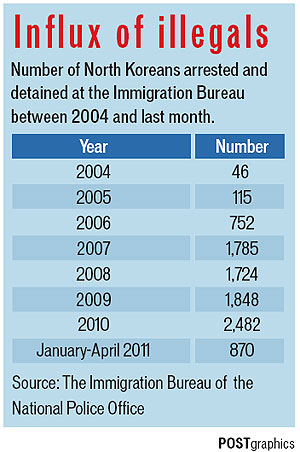
Thai authorities have rejected South Korea’s proposal to build a coordination centre to deal with North Koreans illegally entering the country over concerns that it might encourage more inflows of migrants from the communist nation.

South Korea reportedly asked the government early this year to build the centre in Chiang Rai province, a popular entry point for illegal North Korean immigrants into Thailand.

Most of the immigrants have escaped economic hardship in North Korea and travelled to Thailand for temporary refuge in the hope of being able to resettle in third countries, usually South Korea, a source at the Internal Security Operations Command (Isoc) said.

From October last year until April this year, 899 North Koreans were arrested for illegal entry, said Isoc spokesman Maj Gen Dithaporn Sasamit. The source said South Korea had offered to pay to take care of the illegal migrants. However, the government had turned down the proposal because it had no policy to open a new refugee centre.

The South Korean government has played an important role in helping North Koreans by allowing them to resettle in its country.

Pol Maj Gen Phansak Kasemasanta, deputy chief of the Immigration Bureau, said that North Koreans illegally entering Thailand would be arrested.

After being tried in court, the immigrants would be detained at the Immigration Bureau while awaiting deportation.

The immigrants normally protest at being sent back to North Korea, allowing South Korean officials to step in and help, Pol Maj Gen Phansak said.

He added that instead of building a new centre for the North Korean migrants, South Korea could help improve the present detention centre at the Immigration Bureau.

North Koreans could stay there along with other illegal immigrants from other nations, he said.

According to the Isoc and the Immigration Bureau, North Koreans are normally helped by human trafficking gangs to travel to China.

They are then put on board Chinese cargo boats to Laos before boarding smaller boats or travelling on foot to Chiang Rai’s Chiang Saen and Chiang Khong districts.

“The trips are arranged by gangs made up of North Korean, Chinese and Thai nationals,” said Maj Gen Thawip Bunma, a senior Isoc official.

The Isoc and the Immigration Bureau have been tracking down people involved in the human trafficking gangs.

However, Pol Maj Gen Phansak said police still have no evidence to confirm that Thais were involved.North Korean migrants who have been arrested have told officials that they had to pay at least 100,000 baht to the gangs to help arrange their trips to Thailand.

Most of the migrants were willing to turn themselves in to Thai authorities, seeing it as the first step for them to travel on to the third countries they ultimately wish to settle in.

Read the full story here:
Illegal North Korean migrants on rise
Bangkok Post
2011-5-6

Share
