Archive for the ‘Political economy’ Category

North Korea: Brainwashing in reverse

Tuesday, September 11th, 2007

Asia Times
Sunny Lee
9/11/2007

BEIJING – This was certainly not one of your normal press briefings. The venue was unusual – Pyongyang. Last week, North Korea’s National Security Agency invited its propaganda news arm and a handful of foreign media there to announce a botched espionage plot against its “major military facilities and places of vital strategic importance”.

“The state security organ of the DPRK [Democratic People’s Republic of Korea] arrested moles working for a foreign intelligence service, a [foreign] agent, and seized their spying equipment,” North Korea’s official Korean Central News Agency (KCNA) said. 
 
The foreign intelligence service had approached some North Korean citizens traveling abroad with “money, sexual gratification and blackmail” and turned them into its spies, National Security Agency spokesman Li Su-gil said at the briefing, held at the People’s Palace of Culture in Pyongyang on Wednesday.

According to Lee, the foreign intelligence body had these recruits undergo an anti-communist brainwashing session and taught them how to collect intelligence data as well as how to use electronic equipment for spying.

“Their duty was also to collect information on the ideological tendencies of the [North Korean] people and, at the same time, to create an illusion about the ‘free world’ among some key officials and lure them out to third countries,” the KCNA said.

Pyongyang said the foreign intelligence service had sent its agent to North Korea posing as a businessman and commanded the spy activities. But “the counterespionage officers of the DPRK who had watched every movement of the enemy arrested them on the spot while they were exchanging the data”, the KCNA said.

“This is the first time North Korea has announced such news publicly,” said Li Dunqiu, a well-known Chinese government analyst on North Korea. Li, however, politely declined to discuss the issue further, citing its sensitivity.

Yoo Ho-yeol, professor of Korean politics and foreign policy at Korea University, said, “Not only did they announce it publicly, but the press briefing also included very concrete details. Further, the spokesman of the secretive National Security Service made the announcement himself. That’s unusual.”

At the security agency’s press conference, spokesman Lee went into details about the case, including that the spies had used the Global Positioning System and Sony transmission equipment, and then took questions from reporters. The whole scene was staged very much like a press conference.

China’s Xinhua news agency aired the news first. There are a handful of foreign reporters in North Korea, including from China and Russia. Pyongyang also has a bureau for the television arm of the Associated Press, where locally hired employees transmit television footage to the that media agency. Reporters with Japan’s Kyoto news agency are also allowed to visit Pyongyang roughly once every two months.

At the press briefing, neither the identity of the spy nor his nationality was disclosed. The fact that North Korea didn’t name the country was meant “to warn any country that attempts to overthrow the regime”, said Koh Yoo-hwan, a professor of North Korean Studies at Dongguk University in Seoul.

“As North Korea is slowly opening up to the outside world, more and more foreign humanitarian-aid organizations and businessmen are visiting North Korea these days. That means more North Koreans are meeting foreigners,” Koh said. “That, however, poses a threat to the North. So the announcement has two purposes. On one hand, it was meant to overhaul its internal system, and on the other hand, it was an expression of will to let the world know that it won’t allow any outside attempt to overthrow the regime.”

Yoo concurred with Koh: “North Korea is already on a track to open up to the outside world. In the process, there will be increased contact between North Koreans and foreigners. In this transitional period, Pyongyang feels the need to strengthen its internal supervision.”

Li Su-gil warned that although on the surface there has been an improvement of relations between North Korea and other countries, “There is also an intensifying foreign intelligence effort to oppose our system and our people. That is happening even when there are dialogue and negotiation under way. Especially, the dark tentacles of the foreign intelligence agencies are focusing on our military facilities and gathering information necessary for preemptive strikes.”

Yoo, who visited North Korea early last month, said the country appears somewhat edgy during this “opening-up” period. “In my previous visits, they had allowed me to take pictures freely, but this time they wouldn’t. They only allowed me to take pictures at tourist spots and at certain angles.

“North Korea knows that when foreigners take pictures, the pictures can be circulated in the outside world. So they carefully choose what to show and what not to show to the outside world. I got the feeling that they have become much more sensitive on that lately,” Yoo said.

Nonetheless, Yoo believes that the fact that North Korea went public about the case is a departure from its past secretive practices. “Spy activities in any country are subject to legal punishment, including in the US. Although North Korea is a somewhat peculiar country, it also has relevant laws. In a sense, it is using the tools used by the international community.”

Yoo added that North Korea is expected to do a follow-up announcement and disclose the identity of the spy and the prison term he will receive.

While Pyongyang keeps the identity of the spy in the dark, Professor Yoo believes he is very likely Japanese. “Only certain nationalities in the world can enter North Korea relatively easily and frequently. There are Chinese and Russians. If the spy were from one of these countries, given that they are ideological allies to North Korea, Pyongyang would have resolved it quietly.”

According to Yoo, using the media is a strategy publicly to pressure the country from which the spy came. And the timing of Pyongyang’s announcement is the key: it came on the same day North Korea started normalization negotiations with Japan in Ulan Bator.

At the negotiation, North Korea demanded Japanese compensation for its past occupation of the Korean Peninsula and the lifting of economic sanctions, while Japan demanded a full account of 17 of its nationals allegedly kidnapped by North Korea some three decades ago.

The talks, however, ended without a breakthrough. Over the weekend, Japan announced that it would extend economic sanctions on North Korea for another six months.

Professor Yoo did not raise the possibility of the spy being a South Korean. Many South Korean business people travel to the North via China. North Korea is scheduled to hold a summit with the South early next month.

North Korea’s past nabbing of foreign spies includes citizens from the US and Japan, and Chinese of Korean descent.

Koh of Dongguk University said the very fact that the leaders of the two Koreas meet is an achievement in its own right, adding that the meeting will yield some “meaningful results”.

“It’s a meeting that the top leader of North Korea himself attends. If it doesn’t bear any fruit, then it will also become a burden for Kim Jong-il,” Koh said.

Koh reasons that if Kim doesn’t score major achievements at the summit, it will corner the Dear Leader politically, because it will give more political leverage to the hardline military faction that opposes engagement with South Korea.

Yoo disagreed. “The timing [of the summit] is very bad. It comes right before the presidential election in South Korea. It will be a gamble if the Seoul government tries to use the summit to influence the election outcome. For that to happen, North Korea has to make some surprising decisions, including those related to the six-party talks [on nuclear disarmament]. Seoul, in response, will pledge massive economic aid.

“But North Korea knows well that whatever promises the current South Korean government makes, it is up to the next administration to decide whether to carry them out. So there is this uncertainty. I think the two sides approach the summit with a relatively low expectation.”


Joong Ang Daily

9/6/2007

North Korea said yesterday it had arrested spies working for an unspecified foreign country who were collecting intelligence on the communist state’s military and state secrets.

It said a foreign spy agency had trapped “some corrupt” North Koreans traveling abroad by using money, sex and blackmail and turned them into moles, the official Korean Central News Agency said.

“Recently, the National Security Service of the DPRK has arrested spies who were recruited by a foreign spy agency and the agent who was directing them,” it said.

The agent posed as a businessman, it said, adding the spies’ missions included taking pictures and drawing maps of key military facilities.

They were also asked to collect documents on military and state secrets and spread the ideas of freedom and democracy to key figures so that they would flee the authoritarian North, the KCNA said.

“Anti-espionage agents of the DPRK, who had been watching them closely, arrested on the spot those spies and the agent who had been giving the spies espionage equipment including global positioning systems,” it said.

Neither their identities nor the foreign country involved were revealed.

Earlier, a spokesman for North Korea’s National Security Service told reporters in Pyongyang that an unspecified number of foreigners were caught as they were conducting espionage activities, according to Xinhua.

Several North Korean nationals were also arrested for helping the alleged spies, Xinhua cited the spokesman, Li Su-Gil, as saying.

“We arrested those spies when they were busy transmitting information, and they will be brought to justice under DPRK law,” said the spokesman.

Li said the arrests of the spies showed espionage activities against communist North Korea were on the rise, despite a recent improvement in its relations with other nations.

“The situation on the Korean Peninsula seems to be easing up on the surface, but in fact hostile forces are intensifying their espionage against the DPRK,” Li said.

“The goal of hostile forces is to start a psychological war against the DPRK and overthrow socialism and the regime in our country. The people and security service will remain on high alert for this.”

The talk of an improving situation on the peninsula was apparently a reference to progress in multilateral talks aimed at disarming North Korea.

Those talks have led to North Korea and the United States beginning discussions that could eventually see them establish normal diplomatic relations.

Li said the spies had used a wide range of equipment including digital and pinhole cameras.

At the press conference, footage was shown of apparently captured spy equipment, including a fake rock containing a satellite communications gadget and a listening bug in a flower pot, according to Xinhua.

China is North Korea’s closest political and military ally, and one of the few nations allowed to have journalists based in Pyongyang.

North Korean NSA Arrested Foreign Spies
Daily NK

Yang Jung A
9/6/2007

The Xinhua, a Chinese news agency, reported on the 5th that the National Security Agency (NSA) of North Korea arrested a number foreign spies and North Korean citizens on suspicion of espionage.

The NSA held a press conference and announced that it had arrested foreign alleged spies and native citizens working for a foreign intelligence service, according to the Xinhua.

It is unprecedented that the North Korean authorities revealed the espionage issue publicly; even more surprising is the fact that authorities released this information to the foreign media. Therefore, the underlying reasons for these actions are under speculation.

The spokesperson, Li Su Gil claimed that the foreign spies had collected North Korean official documents and information on important military facilities and had spread the idea of democracy and freedom to the people. Additionally, Li proclaimed they would be brought to justice under North Korean law.

However, the NSA did not reveal further details on the alleged spies such as the number of suspects, their nationalities, when, where or how they were arrested.

According to Xinhua, Li said they had performed their tasks using advanced technology such as digital cameras, pinhole cameras, GPS, even a fake rock containing a satellite communications device, a bug in a flowerpot and other devices of espionage. The NSA showed footage which captured the rigging of these devices at the press conference.

Spokesperson Li stated that the situation of the Korean Peninsula seems to be easing up on the surface, but in fact hostile forces are intensifying their espionage against North Korea.

He added that “The goal of hostile forces is to instigate psychological warfare against North Korea and overthrow socialism and the regime in our country. The people and the security service will remain on high alert.”

So far, the North Korean authorities have been communicating the “espionage issue by the American imperialists” to the people through public lectures, but have yet to release information regarding the NSA’s formal announcement to Rodong Shinmun, North Korea’s state-controlled newspaper.

Therefore, there is much speculation as to the nature of the NSA’s sudden announcement to the foreign media regarding this espionage issue.

Share

Obsession With Nuclear Family

Sunday, September 9th, 2007

Korea Times
Andrei Lankov
9/9/2007

On Aug. 24, 1962, the Soviet Ambassador to Pyongyang, Vasilii Moskovski, met the North Korean foreign minister, Pak Song-chol. The issue to be discussed was nuclear non-proliferation, one closely related to the nuclear test ban treaty, then in preparation. Moscow was an enthusiastic backer of the treaty, and wanted support from its allies. Relations with North Korea were deteriorating fast, but still some supportive gesture from the North was hoped for.

However, Comrade Pak was straightforward: a non-proliferation treaty was a bad idea. He explained the reasons for his skepticism. He asked a Soviet diplomat: “Who can impose such a treaty on countries that do not have nuclear weapons, but are perhaps successfully working in that direction?” Having said that, the North Korean foreign minister continued, “The Americans hold on to Taiwan, to South Korea, and South Vietnam, they blackmail the people with their nuclear weapons, and so rule over those lands and do not intend to leave. Their possession of nuclear weapons, and the lack thereof in our hands, objectively helps them, therefore, to eternalize their rule.”

Indeed, soon Ambassador Moskovski learned that the North Koreans were trying to acquire nuclear technology. As a matter of fact, recently de-classified Soviet papers confirm that in late 1963 Moskovski heard something to this effect more or less every month.

In August 1963 the East German ambassador informed Moskovski that “the [North] Koreans … are asking whether they could obtain any kind of information about nuclear weapons and the atomic industry from German universities and research institutes.”

In September 1963 Soviet geologists, then employed as technical consultants to the North Korean uranium mine, told Ambassador Moskovski that “the Korean side incessantly tries to obtain information about the deposits and quality of the uranium ore mined in the Soviet Union.” They also noticed that the amount of the uranium ore extracted in the North far exceeded the modest demands of its small-scale research program.

In October 1963, another Soviet scientist told the ambassador about a recent conversation on the same subject with a Korean engineer. The engineer asked whether Koreans were able to create an atomic bomb. The Soviet scientist said that the economy of the DPRK could not cope with such a task. But, according to an Embassy document, “the Korean said that it would cost much less in the DPRK than in other countries. If we tell our workers, he declared, that we are taking up such a task, they will agree to work free of charge for several years.”

This new evidence, recently obtained and published by Balazs Szalontaj and Sergei Radchenko, finally confirms what has been long suspected by many (and known to the few) _ from its inception, the North Korean nuclear program was military in its nature.

Actually, North Korea was to some extent involved in nuclear politics as early as the 1940s. It has large deposits of a particular monazite, a mineral that was seen as potentially useful for the Soviet nuclear program. The Soviets demanded payments in monazite for their sales to the North. Eventually, the engineers were disappointed with the properties of the mineral, and abandoned their plans to use it as a source of nuclear material. Russia still does not know what to do with the large stockpiles of monazite it still has from the 1940s.

The North Koreans were mining for uranium as well. There were two major quarries operated with Soviet technical support. The quality of the uranium remained low, but its production was still seen as necessary for the sake of the future.

In 1959 the DPRK signed an agreement on nuclear research with the USSR (soon afterwards, a very similar agreement was signed with China as well). The Soviet Union was becoming very strict about non-proliferation, and the agreement was probably seen as a potential safeguard, to make sure that North Korean ambitions would not result in a military nuclear program.

Needless to say, such a program was indeed what they wanted, and the North Koreans had many ways to outsmart the Soviet supervisors _ not least, by skillfully exploiting the deepening rivalry between Moscow and Beijing, and so it was that Soviet assistance helped Pyongyang launch its first research reactor in 1965.

It seems that the nuclear weapons were not much feared _ generally, in line with Mao’s mad dictum about the `paper tiger.’ In 1962, for example, the East German ambassador had a remarkable talk with Yi Chu-yon, then a Politburo member and one of North Korea’s top leaders.

Yi Chu-yon suggested that it was a good time to start a Third World War. He said that “now, when the USSR has such powerful means of waging war, with missiles that can strike all ranges, perhaps it would be better not to wait, but to strike the imperialists.” Yi Chu-yon received some support, since, according to the East German diplomat, “other Korean comrades who accompanied us also insistently advocated a military resolution of all contradictions between capitalism and socialism.”

Hence, North Korean nuclear ambitions have remained a constant for nearly half a century. However, it took a couple of decades to get things moving. The North was, indeed, too poor for such an undertaking, and no amount of drum-beating nationalism could compensate for lack of resources and technology. At the same time, none of the great power allies was enthusiastic about helping Pyongyang arm itself with nukes.

Nonetheless, work continued, and by the early 1980s the first rumors of the North Korean nuclear weapons project began to spread along the people in the know.

Share

N. Korean leader’s public appearance up sharply in August

Sunday, September 9th, 2007

Yonhap
9/9/2007

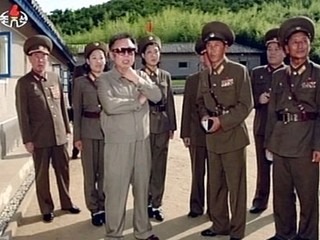
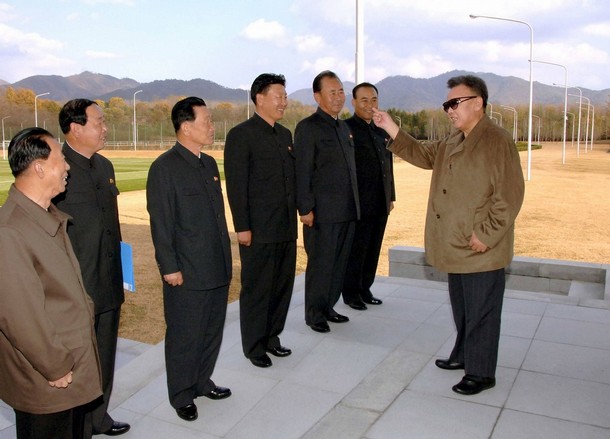
North Korean leader Kim Jong-il made as many as 17 public appearances in August, as he made more visits to factories than military units, statistics compiled by Yonhap News Agency showed Sunday.

The 65-year-old leader’s public appearances in August, as reported by the communist country’s media, included nine tours of industrial facilities mainly in North Hamgyeong Province and five visits to military units.

The August figures compared with two to seven appearances Kim made a month between January and July.

Kim made a total of 21 public appearances in May 2001, followed by 18 in October of 2002 and 2005. He also made 17 appearances in May last year.

South Korean officials believe that the leader is shifting his attention to the North’s moribund economy, as his country is moving to ease tension with the international community over its nuclear weapons program.

Yonhap is the only South Korean news organization to be authorized by the government to monitor North Korean media reports. South Korea has a tough anti-communist law banning its people from listening to North Korean radio and television reports.

The two Koreas, divided since 1945, are still technically at war, having signed no peace treaty at the end of the 1950-53 Korean War.

Share

N. Korea Agrees to Nuclear Deadline

Monday, September 3rd, 2007

Washington Post
John Ward Anderson
9/3/2007; Page A10

Deal Would Disable Programs, U.S. Says

North Korea agreed to disclose all of its nuclear activities and disable its nuclear programs by the end of the year, a senior U.S. official said Sunday after negotiations this weekend in Geneva.

Assistant Secretary of State Christopher R. Hill said details of North Korea’s agreement would be worked out later this month in meetings sponsored by China and involving Russia, Japan and South Korea, in addition to the United States and North Korea.

“One thing that we agreed on is that the DPRK will provide a full declaration of all their nuclear programs and will disable their nuclear programs by the end of this year, 2007,” Hill said, using the initials for North Korea’s formal name, the Democratic People’s Republic of Korea. Hill said it was the first time North Korea had agreed to a timeline to end its nuclear programs.

In separate remarks, the head of the North Korean delegation, Kim Gye Gwan, said his country had agreed to declare and dismantle its nuclear facilities, but he did not mention a deadline.

“We made it clear, we showed clear willingness to declare and dismantle all nuclear facilities,” Kim said, the Associated Press reported. “We are happy with the way the peace talks went.”

Hill, who described the talks as “very good and very substantive,” said the agreement included disclosing and dismantling any uranium enrichment programs, which the United States fears could be used to make nuclear weapons but North Korea previously had not acknowledged having.

The discussions this weekend also focused on North Korean demands to normalize relations with the United States, Hill said. In particular, North Korea wants to be removed from the U.S. list of states that sponsor terrorism, a listing that imposes a ban on arms-related sales to the country and restricts economic aid.

Closer ties with the United States will be built “step by step, with the understanding that we’re not going to have a normalized relationship until we have a denuclearized North Korea,” Hill said Sunday before the talks ended. “To the extent that we can move quickly to denuclearization, we can move quickly to normalization.”

Japan also has refused to forge warmer relations with North Korea until it provides an accounting of what happened to Japanese citizens who were kidnapped by North Korean security services in the 1970s and ’80s.

Negotiations over North Korea’s nuclear programs and normalizing relations with the xenophobic, communist country have been fitful for years.

Last October, while talks were stalled, North Korea announced it had conducted its first underground nuclear test. In February, the United States and North Korea agreed to a sweeping deal to restore diplomatic and economic relations and end the country’s nuclear programs. In July, North Korea closed its main plutonium reactor at Yongbyon after receiving 50,000 tons of heavy fuel oil from South Korea — the first installment of 1 million tons pledged as part of the February agreement.

Share

If Have a Gift for Kim Jong Il, Safe Passage through the North Korean Customs

Saturday, September 1st, 2007

Daily NK
Kim Min Se
9/1/2007

The news of one Chinese trader resolving all issues with the “certification of gifts,” while passing through a high-level North Korean customs’ confiscation of goods and demand of open bribes, has received recent spotlight.

In the latter half of the 90s, a businessman who has been exporting and importing North Korean cultural and daily necessities while coming and going from North Korea met a reporter on the 30th in Dandong and relayed this anecdote, “I have returned to China after having received “honored” treatment from all customs officials under the Shinuiju customs director. That is the first time I received such treatment in the 10 years I have been conducting the trade business.”

The story of the businessman has also apparently become noteworthy news in the Dandong customs office in China.

The businessman is supposed to have earned huge gains by handling North Korean porcelain since the latter half of the 90s. Thus, for long-term gains, he supported the arts and culture projects for the idolization of the Kim father and son in North Korea under his company’s name.

Subsequently, a North Korean writers’ company recently invited him and showed him several sights in North Korea and relayed a gift (edibles) under Kim Jong Il’s name afterwards.

The businessman, after eating the goods he received as gifts in the hotel he was staying in at the time, left with the “certification of gift” in his bag as his souvenir.

He said, “At the time, in Chosun (North Korea), I acquired quite a bit of North Korean silk for gift-giving to close acquaintances, such porcelain and paintings of famous artists. However, the cargo was heavier than expected, almost one carload (2.5 tons trucks). From Pyongyang to Shinuiju, I arrived without much mishap because transportation was provided, but passing through customs was not an easy feat.”

“The North Korean customs unpackaged all goods, so they started going through my stuff as soon as I arrived. Also, they started going through the bag I was carrying and the eyes of the inspector became fixed as the goods were taken out one by one. He had seen the “gift certification” inside a red case.”

Further, he added, “The customs officer verified the name of the certification and my passport and quickly went into an office with the ‘certification.’ Shortly after, the customs director came out and ushered me into a reception area and asked about the context for my receipt of the gift.”

At the time, the customs director had said, “You are a distinguished person who has done a huge work for our country. We did not recognize that. Please let us know if there is anything you are uncomfortable with. Whatever it is, we will help you.”

Then, he is supposed to have ordered the lower level officers, “Using the customs car, make sure that this person’s luggage arrives safely in China without any damage.”

He said that a single piece of Kim Jong Il’s “gift certification” carrying so much weight was beyond the expectations of not only himself but the Chinese customs personnel.

Another related source of the Dandong customs office said, “We were surprised that a single piece of the “gift certification” could wield such power. This event became a famous anecdote within the Dandong customs office.”

Share

1972 Declaration

Thursday, August 30th, 2007

Korea Times
Andrei Lankov
8/30/2007

At 10:00 in the morning of July 4, 1974, Lee Hu-rak, the director of the Korean Central Intelligence Agency (KCIA), convened a special press conference. It was just the place to drop a bombshell. He told the journalists that in May and June, secret high-level exchanges had been conducted between the North and South Korean governments.

Lee himself went to Pyongyang, while Seoul was secretly visited by Kim Yong-ju, the younger brother of then North Korean President Kim Il-sung. In those days Kim Yong-ju was considered as a likely heir to the North Korean dictator (Kim Jong-il was still too young).

The visits themselves were a sensation since for the two decades following the end of the 1950-53 Korean War there were virtually no government-level contacts between the two Koreas. These secret talks produced a document which is known as the “July 4 Declaration” to the Koreans, but in English language publications it is usually referred to as the “1972 Declaration.”

The declaration stated that both Korean governments were committed to eventual unification, and that this unification should be reached independently (without the involvement of foreign forces), peacefully and with respect to their political and ideological differences.

Frankly, it was not very precise wording. However, in one regard the document was important indeed: for the first time in decades it stated that both Korean states, at least theoretically, were ready to coexist and negotiate.

The declaration produced much hype in the international media, and was welcomed as a “great breakthrough.” Of course, this was not the case, and all long-time Korea watchers knew only too well that from time to time some events would be presented by the world media as a “great turning point” _ only to be forgotten or made irrelevant in few years.

Still, the 1972 Declaration was surely a sign of new times: grudgingly, each Korea began to accept existence of the other side. Not its right to exist, God forbid, but merely its physical existence as a rather unpleasant but unchangeable fact.

This turn took place just after the worst period of confrontation, when the two Koreas seemed to be on the eve of a second Korean War. In 1968 North Korean commandos stormed (unsuccessfully) the presidential office of Cheong Wa Dae in Seoul, and they waged campaigns in the mountain ranges along the eastern coast of South Korea.

Seemingly influenced by the success of the Vietnamese Communist guerrillas, the North Korean strategists believed that a Communist revolution could be started in the South as well.

However, by 1970 Kim Il-sung and his coterie finally realized that their hopes for a Vietnam-style uprising in the South were unfounded. Perhaps, the news from Germany where the Eastern and the Western states finally recognized each other, also had some impact: Koreans always paid attention to events in Germany, another divided country.

South Korea changed its strategy as well. Since 1948, the South Korean state had not made a secret of its willingness to use all means, including military ones, to achieve unification and the “liberation” of the North from “Communist slavery.” (The North Korean leaders, in their turn, vowed to save Southerners from “Capitalist hell”).

However, on August 15, 1970, President Park Chung-hee said that unification should be achieved peacefully. He addressed the North Korean leaders (the same people who tried to kill him two years earlier) and urged them to engage in peaceful economic competition.

This statement reflected a new confidence in Seoul: throughout the first decade of the dictatorial but efficient rule of Park, South Korea’s economy was booming. The South Korean leaders thought they would win the economic competition. We know now that they were correct in this assumption.

Hence, negotiations made sense, at least as a way to win time. Indeed, for a short period after the 1972 Declaration there were a number of exchanges and contacts. The Red Cross societies of both Koreas were engaged in the negotiations of a painful question: the arrangement of meetings between members of separated families.

For all practical purposes, in those years the Red Cross societies acted as major channels of dialogues, hence both sides staffed these NGO-type bodies with high-level officials. The first rounds of talks led to nothing, but even the fact that both Koreas were willing to talk was seen as a great novelty after 25 years of division, war, and propaganda.

In 1973, the ROK government made it clear that it would tolerate the participation of North Korea in international organizations. Shortly before that, the principle of mutually exclusive international recognition had also been dropped: a foreign country could henceforth have ambassadors stationed both in Seoul and in Pyongyang.

However, the declaration did not change as much as newspaper readers worldwide were led to believe in those July days. Neither side was going to compromise too much. Domestically, both sides continued with their propaganda war, an enterprise, which was quite hysterical in the South and much worse in the North.

The generals planned future military operations, and secret services were conducting their silent war with the same zeal. Nobody was willing to give in, and talks were interrupted in 1973. They resumed only a decade later, and by that time the situation in and around Korea had changed dramatically.

Prof. Andrei Lankov was born in St. Petersburg, Russia, and now teaches at Kookmin University in Seoul.

Share

North Korea Uncovered v.4 on Google Earth

Wednesday, August 29th, 2007

The most authoritative, publicly available map of North Korea
Version 4: August 29, 2007

Download it here 

This map covers North Korea’s agriculture, aviation, cultural locations, manufacturing facilities, railroad, energy infrastructure, politics, sports venues, military establishments, religious facilities, leisure destinations, and national parks. It is continually expanding and undergoing revisions. This is the fourth version.

Additions to the latest version of “North Korea Uncovered” include the city of Manpo along the Chinese border, KEDO, Kumgang Resort expansion, Kaesong Industrial Zone, as well as a few more parks, antiaircraft sites, dams, mines, canals, etc. I have also added more links in the menu which will tell the viewer a bit about the locations themselves. I have also changed the color scheme to make the collage easier to view.

Disclaimer: I cannot vouch for the authenticity of many locations since I have not seen or been to them, but great efforts have been made to check for authenticity. These efforts include pouring over books, maps, conducting interviews, and keeping up with other peoples’ discoveries. In many cases, I have posted sources, though not for all. This is a thorough compilation of lots of material, but I will leave it up to the reader to make up their own minds as to what they see. I cannot catch everything and I welcome contributions.

I hope this map will increase interest in North Korea. There is still plenty more to learn, and I look forward to receiving your additions to this project.

Share

The Forgotten Victims of the North Korean Crisis

Wednesday, August 29th, 2007

Japan Focus
Tessa Morris-Suzuki
3/15/2007

As the slow and difficult negotiations on North Korean denuclearisation unfold, one small group of a hundred people or so in Japan are watching proceedings with a unique personal interest. Some are Japanese, others ethnic Koreans. All are survivors of one of the modern world’s most bizarre, tragic and utterly forgotten “humanitarian” projects.

Between 1959 and 1984, these few were among the 93,340 people who migrated from Japan to North Korea in search of a new and better life. There were several particularly ironic features of this migration. First, it took place precisely at the time of Japan’s “economic miracle”. Secondly, although it was described as a “repatriation”, almost all those who “returned” to North Korea originally came from the south of the Korean peninsula, and many had been born and lived all their lives in Japan. Third, the glowing images of life which tempted them to Kim Il Sung’s “worker’s paradise” came, not just from the North Korean propaganda machine but from the Japanese mainstream media, supported and encouraged by politicians including key members of Japan’s ruling Liberal Democratic Party.

After decades in North Korea, around one hundred migrants have now escaped the harsh realities of life there, and made the perilous return journey back to Japan. Other survivors of the same project who managed to escape have settled in South Korea.

The story of their migration has been almost entirely unheard by the rest of the world. But it urgently needs to be heard, not least because it involves an injustice that resulted in the deaths of thousands of people, and is still causing the deaths and untold suffering today. The history of this migration also reveals the complexity of postwar Japan’s connections with North Korea: and without understanding this, it is impossible fully to understand the impasse which their relations have now reached.

As secret documents from the Cold War era are declassified and testimony from survivors emerges, the true story of this mass movement is now starting to emerge for the first time. We now know that it was the product of a deliberate policy, very carefully designed and implemented at the height of the Cold War by the North Korean and Japanese governments often working in concert, and supported in various ways by the Soviet Union, the United States and the International Red Cross movement. It is a history that sheds important light on the complex background to Northeast Asia’s contemporary conflicts. It also evokes chilling echoes of other coerced or manipulated migrations, including the repatriation of Eastern Europeans to the Soviet Union and other Communist countries in the immediate post-war era.

The story starts in the mid-1950s at the height of the Cold War. Some 600,000 Koreans were living in Japan, most having migrated to Japan from the southern part of the Korean Peninsula during the colonial period (1910-1945). Having been unilaterally designated “foreigners” by the Japanese government, they had no legal right to permanent residence and faced continual discrimination, prejudice and poverty. South Korea was then an impoverished nation under the authoritarian rule of Yi Seung-Man (Syngman Rhee) and had no interest in taking them back.

The newly released records show that from 1955 onwards, some Japanese bureaucrats and politicians (notably members of the ruling party then and now) began to develop strategies to encourage Koreans in Japan to “return” instead to North Korea. Knowing that this was a politically explosive issue, they tried to keep their role in the scheme covert and to ensure that the exodus was carried out under the auspices of the neutral and humanitarian Red Cross. However, as a leading Japanese Red Cross official put it, his government’s real aim was “to rid itself of several tens of thousands of Koreans who are indigent and vaguely communist”.

Via their national Red Cross Societies, Japan made secret contact with North Korea in 1956 and 1957, urging its government to accept a substantial influx of Koreans from Japan. The Japanese government and Japan Red Cross officials placed intense pressure on the International Committee of the Red Cross to lend its name and support to a mass “repatriation”, thus enabling the scheme to be presented to the world as an apolitical, humanitarian venture. To this end, they provided the international body with some highly questionable information.

Meanwhile, the limited welfare payments available to Koreans in Japan were being drastically slashed – a measure that must surely have made the prospect of life in communist North Korea look more appealing. At the same time, the Japanese Red Cross was engaged in a secret search for ships to carry out the project.

At first, the North Korean response to the proposal was cool. It was happy to accept a small number of “true believers”, but it was having enough problems feeding its own people in the wake of the Korean-US War without accepting a mass inflow of immigrants. In 1958, however, North Korean leader Kim Il Sung dramatically changed course. Apparently seeing the scheme as a valuable source of skilled labor, and as an international propaganda coup which might damage Japan’s relations with South Korea and the US, he issued a public welcome to ethnic Koreans from Japan, promising them housing, jobs, education and welfare.

Immediately, propaganda campaigns began to sweep through Japan’s Korean community, orchestrated by a local pro-North Korean organization, but amplified by a flood of articles in the Japanese mass media. A special “Repatriation Cooperation Society”, involving politicians from across Japan’s political spectrum, was set up to distribute information encouraging Koreans to “return” to North Korea. Leading members included former Prime Minister Hatoyama Ichiro and prominent ruling-party politician Koizumi Junya (whose son Koizumi Junichiro was to become Prime Minister in 2001).

Another troubling aspect revealed by declassified documents is the United States attitude toward the scheme. The US State Department was at that time focussed on renegotiating its all-important security treaty with Japan, a process for which it relied on the enthusiastic cooperation of Japanese Prime Minister Kishi Nobusuke (grandfather of the present Japanese Prime Minister, Abe Shinzo).

The US appears to have been unaware of the secret contacts between Japan and North Korea in 1956 and 1957. When it first became aware of the repatriation plan a couple of years later, the Eisenhower administration regarded it with concern. But once the Japanese and North Korean Red Cross Societies reached an agreement on a mass “return” in mid-1959, the Eisenhower administration did not take any practical steps to halt the unfolding tragedy.

US Ambassador in Tokyo Douglas MacArthur II (who played a key role on the US side) told his Australian counterpart in 1959 that the “American Embassy had checked Japanese opinion and found it was almost unanimously in favour of ‘getting rid of the Koreans'”. At this sensitive moment in US-Japan relations, the State Department was clearly cautious of intervening in a scheme that was an obvious vote-winner for the Kishi regime. Besides, MacArthur personally sympathised with the public emotion, commenting (as the Australian Ambassador at the time reported) that “he himself can scarcely criticize the Japanese for this as the Koreans left in Japan are a poor lot including many Communists and many criminals.”

In fact, although some were doubtless ideologically committed to the Kim Il Sung regime, those who “returned” to North Korea included tens of thousands of people whose only dream was a better future for themselves and their families: people who included entrepreneurs, technicians and university lecturers as well as the poor and unemployed. While most were ethnic Koreans, their number also included over 6,000 Japanese nationals (mostly spouses of Korean men). Many thousands, of course, were children.

The International Red Cross “confirmation of free will”, which was set in place to guarantee to the world that this was a voluntary migration, proved (despite the best intentions of some of those involved) to be little more than a public ritual, too poorly-staffed, lacking the necessary information, and carried out too late in the day to have its intended effect.

Testimony from the small number of former “returnees” who have recently slipped across the border out of North Korea recalls the shock they felt on first arriving and realising the desperate poverty of the country to which they had come. Their plight was made worse some years after the start of the “repatriation”, when the North Korean government began to regard “returnees” from Japan with growing suspicion and prejudice. Thousands were sent to labour camps. Of these, many were never heard from again.

Today in Japan, relatives of those who “returned” to North Korea in the Cold War years watch the difficult process of nuclear diplomacy quietly but with intense concern. The support they send through unreliable communications channels is often the only means of survival for family members left behind in North Korea. While the story of the Japanese kidnap victims of North Korea has dominated news headlines, this tragic story of the 93,340 who were “returned” remains little known, and hostility to North Korea (as well as fears for the fate of relatives in the North) makes it difficult for the small group of survivors now living in Japan to raise their voices. Fears of a mass “re-return” of the ethnic Koreans who left under the repatriation scheme is also a little-discussed factor at work in Japanese government calculations on its relationship with North Korea.

The slow process of dialogue that began at the Six Party Talks in Beijing holds out a faint ray of hope for the future of these divided families. In the meanwhile, it is surely time for their story finally to be told.

Video Here:
http://myspacetv.com/index.cfm?fuseaction=vids.individual&videoid=14645562

Tessa Morris-Suzuki is Professor of Japanese History and Convenor of the Division of Pacific and Asian History in the College of Asia and the Pacific, Australian National University. Her book Exodus to North Korea: Shadows from Japan’s Cold War will be published next month at Rowman and Littlefield. Contact e-mail: tessams@hotmail.com.

Share

N. Korean leader’s estranged son visits Pyongyang twice this year

Tuesday, August 28th, 2007

Yonhap
8/28/2007

The oldest son of North Korean leader Kim Jong-il, who is living abroad after reportedly falling out of favor with his father due to his wayward lifestyle, has visited Pyongyang twice this year, informed sources said Tuesday.

But they downplayed the possibility that Kim Jong-nam, 36, has started working for North Korea’s ruling party, an indication of vying for succession to the North Korean leader.

Jong-nam humiliated his father and the country when he was expelled from Japan in 2001 while trying to enter the country on a forged passport. The junior Kim at that time told Japanese police that he was trying to visit an amusement park outside Tokyo.

“We think that there is a slim chance that Kim Jong-nam is working for the ruling Workers’ Party after he returned to Pyongyang. As he is staying in China, he has visited Pyongyang several times a year since 2003,” an intelligence source said, asking to remain anonymous. The source added Kim visited Pyongyang in April and July this year.

Kim Jong-il is known to have three sons from two relationships.

Jong-nam’s birth resulted from his father’s unofficial relationship with Sung Hae-rim, an actress who died in Moscow several years ago.

The leader is reported to have taken second son Jong-chul, 25, and third son Jong-un, 23, on a series of military inspections to ascertain who performed best. The mother of Jong-chol and Jong-un is Ko Yong-hi, who died of heart failure in 2004.

“Currently, there is no succession system in North Korea. His three sons, who have no official job titles, all have opportunities, but Ko’s two sons have an advantage as they accompany Kim to field inspections,” a North Korea expert said, asking to remain anonymous.

The North Korean leader, who turned 65 this year, succeeded the communist country’s founding leader Kim Il-sung in 1994 after the elder Kim died of heart failure, the first hereditary succession of power in a communist state. He was officially named the successor of Kim Il-sung in 1980 even though he had been known as the heir apparent since 1974.

He officially took over his father’s position in 1997 and since then has ruled the country under a military-first policy. Although there has been speculation about his possible health problems, including diabetes and kidney and liver problems, the North Korean leader has yet to name a successor, at least in public.

Some observers suggest that after Kim’s death, a collective leadership of military figures might take charge, ending the Kim family’s dynastic power over the impoverished communist state and paving the way for it to abandon its nuclear weapons program and open up to the rest of the world.

Share

Juche (Self-Reliance) on Translation

Sunday, August 26th, 2007

Korea Times
Andrei Lankov
8/26/2007

Many people know that the official North Korean ideology is called “juche.” But what exactly does this term mean? Furthermore, when and how did it develop?

If we look at a reference book, we will probably come across a statement like “juche or self-reliance, the official ideology of North Korea, was first promulgated by Kim Il-sung in 1955.” While not completely wrong, this definition needs a lot of qualifications.

Indeed, December 1955 was the first instance of Kim Il-sung mentioning the term “juche.” North Korean publications remain vague to this day in describing exactly who Kim Il-sung addressed with his “juche speech,” but contemporaneous Soviet materials seemingly indicate that this was not just a meeting of “Party propaganda workers”, but a gathering of the KWP high-level functionaries who came to listen to Kim’s denunciations of the country’s excessive dependence on the Soviet models in culture and ideology.

However, the “juche speech” can be seen as a starting point in the history of the term only with some major caveats. The 1955 speech remained secret for the next few years, but it was distributed among party cadres, including journalists. Having scrutinized the North Korean newspapers from that period in depth, and being acquainted with the text of the speech, I have seen a number of hidden quotations circa 1956. However, the word `juche’ did not feature prominently in these quotations. In fact, it was hardly mentioned at all. For the journalists and propagandists, the key words of Kim’s speech were `dogmatism’ and `formalism’ which hinted at the excessive use of foreign, that is to say Soviet and Chinese, methods. In 1956 or 1957 nobody, including probably Kim Il Sung himself, thought that juche was going to become the name of the country’s official secular faith.

And what does `juche’ mean? Contrary to the commonly repeated idea, it has nothing to do with `self-reliance’. Juche is a Sino-Korean word, a combination of two Chinese characters that are used in all languages of the region. It means `subject’ or `one’s own identity’. When it was first used in 1955, Kim Il Sung meant that Koreans must assert their identity more aggressively against foreign pressures.

If so, where did the descriptive pseudo-translation of `self-reliance’ come from? In the early 1960s juche began to be re-defined as North Korea’s (or Kim Il-sung’s) own ideology. This happened against the backdrop of the growing Sino-Soviet split. Facing two quarrelling giants, North Korean began to advance its own brand of Marxism-Leninism, one that was allegedly superior to both the Soviet “revisionist” and Chinese “dogmatist” interpretations. At this stage juche was still interpreted as a local form of Marxism, or as a “creative application of the eternal truth of Marxism-Leninism to the North Korean reality.” Thus, juche began to acquire new dimensions and meanings.

This process culminated in April 1965 when Kim Il Sung delivered a lengthy speech in Indonesia. This speech was the first attempt to present the juche idea as a coherent ideology of worldwide significance. At that stage, it mostly targeted Third World countries. Kim Il Sung stressed that juche implied “independence in politics, self-reliance in the economy, self-defence in the military.” Hence, it was from that broadened understanding that the now commonly used “translation” of juche as “self-reliance” probably originated.

However, juche is more than self-reliance. In fact, it has much greater connotations with nationalism, and in later years when economic self-reliance, once much trumpeted in Pyongyang, went out of fashion, the nationalistic essence of juche became even more visible.

In 1972, juche acquired formal standing as the country’s official ideology. Article 4 of the new Constitution mentioned it alongside Marxism-Leninism as the `guiding ideology’ of the DPRK. Marxism survived _ not least due to diplomatic considerations. An open demotion of Marxism-Leninism would definitely trigger serious friction with fellow Communist countries, and thus Marxism temporarily lived on as an appendix to the North Korean state. Only in 1992, after the demise of the Communist bloc, was the reference to Marxism dropped, and juche remained the sole ideological foundation of the DPRK.

Frankly, I am sceptical when my colleagues try to explain North Korea’s actual policies as reflections of juche ideas. The definition of juche has changed so many times that it has essentially become a meaningless label encompassing everything the Kims’ considered useful or praiseworthy at any given stage of the country’s history. Perhaps, only the nationalist component has remained unchanged. But that is another story altogether.

Share

An affiliate of 38 North