Compared to last year, the activities of Kim Jong Un for the first half of 2013 revealed that he took part in more public activities with working groups rather than senior officials.
According to the ROK Ministry of Unification (MOU), Kim Jong Un has made 95 public appearances, which is an increase of 117 percent compared to the previous year of 81 public activities.
In particular, Kim took part in military related activities the most (29 times) as the U.S. and South Korea held joint military exercises (Key Resolve and Foal Eagle) in the earlier part of this year. His other public activities were economic related (28 times), social and cultural (18 times), political (14 times), and attendance at various performances (8 times).
However, starting from April 1, Chairman Kim’s military-related activities from first quarter to second quarter decreased from 50 to 15 percent while his economy-related activities increased from 10 to 50 percent.
Furthermore, economy-related activities this year entailed visitations to production units in machinery factories, cooperative farms, and business enterprises and complexes. The previous year saw mainly entertainment-related activities.
Compared to his father Kim Jong Il, on his onsite inspections Kim Jong Un was accompanied by an entourage consisting of proportionally more working-level officials rather than senior officials. While his first year inspections were accompanied by senior officials, the group accompanying Kim Jong Un are younger and experienced officials in the field. In particular, Choe Hwi, first vice department director of the Korean Workers’ Party Central Committee, is seen with Kim Jong Un the most. Choe Hwi is a graduate of Kim Il Sung University and served as secretary of the Youth League and senior deputy director of the Korean Workers’ Party politburo.
Meanwhile, South Korea’s Unification Ministry estimated the amount of rice reserve in North Korea remains the same as last year, although there is regional variation. Grain imports are at 75 percent against the previous year, and the food ration and situation range widely by region. The market price for 1 kg of rice is 5,000 KPW, which is valued at approximately 1.667 USD, or about 600 g per one USD or 8,000 KRW.
In addition, the MOU assesses that North Korea is making changes in its economic management under the name of “Our Method of Economic Management,” with relatively heavy focus on agriculture, light, and distribution industries. The North Korean leadership seems to recognize the importance of production output in the economic sector. However, it will be impossible to observe immediate results without improvements in raw materials, power, machines, and equipment.
On the other hand, the MOU analyzes that the North Korean leadership is placing more attention on the agricultural sector and improving production and supply of fertilizer since it shows an immediately visible result in the agricultural sector, especially to the North Korean residents. In this regard, the military is also increasingly emphasizing “self-reliance” and the need for “solving food issues on its own.”
After Kim Jong Un came to power about a year ago, his main official activities reportedly were focused on the military. The young leader is said to be looking to consolidate control over the military to strengthen the monolithic leadership system.
Recently, South Korea’s Ministry of Unification (MOU) released a report on the first anniversary of Kim Jong Un’s appointment as the first secretary of the Workers’ Party. In the report, Kim Jong Un is reported to have made a total of 192 official activities in which 38 percent (73 activities) were focused on the military while political and economy related activities were 23 percent (45) and 20 percent (37), respectively.
Compared to Kim Jong Il’s record of 145 activities in 2011, in which military related events were 39 while economic and political and entertainment performances were 11 and 29, respectively, Kim Jong Un’s activities were focused more on the military.
In addition, a higher number of military elites were seen accompanying the state leader to these military-related events.
The report also stressed the difficulty in assuming that the North Korean economy drastically improved or deteriorated after Kim Jong Un took power. According to FAO and WFP reports, 2012 to 2013 grain production reached 4.92 million tons, which is an increase of 10.5 percent against the previous year.
This is the third consecutive year where an increase in grain production has been reported; but North Korea still faces a deficit of 210,000 tons, as 5.43 million tons is estimated to be minimum grain requirement (according to FAO) and only 300,000 tons is expected to come in from overseas. However, MOU authorities explain that regardless of the food supply, distribution difficulties still remain in North Korea.
The exchange rates are reported to have been continuously on the rise from last year. As of March of this year, 1 USD exchanged for 8,000 KPW and the price of 1 kg of rice was 5,500 KPW. Considering the average monthly salary of North Korean workers ranges between 3,000 to 4,000 KPW, the food situation for the ordinary people is suspected to still be poor.
The report also did not see any significant signs of changes in North Korean economic policy. In North Korean leader Kim Jong Un’s New Year message, building a strong economic nation was named as the top agenda for the year, with agricultural and light industries as key sectors. However, the national budget recently released by North Korea’s Supreme People’s Assembly (SPA) revealed a decrease in the budget for agricultural and light industries while the defense budget has increased.
Kim Jong-un ditched the new year “Joint Editorial” of the Kim Jong-il era and has personally taken on the role of reading a new year speech (appx .5 hrs)–as was done by his grandfather, Kim Il-sung. Here is a video of the speech (in Korean..no subtitles):
Having read it all, I can understand why Kim Jong-il did not want to give these speeches. If I had absolute power I would not want to either. Here is some analysis that others have provided:
The New York Times highlighted Kim jong-un’s softening tone towards South Korea:
“A key to ending the divide of the nation and achieving reunification is to end the situation of confrontation between the North and the South,” Mr. Kim said. “A basic precondition to improving North-South relations and advancing national reunification is to honor and implement North-South joint declarations.”
He was referring to two inter-Korean agreements, signed in 2000 and 2007, when two South Korean presidents, Kim Dae-jung and Roh Moo-hyun, were pursuing a “Sunshine Policy” of reconciliation and economic cooperation with North Korea and met Mr. Kim’s father in the North Korean capital, Pyongyang.
And on economics:
In his speech, Kim Jong-un, echoed themes of previous New Year’s messages, emphasizing that improving the living standards of North Koreans and rejuvenating the agricultural and light industries were among the country’s main priorities.
But he revealed no details of any planned economic policy changes. He mentioned only a need to “improve economic leadership and management” and “spread useful experiences created in various work units.”
According to the Ministry of Unification in Seoul, “Overall there was no new policy; they stuck to the existing line.”
In last year’s New Year’s Joint Editorial, the Kim Jong Il era equivalent of this morning’s address, a North Korean regime conscious of the risks of succession emphasized little more than the need to adhere closely to the last instructions of Kim Jong Il as a means of promoting social stability. Kim Jong Il’s name was mentioned a total of 34 times in that editorial.
This year, Kim Jong Eun focused on propagating the accomplishments of his first year, predominantly the December 12th rocket launch success, which he set up as an example for all sectors of the North Korean economy to promote growth. He even put forward a rocket-inspired slogan for 2013, calling for overall economic development based on the “spirit that conquered the universe.”
Cho Bong Hyun, a researcher with IBK’s economic research arm, told Daily NK today, “The core characteristic of this year’s New Year’s Address was emphasizing the Unha-3 launch and linking it to the economy. Kim Jong Eun seems to be planning to use the success of the rocket launch as a tool with which to vitalize the economy.”
However, the list of major achievements mentioned in the address included the military parade that marked the 100th anniversary of Kim Il Sung’s birth, the completion of Huichon Dam and its affiliated power plant, and the construction of athletic facilities around Pyongyang. It is hard not to regard such projects as indicators of North Korea’s fundamental economic weakness rather than strength.
Kim made references to reunification and improving relations with South Korea as well, but did not appear to offer a compromise position that could spur dialogue. Indeed, he appeared also to confirm that Kim Jong Il’s military-first political line is set to continue in 2013 and on into Kim Jong Eun’s rule.
Regarding the softer tone with South Korea, the Daily NK had this to say:
The message for South Korea in North Korea’s statement for the New Year was considerably more gracious than that of last year. Kim Jong Eun stated in his address, as per the subsequent official translation, “An important issue in putting an end to the division of the country and achieving its reunification is to remove confrontation between the north and the south.”
Despite the fact that the “unity of the Korean people” has been a constant theme of North Korean discourse over several decades now, the reaction to Kim’s words was abnormally enthusiastic. Some experts even believe that the speech revealed Kim Jong Eun’s ardent wish to restore inter-Korean relations, and say that North Korea is sure to put more weight on dialogue with South Korea going forward. The state-run Korea Institute for National Unification (KINU) concluded that North Korea has returned to a gentler South Korea policy.
Yet the reality is that North Korea has been going back and forth between dialogue and provocation over many years. This was even true under the left wing Kim Dae Jung and Roh Moo Hyun administrations. Lest we should forget, at the launch of the Lee Myung Bak administration in 2008, the first conservative administration for ten years, North Korea expressed great anticipation that progress in inter-Korean relations was impending.
At that time, North Korea called for the creation of “a new history of peaceful prosperity” and the promotion of legal and institutional mechanisms to prepare for unification. However, as inter-Korean relations went astray and Kim Jong Eun moved closer to the driving seat, North Korea embarked on a set of extreme provocations. Mind you, even then North and South were still discussing the possibility of a summit behind the scenes.
North Korea has chosen to limit its attacks on the new administration for one major reason; to test it. This happened in the 2003 and 2008 addresses (then known as the New Year’s Joint Editorial); indeed, it happens each time a new administration is launched down in Seoul.
The Daily NK also reports that the new year speech’s treatment of economic issues is nothing new:
[…] Promoting the development of light industry has been a key feature of a number of recent New Year’s Joint Editorials, the keynote editorial carried across North Korea’s three main publications; Rodong Shinmun (for the Chosun Workers’ Party), Chosun People’s Army (for the military) and Minju Chosun (for the Cabinet).
Evan Ramstad at the Wall Street Journal highlights a similar theme. In his article, “North Korea’s Message: New Style, Similar Script“, he very cleverly compares 2013, 2012, 2011 publications. They are very similar.
Stephan Haggard confesses to being worn down (as am I), but offers some thoughtful comments nonetheless:
The basic economic message seems to be “do everything,” which is really equivalent to not prioritizing anything at all. But it is possibly worse than that. The slogan for the year is “Let us bring about a radical turn in the building of an economic giant with the same spirit and mettle as were displayed in conquering space!” This approach suggests that the regime’s thinking is still locked into the idea of leapfrogging, “100 day battles,” and monumentalism; indeed, the first reference to economics in the speech is to “Juche-oriented and modern factories and enterprises and reconstructed major production bases in key industrial sectors on the basis of advanced science and technology…”
If there is any logic to the speech—a big assumption—it sounds like heavy industry comes first. (“By adopting decisive steps to shore up the vanguard sectors of the national economy and the sectors of basic industries, we should develop coal-mining, electric-power and metallurgical industries and rail transport on a preferential basis and provide a firm springboard for the building of an economic giant.”) This is disheartening to say the least, but who knows? In the next section, the speech says the country should concentrate on people’s livelihoods, agriculture and light industry “too,” and also with the increasing emphasis seen in recent speeches on “science and technology” as a panacea.
We see three things in the speech, editorials and posters that are discouraging. The first is the ongoing confusion between ends (being a strong and prosperous nation) and the strategy of getting there (heavy industry first, technological leap-frogging, vague injunctions to focus on people’s livelihoods). Second, the emphasis on technology as a form of economic deliverance is everywhere (“Today’s era is an era of science and technology, and we should open up an epoch-making phase in building an economically powerful state with the power of science and technology. The key to crushing the sanctions and blockades by the imperialists and leaping forward into an economically powerful state lies in science and technology.”) A single-minded focus on technology can put a missile in space, and the launch has to be seen as an achievement. But a single-minded focus on technology can’t produce economic growth in the absence of policies that promote ongoing innovation and provide incentives to using technology in an efficient way.In our humble opinion, it is a greater–if more mundane–achievement to grow at 3-4 percent a year than to waste hundreds of millions of dollars on a non-functioning satellite and military posturing.
Which brings us to the final problem: what we call the exhortatory approach to economic growth. The endless exhortation in important speeches is not coincidental. In the absence of meaningful incentives, the only way to squeeze more juice out of the workforce is hope that they respond to nationalist appeals by increasing effort. But a country’s workforce can work very hard and remain poor if what it is doing destroys value, as forced-march economic campaigns typically do. As we know from past socialist collapses, a surprising share of the capital stock in the former Soviet Union and Eastern Europe was essentially worthless when the final reckoning came. Effort cannot substitute for fundamentals, if anyone is even paying attention to these campaigns any more.
Evans Revere, writing for Brookings, made some interesting observations:
Kim Jong-un’s choice of venue for the New Year’s speech was important. He delivered his remarks at the Korean Workers’ Party (KWP) Central Committee building, a site selected to reinforce another theme of his year-old leadership: the primacy of the Party over other institutions and the role of the KWP as the main vehicle for his rule. It was no accident that the Party flag was displayed prominently next to Kim as he spoke.
Having sought to convey that he is a leader in his grandfather’s mold, and having reminded the nation (particularly the military) that the Party under his leadership is in the driver’s seat, Kim spent much of the speech holding forth on another central theme of his reign: economic growth. Looking through this section of the speech, one is hard pressed to find details about future economic plans or concrete new ideas aimed at boosting the DPRK’s anemic economy. In fact, its hortatory calls for making new “advances,” “building an economic giant,” and “breaking through the cutting edge” resemble the timeworn, empty exhortations of past New Year’s editorials. Thin gruel indeed.
Andray Abrahamian at Choson Exchange picks up on a similar theme:
For those of you with an interest in empirical measurements, Kim Jong Il’s “Songun” only got six mentions this year. Kim Il Sung’s “Juche” got 13. But as much as the content of Kim’s speech is important, the very fact that he made a speech at all demonstrates his continuing efforts to associate himself with the pre-Songun era of his grandfather. Implicit in Kim’s style is a return to the relative stability and prosperity that Kim Il Sung oversaw.
The Institute for Far Eastern Studies issued two reports on the new year speech:
In the New Year’s address delivered by Kim Jong Un, emphasis was placed on easing the hostile inter-Korean relations and implementation of the June 15 inter-Korean joint declaration.
An intriguing point of this year’s speech was its format, as Kim Jong Un’s delivery of the New Year’s Address was televised — a rare occurrence, considering the last one to be televised was that given by Kim Il Sung in 1994, some nineteen years ago. The Korean Central News Agency and Korean Central Television broadcasted this year’s speech.
The highlight of the speech was Kim Jong Un’s declaration, “To end the state of division of the country and achieve reunification, we must remove confrontations between North and South.” He added, “Respecting and thoroughly implementing the north-south joint declarations is a basic prerequisite to promoting the inter-Korean relations and hastening the country’s reunification.”
This can be interpreted as an effort by the North as a hopeful message to the newly elected South Korean president Park Geun-hye for improved relations and to urge her administration to depart from her predecessor’s North Korea policy and implement the June 15 and October 4 Joint Declarations.
In the 2008 New Year address, North Korea made a similar statement encouraging the then Lee Myong-bak administration to fulfill the joint declarations.
As for North Korea’s foreign relations, Kim stressed that it will expand and develop relations with those countries that are friendly and cooperative to North Korea and affirmed to “strive actively to realize independence in the world and safeguard peace and stability in the region.” However, there was no mention of North Korea’s position on the nuclear issue or US-DPRK relations.
As for the economy, Kim stressed that “the entire Party, the whole country and all the people should wage an all-out struggle this year to effect a turnaround in building an economic giant and improving the people’s standard of living.” The importance of economy and the improvement of the lives of its people were reiterated and agriculture and light industry was named as frontline industries.
Similarly, last year’s New Year joint editorial called for revolution in light industry and agriculture. This year’s message stressed that economic guidance and management must be improved to reflect the realities of development. It also stressed that the North “hold fast to the socialist economic system of our own style, steadily improve and perfect the methods of economic management on the principle of encouraging the working masses to fulfill their responsibility and role befitting the masters of production, and generalize on an extensive scale the good experiences gained at several units.”
In 2012, North Korea announced its ‘June 28 policy’. There is speculation that changes are taking place in various parts of the country to pilot changes in its economic system.
The New Year address also emphasizes the military. “The military might of a country represents its national strength; only when it builds up its military might in every way can it develop into a thriving country and defend the security and happiness of its people.” Kim Jong Un also emphasized that “The sector of defense industry should develop in larger numbers sophisticated military hardware of our own style that can contribute to implementing the Party’s military strategy.”
South Korean government showed a lukewarm response to North Korea’s New Year address. While the format of the address was relatively novel in that it was televised, most North Korea watchers see the content and format of the joint editorial as similar to past addresses. Kim Jong Un placed heavy emphasis on the economic sector, but the method of improvement revealed no major changes from the current policy. Likewise, no concrete measures were suggested for the improvement of inter-Korean relations except for a general suggestion to open the doors for dialogue.
and…
North Korea’s National Science and Technology Council calls the New Year’s Address, “A Shortcut Measure to Become an Economic Powerhouse”
2013-1-11
In the 2013 New Year speech by Kim Jong Un, plans to strengthen the National Science and Technology Council can be noticed to serve as a driving force for the future economic construction of North Korea.
According to the Chosun Shinbo, a pro-North Korean newspaper in Japan, the National Science and Technology Council assessed the New Year speech to substantiate, “The teachings of our leader Kim Jong Un, to stipulate the power of science and technology in order to provide a shortcut in constructing a strong economic nation.”
The news evaluated 2012 as a year of revolutionary achievement for succeeding in the satellite launch as it was the last year of the “Third Five-Year Plan” of scientific and technological development.
According to the newspaper, the National Science and Technology Council was acclaimed as an esteemed mechanism in conducting scientific research contributing to the nation’s economic development and in creating a new foundation for various scientific research sectors to carry out its projects.
As a result, the news claimed noteworthy achievements were made in state-of-the-art scientific research, with over hundreds of studies conducted in reconstruction and modernization projects in factories and enterprises across the country.
The 2013 marks the first year of the “Fourth Five-Year Plan of Scientific and Technological Development” and the National Science and Technology Council outlined its major goals and tasks of this year: “Our scientists and technicians will carry out the tasks put forth by the New Year speech to realize the modernization of our economy and build a strong nation from advancement in science and technology.”
The Presidium of the Supreme People’s Assembly decided last month to award the Medal of Kim Jong Il to the Korean Committee of Space Technology (KCST) for the successful launch of the Kwangmyongsong 3-2 satellite and commended it as the “paramount event and celebration in our national history of 5,000 years and of our people.”
The successful launch of the long-range rocket was lauded as a major national achievement to North Koreans, with the opportunity to embark on the building of a new satellite named “Kim Jong Un.”
In addition, Rodong Sinmun, the official newspaper of Workers’ Party of Korea, declared that the era of President Kim Il Sung and Kim Jong-il should be known as the “100 Years of Juche,” while the newspaper referred to Kim Jong Un’s era as the “new 100 Years of Juche.”
For Kim Jong Un, it is critical that his regime improve the North Korean economy in order for him to fully consolidate his power and win the hearts of the North Korean people. Kim is likely to continue to push forward with economic development efforts in 2013, through promoting political stability.
In this year’s New Year’s message, the year 2012 was named as the “year of the people” while agriculture and light industry were said to be major fronts for economic construction of a kangsong taeguk, or strong and prosperous nation. Food shortage and livelihood of the people were also named as major challenges to be resolved to realize kangsong taeguk.
From this year, “June 28 Policy” is likely to continue and already, pilot measures were implemented in selected rural areas to improve economic management and expand autonomy of factories and work sites. Depending on the outcomes of the pilot measure, changes in economic policy is likely to occur this year.
Some new measures likely to take place are as follows: in the agricultural sector, the expansion of farmers’ right to dispose of grain yield; in the industrial sector, the increase of incentives via increasing the autonomy of each company.
The level of celebration is no up to that of Kim Il-sung or Kim Jong-il, but the Daily NK provides interesting details of the new “holiday”:
Inside sources have revealed that North Korea marked January 8th, Kim Jong Eun’s birthday, with a nationwide program of commemorative lectures and meetings, along with the delivery of gifts to children.
A source from Hyesan in Yangkang Province told Daily NK on the 8th, “On the 7th at 5PM, everyone had to attend a commemorative lecture to celebrate the birth of comrade Kim Jong Eun. They congratulated comrade Kim Jong Eun on his 33rd birthday and first year working in the Central Party Committee, and made us declare that we would comprehensively implement the New Year’s Address.”
The source added, “People then had to gather in their units by 7AM this morning to pledge allegiance to him. The main point was to say that we will serve Marshal Kim Jong Eun loyally and only follow the Marshal.”
A second source from Hoiryeong added, “At 7AM today the authorities started distributing gifts to elementary, kindergarten and middle schools to mark comrade Kim Jong Eun’s birthday. In the past gifts were delivered to individual schools, but this time a team was formed to deliver them one by one. This was done so that every child would be sure to receive his or her gift.”
The source explained, “Children had to show their birth certificates to the team to receive their gift bag. The gift bag included five things; a 100g bag of candy, a bag of cookies, candy made of beans, gum and rice crackers. However, the quality of the snacks was no better than in the past, and a lot of the kids didn’t much want to eat them.”
Despite the birthday events, January 8th 2013 still paled in comparison to the events held annually on February 16th and April 15th, the anniversaries of the births of Kim Jong Il and Kim Il Sung respectively. This is because it has only been a year since Kim Jong Eun became supreme leader upon the death of his father. As such, this year the authorities did not hold any public celebration events, a trend that is expected to continue for the first three years of Kim Jong Eun’s rule.
Read the full story here:
January 8th Marked by Lectures and Loyalty Daily NK
Kim Kwang Jin
2013-01-08
UPDATE 4 (2013-8-27): Kim Han Sol is attending university in France. According to the Daily NK:
A spokesperson for the prestigious French university Sciences Po has confirmed that Kim Han Sol, son of Kim Jong Il’s eldest son Kim Jong Nam, will begin classes at the Le Havre campus of the university this September, according to the French media.
Officially known as the Paris Institute of Political Studies, Sciences Po is one of Europe’s elite social sciences institutes.
18-year old Kim, who previously attended a branch of the British-based United World Colleges located in Mostar, Bosnia-Herzegovina, will join the university’s three-year Europe-Asia undergraduate program, which is taught in English.
Kim Han Sol was primarily educated in Macau and speaks excellent English. He shot to fame in October 2012 when he gave a televised interview with Finnish politician Elisabeth Rehn, in which he shared some modest details about his upbringing and his hopes for peace on the peninsula. However, since then he has largely disappeared from public view once again.
UPDATE 3 (2013-5-31): Kim Han-sol has graduated from high school. According to the Choson Ilbo:
Kim Han-sol, the grandson of former North Korean leader Kim Jong-il, attended his graduation ceremony at an international school in Bosnia on Tuesday, the Serbian daily Novosti reported.
UPDATE 2 (2012-10-17): Kim Han-sol has gone missing. According to NK News:
Kim Han Sol, the grandson of the late Kim Jong Il and a student at the Mostar-based branch of the United World College (UWC) has not been seen for days, a Bosnian newspaper said on the 19th.
…
“He doesn’t to go North Korea at all, he lives here [in Mostar], he has his circle of friends and he’s an excellent learner,” Bosnian newspaper Glas Srpske reported the UWC Mostar headmistress Valentina Mindoljević as saying to Croatian daily Slobodna Dalmacija. Local media reports suggest Kim Han Sol may only have left Mostar temporarily.
A journalist reportedly went to Mostar to question students about Kim Han Sol’s whereabouts for the Bosnian daily, but was unable to track him down. One student, however, confirmed that Kim Han Sol had been absent from classes for some days, and a local newspaper vendor confirmed he had not been seen recently.
UPDATE 1 (2012-10-17): A big thanks to to Eric T. for sending this along. Here is a description of the interview offered on YouTube:
Kim Han Sol interviewed by Elisabeth Rehn for Finnish television.
After watching the interview, Mr. Kim seems like a mature and astute individual. He offers quite a bit of personal information and politely hedges his political opinions to avoid saying anything too controversial.
Here is the full interview (conducted on Mr. Kim’s part in nearly-perfect American-English):
ORIGINAL POST (2011-10-20): I do not have much interest in writing about Kim Han-sol, but for archival purposes I have posted a bunch of recent links about him below. Personally I think we should leave him alone and let him get on with his schooling.
UPDATE: A friend sent in a link to the video of the unveiling that appeared on North Korean television:
ORIGINAL POST:
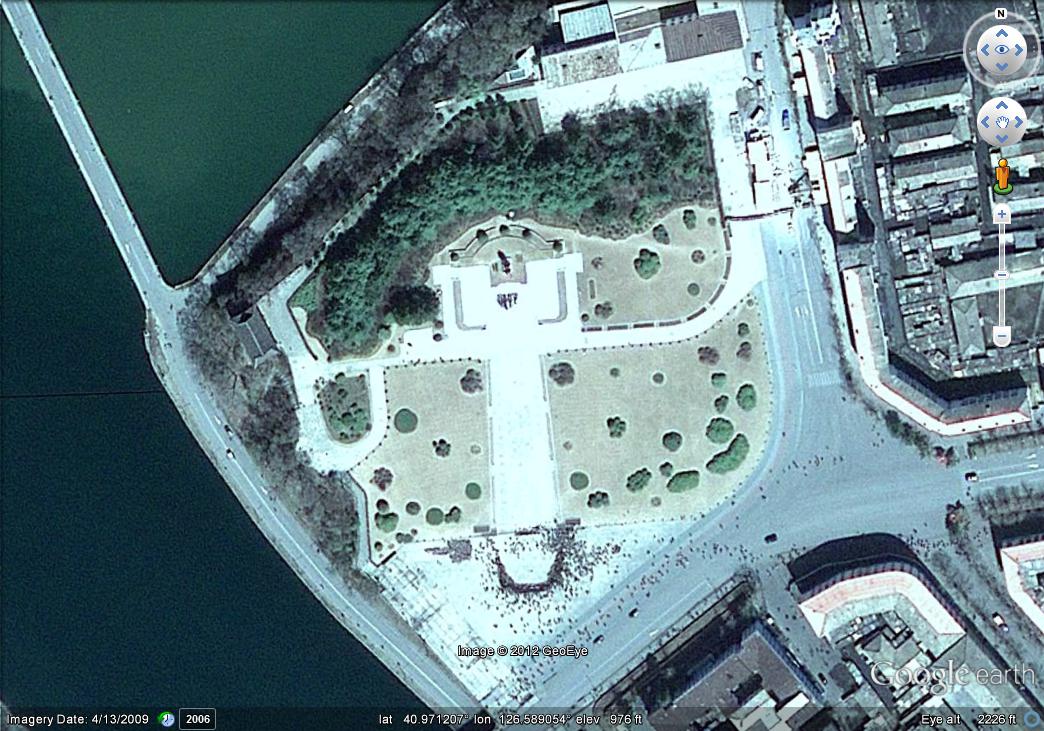
Pictured above (Google Earth: 40.971557°, 126.588980°) the old Kim Il-sung statue in Kanggye, Jagang Province.
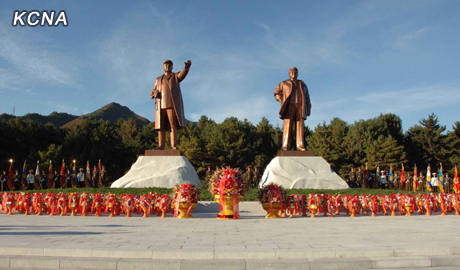
Satellite imagery is not recent enough to show the change, but KCNA reports that Kanggye City, the capital of Jagang Province, has received new statues of the deceased Kims:
Pyongyang, October 11 (KCNA) — Statues of President Kim Il Sung and leader Kim Jong Il were erected in Kanggye City, Jagang Province.
The statue of Kim Il Sung depicts him standing in his military uniform whose coat flying in the wind, his right hand held high and left hand taking a pair of binoculars. He seems to dynamically arouse the army and people of the DPRK to provide a turning-point in the Fatherland Liberation War. The statue of Kim Jong Il imposingly standing in his padded dress conveying so many stories about the Songun revolution depicts him with one of his hands placed on his waist. His face beaming with a broad smile looks as if he were wishing the great Paektusan power a rosy future.
An unveiling ceremony took place on Thursday.
Present there were Kim Yong Nam, Choe Yong Rim, Choe Ryong Hae, Kim Jong Gak, Kim Ki Nam, officials concerned, service personnel, officials and employees of the units who contributed to the erection of the statues, members of the shock brigades and people and school youth and children in the province.
The statues were unveiled by senior party, state and army officials and leading officials of the province.
A floral basket sent by the dear respected Kim Jong Un was laid before the statues.
Laid there then was a floral basket in the joint name of the Central Committee of the Worker’ Party of Korea, the Presidium of the Supreme People’s Assembly and the DPRK Cabinet.
Also placed there were a floral basket in the name of Jagang Province and floral baskets in the name of the party and power organs, bodies of different levels, enterprises, factories and farms, KPA units, etc. in Jagang Province.
All the participants paid tribute in profound reverence to the statues of Kim Il Sung and Kim Jong Il.
Kim Yong Nam, member of the Presidium of the Political Bureau of the Central Committee of the WPK and president of the Presidium of the SPA, made an unveiling speech.
He said the great Generalissimos paved the way of turning the province, which had been considered as unfit for human habitation, into a good place to live in and made sure that the province took the lead in the drive for building a thriving nation.
Recalling that it was the ardent desire of the people in the province to have statues of the great Generalissimos, he said the statues were erected in a brief span of time on the highest level thanks to their loyalty.
After being briefed on the statues, the participants looked round the statues.
A valued reader pointed out to me some some peculiar language (in the English version of the story). I point it out below:
He seems to dynamically arouse the army and people of the DPRK to provide a turning-point in the Fatherland Liberation War. The statue of Kim Jong Il imposingly standing in his padded dress conveying so many stories about the Songun revolution depicts him with one of his hands placed on his waist.
I have to laugh at the phrase “dynamically arouse”. Someday I will need to work that into a conversation. And just what would you make of a statue of Kim jong-il “imposingly standing in his padded dress”? If only I was proficient with Photoshop…
This will be the 11th Kim Jong-il statue of which I am aware. At this point we can probably expect new Kim Il-sung and Kim Jong-il statues to go up in all of the provincial capitals.
All of these statues are constructed by the Mansudae Art Studio in Phyongchon, Pyongyang.
Writing in the Daily NK, John Cha offers a brief model of the North Korean economy as envisioned by Kim Jong-il:
According to our former teacher Hwang Jang Yop, the economic model that is in place now is a brainchild created by [Kim Jong-il] based solely on his greed for power and control.
In the mid 1970s, [Kim Jong-il], then a young understudy to the throne, devised a three-tiered economy: the Party; the military; and third, the general masses. These units are separate, independent and don’t interact with each other.
The Party economy is operated and managed by the Chosun Workers’ Party. It consists of the most lucrative enterprises in mining, shiitake mushrooms, light manufacturing, fisheries, and other industries that produce foreign currency. Kim the 2nd kept his hand in the Party economy and amassed his personal fortune, which he used to reward his loyal followers, through it. As a result, Party elites enjoy the ‘life of Riley’; the best food, housing, clothing and education for their children. They are able to accumulate wealth.
The military economy consists of production and the sale of arms and munitions, as well as heavy construction projects like roads, railroads, tunnels and power plants. The military sector manages these enterprises, generates its own revenue and feeds a huge army. Military elites do fine as well. They live in fine houses, drive nice cars and so on.
Finally, the general public ends up with whatever is left over. There is no trickling down of any sort. Average workers and farmers scrap for what’s left and barely manage to subsist on their own with no help forthcoming from the Party or the military. The latest typhoons and floods shrank their food supply to a dangerous level, and people worry about the second coming of the famine, not to mention perennial shortages of fuel and electricity.
This anecdote is third hand by its own admission, but if true it is an interesting insight into the mental model under which the former North Korean leader was making policy decisions. I wonder what economic models, if any, have been taught to the new leader.
You can read the full article here:
Who Can Kill the 3-Tiered Economy? Daily NK
John Cha
2012-10-4
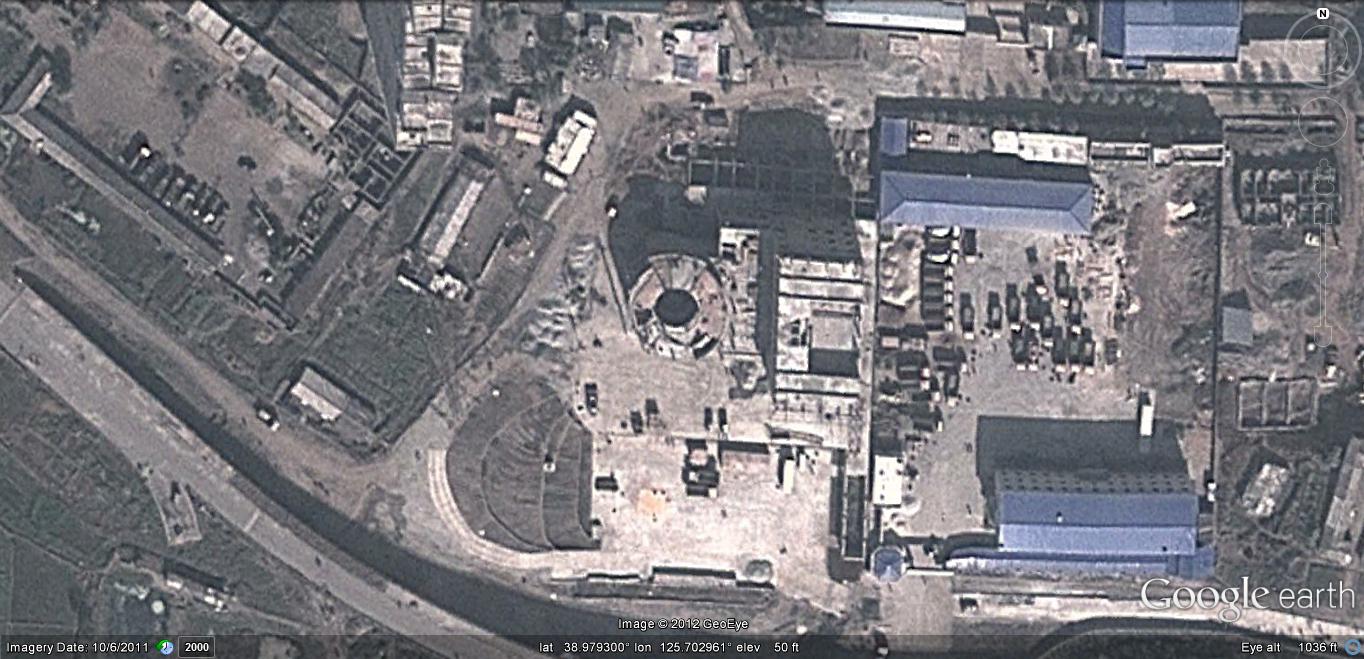
Pictured Above (Google Earth): Construction of the Sporting Center on Tongil Street ( 38.979300°, 125.702961°)
I watched a documentary of Kim Jong-un’s guidance trips in May 2012 and noticed that there was a visit in the video that was never reported in KCNA (neither the .kp nor the .jp versions) . The visit was to the “Sporting Center in Thongil Street”. I have posted the relevant video to YouTube:
According to the chronology of the video, the guidance trip took place sometime between Kim’s attendance of a performance by the Unhasu Orchestra (2012-5-1) and his guidance trip to the Mangyongdae Funfair (2012-5-9). The visit was unlikely to have taken place on 2012-5-2, however, since Kim is reported to have visited the command of the KPA Air Force (which was not reported in the documentary).
I was unable to recognize the people who attended the guidance trip with Kim, so I asked Michael Madden (NK Leadership Watch), who is quite good at this sort of thing, for some assistance. Here is his response:
[Kim Jong-un] was accompanied at that visit by VMar Choe Ryong Hae, Jang Song Taek, VMar Hyon Chol Hae, Gen. Pak Jae Gyong, Col. Gen. Son Chol Ju, Pak To Chun, Hwang Pyong So and VMar Ri Yong Ho. Also in attendance were members of the Guard Command and KJU’s personal secretariat.
Interestingly, KCNA did report that Choe Ryong Hae visited this facility on May 30 and hinted at the earlier Kim Jong-un visit:
Choe Ryong Hae Makes Field Survey of Sporting Center in Thongil Street
Choe Ryong Hae, member of the Presidium of the Political Bureau of the Central Committee of the Workers’ Party of Korea and director of the General Political Bureau of the Korean People’s Army, on Wednesday made field survey of the Sporting Center in Thongil Street.
The construction of the modern center for the promotion of the people’s health started at the initiative of the dear respected Kim Jong Un and under his plan. It is now nearing its completion.
There are in the center with a huge plottage hundreds of sports apparatuses of various kinds, recuperation rooms, table tennis halls, a supersonic wave wading pool, etc.
Choe Ryong Hae went round various places of the center associated with footsteps left by Supreme Commander Kim Jong Un with loving care for the people.
Choe underscored the need for builders to fully display the serve-the-people spirit in building, bearing deep in mind the intention of the supreme commander to make the people fully enjoy wealth and prosperity under socialism.
Each sports apparatus is associated with the warm loving care of the supreme commander, Choe said, calling for managing apparatuses and equipment well to provide convenience to visitors on a priority basis.
Going round the meat and fish shop conducive to improving the diet of people, he underscored the need for the officials and servants of the center to fufil their responsibility and role, deeply cherishing their mission as the servants of the people in hearty response to the party’s slogan “We Serve the People!”
He stressed the need for the soldier-builders to thoroughly implement the order of the supreme commander and successfully complete the center as early as possible.
So I am unsure why KCNA never reported on this particular Kim visit. Theories welcome. It makes me wonder what other visits go unreported!
There is increasing speculation that the new Kim Jong Un regime is pushing toward economic reform. This may be due to Kim’s young age, as he is considered to be more open to change than his father.
According to an unnamed South Korean official, there is a growing prospect that North Korea will soon release a new economic reform measure. More and more testimonies from North Korean defectors suggest that since Kim Jong Il’s death, reform measures are slowly taking place. But it is unclear when such new economic reform measure will occur.
North Korea’s behavior also implies that certain economic reform may occur. The spokesperson for the DPRK’s foreign ministry made a statement last month to the KCNA, “The dear respected Kim Jong Un has already set forth a goal of Korean-style development and strategies and tactics for enabling the Korean people to live well with nothing to desire more in the world. He is now wisely leading the general advance of the Korean people for economic construction and improving the standard of people’s living.” This indirectly suggests that the Kim Jong Un regime will put forth a new economic measure.
On the other hand, the content and timing of such still remains uncertain. According to the NK Intellectuals Solidarity, the Central Committee of Workers’ Party decided on a policy to introduce a new economic management system on August 1, one that would be centered around the cabinet.
What path North Korea will take with the new economic reform is unknown. However, the reform will comprise various economic sectors including agriculture, commerce, production and distribution. Details of the reform are unavailable.
The NK Intellectuals Solidarity predicted that new measures will be centered around the legalization of permitting private investment and commercial activities in service and trade sectors and private contract system for agriculture.
In contrast, Daily NK expects the core of the new economic measure will involve downsizing of cooperative farms (from 10-to-25 people in size to 4-to-6 people) and permit farming in unused lands; enforce government procurement system based on market price and strengthening self-supporting accounting system for companies.
The Choson Sinbo, a Japan-based pro-North Korean newspaper ran an editorial on July 11 that North Korea’s economic revival strategy is to follow the global trend but doing it “our-way.” The news also added that North Korea has already entered the path toward economic restoration and praised Kim Jong Un’s “our-style development goal and strategy” to improve the lives of the people while following the current trend of knowledge-based economy.
The news explicated that emphasis on “following the global trend” did not mean following and copying other nations but aimed for the nation to develop and rise on its own to reach the most advanced level of society. In addition, it is considered a refute against South Korea’s over interpretation about the possibility for opening and reform in North Korea during the Kim Jong Un era.
Bribery has little to do with ethics or honesty but relative costs and benefits:
The incorruptibility of the old bureaucracy has a rather simple and rational explanation: Most of the time, it did not pay to be a corrupt official under Kim Il-sung. Money was of surprisingly little use in the 1960s and 1970s, when pretty much everything was rationed and distributed by the state according to predetermined quotas and norms.
In those days officials lived significantly better than the average North Korean, no doubt. But they were affluent not because they had significantly more money (the wage differential between a top official and a humble worker was remarkably low), but rather because they had access to higher-quality goods and services that were not available to the common people. One of my North Korean interlocutors said: “Back in the 1980s, I did not care about money. Nobody did, since money did not buy much in those days.” In those days, in the 1970s or 1980s, one had to be an official to drink beer every week, to smoke cigarettes with filters, or feast on pork a few times a month. But officials did not buy these goods at market; rather they received them from the state as part of their special (very special) rations.
In this situation, it did not make sense for an official to accept bribes as a reward for overlooking some misbehavior or violations of some rules. Money would not be particularly useful and at the same time there was a significant risk of being caught. If caught, an unlucky official would at best lose his or her job and at worst even freedom, and no amount of money would compensate for this disaster.
In highly regulated economies, bribery and growth are positively correlated:
We are conditioned to see official corruption as an evil, but in present-day North Korea, corruption might be a life-saver. The average North Korean gets most of his or her income (about 75%, if recent estimates are to be believed) from private economic activities – these include private agriculture, trade and small-scale household production, and myriad other things. Nonetheless, nearly all of these activities remain technically illegal. Unlike China, North Korea has never undertaken serious economic reform, so private economic activities are still considered crimes, even though they have long become, in practice, a universal norm (and without such activities many would be unable to stay alive).
The only reason these activities are able to exist is corruption. Without widespread corruption, many more North Koreans would probably have perished in the great famine because there would have been no way to have private agriculture, and it would have been nearly impossible for private traders to move food across the country, delivering it to areas where the food situation was especially dire. After all, trade in grain and long-distance travel for commercial purposes are both technically crimes. No markets would be possible had the local bureaucracy been serious about enforcing a multitude of bans and restrictions on commercial activities.
Although corruption will lead to low levels of growth, it will impede overall development in the long-term:
Even when the Kim family regime meets its eventual demise, when a new North Korea emerges, the culture of corruption may remain as part of its heritage. And perhaps eventually it will become a serious burden to a resurgent North Korean economy.