Archive for the ‘Political economy’ Category

Kim Jong-il on an economic on site instruction blitz

Monday, August 9th, 2010

Institute for Far Eastern Studies (IFES)
NK Brief No. 10-08-09-1
8/9/2010

This year, North Korean leader Kim Jong Il has been very active in giving on-site guidance at economically-important venues. As recently as July 31, Kim visited the Ganggye and Huicheon areas of Jagang Province, inspecting and providing instruction at a number of facilities, including the Ganggye Tractor Complex, the Jangja River Construction Instrument Factory, the September Textile Factory, the Jangja Mountain Food Complex, and the Ganggye Basic Foods Factory. Between August 2-5, Kim Jong Il spent several days visiting venues in South Hamgyeong Province, including the February 8 Vinalon Complex, the Ryongseong Instrument Complex Military First Foundry, the People’s Consumables Exhibit Hall, and the Geumya River Power Station Construction Office.

Just by looking at Kim Jong Il’s public outings, one can see that he is focusing his efforts on economic recovery. From the beginning of the year until August 5, Kim has made a total of 90 public appearances, with 42 (46.7%) being to economic venues, 23 (25.6%) to military venues, 19 (21.1%) to theaters or other performance halls, and 6 (6.6%) to reception halls or other venues for foreign guests and dignitaries. Compared to the same period last year, Kim has made 4.7 percent more public appearances, and visits to economic venues increased by 7.2 percent. In 2009, he made 34 (39.5%) visits to economic venues, 23 (26.7%) to military installations, and 4 (4.7%) visits related to foreign diplomacy. The other 25 (29.1%) visits were to various other facilities. Reviews of artistic performances were down 8 percent (29.1%  21.1%) and inspections of military facilities fell 1.1 percent (26.7%  25.6%), while appearances at foreign diplomatic venues were up 1.9 percent (4.7 6.6%).

Kim Jong Il’s focus on the economy comes in a year in which the Workers’ Party of Korea celebrates its 65th anniversary (October 10), and the WPK party representatives are expected to meet in September for the first time in forty-four years, increasing pressure on Kim for visible economic improvements. Furthermore, reviving the stagnant economy is essential to providing a stable succession system for his third son, Kim Jong Eun. In the spirit of the movement, North Korea’s mass media outlets have also joined the campaign, encouraging the residents of North Korea to put forth more effort daily. An editorial in the WPK newspaper, Rodong Sinmun, on August 2 urged all the people of North Korea to strive harder to achieve the goals set forth in this year’s New Year’s Joint Editorial, and tied this to the upcoming “historic” WPK representatives meeting and the 65th anniversary, encouraging “glorious efforts” worthy of such political milestones.

On a different note, Kim Jong Il also launched a ‘good health’ campaign in the second half of July, inspecting health and wellness-related sights and promoting better health for all North Koreans. Kim has been making frequent site visits, but the fact that they have been only in a relatively limited area has raised questions as to just how healthy the leader is. Last month, after travelling frequently during the first two weeks, Kim’s travels toward the end of the month slowed down, with him making only three visits, all to artistic performances. Some wonder if it is not poor health that has slowed him down.

Share

DPRK reportedly executes another official

Tuesday, July 20th, 2010

According to the Guardian:

Kwon Ho Ung – Pyongyang’s chief delegate from 2004 to 2007 for ministerial talks with Seoul’s then liberal government – was executed by firing squad, Seoul’s mass-circulation Dong-a Ilbo newspaper said, citing an unidentified source in Beijing.

South Korea’s intelligence agency and the unification ministry, which handles relations with North Korea, refused to comment on the report.

The newspaper report said it had not confirmed when and where Kwon was executed.

You can read the full Guardian story here.

Share

Former DPRK railway minister reportedly executed

Thursday, July 15th, 2010

According to Breitbart (via Breitbart):

Former North Korean Railways Minister Kim Yong Sam was executed in March last year for failing to maintain locomotive trains that had been in store for wartime, Radio Free Asia, a nonprofit radio station, reported Wednesday on its Internet edition.

A source on North Korean affairs said Kim got into trouble during an inspection by the National Defense Commission for scrapping locomotive trains that were in store for wartime.

After the inspection, carried out after celebrations were held to mark the country’s 60th birthday on Sept. 9, 2008, Kim was handed over to the State Security Department, report said.

He had been railways minister for 10 years from September, 1998.

The Choson Ilbo has more:

A nationwide campaign is underway recently in North Korea to get rid of photos and publications of executed former senior officials, Radio Free Asia claimed Tuesday.

This campaign was ordered by leader Kim Jong-il on July 2. The North’s Press Censorship Bureau is reportedly destroying documents and materials collected from across the country.

According to RFA, the campaign’s targets include Pak Nam-gi, the former director of the North Korean Workers Party’s Planning and Finance Department who was executed in March over the disastrous currency reform, and former railways minister Kim Yong-sam.

“Railway workers suffering from the food shortage stole copper and aluminum parts from locomotive trains that were in store for wartime and sold them as scrap metal. As a result, about 100 locomotives were scrapped,” it claimed. “This was revealed in an inspection by the National Defense Commission in 2008.” Kim Yong-sam was then taken to the State Security Department and executed in March the following year, it added.

Kim Yong-sam was appointed railways minister in September 1998 but has not been seen in public since October 2008, when he was replaced by current minister Jon Kil-su.

A Unification Ministry official said rumors about his execution are “rampant.”

Read the full stories here:
Former N. Korean railways minister Kim Yong Sam executed: report
Kyodo (via Breitbart)
7/14/2010

N.Korea’s Ex-Railways Minister Executed
Choson Ilbo
7/15/2010

Share

KWP acsends in September

Wednesday, July 14th, 2010

UPDATE:  The Daily NK also offers some propaganda posters leading up to the event.

ORIGINAL POST: According to the Daily NK:

Hwang Jang Yop, President of the Committee for the Democratization of North Korea, believes the motivation behind the Chosun Workers’ Party (KWP) delegates’ conference, which is to be held for the first time in 44 years this September, is Kim Jong Il’s belief that the power of the Party needs to be increased since too much authority is currently concentrated in the National Defense Commission, and this could represent an obstacle to the establishment of Kim Jong Eun’s succession.

Hwang, who was speaking at a forum in Seoul on July 13th, explained, “Kim Jong Il relies on the military to reign, and the core of that power is the National Defense Commission, but he is trying to solve the succession issue by strengthening the authority of the Party.”

“Kim wants to return the National Defense Commission to its previous role, which was to devote itself to military duty,” he added.

Hwang stated, “Kim Jong Il believes that Kim Jong Eun’s succession cannot be same as his own, which was done through the military. He believes that Kim Jong Eun cannot manage the military as well as he could, and therefore, if Kim Jong Il dies with power concentrated in the National Defense Commission, stabilizing the succession will be difficult.”

“The military is difficult to control if there is a problem, and since Kim Jong Il understands this fact, he is intending to control the military through the Party. Also, Kim will want to announce the succession issue to the North Korean people through the Party rather than the military.”

“The previous Military Commission of the Chosun Worker’s Party served the role of an administrative organization,” Hwang reminded listeners. “Taking the opportunity offered by the Chosun Workers’ Party delegates’ conference, the functions of the Party will be acknowledged and strengthened, while the military will be refocused on military work.”

He also commented, “Kim Jong Il has threatened the international community through the military in difficult political and economic times, and run North Korea by directly mobilizing the army. However, the cultural and ideological unification of North Korean citizens is impossible through the military so, Kim Jong Il will actively use the Party in the establishment of the succession.”

“Kim Jong Il believes that only the Party can unite the North Korean people ideologically during the establishment of the succession, so therefore he is hosting the Chosun Workers’ Party delegates’ conference to begin the process by reinforcing Party authority,” Hwang concluded, returning to the main theme.

Previous posts on September conference here and here.

Read the full story here:
KWP to Take the Power Back in September
Daily NK
Kim Yong Hun
7/14/2010

Share

Aidan Foster-Carter offers DPRK current events summary…

Thursday, July 8th, 2010

In the East Asia Forum:

June 2010 saw two major anniversaries on the Korean peninsula. On June 25 sixty years ago the Korean People’s Army (KPA) invaded the South launching a bitter three-year war. North Korea still denies culpability, claiming it was repelling a Southern invasion; despite overwhelming evidence, now backed by Soviet archives, that it was the aggressor. No less mendaciously Pyongyang nonetheless celebrates the July 27, 1953 Armistice which ended open hostilities as a ‘brilliant victory in the Fatherland Liberation War’ — even though this left the North bombed and napalmed to ruination.

China still formally backs the North’s version, but this year some brave soul decided to take seriously the late Deng Xiaoping’s instruction to ‘Seek truth from facts.’ The International Herald Leader, an affiliate of Xinhua news agency let the cat out of the bag. It featured interviews with Chinese historians telling the true story, and a timeline stating that ‘The North Korean military crossed the parallel on June 25 1950 and Seoul was taken in four days.’ Naturally, the article rapidly vanished from the web. But many Chinese now are openly critical of the DPRK, and embarrassed that Beijing continues to toe Pyongyang’s line.

North Korea itself sticks to the old tunes. On June 22 the Korean Central News Agency (KCNA) reported what it headlined as ‘Revenge-vowing Meetings.’

Youth and students and agricultural workers gathered in Susan-ri… and in Sinchon … Tuesday to vow to take revenge upon the U.S. imperialists on the occasion of the ‘June 25, the day of the struggle against the U.S. imperialists’.

The reporters and speakers at the meetings recalled that the U.S. imperialists brutally destroyed cities, villages, factories and farms and killed innocent civilians…denouncing the Yankees as a herd of wolves in human skin and the Koreans’ sworn-enemy with whom they cannot live under the same sky…

They bitterly condemned the U.S. imperialists and the Lee group of traitors for totally negating the historic June 15 North-South Joint….

If the U.S. imperialists intrude into the DPRK even an inch, all the servicepersons and people will mercilessly wipe out the aggressors.

Rhetoric like the above is clearly intended to fan the flames of hatred.

A further KCNA item on June 24 purported to list the ‘Tremendous Damage Done to DPRK by US.’ The KCNA, with unusual precision, computed a total of nearly 65 trillion dollars for human and material losses inflicted from 1945 up to the present. Considering the state of US public finances, Kim Jong-il should not expect a cheque any time soon. There is also a degree of inflation; last time KCNA published such an exercise, in November 2003, the bill was a mere US$ 43 trillion. One can only wonder what is the point of such grandstanding.

So savage a mood has torpedoed a second anniversary; one which should have been happier. On June 13 2000 South Korea’s then president, the veteran democrat Kim Dae-jung flew to Pyongyang for the first ever inter-Korean summit with the North’s leader, Kim Jong-il. On June 15 they signed a North-South Joint Declaration; Kim Dae-jung was awarded that year’s Nobel Peace Prize. Thus began a decade of unprecedented North-South cooperation, albeit patchy and one-sided. This ‘sunshine’ policy was ended by South Korea’s current president, Lee Myung-bak, who insists that the North must give up its nuclear weapons first if it wants better ties with the South. That sounds fine in theory, but few expect it will ever happen.

North Korea made much of the June 15 anniversary, even while excoriating the ‘traitor’ Lee Myung-bak for trampling on it. Pyongyang warmly welcomed a South Korean radical priest, Han Song-ryeol, who made the trip illegally to mark the occasion.

South Korea by contrast played up the war anniversary more than the inter-Korean one. Lee Myung-bak used this occasion to once again call on the North to admit that it sank the ROK corvette Cheonan on March 26, and to apologise.

Will the Cheonan go unpunished?
Nevertheless, it looks increasingly like Pyongyang has got away with it. June brought Lee Myung-bak little joy on the issue, at home or abroad. Local elections in South Korea on June 2 saw his ruling Grand National Party (GNP) rebuffed. Many voters saw Lee’s tough first reactions, which roiled global markets, as adding to rather than reducing risk.

Abroad too Lee has met obstacles. Assured of firm US and other Western support he is struggling to convince Russia and China. That was predictable: for Beijing and Moscow, unwillingness to paint Pyongyang into a corner was always going to trump the facts. A Russian naval team visited Seoul to inspect the Cheonan wreckage, including DPRK torpedo parts, but is not expected to report until July. In this light the ROK government will be relieved that the G-8 summit in Canada on June 25 issued a strong statement on the Cheonan – after energetic lobbying by Japan’s new prime minister Naoto Kan, which will get his relations with Lee Myung-bak off to a good start. Connoisseurs of diplomatic wordplay noted that while the G-8 condemned the attack, noted that an international team had blamed it on Pyongyang, and called on the DPRK to avoid any attacks against the ROK, it did not quite join up all those dots; doubtless at Moscow’s behest. Lee may lobby similarly when he arrives for the ensuing G-20 summit; although since South Korea chairs the group and will host its next jamboree in Seoul in November, it may look bad if he were perceived as acting in too particularist a way.

Earlier, on June 4 South Korea formally referred the Cheonan incident to the UN Security Council (UNSC). On June 14 both Korean states briefed the UNSC, with the North as ever denying all responsibility and urging the Council not to consider the matter. No official response is expected until July. With Russia and China likely to abstain at best, whatever the Security Council eventually comes up with looks set to be a damp squib. South Korea has already said it will not seek further sanctions, on top of those already in force under earlier UNSC resolutions from 2006 and 2009 after the North’s two nuclear tests. But it would like a clear, resounding condemnation, preferably in the form of a resolution.

Looking ahead, it is not too soon to wonder how the two Koreas will get past Cheonan. Record numbers of DPRK workers at the Kaesong Industrial Zone (KIZ) – 44,000 as of June, according to the ROK unification ministry (MOU) – are seen in Seoul as a sign that at some level Pyongyang remains committed to this joint venture at least.

A big event in September
Meanwhile North Korea looks more preoccupied with the succession issue than in reaching out to South Korea.

On June 26 KCNA reported that ‘the Political Bureau of the WPK [Workers’ Party of Korea] Central Committee decides to convene early in September … a conference of the WPK for electing its highest leading body reflecting the new requirements of the WPK.’

Though nominally it is North Korea’s ruling communist party, and still an important tool of control at lower echelons, the WPK has seen its topmost organs atrophy under Kim Jong-il. Neither the rarely mentioned Politburo nor the Central Committee (CC) is known to have met at all in the 16 years since Kim Il-sung died. Kim Jong-il has favoured the army, ruling through the NDC and informally via a kitchen cabinet of trusted cronies. The dear leader is also of course secretary-general of the WPK, but he acquired that post irregularly: by acclamation at a series of local Party meetings, rather than being duly elected by the CC.

Hence while the precise nature of September’s meeting remains vague, like its exact date, it looks like a long overdue effort to restore a measure of due process to the Party. If this is in fact a full formal WPK congress, it would be the first since the Sixth Congress thirty years ago in October 1980. It was then that Kim Jong-il, hitherto veiled behind coded references to a mysterious ‘Party Centre’, was finally revealed in the flesh. The speculation is that this new meeting similarly will finally give the world a glimpse of the enigmatic Kim Jong-eun.

While all rumours emanating from Seoul should be treated carefully it’s hard not to link this news with reports that Kim Jong-il’s health is worsening. There are claims that on some aides including his son are duping him with Potemkin factories to hide from him how dire the economy really is. An already tardy succession can clearly brook no further delay, or else regime stability and continuity may be gravely imperilled.

The economy shrank again last year
If Kim Jong-il wants to know how his economy is really doing, he could look at the latest estimates from the enemy.

The (southern) Bank of Korea (BOK) published its latest estimates, covering 2009, on June 24, just in time for Seoul to crow about them as it marked the Korean War anniversary. By this reckoning North Korea’s real annual gross domestic product (GDP) shrank by 0.9 per cent last year. Unlike most other countries this had little to do with the global financial crisis. Rather it reflected local conditions, natural and man-made.

The gaps just get wider
The result is a huge and ever widening gap. North Korea’s gross national income (GNI) in 2009 was a mere 2.7 per cent of the South’s. BOK cites Northern GNI in 2009 was US$22.4 billion, compared to US$837 billion for the South. True, the South has over twice as many people. But the average North Korean per capita income too is a minute fraction of the South’s, with the ROK topping US$17,000 while the DPRK’s is a paltry US960. (Some experts, including a former unification minister, think even this is too high and posit a figure nearer US$300, putting North Korea among the poorest nations on earth.)

With trade figures the gap is even wider. This year inter-Korean trade will fall, since Seoul has banned most of it (except the Kaesong zone, which accounts for over half) as punishment for the Cheonan. Peanuts to the South, this has been crucial for the North: South Korea is its largest market, taking almost half of its meagre total exports. Last year inter-Korean trade like DPRK trade overall fell slightly, from US$1.82 to US$1.68 billion. Yet Northern exports crept up, from US$932 to 934 million.

In 2009 North Korea’s real trade totals were just under US$2 billion in exports and US$3.1 billion in imports. They are still dwarfed by South Korea’s respective figures of US$364 and US$324 billion – and this in a bad year for the South, due to the downturn.

Every year the gap widens further, yet still Kim Jong-il refuses economic reform. It is hard to fathom a mind-set which can inflict such disaster and tragedy on a once proud land and people – and whose idea of a way out of its self-dug hole is to fire a sneaky torpedo.

Good losers
It was left to North Korea’s footballers to remind the world that their country does not lack for talent and virtue. As one would expect, North Korea were a disciplined team. They kept to themselves and avoided the press – with one striking exception, Jong Tae-se. Born in Japan to a South Korean father and a pro-North Korean mother, and having attended schools run by Chongryun – the organisation of pro-North Koreans in Japan – he elected to play for the DPRK; although he still holds ROK nationality, lives in Japan and plays in the J-League for Kawasaki Frontale.

A young man whose talk is as uninhibited as his style of play, Jong cried when the DPRK anthem was played before the Brazil match. Yet his love for his adopted homeland is not uncritical. ‘Everybody thinks about our country as being closed and mysterious, so we have to change that,’ he told AFP. ‘We can change for the better if we are more open with the way we talk to people and it would make a better team.’

It would make a better country too. If North Korea’s fate must rest in the hands of an untried youth, better it were the warm-hearted and wised-up Jong Tae-se than Kim Jong-eun.

Read the full story here:
North Korea: Unhappy anniversaries
East Asia Forum
Aidan Foster-Carter
7/6/2010

Share

Kim Jong-il visits Sinuiju, successor Kim Jong-eun takes up on-site guidance

Thursday, June 24th, 2010

Institute for Far Eastern Studies (IFES)
NK Brief No. 10-6-23-2
6/23/2010

Kim Jong Il visited Sinuiju on June 17, spending three days inspecting industrial facilities with third son and possible successor Kim Jong Eun. One visit was to a shoe factory, at which Kim Jong Il observed modernized technology and production equipment. On another stop, at the Sinuiju Cosmetics Factory, Kim Jong Il met with the factory manager and foremen, providing them and the laborers with encouragement. Kim Jong Eun also made an appearance at the meeting, indicating that the effort to install him as the next North Korean leader has progressed to the point at which he is being directly introduced to the people.

According to a Daily NK report quoting a source in Sinuiju, Kim Jong Il’s automobile procession to Sinuiju was “impressive”, and was “about twice as large” as previous processions. The report also noted that Kim Jong Eun exited a care and met directly with workers at the cosmetics factor and at Rakwon Machine Complex, and that “Kim Jong Eun took most of the responsibility for [Kim Jong Il’s] protection entourage and for the on-site guidance.”

That on-site guidance parties have grown considerably larger than in other years is partly due to the fact that Kim Jong Eun is accompanying his father, but also because many more other officials are also traveling with Kim Jong Il. On-site guidance has transformed from that of giving business advice to actively promoting succession by Kim Jong Eun. According to one source, Kim Jong Eun took the lead on everything from succession issues to on-site guidance during this latest visit. In addition, central authorities were said to have encouraged business and city officials to follow Kim Jong Eun.

Last December, documents for indoctrinating cadres were distributed by Party officials. The propaganda praised Kim Jong Eun, calling him ‘the number-one guard of [Kim Jong Il], stepping first to the General’s on-site guidance visits to every site without regard to any conditions; in all weather, any temperature or wind and any landscape.’ In the documents, Kim Jong Il is quoted as saying, “The Captain has been assisting me with lots of my work,’ noting that Kim Jong Eun is taking part not only in his father’s security, but also in on-site guidance.

Kim Jong Eun’s actions during the latest visit to Sinuiju show that he has gained enough power in the protection bureau to be directing the bodyguard contingent assigned to his father, and his influence and authority is evident through his on-site guidance. Kim Jong Il’s visit to Sinuiju, which serves as a gateway for trade with China, could be part of preparations for large-scale economic cooperation with the PRC. Last December, Kim Jong Il visited Rason City, the site of the country’s first free trade zone, and declared Rason a ‘Special City’ in an effort to attract foreign investment from Beijing and abroad. Sinuiju and Rason will serve as conduits for economic cooperation and trade with China.

Share

Lankov on succession

Tuesday, June 15th, 2010

Writing in the Asia Times

A few days ago, a new session of the Supreme People’s Assembly – North Korea’s rubber-stamp parliament – was convened in Pyongyang. In most cases, such sessions do not attract much attention outside a tiny circle of the full-time Pyongyang watchers: few people would be excited by the sight of monotonously and tastelessly dressed men and women sitting in rows and raising their hands to signal their unanimous approval of the laws and resolutions that – as everybody understands – seldom bear any relation to reality.

However, this time observers suspected that something unusual was going to happen. The assembly’s last session took place in April, and was not supposed to meet again so soon. As we learned on June 7, parliament was convened to authorize (with the expected 100% approval rate) a major reshuffle of the North Korean leadership – and, judging by the urgency of gathering, this reshuffle was seen as a pressing matter.

A few days earlier, on June 3, the official North Korean wire agency reported that one day before, Yi Che-kang, the first deputy chairman of the ruling Korean Workers’ Party, had been killed in a traffic accident. The victim of a car crash was, formally speaking, second only to Dear Leader Kim Jong-il in the party hierarchy.

This news had to be suspicious: North Korea’s traffic is arguably the thinnest in Asia, but the country has a long tradition of traffic incidents taking the lives of high officials. The first such incidents occurred in the early 1970s, during the transition of power from the country’s founding father Kim Il-sung to his son.

Nowadays, the new dynastic transition is unrolling. In early 2009, after long delays and much hesitation, Kim Jong-il decided that his youngest son, Kim Jong-un, would become the next great leader of the country. So far, no reference to the “Young General” has appeared in the open media, but one can come across accolades to his greatness and superhuman wisdom in classified materials that are published for the benefit of officials (and distributed widely).

The events of the past week allow us to surmise how the power structure of North Korea will look like in the first years after Kim Jong-il’s death. It seems that North Korean political heavyweights have finally begun to prepare for the unthinkable – the demise of the Dear Leader.

The choice of Kim Jong-un as a heir designate serves, above all, the interests of the North Korean elite, so one can even suspect that the choice was somehow pushed on Kim Jong-il by his entourage. The “Young General” really is young, being merely 27 or 28 years old. Even North Korean propaganda mongers find this embarrassing, so they insist General Kim is in his early 30s.

The choice of such an exceptionally young candidate serves, above all, the interests of the old guard, Kim Jong-il’s own entourage. A young crown prince has no power base and no allies. Thus, even if he technically becomes the supreme leader, he will have no choice but to follow the advice of his father’s entourage, that is, people who are running the country now. He is doomed to become a puppet – at least for some while.

However, a weak crown prince will require an able prince regent. For the past few years, most Pyongyang watchers agreed that the most likely candidate to take such a position is Jang Song-taek, a brother-in-law of Kim Jong-il.

Born in 1946, he is 64 and hence young by the standards of North Korea, where a majority of the top leaders are in their 70s and 80s. The recent Supreme People’s Assembly session confirmed these speculations. At the session, Jang was appointed vice chairman of the National Defense Commission. The North Korean constitution stipulates that the chairman of this body is head of the state, and Kim Jong-il runs the country exactly in this capacity. Therefore, Jang officially became the second-placed person in the country.

The car incident that killed Yi Che-kang was also timely for Jang Song-taek. Yi was widely believed to be a rival of Jang. Now, with Yi dead, Jang seems to have no serious rivals left. The recent assembly session also appointed a new head of the North Korean cabinet. In North Korea, the prime minister is essentially a top technocrat, but it is still significant that this position went to Choe Yong-rim, who is rumored to be close to Jang.

Jang’s position remains precarious: Kim Jong-il is still the supreme leader, and in North Korea even blood connections with the highest family do not always secure a person from august wrath. In the past, family members have been exiled a number of times, and in one case a young relative of the Dear Leader was assassinated in Seoul, where he had defected. A few years ago, Jang Song-taek disappeared from public sight for a year, and he is widely believed to have spent this time in exile.

At any rate, the North Korean elite – with at least tacit approval of Kim Jong-il – began to work on the architecture of a post-Kim Jong-il regime. It seems that the future power structure will consist of Kim Jong-un, a much extolled Star of Revolution and Shining Comrade (or whichever flowery titles they will invent) who will essentially be a powerless puppet while real authority will dwell with a council of technocrats and generals presided over by Jang Song-taek. In all probability, it means that the death of Kim Jong-il will not bring about much change: for a while the country will be steered by the same people who have been running it for the past two or three decades.

However, power transitions do not always go as intended. To start with, Kim Jong-un’s personality cult is still in its infancy, and it will take few years to develop it to the usual North Korean levels. We are yet to see pages of all newspapers filled with countless stories of the “Young General’s benevolence”. However, before the personality cult is developed enough, not only Kim Jong-un’s position but the entire system will remain insecure. We do not know whether Kim Jong-il and his old guard have enough time at their disposal: at the latest Supreme People’s Assembly session the Dear Leader did not look particularly well.

It is also possible that after Kim Jong-il’s death some cracks in the top leadership, now invisible, will lead to intense infighting and thus undermine the cohesion that is essential for the stability of the system.

And even if the transition goes smoothly enough, the resulting system will remain inherently unstable. Kim Jong-un might be young, inexperienced and compliant now, but he will get stronger and wiser, and in all probability will not be too happy about the control of the old dignitaries. Many young kings ended up challenging and removing their regents.

On the other hand, the likely members of the future regent council are quite old, with an average age of 75 or so, hence in a decade many of the present-day top dignitaries will be dead from natural causes (and, perhaps a car crash or two).

Finally, Jang Song-taek might be tempted into assuming all power for himself. Nasty things are known to have happened to young crown princes in the past – from food poisoning to riding incidents and, perhaps, even good old car crashes.

But, whatever happens, the first days of June saw the contours of post-Kim Jong-il North Korea emerge.

Read the full story below:
Son rising for a post Dear Leader era
Asia Times
Andrei Lankov
6/16/2010

Share

12th SPA’s 3rd session–second meeting in 2010

Monday, June 7th, 2010

The DPRK’s Supreme People’s Assembly (SPA) just held a rare second session this year.  According to the Wall Street Journal:

“There was no discussion about the Cheonan stuff,” said Kim Young-soo, a professor at Sogang University in Seoul. “It was more focused on internal politics and administration.”

Jang Song Taek, who is married to Mr. Kim’s younger sister, was named vice chairman of National Defense Commission, the highest state body in North Korea. Mr. Kim is the commission’s chairman, his only title.

In the other prominent appointment Monday, Choe Yong Rim was appointed premier, the job that is portrayed in North Korea as the second-most powerful but that outside analysts consider below the importance of a seat on the defense commission. He succeeds Kim Yong Il, whose travels overseas gave him more contact with foreign leaders than Kim Jong Il has ever had. The two Kims are not related.

Analysts said the change in premiership appeared tied to the economic reform measures from last December that created a backlash noticeable for its volume and visibility to outsiders. Several lower positions were also changed for that reason, said the South Korean professor Mr. Kim, noting the use of the term “recall” in the North’s official announcement.

“In North Korea when the regime ‘recalls’ an official, it means the person wrongly implemented policies and should take responsibility for it,” he said. “So the ‘recalled’ officials, not Kim Jong Il, are publicly blamed for their failed handling of the administration.”

Mr. Jang since 2007 has been seen as Mr. Kim’s closest aide and is believed to be playing a key role in rallying support among the country’s elite for Kim Jong Eun, Mr. Kim’s third son, to succeed the dictator. Mr. Jang, who is 64 years old and whose background is in political operations of the regime, was appointed just last year to the defense commission.

“Kim wants to keep more tight grip on party elites and people by giving more power to Jang,” says Cheong Seong-chang, director of inter-Korean studies at the Sejong Institute, a private think tank in Seoul.

Mr. Jang becomes one of four vice chairmen of the 11-person commission, though is the one closest to Kim Jong Il.

Mr. Choe, 81 years old, has been associated with the ruling Kim family for decades, having served as a confidential secretary to Mr. Kim’s father, Kim Il Sung, who started North Korea in 1948 and led it until his death in 1994.

Mr. Choe most recently served as chief secretary of the Pyongyang City Committee of the Korean Workers’ Party and, in recent months, attended numerous public functions with Kim Jong Il, including a trip to the remote city of Hamhung and opening of an indoor swimming pool in Pyongyang.

Mr. Choe was economic planning minister in the 1980s, mining minister in the 1990s and chief prosecutor in Pyongyang earlier this decade.

This year has been volatile for Mr. Kim’s regime. Not counting Monday’s changes, 11 prominent members of the regime have died, been replaced or been shuffled out of view so far this year, according to a count by the web site NK Leadership Watch. The disappearance of one of those, Pak Nam Gi, is mired in controversy, with some reports in South Korean media saying that he was executed for the economic-reform mess.

Read the full Wall Street Journal story here:

North Korea Shifts Leaders
Wall Street Journal
Woo Jae-yeon
6/7/2010

Share

Waiting for an [economic] miracle

Monday, May 24th, 2010

Andrei Lankov writes in the Korea Times:

Kim Jong-il’s recent visit to China was somewhat unusual: instead of going straight to Beijing, Kim visited a number of sites which are associated with China’s economic development.

He went first to the port city of Dalian and spent time there inspecting the harbor and hi-tech centers located nearby (including even a semi-conductor plant operated by Intel). While in Beijing, he continued such visits.

Had this happened a few years ago, we would expect a wave of optimistic speculation: such interest in modern technology would have been interpreted as a sure indicator of North Korea’s readiness to launch Chinese-style reforms. This time, it seems that even the optimists have become tired of making prophecies which never come true.

Nonetheless, the trip once again demonstrated a peculiar feature which the North Korean regime shares with the now-extinct Leninist regimes of Eastern Europe. The Pyongyang leaders have an almost religious belief in the miraculous power of modern technology.

They hope that all their problems can be easily and quickly fixed once a proper technology is found and applied (of course, application has to be done by state). However, the social dimensions of the economic problems are ignored.

It sounds very non-Marxist: after all, the founding fathers of Communism explicitly stated that it is the social structure and property relations, not technology, which determines the economic productivity. But their supposed disciples would never agree that the economic woes of the Communist countries were brought by the less than perfect social system.

This unwillingness is understandable: social change might become dangerous for those who are in power. Therefore they have a vested interest in presenting their system as perfect.

So, if there are problems, those problems should have an easy technocratic decision ― and the only force which can find and introduce such decision is, of course, the regime in power.

When in the early 1950s the Soviet agricultural industry was clearly in trouble, Stalin decided to do something about it. His solution was a program of planting forest strips which would decrease soil erosion.

Stalin was also much interested in the grotesque promises of Trofim Lysenko, a notorious charlatan who was talking about “educating” plants into yielding greater harvest.

Lysenko also enjoyed the support of Khrushchev, Stalin’s successor. Khrushchev’s pet technology was corn production, and insisted that the nationwide switch to this wonder plant would miraculously raise productivity.

However, corn, being a Mesoamerican plant, did not grow well near the polar circle, and plants did not show any sickness of being susceptible to `education’. Russia, once a major exporter of grain, became an increasingly voracious importer of food.

Of course, the problems of the Soviet agriculture were caused not by the insufficient attention paid to corn production. It was the social problems that made the Soviet agricultural system so inefficient: farmers, being badly paid employees of the government-run farms, had no reason to work diligently.

When they toiled the small patches of their own land, which they were legally allowed, they showed a remarkable level of productivity. But this was not what the Soviet government was willing to see.

It was Mao’s China, though, which produced the weirdest examples of belief in wonder technologies. It reached its height during the Great Leap Forward in the late 1950s.

Mao wanted small furnaces to be built everywhere: during the Great Leap even schools and farms were required to make their own steel in the backyard furnaces. Predictably, the home-made steel was useless because of the low quality.

Simultaneously, Mao told the farmers to use “close cropping.” Seeds were sown far more densely than normal on the “politically correct” assumption that “seeds of the same class would not compete with each other” (of course, crops were ruined).

The farmers were also ordered to plough two meters deep, since this would “encourage plants to develop extensive root systems.” The result was famine which killed between 20 and 30 million people. However, it seems that Mao and his henchmen never abandoned their belief in miraculous technologies.

North Korea is no different. Its leaders also are firm believers in the power of technology, if this technology is carefully selected by the state and introduced by its agents. Kim Il-sung, being a son of a farming family, paid special attention to the agriculture.

Among other things, he was a great enthusiast for terrace fields. He wanted to transform the barren hills of North Korea into rice-producing areas, and kept reminding his officials that no efforts should be spared to do so.

Predictably, the result was a disaster: in the 1990s terrace fields were washed away by floods while the few remaining became unusable since a large electric pump would be necessary to provide those high-rise fields with water.

Kim Jong-il shares the belief in wonders, but in his case the major hope is modern industrial technology, preferably related to computers (an approach clearly influenced by gadgetry).

The Dear Leader reputedly said that it was a great folly not to study computers, and most of his technological initiatives are clearly related to IT.

Since last year, for example, the Pyongyang streets have been covered with posters which tell about wonders of the CNC technology (in an unusual twist, the English acronym is used). CNC stands for “computer numerically controlled” technology and, to put it simply, describes computer-controlled industrial equipment.

It is remarkable that the present author heard the same slogans many decades ago, in the 1970s. Indeed, the Soviet leaders also had much hope about the CNC and worked hard to introduce it as a cure for the Soviet economy ― with the predictable lack of success.

Therefore, not much should be read from Kim Jong-il’s visit to Intel. He might dream of computer-operated giant plants, but he lives under severe political constraints, and these constraints ensure that North Korea will remain a very inhospitable environment for high technology (apart from some ultra-cool gadgetry for the chosen few, of course).

This might be changed only if the system itself will be changed, but this is clearly not what Kim wants.

Read the full story below:
Waiting for a miracle
Korea Times
Andrei Lankov
5/24/2010

Share

DPRK-PRC summit and the outlook for bilateral economic cooperation

Wednesday, May 12th, 2010

Institute for Far Eastern Studies (IFES)
NK Brief No. 10-05-11-1
5-11-2010

As North Korean leader Kim Jong Il spent four nights and five days in China, meeting with President Hu Jintao, Premier Wen Jaibao, and other top Chinese leaders, it appears that the issue of bilateral economic cooperation was high on the agenda, and was discussed in depth.

‘Strengthening economic and trade cooperation’ was one of the five proposals for bolstering PRC-DPRK relations made by Hu Jintao during the May 5 summit meeting with Kim Jong Il, giving some indication of just how much emphasis he and Kim were putting on economic cooperation during the latest visit.

Hu stated that strengthening cooperation between Beijing and Pyongyang would help both countries build their socialist systems, and would be in their shared interests as it would further development and help to bring peace, stability and prosperity to the region. According to China Daily, the five suggestions made by Hu Jintao are as follows:

1) To maintain high-level contacts. The leaders of the two countries should keep in touch by exchanging visits, as well as sending special envoys and messages.
2) To reinforce strategic coordination. The two sides should exchange views in a timely manner and regularly on major domestic and diplomatic issues, international and regional situation, as well as on governance experience.
3) To deepen economic and trade cooperation. The relevant departments of the two governments should discuss and explore ways of expanding economic and trade cooperation.
4) To increase personnel exchanges. The two sides should expand exchanges in the cultural, sports, and educational fields, and the contacts between the youth in particular to inherit the traditional friendship from generation to generation.
5) To strengthen coordination in international and regional affairs to better serve regional peace and stability.

In response, Kim Jong Il expressed his appreciation for Hu Jintao’s heartfelt invitation and warm greeting, and agreed with Hu’s five suggestions for developing bilateral cooperation. He highlighted the construction of a new bridge over the Yalu River as the latest sign of friendly cooperation between China and North Korea, and added that he “welcomes investment in North Korea by Chinese companies and boosting bilateral working-level cooperation based on the principle of mutual prosperity.”

Economic issues were at the heart of Kim Jong Il’s meeting with Premier Wen Jiabao, as well. Following their meeting, Wen said, “PRC-DPRK economic cooperation has great potential,” and that he actively supports bilateral efforts. He stated that he had high hopes for infrastructure projects and other cooperative efforts in the border region.

He went on to say, “China actively supports North Korea’s economic development and improvements in the lives of its people,” and that he would like to introduce to North Korea “Chinese-style know-how” by sharing China’s experiences with reform and economic construction.

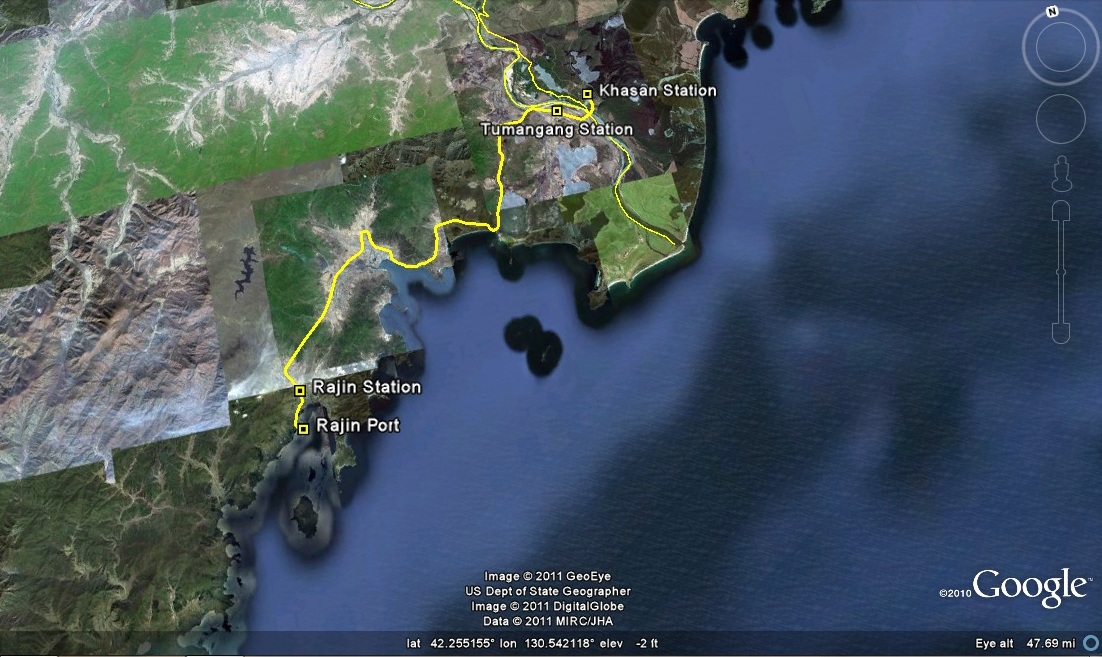
In October of last year, Premier Wen introduced the “Chang-Ji-Tu Development Plan” during his visit to North Korea, pushing hard for the North’s cooperation in developing the border region. That, along with North Korea’s extension of the contract giving Chinese companies access to Rajin Port and the latest talks during Kim’s visit to China give a clearer picture of the future direction of PRC-DPRK cooperative economic efforts.

The Chang-Ji-Tu plan to develop the Jilin and Tumen River regions calls for the establishment of an economic ‘beltway’ by 2020, and the revival of the antiquated industrial areas of China’s three northeastern provinces. To be successful, the plan requires North Korean cooperation on securing access to the East Sea. In 2008, North Korea granted China usage rights to Pier 1 in Rajin Port, and then signed an agreement with China last November on the joint development of the port into an ‘international distribution hub’ providing a link for China to the global market. China’s Jilin Province has already earmarked 3 billion yuan (500 billion won) for Rajin Port’s development.

This, along with the construction of a new border-crossing bridge on the Tumen River and other similar projects, reflects the infrastructure development plans for the border region. Construction on the new 33 meter-long bridge began last October, and China is bearing the burden of a 1.7 billion yuan (290 billion won) price tag. In March, China also began restoration of the bridge over the Tumen River linking Hunchun and North Korea, and is expected to move forward quickly with a road construction project linking the bridge to Rajin Port.

Another cooperative effort is focused on the development of the Hwangeum Industrial Complex, a free trade zone on Hwanggeum Island, in the Tumen River. Ryongaksan General Trading Company, which currently holds the development rights to Hwanggeumpyeong and Uihwa islands, is actively seeking to attract foreign investment. Kim Jong Il’s latest trip to China is seen by some as an opportunity to push for increased Chinese investment and assistance in developing the region.

Workers’ Party of Korea Unification Strategy Department Director Kim Yang Gong, as chairman of the Korea Taepung International Investment Group, traveled with Kim Jong Il in China, and it appears to have been in order to more strongly call for investment in North Korea, and the development of Rajin Port, in particular.

Beijing permitting North Korean sight-seeing tours and joint development in its three northeastern provinces indicates its support for the increasing pace of bilateral economic cooperation with Pyongyang.

Share

An affiliate of 38 North