Archive for the ‘International Organizaitons’ Category

DPRK currency reform hit markets hard

Thursday, April 22nd, 2010

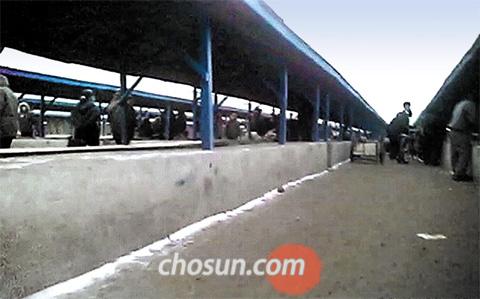
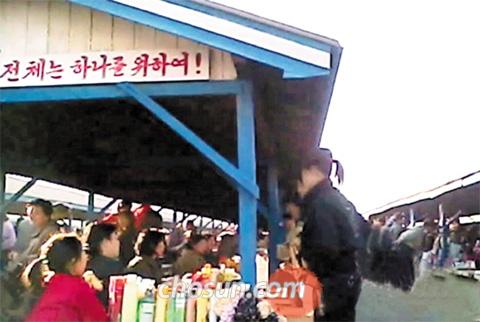
Great reporting by the Choson Ilbo–which provides video footage (before and after) of the DPRK’s currency reform on the market  in northern Onsong.

onsong-before.jpg

(October 2009)

 onsong-after.jpg

(March 2010)

Video of the market is available from the the Choson Ilbo and ABC web pages.

According to the Choson Ilbo:

Footage taken in October shows a bustling market, but the same place in March is almost deserted, with only a few traders selling goods. In October, the market was overflowing with food, clothes, shoes, cooking oils, squid and other goods. But three months after the currency debacle, only a few bags of corn are visible in the stalls. Products that were part of South Korean aid shipments to North Korea can also be spotted.

“Judging by the fact that the market was still deserted even in late March, it appears that retailers are waiting until prices go up even more,” said an official at the Unification Ministry. “The sale of goods picked up somewhat after North Korean authorities increased supply by importing products from China and other countries ahead of Kim Il-sung’s birthday” on April 15, a North Korean source said.

Onsong market before the currency revaluation used to include both roofed and open-air stalls where unauthorized merchants sold goods on mats placed on the ground. The square in front of the train station was also a bustling market where traders sold products away from the watchful eye of the authorities. But in early March 90 percent of the stalls were empty.

Pastor Kim Sung-eun of the Caleb Mission said, “If the owners of roofed stalls, who paid a fee for official approval to sell goods, disappeared, it suggests that North Korea’s middle class has collapsed.”

There was also evidence of South Korean aid products being sold in the markets. Bags of grain bearing the South Korean Red Cross symbol could be seen in various parts of the market. Some North Koreans used them as shopping bags. Goods sent as part of aid shipments by South Korea including grain bags are said to be very popular in the North. “There are rumors that high-ranking North Korean officials sold South Korean aid products in the markets, but none of them have been confirmed,” a Unification ministry official said.

“The market opens around 8:30 a.m. and closes around 7 p.m. after sunset,” said a North Korean defector from Onsong. “It’s heartbreaking to see the once bustling market so empty.”

This particular market is not visible on Google Earth.  The imagery is low-resolution and likely predates the construction of the market. See for yourself.

Share

“Let’s eat huge rabbits” (Part 2)

Wednesday, April 21st, 2010

Back in 2007 a German breeder of large rabbits expressed concern that some rabbits he sold to the DPRK had been eaten.  You can read about it here.

Well, the rabbit story is back.  According to Radio Free Asia:

The fate of dozens of giant rabbits sent to North Korean to start breeding a cheap source of protein for the famine-hit poor is still unknown, leading to speculation that they may already have been eaten by officials in the isolated Stalinist state.

“I am not aware of [exactly] what happened after we sent the rabbits,” said Jin Sook Lee, the director of the German charity, the German Overseas Korean Cooperation Association. “I don’t even know if they are being used to boost the food supply.”

She said the intended breeding program had run into difficulties once the German-bred outsize rabbits arrived in the isolated Stalinist state, where some sectors of the population still face malnutrition.

To ensure the successful expansion of the giant rabbit population, rabbit cross-breeding and species hybridization were needed, Lee said.

But many female rabbits failed to get pregnant, and of the rabbit kittens that were born, many were deformed, she added.

Boosting ‘rabbit-breeding’

Several charities have raised money to send giant rabbits to North Korea to boost the food supply, as the animals yield up to 10 kilos (22 lbs) of meat.

While the uber-bunnies normally breed as rapidly as their smaller cousins, the French humanitarian group Premier Urgence said it had send staff to North Korea to boost “rabbit breeding skills” among officials in charge of the farms.

The charity, which has received around U.S.$1.5 million in European Commission assistance funds for North Korea, said last November it planned to send a further 200 giant rabbits purchased in neighboring China to North Korea.

Chinese media have meanwhile reported comments made to the German magazine Der Spiegel by the original breeder of giant rabbits Karl Szmolinsky, who has had no information from North Korean officials since he sent 12 rabbits to boost the breeding farms in 2007.

“The only conclusion I can come to is that my rabbits made a nice meal for someone,” an online Chinese farmers’ news service quoted him as saying.

“I would really like to go over there and give them a hand.”

Premiere Urgence said in November that it had sent giant rabbits to seven farms in the country, including Ryongsung in Pyongyang, Youngtan in Northern Hwanghae province, Mikok, and Chungjong in Northern Pyongan province.

Livestock failures

Premiere Urgence said it planned to help the North Koreans improve giant rabbit reproductive rates by sending equipment and working on rabbit-farming skills.

The group said in November it had already dispatched three international staff members to Pyongyang, including a French and a Dutch national, while seven local staff members were already in the office, tasked with technical and clerical duties.

In an attempt to overcome severe food shortages, the North Korean authorities have already experimented with chicken, cow, and pig farming.

However, because of the decrepit state of North Korea’s facilities and the lack of technical skills, most attempts to raise livestock for food appear to have failed.

Director Lee said that sending giant rabbits from Europe was very expensive, costing about U.S. $100 per animal.

The first two rabbits to travel to North Korea paid a fare of U.S. $1,300, with vaccinations and veterinary fees on top of that.

She said her group had given up further plans to send giant rabbits to North Korea.

Experts also said the giant rabbits require more than one kilo (2.2 lbs) of carrots and potatoes daily, hard to come by in impoverished North Korea.

Szmolinsky, 67, of the eastern German town of Eberswalde near Berlin, was first approached by North Korean officials in 2006 after he won a prize for breeding Germany’s largest rabbit.

According to the United Nations, North Korea suffers widespread food shortages, and many people “struggle to feed themselves on a diet critically deficient in protein, fats, and micronutrients.”

Each of Szmolinsky’s rabbits produces around seven kilos (15 lbs) of meat, and under normal conditions should be able to produce 60 offspring a year.

Read the full story here:
Giant Rabbits’ Fate ‘Unknown’
Radio Free Asia
Noh Jung-min
4/19/2010

Share

German NGO worker on the DPRK

Wednesday, April 21st, 2010

According to the Times of India:

Economic sanctions by the United States and other western countries is actually strengthening the Kim Jong-il’s regime, a German social worker involved with a non-government organization told reporters here this morning. Sanctions are also affecting life in other ways like the new-found emphasis on sustainable agriculture, she said.

“The leaders are using the sanctions as a justification. People believe the country is in a bad condition because of outside forces,” Karin Janz, country director in North Korea for the German NGO Welthungerhilfe, said while speaking at the Foreign Correspondents Club in Beijing. The official media justified its actions as efforts to fortify the nation against the onslaught of foreign forces, and the people fully believed it, she said.

The sanctions have hit the North Korean agriculture and caused fears of a worsening of the food situation, Karin said. “The North Korean agriculture is highly industrialized,” she said while explaining the country’s agriculture is heavily dependent on imported farm machines and chemical fertilizers. Most of these materials came from South Korea, which has now slammed the doors.

The government has suddenly realized the value of sustainable development and is asking agricultural cooperatives to change their focus. They are being asked to go for organic farming, grow composts and reduce their dependence on chemicals. It is a new policy on sustainable development by default, she said.

“It could be a good start in the direction of sustainable development. But it is a long way to rehabilitate the soil, which is badly damaged” she said.

The Internet is banned to ensure that local citizens do not communicate with the outside world. There is a limited form of Intranet for university students to chat among themselves. But if the ban on Internet were to be lifted, most North Koreans will use it to absorb new knowledge and grow the country with new technological inputs.

“I cannot imagine some kind of opposition rising because it is simply not possible,” she said while discussing the highly militarized nature of the society. The government controls every aspect of life in North Korea and ordinary people seem to be comfortable living in some kind of a “safety shell”, she said.

Patriotism runs high among the people and most have full faith in their leaders. The only sign of dissatisfaction Karin saw was in January when currency reforms hit a large number of people very badly. People who held old currency notes suddenly found they could not exchange them for the new Won notes the government introduced early this year.

Welthungerhilfe is one of the few foreign NGOs that are still operating in North Korea when most of the others have left either because of the challenges posed by government rules and the drying of financing from western sources. There are many Chinese NGOs but the local government does not allow they to communication with those from western countries.

In her five years travelling across nine provinces of North Korea, Karin has not come across a single case of starvation. The food situation is bad, but it is not as grave as the western media tended to show, she said. The government has also done a fairly good job of developing infrastructure and provide school education although the conditions are still a far cry from what prevails in the developed world, she said.

Here is the Welthungerlife North Korea web page (in German).  Here is the page in English (via Google Translate).

I cannot prove it, but I am willing to bet that Welthungerhilfe built these greenhouses near Kujang (via Kernbeisser).  These greenhouses are too new to be visible on Google Earth.

Read the full story here:
Economic sanctions strengthen North Korea’s dictatorship, says German NGO
The Times of India
Saibal Dasgupta
4/20/2010

Share

DPRK to produce mobile phones

Wednesday, April 21st, 2010

According to Telegeography:

Tokyo-based newspaper Chosun Sinbo has reported that mobile subscriptions in the DPRK are continuing to rise steadily and could reach 600,000 by the end of the year. The pro-North Korea newspaper added that the number of cellular customers in the communist state currently stands at over 120,000, with wireless infrastructure reportedly present in more than half of the country’s cities and counties that is expected to accommodate 600,000 subscribers by year-end. The DPRK’s only mobile operator is CHEO Technology, which offers services under the Koryolink brand. Citing the head of North Korea’s mobile telecoms department, Choe Un, the report also added that the state plans to produce its own handsets – currently manufactured in China – within the next six months.

According to TeleGeography’s GlobalComms Database, CHEO was awarded a 25-year licence to operate a 3G network in January 2008, with the first four years on an exclusive basis. It is owned by Orascom Telecom Holding of Egypt (75%) and state-owned Korea Post and Telecoms Corporation (25%). Services were launched in December 2008 in the capital Pyongyang, but the network has since been expanded to include the main road running up to the northern city of Hyangsan, with the company currently working on expanding services nationwide.

Yonhap asserts that the Choson Sinbo piece claims the DPRK will start manufacturing mobile phones:

“Within half a year, handphone terminals will begin to be produced,” the paper said. “For a certain time, parts will be imported from overseas and assembled, but eventually the prospect is that development will be self-sufficient.”

The report said equipment for mobile service has been set up in more than half of the cities and counties in the country, adding the service will also be used on major roads and railways.

If a reader can send me a link to the original Choson Sinbo artilce I would appreciate it.  I have troubles navigating that site.

Here are previous posts about North Korea’s mobile phone networks and Orascom.

Share

New evidence on clandestine South Korean members of the KWP

Monday, April 19th, 2010

According to the Wilson Center’s North Korea International Documentation Project (NKIDP):

Documents obtained by NKIDP scholar Bernd Schaefer from the archives of East Germany’s state security service, or Stasi, were featured in an article in South Korea’s Dong-a Ilbo. The documents detail procedures for admitting clandestine members of the Korean Workers’ Party from South Korea to East Germany for meetings with North Korean officials. According to the documents, North Korea and East Germany established special procedures for South Korean “comrades” to secretly enter the GDR for meetings with North Korean officials at the DPRK embassy. East Berlin was also used as a stopover for these South Korean “comrades” traveling to Pyongyang for meetings with North Korean officials.

View the article in Korean at the Dong-a Ilbo website.  There were additional articles in Korean (here and here) and one in English here.

Share

PSCORE offers Google Earth locations

Friday, April 16th, 2010

PSCORE (People for Successful COrean REunification) is a non-profit, non-religious, non-partisan NGO based in Seoul & Washington, DC. According to their web page, they “strive for mutual understanding and harmony between the two Koreas and aim to provide a platform to discuss topics such as democratization, human rights and social issues.”

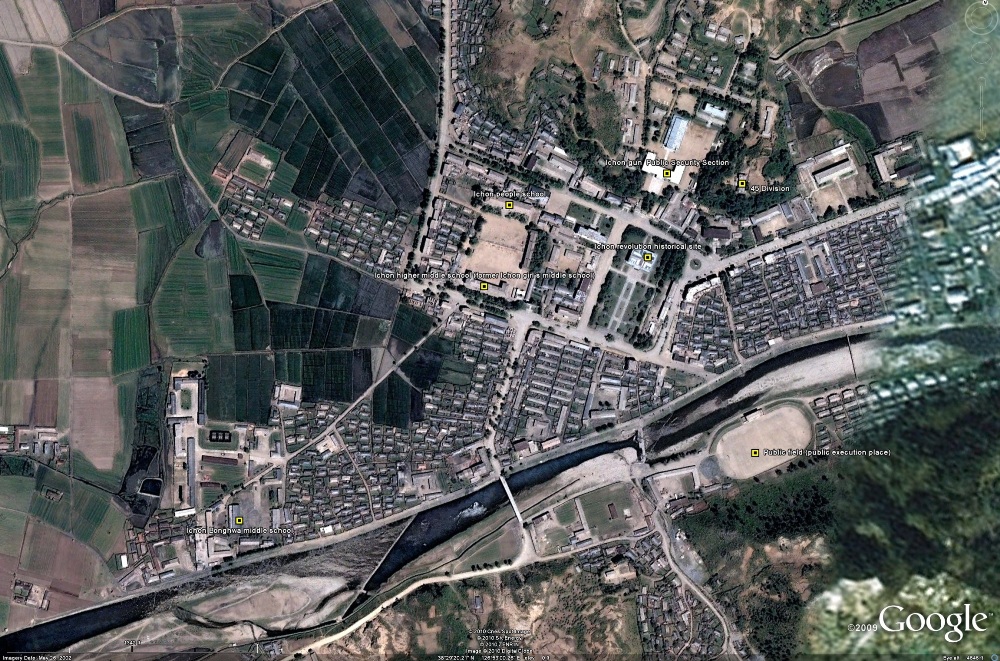
pscore-ichon.jpg

Well the team at PSCORE just sent me some North Korea map locations to add to the next version of the Google Earth project.  I am looking forward to sorting these out over the weekend, but just so you don’t have to wait on me, I have posted them on line for you to download yourself. 

Click here to download the PSCORE Google Earth locations.

Click here to learn more about PSCORE.

Share

GPI hosting May DPRK business delegation

Tuesday, April 13th, 2010

According to GPI:

In the current financial and economic situation, companies face many challenges. They must cut costs, develop new products and find new markets. In these fields, North-Korea might be an interesting option. Since a few years, it is opening its doors to foreign enterprises. The labor costs are the lowest of Asia, and its skilled labor is of a high quality. It established free trade zones to attract foreign investors and there are several sectors, including textile industry, agro business, shipbuilding, logistics, mining and Information Technology that can be considered for trade and investment.
  
European Business Mission to Pyongyang: May 2010
In order to explore these business opportunities, we will organize again a business mission to North-Korea (15-22 May). We will also visit the annual Pyongyang Spring International Trade Fair (see photo). This fair can be used by European companies to come in contact with potential buyers and suppliers in North-Korea. Information abouth both events has been attached. In case this date is not convenient for you, individual business trips are possible as well. Later this year, another trade mission will visit Pyongyang from 11-18 September. 
       
With best regards, Paul Tjia (director)  
GPI Consultancy, P.O. Box 26151, 3002 ED Rotterdam, The Netherlands
E-mail: paul@gpic.nl
Tel: +31-10-4254172 
Fax: +31-10-4254317
Website: www.gpic.nl

Here is the program flyer (PDF) 

Share

DPRK authorities slash all prices by 99 percent

Monday, April 12th, 2010

Institute for Far Eastern Studies (IFES)
NK Brief No. 10-04-12-1
4/12/2010

As inflation and food worries continue to grow in North Korea, social unrest is palpable. According to the group ‘Good Friends’, North Korean officials slashed prices on all goods to 1/100th of their going rate in an effort to ease the public. Considering the fact that North Korea revalued its currency by the same ratio on November 30, it appears that Pyongyang is effectively acknowledging the reform’s failure.

The Good Friends newsletter reports that the Korean Workers’ Party cabinet had handed down an order to reduce the price of all goods by a factor of 100:1, while the people of North Korea were told during local meetings that currency was revalued at 100 to 1, but not in order to reduce the sale of goods by 100 to 1, as well.

It also stated that at the first cabinet meeting in March, there was discussion on the fact that it was rumored that prices had climbed several times higher than official prices, and would continue to rise. It was decided that, at first, people thought of the currency reform as a 100-fold increase in prices, and that the same was true of management in state-run organizations. Later, at the second meeting of the cabinet, it was decided that a ‘100 to 1 Price Plan’ would be distributed to each city and town.

Now, People’s Committees and security forces in each city and town are enforcing the ‘100 to 1 Price Plan’ while the central Party’s 100:1 commerce committee has distributed a class syllabus in support of the price modifications, which was lectured on throughout the country from March 16-18. This indicates that the government is again controlling all prices throughout the country.

With no goods or aid flowing in from outside, it is likely that the price and exchange rates will continue to climb. On December 9, rice sold for 23 won, but the value of the new currency falls daily, and starvation is striking people in several areas throughout the country. Anger over government policies and general feelings angst are not hard to find in families and labor groups. The government is trying to control the prices of daily necessities, but if it is unable to do so, this situation cannot avoid becoming explosive. The central government has also sent officials out to different areas of the country to enforce a rice price of 25 won/Kg. This is the highest rice sold for in markets prior to the currency reform. Enforcing the same price throughout the country is an attempt to stabilize markets, and is a temporary measure to try to keep residents’ tempers from flaring.

The November currency reform was the first currency revaluation in 17 years, and was part of a set of strong measures to restrict markets, along with market closures and bans on foreign currency. However, since last February, the inflation sparked by the currency revaluation has grown severe and internal unrest has increased, leading authorities to reopen markets and set price caps. Now, the price of rice in North Korean markets appears to have stabilized at 400 won per kilogram, but due to the unrest over the last 100 days, many middle-class residents have fallen into poverty.

Share

ROK aid group to send food to DPRK

Tuesday, April 6th, 2010

According to the AFP:

A South Korean aid group said Tuesday it would send 300 tons of flour and other supplies to needy North Koreans this week amid reports that dire food shortages are worsening.

A ship carrying 60 containers of food, daily supplies and educational needs such as pencils will leave the western port of Incheon Saturday, said the Join Together Society.

“The shipment will benefit some 12,000 marginalised people at 50 orphanages and other institutions across the country,” society spokesman Seo Dong-Woo told AFP.

It includes 300 tons of wheat flour, 360,000 packs of soy milk and other foodstuffs, enough to feed 12,000 people for three months, he said, declining to disclose the cost.

South Korean officials and aid groups say the already severe food shortages are expected to worsen this year after a poor grain harvest in 2009.

A bungled currency revaluation last November has reportedly played havoc with distribution networks, aggravating food shortages and sparking inflation.

North Korea has relied on foreign aid to feed its people since a devastating famine in the 1990s killed hundreds of thousands.

Overseas donations for programmes run by the UN’s World Food Programme and others have fallen sharply because of the standoff over the North’s nuclear and missile programmes. Pyongyang has also rejected some aid.

South Korea’s government has since 2008 suspended annual shipments of fertiliser and food to the North amid rising tensions, but private aid groups continue to send shipments.

Read the full story here:
S.Korean aid group to send food to North
Associated Free Press
4/6/2010

Share

DPRK legal efforts to strengthen planned economy follow currency reforms

Monday, April 5th, 2010

Institute for Far Eastern Studies
NK Brief No. 10-04-05-1
4/5/2010

It has recently been verified that following the currency reforms at the end of last year, North Korea passed 11 laws revising and reforming the system of government control over the economy. Among these measures is a law banning the black market sales of grain.

The North’s food administration law, revised last November 3, clearly bans the black market trade and smuggling of grains, and sets the punishment for such activities as the confiscation of the grains in question. In addition, an order was passed down stating that when food supplies are rationed to a labor management office, they are to be distributed in accordance with a worker’s efforts, position, and productivity. On the same day, a new agricultural law was passed that stated if organizations and groups that were granted land for private plots failed to meet state-set harvest quotas, the plots could be confiscated.

In November and December of last year, North Korea also enacted the Real Estate Management Law, Goods Consumption Standard Law, Construction Materials Import Law, Import/Export Country of Origin Law, Waterworks Law, Labor Quantity Law, Farm Law, Sewer System Law, and the Mariner Law. Among these, the Labor Quantity Law sets the number of laborers per hourly production demands, stipulates labor contracts, and determines remuneration in accordance with worker performance. This law is unprecedented in that it allows the responsible organization or business managers or supervisors administrative and even penal authority by giving them power over labor evaluations and payment.

The Farm Law allows each farm to retain some of its harvest, and making it responsible for selling its goods to the state, while on the other hand, forbidding illegal agricultural production. This law, by strengthening state control over agricultural goods, appears to be an effort to restart the Public Distribution System.

The Real Estate Law, a mechanism to collect user fees, stipulates, “Real estate cannot be lent or left to different individuals, groups, organizations or enterprises without the permission of the applicable authority.” Along with this, the law on consumption includes a clause that links consumption of particular goods with those goods’ production in order to prevent waste, as well as a clause designed to reduce or eliminate the use of imported goods.

The law on the import of construction materials gives the government leverage in all aspects of such activity, including planning, processing, transfer, inspection, construction and testing. In addition, if someone from an enterprise or organization imports construction goods without government authorization, changes an import plan, distributes, transports, or wastes construction wares, he or she is subject to administrative punishment.

Ultimately, economic legislation enacted or revised after the currency reform appears to be aimed at strengthening the planned economic system while increasing government control over public revenue and encouraging efforts to recover without outside assistance.

Share

An affiliate of 38 North