Archive for the ‘Light Industry’ Category

Kim Jong-un pushes CNC deployment

Friday, November 19th, 2010

If you are not sure what CNC is, read my previous post here.

According to the Joongang Daily:

North Korean leader Kim Jong-il’s youngest son is making unofficial rounds to munitions factories in the communist state, encouraging the modernization of technology in the manufacture of weapons and following his father’s footsteps in songun, or “military-first,” politics, according to U.S.-based Radio Free Asia (RFA) on Wednesday.

Kim Jong-un wants all factories to implement computer numerical control (CNC), which enables the automation of machines with computer-assisted technology. CNC has been connected to the young leader-to-be since last year when he was tapped for succession. South Korean government officials have said that the technical term is being used in connection with Kim Jong-un because the technology is new in North Korea – suggesting the rise of a young new leader intent on modernizing military production.

“With news that Kim Jong-un will visit a munitions factory in Chongjin, North Hamgyong, the factory has been busy with movement. He is coming to inspect the CNC of the factory’s production line,” said a well-informed source cited by RFA. The factory, which is in an area of northeastern North Korea located about 50 miles from the Chinese border, is known to produce shells for multiple-launch artillery pieces. It was also mentioned in a recent broadcast by the state’s official television network for its implementation of CNC technology along with other machinery factories, “standing at the cutting-edge of machinery development,” KCTV said.

According to the source, Kim Jong-un is visiting production lines in North Hamgyong and Jagang, and munitions factories were the first to receive orders to implement CNC to “set an example” for the entire country.

The new technology is utilized to develop more weapons, which could easily attack Seoul and the metropolitan area and could put more pressure on the South Korean government.

North Korea has been urging talks with Seoul to resume cross-border tourism while simultaneously trying to hint that it wants to return to the six-party talks on denuclearization.

Kim Jong-un was also reported to have shown a friendly side to those who have cooperated with his CNC implementation plan. Factories that he visited are reportedly being given incentives, such as cooking oil for workers’ families. Kim Jong-un’s visits mirror those of his father’s past field guidance trips to various places in the communist state and indicate he is well on his way to becoming the next North Korean leader. The field guidance trips are usually touted by the North’s official media without exact dates of when the visits actually happened.

Read the full story here:
Kim Jong-un pushing ‘military-first’
JoongAng Daily
Christine Kim
11/19/2010

Share

DPRK manufacturing mobile phones

Monday, November 15th, 2010

According to Bernama:

North Korea has started to mass-produce cellular phones while trying to customize their operating systems to satisfy local needs, Yonhap news agency reported, citing a pro-Pyongyang newspaper as saying.

The report by Chosun Sinbo, run by a group of pro-North Korea residents in Tokyo and monitored in Seoul, came after Cairo-based Orascom Telecom Holding announced earlier this month that its mobile business in the communist state is rapidly expanding.

The number of mobile phone subscribers has at least quadrupled over the period of one year in North Korea, according to Orascom. The expansion doesn’t mean that the regime has eased its rules aimed at restricting the flow of information in and out of the country.

Chosun Sinbo said Monday in its report from Pyongyang that a firm known as Checom Technology Joint Venture Company has set up a “flow manufacturing process and is producing hundreds of high-performance cellular phones each day.”

Checom is a Pyongyang-based electronics and communications company, according to the Web site of Songsang Company, a Dandong, China-based firm that trades with North Korea.

Flow manufacturing is a build-to-order process aimed at minimizing inventory.

“Related sectors are testing new devices and actively working on a project aimed at modifying the operating software to suit the needs of local users,” Chosun Sinbo said.

“Central engineering rooms for mobile communications are also pushing a program to develop software for their main machines to meet the domestic environment.”

The report added that a video calling service has also been made available while “hundreds of base stations” that transmit signals have been set up across the country.

Orascom, which operates jointly with the local Koryolink, had said in its earnings report that video calling “resulted in a high level of demand, especially from the youth segment.”

North Korea first launched a mobile phone service in Pyongyang in November 2002, but banned it after a deadly explosion in the northern Ryongchon train station in April 2004, possibly out of concern that it could be used in a plot against the regime.

In 2008, the country reversed its policy and introduced a 3G mobile phone network in the joint venture with Orascom.

However, the overall “mobile penetration” remains at 1 percent in the country that has a per-capita GDP of US$1,900 and a population of 22.8 million, according to Orascom.

Read the full story here:
North Korea begins mass-producing cell phones to meet local demands
Bernama (Malaysia)
11/15/2010

Share

DPRK cabinet discusses 4th quarter projects as Chinese participation grows in the Pyongyang International Trade Fair

Monday, November 8th, 2010

Institute for Far Eastern Studies (IFES)
NK Brief No. 10-11-8-1
11/8/2010

North Korea held an extended meeting of the entire Cabinet in order to discuss the types of projects to be pursued in the last quarter of the year, and to strategize on how these projects should be implemented.

On October 28, the CHOSUN SHINBO reported on an article in the MINJU CHOSUN, which is under the control of the North Korean Cabinet. According to the article, efforts are being made to strongly construct the foundation upon which exemplars of the ‘military-first’ era will be erected. Production lines and facilities in all realms of the People’s Economy need to come into alignment with CNC, and efforts need to be made toward modernization, environmental protection, and reforestation. In particular, the Cabinet has pledged to decisively improve city management and restore socialism in cities and agricultural villages. Efforts will be focused on restoring socialist principles to economic management and ensuring that the centrally planned national economy is implemented.

The newspaper also reported that the North’s Cabinet held discussions on how to successfully fulfill all the goals set for the third quarter while creating a strategy to meet all of the targets set for the annual People’s Economy. It is unknown exactly when this meeting was held, but Premier Choi Yong-rim and other Cabinet members were all in attendance, as were city and town People’s Committee representatives, committee members from factories and farming communities, economic planners, and managers from critical factories and organizations.

As officials discuss economic reforms, the sixth annual autumn Pyongyang International Trade Fair was held from October 18-21, and it saw a greater Chinese presence than the thirteenth annual spring trade fair held last May. This could be the result of Kim Jong Il’s August visit to China. According to the newspaper, seventeen countries were represented by over 140 companies (48 from North Korea, 93 from abroad) — This was three countries and over twenty companies more than were at the spring fair. India participated for the first time this fall.

An official from the trade fair told the newspaper that the increased participation from Chinese companies was a direct result of Kim Jong Il’s recent visit to China’s northeastern region and the improved economic relations between Pyongyang and Beijing that came out of that visit. From machinery and equipment to steel products, electronic goods and light industrial products, food, pharmaceuticals, traditional herbal medicines and chemical products, over 57,000 products in over 2,300 different categories were on display. This is more than 600 categories of goods not seen last year.

Foreign companies participating in the fair signed contracts with North Korean offices for sales, technology exchanges, joint ventures, and investment opportunities, building on the ‘Introduction and Negotiations on the Investment Environment of the Democratic People’s Republic of Korea’ held on October 18.

Share

Russian blog debuts DPRK PDA device

Wednesday, November 3rd, 2010

UPDATE: Martyn Williams writes in PC World (11/5/2010):

A new PDA (personal digital assistant) has hit stores in North Korea, according to a student who writes a blog from the secretive state.

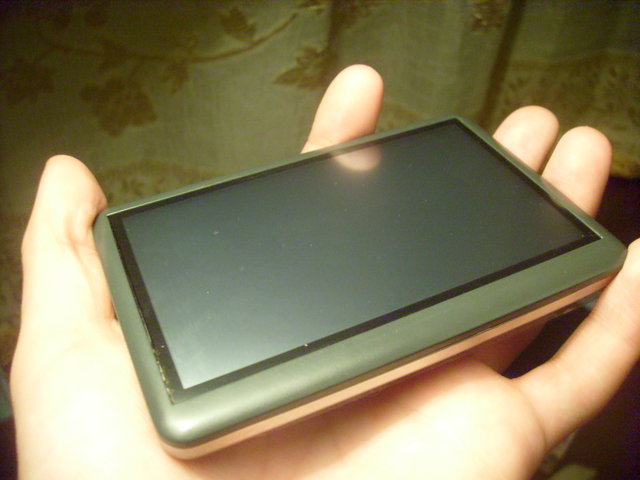
The device, which doesn’t appear to carry any branding, has a color touchscreen display that occupies its entire front, according to photos published on the “Pyongyang Show and Tell” blog. The Russian-language blog is maintained by a Russian student who is studying in the country.

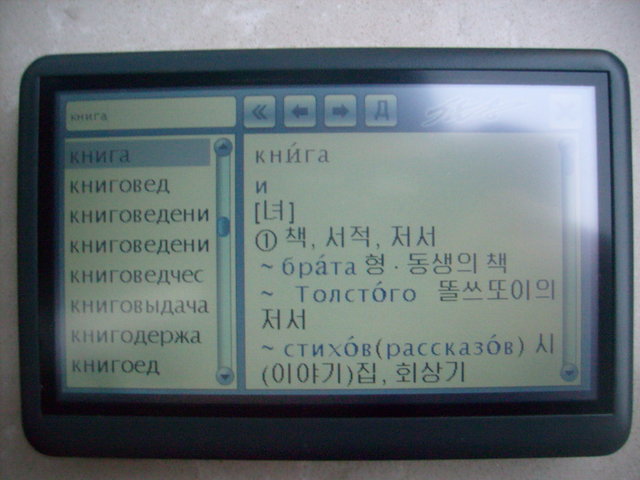
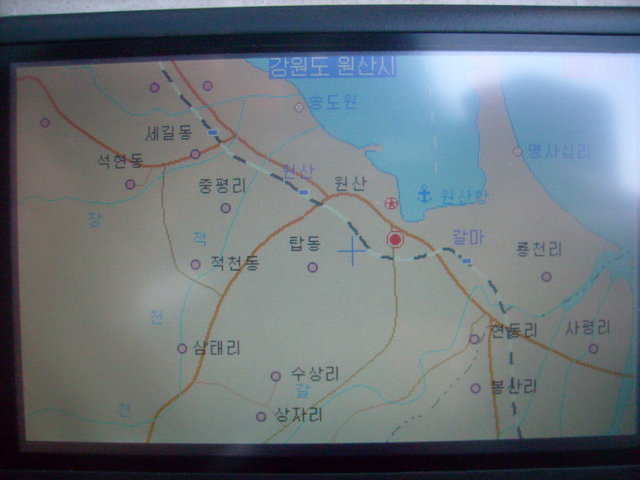
Installed software includes a Korean dictionary and translation dictionaries pairing Korean to and from Russian, English, Chinese and German, the blog report said. There are several basic utility programs and an electronic map of the country although the PDA does not feature GPS (global positioning system).

There is also no wireless networking so data transfer has to take place via a USB connection to a Windows or Linux computer. Data can also be transferred via MicroSD card, which is the same as used in domestic cell phones.

“Comparing it to modern things like, let’s say, the iPad, it’s nothing,” the blog’s author, who didn’t wish his name to be used, told IDG News Service via email. “It’s still good as a dictionary, except I don’t see any other advantages.”

It’s not the first PDA in North Korea.

In 2003 the country’s media said “Hana 21,” a PDA developed by the Samilpo Information Center, had been put on sale. The device included English-Korean and Korean-English dictionaries as its main function and also had several games and a basic word processor. Input was by pen and touchscreen.

According to published images of the Hana 21, the two devices are different.

At the time the Hana 21 was said to cost around 200 euros (US$182 at the exchange rate of the time).

The new PDA that hit stores recently costs around US$140.

“It’s still hard to buy for a Korean, but there are many people who keep their money for years and can afford it,” the student said via email.

PDAs have long been out of fashion in many countries after their features and functions were duplicated by smartphones. North Korea has a 3G cellular network, but most cell phones have only basic features.

ORIGINAL POST: Show and Tell Pyongyang introduced the world to the DPRK’s version of Linux: Red Star.  Now he has introduced us to the DPRK’s new Personal Digital Assistant (PDA).

Here are pictures from the Russian web page:

According to the Russian-language web page (via Google Translate):

A few weeks ago in North Korea has started selling the first PDA. In all the computer shops you can see the advertising of the new items. [I] offer a small review of this device.

On sale are a few options. The difference between them – is the amount of internal memory and a built-in slot for the stylus. The most feature-rich [costs] $ 140 and has 8 gigs of internal memory and a slot for the stylus, so you do not accidentally lose it.

In addition, there is a slot for MicroSD memory cards – the same as in the local mobile phones.

The main function of which is worth noting (and more generally for which there is a fly sabzh), an electronic dictionary Samhyn (삼흥) with the Russian language. It is no secret that South Korea produced electronic translators, but, according to eyewitnesses, the Russian language is absent in them as fact. And in this case, Russian-Korean and Korean-Russian dictionaries most voluminous in the number of vocabulary words. Besides, there are English, Chinese and German. Also has a large Korean Wiki Grand Korean Dictionary.

So for me personally, the main value of the PDA – is an electronic dictionary, which can carry with them always and everywhere. And the rest is not so important.

So what else is there? There is a map of Korea’s system of teaching foreign languages (English, Chinese). By the way, about a month ago there was an opportunity to put maps on your mobile phone. Application free of charge and requires activation. Put it on a large computer center of the city. []

Device has access to TV, headphones and a USB-slot. Possible to connect devices to both Windows, and Linux (in this case, Red Star)

On the whole – everything is simple and works quite well. At the moment, the firmware needs some work, not all features fully implemented, but the Korean comrades promise to update and refine.

If anyone else has more information, please let me know.

Share

CNC – Juche’s industry power

Wednesday, June 30th, 2010

For those of you who have recently visited the DPRK or who spend too much time perusing Elufa.net or reading KCNA, you are undoubtedly aware of the DPRK’s recent emphasis on something called “CNC”.  I had no idea what CNC was, so I began collecting as much information as I could find on the net and I have posted it below.

Here is the Wikipedia page for CNC.  For those of you in China, here is what it says:

Numerical control (NC) refers to the automation of machine tools that are operated by abstractly programmed commands encoded on a storage medium, as opposed to manually controlled via handwheels or levers, or mechanically automated via cams alone. The first NC machines were built in the 1940s and ’50s, based on existing tools that were modified with motors that moved the controls to follow points fed into the system on paper tape. These early servomechanisms were rapidly augmented with analog and digital computers, creating the modern computed numerically controlled (CNC) machine tools that have revolutionized the design process.

In modern CNC systems, end-to-end component design is highly automated using CAD/CAM programs. The programs produce a computer file that is interpreted to extract the commands needed to operate a particular machine via a post processor, and then loaded into the CNC machines for production. Since any particular component might require the use of a number of different tools—drills, saws, etc.—modern machines often combine multiple tools into a single “cell”. In other cases, a number of different machines are used with an external controller and human or robotic operators that move the component from machine to machine. In either case, the complex series of steps needed to produce any part is highly automated and produces a part that closely matches the original CAD design.

That description is not nearly as helpful as this video on CNC: Click here (Might not work for readers in China).

The Asia Times ran a story which included a short history of CNC in the DPRK:

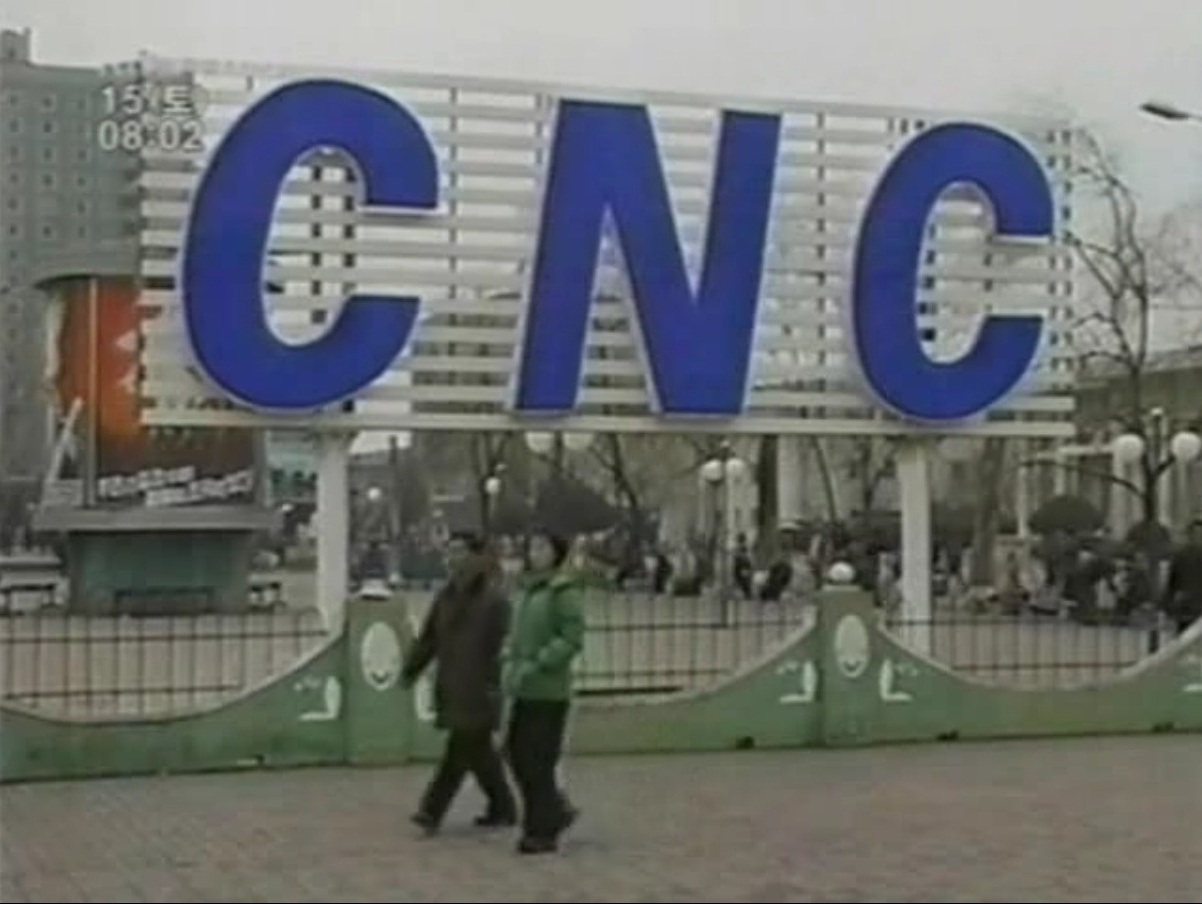
The name of the game is CNC – Computer Numerical Control – machine tools that have revolutionized the design process and said to be developed in the DPRK and already exported, for example, to China. Top exponents are the Korea Ryonha Machine Tool Corporation and the Taean Heavy Machine Complex. CNC billboards are all over Pyongyang. Inevitably CNC has its own dedicated patriotic song (no music video yet). Here are the lyrics, as translated by Andray Abrahamian, a doctoral candidate at the University of Ulsan in South Korea:

If you set your heart on anything
We follow the program making the Songun era machine technology’s pride
Our style CNC technology

(chorus)

CNC – Juche industry’s power!
CNC – an example of self-strength and reliance!
Following the General’s leading path
Breakthrough the cutting edge

Arirang! Arirang! The people’s pride is high
Let’s build a science-technology great power
Happiness rolls over us like a wave

So the narrative of building a “socialist paradise” is now being supplanted by the narrative of developing and producing state-of-the-art technology to, as the Pyongyang Times indelibly put it, “improve the people’s living standard on the word level”. This is how the DPRK is mobilizing its people to “open the gate to a thriving nation in 2012”. South Korea, watch out.

By way of luck, I managed to obtain a copy of the DPRK’s CNC song. You can download the MP3 by right clicking here.

UPDATE: A reader did find this DPRK karaoke version of the CNC song complete with lyrics (in Korean).  Watch it here.

UPDATE 2: A reader also sends in this acoustic version of the CNC song (YouTube).

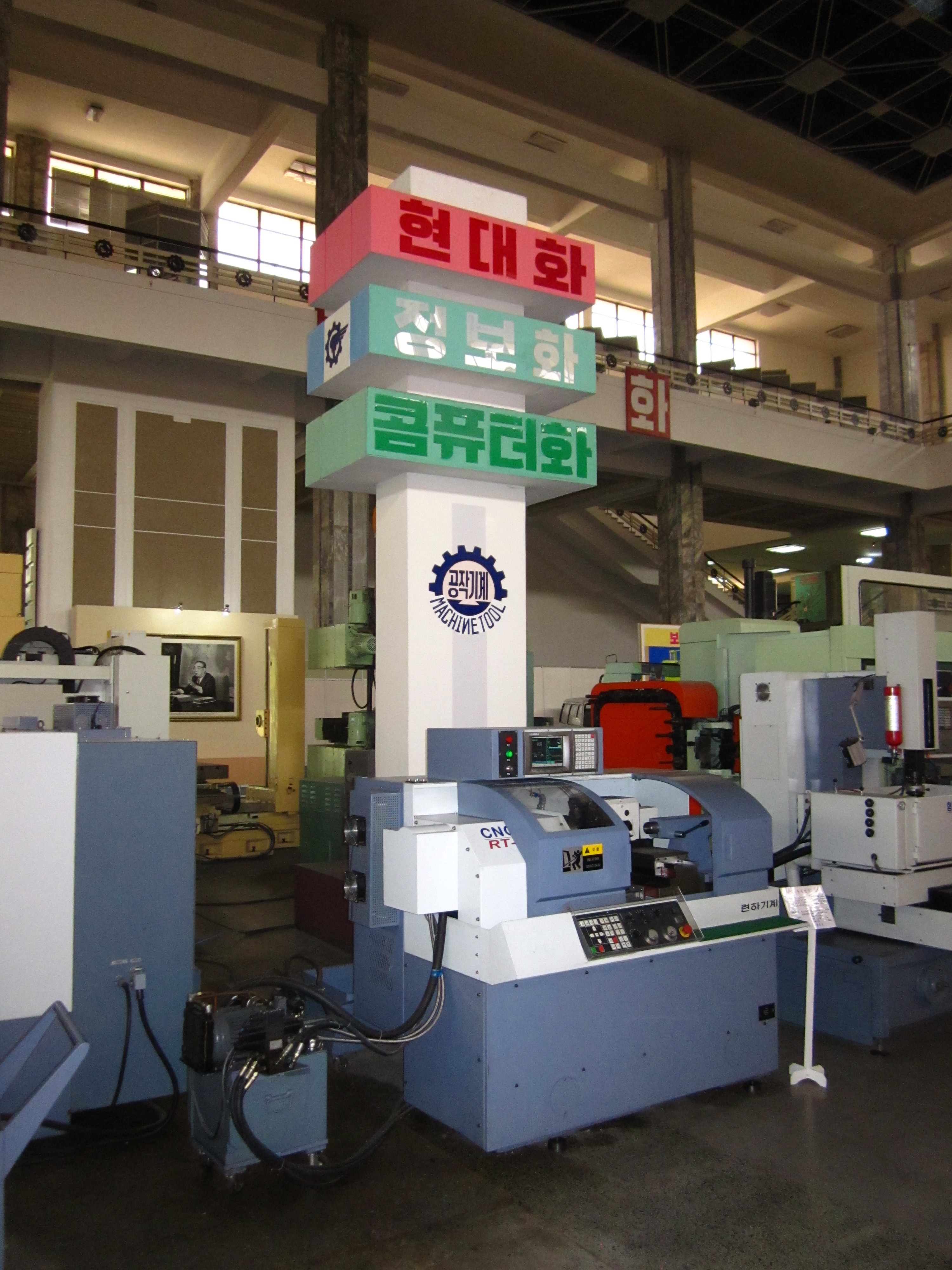
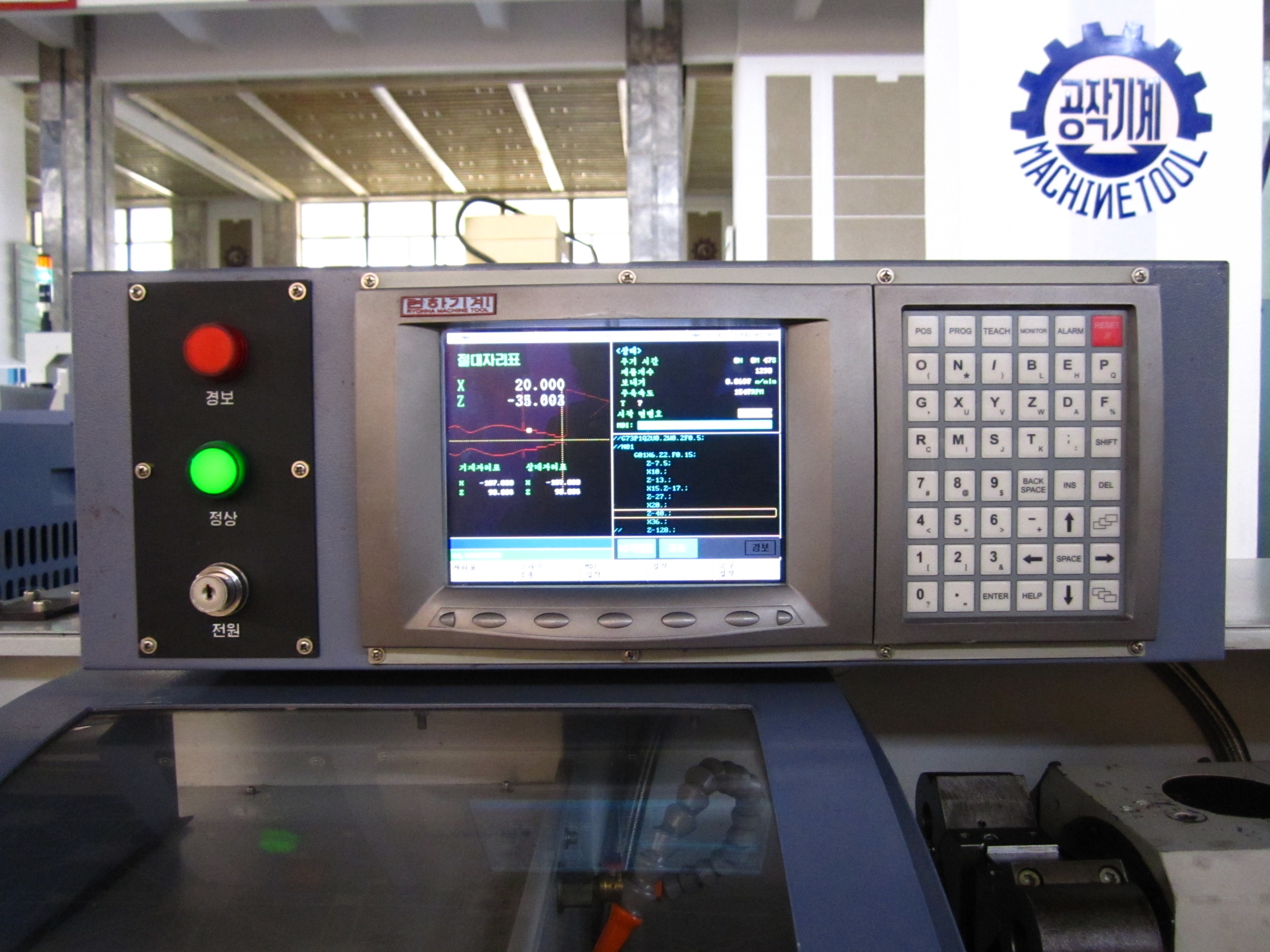
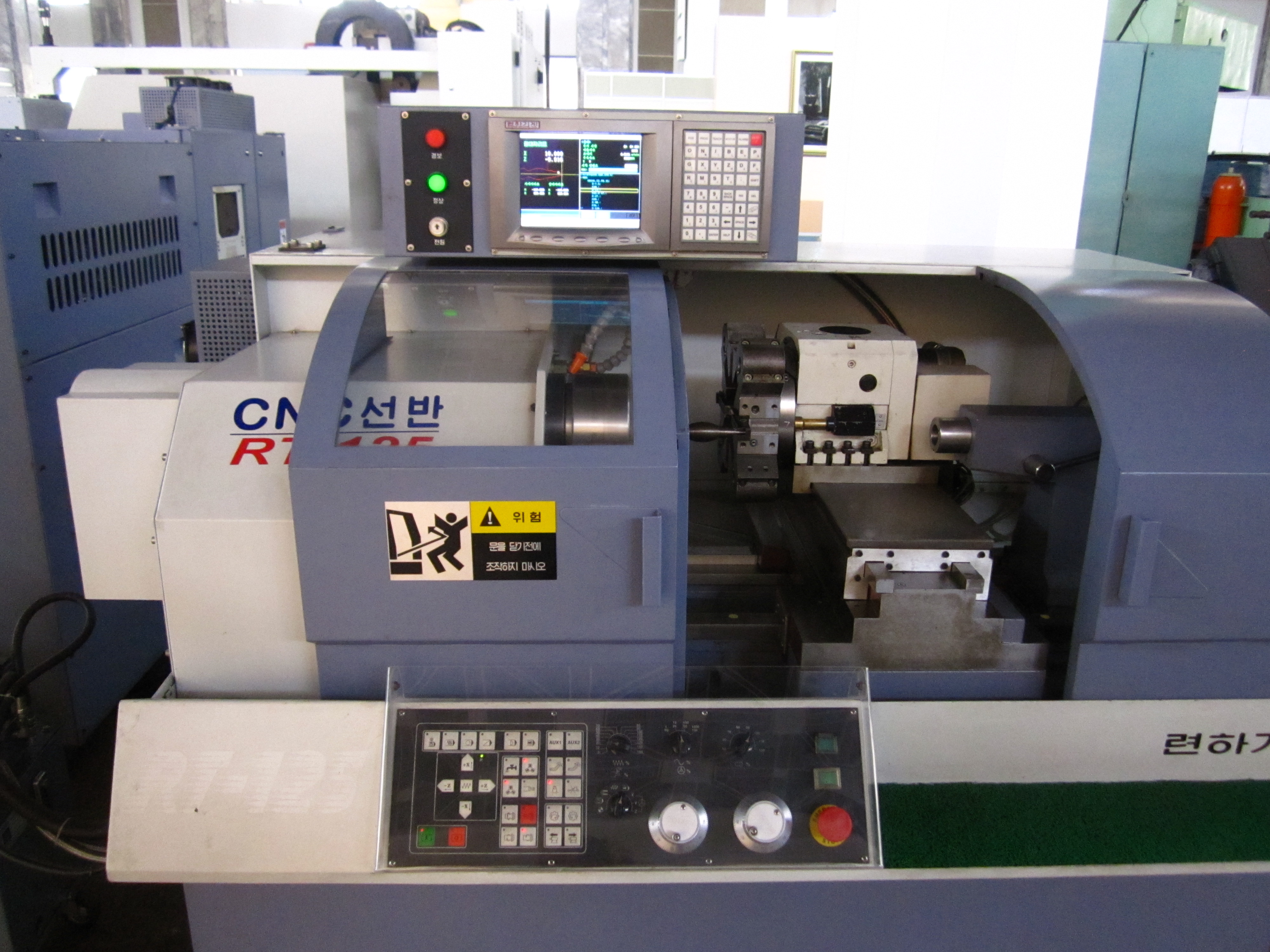
If you are itching to know what the DPRK’s CNC machines look like, here is one display at the Three Revolutions Museum in Pyongyang:

cnc1-thumb.jpg cnc2-thumb.jpg cnc3-thumb.jpg

Click images for larger versions

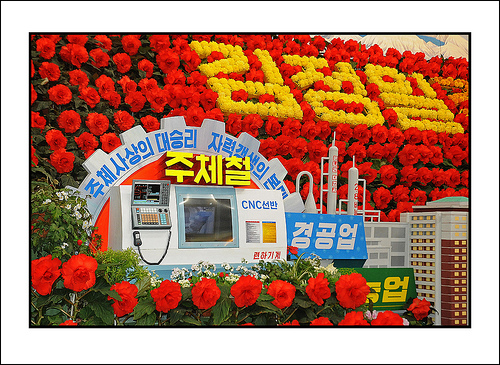
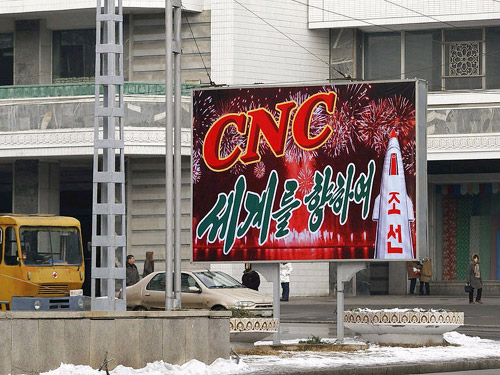
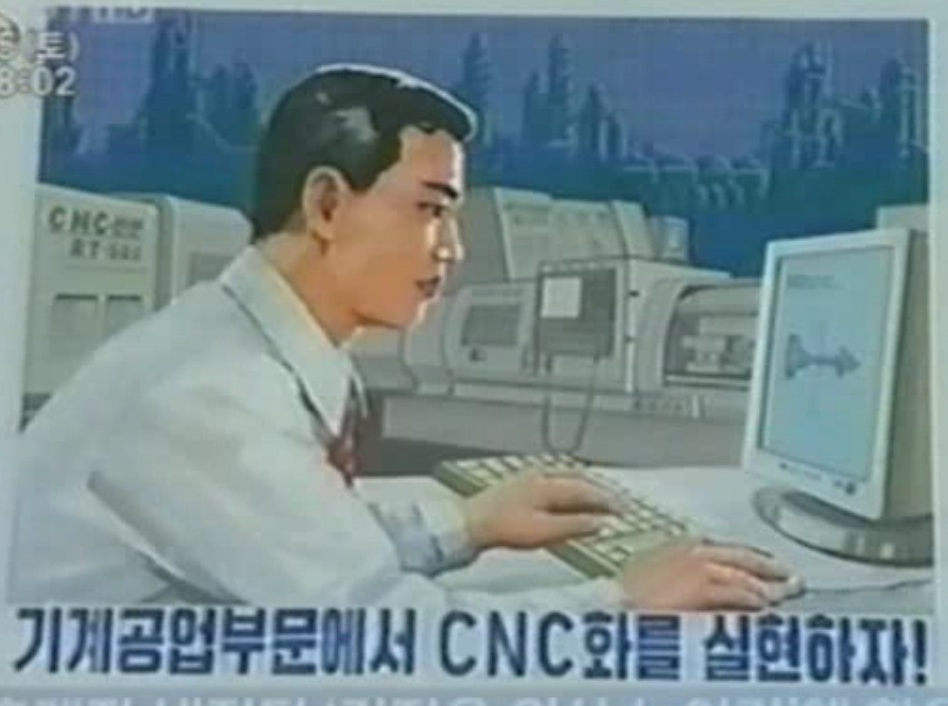
And here is some CNC propaganda that has appeared around Pyongyang:

cnc-prop-1.jpg cnc-prop-2.jpg cnc-prop-3.jpg cnc-prop-4.jpg

Click images for larger versions

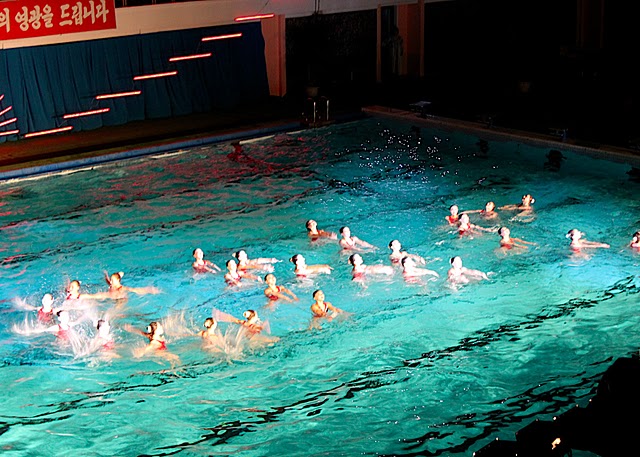
UPDATE: here is an additional photo taken by an anonymous tourist:


cnc-pool.JPG

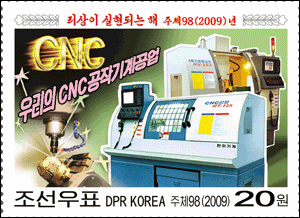
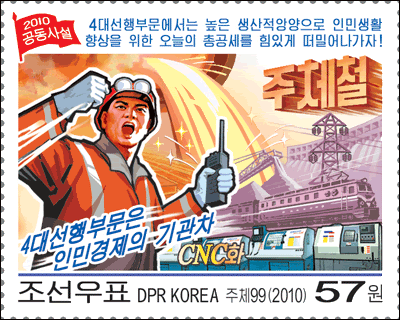
UPDATE: Here are some CNC postage stamps:


dprk-cnc-stamp.gif

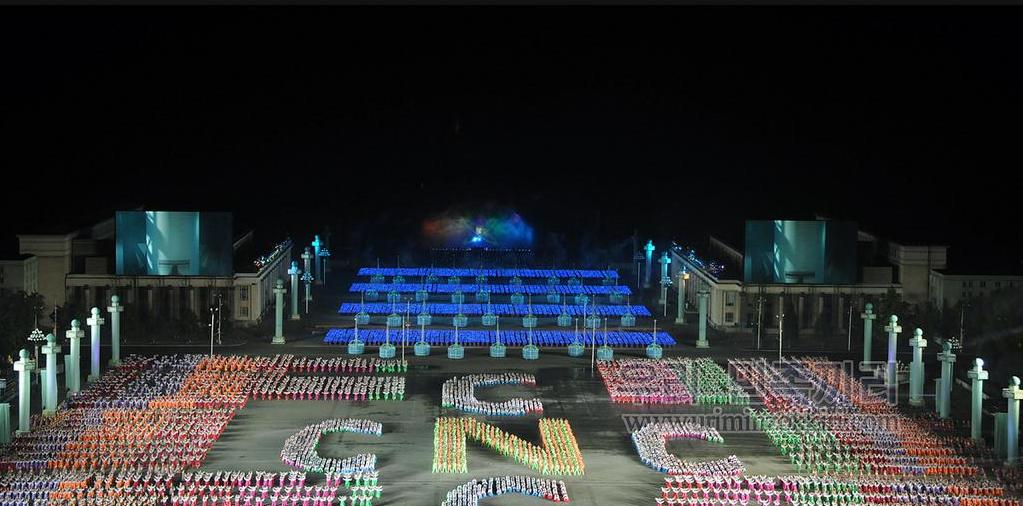
UPDATE: And CNC made part of the 2010 Mass Games (You Tube at the 1:25 mark). See a photo here.

KCNA has published plenty of news stories about CNC.  You can see them here courtesy of the Stalin Search Engine. CNC was first first mentioned on January 15, 2002 (KCNA) .  One phrase that is frequently mentioned is that thanks to innovations like CNC the DPRK is “Pushing back the frontiers of science”.  Indeed North Korean economic policy seems hell-bent to do just that.  Hopefully we will soon see them change their policies to “push back the frontiers of ignorance”.

CNC machines are produced by the Ryonha Machine [Tool] Factory (KCNA) and they have been widely promoted in the official media (here, here, here, here, and here for example).  It appears also that the Ryonha Machine Tool Factory has partnered up (with someone) to form a JV company which focuses on international trade, the Ryonha Machinery Joint Venture Corporation. Here is a PDF flyer of their products taken from the KFA web page, and some of the items they are selling can be seen here and here.

They Ryonha Machine Joint Venture Company, however, seems to have a history that might scare away many potential customers.  According to the US Treasury Department:

The U.S. Department of the Treasury today designated eight North Korean entities pursuant to Executive Order 13382, an authority aimed at freezing the assets of proliferators of weapons of mass destruction (WMD) and their delivery vehicles.  Today’s action prohibits all transactions between the designated entities and any U.S. person and freezes any assets the entities may have under U.S. jurisdiction.

“Proliferators of WMD often rely on front companies to mask their illicit activities and cover their tracks,” said Stuart Levey, the Treasury’s Under Secretary for Terrorism and Financial Intelligence (TFI).  “Today’s action turns a spotlight on eight firms involved in WMD proliferation out of North Korea.  We will continue to expose and designate these dangerous actors.”

Today’s action builds on President Bush’s issuance of E.O. 13382 on June 29, 2005.  The Order carried with it an annex that designated eight entities – operating in North Korea, Iran, and Syria – for their support of WMD proliferation.  The President at that time also authorized the Secretaries of Treasury and State to designate additional entities and individuals proliferating WMD and the missiles that carry them.

Korea Mining Development Corporation (KOMID), which was designated in the annex of E.O. 13382, is the parent company of two of the Pyongyang-based entities designated today, Hesong Trading Corporation and Tosong Technology Trading Corporation.  These direct associations meet the criteria for designation because the entities are owned or controlled by, or act or purport to act for or on behalf of KOMID.

Korea Ryonbong General Corporation, also named in the annex, is the parent company of the remaining six Pyongyang-based entities designated today.  These entities include Korea Complex Equipment Import Corporation, Korea International Chemical Joint Venture Company, Korea Kwangsong Trading Corporation, Korea Pugang Trading Corporation, Korea Ryongwang Trading Corporation, and Korea Ryonha Machinery Joint Venture Corporation.

As subsidiaries of KOMID and Korea Ryonbong General Corporation, many of these entities have engaged in proliferation-related transactions.

I have been unable to locate the Ryonha Machine Tool Factory on Google Earth. If anyone has any pointers, please let me know.

Here is a list of factories the DPRK claims to be using CNC technology:

Amnokgang Daily Necessities Factory (KCNA)
Amnokgang Gauge and Instrument General Factory (KCNA)
Cholima Steel Complex (KCNA, Naenara)
Chonma Electrical Machine Plant (KCNA)
Feb 8 Vinalon Complex (KCNA)
Hamhung Wood Processing (KCNA)
Huichon Machine Tool Plant (KCNA)
Kangdong Weak Current Apparatus Factory (KCNA)
Kanggye General Tractor Plant (KCNA) (Underground)
Kanggye Knitted Goods Factory (KCNA)
Kanggye Wine Factory (KCNA)
KimChaek Iron and Steel Complex (KCNA)
Kusong Machine Tool Factory (KCNA)
Kwanmobong Machine Building Plant (KCNA)
October 10 Factory (KCNA)
Pukjung Machine Complex (KCNA)
Pyongyang Cornstarch Factory (KCNA)
Rakwon Machine Complex (KCNA)
Ryongsong Machine Complex (KCNA)
Sinuiju Spinning Machine Factory (KCNA)
Suphung Bearing Factory (KCNA)
Sungri Motor complex (KCNA)
Taean Heavy Machine Complex (KCNA)
Taedonggang Brewery (KCNA)
Tahungsan Machine Plant (KCNA)
Unsan Machine Tool Factory (KCNA)

I know the locations of many of these factories but not all.  If anyone has any information on their coordinates, please let me know.

Share

DPRK shakes up elite in order to meet 2012 “strong and prosperous” goal

Tuesday, June 15th, 2010

Institute for Far Eastern Studies (IFES)
NK Brief No. 10-06-14-2
6/14/2010

During the third session of the 12th Supreme People’s Assembly, convened on June 7, Kim Jong Il promoted his brother-in-law Jang Sung Thaek to vice-chairman of the National Defense Commission (NDC), named a new premier, and replaced several department heads and ministers. This appears to be an attempt to shore up the regime as it seeks to “open the door to a strong and prosperous nation” by 2012, the 100th anniversary of the birth of Kim Il Sung. Kim Jong Il made a personal appearance at this latest assembly meeting, unlike the SPA meeting held in April. The leader’s presence hints at the importance of the latest gathering.

This promotion of Jang Sung Thaek and shake up of Cabinet positions appears to be part of efforts to realize the quickly approaching goal of establishing a ‘strong and prosperous nation’ by 2012, assigning those most able to positions of responsibility, regardless of age or experience. Most notably, Jang, widely thought to be second-in-command in North Korea, was promoted to vice-chairman of the NDC. He was first appointed to the NDC at the first meeting of the 12th SPA in April 2009, making his climb to vice-chairman in a mere 14 months.

Before the latest promotion, Jang held the position of vice-director of the Workers’ Party of Korea, a newly created position that he was the first to hold. In this position, Jang oversaw national security offices, police, and the courts, putting him in a position of power difficult for anyone else to achieve. Having traveled to both South Korea and China, Jang Sung Thaek was likely promoted to present the image of a strong military and, at the same time, establish stable relations with the international community in order to ensure a smooth transition of power as well as to resurrect the economy by 2012. When Kim Jong Il led a delegation to China last May, the Chinese government treated Jang very well, ignoring standard protocol for someone in his position.

In addition, Choe Yong Rim was named the North’s new premier, and eight new vice-ministers were appointed. Regional Party secretaries were allowed to participate directly, allowing those who are most knowledgeable of local conditions to impact the decisions of the administration. Most of the new appointments were very experienced elites, including Choe Yong Rim (80) as premier, and Kang Neung Su (80), Kim Rak Hui (77), Ri Thae Nam (70), and Jun Ha Chul (82). The regime is promoting a number of veterans who are making their “last stand for the motherland” as part of the effort to ensure stable transformation of power after Kim Jong Il.

With Kim Rak Hui’s appointment as vice-premier and new appointments to the Ministry of Foodstuff and Daily Necessities Industry as well as the head of the Light Industry Ministry, North Korea seems to be pursuing the improvement of standards of living promised in the 2010 New Year’s joint editorial. Pyongyang Party officials appear to be attempting to reassert a centrally planned economy in the aftermath of botched currency reform efforts; however those witnessing regional economic conditions appear much more able to come up with appropriate economic policies. North Korea has been unable to make any significant progress in resolving its food shortages or its inability to provide daily necessities to the public, leading the regime to scapegoat some high-ranking officials. Now, many in and outside of North Korea are watching closely to see if the regime can launch economic efforts capable of successfully ‘opening the door to a Strong and Prosperous Nation’ in the next two years.

Share

DPRK to promote production of consumer goods

Thursday, April 22nd, 2010

According to the People’s Daily (Xinhua):

The Democratic People’s Republic of Korea (DPRK) has decided to promote the production of consumer goods in order to improve people’s lives, the Rodong Sinmun newspaper reported Wednesday.

The major task was to continue exploiting the potential of the light industry, raising production, improving quality, promoting the modernization of enterprises and guaranteeing its operation at full capacity, a cabinet meeting has agreed.

Besides, the ministers underlined the importance of the spring ploughing and sowing, saying supply to the rural area should be ensured.

They also demanded sectors such as metal, electricity, coal and railway continue promoting production to create condition for the improvement of people’s lives.

The newspaper said DPRK’s Premier Kim Yong Il attended the cabinet meeting, but did not mention the exact date.

Industrial production grew 16 percent in the first quarter, compared to the same period a year before, said the paper.

Consumer goods are part of Kim Kyung-hui’s (Kim Jong-il’s sister) portfolio as head of the KWP’s light industry department.

Read the full story here:
DPRK to promote production of consumer goods
People’s Daily (Xinhua)
4/21/2010

Share

Campaign to sell Kaesong goods in Pyongyang

Tuesday, October 27th, 2009

Institute for Far Eastern Studies (IFES)
NK Brief No. 09-10-26-1
10/26/2009

Companies in the Kaesong Industrial Complex (KIC) are pushing for permission to transport goods manufactured within the complex along the railway running from Kaesong to Sinuiju and the highways connecting Kaesong, Pyongyang, Sinuiju and the Chinese city of Dandong.

Currently, the majority of goods exported from the KIC flow through the South Korean port of Incheon. They are then distributed elsewhere after arriving at the Chinese port of Dalian. This route is expensive and slow. Shipping by sea costs 1,900 USD per container and takes as many as 10 days, while if the railway infrastructure was built up between Kaesong and Sinuiju, both the cost and the time could be significantly reduced.

Seventeen percent of Kaesong goods are exported not only to China, but to Europe, the Middle East and Russia. In the mid- to long-term, Kaesong needs to be connected with Rajin-Sunbong, so that goods can be distributed throughout Russia and Europe via the Trans-Siberian Railway. In order to make this happen, companies within the KIC are seeking to attract foreign joint-ventures and investments while at the same time lobbying North Korean authorities in an effort to convince them of the need for such land transportation infrastructure.

These companies are also pushing for improvements in the highway spanning the 160 km between the KIC and Pyongyang and the injection of KIC goods into the Pyongyang markets, where they could compete with Chinese imports. One part of this effort is promoting the attachment of ‘Made In DPRK’ labels to goods produced in these factories.

It appears that North Korean authorities have been receptive to these ideas, but questions still remain on the logistics of the project. One source has said that the North Korean Central Special Direct General Bureau has shown interest recently in the idea of including KIC goods in the annual Pyongyang International Trade Fair.

On the one hand, the number of North Korean workers in the KIC has now topped 40,000; but on the other hand, given the number and size of the factories in the complex, the factories are about 26,000 workers short of full capacity. The effort to find suitable workers means that now people from Sariwon, Pyongyang and Hamheung have been brought in. Companies in the KIC are adamant that construction of dormitories in the complex needs to be sped up. At the same time, North Korean authorities are demanding that workers be paid according to their level of education, job description, and experience.

For the first time in 13 months, trade between the two Koreas began to rise again. In September 2009, inter-Korean trade amounted to 173.17 million USD, a 2.6 percent rise over the 166.86 million USD recorded in 2008. The economy has shown signs of recovery since last July, and as inter-Korean relations have inched toward improvement, trade has also risen.

Share

2009 bad year for Kaesong Zone

Wednesday, September 16th, 2009

UPDATE 9/16/2009: Despite the downward trajectory that business in the Kaesong Zone seemed to be taking this year, things appear to have bottomed out.  According to Yonhap, the Koreas have signed a Kaesong wage increase.  According to the article:

South and North Korea agreed to a 5 percent wage hike at a joint industrial park on Wednesday, the Unification Ministry here said, in the latest sign of inter-Korean projects returning to normal.

North Korea earlier demanded a 400 percent raise in monthly wages for its workers at the South Korean-run park in Kaesong, just north of the border.

South Korea’s management office in Kaesong “signed an agreement on a 5 percent wage increase” with its North Korean counterpart, ministry spokesman Chun Hae-sung said in a brief statement.

The North voluntarily withdrew its earlier demand last week in a striking shift from its unyielding attitude in four rounds of negotiations from April to July. The demand called for monthly wages be raised to US$300 from the average $70-80, apparently in retaliation against Seoul’s hard-line policy toward Pyongyang.

The Kaesong park opened in late 2004 as an outcome of the first inter-Korean summit four years earlier. It houses 114 mostly small-sized South Korean firms producing clothing, electronic equipment, kitchenware and other labor-intensive goods with about 40,000 North Korean workers.

The venture is seen as a much-needed source of dollar income for the North, which is currently under U.N. sanctions for its May nuclear test that bans cash flows to the country.

The 5 percent rate hike will increase the minimum wage to about $58 from the current $55.

Separately, North Korea was conducting a door-to-door survey on South Korean businesses at the joint park, said ministry spokeswoman Lee Jong-joo.

North Korea asserted that the two-day survey that continues until Thursday was to examine the firms’ output and “listen to their complaints and difficulties regarding tax and accounting,” Lee said. Such on-site surveys have been done sporadically, she added.

Although tensions might have eased, it remains to be seen whether the business community can be coaxed into making serious capital investments in the DPRK.

Read previous Kaesong Industrial Zone news below:

(more…)

Share

DPRK preparing for jump in construction demand

Friday, August 14th, 2009

Institute for Far Eastern Studies (IFES)
NK Brief No. 09-8-13-1
2009-08-13

As North Korea continues to pursue the creation of a Strong and Prosperous Nation by 2012, it is now reportedly building a large-scale construction materials facility to meet expected growth in building demand. North Korean authorities have designated the Daedong River Tile Factory, visited by North Korean leader Kim Jong Il on the 13th of last month, as a large-scale construction materials distribution center, and expect the second stage of its construction to be complete by April 2012.

The Tongil Sinbo, a weekly North Korean publication, printed in its recent (July 18) edition that upon completion of the second stage of construction, the facility would be capable of producing 225 million cubic meters of tiles, shingles, plastic materials and other building supplies. The first stage of construction began in July 2003, and was only recently completed, after five years and nine months, opening on April 15. North Korea is expected to invest 10.5 billion Won (80.77 million USD) into completing the second stage of construction, a considerable investment in light of the troubles facing the North‘s economy.

Upon completion of the facility, taking up more than 225 thousand pyong, it will produce indoor and outdoor tile, polished marble tiles, composite glass tiles and other porcelain and plastic products, as well as pre-fabricated housing components and coal gas. According to the newspaper, it will also house its own electrical generator.

When Kim Jong Il visited the factory, located near the Chollima Steel Complex in South Pyeongan Province, he declared the site to “hold a critical role in the development of the country’s construction industry,” stating that upon completion of the second stage of construction, the factory would serve as a “large-scale base for all modern construction projects.”

North Korea is currently pressing ahead with large-scale redevelopment projects in Pyongyang and other major cities, with one goal being the construction of 100,000 new homes by the year 2012. The Workers’ Party of Korea newspaper, the Rodong Sinmun, has called for all citizens to “make something from nothing” in an effort to build up each region. One point of interest to North Korea-watchers as this massive construction scheme unfolds is that a new position was created to oversee the project, and Kim’s third son, Kim Jong-un, was appointed.

Share

An affiliate of 38 North