Archive for the ‘International trade’ Category

South Korean Products Popular

Tuesday, September 4th, 2007

Daily NK
Han Young Jin
9/4/2007

Distribution with “Korea” Trademark…”Rice Cookers Popular”

In the North Korean jangmadang (market), South Korean products are drawing huge popularity among citizens and are publicly being sold, relayed an internal source on the 30th.

The source said, “In the Pyongyang, Shinuiju, Hamheung, Chungjin, and other large-scale jangmadangs, South Korean products with the “Made in Korea” label is fairly popular among wealthy people.”

In the past, South Korean products were secretly sold in the North Korean market. When selling South Korean products, we sold them after removing the product label, “Made in Korea.” However, recently, only products with the label are recognized as South Korean products of good quality and sold at a high price.

The source added, “‘Made in Korea’ lends credibility to the people. Without this, people do not believe that the product is a Korean-made good. The label has to be there because Chinese products are disguised as South Korean goods.”

The South Korean product which is most sold in North Korea is the electric rice-cooker (Cuckoo), instantaneous water heaters, cosmetics, aromatics, computers, toothpaste, medical goods and a variety of sweets. Also, North Korean citizens have a lot of confidence in South Korean medicine. South Korean-made medicine or sweets are not discarded even after the expiration date.

He said, “Because Chinese-made products are no good, people who have money usually used Japanese products. In the place where Japanese products became rare, Korean-made products are now occupying that place.”

In Dandong, China, Kim Chi Duk (pseudonym), who is engaging in North Korea-Chinese trade met with the reporter and retorted, “Currently in Chosun (North Korea), Japanese-made products are still counted as number 1. Then there are South Korean-made products, then Chinese-made products. Poor people, even when the quality is lower, use Chinese-made products and those with money use South Korean products or Japanese-made products. What is the issue if one is buying with his or her money?”

He said, “Those with some amount of money use at least one or two South Korean products.”

The source relayed, “Currently in the Shinuiju market, South Korean toothpaste is 5,000 won (USD1.85), 1 set of aromatics (machinery and 2 bottles of gas) is 30,000 won (USD11.1), and one pack of Time cigarettes (tax-exempt) 3,000 won.” However, “Time,” a kind of South Korean cigarettes are counterfeit goods made in China, so is offered at a cheaper price than their domestic price.

Mr. Kim said, “Those who trade in North Korea request for South Korean-made goods, but I do not know whether they plan to export them or to use them. The authorities do not allow American-made goods, but is there anyone who doesn’t like the dollar? If it is not a big issue, they use everything.”

Share

If Have a Gift for Kim Jong Il, Safe Passage through the North Korean Customs

Saturday, September 1st, 2007

Daily NK
Kim Min Se
9/1/2007

The news of one Chinese trader resolving all issues with the “certification of gifts,” while passing through a high-level North Korean customs’ confiscation of goods and demand of open bribes, has received recent spotlight.

In the latter half of the 90s, a businessman who has been exporting and importing North Korean cultural and daily necessities while coming and going from North Korea met a reporter on the 30th in Dandong and relayed this anecdote, “I have returned to China after having received “honored” treatment from all customs officials under the Shinuiju customs director. That is the first time I received such treatment in the 10 years I have been conducting the trade business.”

The story of the businessman has also apparently become noteworthy news in the Dandong customs office in China.

The businessman is supposed to have earned huge gains by handling North Korean porcelain since the latter half of the 90s. Thus, for long-term gains, he supported the arts and culture projects for the idolization of the Kim father and son in North Korea under his company’s name.

Subsequently, a North Korean writers’ company recently invited him and showed him several sights in North Korea and relayed a gift (edibles) under Kim Jong Il’s name afterwards.

The businessman, after eating the goods he received as gifts in the hotel he was staying in at the time, left with the “certification of gift” in his bag as his souvenir.

He said, “At the time, in Chosun (North Korea), I acquired quite a bit of North Korean silk for gift-giving to close acquaintances, such porcelain and paintings of famous artists. However, the cargo was heavier than expected, almost one carload (2.5 tons trucks). From Pyongyang to Shinuiju, I arrived without much mishap because transportation was provided, but passing through customs was not an easy feat.”

“The North Korean customs unpackaged all goods, so they started going through my stuff as soon as I arrived. Also, they started going through the bag I was carrying and the eyes of the inspector became fixed as the goods were taken out one by one. He had seen the “gift certification” inside a red case.”

Further, he added, “The customs officer verified the name of the certification and my passport and quickly went into an office with the ‘certification.’ Shortly after, the customs director came out and ushered me into a reception area and asked about the context for my receipt of the gift.”

At the time, the customs director had said, “You are a distinguished person who has done a huge work for our country. We did not recognize that. Please let us know if there is anything you are uncomfortable with. Whatever it is, we will help you.”

Then, he is supposed to have ordered the lower level officers, “Using the customs car, make sure that this person’s luggage arrives safely in China without any damage.”

He said that a single piece of Kim Jong Il’s “gift certification” carrying so much weight was beyond the expectations of not only himself but the Chinese customs personnel.

Another related source of the Dandong customs office said, “We were surprised that a single piece of the “gift certification” could wield such power. This event became a famous anecdote within the Dandong customs office.”

Share

Every Time I Enter North Korea Customs I Feel Like a Criminal

Friday, August 31st, 2007

Daily NK
Kim Min Se
8/31/2007

There is one place that traders curse every time they pass through North Korea and China. That is towards the corruptive and fastidious North Korean customs officers.

It is widely known that North Korean customs officers blatantly seek bribes and extort goods justifying it is for inspection.

As more and more citizens became disgruntled by the security at customs, North Korean authorities enforced strict investigations towards customs officers. However, tradesmen who travel in and out of North Korea comment that the corruption occurring at customs is still prevalent.

Wang Hae Dong (pseudonym), one tradesman who has been bringing goods manufactured in China into North Korea for the past 10 years said on 29th, “It’s becoming harder and harder to bring goods into the country because of the demanding customs officers” and “There is nothing left if you bring 100,000 yuan amount of goods as there are now many tradesmen who have been specifically sent from North Korea to acquire items manufactured in China.”

Wang, a Chinese merchant born in North Korea has been living in North Korea for over 20 years and now runs a trading company which sends items for daily living to North Korea.

Wang said, “Not only is it becoming harder to earn money but when customs officers speak rudely and undergo picky inspections, I don’t want to trade anymore and want to give everything up.” He said, “What’s more annoying is the fact that goods disappear every time inspections are made and yet there is no where to make complaints.”

“Losing one or two items of clothing is nothing. I am lucky not to get bundles of clothing taken away from me” he said.

He said, “I barely make a profit of 0.2~03 Yuan from a piece of clothing bought for 10 Yuan. I import about 5 tons of goods in 3 trucks in one go (worth 1million Yuan) but after I sell all of the goods, I’m left with about 3~40,000 Yuan. After delivery fees and taxes, there are many times I’m left with only 10,000 Yuan but when one or two bundles of goods disappear, the work becomes worthless.”

Irrespective of importing or exporting goods to and from China, all items must undergo thorough inspection at customs. Nothing is exempted from goods transported by car or containers to individual pockets and even purses.

Local traders describe the scene of North Korean customs officers opening and inspecting every piece of item as pandemonium.

Many goods also become damaged despite have been well packaged as they are roughly handled by officers. Losing one or two items is common, though there are cases where even whole boxes are lost.

Wang said, “As of 2 years ago, money was given to Chosun superintendents with an import license to clear goods because Chosun customs was so selective yet still goods went missing. What can I do? I still take goods to Chosun once a week, 4 times a month. Don’t I just have to accept the fact that I can’t redeem the lost money?”

Regarding the reasons why North Korean customs officers scavenge through all the goods like searching for lice, Wang said, “Isn’t so they can find another reason to collect extra money?” and “I think that’s what they live off.”

He added, “Every time I pass through Chosun customs, the customs officers seem like the prison guards and I feel like a criminal who is paying for his crime.”

Share

S.Korean Networks to Pay Millions for N.Korean Footage

Thursday, August 30th, 2007

Choson Ilbo (Hat Tip DPRK Studies)
8/30/2007

Three South Korean terrestrial TV stations agreed in July to pay tens of millions to North Korea annually for footage from North Korea’s state-run Korean Central Broadcasting Station. An SBS executive said South Korean TV stations have used TV pictures aired by KCBS for free, but in July, the Korean Foundation for South-North Economic and Cultural Cooperation, as a proxy of the North Korean TV station, concluded negotiations with three TV stations whereby SBS will pay about W20 million every year to KCBS through the foundation. MBC will pay slightly more than that, and KBS will pay about W30 million.

The foundation, chaired by United New Democratic Party member Im Jong-seok, was established in 2004. It held talks with the three terrestrial networks for a year and a half. In the talks, the three argued it was unreasonable for South Korean TV stations to pay for North Korean footage in programs that aim at promoting mutual understanding, and they generally rejected the idea of unilaterally paying North Korea when the North does not pay South Korean broadcasters for footage.

Share

North Korea Uncovered v.4 on Google Earth

Wednesday, August 29th, 2007

The most authoritative, publicly available map of North Korea
Version 4: August 29, 2007

Download it here 

This map covers North Korea’s agriculture, aviation, cultural locations, manufacturing facilities, railroad, energy infrastructure, politics, sports venues, military establishments, religious facilities, leisure destinations, and national parks. It is continually expanding and undergoing revisions. This is the fourth version.

Additions to the latest version of “North Korea Uncovered” include the city of Manpo along the Chinese border, KEDO, Kumgang Resort expansion, Kaesong Industrial Zone, as well as a few more parks, antiaircraft sites, dams, mines, canals, etc. I have also added more links in the menu which will tell the viewer a bit about the locations themselves. I have also changed the color scheme to make the collage easier to view.

Disclaimer: I cannot vouch for the authenticity of many locations since I have not seen or been to them, but great efforts have been made to check for authenticity. These efforts include pouring over books, maps, conducting interviews, and keeping up with other peoples’ discoveries. In many cases, I have posted sources, though not for all. This is a thorough compilation of lots of material, but I will leave it up to the reader to make up their own minds as to what they see. I cannot catch everything and I welcome contributions.

I hope this map will increase interest in North Korea. There is still plenty more to learn, and I look forward to receiving your additions to this project.

Share

Great Review of ‘Famine in North Korea’

Sunday, August 26th, 2007

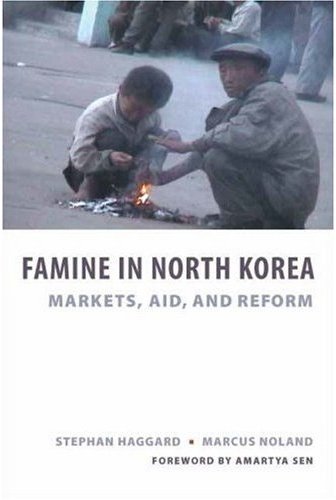
noland-haggard.jpgFor several months I have been meaning to post a review of Stephen Haggard and Marcus Noland’s book, Famine in North Korea, but for thousands of reasons it was always pushed back.

Stephen Haggard and Marcus Noland wrote the definitive book on the DPRK’s Arduous March, and it is required reading for any serious North Korea watcher.

Now…Joshua at One Free Korea has written the definitive review of the book, so I will just put links to his posts: Part One, Part Two, Part Three.

Share

International Train Crew is the Best Job in North Korea

Friday, August 24th, 2007

Daily NK
Kwon Jeong Hyun
8/24/2007

The term for the train crew of North Korean Pyongyang-Beijing international rail connecting North Korea and China is limited to two years, relayed a related person of Dandong Customs in China on the 22nd.

The source at the customs said in an interview with DailyNK, “The crew of Pyongyang-Beijing international rail is a very competitive position. Only by paying a significant sum of bribe can one gain such a position.”

The source said, “Most of the international rail crew simultaneously trade. The crew who can conduct secret trade via trains is known as a covetable profession among the North Korean citizens.

Further, “The term of employment for North Korean crew do not surpass two years. There is so much corruption and the positions are quickly exchanged after the upper-level management receiving bribery from other applicants.”

He said that he has received introductions from new North Korean crews to watch over them during the 2 years.

The person said, “Most of the crew do secret trade. They think that they have offered that much, so they should earn that much as well. There are many instances where even the customs is aware of what is going on.”

He said that the product which is usually traded is cigarettes. “Cigarettes are brought in North Korea at around 4 boxes (around 2,000 packs) per a person.”

“They relay goods that outsiders send and also goods that cannot legally come out of North Korea. Please understand my difficulty in revealing the situation in greater detail. All kinds of goods can be secretly brought onto trains.”

The cigarettes are a favorite good which both the North Korean and Chinese customs make efforts to pay back the duties. However, by bringing these cigarettes secretly into North Korea without the payment of duties, the making of money is inevitable.”

The source said, “According to what I have heard from Chosun (North Korea) crews, there is a saying that failure to earn several hundreds of thousands of dollars during the two years is moronic. How many train crew are there? They consider the international rails as private trading floors, so what is there that they cannot do? I know of workers of the international freight trains who saved over 50,000 dollars.”

He said, “While observing North Korean railroads for over 10 years, I only saw once one person working as a crew for the freight train for four years.”

International rail between China and North Korea operates twice weekly. 2-3 passenger trains on the back of the Pyongyang-Shinuiju rail and 1 freight train have been divided as international rails and operate to Beijing.”

Share

DPRK Economic Growth Estimates for 2006

Wednesday, August 22nd, 2007

Institute for Far East Studies (IFES)
NK Brief No. 07-8-22-1

The Bank of Korea released a report on August 17 that details economic estimates on a variety of sectors in North Korea. Overall, North Korea’s Gross Domestic Product (GDP) fell 1.1 percent during 2006, the first time since 1999 that the North has failed to increase its GDP. Inclement weather was one factor that played into a fall in agricultural production, and there also appears to have been little progress in the construction of public works in the country. Overall, North Korean GNI was 2.9 percent of that in the South, with per capita GNI at 1,108 USD, 6 percent of the 18,372 USD per capita GNI in South Korea.

The entire economy of the DPRK is approximately 1/35th that of the South, with the Gross National Income (GNI) a mere 1/17th the level seen in the ROK. This shows a growing divide between the two Koreas, as the comparisons in the previous year were 1/33rd and 1/16th, respectively. Due to the North Korean nuclear issues and other foreign relations problems faced during 2006, a worsening of diplomatic relations with other countries, energy shortages and other economic woes befell the North, putting the entire economy in a difficult situation.

The North showed a weakening of the agricultural and forestry industries, increasing production by a mere 2.4 percent, 2.6 percent down from 2005. Corn and other cereal production grew by 7 percent, but rice was down 6.4 percent, and bean production was down 6.6 percent from the year before, leaving overall grain output down 3.6 percent. On the other hand, shellfish and crustacean harvests grew by 1.5 percent, while timber and livestock harvests remained unchanged.

On the mining front, coal and other non-metal mined resources showed promising increases, but production of lead, zinc, and copper fell by 1.7 percent, compared to the 3.5 percent growth posted in the previous year. Despite promising increases in production of manufactured goods and growth in the chemical and heavy industries in 2005, last year North Korean production growth rates in these fields fell flat at a mere 0.4 percent, increasing production rates of fibers, clothing and shoes, but turning out less kitchenware and food-related products. Coal and fuel products looked favorable, but fabricated metals and machine parts, as well as nonferrous metal products grew at a rate of 1.1 percent, down from 5.4 percent.

Gas-fired electrical generation was up 17 percent, while hydroelectric power grew only 2.7 percent, falling from 4.4 percent in 2005. Other infrastructure projects were also on the decline, with only 49 km of road paved in 2006.

The number of foreign tourists declined, with visitors to Kumgang Mountain falling from 366,000 in 2005 to only 265,000 last year, adding to the 21.8 percent decline in the food and lodging sector, but the transportation and communication sector grew by 5.1 percent, leading to an overall gain of 1.1 percent in the service industry.

The gap in overseas trade between the two Koreas increased from 182-fold to 212-fold as North Korean foreign trade fell off 5.2 percent. Imports in the North were up 2.3%, although seafood imports were down 48.4 percent. The slack was made up by a 34.1 percent increase in the import of plastics, a 31.2 percent increase in imported chemical goods, and a 12.4 percent increase in imported machinery.

During 2006, inter-Korean exchanges grew 27.8 percent, reaching 13.5 billion USD. South Korean exports to the North grew 16 percent as Seoul increased rice and fertilizer aid, and exports to the Kaesong Industrial Complex grew. On the other hand, North-South cooperative projects grew 52.7 percent as South Korea increasingly imported North Korean zinc, sand, and other natural resources.

In order to give some perspective to the North Korean economic data, the Bank of Korea offered the following comparisons:

DPRK/ROK/Ratio
Population (thousand) 23,079/48.297/2.1
Economic Growth (2006) -1.1%/5.0%
Nominal GNI (100 million USD) 256/8,873/34.7
Per Capita GNI (USD) 1,108/18,372/16.6
Exports (100 million USD) 9.5/3,254.6/343.8
Imports (100 million USD) 20.5/3,93.8/151.0
Coal Production (10,000 tons) 2,468/280/0.11
Electrical Use (10,000 kW) 782/6,551/8.4
Electrical Production Capacity (100 mill. KW) 225/3,812/16.9
Petroleum Imports (10,000 bbl) 384/88,843/231.4
Cereal Production (10,000 tons) 448.3/530.0/1.2
Rice Production (10,000 tons) 189.4/468.0/2.5
Seafood Harvest (10,000 tons) 92.3/303.3/3.3
Iron Ore Mining (10,000 tons) 504.1/22.7/0.05
Nonferrous Metals Mining (10,000 tons) 8.6/187.7/21.8
Automobile Production (10,000) 0.44/384.0/872.8
Steel (10,000 tons) 118.1/4,843.3/41.0
Cement (10,000 tons) 615.5/4,920.9/8.0
Fertilizer (10,000 tons) 45.4/318.3/7.0
Chemical Products (10,000 tons) 2.9/145.7/50.2
Railways (km) 5,235/3,392/0.6
Roads (km) 25,544/102,061/4.0
Port Loading Capacity (10,000 tons) 3,700/69,213/18.7
Shipping Capacity (10,000 tons) 90.4/1,180.2/13.1

Share

Price of Rice and Inflation

Sunday, August 19th, 2007

Korea Times
Andrei Lankov
8/19/2007

Sometimes even Stalinist propaganda tells the truth. When the North Korean newspapers occasionally told grossly exaggerated horror stories about South Korean inflation, they stressed that nothing like that could possibly happen in North Korea. This was the case indeed. For nearly half a century, from the late 1950s to the late 1980s retail prices in North Korea remained essentially unchanged. One kilogram of rice cost 0.08 won in 1960. It was still the same price in 1990.

This was possible because almost nothing was actually “sold’’ in North Korea. Communist states often rationed goods distributed through retail trade, but in most cases it was only a handful of most prestigious goods that were subjected to rationing _ like, say, cars. North Korea went much further: by the early 1970s, retail trade in the North ceased to exist, being completely replaced by an elaborate public distribution system. Rations depended on a type of work performed, but also on one’s position within a complicated hierarchy of social groups, as well as one’s place of residence (inhabitants of major cities, and Pyongyang in particular, enjoyed much better rations than those in the countryside).

There were some markets, of course, barely tolerated by the government. But until the late 1980s markets were small, with their trade volume being almost negligible. It seems that most people were reasonably satisfied with what they could get from the state distribution system _ of course, it helped that they knew next to nothing about the situation in other countries, so they could not compare.

The situation began to change around 1990 when the old distribution system collapsed under the pressure of an economic crisis. From 1993-94 there were increasing problems with rations, and from around 1996 rations pretty much stopped altogether. Some food was still distributed in major urban centers, but even there the distributed amount was so meager that nobody could survive on rations alone. A large-scale famine ensued, with at least half to one million dead (the oft-cited figure of three million victims seems to be an exaggeration).

People turned to trade and handicrafts, and with this arrival of a market economy inflation became a North Korean phenomenon as well. Even in the 1980s market prices exceeded the official prices in the state shops. By the mid-1990s, the difference was much greater. In theory, rice still cost 0.08 a kilo, but by 2000 its price on the market reached 45-50 won. Official wages remained unchanged, however, so around 2001 the average salary was approximately 20 times less than the income necessary for physical survival. People had no choice but to augment their income.

The government understood that there was no way to restore the old system: a decade of economic crisis had undermined the basic machinery of distribution and obviously the system was beyond repair. Thus, in 2002 the much trumpeted “July 1 Reforms” were introduced.

It’s difficult to describe these measures as “reforms”–the government simply gave official recognition to the situation which had existed for quite a few years.

The distribution system (long defunct) was curtailed. There was a dramatic increase in the retail prices of basic goods and services _ obviously in an attempt to approximate the prices of the market. Thus, that one-kilo of rice which cost 0.08 won since July cost 44 won.

Wages increased as well. Obviously, the wage increase was not even, and some groups have gained _ or lost _ more than others. It was estimated that the average increase in wages has been approximately 2500 percent (that is, 25 times). At the same time, prices have increased 3000-4000 percent (that is, 30-40 times). This necessitated the issue of 1000 won bills _ the largest denomination in North Korean financial history since the 1959 currency reform. Later, 5000 won bills were issued as well.

But the measures had another effect. The increase in salaries meant that the market was instantly flooded with cash. Needless to say, the only outcome could be inflation. Some people speculated that this was the intention of the Pyongyang leaders who hoped to kick-start the economy in such a way. Perhaps. But I would not be surprised if in 15 or 20 years down the track we learn from interviews and talks with the planners of this reform that they did not really expect inflation. Pyongyang economic managers have not had much exposure to market theory, and are sometimes very naive in their understanding of these questions.

Indeed, by October 2002 the market price of rice had increased to 120 won per kilo. In 2003, the price doubled to 250-300 won, and now it is about 1000 won. Inflation has become a part of North Korean life.

What will happen next? Will the North Korean leaders manage to stabilize the situation, or will a new wave of economic crisis wipe out the entire North Korean system? We do not know yet. But it is clear that there is no return to old days when a kilo of rice could be had for 0.08 won _ that is, if you were lucky enough to live in an area where they distributed grain rations in rice, not in maize.

Share

NK Economy Shrinks 1.1% in 2006

Thursday, August 16th, 2007

Korea Times
Na Jeong-ju
8/16/2007

North Korea’s economy posted negative growth in 2006 for the first time in eight years on decreased production of agricultural and fisheries goods, the Bank of Korea (BOK) said Thursday.

In its estimate for the North’s economic growth, the central bank said the North’s real gross domestic product (GDP) shrank 1.1 percent in 2006 from a year ago, a turnaround from a 3.8 percent expansion in 2005. Until 2006, the North’s GDP had grown for seven years in a row since a 6.2 percent rise in 1999.

The GDP is the total output of goods and services produced within a country.

“Due to bad weather, North Korea’s agricultural, forestry and fisheries production fell with the construction industry remaining sluggish,” the BOK said. “North Korea seems to have suffered a blow as its international relations deteriorated due to its nuclear issues on top of a shortage of energy.”

The economic gap between the two Koreas grew larger last year.

North Korea’s nominal GDP increased 5.8 percent from a year ago to $25.6 billion last year, while South Korea’s GDP rose to $887.3 billion. South Korea’s GDP is 34.7 times larger than that of North Korea, widening from a 32.6-fold difference in 2005.

North Korea’s per-capita gross national income (GNI) came to $1,108 last year, up from $1,056 a year earlier, while South Korea’s per-capita GNI of $18,372 was 16.6 times bigger than that of the North, expanding from a 15.5 fold-difference. The North’s population reached 23.1 million, while the South’s was 48.3 million.

North Korea’s trade remained unchanged year-on-year at $3 billion last year, compared with South Korea’s $634.9 billion. The South’s trade was 212 times bigger than the North’s last year, rising from a 182-fold difference in 2005.

Pyongyang saw its exports dip 5.2 percent year-on-year to $950 million in 2006 as outbound shipments of animal products, non-metal goods and machinery decreased, while imports gained 2.3 percent to $2.1 billion.

Inter-Korean trade increased 27.8 percent from a year earlier to $1.4 billion. South Korea’s shipments to North Korea advanced 16 percent to $830.2 million, mainly on increased rice and fertilizer aid.

Inbound shipments from the North jumped 52.7 percent to $519.5 million on a hike in inter-Korean projects and mineral imports, the BOK said.

North Korea’s agricultural, forestry and fisheries industry declined 2.6 percent year-on-year last year, a turnaround from a 5 percent gain in 2005. The construction industry dipped 11.5 percent after gaining 6.1 percent the previous year.

The mining sector growth decelerated to 1.9 percent from 3.5 percent. Its manufacturing sector expansion slowed to 0.4 percent from 4.9 percent. The services industry grew 1.1 percent last year after increasing 1.3 percent in 2005, the central bank said.

North Korean economy posted 2006 downturn
Joong Ang Daily
Jung Ha-won
8/17/2007

North Korea’s economy shrank for the first time in eight years last year as agricultural production declined due to natural disasters and sluggish infrastructure development, according to estimates by South Korea’s central bank.

The Bank of Korea said yesterday that it believes North Korea’s 2006 gross domestic product declined 1.1 percent from a year earlier, the first downturn since 1999. The BOK, since 1991, has estimated the figures based on data from South Korean intelligence agencies and other research institutes. North Korea does not release economic data.

According to the estimate released yesterday, North Korea’s agriculture and marine industries last year declined 2.6 percent from 2005, when production rose by 5 percent.

“North Korea suffered from a serious flood last year, in stark contrast to 2005 when there was no major flood and farm production was good,” said a BOK official who refused to be named.

Growth in mining production, one of North Korea’s major industries, slowed to 1.9 percent from 3.5 percent in 2005. Manufacturing inched up 0.4 percent, down from 4.9 percent growth in 2005.

Construction sector production showed the biggest downturn at 11.5 percent from a year earlier, compared to 6.1 percent growth in 2005, as road and railway construction slowed, the central bank said.

Using satellite data, the bank estimated North Korea built just 49 kilometers (30.4 miles) of new roads last year, a sharp decline from 310 kilometers built in 2005.

Share
