Archive for the ‘Finance’ Category

2008 DPRK won exchange rate

Saturday, February 7th, 2009

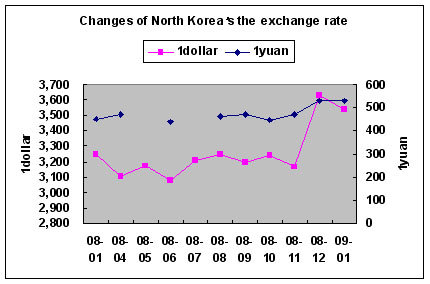
(Hat tip to One Free Korea)—According to Open Radio for North Korea, the DPRK won experienced a significant devaluation against to the dollar in the latter half of 2008:

dprk-prc-us-er-2008.jpg

According to the table and the article:

In 2008, North Korea’s exchange rate has shown relative stability of 3200 Won per Dollar and 460 Won per Chinese Yuan.

However, in December 2008, the exchange rate started to skyrocket.  The exchange rate in December was 3630 won per Dollar and 530 Won per Chinese Yuan- which was approximately 13 to 15 percent increase from the month before.  The exchange rate fell slightly to 3540 Won per Dollar and 530 Won per Yuan in January.  Nonetheless, the exchange rate isn’t likely to decrease further.

The sudden rise in foreign currency exchange rate in December seems to have correlation with the Chinese restriction on North Korean imports.  According to Chinese and North Korean traders, the sub par quality of imported products from China (speculated to be food products with melamine) was the origin of the Chinese restriction.  Sporadic breakout of illnesses in various regions of North Korea caused general distrust over Chinese imports, and the North Korean government relayed the complaints to Chinese authorities.  China in turn took a chauvinistic approach and unilaterally regulated trade between China and North Korea to teach North Korea a “lesson”

Nearly 50% of North Korean trade is with China.  Therefore, regulation on trade between North Korea and China, especially on North Korean exports to China inevitably has a severe impact on foreign currency market in North Korea.

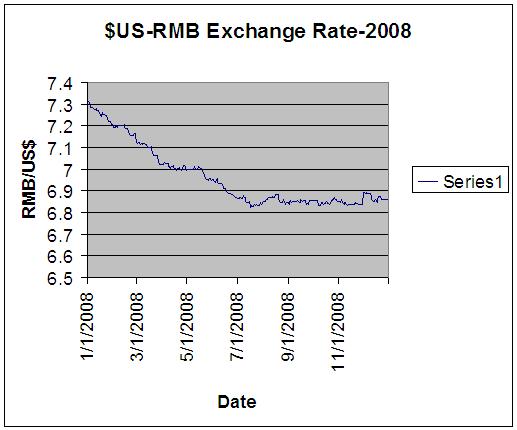
For comparison I put together a table of the US$-RMB exchange rate during 2008 (interbank spot rate) using FX history:

usd-rmb-er-2008.JPG

So now we can conclude that in 2008 the Yuan appreciated against both the DPRK won and the and the US dollar, and that the US dollar appreciated against the DPRK won. 

So the next question is: how efficient are the currency markets which trade DPRK won? Doing some back of the napkin calculations using data from these two different sources (the story and FX History), I seem to have reached the conclusion that the DPRK won is traded rather efficiently.

The average RMB/USD exchange rate (interbank spot) in December 2008 was 6.86 RMB/USD (from FX history).  If you converted 686 RMB into USD, you would receive $100.  If you converted US$100 into DPRK won at the 3,630 rate in the story quoted above, you would receive w 363,000.  If you exchanged those won for Chinese RMB at the 530 rate quoted in the story, you would receive 684.90 RMB.  684.90 is 99.83% of 686

That seems too good to be true.

Share

DPRK won exchange rate continues to climb

Thursday, January 15th, 2009

Institute for Far Eastern Studies (IFES)
NK Brief No. 09-1-15-1
2009-01-15   

The exchange rate for the North Korean won shot up approximately 13-15 percent at the end of last year, and has maintained this high rate into January, according to an article in the on-line newsletter, “Open News for North Korea,” on January 12.

According to the inaugural edition of the newsletter, the exchange rate last year was around 3,200 won per USD, or 460 won per Yuan, with only slight fluctuations, but shot up to 3,630 won per USD and 530 won per Yuan in December. In the first weeks of the new year, it has fallen only slightly, to 3,540 won per USD, and 530 won per Yuan.

According to traders who import and export between North Korea and China, “The sudden rise in the exchange rate appears to be related to trade regulations on goods imported from the North,” and they stressed, “After North Korea protested to China about inferior Chinese goods leading to accidents around the country, China decided to set an example, and unilaterally imposed [trade] restrictions.”

Because business with China makes up almost 50 percent of North Korea’s trade, if DPRK-PRC trade, and in particular, North Korea’s exports to China, are restricted, this would cause a large shock to the foreign currency market,” and, “China’s regulatory measures were eased as January come around,” but, “this year, North Korea is strengthening crackdowns on domestic markets, making it difficult to expect the exchange rate to return” to last year’s lower numbers. According to the article, “There is a foreign currency crisis in North Korea, as well, the scale of which is so great it can’t even be compared to what is happening in the South.”

The black market price for U.S. dollars has shot up from a low of 200 won, in July 2002, to 3,200 won in July of last year, and has continued to rise, peaking at 3.500 won currently. This is a sixteen-fold increase in just over six years. The newsletter put this in perspective by explaining, “North Korea has experienced a foreign currency crisis like that seen in South Korea in 1998 every year since 2002.”

North Korea’s haphazard currency distribution and chronic trade deficit has led to a reduction in the country’s foreign currency reserves, while the failure of the authorities’ currency stabilization policies combined with the growing demand for U.S. dollars by North Korean residents seeking imported goods have led to the sharp growth in the exchange rate.

Share

Lessons in insurance

Friday, December 19th, 2008

In September 2006 the first questions about North Korean reinsurance contracts hit the media (Joong Ang Daily, Sept. 20).  North Korea’s Minjok Insurance General Company filed claims in London and Moscow for two railway crashes, a ferry sinking, and a helicopter crash.  The Joong Ang Daily reported that that the accident sites were examined by industry representatives—though the checks had not been cut.  At the time the filings were interpreted in the west as a sign of tough financial times in the DPRK. Others suggested Pyongyang was learning how to manipulate global financial systems.

By December 2006, many underwriters began to (publicly) suspect fraud in these cases.  

North Korea Suspected of Collecting Millions in Reinsurance Fraud
Monday , December 04, 2006
By George Russell

[Excerpt] The central focus of concern is the absolute control of ownership and information in North Korea by Kim Jong-Il and his regime. All North Korean insurance is controlled by one state-owned firm, the Korea National Insurance Corporation (KNIC), formerly known as the Korea Foreign Insurance Company, which in turn purchases reinsurance coverage abroad for risks that it has assumed in its domestic market.

The alleged fraud involves a wide variety of North Korean industrial and personal calamities where insurers have been presented with perfect government-controlled documentation of accidents, including deaths, along with carefully gathered photographic evidence, all compiled in a startlingly brief time.

That paperwork is coupled with a resistance to letting foreign insurance adjusters examine some of the most crucial physical evidence, except after long delays and under a watchful eye, if at all.

The growing concern in the reinsurance industry is that the property damage being claimed is vastly overstated, and the circumstances of some alleged accidents may have been altered, or that deaths for which insurance payment is claimed may have had nothing to do with the accidents.

The number of apparently ordinary people in the dictatorship who have suddenly been found to have foreign-backed life insurance is raising insurers’ eyebrows.  The chief concern is that only the Kim Jong-Il regime controls the information required to trigger the payments.

So what specifically looked suspicious?

Suspicions in London began to gel in July 2005, when North Korea reported that a medical rescue helicopter had crashed into a government-owned warehouse that authorities said was crammed with disaster relief supplies.

The entire contents of the warehouse, which ran to hundreds of thousands of items, were destroyed, KNIC said, submitting within 10 days a list compiled by the relief center of every single commodity that it said had been lost.

Along with the lengthy list came a reinsurance claim for more than 40 million euros, or almost $50 million at then-current rates, for 95 percent of the damages. The reinsurance was placed through London, but the risk was spread among reinsurers worldwide.

“They provided details including tens of thousands of children’s gloves, handkerchiefs, leather gloves, toilet soap and washing soap, within 10 days,” Payton said. “In the chaos which follows an accident of this kind, that is unheard of.

“A similar loss report in Britain might take months to compile.”

The North Koreans also supplied photos of the devastation, which insurers turned over to leading experts at photographic estimates of fire damage. The experts concluded that the volume of debris remaining within the warehouse, as assessed from the photographs, did not support the high volumes of relief supplies that were claimed to be there before the fire.

“The North Korean claims are supported by meticulous paperwork, something at which the North Koreans excel,” Payton (senior partner in the London-based international law firm of Clyde & Co.) said.

“For example, where death certificates and hospital reports are required, the regime’s attitude is ‘tell us what you want, we’ll give it to you.’”

In the case of a ferry accident that allegedly took place last April, near the coastal city of Wonsan, North Korean authorities declared that 129 people had died aboard the vessel after it struck a rock about 1,000 yards off the Korean coast, and only about 100 yards from an island. All of them, the Koreans claim, had been automatically covered with life insurance when they bought their ferry ticket, and that insurance risk had been passed on to the London market through a common reinsurance product known as “excess loss personal accident reinsurance.” Here the claims from reinsurers totaled about 5 million euros, or roughly $6 million.

The North Koreans claimed that most of the victims had died of hypothermia in the freezing water. Industry sources say that when insurance investigators discovered that weather conditions were warmer than claimed at that time, the North Koreans responded that severe winds were blowing from Siberia in the spring, making the water unusually frigid.

When insurers asked for permission to send an independent diver to inspect the ferry wreck, they were refused.

Britain’s Foreign Office says the lack of firm proof of fraud is why it hasn’t taken action on the reinsurance issue, although British diplomats say they are aware of it.

Apparently, these circumstances led the insurers to refuse payment, and the North Koreans took them to court in London. Quoting from the Times of London (January 2007): 

The state-owned Korea National Insurance Corporation (KNIC) is demanding €44 million in a London court from a group of reinsurers, including Lloyd’s syndicates, for damage caused in a catastrophic helicopter crash in 2005.

The North Koreans have supplied exhaustive documentation and their claims have been authenticated by independent loss adjusters and upheld in a North Korean court. But the reinsurers argue that the nature of the regime makes it impossible to trust and that the claim is a fraudulent one intended to bring in desperately needed foreign exchange.

The accident took place in April 2005 when, it is claimed, a helicopter owned by Air Koryo, the North Korean state airline, was dispatched from Pyongyang, the capital, to collect a woman who was in labour with triplets from a remote island. On the return flight it crashed into a warehouse on the outskirts of the city, causing a fire that destroyed a large amount of humanitarian relief goods.

The KNIC settled an insurance claim by the airline, which had compensated the owner of the warehouse, and claimed this back from its London reinsurers. According to the contract, disputes were to be settled under North Korean law and last month a court in Pyongyang ordered the reinsurers to pay the North Korean company the €44 million. They refuse to do so.

Lawyers for the KNIC say that, having pocketed premiums for the previous nine years without any claims, the reinsurers are simply reluctant to pay out such a large sum.

“There is no evidence at all to suggest that the helicopter claim is fraudulent,” says Tim Akeroyd, of the law firm Elborne Mitchell, which is acting for the KNIC. “All the evidence available, including the reports of loss adjusters appointed by Mr Payton’s clients, clearly established that this was a bona fide claim.”

The contract also states that claims in North Korean won will be converted at a rate of 160 won to the euro, close to the Government’s exchange rate. But the black market rate, which is used for all practical purposes in North Korea, is closer to 2,000 won to the euro. If this were applied it would reduce the reinsurers’ bill from €44 million to €3.5 million.

This month the European reinsurers settled the case–delivering the DPRK’s KNIC nearly totoal victory in the suit pertaining to the helicopter crash. Quoting from the Financial Times:

Court proceedings in London have ended after a group of re­insurers, including Allianz of Germany, Generali of Italy, [Misr Insurance of Egypt], and three Lloyd’s of London syndicates, agreed to pay 95 per cent of the reinsurance claim, or €39.2m ($58.2m).

[One member of the reinsurance consortium, Aviabel of Belgium, has refused to accept the settlement and legal proceedings are continuing.]

The reinsurers also agreed to retract and withdraw all allegations of fraud and impropriety made against the Korea National Insurance Company.

It is not unusual for reinsurers robustly to contest claims. But it is thought this is the first victory of its kind in an overseas court for [North Korea’s monopoly insurance provider].

Apparently the other cases (particularly the ferry sinking) are still pending. Quoting from Reuters:

The lawsuit is one of several which North Korea is pursuing, with claims exceeding $150 million dollar according to some estimates, involving several calamities.

Why did the European insurers settle the case?

[L]awyers representing the North Koreans argued that the insurance claim was a legitimate commercial debt owed to KNIC by reinsurers who were fully aware of the nature of the contract when they signed it, and had even agreed to let a North Korean tribunal adjudicate the claim.

English judges evidently agreed. The reinsurer’s position was first rejected in England’s High Court of Justice in August, 2007, and again on appeal two months later. Another trial began on November 12, 2008 before the Commercial Court in London before the two sides came to their agreement.

The settlement amounts to roughly 95 percent of what KNIC had originally demanded. It includes a specific confirmation that the reinsurers “have retracted and withdrawn all allegations of fraud and impropriety against KNIC.”

Settlement here (via Fox News): dprk_settlement_agreement.pdf

UPDATE: Aidan Foster-Carter issued a personal comment on the case.  You can read a PDF of it here.

Read articles here:
North finds reinsurance a source of hard cash
Joong Ang Daily
Lee Young-jong, Shin Eun-jin, Sohn Hae-yong
9/20/2006

North Korea Suspected of Collecting Millions in Reinsurance Fraud
Fox News
By George Russell
12/4/2006

North Korea ‘trying £30m insurance scam’
Times of London
Richard Lloyd Parry
1/26/2007

N Korea state insurance group wins case
Financial Times
Sundeep Tucker
12/10/2008

Reinsurers pay North Korea claim, drop fraud case
Reuters
Nadine Jakobs
12/10/2008
Share

Orascom 3G wrap up

Friday, December 19th, 2008

UPDATE: Here is an older paper by Stacey Banks which I have not read: North Korean Telecommunication: On Hold.

ORIGINAL POST: On Monday the Orascom 3G mobile network launched in North Korea.  Just about everyone covered this story…so here are the highlights:

Telecommunications in North Korea: Has Orascom Made the Connection?
Working Paper: Marcus Noland

The topicality of the second paper, on the Egyptian firm Orascom’s role in North Korea’s telecommunications modernization, received a boost this week with the announcement in Pyongyang that Orascom was finally rolling out its cell phone service and creating a joint venture bank with a North Korean partner.  The planned Orascom investments are large: if actualized, they would be the largest non-Chinese or non-South Korean investments in North Korea, and would exceed total private investment in the Kaesong Industrial Complex to date

Financial Times

Orascom is confident North Korea is opening up its economy and says it has been assured by the ­government that everyone will be allowed to buy a mobile. However, experts think that such a volte-face is highly unlikely and reckon only senior military and government officials will be allowed access, and then only to a closed network.

When asked how many people would ultimately use the service, Orascom’s chairman Naguib Sawiris said: “We have a modest target of 5 to 10 per cent of the population.” The population is about 23m. Mr Sawiris expects 50,000 subscriptions in the first three-to-six months.

Jim Hoare, Britain’s former chargé d’affaires to Pyongyang, says the new network is bound to have severe restrictions.

“It’s unlikely that a country that doesn’t allow you to have a radio unless it’s set to the state frequency will suddenly allow everyone to have mobile phones. It’s more credible that there will be a limited network for officials in Pyongyang and Nampo.”

Dong Yong-sung, chief of the economic security team at the Samsung Economic Research Institute in Seoul, believes another obstacle to ordinary North Koreans owning phones will be the cost. “As far as I know, mobile phone registration costs about $1,000,” he said, a sum equivalent to the average annual income.

(NKeconWatch: Others put the price at $700…and there are many problems with asserting that the DPRK’s per capita income is $1,000 per year.)

Bloomberg

The inauguration of Koryolink took place today in North Korea, Orascom Telecom said in an e-mailed statement. Orascom Telecom Chief Executive Officer and Chairman Sawiris attended the event, a company official said, requesting anonymity. The Cairo- based company got a 25-year license and exclusive access for four years in January. It plans to spend as much as $400 million on a high-speed network and the license for the first three years.

The North Korean venture is “in line with our strategy to penetrate countries with high population and low penetration by providing the first mobile telephony services,” Sawiris said in a statement earlier this year.

CHEO Technology JV Company, the North Korean unit that will operate under the Koryolink name, is 75 percent owned by Orascom Telecom and 25 percent by the state-owned Korea Post and Telecommunications Corporation.

The unit will see average revenue per user of $12 to $15 this year as Orascom Telecom targets three of the country’s biggest cities, according to company forecasts.

Koryolink has rolled out its so-called third-generation grid to initially cover Pyongyang, with a population of 2 million.

Orascom is counting on four potential markets in the Stalinist nation, according to a study by Marcus Noland of the Peterson Institute for International Economics.

The military and government officials are the top targets, followed by foreigners working for UN organizations and diplomats. The others are customers from South Korea, which has several economic projects with its neighbor, and local demand from rich North Koreans.

To protect its investment, Orascom “hedged its bet, committing only half of its investment at the outset and making additional investment conditional on its assessment of conditions going forward,” Noland said.

If the deal is threatened, Orascom may withdraw specialized equipment or technicians, reducing the value of the network to Pyongyang, Noland said in his study.

“Orascom may have spread the wealth informally, creating beneficiaries within the decision-making apparatus who would stand to lose if the agreement failed,” according to the study.

Bloomberg

Orascom Telecom, the Middle East’s biggest wireless company, opened Ora Bank in Pyongyang in the presence of Chairman and Chief Executive Officer Naguib Sawiris, a company official said on condition of anonymity. Ezzeldine Heikal, who is also head of Koryolink, Orascom’s North Korean mobile-phone network, was appointed president of the bank, the official said without providing further details.

“This is a big deal, especially as far as North Korea is concerned, because the current banking system is virtually non- existent,” Marcus Noland of the Peterson Institute for International Economics said in a telephone interview from Washington, D.C. “It’s a ground that others have feared to tread and is perhaps an endorsement for North Korea that says ‘we’re open for business.’”

Ora Bank is a joint venture between Orascom Telecom and North Korea’s state-owned Foreign Trade Bank, North Korea’s official news agency reported today. The director of North Korea’s central bank Kim Chon Gyun and Egypt’s ambassador to Pyongyang Ismail Abdelrahman Ghoneim Hussein, were also present at the opening ceremony, the news agency said.

Radio Free Asia

Chinese traders who regularly travel back and forth to North Korea said local residents showed little enthusiasm for the new service, which cost more than U.S. $900 to set up before the Ryongchun explosion.

North Korean defector Kim Kwang-jin, a senior researcher at the Institute for National Security Strategy in Seoul, said the fact that the government had once pulled the plug on North Korean cell phones meant that it could easily do so again.

“In the beginning, people will be hesitant, because a few years ago many of them made a big investment in cell phones. But service was suspended abruptly, so they are still very concerned that might happen again,” Kim said.

“People are also worried that the ability to pay such a high amount of money for a cell phone may raise a red flag and bring them under scrutiny by the North Korean authorities.”

Most foreigners are banned from using cell phones while in North Korea, although a network for government officials is believed to exist in the capital, Pyongyang.

(NKeconWatch: I personally saw elite North Koreans use mobile phones and even some western journalists in 2005.)

The Guardan

North Korea first experimented with mobile phones in 2002, but recalled the handsets 18 months later after a mysterious train explosion that killed an estimated 160 people. Some experts argue that officials feared the incident was an attempt to assassinate the regime’s “dear leader”, Kim Jong-il, and that mobile phones were involved.

BBC

Some reports suggest that handsets for the new network will cost around $700 each, putting them far beyond the reach of the vast majority of people in the impoverished country.

Choson Ilbo

Although the technology would enable users to send and receive text messages and video content, North Korean customers will only be allowed to speak over their phones.

BMI Political Risk Analysis, Dec 16, 2008 (h/t Oliver)

BMI View: North Korea has officially begun third-generation (3G) mobile phone services, thanks to Egypt’s Orascom Telecom (OT). However, the growth of the network could be limited by the regime’s fear that mobile phones will increase the scope for anti-regime activities.

North Korea has officially commenced third-generation (3G) mobile phone services, thanks to an investment by Egypt’s Orascom Telecom (OT). The firm’s initial target is 100,000 subscribers in three major cities, including Pyongyang, and it eventually hopes to develop a nation-wide network connecting North Korea’s 23mn citizens. OT has promised to invest US$400mn in network infrastructure over the next four years. It has signed a 25-year contract with the North Korean government, and owns 75% of their joint-venture (known as Korealink). OT’s exclusivity rights will last for four years. Orascom’s foray is something of a coup, given that North Korea’s communications network is so rudimentary (for further background see December 8 2008, Industry Trend Analysis – North Korea Prepares For Mobile Network Launch).

Why Pyongyang Fears Mobile Phones
North Korea launched a mobile phone service operated by a Thai subsidiary firm in 2002, but reversed course in 2004, apparently because of a devastating bomb blast on a train in Ryongchon in April of that year. Given that North Korean leader Kim Jong Il’s personal train had passed through the area only a few hours earlier, there was speculation that the explosion had been an assassination attempt, possibly triggered by mobile phone. Since then, only those living in areas close to the border with China have had access to mobile phones, thanks to the proximity of the Chinese network.

Aside from the notion of mobile phones as bomb triggers, they can also make it easier for citizens to communicate with one another. This would increase citizens’ ability to organise anti-government activities – such as protests or sabotage. For example, the popular uprising that led to the overthrow of Philippine president Joseph Estrada in 2001 was dubbed the ‘text message revolution’, because that is how the marches were announced and coordinated. Admittedly, the Philippines is a far more open society than North Korea, but the subversive aspect has not been lost on the regime.

Mobile phones would also make it easier for North Koreans to communicate with the outside world, and thus allow the real-time transmission of information or intelligence to foreign media or spy agencies, and vice versa. They would also allow the North Korean elite to communicate more efficiently, allowing dissident elements to plot against the regime.

Thus, even something as basic as mobile phones are seen as potentially regime threatening.

Mobile Service Difficult To Spread
Consequently, Orascom will surely find it difficult to spread its mobile service across the country. For a start, registration will be tightly watched. Secondly, the cost of the handsets, at several hundred dollars, will mean that only the political and moneyed elites will be able to afford mobiles. Of course, elements of the elite can ‘misuse’ their phones to arrange subversive actions if they deem it worthy, but it seems that the regime are counting on loyalty. Indeed, depending on the sophistication of their equipment, the regime will probably be able to snoop in on the elite’s conversations and movements, giving them an additional layer of security.

Read the full articles below:
Orascom eyes North Korean network
Financial Times
Christian Oliver
12/14/2008

Orascom Telecom’s Sawiris Signs North Korean Deal
Bloomberg
Tarek Al-Issawi
12/15/2008

Orascom Telecom of Egypt Opens Bank in North Korea
Bloomberg
Tarek Al-Issawi
12/16/2008

North Korea Brings Back Cell Phones
Radio Free Asia
Jung Young
12/16/2008

Secretive North Korea launches restricted mobile phone service
The Guardian
Tania Branigan
12/16/2008

N Korea launches 3G phone network
BBC
Steve Jackson
12/15/2008

N.Korea Restarts Cell Phone Service
Choson Ilbo
12/17/2008

Share

Singapore-North Korea trade deal

Tuesday, December 2nd, 2008

The Singaporean government is insuring investment in the DPRK…

Quoting from the article:

Singapore firms keen to expand into the largely untapped market of North Korea now have a foot in the door, thanks to two new agreements inked on Tuesday.

The Ministry of Trade and Industry (MTI) said that Singapore signed an Investment Guarantee Agreement (IGA) with the country on Tuesday.

Trade and Industry Minister Lim Hng Kiang and his North Korean counterpart, Mr Ri Ryong Nam, signed the IGA during the North Korean Foreign Trade Minister’s official visit to Singapore.

MTI said the IGA will help promote bilateral investment flows by protecting investors and their investments.

Under the agreement, investors will be accorded non-discriminatory treatment, compensation in the event of expropriation or nationalisation of their investments, and free transfer of capital and returns from investment – perennial ‘banana peels’ for businesses entering a less-developed and unexplored market.

Separately, the Singapore Business Federation (SBF) also signed a Memorandum of Understanding with the North Korean Chamber of Commerce.

According to the SBF, North Korea remains an unexplored market for many Singapore firms but there exists many opportunities for local businesses to tap into such as its high-quality yet affordable workforce and the abundance of natural resources.

Read the full article below:
S’pore, N.Korea ink trade deals
The Straights Times
Francis Chan
12/2/2008

Share

Pyongyang remodeling underway

Tuesday, November 18th, 2008

Institute for Far Eastern Studies (IFES)
NK Brief No. 08-11-17-1
11-17-2008

North Korea’s capital city of Pyongyang appears to be getting a facelift. The (North) Korean Central Broadcasters has reported that a city beautification project is underway in Pyongyang.

An apartment-erecting crane is building a new skyscraper, while construction has been restarted on the 16-year old remains of the shell of the Ryukyung Hotel as large-scale construction equipment and barges crowd the river as piles of construction materials can be found at each construction site.

Pyongyang insiders report that efforts getting underway in this anniversary year marking 60 years since the founding of the country are part of an effort to make Pyongyang a completely new city by 2012, when the North will mark the 100th birthday of its eternal president, Kim Il Sung.

Pyongyang is being developed as a ‘showcase capital’ for international visitors to the poverty-stricken North, as the North Korean people refer to Pyongyang as the ‘capital of the revolution.’

Recently, South Korean representatives from organizations providing aid to the North have reported being been surrounded by new construction of hotels and other buildings and the refurbishment of older buildings such as the Pyongyang Grand Theater.

What is curious is that the origin of the capital needed for these large-scale construction projects appears to indicate growing investment from foreign enterprises. The Ryukyung Hotel construction is reportedly being supported by a United Arab Emirates (UAE) company.*

A South Korean entrepreneur recently in Pyongyang quoted a Pyongyang official as saying, “The Ryukyung Hotel will be complete within three years,” and that the Daedong River Hotel construction was almost in the finishing stages with the help of foreign investment.

In January of this year, the Egyptian wireless communications company Orascom announced it would invest 400 million USD in order to construct the North’s first wireless communications network.

Also, North Korea’s foreign trade appears to have grown this year, especially because, as energy demand has sharply increased, the North’s export of mined materials to China appears in early calculations to have expanded considerably.

* NKeconWatch: This is the first I have heard about a UAE firm.  Previously, discussion centered only around Orascom.

Share

Bicycle business growing in North Korea

Tuesday, November 4th, 2008

Institute for Far Eastern Studies (IFES)
NK Brief No. 08-11-3-1
11/3/2008

The Daily NK has reported that the use of bicycles for business and transportation around the city of Pyongyang is becoming more and more commonplace, with 7 out of 10 households owning a bike, despite the fact that the cost of a bicycle in the capital city has doubled in the last twelve months alone.

According to North Korean defectors, until the early part of the 21st century, bicycles were the most sought-after purchases, with only 30~40 percent of families able to buy them.

According to a source in Pyongyang, “If you go to a [market] these days, you’d see that people who sell or purchase goods mostly use bicycles,” adding, “With the exception of those houses with extremely difficult situations, most households have a bike.”

The source explained that the growing use of bicycles is not due to improvements in the lives of the people, but rather, due to a shift in mentality. In the past, someone wishing to purchase a bike would first have to save up money for it, while today they think they can borrow the money, even at high interest rates, and then repay the loan through business profits.

The Daily NK explains, “With the ubiquity of [market] trading and the increase in business competition, bicycles have become must-have items.”

In Sinuiju, as well, bicycles have become a necessity for traders. A source there reported, “In farmlands that are distant from the [market], bicycles are an important means of linking to city markets. The merchants can triple or quadruple their profit, compared with those that don’t own bicycles.”

Most traders with bicycles take orders from those living in farming villages, fill the orders in city markets, then barter the items in the villages for vegetables and grains which they then turn around and sell in markets for a profit. Competition is stiff as traders follow price differences between the markets in order to squeeze out even a 100 won profit.

Read two recent stories on North Korea’s bicycle culture here:
70% of Households Use Bikes
Daily NK
Jung Kwon Ho
10/30/2008

People’s Safety Agency Targeting Women Cyclists
Daily NK
Jung Kwon Ho
11/6/2008

Share

DPRK external debt approaches 100% of estimated GDP

Tuesday, October 7th, 2008

According to Yonhap:

North Korea owes a total of $18 billion to 30 different countries, including Russia and China, said Kwon Young-se of the ruling Grand National Party (GNP), citing estimates from the Unification Ministry.

The amount is almost equal to North Korea’s gross domestic product (GDP) for last year, which totaled 24.7 trillion won ($18.4 billion).

South Korea has loaned roughly 1.19 trillion won to the North, equivalent to nearly five percent of Pyongyang ‘s total foreign debt.

“North Korea’s foreign debt is the result of the accumulation of unpaid trade bills and loans that it received from socialist states in the 1950s and 60s and from the Western world in the 70s to develop its economy,” Kwon said.

“The volume of foreign debt is expected to continue to rise due to the interest added to unpaid debts, although that can fluctuate depending on the result of negotiations with foreign creditors,” he added. (Yonhap)

According to the CIA world factbook, however, North Korea’s total external debt was estimated at $12.5 billion in 2001.  If I put aside the fact that the South Korean Ministry of Unification and the US CIA are probably reporting dollar figures using different basis years, North Korea’s external debt has increased increased nearly 47% in the last seven years.  I do not think this drastic increase could be attributed to the accumulation of interest arrears dating back to the 1950s.

Share

North Korea on Google Earth

Thursday, October 2nd, 2008

North Korea Uncovered: Version 12
Download it here

mayday.JPGAbout this Project: This map covers North Korea’s agriculture, aviation, cultural locations, markets, manufacturing facilities, energy infrastructure, political facilities, sports venues, military establishments, religious facilities, leisure destinations, national parks, shipping, mining, and railway infrastructure. It is continually expanding and undergoing revisions. This is the 12th version.

Additions include: Tongch’ang-dong launch facility overlay (thanks to Mr. Bermudez), Yongbyon overlay with destroyed cooling tower (thanks to Jung Min Noh), “The Barn” (where the Pueblo crew were kept), Kim Chaek Taehung Fishing Enterprise, Hamhung University of education, Haeju Zoo, Pyongyang: Kim il Sung Institute of Politics, Polish Embassy, Munsu Diplomatic Store, Munsu Gas Station, Munsu Friendship Restaurant, Mongolian Embassy, Nigerian Embassy, UN World Food Program Building, CONCERN House, Czech Republic Embassy, Rungnang Cinema, Pyongyang University of Science and Technology, Pyongyang Number 3 Hospital, Electric Machines Facotry, Bonghuajinlyoso, Second National Academy of Sciences, Central Committee Building, Party Administration Building, Central Statistics Bureau, Willow Capital Food House, Thongounjong Pleasure Ground, Onpho spa, Phipa Resort Hotel, Sunoni Chemical Complex (east coast refinery), Ponghwa Chemical complex (west coast refinery), Songbon Port Revolutionary Monument, Hoeryong People’s Library, Pyongyang Monument to the anti Japanese martyrs, tideland reclamation project on Taegye Island. Additionally the electricity grid was expanded and the thermal power plants have been better organized. Additional thanks to Ryan for his pointers.

I hope this map will increase interest in North Korea. There is still plenty more to learn, and I look forward to receiving your contributions to this project.

Version 12 available: Download it here

Share

North Korea juggles South, Japan, Russia, and US

Tuesday, September 30th, 2008

The DPRK’s recent efforts to reconstruct the Yongbyon 5MW nuclear reactor seem to have brought implementation of the “second” Agreed Framework to a halt, though it was already behind schedule.  This week the US sent Chris Hill to Pyongyang to try and rescue the process which is hung up on verification protocol.   The North claims to have sufficiently declared their nuclear capabilities and believe they should be removed from the US list of state sponsors of terror.  The US does not believe this condition has been met and seeks to establish a protocol to verify if the North’s declaration is accurate.

Japan is also set to extend sanctions (due to expire) on the DPRK.  According to Bloomberg:

Japan’s ruling Liberal Democratic Party decided to extend sanctions against North Korea for six months after their Oct. 13 expiration date, Jiji Press reported.

LDP lawmakers agreed to extend the sanctions because North Korea took steps to reactivate its nuclear program and made little progress in an investigation into Japanese nationals abducted by North Korean agents, Jiji reported.

Prime Minister Taro Aso’s Cabinet is likely to endorse the extension by Oct. 10., the Japanese wire service said.

The sanctions include a ban on North Korean imports and the entry of North Korean ships into Japanese ports. The extension will be the fourth since sanctions began after North Korea’s October 2006 nuclear test, Jiji said.

Just as the DPRKs hopes of restoring/establishing relations with Japan and the US start to dim, however, they have reached out to South Korea, with whom political relations had recently gone sour due to the South’s policy change from unsupervised aid provision under the “sunshine policy” to a quid-pro-quo relationship under a “policy of mutual benefits and common prosperity“.  Additionally, the fatal shooting of a South Korean tourist in Kumgangsan led to a deterioration in cooperation between the two governments and suspension of the inter-Korean project (a cash cow for the North).

How much was the Sunshine Policy worth to the North?  South Korean GNP lawmaker Jin Yeong, who analzed data submitted by the Unification Ministry and the Export-Import Bank of Korea, claims that the Kim and Roh administrations oversaw the transfer of 8.38 trillion South Korean Won in aid and loans since 1998.

Taking office in February 2003 after the second North Korean nuclear crisis emerged in September 2002, Roh doled out 5.68 trillion won to Pyongyang over his five-year term, double that of his predecessor Kim (2.70 trillion won).

Kim and Roh gave to North Korea 2.4 trillion won for building light-water reactors and in food aid; 2.5 trillion won to pin the price of rice aid to that of the global market; 2.8 trillion won for other aid including fertilizer; and 696 billion won in aid from advocacy groups and provincial governments.

In 2003, South Korean aid to the North reached a high of 1.56 trillion won. Then after North Korean leader Kim Jong Il declared that his country had gone nuclear in 2005, the Roh administration sent 1.48 trillion won to the North.

Jin said, “South Korea gave a loan with rice first in 2000. Payments on the loan are deferred for 10 years. Thus, we are to receive the first repayment installment in 2010. But most of the 2.4 trillion won in loans seem irrecoverable.”

PricewaterhouseCoopers Korea audited the fiscal 2007 accounts of Seoul`s inter-Korean cooperation funds, saying, “Considering the characteristics of the North Korean government, grave uncertainty exists over the possibility of redeeming the loans given to the regime. The ultimate outcome depends heavily on the conditions around the Korean Peninsula.”

Since President Lee Myung-bak took office this year, exchanges between the two Koreas have been rare. Still, aid to the light-water reactor and the Gaesong industrial complex projects and civilian donations have continued, amounting to a combined 211.3 billion won. (Donga Ilbo)

It appears the Russians are doing their part to bring the North and South together through a project they can all agree on—building a natural gas pipeline from Russia to South Korea via the DPRK:

South Korea plans to import $90 billion of natural gas from Russia via North Korea, with which it shares one of the world’s most heavily fortified borders, to reduce its reliance on more expensive cargoes arriving by sea.

State-run Korea Gas Corp. signed a preliminary agreement with OAO Gazprom, Russia’s largest energy company, to import 10 billion cubic meters of natural gas over 30 years starting in 2015, the Ministry of Knowledge Economy said in a statement. The accord was signed in Moscow during President Lee Myung Bak’s three-day visit that began yesterday.

Gazprom Chief Executive Officer Alexei Miller said after talks today between Lee and Russian President Dmitry Medvedev that the exact delivery route hasn’t been determined and that shipments could begin as early as 2015.

“Russia suggested a pipeline via North Korea, which is expected to be more economical than other possible routes,” the minister said in a news briefing. “Russia will contact the North to discuss this.”

“Transporting gas through North Korea could be risky for South Korea,” said Kim Jin Woo, a senior research analyst at Korea Energy Economics Institute. “But the project will ease tensions on the Korean peninsula if Russia successfully persuades North Korea” to accept the plan.

North Korea could earn $100 million a year from the gas- pipeline project, the Ministry of Knowledge Economy said.

“Russia will supply the fuel in the form of LNG or compressed natural gas if negotiations with North Korea do not work out,” according to the ministry’s statement. South Korea and Russia will sign a final agreement in 2010 when a study on the route is completed.

South Korea is turning to Russia, holder of the world’s biggest proven gas reserves, as it faces intensifying competition for energy resources from China and Japan. Asia’s fourth-largest economy depends on gas for 16 percent of its power generation.

Under the agreement, a pipeline to South Korea will be laid via North Korea from gas fields on Sakhalin Island in Russia’s Far East. The pipeline would initially carry 10 billion cubic meters of gas a year, or about 20 percent of South Korea’s annual consumption. The cost of the gas link’s construction is estimated at $3 billion, the ministry said.

Read the full articles here:
South Korea Seeks $90 Billion of Russian Natural Gas
Bloomberg
Shinhye Kang
9/29/2008

Liberal Gov`ts Gave W8.38 Bln to North Korea`
Donga Ilbo
9/30/2008

Share