Archive for the ‘Finance’ Category

China/North Korea financial integration

Saturday, April 12th, 2008

Last week we discussed the growing presence of North Korean companies in Russia.  This week, the Daily NK reports on China’s first steps at financial integration with North Korea:

China has introduced a new settlement system which allows North Korean business to open bank accounts in China and settle business transactions in Yuan, the Nikkei reported on Sunday.

With the adoption of the system, North Korean people and companies can open Yuan bank accounts within China after some formalities and use the accounts for trade settlement with their Chinese business partners. Accordingly, North Korea is now able to buy foreign currencies such as dollars and euros with its Yuan income from trade. In addition, North Korea can legally bring in foreign currencies or send them to third countries.

North Korean companies used to have difficulties of making a trade settlement with China in cash or by barter since the U.S. enacted financial sanctions on North Korea and China imposed economic sanctions regarding remittance and bank accounts after North Korea’s nuclear tests. However, China too suffered from the sanctions as the amount of Yuan smuggled into North Korea has skyrocketed proportional to the increasing volume of trade between North Korea and China.

The new settlement system will help reinvigorate the trade between two countries. However, the system can cause concerns at the Six Party Talks as it lowers the bargaining power needed to pressure North Korea to give up its nuclear programs, the Nikkei said.

Meanwhile, the People’s Government of Yanbian Korean Autonomous Prefecture announced last February that Jilin Province would allow North Korean people and companies operating in China to open Yuan bank accounts for trade purpose starting with February 20, 2008.

You can read the full article here:
China Lifts Sanctions on North Korea
Daily NK
Park Eun Jae
4/9/2008

Share

North Korea launching massive anti-corruption drive

Monday, February 11th, 2008

Last Friday, Yonhap reported that Kim Jong Il has ordered an anti-corruption investigation of two key agencies, both of which manage South Korean investments in the DPRK: the United Front Department (which Lankov claims is involved in clandestine operations) and the National Economic Cooperation Council.

North Korea is in the midst of a massive anti-corruption drive which has already resulted in the arrest of one of its top officials handling business with South Korea, informed sources in Seoul said Saturday.

The campaign, ordered by leader Kim Jong-il, was prompted by widespread allegations that some top party and administration officials took bribes as they pushed business projects with South Korean industrialists, said the sources well versed in North Korean affairs.

“The probe was launched as National Defense Commission Chairman Kim Jong-il said there was a lack of supervision over the United Front Department [a key party organization that supervises inter-Korean affairs], although lots of suspicions were raised over the department’s corruption,” one source told Yonhap News Agency.

According to the sources in Seoul, the North Korean leader was enraged after getting a report that some party and government officials allegedly pocketed bribes and diverted food and other aid from South Korea to black markets.

Also under investigation is the National Economic Cooperation Council, a government body that handles business with South Korean entrepreneurs, the sources said.

The Council’s chief, Jeong Woon-eop, remains under arrest pending investigation into allegations that he took “huge amounts” of bribes, said the sources, who wanted to remain anonymous. (Yonhap excerpted)

Frequently “anti-corruption campaigns” in developing countries have nothing to do with making the bureaucracy more accountable or responsive to public demands, but rather are political maneuvers to prevent “rents” or funds from being channeled to uses that lie outside the leadership’s control (or some faction of the leadership).  In other words, they are regime enhancing.  The announcement of this campaign demonstrates two important principles that deserve explicit mention:

1. Not all profits earned by North Korean joint ventures are channeled to the leadership, and in fact many of them are siphoned off by middlemen who actually control the financial machinery.  Once skimmed off the top, it is likely that these funds are used in illicit private commercial operations since they cannot be legally declared by the owner (unless there are domestic channels for laundering money in North Korea).

2.  If funds are being siphoned off of high-profile official joint venture operations, then the leadership is not in control of its internal fiscal affairs.  Indeed it is likely that, as in the Soviet Union, the people who keep the private economy running are the trusted mid- to senior-level officials who can skirt the rules and know how to actually get things done within the system.

Update 2/24/2008:

North Korean authorities have been investigating the chief of a North Korean committee in charge of inter-Korean economic cooperation for months after seizing $20 million from his house, a report said Friday.

The full article can be found here:
NK Official Suspected of Embezzling Funds From Seoul
Korea Times
Jung Sung-ki

Update 2/12/2008:

The chief of Daesung General Bureau, a division of the 39th Department which manages foreign transactions, was fired on suspicion of embezzling US$1.4 million last fall.” (Daily NK)

The full article can be found here:
North Korea launching massive anti-corruption drive
Yonhap
2/9/2008

Share

Law on Foreign-invested Bank

Monday, February 11th, 2008

From Naenara:

The Law of the DPRK on Foreign-invested Bank was adopted by Decision No. 42 of the Standing Committee of the Supreme People’s Assembly on November 24, 1993 and amended by Decree No. 484 of the Presidium of the SPA on February 26, 1999. It was amended by Decree No. 3400 of the Presidium of the SPA on November 7, 2002.

The law consists of 32 articles in 5 chapters.

Chapter 1. Fundamentals (Articles 1-7)

This chapter stipulates that the law shall contribute to the expansion and development of cooperation with different countries the world over in the area of finance.

A foreign investor may establish and operate a foreign-invested bank within the territory of the DPRK.

Foreign-invested banks include joint venture banks, wholly foreign-owned banks and branches of foreign banks.

The state shall protect the legal rights and interests of foreign-invested banks established in the territory of the DPRK.

Chapter 2. Establishment and Dissolution of Foreign-invested Banks (Articles 8-17)

This chapter stipulates that an investor who intends to establish a foreign-invested bank in the territory of the DPRK shall file an application to the DPRK Central Bank, declaring the name of the bank, the name and curriculum vitae of its president, the registered capital, paid-up capital, operation fund, investment rate, details of business, etc.

The Central Bank of the DPRK shall decide upon the approval or rejection of the application within 50 days from its receipt.

A foreign-invested bank shall be dissolved when it cannot continue its operation due to such reasons as the expiry of the term approved, merger of the banks, insolvency, defaulting of the contract and natural calamities.

Chapter 3. Capital and Reserve Funds of Foreign-invested Banks (Articles 18 – 22)

This chapter stipulates that a foreign-invested bank shall deposit the primary paid-up capital and operating capital with a bank designated by the Central Bank of the DPRK within 30 days from the date when it obtained the approval of establishment and shall have it confirmed by a certified public accountant.

A joint venture bank and a wholly foreign-owned bank shall set aside as reserve fund 5 per cent of its annual profits each year until the reserve fund grows to 25 per cent of the registered capital and a foreign-invested bank may reserve such funds in need as bonus fund, welfare fund and R&D fund.

Chapter 4. Transactions and Settlement of Foreign-invested Banks (Articles 23 – 28)

This chapter stipulates that a foreign-invested bank may engage in part or whole of the following transactions:

A·  Accepting deposits of foreign currencies of foreign-invested enterprises, foreign enterprises and
         foreigners,

B· Granting loans in foreign currencies, overdrafting on the current account excess payment and
         discounting of foreign currency bills,

C· Dealing in foreign exchange,

D· Investment in foreign currencies,

E ·Guarantee against liabilities in foreign currencies and defaulting of contract obligations,

F· Remittance of foreign currencies,

G· Transactions of securities in foreign currencies,

H· Trust banking,

I· Credit survey and consultation.

A foreign-invested bank shall open an account with the branch of the Central Bank of the DPRK in the area where it is located and deposit the reserve fund for deposit payment.

A foreign-invested bank shall submit to the foreign exchange control organ the annual balance sheet and profit and loss account confirmed by a certified public accountant within 30 days from the date of the completion of the annual business settlement, and the quarterly financial statement and necessary statistics by the 15th day of the first month of the ensuing quarter of the year.

Chapter 5. Penalties and Settlement of Disputes (Articles 29 – 32)

This chapter stipulates that a foreign-invested bank shall be liable to fining in the following cases:

J · In case it has changed its president or vice-president or the location of the bank without approval,

K· In case it has failed to set aside the reserve fund of required amount,

L· In case it has obstructed or caused difficulties in inspection, and

M· In case it has failed to submit regular reports within a fixed period of time, or submitted false ones.

In case a foreign-invested bank engages in other transactions than those approved, or revises the memorandum, or increases or decreases the registered capital and operating capital without approval, it may be ordered out of operation.

In case an applicant for establishment of a bank fails to commence banking business within 10 months from the date of the approval, the approval granted for establishment of the bank may be withdrawn.

The Law of the DPRK on Foreign-invested Bank shall ensure stability of activities of foreign-investors and contribute to the expansion and development of the external economic relations by establishing system and order for foreign-invested banks.

Share

North Korean run restaurants diversify product lines

Thursday, February 7th, 2008

Writing today for the Asia Times, Sunny Lee gives an update on the North Korean-run restaurants in China and South East Asia.  Much has already been published on these restaurants: how they channel money back to North Korea and how the waitresses tend to defect.  (As mentioned in the Kaesong post yesterday, they probably also pay hefty bribes for their overseas posts and have well-connected relatives.)

Sunny Lee points out that these restaurants (see YouTube video here) are now diversifying their product lines to boost profits, and like other successful capitalists across Asia, they are doing it by leveraging their most unique asset–attractive North Korean women.  How?  By transforming into karaoke bars after dinner hours.

North Korea has some 100 restaurants overseas, mostly in China and Southeast Asia, including Laos, Vietnam and Cambodia. These restaurants serve as an important revenue pipeline for earning foreign currencies for Pyongyang. Each overseas North Korean restaurant is said to be allotted a revenue quota to fill, ranging from US$100,000 to $300,000 a year to send to Pyongyang, which makes the total revenue estimation some tens of millions of dollars.

The business formula – restaurant by day and karaoke bar by night – is also seen as an effort for these restaurants to meet the assigned financial quota. Currently, there are scores of North Korean restaurants in China, including in cities such as Beijing, Tianjin, Tsingdao, Dandong and Yanji. Beijing has 11 North Korean restaurants. All of these employ North Koreans whose total employment number in China is estimated to be several hundred. (Asia Times)

Despite the higher cost, business is brisk…

The reason that North Korean restaurants are expensive yet remain popular among customers is their immaculate service from beautiful employees. In China, where service quality at restaurants is often unsatisfactory, North Korean restaurants are becoming a favorite alternative among members of the businesses community. (Asia Times)

However, if you want to enjoy an authentic North Korean dining experience but have moral qualms about supporting the regime, then you can patronize similar resturants managed by North Korean defectors in South Korea–though the experience is quite different.  Whereas the Chinese pay extra for premium restaurant service in Beijing, the South Koreans pay for the genuine socialist restaurant experience.  In other words, they pay to be treated like an annoyance to the staff.

[At the Pyongyang Moran Bar (located in South Korea), the] North Korean waitresses wore traditional dresses in the bright colors that were fashionable in the South some years back. The singer’s interpretation of “Whistle,” a North Korean standard of the 1980’s, was shaky and off-key. Service was bad and included at least one mild threat. Drinks were spilled, beer bottles left unopened and unpoured.

But the South Korean customers could not get enough of the Pyongyang Moran Bar. (New York Times)

So you have your choice of North Korean themed restaurants:  The propaganda ideal or the  socialist reality.

The full articles can be found here:
Chillin’ at a North Korean karaoke bar
Asia Times
Sunny Lee
2/8/2008

In Deep South, North Koreans Find a Hot Market
New York Times
Norimitsu Onishi
5/25/2006

Share

DPRK’s largest copper mine flooded with difficulties

Saturday, February 2nd, 2008

Institute for Far Eastern Studies
NK Brief No. 08-1-29-1

It is being reported that North Korea’s Chungnyun Mine, in Hyesan, Ryanggang Province, is facing severe economic difficulties due to floodwater. Hyesan mines produce 80 percent of all North Korean copper, and the North had estimated that it will be able to continue mining copper there for the next forty years. Chinese firms in Hebei’s Luan River region had wanted to import 51 percent of Hyesan Chungnyun Mine’s product, but the deal fell through due to opposition from North Korea’s committee overseeing its second (military) economy.

In 1996, during the North’s ‘Arduous March’, electricity was not provided to the mine, leading to flooding in the mineshafts. Since 1998, Kim Jong Il has budgeted 8.2 million USD to dewater the mine, and the mine was recovered using electricity and equipment provided by China.

The mine resumed operations in May, 2004, and in March of last year even an ore-dressing plant and crushing facility were constructed, indicating that there were high expectations that production would grow. However, as water filled up at the dam for the near-by Samsoo Powerplant, completed in May, the mines began to flood again.

There was no end to criticism that the powerplant, located in Jangan-Ri, Hyesan, Ryanggang Province, was to be constructed on a limestone foundation that would leech massive amounts of water, however, as a result of its construction, despite this opposition, water leaks out of the power station and has flooded the mine.

In the event that North Korea abandons the Hyesan Chungnyun Mine, it will be faced with the difficulty of needing to import the large amounts of copper required by the manufacturing industry. As this mine began to flood, North Korea has begun to import most of the copper necessary for its economy from Chile.

Currently, there is no feasible way to technically restore the mine, so as senior authorities in the North are demanding that the mine be saved at any cost, those in charge of operations are said to be uneasy.

Share

2008 Index of Economic Freedom

Thursday, January 31st, 2008

efindexcover.jpgThe 2008 Index of Economic Freedom published by the Heritage Foundation and the Wall Street Journal covers 162 countries across 10 specific freedoms such as trade freedom, business freedom, investment freedom, and property rights. Unlike the Freedom House rankings, this is an index, meaning there is a first place winner (who should be rewarded with lots of investment and business creation) and a last place “winner” (who should be shamed into moving up the list for the same prizes)

The bottom ten countries:
148. Venezuela
149. Bangladesh
150. Belarus
151. Iran
152. Turkmenistan
153. Burma (Myanmar)
154. Libya
155. Zimbabwe
156. Cuba
157. North Korea  (unchanged)

Share

Cancor Report #297: Knowledge Sharing with the DPRK

Sunday, January 27th, 2008

November 12, 2007

The latest edition of the CanKor Report has only one longer-than-usual item.  It is the preparatory document of a workshop recently held in Seoul, Korea, in which NGOs, academics, practitioners and diplomats from Europe, Asia, Australia and North America consulted about the prospects for international cooperation regarding education and training programmes that need to be undertaken with the DPRK if denuclearization proceeds according to the Six-Party timetable.  Experts in economic development believe that the next step in international engagement will have to be the building up of DPRK expertise and intellectual capacity to absorb the significant development assistance that may follow successful completion of the Six-Party process. In this working paper, loyal CanKor reader and former World Bank official Bradley Babson defines “knowledge sharing”, explains why the time is ripe for all sectors to become involved, outlines potential pitfalls, and suggests guiding principles for future engagement by the international community.
*************************************************

Contents:

1.   KNOWLEDGE SHARING WITH THE DPRK
    Bradley O. Babson, CanKor original
       Introduction
       Why knowledge sharing?
       Strategic considerations
       DPRK internal challenges
       Nuclear politics
       Inter-Korean reconciliation
       China, Russia and Northeast Asia regional perspectives
       Operational challenges in the DPRK context
       An underlying tension
       Relationships
       Information
       Absorptive capacity
       Coordination
       Resources
       International experience and best practices
       Conclusions and principles for future engagement
*************************************************

(more…)

Share

N. Korea repays Seoul aid with minerals

Friday, January 4th, 2008

In the 1980s Pepsi went on sale in the Soviet Union [as did eventually Coke].  Since the hard currency needed to buy the syrup was scarce, the Soviets traded it for Vodka (which they presumably had plenty of)–At least this is what I was able to piece together when I visited the USSR as a teenager.

Yonhap (January 4, 2008) reports that North Korea has adopted the same basic strategy to repay its external debts.  This is a positive move on the part of the North because it is the first time the North has made an effort at repaying its external bills.

(excerpt from Yonhap)  The South-North Korea Exchanges and Cooperation Support Association said 500 tons of North Korean-produced zinc, worth about US$1.2 million, arrived in the port of Incheon on Thursday and was unloaded on Friday. It was the second repayment by the communist country for economic assistance provided by Seoul.

Although the amount agreed upon by both countries for 2007 has been paid in full, the installment represents only 3 percent of the North’s total debt to South Korea [appx. USD$80 million]. Pyongyang had agreed to pay Seoul with $2.4 million worth of mineral ore to reimburse it for aid.

[…]reportedly mark[ing] the first time the North has redeemed any of its debt.

Share

DPRK Holds Annual Lottery for Government Bond Repayments

Thursday, January 3rd, 2008

Institute for Far Eastern Studies (IFES)
Nk Brief No. 08-1-3-2

1/3/2008

North Korea has announced the winners of its sixth drawing for payouts of ‘People’s Life Bonds’, through which it provides ticket buyers with not only payment of principal, but also additional lottery winnings. From July to November of 2003, North Korea sold 10-year bonds worth 500, 1000, and 5000 won, and since then has held drawings once or twice per year repaying the bonds and lottery winnings as a way to pull in idle cash from the people.

(North) Korean Central TV reported that the 6th People’s Life Bond drawing had taken place and provided some numbers regarding the payments. In the latest drawing, thirteen 5000 won, eight 1000 won, and ten 500 won tickets were drawn. The television announcement explained that winners could report to the appropriate bank during the first quarter of 2008 to collect their winnings. It was also reported that during the latest fourth-quarter drawing, one first-prize, ten second-prizes, and fifteen third-prizes had been chosen, but provided no concrete details regarding the amount of the prize winnings. North Korean bonds do not pay interest to the investors, but rather, provide prize winnings greater than the amount of interest that would have been paid to winners each quarter.

The fifth round of drawings took place in January 2006 in Sariwon, North Hwanghae Province, when thirty tickets were drawn. North Korea’s savings and bond lottery system appears to be an attempt at improving financial difficulties faced due to the government’s collection of idle hard currency from each family.

Share

North Korea Google Earth (Version 7)

Friday, December 14th, 2007

The most authoritative map of North Korea on Google Earth
North Korea Uncovered v.7
Download it here

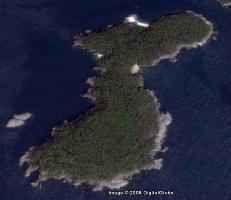
koreaisland.JPGThis map covers North Korea’s agriculture, aviation, cultural locations, manufacturing facilities, railroad, energy infrastructure, politics, sports venues, military establishments, religious facilities, leisure destinations, and national parks. It is continually expanding and undergoing revisions. This is the sixth version.

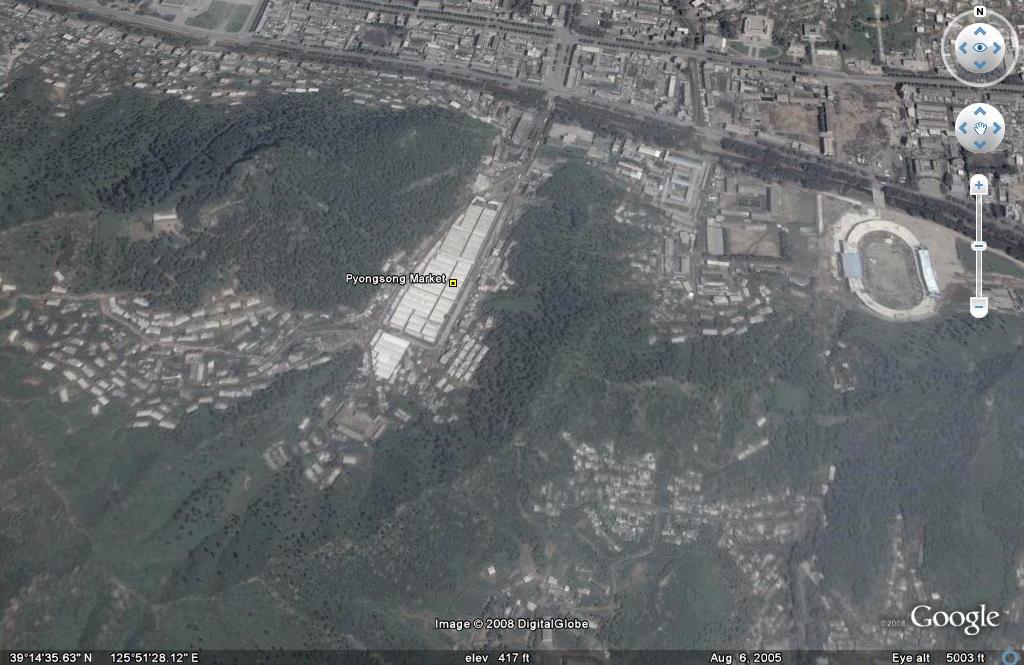
Additions to the latest version of “North Korea Uncovered” include: A Korean War folder featuring overlays of US attacks on the Sui Ho Dam, Yalu Bridge, and Nakwon Munitians Plant (before/after), plus other locations such as the Hoeryong Revolutionary Site, Ponghwa Revolutionary Site, Taechon reactor (overlay), Pyongyang Railway Museum, Kwangmyong Salt Works, Woljong Temple, Sansong Revolutionary Site, Jongbansan Fort and park, Jangsan Cape, Yongbyon House of Culture, Chongsokjong, Lake Yonpung, Nortern Limit Line (NLL), Sinuiju Old Fort Walls, Pyongyang open air market, and confirmed Pyongyang Intranet nodes.

Disclaimer: I cannot vouch for the authenticity of many locations since I have not seen or been to them, but great efforts have been made to check for authenticity. These efforts include pouring over books, maps, conducting interviews, and keeping up with other peoples’ discoveries. In many cases, I have posted sources, though not for all. This is a thorough compilation of lots of material, but I will leave it up to the reader to make up their own minds as to what they see. I cannot catch everything and I welcome contributions.

Share

An affiliate of 38 North