Archive for the ‘Economic reform’ Category

The All-North Korean Pig Farming Sector

Saturday, July 10th, 2010

Accroding to the Daily NK:

The 8th issue of Rimjingang, the periodical written by North Korean underground journalists, sheds light on North Korea’s private livestock industry.

One article, “Livestock Industry Developing from Private Means of Living into Private Enterprise,” describes how pig farming has developed during and since the famine period. It explains how, under the functioning planned economy, the “livestock industry” amounted to each household unit raising pigs to sell on the side, but now the planned economy is little more than a distant memory and the livestock sector has been specialized and systematized into sectors; breeding, butchery, distribution and sale.

That is why in North Korean markets 90% of goods are Chinese, but 100% of pigs and pork is North Korean.

Under the planned economy, roughly 20% of people in rural areas privately raised pigs and sold them to state meat procurement stores for two kilograms of corn per kilo of meat, the report notes. But from the mid 1980s, procurement stores bought them for cash, so competition grew and eventually the stores had to close due to increasing prices and their own lack of ready cash. Since the 1990s, distribution has stopped and more than 50% of people have started raising pigs in more specialized ways, it adds.

The report goes on to explain that during the March of Tribulation people figured out that their salaries, even when received, represented a mere tiny fraction of the labor value they could realize by trading illegally in the jangmadang. Many were unwilling to put up with it.

“Going through the March of Tribulation, the profit motive through the market has opened the door to new food lives which the Leader cannot open with his slogan, ‘reform food lives with meat,’” the report asserts. “Now, since a powerful supply and demand system has been spontaneously established, anybody can afford to eat meat as long as they can earn money.”

“’Leave us alone!’ is the real voice of the people of Chosun,” the report concludes, adding that the phenomenon of the Chosun pig farming industry implies the clear potential to develop modern industry in North Korea.

The 8th edition of Rimjingang was published in Korean on June 30th.

Read the full story here:
The All-North Korean Pig Farming Sector
Daily NK
Yoo Gwan Hee
7/10/2010

Share

Rason news from Germany

Thursday, July 8th, 2010

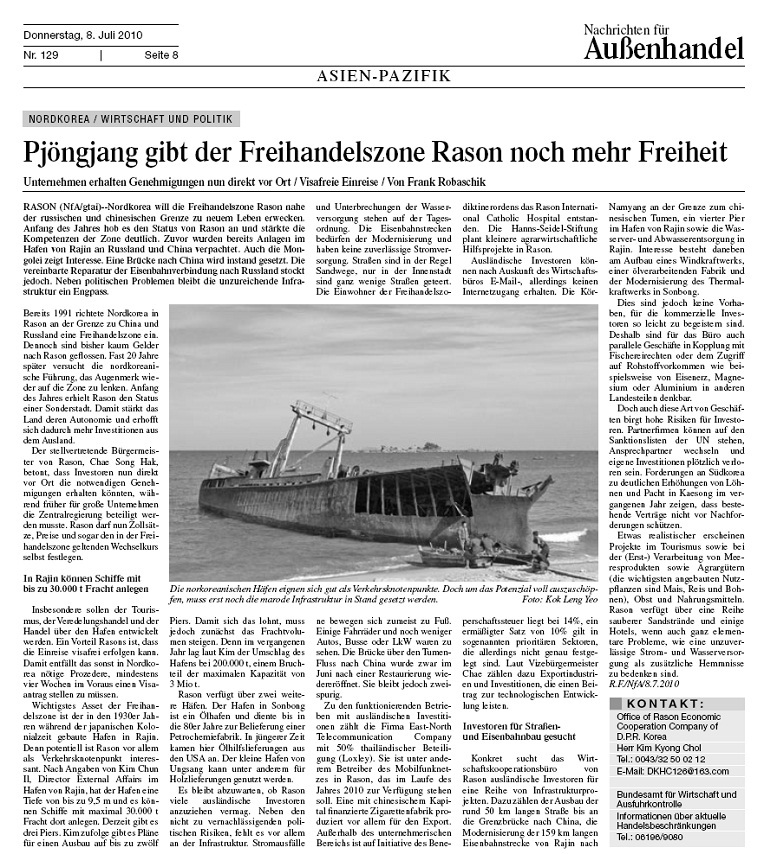
A (much appreciated) reader in Germany sent me an interesting article from the German publication Nachrichten fuer Aussenhandel (News for Foreign Trade), which is a government-sposored daily paper promoting foreign trade. 

The full article is available in German below, but in summary, the Vice Major of Rason, Mr. Chae Song Hak has started an initiative to promote the Rason free trade zone. The zone can be reached visa free and investors can obtain all required permits locally within the zone—without having to involve the central Government in Pyongyang.  Rason also, independently sets duty rates and local prices (I suppose for labour as well as for utility- and other local services) as well as applicable exchange rates within the zone.

If there are any German readers who care to provide a bit more informaiton about this article, I would appreciate it. 

Click image below for full story (in German and in JPG format):

rason-news-for-foreign-trade.jpg

Share

Market prices stable

Thursday, July 8th, 2010

According to the Daily NK:

Food price in North Korea at the end of spring held steady against food prices in March, and worries about an impending famine proved unfounded.

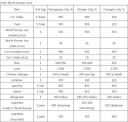
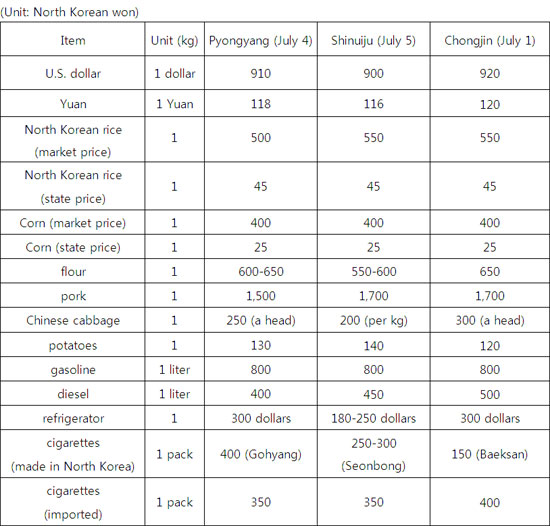
The Daily NK has looked at market food prices in Pyongyang, Shinuiju, and Chongjin over the first week of July. Everywhere, rice cost about 500 won while corn cost about 400 won. Compared to food prices in March, during the period when food is traditionally in the shortest supply, rice prices were much the same, whereas corn prices had risen by 50 percent.

A source inside North Korea explained, “Since the redenomination, some people have dropped from ‘middle income’ to ‘poor.’ As a result, demand for corn has increased, and that is the reason why corn prices have gone up. Some people still eat rice; however, many of those who used to eat rice are now feeding their families on corn.”

“Because of the planting battle, market hours were made shorter, but the market is running smoothly and food prices are stabilizing.”

However, the source conceded that the food security of senior citizens with no family support and homeless children seems to be very bad. The source said some of these people are indeed dying of malnutrition and disease, though not outright starvation.

So, while the food supply situation in North Korea is not in unusually poor shape, it seems that the aftereffects of last year’s redenomination are still taking effect,

Corn prices have increased by almost 100 won on average in the last month, and flour prices have also increased by about 200 won.

However, the price of fuels such as gasoline and diesel either remained the same or decreased slightly. Gasoline remains at 900 won, which is a hundred won less than it was in May. Diesel remains at 400 won, which is 200 hundred won less than it was.

Since last year, North Korea has been pursuing various construction projects as part of its goal of building a strong and prosperous state by 2012. It is possible that fuel heading for construction sites is finding its way into the markets.

Here is the data in JPG format!

2010-7-7-dnk-food-data.jpg

Read the full story here:
Market Prices Holding Firm
Daily NK
http://www.dailynk.com/english/read.php?cataId=nk01500&num=6568
Yang Jung A
7/7/2010
 

Share

10 North Koreans presumably killed in Kaesong bus accident

Wednesday, July 7th, 2010

According to Yonhap:

Ten North Korean workers presumably died and about 40 others were injured last week when two buses carrying them collided with each other at the communist state’s border industrial complex joint run by South Korean firms, officials here said Wednesday.

The collision took place Friday evening at an intersection at the Kaesong industrial park where about 120 South Korean firms employ 42,000 North Koreans to produce labor-intensive goods.

Citing South Korean witnesses, police in the South Korean border city of Paju said that a commuter bus hit another on the side amid heavy rains but no South Koreans were aboard the buses.

“The case was reported by South Korean workers traveling to and from the Kaesong complex,” a police official said, declining to be identified. “The exact number of casualties and how the accident happened have not been ascertained.”

An official at the Unification Ministry, which handles inter-Korean matters, said North Korean authorities blockaded the area after the collision, making it difficult to determine casualties.

“The North would not let us know about the accident,” he said, also declining to be identified.

The factory park is the last remaining symbol of reconciliation between the two Koreas, which remain technically at war after the 1950-53 Korean War ended in a truce rather than a peace treaty.

Its fate has increasingly hung in the balance this year as tensions rise along the inter-Korean border over the deadly March 26 sinking of a South Korean warship off the west coast.

Read the full story here:
10 N. Koreans presumed killed in bus collision at joint factory park with S. Korea
Yonhap
7/7/2010

Share

Life tough in Pyongyang

Tuesday, July 6th, 2010

According to the Daily NK:

The gap between the rich and poor in North Korea is growing as the number of people trying to sell their family home to buy food expands in the aftermath of last November’s currency reforms, according to a source from inside the country.

The source from South Pyongan Province told The Daily NK on Thursday, “An increasing number of homes are being sold to buy food, and now it seems like about two out of every ten people around here have lost their home.”

According to the source, the rich buy up the houses, demolish them and build new ones to sell for a profit. Those who have amassed dollars or Chinese Yuan from trading are now turning to the housing market.

Even in Pyongyang, where the public distribution system continues to function, there are homeless people on the street, according to the source, who added, “When I was in Pyongyang, there were homeless people sleeping in the subway in large numbers.”

The source went on, “People’s lives are very difficult. There are even some who rely on digging up 5kg of wormwood, walking three hours to sell it, and only getting 100 won per kg.”

Currently, 1kg of rice sells for 400 to 500 won in Pyongyang, and 500 to 600 won in other areas.

The source also explained, “While public distribution still functions in Pyongyang, there are strict restrictions on movement, and even with our salaries we can’t buy food because there is too little.”

Since the economy is so bad, the crime rate is also going up, he added, “There are now more and more pick pocketing cases, and these days, they not only use small knives to steal purses, but even tweezers to pick stuff from pockets.”

The source’s assertion that there was public distribution until mid-June contradicts the claim of one NGO, which said that on May 26 the authorities ordered each area to look out for its own food supply. The source, when asked about the decree, said he was unaware of its existence.

Read the full story here:
Life Even Tough in Pyongyang
Daily NK
Kim So Yeol
7/2/2010

Share

Kim Jong Il, the reformer?

Monday, June 28th, 2010

Bradley Martin, author of Under the Loving Care of the Fatherly Leader, writes in the Global Post:

Now that food shortages reportedly have forced North Korea to reverse its crackdown on capitalist-style markets, more systematic reforms for its collapsed economy may not be far behind.

The markets policy reversal came May 26 in directives issued by the cabinet and the ruling Workers’ Party to subordinate organizations, according to a report by the Seoul-based newsletter North Korea Today, which gets its information from officials and ordinary citizens inside the North. “The government cannot take any immediate measures” to relieve a food shortage that is “worse than expected,” the newsletter quoted one of the directives as saying in explanation for the policy change.

The same authorities only late last year decreed a sudden currency revaluation that crippled the “anti-socialist” markets, where stallholders had been trading for individual profit, by confiscating the traders’ wealth. The new decrees bless and deregulate what’s left of the markets, which have shrunk and in some cases closed completely in the interim, in the hope that market trading will keep people from starving. And the directives instruct managers of state-run enterprises to pursue lucrative deals — especially in foreign trade — that could help feed their employees.

This could all turn out to be the big event that finally pushes the very reluctant leadership into a multi-year campaign of serious reforms of the sort that began decades ago in Vietnam and China, according to Felix Abt, a Swiss involved in North Korean joint ventures in pharmaceutical manufacturing and computer software.

“Given an industrial stock and an infrastructure beyond repair, and the impossible task of maintaining a huge army, economic reforms appear unavoidable in the very near future,” Abt, a former president of Pyongyang’s European Business Association, wrote in an email exchange.

“It looks intriguing and it reminds me of Vietnam’s history of reforms,” said Abt, who did business for years in Vietnam before going to Pyongyang and recently has moved back to Vietnam while maintaining his involvement in North Korea.

“The Vietnamese economic situation looked dire at the beginning of the 1980s,” he explained. “Nguyen Van Linh, party secretary in Ho Chi Minh City, favored moderate economic reforms. He tried too early, lost his job and left the political bureau in 1982.

“Le Duan, secretary general of the Communist Party, was categorically against any economic reforms. He died in 1986, the year of the five-year party congress which brought Nguyen Van Linh back and elected him as his successor. The new party secretary general immediately launched the Doi Moi policy — ‘reforms.’”

Abt ventured the lesson that triggering reforms “takes something big like the death of a leading politician” in Vietnam — or, in North Korea, a “ruinous” currency revaluation.

Not every foreigner who has had firsthand economic dealings with North Korea is convinced the recent events constitute that trigger. Some worry that U.S.-led sanctions could nip any flowering of capitalism in the bud.

“The problem is still U.S. Treasury’s attitude,” said one such foreigner, who asked not to be identified further. Treasury Department officials began working several years ago to take North Korea “out of the international banking system,” discouraging trade, he noted.

Some U.S.-sponsored sanctions subsequently were eased in an effort to persuade Kim Jong Il to negotiate away his nuclear weapons capability, but after those talks went nowhere — and especially after North Korea allegedly torpedoed a South Korean warship earlier this year — enthusiasm for compromise cooled. Recent reports say Washington is moving toward aggressively strangling cash flow into the country.

There is also the argument that Kim believes he cannot afford to reform the economy because it would let in information and influences that would undermine his family’s rule by letting his isolated subjects learn that the rival South Korean system works much better.

According to Abt, one answer to both concerns could be China, which “will provide all the support necessary to the DPRK party and government to enable economic reforms without regime change.” He used the abbreviation of Democratic People’s Republic of Korea, the country’s official name. “The DPRK may expect support from other quarters, for example, the European Union, too,” he said.

“I think the dilemma of the leadership — economic upsurge versus the inflow of ‘subversive’ system-destabilizing information and ideas, particularly regarding the South — can be overcome with the necessary Chinese support,” Abt said. “Though the division of Korea can only be compared with that of Germany before 1990, China’s division — capitalist Hong Kong, capitalist Taiwan — was a sort of challenge to Deng Xiaoping and successors, too, but they learnt to manage that quite well.”

Read the full the story here:
Analysis: Kim Jong Il, the reformer?
Global Post
Bradley Martin
6/24/2010

Share

North Koreans hoarding Yuan

Thursday, June 24th, 2010

According to Radio Free Asia:

North Koreans who can afford to save their money are ignoring a new currency brought in by the ruling Workers’ Party in the isolated Stalinist state in favor of the more trusted renminbi yuan from China.

“Our [North Korean] money is now called ‘the commoners’ currency,’ used only as a means of exchange when goods are purchased, but not as a means of saving,” a resident of Chungjin city in the northern province of Hamgyeong said.

“North Koreans [still] hold their savings in Chinese money,” the resident said.

On the country’s black markets—the chief source of essential goods for many under a planned economy in which products are scarce and often monopolized by the country’s elite—any buyer offering to pay in yuan can expect a large discount, residents say.

“Nowadays even children look for Chinese money, knowing that a hefty discount may be available if Chinese money is used in an exchange,” another source said, speaking during a visit to relatives in the northeastern Chinese city of Dandong, which borders North Korea.

The renminbi—known in North Korea simply as “B”—is strongly preferred to the local currency, as it can buy anything, the second source added.

Purported crackdown

North Korean authorities including the state security department claim to be cracking down on the use of the yuan for transactions, he said.

“But because high-ranking officials are the first to hold their savings in Chinese money, the implementation of such crackdowns is half-hearted at best, and mostly ineffective,” the source said.

“North Korean officials won’t even touch the domestic currency.”

Other sources said they fully expect the North Korean currency to collapse once enough yuan are in circulation to fuel the country’s black markets.

“It is obvious that the North Korean currency will collapse once more money enters circulation,” a third North Korean said.

That source, who like the others spoke on condition of anonymity, said the apparent stability in the North Korean currency is an illusion caused by the fact that not enough money is in circulation for it to devalue domestically.

The tight money supply partly results from nonpayment of salaries by the government, the country’s only official employer.

“In Sinuiju, only 25 percent of the people have received their salaries,” the third source said.

“Workers and those employed at manufacturing facilities received the appropriate pay only during the month after the currency reform was implemented, and then started missing paychecks,” the third source said.

Devaluation crisis

The South Korea-based Web site “Daily NK,” which publishes North Korean news, said North Koreans who use domestic currency, rather than Chinese yuan or U.S. dollars, have to pay about 10 percent more for their purchases in open markets.

North Korea issued its revalued won last December, dropping two zeroes off the old won.

At the time, the North Korean central bank put strict limits on the amount of old money that could be exchanged for the new won.

At the old rate, U.S. $1 was equal to 135 North Korean won.

The move sent shockwaves through North Korea, with reports of citizens rushing to black-market moneychangers to cash in their won for more stable U.S. dollars and Chinese yuan.

North Korean citizens were threatened with “merciless punishment” for defiance of the new currency rules and were told they had only a week to exchange a maximum of 100,000 won (U.S. $690 at the official rate, but less than U.S. $40 according to black market rates) per person of the old currency for new bills.

NGOs in Seoul reported that in response to widespread anger, those limits were raised to 150,000 won in cash and 500,000 won in bank notes.

A leading expert on the North Korean economy has said that the economic system is split between the concerns and needs of ordinary North Koreans and the country’s political elite, which runs a “royal palace economy.”

Kim Kwang Jin, visiting researcher with the U.S. Committee for Human Rights in North Korea, said the scale of Kim Jong Il’s “royal palace economy” is in the hundreds of millions of dollars a year, while the much less significant “people’s economy” doesn’t exceed a few million dollars a year.

Read the full story here:
North Koreans Shun New Won
Radio Free Asia
Sung Hwi Moon
6/23/2010

Share

Number of North Korean wokers at Kaesong continue to increase

Thursday, June 24th, 2010

According to the Choson Ilbo:

According to a report by the Ministry of Unification submitted to the National Assembly, there are about 120 companies operating at the complex employing over 44,000 North Koreans.

The number of workers continues to grow from 42,000 in January to 43,000 in April to 44,000 this month, the report said.

Read the full story here:
Number of N.Korean Workers at Kaesong Increases Despite Inter-Korean Tensions
Choson Ilbo
6/24/2010

Share

DPRK abandons food rations, orders self-sufficiency

Thursday, June 17th, 2010

Institute for Far Eastern Studies (IFES)
NK Brief No. 10-06-17-1
6/17/2010
 
As North Korea’s food shortages worsen and reports of starvation continue to grow, the Workers’ Party of Korea have acknowledged the failure of the central food ration program. Since the end of May, the Party has permitted the operation of 24-hour markets, and the regime has ordered the people of the North to provide for themselves.

The human rights organization Good Friends reported this move on June 14. According to Good Friends, the Workers’ Party organization and guidance bureau handed down an order on May 26 titled ‘Relating to Korea’s Current Food Situation’ that allowed markets to stay open and ordered North Koreans to purchase their own food. This order, recognizing that the food shortages in the North have continued to worsen over the last six months, since the failed attempts at currency reform, acknowledged the difficulty of providing government food rations. It calls on those who were receiving rations to now feed themselves, while also calling on the Party, Cabinet, security forces and other relevant government agencies to come up with necessary countermeasures. Now, authorities officially allow the 24-hour operation of markets, something that most had already tacitly permitted, and encourage individuals, even those not working in trading companies, to actively import goods from China.

It has been reported that government food rations to all regions and all classes of society, even to those in Pyongyang, were suspended in April. The last distribution of food was a 20-day supply provided to each North Korean on April 15, the anniversary of the birth of Kim Il Sung. Because of the difficulty of travelling to markets, the suspension of rations caused many in farming communities to starve to death. When Kim Jong Il’s recent visit to China failed to secure expected food aid, the Workers’ Party had no choice but to hand down the ‘May 26 Party Decree’. While the suspension of rations has considerably extended the economic independence of North Korean people, the regime has significantly stepped up other forms of control over society. Public security officers have begun confiscating knives, saws and other potential weapons over 9 centimeters long in an effort to stem murder and other violent crimes. Additionally, state security officials are cracking down on forcefully resettling some residents of the age most likely to defect, while sending to prison those thought to have contacted relatives in South Korea.

According to Daily NK, North Korean security officials are pushing trading companies to continue trading with China, while calling on Chinese businesses to provide food aid. It also appears that North Korean customs inspections along the Tumen River have been considerably eased, and there is no real attempt to identify the origin or intended use of food imported from China. Sinheung Trading Company has asked Chinese partners investing in the North to send flour, corn and other foodstuffs. The Sinheung Trading Company is operated by the Ministry of State Security, and is responsible for earning the ministry foreign capital. It appears that food acquisition is now a matter of national security, as North Korea is expecting South Korea and the rest of the international community to economically isolate the country.

Share

Kaesong firms to ask for emergency funds

Thursday, June 17th, 2010

According ot Yonhap:

South Korean companies at a joint industrial complex in North Korea said Thursday they will ask their government to provide emergency funds, as business conditions worsened amid heightened cross-border tensions triggered by the North’s sinking of a southern warship in March.

The industrial park in the North’s border city of Kaesong, where 110 South Korean factories operate with some 42,000 North Koreans hired, is the last-remaining inter-Korean business project. Its future is thrown into doubt after Seoul officially blamed Pyongyang for torpedoing the 1,200-ton Cheonan on March 26 that killed 46 sailors.

South Korea has taken a series of retaliatory measures, including a ban on most inter-Korean trade and diplomatic efforts to censure the North at the U.N. Security Council.

South Korean companies at the joint complex report a sharp drop in orders amid cross-border tensions.

Earlier in the day, representatives of the South Korean firms held a meeting and decided to ask their government to provide emergency funds and ease border restrictions.

About 800 South Koreans are now working at the Kaesong park.

Read the full story here:
S. Korean firms in Kaesong to ask for emergency funds
Yonhap
6/17/2010

Share