Archive for the ‘Economic reform’ Category

Awareness of outside world growing in DPRK

Tuesday, June 15th, 2010

According to National Public Radio:

Conventional wisdom holds that the people of North Korea are trapped in a world of rigid conformity, totalitarian discipline and complete isolation from the rest of the world.

But increasingly another picture is emerging: North Koreans are far more aware of the outside world, according to evidence provided by North Korean refugees, South Korean humanitarian aid workers, Chinese traders and others.

It is rare for an American to travel to North Korea, and even rarer for an American to spend much time there. Steven Linton has done both.

“In general I think North Koreans are clearly growing in their awareness of the rest of the world. I think there’s no question about that,” Linton says.

Linton has been going to North Korea for many years. He is engaged in a campaign to combat tuberculosis there, and he says North Koreans are soaking up information about the rest of the world.

“One of the most underrated realities about North Korea is its very dynamic relationship with China, and the amount of information that flows across that border. Students; business people; it’s a continuous stream of traffic,” he says.

With that traffic come thousands of DVDs, CDs, cellular telephones, used computers and videotapes — many of them from China and South Korea.

Traders Fill Information Gap

Kim Heung Kwang came to South Korea from the North six years ago and created a group called North Korea Intellectuals Solidarity. He has his own network of people in both Koreas. Kim says market-oriented traders and smugglers in the provinces of China bordering on North Korea are filling the information gap.

He says that many Koreans in China make a living by setting up satellite TVs at their homes to receive South Korean media. Then, they burn CDs and DVDs of the programs and sell them to North Koreans — for a profit, not propaganda.

These media are so prevalent inside North Korea now that knowledge about South Korea has become commonplace, says Yoo Ho-yeol, a professor at Korea University in Seoul. Yoo regularly talks to students and refugees from North Korea.

“They are telling us that those people living along the border area, all of them know well about South Korean society or daily life,” he says.

Groups such as North Korea Intellectuals Solidarity also have managed to send cell phones across the Chinese border, and now thousands of people can call to South Korea, via cell phone systems in China, to provide news of developments inside North Korea. And they can receive text messages, photos and music via cell phones.

It was through channels such as these that news leaked out of North Korea late last year of the disastrous currency reform the government had imposed and widespread resistance to it.

Impossible To Stop Flow Of News

It is still not risk-free to possess these materials. But, says Kim of North Korea Intellectuals Solidarity, while possessing a videotape from South Korea in years past might bring a three-year prison or labor camp sentence, now the materials are so common that local authorities appear to understand they’ve already lost this battle.

“The efforts are ongoing to inspect and collect everything that they can find. But because the demand is so big and the activities are [going on in the] black market, the government is feeling that it is fundamentally impossible to eliminate all sources. So I feel that they are just going through the motion now,” he says.

And there is word of mouth. Humanitarian workers from South Korea who have brought medicine or food to North Korea say simple conversation can be transformative.

Hwang Jae-sung has done agricultural work in North Korea for an aid group from the South called Korean Sharing Movement.

“They saw what we were, and what we do and what we brought. And they go back to [their houses] and they just tell their wives and children and so on. The word spreads, a thousand miles,” Hwang says.

Sanctions Undermine Efforts

Ironically, the policies of the United States can get in the way of the freer flow of information. Some economic sanctions imposed by the U.S. have created problems for the North Korea Intellectuals Solidarity group. It has been sending USB drives that carry books, news articles, music, teaching materials and computer games to North Korea.

But North Koreans need more computers to use them, says Kim, the group’s director.

“The prerequisite for this program is enough computers in North Korea. But there are several regulations in place blocking our efforts. So I think that the United States needs to change its regulations on these matters,” he says.

The number of used computers from South Korea and Japan is enormous. But sanctions make it more difficult to get even these computers and more information into North Korea.

Read the full story and hear audio below:
Awareness Of Outside World Growing In North Korea
National Public Radio
Mike Schuster
6/15/2010

Share

Kaesong Zone update

Monday, June 14th, 2010

According to Barbara Demick at the Los Angeles Times:

The numbers change daily, but as of early this month, 818 South Koreans were still working alongside roughly 43,000 North Koreans. Despite the supposed ban on North Korean products, South Korea recently accepted delivery of 20 tons of peeled garlic as well as $17,000 worth of clothing and $250,000 of electrical sockets.

Lim, who is in touch with many workers and managers, says that on a human level, relations between the Koreans at Kaesong are not as hostile as one might imagine. He paraphrased North Korean bureaucrats whispering to South Koreans, “We hate Lee Myung-bak’s government but not you as people.”

The South Koreans at Kaesong either commute — downtown Seoul is only 30 miles away — or live for up to two weeks at a time in dormitories attached to the factories. There they can watch South Korean television and make telephone calls home, although they have no access to the Internet.

Since the recent crisis erupted, the South Korean government has ordered Kaesong’s factory owners to reduce their staffing, fearful of what might happen if the war of words were to erupt into an actual war.

South Korean Defense Minister Kim Tae-young said during parliamentary committee meetings last month that there was a “a great possibility” that South Korean workers could be taken hostage by the North Koreans.

To South Korean factory owners, the idea is preposterous.

“People who have never been to Kaesong and who are only watching the television news keep asking our employees, ‘Are you guys all right?’ ” said Park Yoon-gyu, president of South Korean menswear manufacturer Fine Renown, which has operated out of Kaesong since 2008.

“We South Koreans and North Koreans have become very close to each other,” he said. “Yesterday’s enemies are today’s friends.”

But a South Korean worker who spoke anonymously to the conservative Chosun Ilbo newspaper gave a less sanguine account of the atmosphere at Kaesong. He said that armed North Korean soldiers had been seen inside the compound, despite rules forbidding their presence.

The man also said that North Korean employees were stealing food, office supplies and toilet paper, and even grass seeds from a newly planted lawn, apparently following official orders to take whatever they could from South Korean companies.

Both North and South Korea have substantial amounts of money at stake in Kaesong, which lies just south of the 38th parallel — where the peninsula was divided at the end of World War II — but changed hands during the Korean War.

Kaesong is home to 120 South Korean factories, each of which required an investment of as much as $8 million, according to scholar Lim. For cash-starved North Korea, Kaesong is one of the dwindling sources of hard currency. The North Korean workers receive monthly salaries of $70 to $80, of which all but about $20 goes to the government.

Even in the crisis, the industrial park could help defuse tensions. South Korea hasn’t followed through on its threat to resume propaganda broadcasts at the DMZ, in part out of concern about what might happen to workers at Kaesong. Loudspeakers have been installed at 11 locations but remain quiet — for now, at least.

As an aside, Paul Romer is trying to push the founding of charter cities as a new strategy of reducing poverty in the developing world.  A brief summary of his work has been published in The Atlantic and is worth a read.

You can read the full Los Angeles Times story here:
For Koreas, business park remains a neutral zone
Los Angeles Times
Barbara Demick and Ju-min Park
6/13/2010

Share

Most DPRK defectors watched ROK media

Monday, June 14th, 2010

According to Yonhap:

More than half of North Korean teenage defectors viewed South Korean movies and dramas when they were in the communist country, a survey said Monday.

According to the survey conducted last month by Yoon Sun-hee, a professor for Hanyang University, 79 of 140 students, or 56 percent, in Hangyeore Middle and High School said they watched South Korean films and TV programs in North Korea.

North Korea reportedly strictly bans its people from viewing South Korean broadcasts and films.

Hangyeore, located in Anseong, 77 kilometers south of Seoul, is a school for North Korean defectors founded in 2006.

Among the respondents, 57 students said they saw South Korean movies on DVD and 43 claimed to have watched videotaped dramas, while 15 watched broadcasts on TV, the survey showed.

It did not say how the students had obtained the South Korean DVDs and videos, or gained access to the broadcasts.

Forty students said they could see the South Korean programs whenever they wanted and five watched them everyday, when asked how often they had seen the banned films.

The survey also showed that 21 teenagers said they had watched the programs once a month, six said once a year, while seven students experienced the South Korean material only once during their lifetimes in North Korea.

According to the survey, most of them said South Korean films and dramas were “interesting,” although they had to view them secretly in the reclusive country.

“It’s hard to make generalizations but the results are surprising,” said Prof. Yoon. “The result itself indicates that North Korea is more open than we expected.”

“The study shows that North Korean teenagers tend to protest against the regime and also enjoy their lives,” she added.

Some 125 respondents were living near the North Korea-China border, while 15 others were living closer inland, including Pyongyang.

Read the full story below:
More than half of young N.K. defectors watched S. Korean TV programs: poll
Yonhap
6/14/2010

Share

RoK further restricts trade with DPRK

Monday, June 14th, 2010

According to Joong Ang Daily:

South Korean goods and services going in or out of North Korea will now have to be approved by the unification minister, according to the ministry yesterday. Trade with the Kaesong Industrial Complex will be the only exception to the rule, which takes effect Monday, the ministry said.

This is a follow-up to South Korea’s decision on May 24 to halt all inter-Korean trade, except that at Kaesong, as punishment for the sinking of the South Korean corvette Cheonan in March, which the South has blamed on the North.

“To effectively implement the government’s decision to halt inter-Korean trade, we revised the rules regarding the approval processes regarding goods and services crossing the inter-Korean border,” said Chun Hae-sung, spokesman for the ministry, in a media briefing.

Until yesterday, items traded with North Korea didn’t need to be individually approved. The report by the Korea Development Institute said the suspension of trade will cost North Korea about $280 million annually.

Read the full article here:
Ministry further restricts trade with North Korea
Joong Ang Daily
6/12/2010

Share

DPRK market price of grains stabilizing

Thursday, June 10th, 2010

According to the Daily NK:

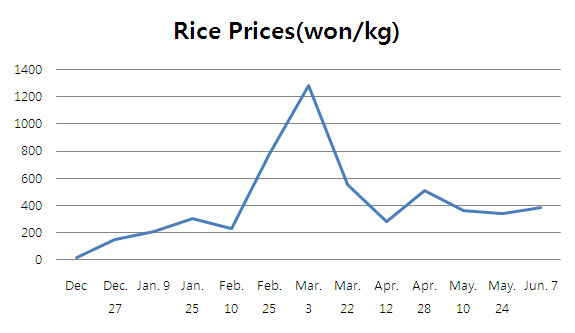
rice-price-6-7-2010.jpg

Today, the North Korean markets seem to have returned to the days before the currency redenomination. The price of rice appears to be rather stable, especially when compared with that of February or March. Especially, following Kim Jong Il’s trip to China, rumors indicating that food would be imported began to circulate, and this has made declining prices even more marked.

According to inside sources, the price of rice in Hoiryeong, North Hamkyung Province is now 480 won per kilo (June 4th), 420 won in Sinuiju (June 7th), 360 won in Sunam-district of Pyongyang (June 2nd), and 380 won in Sariwon (June 7th). The price of corn is approximately 50% that of rice, although recently in Hwanghae Province, households using corn as feed for pigs drove an unusual situation where the corn price reached almost 70% that of rice.

The exact nature of Chinese support for North Korea cannot be confirmed officially, however, the North Korean regime’s encouraging foreign currency earning enterprises to import food from China since March seems to have contributed to rice price stabilization.

One inside source added that the “reactivation of food smuggling on the border between North Korea and China” has also helped.

However, the main overall reason for the failure of the initial prediction, “When the farm hardship period comes in May and June, food prices will skyrocket” appears to have been the normalization of the market.

The source commented, “Compared with the situation prior to the currency redenomination, trading in industrial goods has decreased slightly, however, it is close to its previous condition. Since buyers and sellers can access that market any time, price volatility is not that great anymore.”

That being said, the opening hours of the market have been reduced since the authorities handed down a “rice planting battle order” in early May which stated, “Everyone must participate in the rice planting battle. The market should only be used for the purchase of food, side dishes and those necessities required for the day.”

The source explained, “Markets everywhere now open between 2 and 4 P.M. and close at sunset,” adding that there are small differences depending on the particular market. In North Hamkyung Province, the market normally closes at sunset; however, markets in Hwanghae Province and Pyongan Province, which are under heavier pressure due to the rice planting, close earlier, at around 6 P.M.

But concerns about food will not be solved even if the price of rice remains stable. Merchants are still watching prices with a concerned look since rumors constantly assert that food prices will increase again in July. The North Hamkyung Provincial Party Committee held a cadres meeting last May in which it released news that food distribution for the months from July to October must be prepared by each unit individually, meaning that the central authorities have no plans to assist.

The agricultural situation is one concern. North Korea has been suffering from a severe fertilizer crisis since the beginning of spring farm preparations. After Kim Jong Il’s visit to China, Chinese fertilizer was imported which temporarily alleviated the situation, but the rumor is that fertilizer for the summer has yet to arrive.

Recently, Kim Jong Il visited a domestic fertilizer production facility, Namheung Youth Chemical Works in Anju City, South Pyongan Province. There, he complimented factory management, saying, “It is a relief to know that fertilizer is being produced in Namheung.” The incident displays North Korea’s concerns about fertilizer.

Other factors which destabilize food prices are the icy inter-Korean relationship and international community sanctions.

Recently, around the North Korean market, the number of street vendors, so-called ‘grasshoppers’ has greatly increased. One source explained, “This situation has been caused by the middle class being demoted to the lower classes due to the big damage they incurred during the currency redenomination.”

Sharply decreasing trade in higher priced goods like home appliances and furniture is derived from the same source.

The tumbling credibility of the North Korean currency is another ongoing worry, as is a lack of small denomination bills. One source explained, “If you purchase a 30,000 won jumper from Sungyo Market in Pyongyang, the cost is $30 (market exchange rate, the equivalent of 27,000 won on the day), but it is 30,000 won if you pay in North Korean currency.” That’s a ten percent mark-up for people using local currency, the material representation of a lack of trust in the won.

In areas of Pyongyang, Wonsan, Sariwon, and Haeju, dollars and then Euros are preferred over won, but in Jagang Province, Yangkang Province, and North Hamkyung Province, Yuan are preferable to dollars. Places where all four; U.S. dollars, Yuan, Euros and won are being used are Sinujiu and the port city of Nampo on the west coast. One source explained that due to this situation, high-priced products like televisions, DVD players and refrigerators are being sold only for U.S. dollars or Yuan.

Also, he added, “There is a shortage of small bills which is causing some inconveniences in market trading.”

At the time of the currency redenomination, North Korea displayed 7 kinds of small bills and coins; 1 chon, 5 chon, 10 chon, 50 chon, 1 won, 5 won, and 10 won. The source explained that demand for the ‘chon’ unit coins is practically non-existent; the problem is that 1 won, 5 won, and 10 won are frequently used in market trading but a shortage of bills is causing inconvenience. Merchants are setting the price of goods mostly in increments of 10 won and 50 won as a result.

Read the full story here:
Everything Is Stable, But for How Long?
Daily NK
Park In-ho
6-9-2010

Share

DPRK border guard shoots 3 Chinese

Tuesday, June 8th, 2010

UPDATE 2: According to the Daily NK:

The recent shooting of four Chinese smugglers on the border between North Korea and China by a North Korean border guard was due to a quarrel between the Chinese smugglers and North Korean border guards about an antiques smuggling ring, according to a local trader.

The North Korean border guard shot the four smugglers on June 4th; three were killed and one was wounded. Afterwards, the North Korean authorities apparently issued an apology for the accident to the Dandong municipal government and paid compensation to the victims’ families.

The trader, Kim, who lives in Dandong, reported the details of the shooting accident to The Daily NK earlier this week. The spot where the accident happened was on a boat around Hwanggeumpyeong on Shin Island at the mouth of the Yalu River, he explained, where the facilities of the Shinuiju Shoe Factory are located.

According to Kim, although it was reported in some quarters that the North Korean border guard did not know who was on the boat and fired at it in the dark, in fact, both sides already had close relations.

They were well acquainted with each other thanks to smuggling, Kim said; the North Korean guard had apparently passed several antiques which he had obtained in the North to the Chinese smugglers. However, the Chinese smugglers did not pay for them and severed contacts with him.

The antiques the North Korean guard had procured included rare pieces of white Chosun dynasty china, he said.

After the Chinese smugglers disappeared, the guard tried to find them for a while, but then encountered them by chance while on his patrols.

The guard chased and eventually caught them, then they argued, but the smugglers refused to pay money for the antiques, claiming they were all imitations.

After a while, the smugglers said they would give other goods of equivalent value instead of money and then tried to leave, at which point the guard apparently shot them.

Kim also reported the details of the North’s official response. After the Chinese Ministry of Foreign Affairs released a statement heavily critical of the shooting, the North sent a delegate to Dandong on the 15th to apologize, he explained.

In a meeting with Dandong governmental officials, the North’s delegate reportedly said it happened accidentally, and expressed the North’s sincere apologies for the accident.

The delegate apparently added that the North would restrict shooting towards the Chinese side and suggested that both sides should strengthen their mutual regulations on smuggling. He also paid $3,000 for each death as per the stipulations of a treaty between the two countries.

Kim said, “I thought the compensation was too low, so I asked once again, but their answer was that it is stipulated by the treaty.”

He added, “They promised the Chinese side that the border guard who shot the Chinese would be severely punished on suspicion of smuggling antiques and killing citizens of an allied country.”

UPDATE 1:  According to Reuters:

The isolated North made the effort to soothe China, its sole major economic and political supporter, after North Korean border guards last week shot at the Chinese nationals crossing the river border near the northeast Chinese city of Dandong.

Three were killed and a fourth was wounded.

Chinese Foreign Ministry spokesman Qin Gang said both countries were now “further investigating and handling the case”. He provided no other details.

On Tuesday, the Foreign Ministry made a rare public complaint about its neighbor and now North Korea appears to be seeking to placate Beijing.

North Korean border authorities said an initial investigation showed the incident was an “accident”, China’s official Xinhua news agency reported.

“The North Korean side expressed its grief over the Chinese deaths, and offered condolences to the families of the dead and to the injured, and will severely punish the perpetrators,” said the report.

“The North Korean border security authorities will further investigate this incident and prevent such incidents from recurring.”

ORIGINAL POST: According to the Associated Press:

A North Korean border guard shot and killed three Chinese citizens and wounded a fourth on the countries’ border last week, China said Tuesday after lodging a formal diplomatic protest.

The guard shot the four residents of the northeastern border town of Dandong last Friday, apparently on suspicion they were crossing the border for illegal trade, Foreign Ministry spokesman Qin Gang said.

“On the morning of June 4, some residents of Dandong, in Liaoning province, were shot by a DPRK border guard on suspicion of crossing the border for trade activities, leaving three dead and one injured,” he said at a regularly scheduled news conference. He used the acronym for North Korea’s formal name, the Democratic People’s Republic of Korea.

“China attaches great importance to that and has immediately raised a solemn representation with the DPRK. Now the case is under investigation,” he said.

Dandong is a major shipping point and rail link for goods going into and out of North Korea from China.

Qin did not give any further information. There have been some reports in South Korean media on the incident, though North Korea has not acknowledged the shootings.

And how did the South Koreans react?  According to the Los Angeles Times:

The irony of China’s protest over last week’s shooting was not lost on South Korea.

“This time it is their citizens who are killed, and they show they are not so naive after all about North Korea,” said Kim Tae Jin, a North Korean defector and human rights activist in Seoul. However, he applauded China’s protest of the shooting. China needs to show North Korean leader Kim Jong Il “that he can’t get away with whatever he wants,” Kim said.

China’s public protest is unusual in that relations between China and North Korea are normally shrouded in secrecy, to be discussed only in the politburos of the longtime communist allies.

“It is rare for China to publicly complain. Usually there is a private apology or money paid,” said Kim Heung Gwang, a former North Korean college professor and head of Seoul-based North Korea Intellectuals Solidarity.

The stretch of the Yalu just south of Dandong is frequently trafficked by smugglers, some of them bringing North Korean-made drugs into China or banned Chinese products, such as DVDs or cellphones, into North Korea.

The North Korean government is especially strict about the export of copper, which has been looted from factories, electrical and telecommunications facilities by Northerners desperate for money. But the North’s border guards do not normally shoot to kill — at least not when the smugglers are Chinese.

“Only their own people,” said Kim.

Read the full stories here:
China says NKorean border guard killed 3 Chinese
Associated Press
Tini Tran
6/8/2010

China makes rare public protest against North Korea over killing of 3
Los Angeles Times
Barbara Demick
6/9/2010

North Korea seeks to soothe China over border shootings
Reuters
6/10/2010

Share

Ulrich Kelber interview on recent trip to DPRK

Tuesday, June 8th, 2010

The interview (in German) can be found here. A reader, however, sent in an English version:

Klaus-Martin Meyer: Mr. Kelber, you were recently in North Korea for the first time. Was this trip in what is certainly a totally different world consistent with your expectations?

Ulrich Kelber: Though I prepared myself with both oral and written accounts, there were things, both positive and negative, that surprised me. Among the negative things were the uniformity and control; among the positive were how well educated the people are, and their effort to bring the country forward.

Klaus-Martin Meyer: The political climate of the Korean peninsula is currently more tense than ever. The North Koreans described their version of the fall of Cheonan. How realistic is it?

Ulrich Kelber: I’m not an expert on these sorts of questions, which prevents a very detailed assessment. North Korea’s November threats of retribution alone aroused suspicions. But, in fact, South Korea has to allow questions. Why can’t an independent commission examine the evidence? Why aren’t the survivors permitted to testify publicly?

Klaus-Martin Meyer: In Pyongyang you also visited a German joint venture with the company Nosotek. As a member of the Bundestag, what are your impressions of the working conditions and day-to-day work of software developers in this sector of the North Korean economy? Are you convinced that Nosotek is actually developing for the international market?

Ulrich Kelber: Yes, we saw typical products for the international market, which, as a computer scientist, greatly interested me. The programmers and graphic designers are obviously very highly trained, with technical equipment up to Western standards. One significant exception to this is the lack of internet access in the company itself. Of course, this makes business and customer support more difficult, but isn’t an obstacle for actual software development.

The working conditions were the same as I have seen at German start-ups or in developing countries. No one could comment on the wages, which is also the customary rule in Germany. However, I had the feeling that the employees were part of the middle class, to whatever extent it exists in North Korea.

Klaus-Martin Meyer: How do you rate the opportunities and risks for foreign entrepreneurs in North Korea?

Ulrich Kelber: That’s hard to say after a single visit, but at Nosotek there seems to be little standing in the way of economic success. Possible risks would be the regime further shutting the country off, or wider-reaching sanctions. The well-trained employees, which I also can affirm in other areas such as the trades and agriculture, represent a great opportunity for all businesses.

Klaus-Martin Meyer: As usual in closing, our standard question (not just in interviews about communist countries.) Where do you see North Korea being in five years?

Ulrich Kelber: If the regime doesn’t open up economically, the country will barely progress, in spite of any efforts, for example, to maintain their infrastructure. Even with a little more openness, North Korea could make enormous economic gains, since both infrastructure and well-trained workers are available. The possibility of a political thaw depends both on the ability of the North Korean regime to resolve the succession issue, as well as whether or not South Korea’s hardliners keep calling the shots.

Share

Kaesong firms urged to withhold payment to DPRK entities

Monday, June 7th, 2010

According to KBS:

The Unification Ministry has asked South Korean companies that trade with North Korea to put off paying for goods manufactured in the North.

Ministry spokesman Chun Hae-sung told reporters Monday that the ministry made the request in consideration of sanctions and the suspension of inter-Korean trade following the North’s sinking of the “Cheonan” naval ship.

South Korean companies operating at the Gaeseong Industrial Complex manufacture labor-intensive goods using North Korean manpower.

The South Korean government suspended inter-Korean trade except for production at the Gaeseong complex last month to punish the North after the Cheonan incident.

Read the full story here:
Firms Asked to Put Off Payments to NK
KBS
6/7/2010

Share

Aminex to begin oil exploration in the DPRK

Thursday, June 3rd, 2010

UPDATE 2: According to Yonhap:

North Korea has inked a 10-year contract with British oil and gas company Aminex to explore and extract oil on the seabed off the country’s east coast, the Financial Times (FT) in London reported on June 1.

For the deal, North Korea presented Singapore-registered Chosun Energy as its representative to establish a 50-50 joint venture, Korex, with Aminex, the FT said, noting a filing with Singapore’s Accounting and Corporate Regulatory Authority.

Chosun Energy is an investment holding company operated by North Korea with a paid-up capital of US$1.2 million, according to the newspaper. But the newspaper did not elaborate further details on the company.

Korex will search for oil in an area of 50,681 square kilometers (20,272 square miles) in parts of North Korea’s east coast, Aminex said in a statement.

The contract with the British company, which is listed in London and Dublin, was signed around mid-May in London by officials from the North’s oil company and a head official for Aminex.

“Officials from North Korea’s state oil company traveled to London two weeks ago to conclude the 10-year contract. Lord Alton, chairman of Britain’s parliamentary North Korea group, says he showed the officials around parliament,” the FT added.

North Korea has contacted foreign companies and investors to attract foreign capital for searching for its rich natural resources, including crude oil. In 1997, the North claimed it had reserves of 5 to 40 billion barrels of oil.

North Korea has maintained ties with Animex since 1998. Aminex has been hunting for potential oil reserves in the North Korean portion of the Yellow sea since it signed with the country for joint oil and gas development in January 2005.

UPDATE 1: According to the AFP:

The head of a London-based energy firm that signed a deal to search for oil off North Korea said on Thursday he hoped to start exploring in a year but was closely monitoring tensions on the peninsula.

Aminex PLC executive chairman Brian Hall told AFP he expected “field work in about a year” off the communist nation’s east coast and aimed to “find substantial reserves”.

However, relations on the peninsula have become strained after North Korea was accused of carrying out a torpedo attack on a South Korean warship in March that left 46 sailors dead and stoked fears of an armed conflict.

Pyongyang has denied involvement in the sinking and threatened war in response to a trade suspension and other reprisals by the South.

Asked about the timing of the North Korea contract, Hall said “we have been working with (the) North Koreans for over a decade and an agreement such as the one we have recently signed takes many months to negotiate”.

He added: “Naturally we will keep a very close eye on the tensions on the peninsula, as we have done during previous incidents, but our project is of a long-term nature and well thought through.”

Aminex announced last week that an associate company had signed a 10-year contract with North Korea to search for oil in an area of about 50,681 square kilometres (20,272 square miles) in the Korean East Sea.

Hall declined to give an estimate of the potential deposits.

The contract was signed by Korex — a 50-50 venture between Aminex and Singapore-registered Chosun Energy — and the Korean Oil Exploration Company, the North’s state oil firm.

Victor Shum, an analyst with energy consultancy Purvin and Gertz, said there was every chance that oil would be found in the area but stressed the reserves must be of a significant size in order for exploration to progress further.

“The question is whether any oil reserves that may be discovered there are going to be economically viable to extract,” Singapore-based Shum told AFP.

“I think there has been interest certainly by oil companies so there is therefore a possibility of something there … So far the production isn’t large,” he said.

Aminex, with listings on the London and Irish stock exchanges, describes itself as an upstream oil and gas company with concessions in several countries including the United States, Kenya and Egypt.

According to a filing with Singapore’s Accounting and Corporate Regulatory Authority obtained by AFP, Aminex’s partner Chosun Energy is an investment holding company with a paid-up capital of 1.2 million dollars.

It listed its address as the German Centre in Singapore, a building that hosts small and medium-sized foreign companies, and named three directors — an American, one Briton and a Singaporean.

But staff at the German Centre told AFP the company had moved out.

Singapore is a major financial centre and corporate hub, attracting companies from all over the world because of the ease of doing business and access to funding.

North Korea, one of the world’s most impoverished countries, is starved of energy and foreign exchange after decades of isolation as well as economic sanctions, but is believed by US officials to have up to six nuclear weapons.

South Korea’s ban on most trade with North Korea in response to the ship sinking will cost the communist state hundreds of millions of dollars a year, according to figures from the Seoul-based Korea Development Institute.

ORIGINAL POST: According to the Financial Times:

Aminex, listed in London and Dublin, has formed a company, Korex, to pursue the project jointly with Chosun Energy, a Singapore-listed company that identifies James Passin as one of its directors, according to a filing with Singapore’s Accounting and Corporate Regulatory Authority.

Mr Passin is a New York-based fund manager. His Firebird Global Master Fund II half owns Chosun Energy and targets resource deals in frontier markets.

Officials from North Korea’s state oil company travelled to London two weeks ago to conclude the 10-year contract. Lord Alton, chairman of Britain’s parliamentary North Korea group, says he showed the officials around parliament.

Brian Hall, chairman of Aminex, acknowledged the contract had been concluded at a sensitive time given the rising tensions between Seoul and Pyongyang, but stressed he had opened ties with energy-starved North Korea in 1998. Since then, securing output rights from an exploration block had been “stop-go”.

Additional Information/thoughts: 
1. Here is a previous short post on Aminex.

2. The economics literature overwhelmingly suggests that natural resource windfalls are generally bad news for weak states/developing countries—often fueling corruption, repression, and violence.  The windfall almost never translates into better general working conditions or increases in general income (Botswana being an exception).  There are plenty of papers out there making this point (“Natural Resource Curse”), so feel free to refer to your favorite.

3. I would be weary of building an offshore oil rig in the DPRK.

4.  If oil is discovered in Korea’s East Sea, look for Japan, South Korea, and Russia to begin “drinking from their milkshake”.

Read the full stories here:
Oil firm says N.Korea exploration to start in a year
AFP
Bernice Han
6/2/2010

Anglo-Irish group seeks North Korean oil
Financial Times
Christian Oliver, Kevin Brown
6/1/2010

Share

Impact of the ROK’s May 24 economic sanctions against the DPRK

Monday, May 31st, 2010

Institute for Far Eastern Studies (IFES)
NK Brief No. 10-05-27-1
5/27/2010

On May 24, the South Korean government announced, in response to the Cheonan incident, the cessation of inter-Korean exchanges and other sanctions against Pyongyang. These measures will directly impact the North, costing it 250~300 million USD. According to the Ministry of Unification, North Korea earned 245.19 million USD from inter-Korean cooperative schemes not related to the Kaesong Industrial Complex. This does not include additions monies for customs fees, transportation costs, mediation fees and other incidentals.

About 254 million USD worth of goods were produced on commission in the North after raw materials or partially manufactured products were sent from the South. 10~15 percent of this (25-38 million USD) covers labor and other costs. Therefore, by halting all exchanges and cooperative schemes other than the Kaesong Industrial Complex, North Korea stands to lose at least 200 million USD.

In particular, as the South has banned the import of North Korean sand and marine products, both known to be money-earners for the North’s military, it appears these sanctions have the potential to really pressure Pyongyang. In addition, preventing North Korean ships from using South Korean waters could cost an additional nine million USD. An additional 6 billion won-worth of government-related projects for the North has also been suspended. Ultimately, the cessation of inter-Korean exchange will cost North Korea 250~300 million USD.

The Korea Defense Institute estimates that through inter-Korean projects, tourism, and the Kaesong Industrial Complex, North Korea earned 180 million USD in 2004, but that jumped to 233 million USD in 2005, 341 million in 2006, and 534 million USD in 2007, before falling to 490 million in 2008, and 347 million USD last year.

It appears that the reduction in foreign currency earned by the North has somewhat impacted its economy. Now, the cessation of inter-Korean contacts means further reduction in the North’s access to foreign currency, possibly causing severe shortages of daily necessities because of a lack of trade and insufficient production capacity. If inter-Korean trade ceases, the North can no longer earn foreign capital from Seoul, and this could cause DPRK-PRC trade to drop off, if the North is unable to cover its bills.

It will also cause a loss of jobs for all those North Koreans involved in consignment production, fishing, farming, and other areas of the economy hit by the freeze in trade with the South. As the processing-on-consignment business has reached 30~35 million USD per year, labor involved in the industry nears that of the Kaesong Industrial Complex, and could mean the loss of as many as 40,000 jobs.

While the government has decided to maintain the Kaesong Industrial Complex, it plans to downsize the ROK manpower by 40-50 percent. The reason given is to be able to ensure the safety of the workers, but if the number of workers is cut by 50 percent, this cannot help but have a huge impact on production, raising concerns with North and South Korean employees alike.

Share