Archive for the ‘Economic reform’ Category

Rice price climbing

Tuesday, July 20th, 2010

According to the Daily NK:

The price of rice has exceeded 1,000 won in border areas of North Korea, according to sources.

A source from North Hamkyung Province reported to The Daily NK on Sunday that the rice price had reached 1,050 won in Hoiryeong, 1,000 won in Hyesan and 950 won in Shinuiju.

Another source from Hoiryeong reported on Monday morning, “Rice prices have been going up since July, and they continue to rise steeply. Once rice prices go up, other prices follow suit. It is worrisome.”

The pace of the rises is dramatic. On the 1st of this month, the price hit 500 won, on around the 11th, 750 won, and on the 18th, 1,000 won. In just two weeks, then, it has doubled. If it keeps rising at this speed, it will rise to more than 1,200 won, a price which was also recorded in February this year.

Indeed, one South Korean NGO, People for Successful Corean Reunification (PSCORE), said today that the rice price in Musan, North Hamkyung Province has already hit 1,200 won.

Sources unanimously agree that the cause of the rises is the rising value of the Chinese Yuan.

The North Hamkyung Province source said, “In one week, one Yuan grew to be worth 220 won (from 150 won). That is exactly double the value of the won late last month.” It is also exactly the same rate of increase as rice is experiencing.

The source predicted that, “In short order, one Yuan may be worth 300 won.”

“People are suffering from increasing food prices. Even corn is now 500 won (per kilogram),” he added.

Even though the authorities hope to trumpet economic achievements in the September Delegates’ Conference in order to publicize Kim Jong Eun’s succession, it seems that complaints against the third generation succession as well as rising food prices are increasing.

Sources are watching with keen interest whether the authorities are planning to try and ameliorate the skyrocketing prices.

Read the full story below:
Rice Prices Break Through 1,000 Won
Daily NK
Yoo Gwan Hee
7/19/2010

Share

Kaesong exports to ROK remain constant

Tuesday, July 20th, 2010

According to Yonhap:

The volume of goods brought into South Korea from a joint factory park in North Korea has remained unchanged despite Seoul’s trade ban slapped on Pyongyang in May in retaliation for its deadly attack on a South Korean warship, the government here said Tuesday.

The volume of products transported from the Kaesong industrial park stood at 6,953 tons in June, compared to 7,004 tons a month earlier when South Korea banned trade with North Korea and cut the number of South Korean workers staying in the North Korean border town, the Unification Ministry said in a release.

“There has been little difference in the amount of manufactured products brought in since the May 24 measures,” which the South imposed after a multinational investigation found the North responsible for the March sinking of the Cheonan, it said.

Ministry spokesman Chun Hae-sung said currency conversions for the data were not immediately available.

North Korea has denied any responsibility for the attack in the Yellow Sea that left 46 sailors dead. About 121 South Korean firms operate in Kaesong, employing 44,000 North Korean workers — the last remaining major symbol of detente between the divided countries.

According to the ministry that handles cross-border affairs, the amount of goods brought into South Korea for the first half of this year nearly doubled compared to the same period last year. The figures signaled the Kaesong factory park continued to grow even though the relations between the Koreas have soured since 2008.

But many of the Kaesong companies have complained of falling orders and are seeking rescue funds, arguing the deteriorating political relations are increasingly becoming a liability for their businesses.

Read the full story here:
Influx of goods from inter-Korean factory park stays consistent: gov’t
Yonhap
Sam Kim
7/20/2010

Share

China launches anti-drug smuggling boats on Yalu river

Sunday, July 18th, 2010

By Michael Rank

China has launched a fleet of patrol boats to combat drug trafficking on the North Korean border, a Chinese website reports.

The report shows pictures of the four boats, which are being deployed on a stretch of the Yalu river known as Badaojiang八道江, but gives few details.

The only drug named in the report is opium, which North Korea is reported to produce in large quantities. It says officers warn local people not to become engaged in drug smuggling by showing them pictures of opium and other banned substances.

“The creation of the anti-drugs speedboat force is not just a foundation in the people’s war against drugs, it also increases our strength in banning drugs on the river border and will be a force for us in building a harmonious border and in contributing to a drugs-free border,” an official from the new force is quoted as saying.

A separate Chinese newspaper report names a methamphetamine (known as magu 麻古) as another of the main drugs smuggled between North Korea and China, and says a haul of 13,775 magu pills, seized in winter 2004, was the largest amount of drugs ever confiscated by Dandong border guards. It says smuggling reached a peak in the years 2000-2006 and gives little information about the current situation, probably because this is politically too sensitive.

But it does mention the killing of three Chinese smugglers by North Korean border guards in June, and says the dead men were members of a gang led by a man known as Sun Laoer who controls much of the smuggling on one particular stretch of the Yalu. One man was injured in the incident, for which China demanded an apology. North Korea said it was “an accident”, while according to a Chinese television report the North Koreans suspected the smugglers of being South Korean spies.

The Chinese newspaper report says the main goods smuggled between China and North Korea are drugs, scrap metal, cigarettes, DVDs, chemicals and secondhand cars.

The most notorious gang was led by an individual called Jiang Weijia, who specialised in smuggling cigarettes and oil products from North Korea into China. Between June and December 1999 Jiang smuggled 45.8 million yuan worth of cigarettes. The gang was finally smashed in 2003.

The article in Southern Weekend, one of China’s more adventurous newspapers, also mentions human trafficking across the border. It says that “in 1996 you could exchange 50 jin [25 kg] of rice for a Korean daughter-in-law” and adds that the women had to pretend to be deaf and dumb since if they opened their mouths and were found to be from North Korea they would be sent straight back.

It notes that “world opinion suspects that North Korean government departments are covertly involved in smuggling on the Chinese-North Korean border, the reason being that in a country where power is highly concentrated, it would otherwise be almost impossible for large-scale smuggling to take place on the Yalu river border. But despite such suspicions, there is no complete proof.”

The report recalls how in the 1990s North Koreans, in the wake of the famine, would exchange scrap copper for rice at a rate of one kg of metal for one kg of rice and that many North Korean factories were stripped bare of all their metal fittings.

It also recalls how in the 1960s North Korea was richer than China, which suffered through years of Mao-induced famine, and people from Dandong would cross the Yalu at night in search of food.

“This shouldn’t be called smuggling, should it. People were bartering for food in order to survive,” it quotes one man as saying. It quotes another man as saying the border was largely unguarded until recently and when he was a boy (in the 1990s apparently) he would cross the frozen river in winter and North Korean guards would give him sweets.

The report says border trade with North Korea stopped during the Korean war, was revived in 1958 and faded during the Cultural Revolution of the late 1960s and 70s. It was officially revived in September 1981 with an agreement between China’s Liaoning province and North Korea’s Pyeong’an Bakdo. Most of the trade from the early 1980s consisted of China bartering oil for fish.

The article says China-Korean smuggling goes back centuries, and in the 1930s an area of Dandong near the river called Shahezi 沙河子 was a famous smuggling centre under the Japanese. It also says a Qing dynasty customs office has been restored in Jiuliancheng 九连城, some 20 km from Dandong, and the area remains a smuggling centre.

North Korea has been widely reported to be a significant producer of illicit drugs. The CIA World Factbook notes  that for years, from the 1970s into the 2000s, citizens of North Korea, many of them diplomats, were apprehended abroad while trafficking in narcotics and police investigations in Taiwan and Japan in recent years have linked North Korea to large illicit shipments of heroin and methamphetamine, including an attempt by the North Korean merchant ship Pong Su to deliver 150 kg of heroin to Australia in April 2003.

In 2004 the Jamestown Foundation published a report by a North Korean defector who says he “learned of and witnessed first-hand the drug trafficking activities of the North Korean regime” when he worked for the North Korean National Security Agency from 1983 until 1998.

Share

First real estate auction held in Kaesong Industrial Complex

Sunday, July 18th, 2010

Institute for Far Eastern Studies (IFES)
NK Brief No.10-07-15-3
2010-07-15

A real estate auction was held in the Kaesong Industrial Complex for the first time since the joint inter-Korean project was launched. According to the Kaesong Industrial District Development Committee, factory plots (20,472.7 ㎡) in the stage-1 area of the KIC were being auctioned off on July 12. A government source stated, “Land in the KIC has been sold before, but this is the first I know of land rights being auctioned off.”

The company currently on the plot was awarded land rights and permission to build a factory after signing a contract with the North Korean Central Special Development Guidance Bureau. The land rights being auctioned off run until April 12, 2054. It is not known why the land rights are being auctioned off, but it appears that the company currently holding rights to the plot have some financial difficulties, forcing them to sell.

The rights are estimated to be worth more than 1.37 billion won, and the auction is set to close on the 23rd of July. The sale is being handled by the Kaesong Industrial District Management Committee. The committee is handling the sale in accordance with the rules set forth on May 10 by the KIC real estate management office. These rules established a seven-member committee of lawyers and other specialists to handle the auction and sale of real estate within the industrial complex.

After the sinking of the ROK warship Cheonan, Seoul authorized more flexible management of South Korean workers in the KIC in order to help companies avoid financial losses in the complex. The government also increased the amount of the inter-Korean cooperation fund from 50 trillion to 60 trillion won in order to ease financial concerns of South Korean companies operating joint ventures, and announced that loans to 183 companies involved in processing-on-commission, as well as 530 other trading companies, would be made at 2 percent.

This move by the government highlights the fact that South Korean companies in the KIC continue to tread on rocky financial footing, despite the announcement by the Ministry of Unification that emergency management stability funds would be made available.

Following the sinking of the Cheonan, the number of South Korea workers in the KIC on any given weekday was reduced from more than 1000 to around 500, and this has caused companies to produce less, have higher costs, and see lower buyer interest. While Seoul tries to keep the industrial complex open, it is also looking into the laws on the Mount Keumgang tourism project, seeking ways to aggressively assist companies involved in the joint scheme.

Share

Former DPRK railway minister reportedly executed

Thursday, July 15th, 2010

According to Breitbart (via Breitbart):

Former North Korean Railways Minister Kim Yong Sam was executed in March last year for failing to maintain locomotive trains that had been in store for wartime, Radio Free Asia, a nonprofit radio station, reported Wednesday on its Internet edition.

A source on North Korean affairs said Kim got into trouble during an inspection by the National Defense Commission for scrapping locomotive trains that were in store for wartime.

After the inspection, carried out after celebrations were held to mark the country’s 60th birthday on Sept. 9, 2008, Kim was handed over to the State Security Department, report said.

He had been railways minister for 10 years from September, 1998.

The Choson Ilbo has more:

A nationwide campaign is underway recently in North Korea to get rid of photos and publications of executed former senior officials, Radio Free Asia claimed Tuesday.

This campaign was ordered by leader Kim Jong-il on July 2. The North’s Press Censorship Bureau is reportedly destroying documents and materials collected from across the country.

According to RFA, the campaign’s targets include Pak Nam-gi, the former director of the North Korean Workers Party’s Planning and Finance Department who was executed in March over the disastrous currency reform, and former railways minister Kim Yong-sam.

“Railway workers suffering from the food shortage stole copper and aluminum parts from locomotive trains that were in store for wartime and sold them as scrap metal. As a result, about 100 locomotives were scrapped,” it claimed. “This was revealed in an inspection by the National Defense Commission in 2008.” Kim Yong-sam was then taken to the State Security Department and executed in March the following year, it added.

Kim Yong-sam was appointed railways minister in September 1998 but has not been seen in public since October 2008, when he was replaced by current minister Jon Kil-su.

A Unification Ministry official said rumors about his execution are “rampant.”

Read the full stories here:
Former N. Korean railways minister Kim Yong Sam executed: report
Kyodo (via Breitbart)
7/14/2010

N.Korea’s Ex-Railways Minister Executed
Choson Ilbo
7/15/2010

Share

Food price update

Wednesday, July 14th, 2010

According to the Daily NK:

As previously reported, the price of rice in North Korea, which declined in March, has started soaring again. But this rice price fluctuation looks different from those of previous years.

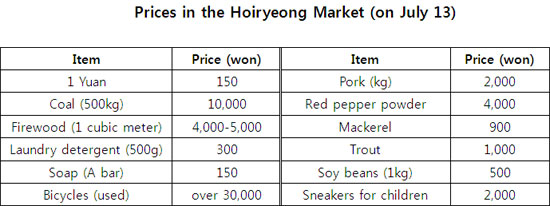
According to a source from North Hamkyung Province, rice in Hoiryeong market was between 450 and 500 won per kilogram until late June, but on July 13th it hit 750 won. Corn rice is also more than 400 won now.

At the same time, one Yuan is now worth 150 won.

Since the mid-2000s when the market economy started to spread, rice prices have risen during the spring poverty season in April and May. And then, in around late June, when potatoes and barley are harvested, prices stabilize, and then, in September, they decline in expectation of the harvest.

Therefore, traders in the jangmadang generally buy rice and other grains in November and December and then sell them in the jangmadang during April. Cadres also use that regular cycle of food price rises and falls to profit by buying rice late in the year and releasing it for a higher prices during the next spring. Therefore, poorer people also try to get rice and grain in winter time.

However, since the currency redenomination, the fluctuations have changed.

Immediately after the redenomination, the authorities released a measure shutting down the markets, so in January rice prices rose by around 60 times compared with before the redenomination. The markets have been open once again since February 5th, but food prices remained unstable through mid-March. That was because people did not buy grains until March, at which time demand promptly far outstripped supply.

In April this year, there was a limited amount of food distribution and some residents in some districts of Pyongyang received corn, which they were supposed to receive in May and June, in advance. Additionally, as a result of Kim Jong Il’s visit to China, rumor had it that a large amount of food would be delivered, so rice prices were relatively flat.

However, when the rumor turned out to be empty, a decree was handed down to lower units in May ordering food self-reliance at the local level. This only intensified anxiety about the food situation.

More serious problems may come in July and August, monsoon season. If the weather affects farming, anxiety about food for the last half of the year will grow. Make things worse, there was cold-weather damage to farming early this year, so a lost harvest is clearly going to be on people’s minds.

On this, one source said, “Food wholesalers predict that prices will go on rising until the harvest in August. And when rising food prices influence general products, big troubles can come, like they did in January of this year.”

dnk-hoeryong-mkt-prices-7-13-2010.jpg


Click image to see Hoeryong market prices.

Read the full story here:
Food Price Cycle Twisting in the Wind
Daily NK
Yoo Gwan Hee
7/13/2010

Share

DPRK-PRC trade up 18.1% from January to May 2010

Tuesday, July 13th, 2010

Institute for Far Eastern Studies (IFES)
NK Brief No.10-07-08-2
7-8-2010

As inter-Korean commerce has all but dried up in the wake of the Cheonan incident, trade between North Korea and China appears to have continued to grow. According to Chinese customs statistics released on July 6, trade with North Korea from January to May amounted to 983.63 million USD; 18.1 percent more than the 833.07 million USD reported for the same period last year.

North Korea imported 727.192 million USD-worth of Chinese goods (29 percent increase over the same period last year), but exports dropped by 4.9 percent, amounting to only 256.438 million USD. This indicates a 60 percent increase in North Korea’s trade deficit with China, which was 470.757 million USD in the first part of 2009. With South Korean sanctions against the North halting all inter-Korean trade outside of the Kaesong Industrial Complex following the sinking of the Cheonan, it is expected that Pyongyang will become even more economically dependent on Beijing.

During this period, crude oil accounted for most of North Korea’s imports from China, as Pyongyang bought 254,000 tons (slightly more than the 247,000 tons in early 2009). However, due to rising international fuel prices, this oil cost the North 157.097 million USD, a 76 percent increase over what Pyongyang spent during this period last year.

In addition, rice (24,400 tons), corn (31,400 tons), beans (20,500 tons), flour (34,000 tons) and other necessary food imports totaling 11,300 tons reflected a 41 percent increase over the same period in 2009. The cost of fertilizer imports also jumped sharply, amounting to 81,943 tons, or 115.6 percent more than the 38,004 tons imported from January to May 2009. Increasing imports of food and fertilizer are a result of the growing agricultural difficulties being faced in the North. Based on current prices, aviation fuel imports also grew by 46.8 percent, freight trucks by 98.7 percent, automobile fuel by 47.4 percent, and bituminous coal by 137 percent.

The top ten official imports of Chinese goods by North Korea were as follows: crude oil (21.6 percent); aviation fuel (3.1 percent); freight trucks (2.9 percent); automobile fuel (2 percent); bituminous coal (1.9 percent); fertilizer (1.8 percent); beans (1.6 percent); flour (1.6 percent); rice (1.5 percent); and corn (1.1 percent).

North Korea’s exports to China were mainly underground natural resources. The top ten exported goods were: iron ore (17.1 percent); anthracite (16 percent); pig iron (9.6 percent); zinc (5 percent); Magnesite (3.6 percent); lead (2.4 percent); silicon (2.3 percent); men’s clothing (2.2 percent); frozen squid (2.1 percent); and aluminum (1.9 percent).

Share

KPA discipline along the Chinese Border

Tuesday, July 13th, 2010

According to the Telegraph:

Previously considered to be among the regime’s most important assets, the North Korean People’s Army has always been well provisioned in order to ensure the troops remain loyal.

But a poor harvest and the disastrous revaluation of the North Korean currency in November of last year has worsened the nation’s already dire economic straits.

Defectors have claimed that they were required to survive on noodles made of ground corn and that meat or fish were a luxury, a journalist for Japan’s Asahi Shimbun reported from the Chinese  city of Shenyang.

On one stretch of the border, Chinese troops apprehended five North Korean soldiers in May alone. Prior to the sinking of the South Korean corvette Cheonan in March, allegedly by a torpedo fired from a North Korean submarine, it was rare for troops to be taken into custody on the Chinese side of the Yalu River.

The defectors have claimed that senior members of the party and the armed forces were stockpiling provisions, another indication that the regime is steeling itself for a military confrontation.

“In the past there have been cases of North Korean troops crossing the border and plundering Chinese farms for their food, which they then took back to their posts in the North,” Kim Sang-hun, a human rights activist in Seoul, told The Daily Telegraph.

However, these soldiers chose to return to the North with the supplies.

Robert Dujarric, a professor of international relations specialising in North-East Asia, said the situation in North Korea was “very bad” at present, due to the poor harvest, but a more dramatic indicator of the scale of the problem would be if military officers or members of elite military units opted to follow in the footsteps of these soldiers.

The defectors apprehended by the Chinese were reportedly returned to North Korea, where they face execution.

Read the full story here:
North Korean soldiers defect to China fuelling fears of imminent military clash
Telegraph
Julian Ryall
7/12/2010

Share

Kaesong output declines

Tuesday, July 13th, 2010

According to Yonhap:

Production at a South Korea-financed factory park in North Korea fell for a second straight month in May, figures showed Tuesday, as manufacturers complained of a decrease in orders amid tension between the divided states.

Production at the joint complex in the North Korean border city of Kaesong stood at US$27.79 million in May, a 1.2 percent decrease from a month earlier, according to the Unification Ministry in Seoul.

The number, however, marked a 56 percent increase from a year earlier, the ministry said, a sign that the complex is expanding on a yearly basis.

Despite the deadly March sinking of a South Korean warship, which was blamed on North Korea and ignited the ensuing tension along the border, the number of North Korean workers in the complex topped 44,000 recently. More than 120 South Korean companies employ the workers to produce labor-intensive goods such as utensils and garments.

The companies have recently called on the Seoul government to ease its restrictions on their operations, including a cap on the number of South Korean workers allowed to travel to Kaesong daily.

South Korea has also banned the companies from new investments in their businesses within the complex, which opened in 2004 and represents the last remaining major symbol of reconciliation between the Koreas.

According to Yonhap:
Output at inter-Korean factory park declines for second month
Yonhap
7/13/2010

Share

Creditors cut off Hyundai Asan

Sunday, July 11th, 2010

According to the Economic Times of India:

Creditors stopped providing new loans Thursday to South Korea’s troubled Hyundai Group, which runs a shipping line and major business projects in North Korea, officials said.

Nine of the group’s 12 units will receive no fresh loans “until the group accepts our demands”, said a spokesman for Korea Exchange Bank, the largest of 13 creditors.

The decision does not affect Hyundai’s better-known operations such as automaking and shipbuilding, which were hived off from the original group into financially separate businesses after the 1997-98 financial crisis.

The Hyundai Group includes the country’s biggest bulk carrier Hyundai Merchant Marine and Hyundai Asan, which operates the troubled projects in the North.

The group was picked by creditors in May as a financially distressed conglomerate. But it has refused to sign a deal to sell non-core assets to reduce debts, insisting its financial health is improving.

Debt piled up last year as Hyundai Merchant Marine suffered heavy losses due to the global business slump. However the shipping line posted 154 billion won (126 million dollars) in operating profit in the second quarter of this year.

“Creditors have ignored our position that such a deal will weaken our competitiveness at a time when the group is improving its financial structure,” a group spokeswoman said, without giving total debt figures.

Hyundai, once South Korea’s largest business empire, has been dowgraded to a second-tier conglomerate since its automaking and shipbuilding arms were hived off in 2000 and 2002.

Hyundai Asan’s projects in North Korea, including the Mount Kumgang tourist resort, have been in trouble since a conservative government took office in Seoul in early 2008.

The Kumgang tours were suspended in July 2008 after North Korean soldiers shot dead a Seoul housewife who strayed into a military zone, causing losses to the South Korean company of tens of millions of dollars.

A day trip from the South to the North’s historic city of Kaesong was later also suspended.

Hyundai Asan also operates a jointly-run industrial estate in the North whose operations have sometimes been hit by political tensions.

Read the full story here:
S Korean banks end new loans to Hyundai Group
Economic Times
7/8/2010

Share
