Archive for the ‘Economic reform’ Category

Chinese investment blurb

Monday, August 23rd, 2010

According to an article in the Korea Times:

Approximately 100 small Chinese companies out of 150 that have investments in North Korea are based in Jilin and Liaoning Provinces near the northeastern border with the North.

Read the full story here:
Investments in NK limit China’s policy choices
Korea Times
Kang Hyun-kyung
8/20/2010

Share

Pak Pong-ju rehabilitated

Saturday, August 21st, 2010

According to Yonhap:

North Korea’s former Premier Pak Pong-ju appears to have returned to power with the Workers’ Party, more than three years after he was ousted due to his economic reform drive, according to a Pyongyang broadcast report on Saturday.

The North’s Korean Central Broadcasting Station introduced Pak as the “first deputy director of the Central Committee of the Workers’ Party of Korea,” reporting on the 50th foundation ceremony of Pyongyang’s flagship Okryu Restaurant held Friday with a number of senior officials and workers.

There is no other known figure with the same name among the North Korean power-holding elite.

Pak, a long-time industry technocrat and pragmatist, was named premier of the North’s Cabinet in September 2003. He spearheaded the North’s so-called July 1st Economic Measure reform drive toward market economy, which aimed to give more autonomy to state firms and gradually reduce state rationing of food and daily necessities.

But his strong initiative triggered a backlash from the party and the military that resulted in his dismissal. Pak was suspended from duty in June 2006 on charges of fund apprehension and was fired in April the following year. Kim Yong-il, then land and marine transport minister, replaced him.

Pak is believed to have been demoted to a managerial post at a clothing factory outside Pyongyang.

Cho Myung-chul, a senior researcher at the Korea Institute for International Economic Policy who has defected from North Korea, viewed Pak’s reinstatement as a signal of a shifting North Korean economic policy toward pragmatism, following its failed currency reform last year.

“Pak is an emblematic figure of the July 1st Economic Measure that promoted pragmatism. His reinstatement could be connected with an economic policy shift back to pragmatism after the anti-market currency reform failed.”

In a bid to curb the burgeoning merchant class and strengthen its socialist system, North Korea implemented a surprise currency reform in November, knocking two zeros off its denominations. But the move backfired, worsening food shortages and triggering social unrest.

Apparently taking responsibility for the botched reform, Premier Kim Yong-il was replaced by Choe Yong-rim in June.

The broadcast report on Saturday did not specify which department of the Workers’ Party Pak joined, but it is likely that he was posted to the light industry department, considering the ceremony involving a restaurant and the fact that he was the department’s first deputy director in 1993.

Pak is believed to be a close confidante to Jang Song-thaek, vice chairman of the National Defense Commission and brother-in-law of North Korean leader Kim Jong-il. Jang is seen as the central figure in grooming Kim’s third and youngest son, Jong-un, as the next leader.

Japan’s Mainichi Shimbun reported on Aug. 15, quoting multiple sources, that Pak and about 20 other figures close to Jang had been reinstated within the past two years. The report also said Pak has risen to the second highest spot in the party’s light industry department, which is headed by Kim Kyong-hui, Kim Jong-il’s sister and Jang’s wife.

According to the New York Times:

He is the latest among senior North Korean officials whose sudden banishment and equally unexpected reinstatement have sparked outside speculation about Mr. Kim’s intentions. Mr. Pak appeared to have fallen from Mr. Kim’s favor when he was fired from the premiership in 2007 and sent to work as a factory manager in a provincial town.

“His reinstatement could signal the return of pragmatists and reformists,” said Cheong Seong-chang, a North Korea analyst in the Sejong Institute south of Seoul. “We may be able to see him push the economic reform and openness he had once championed.”

Analysts in Seoul say that few North Korean officials wield much individual influence in Mr. Kim’s government. But they say that they can infer Mr. Kim’s plans from the way he punishes and rewards officials identified with various policy approaches.

“Pak’s reinstatement indicates that North Korea is shifting back to market reforms, even if grudgingly, after its botched attempt to re-enforce state control on the economy,” said Baek Seung-joo, the head of North Korea research at the government-financed Korea Institute for Defense Analyses in Seoul.

Mr. Pak, a lifetime technocrat, was best known as the architect of “Measures to Improve Economic Management Order.” Issued on July 1, 2002, they indirectly acknowledged the failure of the North’s ration system by instructing factories, collective farms and other economic units to provide their own daily necessities and give incentives for workers.

In September 2003 Mr. Pak was made prime minister, a post in charge of carrying out economic policies.

His reforms were necessitated by the collapse of the centrally planned economy after a famine in the mid-1990s. But they also coincided with — and fueled — the spread of private markets, which quickly emerged as a key source of food and other necessities for North Koreans.

But Mr. Pak’s reform programs irked the government’s old guard, especially in the hard-line military, which had grabbed the lion’s share in trade under the old system. The markets facilitated the influx of DVDs and other smuggled goods the government considered a capitalist threat.

Around 2005, North Korea began controlling markets. Its attempt to reinforce state control on the economy peaked late last year when it replaced its banknotes with a new currency, shut down markets and ordered people to buy goods only from state-run stores. The currency reform was aimed at stifling the markets by drastically reducing traders’ personal wealth in the old currency.

The moves quickly backfired. Inflation surged as traders hoarded their goods and government stores failed to meet demand. Sporadic protests were reported. Earlier this year, Pak Nam-gi, head of finance and planning who led the failed currency reform, was executed, according to South Korean news reports. North Korean markets began coming back to life, according to recent defectors.

Pak Pong-ju, the former prime minister, returns as North Korea prepares for a party caucus early next month. Officials and analysts in Seoul say they will monitor the meeting for changes in the cabinet and party leadership that might provide clues to Mr. Kim’s plans to hand over power to his third son, Kim Jong-un, who is in his late 20s.

Mr. Pak’s reinstatement adds to the growing influence of Jang Song-taek, Mr. Kim’s brother-in-law, said Mr. Baek, the researcher.

In June, Mr. Kim presided over a session of the rubber-stamp Supreme People’s Assembly where Mr. Jang, a potential caretaker for his son, was elevated to the No. 2 post in the ruling hierarchy. In the same meeting, Mr. Pak’s successor as prime minister, Kim Yong-il, who reportedly made a rare apology in February for the botched currency reform, was fired.

Mr. Pak, as first deputy director, is believed to report directly to Kim Kyong-hee, Mr. Kim’s younger sister and Mr. Jang’s wife, who works as party director in charge of the North’s light industries, Mr. Cheong said.

Read the full stories here:
N. Korean ex-PM Pak Pong-ju appears to be back in power
Yonhap
8/21/2010

North Korea Reinstates Market-Oriented Official
New York Times
Choe Sang-hun
8/23/2010

Share

Sinuiju Markets bustling

Thursday, August 19th, 2010

According to the Choson Ilbo:

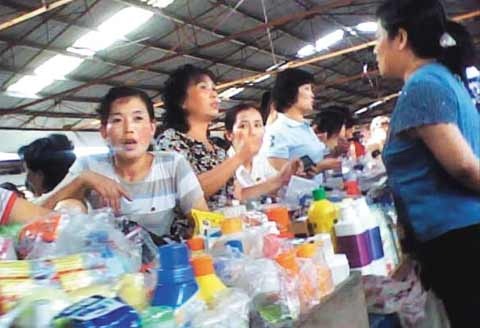
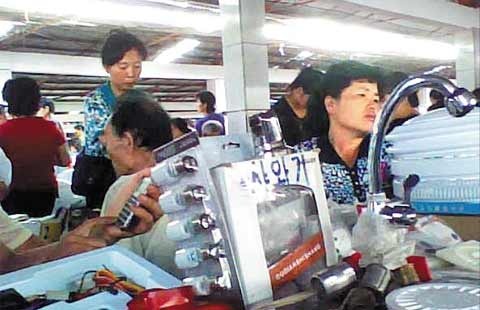
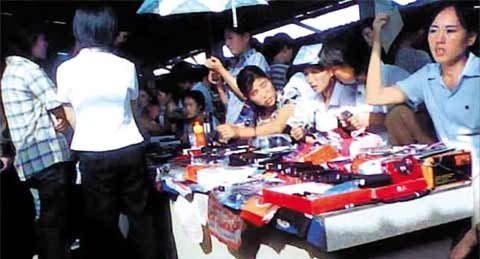
North Korea’s markets appear to be coming to life again after a botched currency reform late last year laid waste to them. Footage obtained by the Chosun Ilbo’s Northeast Asia Research Institute from a North Korean source on Wednesday shows the Chaeha market in the border town of Sinuiju early this month bustling with trade. “The sprawling Chaeha market was set up in 2003 and is located in a wealthy neighborhood along the trade route with China,” the source said.

Images taken in March of a market in Onsong released by the Chosun Ilbo in April showed most of the stalls empty, but the market in Sinuiju is now overflowing with sundries, clothes, hardware, fruits and food.

Lack of State Control

The market is bustling with traders and customers. North Korean security agents used to patrol the markets before the currency reform, but none are to be seen in the video. The only semblance of state control is an official wearing an armband that reads “administrator” walking quietly past the vendors.

According to sources in North Korea, markets in the country were practically deserted until May, but the situation began to change in June. Now business is booming. Sources say the authorities have virtually stopped trying to control the markets after former premier Kim Yong-il apologized for the failed currency reform and Park Nam-gi, the former director of the North Korean Workers Party’s Planning and Finance Department, was executed.

North Koreans apparently protested vehemently when the government failed to provide food following the currency debacle and demanded they be allowed to buy and sell goods in the markets. These days, the traders apparently hurl abuse at any security agents attempting to crack down. A South Korean intelligence source said, “It looks like North Korean authorities have given up their fight against the markets again.”

Clandestine S.Korean Products

Chinese products stacked on the shelves range from plastic basins, porcelain dishes and thermos bottles to cosmetics, electric fans, rice cookers and even motorcycle helmets.

But the scene is quite different behind the stalls. The source who provided the footage said, “Vendors openly sell Chinese products, but they sell South Korean goods under the table.” “Cuckoo rice cookers, Samsung Anycall mobile phones and LG TV sets are very popular,” the source said. “South Korean clothes are brought in with their labels removed, but wealthier people prefer South Korean clothes over Chinese ones.”

The source said a large market which sells only South Korean products has also formed in the Chinese city of Dandong just across the Apnok (or Yalu) River.

The situation is apparently the same in other North Korean markets. One North Korean defector who used to sell goods at an open-air market in North Hamgyong Province, said, “We display Chinese cosmetics but tell customers we also have South Korean ones. When a customer wants South Korean cosmetics, we take them out from under the table and sell them in the backroom.”

The traders sell South Korean products because they fetch a handsome profit. “Chinese products usually have a set price tag and consumers try to haggle, but South Korean products go for a premium and there’s no haggling over prices, because they are considered top-notch products,” the source said.

South Korean DVDs and music CDs are also in high demand. North Korean movies and CDs, are on display, but the latest South Korean soap operas and American action movies are freely available under the table, according to the defector.

I am glad to see that market life in Sinuiju is bustling, but I do not believe this demonstrates how market activity has recovered in places like Onsong.  Sinuiju handles the bulk of the China/DPRK trade and wholesalers from across the country go there to do business.  I would like to see some current footage of market activity in Onsong and other “remote” places (i.e not Phyongsong, Hamhung, Chongjin, or Sinuiju) to have a better idea of how conditions have bounced back.

I believe this is the location of the Chaeha Market, but I am only guessing.  If you have a better idea, please let me know.

Read the full story here:
Footage Shows N.Korean Markets Bustling Again
Choson Ilbo
8/19/2010

Share

Pyongyang International Trade Fair (Sept 2010)

Wednesday, August 18th, 2010

Information can be found on the European Business Association web page.

General information here (PDF).

Registration information here (PDF).

Share

GPI September business delegation to DPRK

Wednesday, August 18th, 2010

According to the GPI web page (PDF):

Exploring new business opportunities
European trade & investment mission to North-Korea
(11 – 18 September 2010)

Rotterdam, 29 June 2010
The Democratic People’s Republic of Korea (DPRK, also known as North-Korea) finds itself at a new era of international economic cooperation, and it especially welcomes business with Europe. The DPRK is offering various products and services to export markets, while the country is also in need for many foreign products and investments.

In the current financial and economic situation, European companies face many challenges. They must cut costs, develop new products and find new markets.

In these fields, North-Korea is an interesting option.

It established several free trade zones to attract foreign investors and there are several sectors, including renewable energy, textile, shipbuilding, agro business, fishing, horticulture, logistics, mining, stone processing, restaurants and Information Technology, that can be considered for trade and investment. DPRK is competing with other Asian countries by offering skilled labour for very low monthly wages. In particular companies with production facilities in China, where the wages are rising fast, are currently investigating alternative options in North-Korea.

Do you want to explore new business opportunities for your company? From 11 to 18 September 2010, GPI Consultancy will organize again a trade & investment mission in order to investigate these business opportunities. This tour is open for business participants from all European countries. Note: in case this date is not convenient for you, other trade missions will take place in 2011.

Our previous economic missions to Pyongyang were informative and successful. The participants found the program, with tailor made business meetings and company visits, interesting and well-varied. In addition, there were many opportunities for informal meetings. A report of such a mission can be found at: www.gpic.nl/NK-report2009.pdf

During our upcoming trip in September, the annual Autumn International Trade Fair in Pyongyang will be held. A visit to this interesting trade fair will be included; participation with a booth is also possible.

Business mission September 2010: short overview
Members of our business delegation will be able to discuss trade opportunities in several areas, including light industry (e.g. textiles, garments, ceramics), agribusiness, fishing, mining, energy and Information Technology / Business Process Outsourcing. We will also receive information about investment opportunities in a number of sectors, and several projects will be offered.

Taking part in a business mission is a very informative way to explore business opportunities in DPRK in detail, and to meet new potential business partners. Participation is also useful for those European companies already doing business with DPRK, since it gives them an easy option to meet their Korean trade partners personally.

Itinerary
Saturday 11 September: Departure of European participants to Beijing (note: departure at an earlier date is possible).

Sunday 12 September: The participants will meet; informal welcome reception and dinner at a local restaurant. Introduction to the studytour.

Monday 13 September: In the morning: visa collection at the DPRK Embassy in Beijing. Receiving Air Koryo airplane tickets. Afternoon: available for individual program. Tentative: the seminar: “Doing business with DPRK” takes place. The event, with several speakers, will address various aspects of doing business in DPRK.

Tuesday 14 September: Transport from the hotel to the airport will be provided. Departure from Beijing to Pyongyang, using the national airline Air Koryo. Upon arrival, we meet representatives of the DPRK Chamber of Commerce. Transport will be arranged to the hotel. Schedules of business meetings will be handed out to the participants, after which a welcome dinner will take place.

Wednesday 15 – Friday 17 September: In the mornings, business meetings with representatives of North-Korean companies will commence in the hotel. These meetings will be arranged, on request by the participants, by the DPRK Chamber of Commerce. In the afternoons, the delegates can visit firms in and around Pyongyang from a range of sectors, including agriculture, textiles and garments, ceramics, computer software, art, animation and cartoons.

A visit to the 6th Pyongyang Autumn International Trade Fair is included. This fair takes place from 13 – 16 September and is organized by the Korea International Exhibition Corporation. In addition, we meet members of EBA (European Business Association): European business people working and living in DPRK.  There is also some time available for informal activities, such as a citytour in and around Pyongyang, a visit to an art gallery and the spectacular Arirang Massgame.

Saturday 18 September: In the morning, departure from Pyongyang to Beijing. Upon arrival, participants can take a connecting flight to Europe, or decide to spent more time in China.

Share

Orascom Update

Wednesday, August 18th, 2010

According to the Korea Times:

The number of North Koreans with a state-approved cell phone topped 185,000 as of the end of June, operator Orascom Telecom said Thursday, as more citizens have mobile access after a recent government expansion of services.

Egypt’s Orascom, which operates the mobile operator Koryolink in partnership with the North Korean regime, said in a first-half report that services have expanded to several cities other than Pyongyang and that 184,531 subscribers had signed up as of June 30.

Sixty percent of citizens now technically have access to the services, the firm said. But the network reportedly excludes cities near the border with South Korea as authorities fear the proximity could allow cross-border communication.

The number of subscribers has increased by some 60,000 since March and almost quadrupled from the same month last year, the report said, making a significant contribution to Orascom’s first half customer base growth.

It also showed an increase in usage, with the average mobile phone user spending 16 more minutes on the phone per month in the second quarter of the year than the first.

According to the Egyptian firm, foreigners, middle-class citizens and young people are all taking advantage of the new services.

But Radio Free Asia said Wednesday that North Koreans have to pay a steep price to go mobile. Customers must pay up to the equivalent of $250 for a phone in addition to high-priced prepaid minutes, it reported, citing sources in the North.

Still, Orascom’s numbers suggest that legal cell phone use could be gaining its strongest foothold yet.

In late 2002, a limited mobile service was launched, but citizens were banned from using them again just eighteen months later.

But in a major industry surprise, Orascom was awarded a 3G license in 2008 and started commercial operations in 2009.

The firm is also completing the construction of a towering hotel in the North ahead of the 100th anniversary of the birth of the country’s late founder, Kim Il-sung, through its construction arm.

Read the full story here:
Cell phones become more popular in N. Korea
Korea Times
Kim Young-jin
8/13/2010

Share

KJI focusing on economic issues

Monday, August 16th, 2010

According to the Choson Ilbo:

North Korean leader Kim Jong-il seems to be putting the priority on his impoverished country’s economy as it groans under international sanctions and foreign currency supplies dry up, analysis of his so-called on-the-spot guidance tours reported in the North Korean media suggests.

Kim made a total of 77 of these trips in the first half of this year, the same as in the corresponding period last year, and 33 of them had to do with business, according to the Unification Ministry analysis. The number was 27 last year. He also made 21 trips to military installations, down from 27 last year.

The senior official who accompanied Kim Jong-il most was his sister Kim Kyong-hee, the head of the Workers Party’s light industry department, with 56 times. She was followed by her husband Jang Song-taek, vice chairman of the National Defense Commission (45 times); Kim Ki-nam, secretary of the party’s Central Committee (40 times); and party secretary Choe Thae-bok.

Kim Kyong-hee was not among the top 10 aides last year. A South Korea security official said her role “appears to have expanded as Kim Jong-il concentrates on the economy.”

The North Korean media report Stakhanovite success stories every day. Korean Central Broadcasting claimed power production during the first half of the year increased more than 1.2 times over the same period last year, while the official Korean Central News Agency said several factories are producing above target.

“North Korea’s frequent references to the economy paradoxically indicate its economic woes,” said Prof. Kim Young-soo of Chungang University. “But Kim Jong-il insists on self-reliance in dealing with them.”  A Unification Ministry official speculated a food shortage in the North due to cold weather and unrest in the aftermath of the botched currency reform last year seem to have prompted false propaganda in an attempt to mitigate public grievances.

Some similar information was recently published by IFES.

Read the full story here:
Kim Jong-il Turns Attention to Economy
Choson Ilbo
8/16/2010

Share

Inter-Korean trade hits record high

Thursday, August 12th, 2010

According to Yonhap:

Inter-Korean trade soared to a record high in the first half of this year despite escalating tensions caused by the sinking of a South Korean naval ship in late March, a government report said Thursday.

Two-way trade jumped 52.4 percent on-year to US$983.2 million in the January-June period, according to report by the Korea Customs Service (KCS). It also represents a six-fold increase from the $161.6 million tallied in the same period in 1999.

Outbound shipments spiked 66 percent on-year to $430.5 million, with imports from the North surging 44 percent to $552.7 million for a deficit of slightly more than $122.2 million.

The report, however, said that with most cross-border exchanges being cut off by Seoul in retaliation for the sinking of the South Korean warship Cheonan, inter-Korean trade is expected to drop about 30 percent on-year in the second half.

A Seoul-led multinational investigation team found the North responsible for the sinking of the 1,200-ton warship that resulted in the deaths of 46 sailors. The North countered that it was in no way in involved.

Only the Kaesong Complex, located just north of the DMZ that separates the two countries, has not been affected by the fallout from the ship sinking. The complex accounts for roughly 70 percent of all inter-Korean trade and is home to 120 South Korean companies that make products with the help of North Korean laborers.

The customs office, meanwhile, said trade between the two Koreas rose from $328.6 million in 1999 to $1.08 billion in 2005 and peaked at $1.82 billion in 2008. Last year, the trade volume fell to $1.66 billion after Pyongyang detonated its second nuclear device.

According to the Choson Ilbo:

In spite of strained inter-Korean relations following the March sinking of the South Korean Navy corvette Cheonan, trade volume between the two Koreas hit a record high in the first half of this year.

According to data from the Korea Customs Service, the total value of exchanged goods reached over US$983 million in the January to June period, up more than 52 percent from $645 million a year ago.

The latest figure tops the previous record of $885 million in 2008, and is six times higher than the $162 million recorded in 1999.

The South’s cross-border exports jumped 66 percent to $435 million, and inbound shipments 44 percent to $553 million.

Amid the ever-changing atmosphere on the Korean Peninsula, inter-governmental efforts to spur North-South trade and the expansion of the joint Kaesong Industrial Complex have fueled a gradual yet continuous growth in trade activity.

The annual trade volume, which amounted to nearly $329 million in 1999, peaked at over $1.8 billion in 2008 before dropping slightly to $1.67 billion in the wake of North Korea’s second nuclear test in 2009.

Experts, however, forecast the trade volume to drop by as much as 30 percent on-year in the second half of this year, reflecting Seoul’s suspension of all trade with Pyongyang, except for operations at the Kaesong Industrial Complex, in response to the sinking of the Cheonan.

Much attention is focused on the future of business at the industrial park, which produces 70 percent of the goods traded between the two sides.

Read the full stories here:
Inter-Korean trade hits record high in H1: report
Yonhap
8/12/2010

Inter-Korean Trade Reaches Record High
Choson Ilbo
8/13/2010

Share

China supporting DPRK border crackdown

Thursday, August 12th, 2010

According to Reuters:

China said Thursday it had offered to help North Korea tackle cross-border crime — two months after North Korean soldiers killed three suspected Chinese smugglers, raising tensions between the allies.

Beijing, Pyongyang’s most important ally and trading partner, said it had handed over military equipment to North Korea’s National Defence Commission during a visit by China’s Deputy Public Security Minister Liu Jing on Sunday.

China said in a statement that it was willing to work with North Korea in cracking down on cross-border crime and building up its law enforcement forces.

The statement gave o details of what type of equipment China had provided or which type of crimes could be targeted.

Read the full story here:
China offers to help N.Korea crack down on crime
Reuters
8/12/2010

Share

Kim Jong-il on an economic on site instruction blitz

Monday, August 9th, 2010

Institute for Far Eastern Studies (IFES)
NK Brief No. 10-08-09-1
8/9/2010

This year, North Korean leader Kim Jong Il has been very active in giving on-site guidance at economically-important venues. As recently as July 31, Kim visited the Ganggye and Huicheon areas of Jagang Province, inspecting and providing instruction at a number of facilities, including the Ganggye Tractor Complex, the Jangja River Construction Instrument Factory, the September Textile Factory, the Jangja Mountain Food Complex, and the Ganggye Basic Foods Factory. Between August 2-5, Kim Jong Il spent several days visiting venues in South Hamgyeong Province, including the February 8 Vinalon Complex, the Ryongseong Instrument Complex Military First Foundry, the People’s Consumables Exhibit Hall, and the Geumya River Power Station Construction Office.

Just by looking at Kim Jong Il’s public outings, one can see that he is focusing his efforts on economic recovery. From the beginning of the year until August 5, Kim has made a total of 90 public appearances, with 42 (46.7%) being to economic venues, 23 (25.6%) to military venues, 19 (21.1%) to theaters or other performance halls, and 6 (6.6%) to reception halls or other venues for foreign guests and dignitaries. Compared to the same period last year, Kim has made 4.7 percent more public appearances, and visits to economic venues increased by 7.2 percent. In 2009, he made 34 (39.5%) visits to economic venues, 23 (26.7%) to military installations, and 4 (4.7%) visits related to foreign diplomacy. The other 25 (29.1%) visits were to various other facilities. Reviews of artistic performances were down 8 percent (29.1%  21.1%) and inspections of military facilities fell 1.1 percent (26.7%  25.6%), while appearances at foreign diplomatic venues were up 1.9 percent (4.7 6.6%).

Kim Jong Il’s focus on the economy comes in a year in which the Workers’ Party of Korea celebrates its 65th anniversary (October 10), and the WPK party representatives are expected to meet in September for the first time in forty-four years, increasing pressure on Kim for visible economic improvements. Furthermore, reviving the stagnant economy is essential to providing a stable succession system for his third son, Kim Jong Eun. In the spirit of the movement, North Korea’s mass media outlets have also joined the campaign, encouraging the residents of North Korea to put forth more effort daily. An editorial in the WPK newspaper, Rodong Sinmun, on August 2 urged all the people of North Korea to strive harder to achieve the goals set forth in this year’s New Year’s Joint Editorial, and tied this to the upcoming “historic” WPK representatives meeting and the 65th anniversary, encouraging “glorious efforts” worthy of such political milestones.

On a different note, Kim Jong Il also launched a ‘good health’ campaign in the second half of July, inspecting health and wellness-related sights and promoting better health for all North Koreans. Kim has been making frequent site visits, but the fact that they have been only in a relatively limited area has raised questions as to just how healthy the leader is. Last month, after travelling frequently during the first two weeks, Kim’s travels toward the end of the month slowed down, with him making only three visits, all to artistic performances. Some wonder if it is not poor health that has slowed him down.

Share