Archive for the ‘Economic reform’ Category

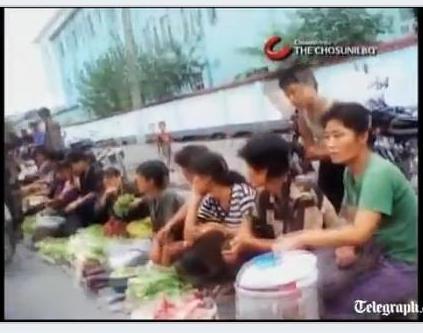
Clandestine video of post-flood Sinuiju

Wednesday, September 8th, 2010

The video was originally released by the Choson Ilbo, but the Telegraph (Britain) has posted a high-quality version of it:

Click image to link to video

According to the Telegraph:

The video, obtained by Chosun Ilbo media agency, shows people [in Sinuiju] living in tents on streets with their water damaged belongings. Others can be seen buying water from a salesman.

The price of water has increased since the floods, according to the agency’s source, with a bowl costing 6 pence. The usual monthly wages are around £1.30.

Heavy rains in July and August have hit food production that, even in a good year, falls a million tonnes short of the amount needed to feed North Korea’s 23 million people.

According to the Chosun Ilbo, North Koreans in Shinuiju were complaining about the government and their inability to help the area properly.

Last week the South Korean government offered to provide £5.5m in emergency aid, including food, relief materials and first aid kits – but not rice nor construction equipment, as per Pyongyang’s request.

North Korea’s request was made through the Red Cross at the weekend, and is being reviewed, the Unification Ministry said in a statement.

South Korea has been reluctant to give rice to the North because it is worried it will not reach the people who need it most.

Pictures of the flooding can be found here.

Read the full story here:
Rare footage from inside North Korea reveals aftermath of floods
Telegraph
9/7/2010

Share

North Korean sanctions hurting South Korean companies

Wednesday, September 8th, 2010

According to the Daily NK:

A new survey [in South Korea] has suggested that the May 24th Measure, which was put in place in response to the sinking of the Cheonan in March, has had a serious effect on entities doing business with North Korea, in many cases harming them in a way capable of putting them out of business altogether.

The survey, conducted by the Korea Chamber of Commerce and Industry, included a total of 500 companies; 200 with trade ties to the North and 300 without.

Of that 200, 93.9% said they have suffered what they characterized as substantial losses since the May 24th Measure imposed a trade ban with the North, while 66.5% said this was enough to put them out of business.

The survey put the average losses of those firms with ties to the North at approximately $800,000.

Meanwhile, around 8 out of 10, or 83%, of the 500 said that they now have no interest in developing business ties with the North, regardless of the political and economic environment.

Read the full story here:
Survey Reveals Effect of Trade Ban
Daily NK
Chris Green
9/8/2010

Share

Kaesong day care center opened, minimum wage raised

Tuesday, September 7th, 2010

Institute for Far Eastern Studies (IFES)
NK Brief No. 10-09-07-1
9/7/2010

Construction on a day-care center for the children of North Korean workers in the Kaesong Industrial Complex (KIC) has been completed, and the center was opened on September 1. The ROK Ministry of Unification released a statement announcing that “a child-care center has been built with the aim of providing care for the children of North Korean female laborers in the KIC and to improve productivity of the industries in the complex.” With the opening of the new center, more than 300 additional children can be cared for, along with the more than 200 children that are currently attending day-care in the complex.

Ground broke on the new facility, with over 3,100 square meters of floorspace, on September 24, 2009, and it took over a year to complete. The real estate was provided by the North, with the South-North Cooperation Fund providing 900 million won for the build. The Kaesong Industrial District Management Committee has turned over the management of the center to the North, and factories in the complex pay approximately fifteen dollars per child per month to send employees’ children to day-care.

In addition, the Kaesong Industrial District Management Committee and the North Korean Central Special Zone Development Guidance General Bureau agreed on August 5 to raise the minimum wage of North Korean workers in the complex by five percent, from 57.881 USD/month to 60.775 USD/month. The raise took effect on August 1 and will need to be reevaluated before July 31, 2011.

Along with the five percent raise in the minimum wage, South Korean companies will gain more control over the hiring process. North and South Korean authorities agreed to strengthen adherence to existing regulations, both on hiring and assigning workers to various positions. Previously, North Korean labor representatives could control work assignments for North Korean workers, but that will be falling under the authority of managers of each business.

According to the guidelines regulating the KIC, North Korean workers will receive a raise of no more than five percent per year, and they have received a five percent raise each year since 2007. North and South have now agreed to continue raises at a rate palatable to businesses in the complex, and to allow South Korean businesses more control over employees.

Share

US dollar popular on DPRK black market

Tuesday, September 7th, 2010

According to the Daily NK:

An inside source reports that popular dependence on foreign currencies for trading continues in spite of last year’s currency redenomination, to the extent that market traders are openly setting separate prices in U.S. dollars or Yuan alongside the depreciating North Korean won.

The inside source from Pyongyang explained to The Daily NK on September 5th, “In recent market trading, usage of dollars has increased rapidly, and now market prices are being set according to a dollar standard. Even when money is loaned and repaid, the amount for repayment is decided based on the dollar standard.”

As of September 2nd, the exchange rate in Pyongyang was around 150,000 won to $100, as North Korean people refer to it. Loans made in North Korean won are always calculated according to the value of the dollar, and the value of the loan fluctuates accordingly.

The source added, “Recently, market merchants have been setting separate Yuan or dollar prices, except for on rice, corn, and ingredients for side-dishes. The fabric stalls in Sunkyo market in Pyongyang put up all their prices in dollars.”

“Especially in the case of wholesalers,” he added, “they are all trading in dollars or Yuan. They depend on foreign currency since the value of the North Korean currency has fallen so badly and also because there is a lack of large-denomination bills.”

Since 2000, Yuan has been in common use alongside the North Korean currency in border regions. The popularity of dollars is higher in Pyongyang and North and South Hwanghae Provinces. Especially in cases where the unit price of the item is high, such as for home appliances or industrial products, most are dealt with in dollars or Yuan.

However, this is also now spreading to lower value consumer goods like shoes and clothing. Dollar and Yuan prices are applied to such items even when the seller is not a foreign currency store or international hotel.

Despite the fact that the North Korean currency was redenominated at a rate of 100:1 on November 30th, 2009, the monetary authorities have not been able to break North Korea’s inflationary cycle. Currently, rice in North Korean markets goes for around 900 won per kilo, which is only around half the 2,000 won it cost prior to the redenomination, far from the approximately 20 won it would cost in a more stable economy.

The source explained, “The value of the won is unstable, making foreign currency exchange rates more volatile. So merchants are selling products at higher prices than normal to compensate for their losses. This phenomenon is creating in them the mentality of raising their product prices.”

He also emphasized, “Prices for all products imported from China are set in dollars or Yuan. Considering the fact more than 90% of products in the North Korean market come from China, it looks like a world in which the North Korean currency is useless is coming.”

The source added, “Since Yuan are used quite commonly in North Hamkyung Province, Yangkang Province, and Shinuiju, a phrase, ‘This is Chinese land!’ is spreading. At the same time, since the dollar is used a lot in Pyongyang, Sariwon, Haeju, and Wonsan, another joke suggesting that ‘here is U.S. soil!’ is going around as well.”

IFES also covered this story:

With last November’s currency reform, North Korea’s dependence on foreign currency has increased to the point that market prices today are determined in terms of dollars or yuan.

According to Daily NK’s internal sources in Pyongyang, a recent surge in the use of dollars in market transactions has meant that market prices of goods are now determined based on dollars. Moreover, it has been revealed that individuals lending and borrowing money from one another collect and pay the interest in dollars.

As of September 2, the exchange rate in Pyongyang was about 100 US dollars to 150,000 won. If someone was to borrow 150,000 North Korean won from a friend, he would later have to repay that loan in however much North Korean won is equivalent to 100 US dollars at the time.

The source said, “These days, the merchants in the market charge everything in yuan and dollars, except for rice, corn or side dishes,” and, “Clothing stores in Pyongyang’s Seonkyo Market have actually put up signs indicating prices in dollars.”

The source added, “Wholesale merchants, especially, do all of their business in dollars or yuan now,” and “The value of North Korean money has fallen, and there are no more large bills anymore, so everyone is dependent on foreign currency.”

After 2000, the yuan and the North Korean won were both came into common use in the border area between North Korea and China, while the dollar became popular in Pyongyang and Hwanghae Province. Expensive items, such as electric home appliance or industrial goods, were more often than not bought and sold in terms of dollars or yuan, bypassing North Korean currency altogether.

However, recent trends show that the use of dollars and yuan has spread to the sale of shoes, clothes, and other everyday consumer goods. Stores put up signs indicating prices in dollars and yuan, once done exclusively by currency exchange shops or hotel restaurants frequented by foreigners.

Last year, North Korea depreciated its currency at a rate of 1:100 in an attempt to reform its currency, but the efforts to control inflation throughout the country failed. The price of rice in North Korean markets today is about 900 won per kilogram, about half the price it was before currency reform (about 2000 won per kilogram).
The source explained, “Because the value of the won is unstable, the exchange rate varies wildly. In order to not lose money, merchants have been fixing their prices higher than normal.”

The source emphasized, “Goods from China are all sold in dollars or yuan,” and “Considering that over 90% of the commodities circulating in the markets today are from China, it appears that North Korean money will be rendered useless in the near future.”

“In North Hamkyeong Province, Yangkang Province, and Sinuiju, where the yuan is often used, they say ‘This is Chinese land,’ and in Pyongyang, Sariwon, Haeju, and Wonsan, where the dollar is often used, they joke, ‘This is American land,’” added the [sic].

Read the full stories here:
North Korea’s Fiscal Sovereignty Collapsing
Daily NK
Park In-ho
9/6/2010

North Korea’s dependence on foreign currency increases
Institute for Far Eastern Studies
NK Brief No.10-09-07-2
9/7/2010

Share

DPRK-PRC promote business in border area

Monday, September 6th, 2010

According to the Choson Ilbo:

North Korea and China are already starting economic cooperation projects in the border area across China’s northeast and the North’s Rajin-Sonbong region.

The Chinese Ministry of Transport recently designated Jilin Province as a pilot region for international trade and logistics encompassing the three northeastern provinces of China and the Duman (or Tumen) River area, the China Shipping Gazette reported last Friday.

The decision is aimed at facilitating transport of goods from China’s northeast to Shanghai and the south via customs points in the Chinese city of Hunchun and the North’s Rajin-Sonbong Port, the weekly added.

A representative of the Yanbian Korean Autonomous Prefecture in Jilin also signed an agreement on bilateral economic cooperation with Kim Su-yol, the chairman of the Rajin-Sonbong special city people’s committee, at the sixth Northeast Asia Trade Expo in Changchun last Thursday.

Read the full story here:
N.Korea, China Promote Business in Border Area\
Choson Ilbo
9/6/2010

Share

Recent fees and taxes in the DPRK

Monday, September 6th, 2010

According to the Daily NK:

North Korea is a “Tax-free country,” according to one of its many propaganda slogans, but this is contradicted by defector testimony, which suggests that residents carry a very heavy burden. According to defectors leaving the country after the North’s currency redenomination, North Korean people pay at least 20 to 30 percent of their monthly living expenses in the form of quasi-taxes to the state.

Since the redenomination, the minimum cost of living for a family of four has been in the vicinity of 50,000 to 60,000 won: around 35,000 for food and some 10,000 for other day-to-day necessities.

Next, North Korean residents pay at least 15,000 won for electricity and other utilities to the state.

Water and sewage and electricity cost, in total, around 1,000 won. Additionally, people have to give 30 percent of the earnings from their private fields every year. For a private field of around 40 pyeong (approximately 132m²), which is the general area for a single household, the farmer of the land has to pay around 3,000 won on average per month in usage fees, according to defectors.

In addition, if one adds other kinds of funding such as that for various kinds of local construction, military aid, fees for child education etc, the sum easily surpasses 10,000 won.

One defector, who arrived from Onsung in North Hamkyung Province in July of this year, said, “An elementary school in Onsung is instructing students to collect 10kg of apricot stones. If they cannot do that, the school forces them to give 5,000 won in cash. There are many cases of students who are unable to provide the apricot stones quitting school since they do not want to suffer under the burden.”

Another defector, who escaped from Hoiryeong in December last year, said, “Kim Ki Song First Middle School students had to pay 30,000 won every each three months for a school beautification project. However, many workers’ children were not able to tolerate that situation and quit.”

Another, who arrived in June from Hoiryeong, explained, “Even though the people were having to get food for themselves because of the absence of food distribution, the authorities took dogs, rabbits, leather or scrap from us all the time and, in addition, for the construction of a road, they pushed us to provide them with cement and bricks, so we had to offer all our income for several days.”

Besides all of this, the around 30 percent of people who do not have their own house have to pay at least 30,000 won in monthly rent.

Then, those who do businesses in the jangmadang have to pay between 300 and 2,000 won for each stall per day.

A defector, who did business in Chongjin until she defected in July last year, said, “The Provincial Committee of the Party took 300 won from each stall every day, and used 60,000 won of that for official expenses, gas for cars and entertainment for other cadres.”

Defectors say that the reason why the number of vagrants, so called kotjebi, has been increasing is also that they cannot afford to pay those fees.

Needless to say, while general people are weighed down by this heavy burden, high cadres in the Party, military or foreign currency earning bodies accumulate property through corruption, privilege, access to foreign currency earning businesses and the like, and enjoy their luxurious lives in high-class apartments in Pyongyang.

One defector who escaped from Pyongyang in February this year explained, “Since the currency redenomination, the preference for products rather than cash has been striking, so the price of apartments has risen a lot. In 2007, an apartment by the Daedong River was around $60,000, but now it is around $80,000 or $90,000.”

“While running errands, I visited one such apartment where high officials lived several times. It was amazing. They had foreign TVs, refrigerators and many other appliances. They used Korean or Japanese cosmetics and their shoes were all designer.”

A diplomat from the U.K. who visited Pyongyang in April, recently told the media that when he dropped by a fast food restaurant in Pyongyang most of the guests were students and some of them were wearing blue jeans and carrying cell phones.

The defector from Pyongyang criticized, “Newly built pizza or fast food restaurants in Pyongyang are like a playground for high officials’ children,” and concluded, “General local people are now struggling to feed this privileged class.”

The Daily NK conducted the interviews with defectors in this article with people who had just passed through the education course at Hanawon (the South Korean resettlement education center for North Korean defectors).

Read the full story here:
Tax Free North Korea Exists Only on Banners
Daily NK
Shin Joo Hyun
9/2/2010

Share

RoK traders with DPRK apply for government loans

Saturday, September 4th, 2010

According to Yonhap:

South Korean companies hampered by Seoul’s ban on their trade with North Korea have signed up for government loans amounting to 17.4 billion won (US$14.8 million), the unification ministry here said Saturday.

According to a ministry official, a total of 66 companies have asked to borrow government money on a 2 percent interest rate. The ministry began reviewing 155 applications on Aug. 2, the official added.

Read the full story here:
Banned S. Korean traders with N. Korea apply for government loans
Yonhap
9/4/2010

Share

PRC tells DPRK its time for reform

Thursday, September 2nd, 2010

According to the Choson Ilbo:

Chinese President Hu Jintao told North Korean leader Kim Jong-il in strong terms to reform the North’s failed socialist economy and open up the country, a senior South Korean government official said Wednesday.

He made the call during a meeting when Kim visited China last week, using rather more direct terms than Chinese Premier Wen Jiabao had used during Kim’s last visit in May, according to the official. Wen told Kim, “I’d like to introduce to you China’s experience in the reform and opening drive.”

But the official quoted Hu as saying, “Socialist modernization is based on China’s three-decade-long experience in reform and opening. Although self-reliance is important, economic development is inseparable from external cooperation.”

According to a Chinese official, Kim too directly used the terms “reform and opening”  this time. He reportedly told Hu, “Since its launch of the reform and opening drive, China has achieved rapid development.”

Up until recently, top Chinese leaders had regarded the terms as taboo words at bilateral summits for fear of upsetting North Korea’s delicate feelings, but Wen first broke the taboo in May, and Hu in his advice to Kim even used language such as “enterprise,” “market mechanism” and “external cooperation.”

A diplomatic source in Beijing said China’s insistence on talking about reform shows how concerned China is with the North’s mismanagement of the economy.

China’s business media made upbeat observations about the North turning toward reform, quoting Kim as saying he was “deeply impressed” after touring major cities in China’s northeastern region such as Changchun, Harbin and Jilin.

In an editorial Tuesday, the Global Times, a sister newspaper of China’s official People’s Daily, wrote, “Living in the shadows of South Korea, Japan and the U.S., North Korea has to wrap itself up tighter in order to fend off military threats, and threats of political and cultural infiltration. North Korea’s opening-up will help relieve tensions in Northeast Asia. But, the knot does not only lie on the North’s side. Other countries in this region must redouble their efforts to untangle the knot.”

It is unclear whether Kim will listen. The North Korean leadership is afraid of any reform that could weaken its stranglehold, and at the moment tight control is essential if the regime is to officially establish Kim Jong-il’s son Jong-un as his father’s heir.

Kim has paid lip-service to the Chinese economic development model before. After returning from a trip in the early 2000s, he introduced some timid elements of the market economy but swiftly clamped down when markets became too brisk and a new class of successful businesspeople began to look like a threat to his regime.

Han Ki-bum, a former deputy director of the National Intelligence Service in charge of North Korean affairs, in his doctoral thesis quotes Kim as telling economic officials in June 2008, “If you think I’m talking about reform and opening as if I were going to introduce the market economy you’re completely mistaken.”

At the moment, Kim apparently wishes to stick it out, but the North’s dire straits amid international sanctions will make it difficult to ignore Chinese demands.

At the meeting, Hu pointed out that economic cooperation between the two countries would be a “win-win strategy” where “the government takes the initiative, enterprises play a leading role, and the market mechanism is set in motion,” according to the South Korean official.

“That means that if China gives the North something, it should also pay in return,” a South Korean security official speculated.

Read the full story here:
Hu ‘Told Kim Jong-il It’s Time for Economic Reform’
Choson Ilbo
9/2/2010

Share

Kimchaek (Songjin) seeks trade fair

Monday, August 30th, 2010

According to the People’s Daily (PR China):

The local government of Kimchuk, North Korea, may plan a trade fair next year, and all countries will be welcome to participate, said Yi Bok-il, the head of the Kimchuk Municipal People’s Committee of North Korea, after the opening ceremony of the 6th China Yanji Tumen River Area International Fair for Investment & Trade 2010, held Saturday in Yanji, Jilin Province.

Yi told the Global Times that it is the first time that Kimchuk has taken part in such economic activities, and the city aims to promote economic communication with China and other countries in Northeast Asia.

However, experts had reservations about the extent of North Korea’s involvement in the economic development of Northeast Asia.

“Given the uncertainties of North Korea’s domestic political and economic orientation in the future, it is still hard to project an overly optimistic estimate of the country’s contribution to the economic cooperation to the pan-Northeast Asian area,” said Yu Xiao, deputy director of the Center for Northeast Asia Studies at Jilin University.

“It will be a long process and be subject to further observation,” he added.

I believe that “Kimchuck” is “Kimchaek”.  A crew of South Korean and Chinese fishermen are being held there now.

Pyongyang already hosts a  semi-annual trade fair.

Read the full sotry here:
North Korea may host int’l trade fair
People’s Daily
8/30/2010

Share

DPRK cracks down on drug markets

Friday, August 27th, 2010

According to the Daily NK:

An inside North Korean source has reported the launch of a renewed movement to expose and punish drug crime.

The source explained during a phone interview with The Daily NK on August 26th, “Starting August 20th, a compulsory public lecture has been given by National Security Agency personnel in each neighborhood office. Party instructions regarding a mass struggle to prevent drug and smuggling crime were introduced there.”

The lectures were attended by people’s unit members, with the exception of workers. It is standard practice for the same lecture to be given in work places separately.

The source added, “As the Chosun Workers’ Party Delegates’ Conference approaches, the number of cases in which National Security Agency agents are directing the education of citizens is increasing. Here, they emphasized that there will be strict legal action and punishment for those who take, sell or smuggle drugs in that jurisdiction.”

The People’s Safety Ministry has apparently also dispatched separate task forces to major cities along the Yalu River to hinder smuggling. They are currently trying to bring the border area under control.

The source reported, “Just within Hoiryeong there are 40 ‘task force’ personnel under the People’s Safety Ministry cracking down on illegal immigration and drug smuggling.”

The fact that North Korean citizens living in the border area regularly take drugs or engage in smuggling is not news.

The smuggling route between Sinujiu, Hyesan, Hoiryeong and Onsung to China came into being during the March of Tribulation in the late 1990s. Pharmacists and doctors started mass-producing methamphetamines (known locally as “Ice”) and sold it in China to survive, but now many, indeed some say most, foreign currency earning units are producing, distributing, and smuggling the drug.

Among the more affluent people living in the border area near the Tumen River, “Would you like some Ice?” is a common greeting. Many such people also take Ice as a painkiller, not least because it is among the few widely available drugs which can do the job. Furthermore, use of the drug has also spread to affluent teenagers, which is creating even more concern.

Currently, in major regional cities like Hamheung and Chongjin, one dose of Ice sells for between 3,000 and 5,000 North Korean won.

Read the full story here:
North Korea Launches Drugs Crackdown
Daily NK
Yoo Gwan Hee
8/27/2010

Share
