Archive for the ‘Economic reform’ Category

DPRK law enforcement guidebook insights

Thursday, June 23rd, 2011

A DPRK law enforcement manual was “released” by a South Korean missionary group named Caleb Mission.  The document seemingly offers a glimpse of the typical workload of a North Korean police officer.  The document, to the best of my knowledge has not been posted on line yet, so caveat emptor.  The Korea Herald offers some details below:

The classified guidebook for law enforcement authorities published by the North’s police agency in June 2009 lists 721 actual cases related to criminal law, civil law and the code of criminal procedure and offers advice on how to punish offenders.

One of the cases in the 791-page reference book is about a hog-raiser who sold pork injected with growth hormones and made a lot of money by selling more meat.

In this case, the North Korean law enforcement authorities cannot do anything about the hog-raiser because the man made money by selling pork at a legally permitted price in the market through his own efforts, explains the guidebook.

The book also explains that the act of getting paid for transporting another person’s luggage from the train station using a bicycle cannot be seen as a crime because the law does not stipulate that selling an individual’s efforts is a crime.

A food salesperson can be punished for “violating the order of product sales,” however, if he sprayed water on his seaweed to make it look fresher.

Much of the guidebook is about crimes where individuals caused damage to the state by stealing from the government or neglecting their duties, an indication of the seriousness of economic difficulties many North Koreans are going through.

Attempts to evade mandatory military service and euthanasia have become social headaches in the North as well.

A doctor who took $800 from five people in exchange for forging their medical records was charged with bribery and violating the law on military duty.

If a person avoided conscription by lying about his eyesight and later was found to have normal eyesight, he could be questioned by the authorities on charges of violating the law on military service.

The guidebook also stresses that euthanasia is illegal, mentioning a case where a son drugged his father to death to relieve him of the pain from illness under the consent of his mother.

Both the mother and the son should be seen as accomplices in a murder because “although they did not have a foul motive in killing him, the victim did not ask for it,” the book reads.

Bribery and treats in exchange for influence-peddling was also prevalent in North Korea.

People accused of trading South Korean or American films were punished for illegally bringing in and distributing “decadent culture” under North Korean criminal law.

Read the whole story here:
Official guidebook offers glimpse of N.K. society
Korea Herald
Kim So-hyun
2011-06-22

Share

North Korea pushes forward with the modernization of Rajin Port

Tuesday, June 21st, 2011

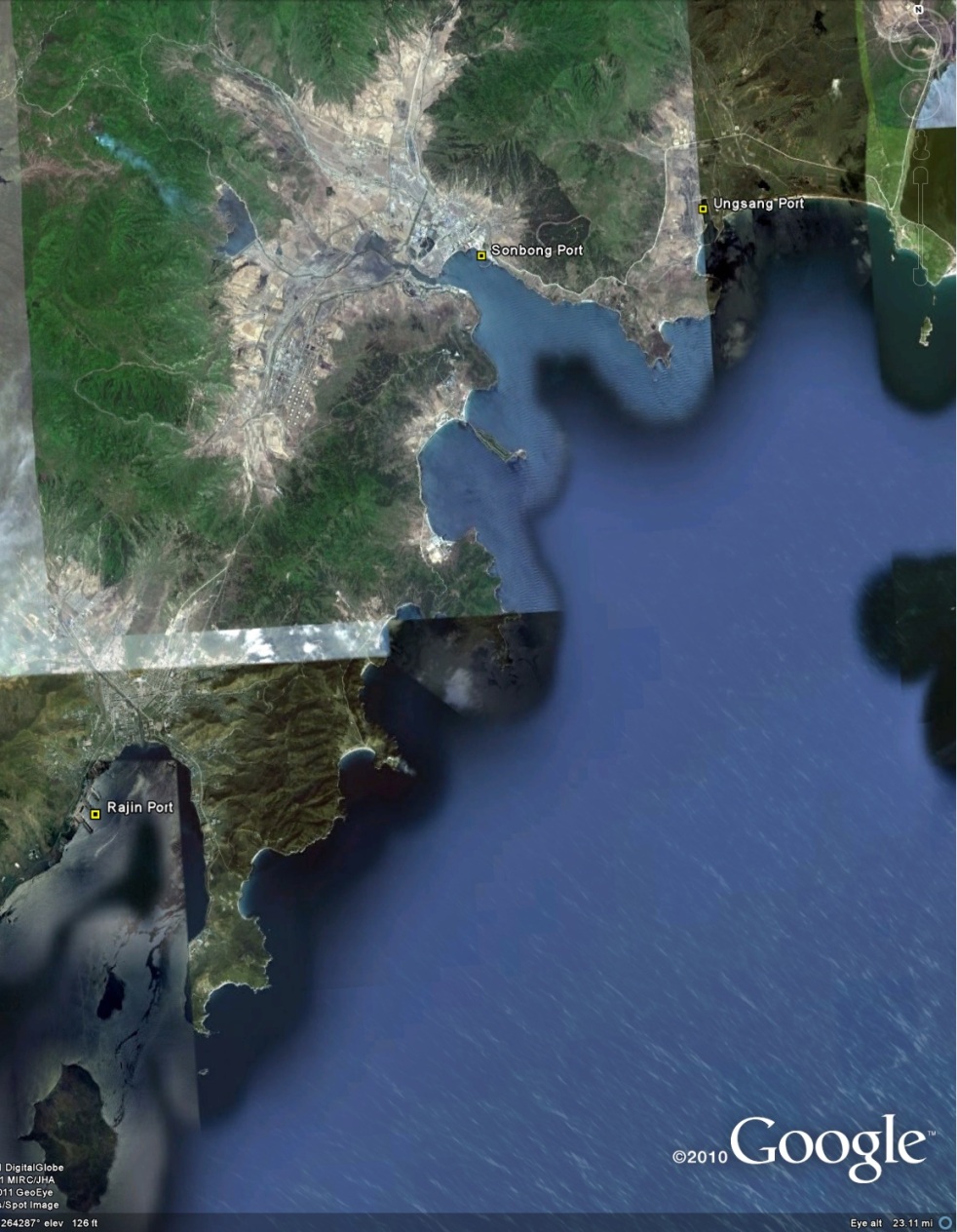
Pictured above (Google Earth): Rason’s three ports: Rajin, Sonbong, Ungsang

Institute for Far Eastern Studies (IFES)
2011-6-21

North Korea and China hosted a groundbreaking ceremony on June 8 for the launch of the joint development project in Hwanggumpyong Island near the DPRK-China border. On the next day, the launching ceremony for the Rason Economic and Trade Zone took place.

The KCNA reported on April 27 that the modernization projects for the Rajin, Sonbong, and Ungsang Ports are to take place. According to the report, “These three ports in Rason City have the geographical advantage for maritime transportation. . . . Rajin Port, surrounded by Daecho and Socho Islands, is an ideal harbor that provides security and excellent marine conditions for docking ships.”

Currently at the Rajin Port, a number of equipment, fishery products, and processed foods are handled. An official from the Rason City People’s Committee stated, “There are plans of advancing Rajin, Sonbong, and Ungsang Ports even further to double the capacity and cargo.”

Recently, news on the Rason Economic and Trade Zone by the KCNA can be heard more frequently as North Korea is making an effort to advertise the development of this area. Recent reports covered news on the preferential tariff system, development program, and light industry zone.

The preferential tariff system of the Rason Economic and Trade Zone was adopted as means to lure more foreign investment into the area and improve the North Korea’s image as being more cooperative and supportive toward foreign businesses. Preferential treatment is being granted to foreign investors in order to turn the area into a major entrepot, export producer, and financial and tourist hub of Northeast Asia. One North Korean official stated, “Rason Economic and Trade Zone has favorable conditions to grow as a major trade zone. There are plans of constructing state-of-the-art equipment, facilities, and light industry factories to develop the area as a major export base.”

China and Russia are said to be paying special attention to the Rason Port development. China is already known to have invested in Pier 1 at Rajin Port and Russia in Pier 3.

North Korea has taken various legal measures to develop the area since Kim Jong Il’s field guidance visit to Rason City in December 2009. Rason City was designated as a “special city” in January 4, 2010 and the Rason Economic and Trade Zone Law was passed on January 27, 2010.

Additional Information:
1. A Swiss firm is alleged to have rented Rajin’s Pier No. 2, but it has not.

2. Here and here is some background information on the new Hwanggumphyon SEZ.  Here is some more information on the Rason ground-breaking and Chinese investment tour.

Share

Meth as medicine

Tuesday, June 21st, 2011

From a recent Newsweek article about meth use in the DPRK:

First synthesized in 1893, meth is now one of the world’s most widely abused drugs, imbuing the user with intense feelings of euphoria, concentration, and grandiosity. Smoked, injected or snorted, the drug also suppresses the need for food and sleep for an extended period of time; coming down can bring fatigue, anxiety, and occasionally suicidal ideation.

Inside North Korea, observers say, many use meth in place of expensive and hard-to-obtain medicine. “People with chronic disease take it until they’re addicted,” says one worker for a South Korea-based NGO, who requested anonymity in order to avoid jeopardizing his work with defectors. “They take it for things like cancer. This drug is their sole form of medication,” says the NGO worker, who has interviewed hundreds of defectors in the past three years. A former bicycle smuggler who defected in 2009 told NEWSWEEK of seeing a doctor administering meth to a friend’s sick father. “He took it and could speak well and move his hand again five minutes later. Because of this kind of effect, elderly people really took to this medicine.”

Jiro Ishimaru, founder and editor of Rimjin-gang, a magazine about North Korea and reported by people inside the country but published in Japan, says he has seen several North Koreans take meth to relieve stress and fatigue, including his former North Korean business partner. “He didn’t start taking it as a drug but as a medicine,” Ishimaru says.

The drug also offers an escape that might not otherwise be possible. As Shin puts it: “There’s so little hope in North Korea—that’s why ice is becoming popular. People have given up.”

Read the full story here:
North Korea’s Meth Export
Newsweek
Isaac Stone Fish
2011-6-19

Share

Lankov on the DPRK’s new SEZs

Tuesday, June 21st, 2011

Lankov writes in the Korea Times about the DPRK’s various Special Economic Zones:

In early June, the governments of China and North Korea declared that they would work to develop two new special economic zones (SEZs). One zone is to be situated in the small port city of Raseon, on the eastern coast of South Korea, just 20 kilometers from the nearest crossing to China. Another zone will be developed on the unremarkable sandy island of Hwanggumpyong, in the vicinity of Sinuiju, the largest city on the border (some three quarters of trade between the two countries pass through this city).

One cannot be surprised by this initiative as talk of new SEZs “soon to be established” has been around for over a decade. There is little doubt that the North Korean government is very interested in the idea of SEZs. Unfortunately, this interest does not necessary mean that the North Korean authorities are willing to make the concessions that would allow the SEZs to operate efficiently.

The history of North Korean SEZs is essentially the history of frequent failures and occasional partial successes. The first attempt to create a SEZ took place in 1991, when the North Korean government established a SEZ in the remote northwestern corner of the country. The Raseon SEZ, as it has now become known, is located where the borders of China, Russia and North Korea meet.

Read the remainder of the story below:
(more…)

Share

Politics comes before economy for DPRK

Monday, June 20th, 2011

The Global Times (PR of China) has posted a very interesting and blunt assessment of the DPRK’s newly announced Special Economic Zone by Zhang Liangui (张连瑰), a specialist in Korean issues and professor at the International Strategic Research Bureau at the Party School of the Central Committee of CPC.  The article is posted below:

After drawing up a 10-Year Economic Development Plan at the beginning of this year, North Korea has announced several measures to readjust its ties with China from an aid-dependent relationship to an economic partnership. Will North Korea switch from its militaristic focus to economic development? What are the implications of the recently announced Hwanggumpyong island project in the middle of the Yalu River? Nanfang People Weekly magazine talked to Zhang Liangui (Zhang), a specialist in Korean issues and professor at the International Strategic Research Bureau at the Party School of the Central Committee of CPC, on these issues.

Q: What is the rationale behind North Korea’s efforts to facilitate the joint development of Hwanggumpyong with China?

Zhang: There are several reasons. The most straightforward motive is obviously to ameliorate the shortage of foreign money, since North Korea is suffering from international sanctions as a result of its nuclear weapon development.

Beyond that, North Korea wants to strengthen its economic ties with China, avoiding a hopeless isolation from the international community. Third, this move also reflects North Korea’s territorial concerns.

Q: Why do you think the cooperation has something to do with territorial issues?

Zhang: Because of the border on the Yalu River. Usually rivers on the border between two sovereign nations are demarcated on a half-to-half basis, which means there’s a middle line of control accepted by both sides.

However, the Yalu River is jointly held by both China and North Korea, while the latter has exclusive possession of Hwanggumpyong island.

For years due to alluvial deposition, the island has continued to expand. It now has abutted on the Chinese side, and local government has to build a fence along the border.

Under this circumstance, North Korea has de facto control over the part of Yalu River to the east of Hwanggumpyong island.

Thus the development on Hwanggumpyong island may help North Korea secure its territorial and river possession.

With the erection of buildings and infrastructure, North Korea expects Chinese developers to build the ground base, cement the foundations and free the island from the threat of alluvial erosion. If there’re many buildings, North Korea will have safe and unchallenged control over the island.

After acquiring Hwanggumpyong, North Korea asked farmers to plant trees and develop farmland. This caused the island to expand as well as causing disputes between the two sides. China should be fully aware of these concerns if it is looking for long-term cooperation over Hwanggumpyong.

Q: Why China is willing to cooperate and provide 80 percent of the funds?

Zhang: Many Chinese believe the US will try to contain China, especially at a time of tension among Northeastern Asian countries. The security concerns may give China and North Korea impetus for cooperation.

China also perceives North Korea’s instability, both economically and politically. China’s aid to North Korea is understandable and necessary in pursuing its goal of regional stability.

But China should be clear that its aid doesn’t serve the purpose of saving a specific government. The survival of any particular government is up to North Korea’s domestic will. And China doesn’t need to intervene in everything.

Q: Why did North Korea grant the opportunity to a Hong Kong enterprise? Will Hwanggumpyong become another Hong Kong, as North Korea wishes?

Zhang: It seems that North Korea is particularly enthusiastic about cooperating with Hong Kong firms. The precedent is the casino in Rason. A casino managed by Hong Kong executives can better woo Chinese tourists, as well as corrupt officials and outlaws.

However, Hong Kong’s prosperity is based on its transparent government, advanced legal system, high credibility, well-established infrastructure and financial markets, and in particular, stability.

It remains a difficult mission for today’s North Korea to build another Hong Kong.

Q: Will the Hwanggumpyong project attract more Chinese business people in the future?

Zhang: North Korea has reason to expect more investors to come. But I think there are several reasons preventing a great number of investors from going to Hwanggumpyong. According to my experience in dealing with Chinese business people, many of them complain of a lack of lawful regulations and the capricious North Korean economic policies.

Besides, many countries including China don’t accept credit cards issued by North Korea. Understandably, much of China’s national investment in North Korea comes out of political reasons rather than economic motivations. Unless North Korea has a stable and predictable government as well as international credibility, the prospect of foreign investment in North Korea is bleak。

Q: What do you think of the 10-Year Economic Development Plan, announced recently by the North Korean government?

Zhang: It seems 10 years is a bit long for North Korea’s management habits. So far, North Korea hasn’t been able to follow through on many of its long-term economic projects.

For example, the Kaesong Industrial Park was once planned to be a lucrative business produced by North-South Korean cooperation.

In May 2009, North Korea unilaterally announced a demand for wage and rent rises and scrapped the agreement they had signed up to. In 2010, the sinking of the Cheonan warship further hampered industrial activities in the region. Thus I think the 10-Year Economic Development Plan remains provisional and is intended more or less for propaganda purpose.

Q: Why does North Korea stress that its 10-Year Economic Development Plan “isn’t a reform and opening-up policy?”

Zhang: This is obviously aimed at China. Many Chinese media are under the delusion that North Korea is emulating China’s example to get rid of poverty and develop its country. In fact, North Korea is very unhappy about this claim.

North Korea is still against the idea of “reform and opening-up,” albeit now inexplicitly. It once equated “reform and opening-up policy” with revisionism and imperialists’ supposed conspiracy to topple socialist regimes.

During Kim Jong-il’s visit on June 5, while the Chinese media speculated about North Korea going through “reform and opening-up policy,” the North Korean media never used this phrase.

Share

Hong Kong company likely to be tapped as developer Hwanggumphyong

Monday, June 20th, 2011

According to Yonhap:

A Hong Kong conglomerate is likely to be tapped as a developer of a China-North Korea joint industrial complex on a North Korean island, a Chinese-language weekly said Monday, a move seen as deepening the North’s economic reliance on its neighboring country.

Earlier this month, China and North Korea broke ground to develop Hwanggumphyong Island, which sits at the estuary of the Yalu River between two border cities, Dandong on the Chinese side and Sinuiju on the North’s side.

The Economic Observer, one of the leading economy-focused newspapers in China, said it has exclusively obtained a document showing that Sunbase International Holdings Ltd., an investment conglomerate based in Hong Kong, will win exclusive rights to develop the border island.

The group, which reportedly has direct control over total assets of over HK$60 billion (US$9.3 billion), is recognized as one of the largest property management companies in Hong Kong and mainland China.

Gunter Gao, chairman of the board of Sunbase International, visited North Korea twice last year and had high-level meetings with North Korean government officials on the economic development of the island, the report said.

The newspaper earlier reported that the 56-year-old Hong Kong tycoon met Kim Yong-nam, president of the Presidium of the North Korean Supreme People’s Assembly, before the groundbreaking ceremony of the joint economic zone. Gao is widely considered to have strong ties with politicians in mainland China.

Gao has long served as one of the Hong Kong members of the National Committee for Chinese People’s Political Consultative, a political advisory body in mainland China.

Citing unnamed sources, the weekly said the North Korean authorities preferred Hong Kong entities rather than mainland Chinese firms as developers of the joint economic zone because Hong Kong companies are more open and international.

The economic cooperation between China and North Korea comes on the heels of North Korean leader Kim Jong-il’s weeklong trip to China in May when he studied the neighboring country’s economic development. It was his third trip to China in just over a year.

Beijing has been trying to lure its impoverished ally to embrace the reform that lifted millions of Chinese out of poverty and helped China’s rise to become the world’s second-largest economy.

North Korea has been facing worsening food shortages and massive inflation, which has increased public anger in the country.

Read the full story hre:
Hong Kong conglomerate likely to be tapped as developer of N. Korean island: report
Yonhap
Kim Young-gyo
2011-6-20

Share

Comparison of NK and USSR

Sunday, June 19th, 2011

Andrei Lankov writes in the Korea Times:

The present author was born in the former Soviet Union and is frequently asked which period of Soviet history the current North Korea is reminiscent of?

I usually say that this question has no straightforward answer. The problem is that depending on what area you look, the associations are remarkably different. The developments in North Korea are not that different from those of the USSR, but in different areas the time seems to flow with a different speed.

North Korea’s official ideology and propaganda continues to be uncannily similar to late Stalinist Soviet culture, to the period of the late 1940s. The North Koreans are still served the same fare of ossified Leninism and strong nationalism, heavily spliced with eulogies to the leaders’ wisdom and benevolence.

It appears as if North Korean propaganda, as well as its official ideology, has been frozen in time since the late 1960s. One can take an article from Rodong Shinmun of, say, 1972 and then compare it with an article published yesterday only to find no major differences in language, style and reasoning.

At the same time, the general mood among educated urban North Koreans is quite similar to the mood which prevailed among the same social milieu in Moscow and Leningrad of the 1960s. People are still afraid to talk politics and most of them do not entertain serious doubts about the fundamentals of the system. They tend to believe that their economic problems have been created by a combination of natural disasters, collapse of the ‘socialist markets’ and, of course, an economic blockade maintained by the greedy U.S. imperialists and their shameless lackeys.

However, very few educated North Koreans nowadays buy the official propaganda message wholesale. They know that the official media lies, and sometimes lies quite shamelessly. While being more or less loyal subjects of their state, they entertain significant (and growing) skepticism about its institutions and the official pronouncements of its leaders.

It seems that social fear, once powerful and omnipresent, is diminishing. The North Korean state remains highly repressive, but the level of repressiveness is in steady decline. Nowadays North Koreans can do many things which would almost definitely have landed them in prison some 20 years ago ― in some cases, even mildly critical statements about the system are now tolerated.

Of course, open dissent is still unthinkable, but genuine enthusiasm is almost impossible to find. This is a picture, clearly reminiscent of the USSR of, say, year 1965 (albeit the North Korean state remains far more repressive than the Soviet Union used to be during Brezhnev’s rule).

The economic situation is different again. In economic terms, present day North Korea is similar to Russia in the early 1990s, the turbulent days that followed the collapse of the Soviet Union. At that time a large number of the Soviet people discovered that their official salaries would not suffice if they wanted to stay alive, so they began to look for additional sources of income. Ex-Soviet officials busily stole state property, whilst less lucky commoners relied on an assorted variety of small businesses, household workshops and subsistence farming.

This is very similar to present-day North Korea, even though the collapse of the socialist economy in North Korea led to far more damaging consequences than was the case in Russia –after all North Korea experienced a disastrous famine, while few if any Russians starved to death in the early post-Soviet period.

In North Korea, the collapse of the state-run economy and rationing system plunged a majority of the population into the world of the grass-roots market economy. No reliable statistics are available, but researchers tend to agree that roughly three-quarters of average household income in North Korea is now derived from private economic activities of different kinds.

Like their early post-Soviet peers, North Korean officials are always on the lookout for a nice bribe. They also don’t mind quietly transforming state property into their own personal property– many North Korean enterprises ostensibly still owned by the government are actually private nowadays. Meanwhile other North Koreans sell, buy, smuggle, farm unofficial plots, run individual workshops or find employment with such workshops.

So, we have a curious picture. Ideology still pretends that almost nothing has changed in the last 50 years (it’s telling that the official media has never mentioned the market economy, as if it doesn’t exist). The political consciousness is less dominated by the state, but still remains under its control.

However, the North Korean state has almost completely lost control of the economic life of its people. This picture has no parallels in the history of the Soviet Union or, for that matter, in the histories of other ex-communist countries, even though all its elements (if taken separately) would appear familiar to the people with Soviet-era experience.

Read the full story here:
Comparison of NK and USSR
Korea Times
Andrei Lankov
2011-6-19

Share

DPRK-ROK oil exploration deal allegedly inked

Thursday, June 16th, 2011

According to the Korea Herald (h/t L.P.):

A number of economic cooperation projects appear ready to take shape between North Korea and China.

A businessman here claimed the North and China have signed a more concrete agreement last year following up on a 2005 preliminary deal to jointly develop an offshore oil field.

“The North has agreed with China to jointly develop an offshore oil field in the waters off Nampo,” a western coastal town, said Kim Young-il, chief executive of a South Korean trading firm and inter-Korean trade adviser to the Korea International Trade Association.

“The North Korea-China agreement on joint development of the oil field seems to have taken place last year.”

It is estimated that some 20 billion tons of crude oil is buried under the Bohai Gulf continental shelf which stretches across the Korea Bay between the North Pyongan Province and China’s Liaoning Province, Kim said during a policy debate session hosted by a legislator.

“The joint exploration would be economically viable because, once about a third of the oil reserve can be extracted, they can extract between 7 and 8 billion tons, enough to meet China’s entire demand for nearly 30 years,” Kim said.

Read the full story here:
Communist allies seek strategic interests
Korea Herald
Kim So-hyun
2011-6-1

Share

Losses grow for South Korean firms invested in DPRK

Thursday, June 16th, 2011

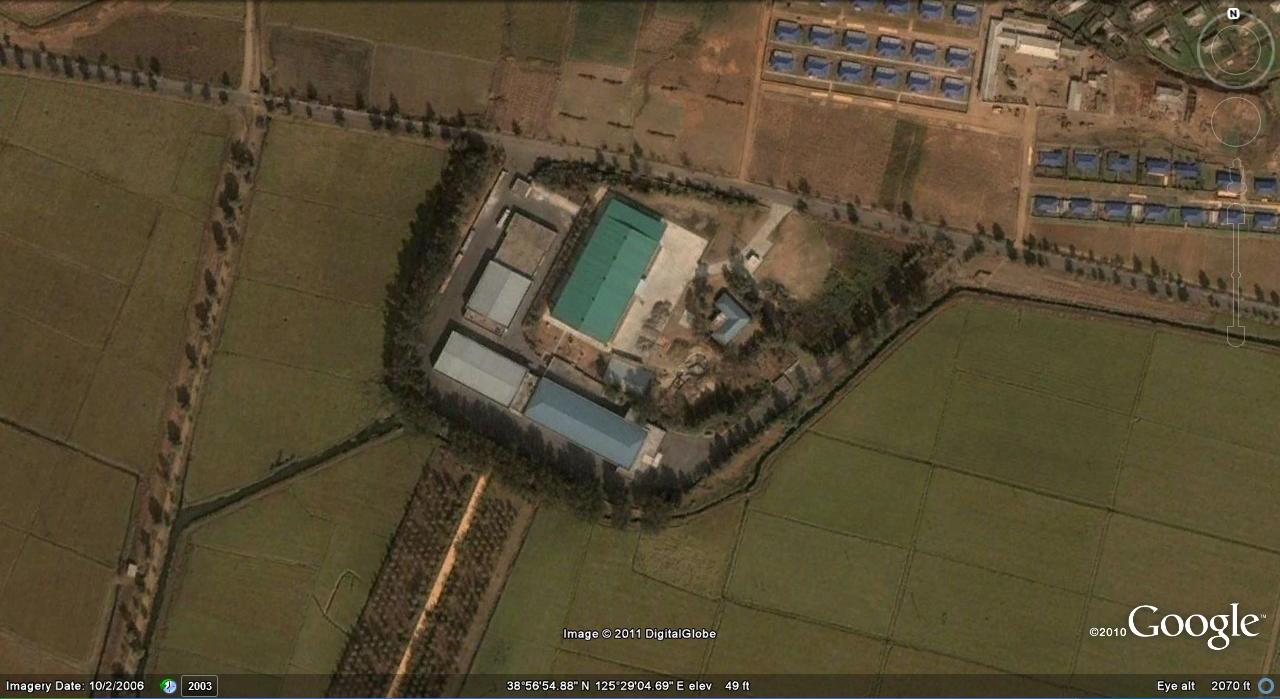
Pictured above (Google Earth): Kangso Mineral Water Processing Factory (Google Maps)

According to the Hankyoreh:

Former DD Trading Chairman Lee Dae-sik, 74, still has trouble sleeping when he thinks about the events of the past few years. In that time, he has had to shut down an effort in the North Korea that was earning 4 to 5 billion won ($3.7 million to $4.6 million) in annual sales just a few years ago, as a result of the Lee Myung-bak administration’s hardline policy against North Korea.

“At the time I was investing in North Korea, we had the Inter-Korean Exchange and Cooperation Act, and I never dreamed they would halt North Korea projects. Now the government will not let us do an effort it granted approval for, something we had been doing consistently. It is just…”

During an interview with the Hankyoreh at a cafe in the Hawolgok neighborhood of Seoul’s Seongbuk District on Tuesday evening, the day before the eleventh anniversary of the June 15 Joint Declaration, Lee was too overcome with emotion to finish his sentence. He is one of the many South Korean businesspeople who have suffered as a result of the government’s restrictions on trade with North Korea. According to a January-February survey of companies engaged in North Korea efforts, the 104 companies that responded sustained an average loss of 3.9 billion won ($3.6 million) as a result of the May 24 measures restricting inter-Korean trade.

Lee is a first-generation North Korea entrepreneur who has been engaged in trade with the country since the Kim Young-sam administration in 1994. Originally the operator of a shoe factory in Busan, Lee struggled with the competition of cheap labor in China and Northeast Asia and searched for a change before finally taking the leap into North Korea. At first, he imported Pyongyang soju and agricultural products like bracken, balloon flower roots, and pine mushrooms.

“After the June 15 summit in 2000, the North Koreans grew more flexible in their attitude and became easier to deal with,” he recalled.

Lee, who steadily expanded the range of his operations over the years, began an effort in 2005 with Pyongyang’s Kangso Yaksu. This mineral water, North Korean National Treasure No. 56, is naturally carbonated and contains minerals like calcium and iron. After securing exclusive sales rights from North Korean authorities, Lee completed construction on a production plant the next year at an investment of 3 billion won. According to the conditions of the contract, Lee sent the cost of the water and the raw materials for the bottles, along with caps and labels, and the North Koreans operates the factory and sent the water produced.

“We imported it to South Korea under the brand name of ‘Gangseo Cheongsan,’ and sales increased from an initial level of 100 thousand to 200 thousand bottles a month to 300 thousand to 400 thousand bottles a month,” he said.

But stormy clouds appeared on the horizon when the Lee Myung-bak administration took office in 2008. As inter-Korean relations grew chilly due to the shooting death of a South Korean tourist at Mt. Kumkang in July of that year and North Korea’s missile launch and nuclear test in April and May of 2009, respectively, the Lee administration placed restrictions on contact with North Korea by civilians.

“When you apply for contact with North Korea, the government tells you to ‘please refrain from doing so,’” Lee said. “They say ‘please refrain,’ but who is going to refuse a request from the government? They are basically telling you, ‘Don’t do it.’”

The decision left Lee unable to send the promised payment and bottle materials to North Korea and to receive the water. One day, a fax came in from North Korea. It notified Lee that the contract was null and void, as he had not supplied the raw materials or collected the water produced. “We had ten or so employees, and they all went their separate ways,” Lee sighed. “Fifteen years of work in North Korea, and all I have left now is a pile of debt.”

“North Korea said it would sell China the water produced at the facilities I invested in,” Lee added.

“Even so, they told me they would restore my rights if I am able to work again like before, so I really hope the inter-Korean trade restrictions are lifted right away so that I can do business freely.”

Read the full story here:
Losses continue for businesses engaged in inter-Korean trade
Hankyoreh
Park Byong-su
2011-6-16

Share

Foreign used clothing popular in DPRK

Sunday, June 12th, 2011

According to the Daily NK:

The North Korean authorities are reportedly reacting more strictly than normal to overt sales of products from South Korea in the country’s domestic markets.

One Korean-Chinese man engaged in business in Pyongan and Hwanghae Provinces told The Daily NK on June 11th, “They’re cracking down hard on products from the Kaesong Industrial Complex in the jangmadang, and are reacting more strongly than before to South Korean products, too. There are no South Korean goods on sale openly.”

Sources say that in many cases this means that traders are being told to remove tags indicating South Korean origin.

The same trader explained, “Community watch guards come to the jangmadang and tell us to remove tags written in Chosun then sell them. They are thoroughly cracking down on things saying ‘Made in Korea’. Even though the clothes are of good quality, and therefore clearly South Korean, if there is no tag, then they are not prohibited.”

Currently, used clothes are said to be selling better than new ones, however. This is partly because people have little cash and are gravitating towards the cheaper prices, and partly because they don’t trust new products.

The trader explained, “The image of South Korean clothes is good as far as used clothes selling better than new ones goes. People think that new clothes are of poor quality and really expensive.”

He explained the reason for the low quality, saying, “Currently, producers are buying fabric in China to bring back and manufacture clothes in Chosun, and then they put ‘Made in China’ tags on them.”

A woman’s short-sleeve t-shirt is now worth 5,000 won for a new one but just 1,500 won for a used one. Since the price difference is huge and new ones are of questionable quality, decent used ones sell better.

Another source from Changbai in China corroborated the story, explaining, “Everybody from North Korea asks us to send them used stuff to sell. We go to Guangzhou to buy used clothes smuggled in from South Korea, and send them to North Korea. The demand from North Korea for South Korean used clothes is pretty high.”

Meanwhile, due to mobilization for seasonal agricultural work, the North Korean markets are currently operating from 5 PM to 7PM. They normally open at 2 PM.

However, the Korean-Chinese trader explained that despite the afternoon market closures, farms are facing an uphill battle, saying, “Since anyone who wants to survive has to trade, the number of traders has doubled. And since almost everyone is trading and their focus is on that, there is no way the farming work can go well.”

Read the full story here:
“Remove Tags, then Sell Them”
Daily NK
Park Jun Hyeong
2011-6-13

Share