Archive for the ‘Economic reform’ Category

Lankov pessimistic on the DPRKs SEZs

Thursday, July 14th, 2011

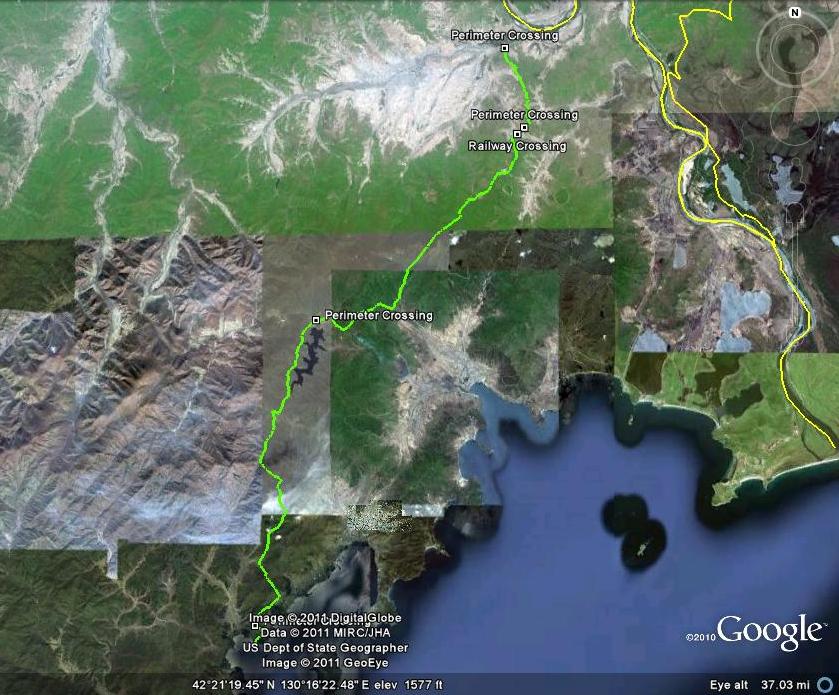
Pictured above (Google Earth) is the electrified fence around the Rason special economic zone.

Lankov writes in the East Asia Forum:

SEZs are acceptable to the North Korean government because they are relatively easy to control. North Korean SEZs have been fenced off with barbed wire and all visitors have had their IDs carefully studied at checkpoints.

The North Korean government obviously hopes that small areas of controlled capitalism will generate enough income to make a difference — or at least to keep afloat the long-decaying economy.

Similar SEZs with China to those recently declared have been attempted before. At Raseon a major problem was its isolated location and underdeveloped transport infrastructure, even by meagre North Korean standards. At Sinuiju there were numerous problems. One was North Korea’s choice of the Chinese entrepreneur Yang Bin to lead the project as he wanted to transform the city into a gambling centre, a Macau of the North. This was not welcomed by the Chinese government. Also, it did not help that the North Koreans, following their modus operandi, did not bother to liaise with the Chinese beforehand.

The success of KIZ might seem encouraging, but it is actually a very special case. It is viable because the South Korean government is willing to go to great lengths to support it. It has subsidised industrial development and has provided adventurous developers and companies with generous subsidies and guarantees that made the entire undertaking possible. This willingness is driven by a multitude of political considerations. Frankly, it is doubtful whether the Chinese side would be equally interested in subsidising a similar undertaking by Chinese companies in Sinuiju.

What will happen to these two planned new SEZs? The fate of Raseon seems pretty certain. Available evidence indicates it is largely about transportation links. Chinese Manchuria is landlocked, so Chinese companies will save a small fortune on transportation costs if they are given access to a seaport on the Eastern coast of the Korean Peninsula. If this is what happens in Raseon, it has a relatively bright future.

The future of the Hwanggumpyong SEZ is far less certain. Obviously Chinese businesses want to do there what their South Korean counterparts did in Kaesong, take advantage of low labour costs in North Korea. Even though Chinese labour is cheap, North Korean labour is much cheaper still, since US$15-20 a month would be seen by the average North Korean worker as a good wage. For the same labour, they would have to pay a Chinese worker between US$100 and US$150 a month.

But that said, the business reputation of North Korean managers leaves much to be desired. They are likely to intervene in operations − partially as a way to extort bribes, but largely because they will worry about excessive exposure of their population to dangerous Chinese influences. South Korean businesses in Kaesong accept such interference, but they are backed by the South Korean government. It remains to be seen whether the same situation will develop in a Chinese-led zone.

Previous posts on the Sinuiju (including Waudo and Hwangumphyong) can be fond here.

Previous posts on Rason (Rajin-Sonbong) can be found here.

Read the full story here:
North Korea-China special economic zones
East Asia Forum
Andrei Lankov
2011-7-14

Share

Reuters opens Pyongyang office

Monday, July 11th, 2011

Following the recent agreement between the DPRK and the Associated Press, Reuters has announced that it is expanding its capabilities in the DPRK. According to the Press release:

NEW YORK, NY, Jul 11, 2011 (MARKETWIRE via COMTEX) — Reuters today announced an expansion of its relationship with the Democratic People’s Republic of Korea’s Central News Agency (KCNA).

The new agreement will provide Reuters access to news video from North Korea via satellite for timely distribution to broadcasters and publishers around the world. The Reuters News Agency will be the first international news organization to have a full time satellite dish in North Korea, delivering clean news video content in addition to the text and pictures covered by a previous agreement – a significant benefit to broadcasters across the globe.

We know the world’s broadcasters are seeking more news from North Korea, and this agreement will ensure our clients have a regular supply of up to the minute video stories from Pyongyang and across the country,” said Chris Ahearn, president of Reuters Media.

The agreement with KCNA covers both breaking and feature news video, and marks a significant expansion by Reuters in delivering news from one of the world’s most important datelines. As part of the arrangement Reuters will also be providing editorial training and KCNA will facilitate regular visits to North Korea by senior Reuters journalists.

So look for some new faces at “The Friendship”.

Share

Phoenix Commercial Ventures update

Friday, July 8th, 2011

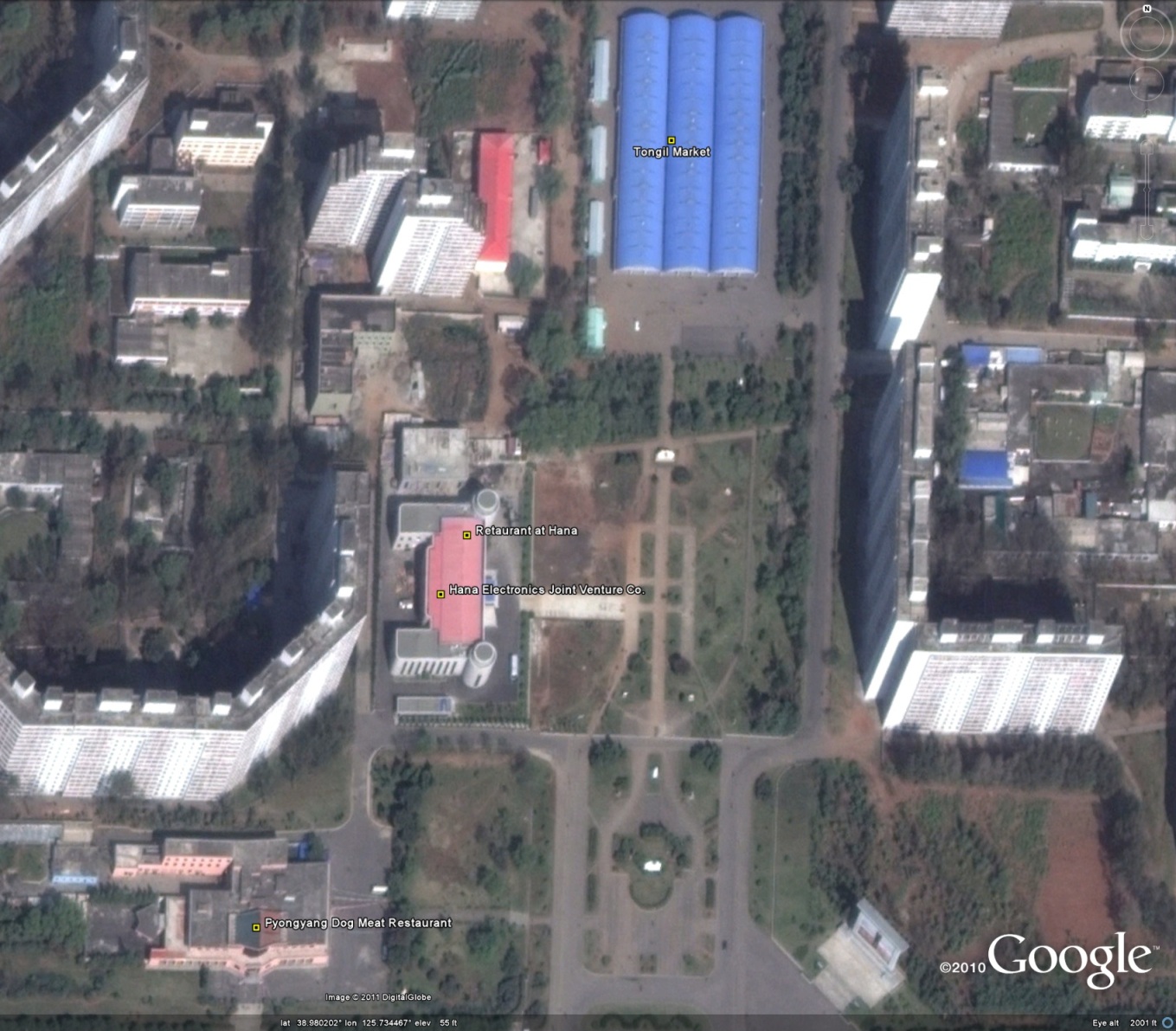
Pictured above (Google Earth): The recently completed Hana Electronics and restaurant building in Rakrang-guyok (락랑구역).  See in Google Maps here.

Phoenix Commercial Ventures has recently launched a new web page and issued the following press release on their latest projects in the DPRK:

FOR IMMEDIATE RELEASE:
Hana Electronics Opens “The Restaurant at Hana”
Pyongyang/London, July 8th 2011

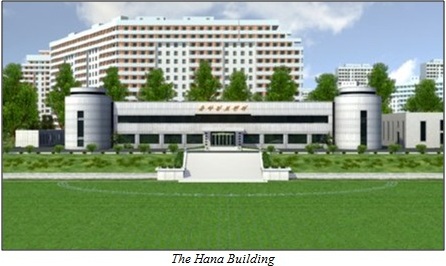
Phoenix Commercial Ventures Ltd (www.pcvltd.com) is proud to announce that Hana Electronics JVC (a 50/50 joint venture based in the DPRK)  completed and moved into its new headquarters based near the T’ongil Market in Pyongyang in Q1 2011.

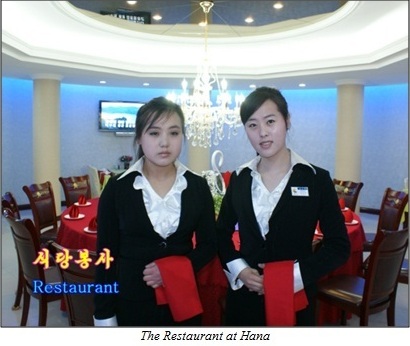
Having moved in and set up its production facilities, Hana has now opened a restaurant (“The Restaurant at Hana”) and related leisure facilities (swimming pool, sauna, hairdresser, bar, gym etc) in its headquarters.

The restaurant (which comprises a main dining room and several private ones) and leisure facilities are open to locals and foreigners alike. Food for the restaurant is sourced from local markets.

A video and photos of the restaurant can be viewed on the Phoenix website.

About Phoenix Commercial Ventures Ltd
Phoenix Commercial Ventures Ltd offers investors business and investment opportunities in the Democratic People’s Republic of Korea (DPRK), enabling them to take advantage of the economic reforms that are taking place there.

Phoenix Commercial Ventures Ltd maintains an office in Pyongyang, almost the only European company to do so, and operates with the following specific aims:

• Identify commercially viable investment projects in the DPRK, on a case by case basis

• Identify reliable local partners for all forms of business in the DPRK, either trade or investment

• Seek overseas investment sources for such projects

• Minimise the risk in such projects, by taking responsibility for supervision of the local set-up procedures and management of the projects

About Hana
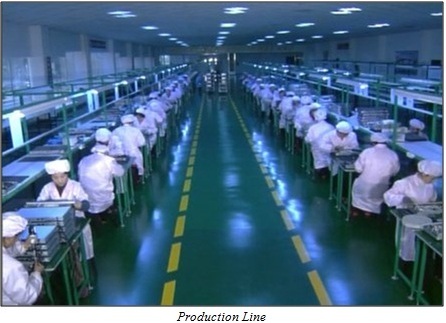
Hana was established in May 2003. In 2004 it began manufacturing and selling DVD and VCD players, as well as pressing and selling CD’s.

When the company first began operations it employed barely a handful of people. Now it employs over 200 people, and has thus become a major employer with significant social responsibilities which it takes very seriously.

Hana have established a nationwide distribution network throughout the major cities in the DPRK. Whilst they manufactured and marketed CD’s, they had an exclusive long term contract with the Mansudae Arts Centre, which belongs to the Ministry of Culture, one of the partners in the JV, for 300 works including; movies, karaoke and other music.

They now produce and sell a range of DVD players, and will move into other consumer electronics products.

Hana is now ranked as one of the top three best performing joint ventures in DPRK, as assessed by the Ministry of Finance.

Hana is proud to have introduced a number of firsts, which show the evolution of the DPRK to a market economy. These include:

• Advertising – the Hana logo, together with the company’s telephone number, appear on every product and packing case

• Offering a guarantee – Hana has also introduced a six-month, no questions asked, guarantee on all products

• Distribution System – Hana have gradually established, from a zero base, a distribution system covering the whole country. They have set up sales offices – for example, in Chongjin, they now have one main office and 13 sub-branches; in Hamhung, they have one main office and 3 sub-offices, and also have offices in Nampo, Sariwon and Sinuiju. They plan to open more outlets, first in the other provincial cities, then in the smaller county seats

• Hana intends to diversify and expand their range of products.

• Hana moved into its newly constructed building, next to the T’ongil Market, in Q1 2011.

• Hana has also opened a restaurant (“The Restaurant at Hana”) and leisure facilities (including a swimming pool) in its new building. The restaurant and leisure facilities are open to locals and foreigners alike.

CONTACT INFORMATION:
Phoenix Commercial Ventures Limited
No. 901
International House of Culture
Ryonhwa-dong
Central District
Pyongyang
Democratic People’s Republic of Korea
Corporate Website www.pcvltd.com

Share

Informal sellers on the rise in DPRK markets

Thursday, July 7th, 2011

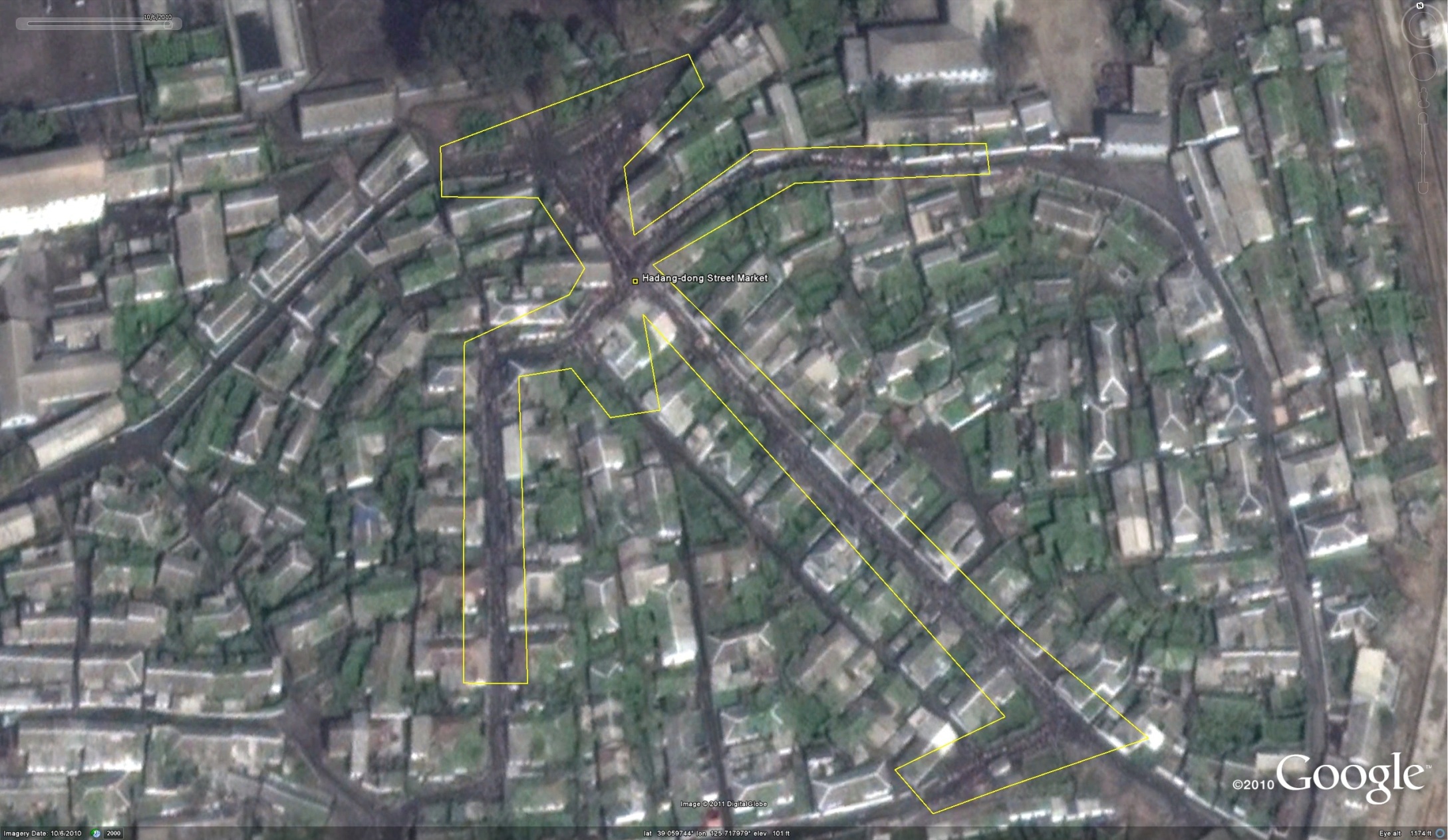
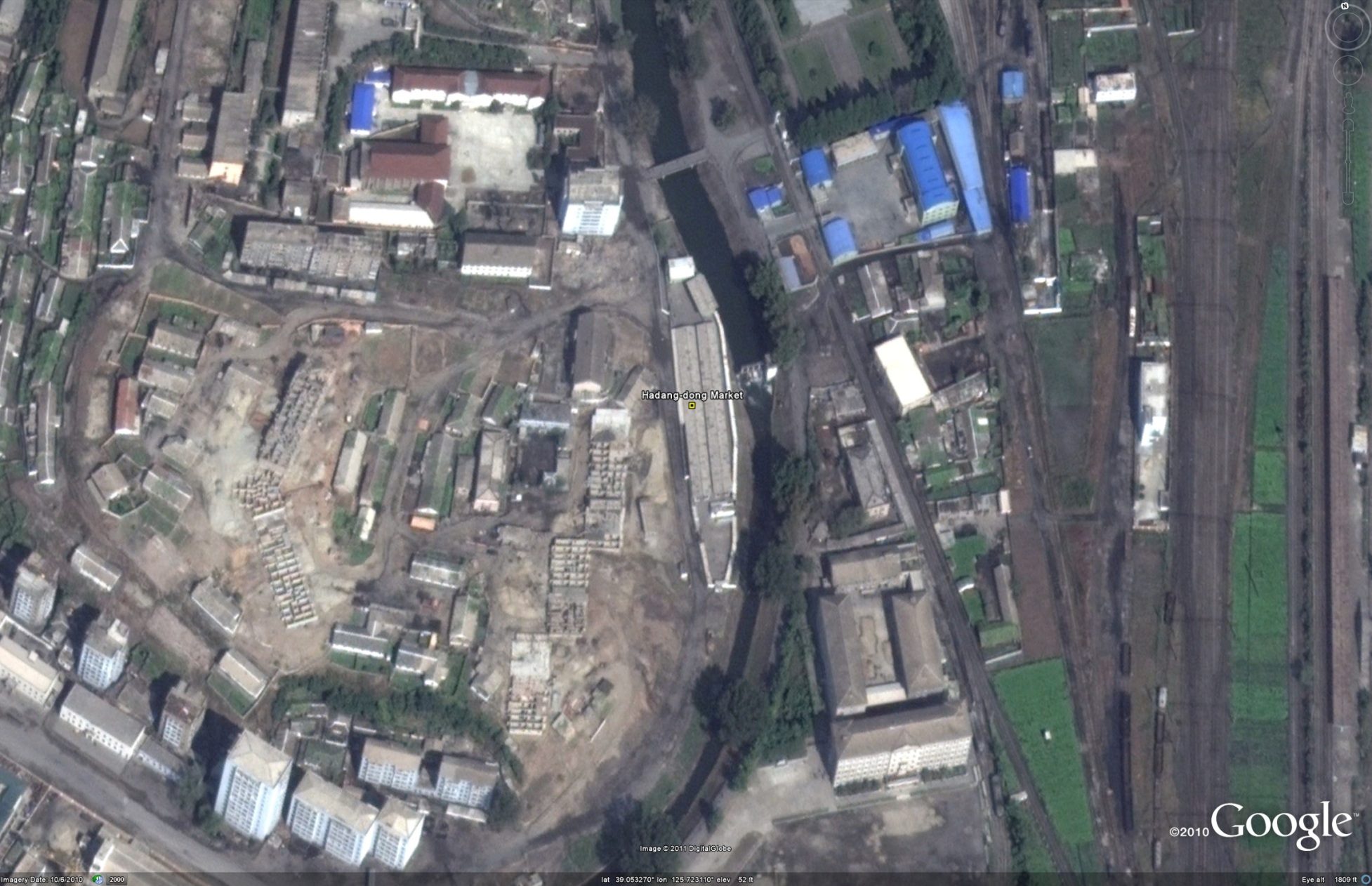
Pictured above (Google Earth, October 2010): (left) informal street market in Hadang-dong, (right) official market in Hadang-dong

According to the Daily NK:

Sources have reported a large increase in the number of ‘grasshopper traders’ in the alleyways around many of North Korea’s markets.

‘Grasshopper traders’ are individuals who conduct their trade activities without an official permit beyond official market boundaries, meaning that when security forces arrive they have to jump, like grasshoppers, to a new location. Growth in this kind of phenomenon would tend to suggest that the class of capital-holding middle class traders is shrinking, while the number of those trading day-to-day in order to make ends meet is growing. It is also related to the fact that official efforts to eliminate grasshopper trading are not as strict as they have been.

One source living in the traditionally more affluent capital, Pyongyang, explained to The Daily NK today that even there, “The number of grasshopper traders has increased a lot of late. There are too many to count,” adding that in the case of Hadang Market, the normal 100-200 grasshopper traders has grown to between 300-400 over a very short period.

Another source from Yangkang Province agreed, saying, “There are grasshopper traders camped in every alleyway around Hyesan Market. People are coming in twice the numbers they normally do, so cracking down on them is not easy.” Other local sources have revealed that markets in the provinces of North Hamkyung and Pyongan are in much the same state.

As expected, with an increasing degree of grasshopper trading comes an increasing number of market watch guards. However, whereas in the past those caught engaging in grasshopper trading stood to lose their wares, nowadays grasshopper traders are just warned about their conduct.

The Pyongyang source explained, “The number of market watch guards has increased by around ten, but their crackdowns are much weaker than they used to be. I know that the authorities have ordered them not to confiscate traders’ wares by force, just to enforce public order.”

This appears to be because the authorities fear that some of their excesses are inflicting too much harm on public opinion.

The Pyongyang source explained, “In many cases people oppose the young market watch guards’ attempts to take the belongings of traders by force, saying ‘they are worse than the Japanese’, and the authorities seem to care about that.”

Officials and the security forces are also being careful about their conduct because of fear of investigation, and this may also be affecting the market environment. Rumors are circulating which suggest that some cadres are being punished for things such as taking bribes.

On this point, the Pyongyang source added, “The central Party is conducting an inspection of the public organs charged with controlling the markets. The word is that people working for these organs are being investigated for things like taking bribes, going to the homes of traders to demand things, or just taking what they want from market stalls.”

Read the full story here:
Grasshopper Numbers Rising Fast
Daily NK
Choi Cheong-ho
2011-7-4

Share

DPRK food prices rising

Tuesday, July 5th, 2011

According to Bloomberg:

North Korean rice prices have quadrupled this year amid concern the regime is facing further economic isolation, according to a South Korean research report.

Rice prices jumped to as much as 2,200 North Korean won per kilogram during the first six months of the year from about 500 won at the end of 2010, South Korea’s state-run Korea Development Institute said today in an e-mailed statement. The difference was mostly caused by a slump in the domestic currency, which is a factor the government considers in setting the price, the report said.

North Korea’s won is not freely traded though the U.S. dollar is the de facto currency used in many markets.

South Korea in May last year cut off most trade with North Korea, accusing Kim Jong Il’s regime of torpedoing one of its warships in March that killed 46 sailors. The U.S. is assessing whether to provide food assistance to North Korea, which is also under United Nations sanctions for its nuclear tests.

The North Korean currency has weakened “sharply” since the regime shelled South Korea’s Yeonpyeong island in November amid concerns worsening relations will lead to further shortages of goods, the report said. North Korea has also increased coal exports to China to make up for the shortfall in trade with South Korea, causing energy shortages, it said.

While the regime lifted its ban on street markets that was placed at the end of 2009, high prices and goods shortages are preventing them from helping meet North Koreans’ needs, the report said.

Read the full story here:
North Korean Rice Prices Quadruple
Bloomberg
Bomi Lim
2010-7-5

Share

Air Koryo revives Pyongyang – Shanghai route

Monday, July 4th, 2011

According to the Choson Ilbo:

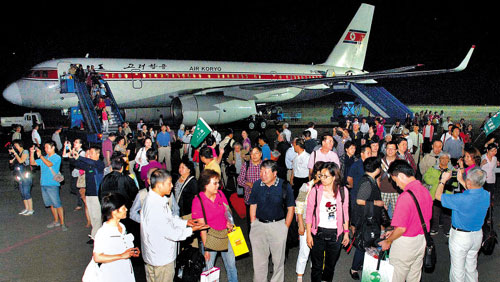
Chinese tourists arrive in Pyongyang on Friday [July 1, 2011] on the inaugural flight of North Korea’s national airline Air Koryo from Pudong Airport in Shanghai to the North Korean capital, in this photo released by Korean Central News Agency on Saturday.

It is the third direct route to Pyongyang from China after flights from Beijing and Shenyang and will operate every Tuesday and Friday.

Additional information:

1. I am not sure about the flights to Shenyang, but the Beijing-Pyongyang route takes place on Tuesday and Saturday.

2. Air Koryo temporarily ran a Shanghai-Pyongyang route last year for “Chinese volunteers” who wanted to visit North Korea for the 60th anniversary of the Korean war.

3. Air Koryo reportedly launched a Pyongyang-Kuwait route earlier this year.

4. No doubt these Chinese tourists will be enjoying the newly “acquired” properties in the Kumgang resort.

4. UPDATE: This from KCNA (2011-8-9):

Many tourists have come to the DPRK by chartered planes.

The Shanghai-Pyongyang air service, which started on July 1, is available on Tuesday and Friday every week.

Tourism through the Xian-Pyongyang air service began on July 28.

Malaysian tourists will come to Pyongyang through direct flight from Kuala Lumpur from August 19.

Along with the increase of tourists, their entry and exit procedures have been simplified.

Under the agreement between the DPRK International Travel Company and a Chinese immigration office, Pyongyang and Pudong airports offer visa exemption to tourists taking the Shanghai-Pyongyang air service.

Share

The Rason Economic and Trade Zone to Adopt the Singapore Model

Thursday, June 30th, 2011

Institute for Far Eastern Studies (IFES)
2011-6-25

Since the June 8 and 9 groundbreaking ceremonies for joint development projects between North Korea and China were held, attention has been directed toward North Korea’s international economic activities. The Japan-based newspaper, Chosun Shinbo, featured an interview article regarding these collective projects, including the areas of Hwanggumpyong and Wiwha Islands and the Rason Economic and Trade Zone.

According to North Korea’s Committee of Investment and Joint Venture, Rason Economic and Trade Zone is, “an important national undertaking following the teachings of Kim Il Sung. . . . Rason will soon become the entrepot port like Singapore, enhancing the lives of North Korean people.”

In addition, it was mentioned that the development of economic zones in Hwanggumpyong and Wiwha Islands will solidify the already strong DPRK-China friendship and expand the boundaries of international economic relations.

According to North Korea’s Committee of Investment and Joint Venture, politically, “Stable political atmosphere allow investors to engage freely in investment activities and necessary legal measures were taken creating favorable legal conditions for foreign investments. This includes the establishment of Joint Venture Law (of 1984) and other related laws.” Economically, “All the necessary substructures supporting the business operation are set. Workers will all be provided free 11-year education and tax rates are the lowest in the region and for those investors investing in sectors that the DPRK is promoting, will be provided with preferential treatment.”

North Korea is encouraging foreign investments especially in the industrial, agricultural, transportation, construction, financial, and tourism sectors. In particular, adopting state-of-the-art production technology is considered most important. This is to increase the area’s competitiveness in the international market through the production of items that have high export value. However, investment restrictions are placed preventing exports on natural resources like ore and coal.

The Committee also stressed the accomplishments of economic cooperation with China and Egypt and revealed plans of passing a double tax avoidance agreement with China, who is the largest foreign investment for North Korea.

The Egyptian company Orascom Telecom has invested in telecommunications, construction, and financial sectors in North Korea. The president of Orascom is said to have met with Kim Jong Il early this year, announcing his plans of expanding investment in the country.

In addition, the Committee reiterated building an independent national economy does not exclude international economic relations. It explained, “We are trying to resolve our shortcomings through international economic activities while maximizing our domestic technology and resources. This is the principle of socialist economic construction.

The Committee of Investment and Joint Venture was established last July, which is a central state organization under the Cabinet overseeing joint ventures and investments. It is in charge of guiding, supervising and administering the inducement of investments from abroad. It is a government body on the level of the Ministry of Trade, which it has close affiliations with. The Ministry is a central organization controlling general trade activities while the Committee is mostly responsible for attracting foreign investment, joint investment, and ventures.

Share

Some alleged guidelines for the Hwanggumphyong SEZ

Friday, June 24th, 2011

According to the JoongAng Daily:

The JoongAng Ilbo has acquired North Korea’s guidelines for Chinese investors at its economic development zone on Hwanggumpyong Island, and many are more liberal than those offered to South Koreans at the Kaesong Industrial Complex.

The date of the document acquired by the JoongAng Ilbo was not known.

According to the guidelines written by a joint committee for the development and organization of the Hwanggumpyong and Rason special economic zone, transactions in Chinese currency are allowed. Independent and joint banks will also be allowed to be established in the zones.

South Korean companies working in Kaesong conduct all business in U.S. dollars. Unlike South Koreans working in Kaesong, investors in the new zones will receive special privileges when it comes to using land. They are free to lease, lend or even bequeath the land to their relatives, as long it is done within a contracted period of time. Those who reside within the special economic zones can also freely use cell phones and are provided with Internet access.

Cell phones are not allowed in the Kaesong industrial complex.

The goal of the zones, the document said, was to “continue to firmly develop the traditional friendship between the two countries,” which was “agreed upon by the two greatest leaders” of China and North Korea, referring to Chinese president Hu Jintao and North Korean leader Kim Jong-il.

“It also supports the hopes and future gains of the people from the two countries,” it said.

The economic zones are also meant to improve North Korea’s manufacturing ability, quality of life for North Koreans and the North’s competitiveness in earning foreign currency, the document added. In order to do so, North Korea’s natural resources would be utilized to their fullest, including human resources, land and minerals.

The document’s role, it said, was to “aid the writing of more detailed development policies.” The guidelines are valid in the 470 square kilometers (181 square miles) of the Rason free economic zone and 16 square kilometers of Hwanggumpyong.

In case the zones fill up, the document hinted at the possibility of a third zone that could be established.

For Rason, the document said three piers leased out to different countries – China, Switzerland and Russia – would be modified to allow vessels of more than 50,000 tons to dock. In addition, new highways, bridges and even an airfield would be built in the area.

At Hwanggumpyong, a new port will be constructed for passengers and cargo vessels between the island and the North Korean city of Sinuiju. The document said the airport at Dandong, which is near Hwanggumpyong, would be “actively utilized.”

The document emphasized that foreign investors’ assets would not be nationalized and that all investors’ legal rights were guaranteed.

The document was written in both Chinese and Korean.

Despite all the promises in the guidelines, analysts remained skeptical as to how successful the trade zones will be. “It’s a mystery as to how many investors will be eager to invest there,” said a diplomatic source in North Korea.

Read the full story here:
Pyongyang promises China investors the moon
JoongAng Daily
Chang Se-jeong, Christine Kim
2011-6-24

Share

Daily NK on anti-socialist activities

Thursday, June 23rd, 2011

Part 1: The Illogicality of Anti-Socialist Policy
Lee Seok Young
2011-6-22

In North Korea today, those actions which are subject to the harshest oversight and most excessive punishment are those deemed anti-socialist, an expression of the extent to which such actions are seen as a threat to the regime.

Yet these very actions have already taken deep root in people’s lifestyles, spreading rapidly as a result of chronic economic difficulties, food insecurity, endemic corruption and the inflow of information from abroad.

First of all, every North Korean and defector the Daily NK meets says much the same thing; that if people had not followed an ‘anti-socialist’ path during the mid-90s famine, they could not have survived. The power which maintains North Korean society through the hardest times is that derived from anti-socialist actions, and it is those actions which the authorities would like to put an end to.

The blocking of these so-called ‘anti-socialist trends’ nominally began with Kim Jong Il’s 1992 work, ‘Socialism Is a Science’, issued following the fall of the Eastern Bloc. A time of great fear for the regime, ‘Socialism Is a Science’ expressed a determination to block out anti-socialist phenomena.

However, a famine exploded nationwide shortly after the publication of the thesis, placing these very anti-socialist modes of behavior at the core of the lives of almost everybody in the nation.

Having completely replaced Kim Jong Il and the Chosun Workers’ Party as the alpha provider of sustenance, money is now uppermost in the minds of the people. If they can, they are moving away from the collective farms, factories and enterprises to become more active in the market.

“At a time when the state didn’t provide rations and workers were not even receiving their monthly wages, the ones who started trading early on were all best able to avoid this predicament,” said one defector, “Others followed after their example and, rather than trying to find work, went straight into the market.”

Money, then, is the fundamental toxin that now threatens to shake the very basis of the Kim regime, completely undermining the ‘let’s work the same, have the same and live well’ lifestyle that the regime has long been demanding from the people.The authorities, as part of a losing battle to halt this slide, ‘educates’ the people with the mantra, “Don’t become a slave to money,” but it makes no difference.

People are growing more and more money-oriented. What simply began as a desperate rearguard action to survive extreme poverty has become a preoccupation with accumulating wealth. The many who don’t have the capital to start a business are keen to work with those who do.

One interviewee, a woman hailing from North Hamkyung Province, told The Daily NK, “They have to keep trying, but they can’t eliminate it. How could they, when the state itself is actually encouraging its spread? Everywhere you go, they demand bribes, and people with money never get punished even when clearly guilty, because everyone is desperate to earn money.”

Given that the central authorities demand Party funds from regional bodies, and regional Party and military cadres in turn work with smugglers, and the cadres charged with inspection turn a blind eye to criminal acts in exchange for bribes, the whole system is, as the interviewee said, rotten from the top down.

One defector who left his position as a cadre in a Yangkang Province enterprise agreed, recalling, “The Party periodically collected money from our factory, but since all the machinery had long since stopped running, they made us work in the market and give 30% of the profits to the authorities. It was the state that promoted anti-socialism in consequence.”

Another defector originally from North Hamkyung Province said in a similar vein, “The National Security and People’s Safety agents stationed on provincial borders stop people without the right permit to travel, but let them pass in exchange for a few packs of cigarettes. Some even ask for your wrist watch. It’s not just the people; the whole nation is busy being anti-socialist.”

Increasing exposure to foreign materials is also influencing the situation somewhat. Such things are especially popular with students and women working in the markets, two groups which are more up-to-date than most.

South Korean and Western culture is being transmitted quickly via DVD, and materials that are brought into the state from China by traders and smugglers are also pushing forward new trends such as the ‘Korean Wave.’

To the North Korean people, who once lived in near complete isolation from the rest of the world, the introduction of foreign materials has intensified their yearnings for a new life style. The stricter the regulations become, the thirstier for something else the people become.

Part 2: Crackdowns Enhancing Anti-Socialist Cycle
Mok Yong Jae
2011-06-23

‘Anti-socialism’ in North Korea is a destabilizing force disturbing the foundations of the system. For that reason, the authorities place a great emphasis on rooting it out. Inspections are frequent and their targets varied. But the fact is that this has done little to stop the growth of such activities; in fact, quite the opposite; some believe that targeted inspections actually increase instances of smuggling, for example.

These focused inspections are handed down in the name of the ‘Party Center’ in other words Kim Jong Il. The latest inspections over anti-socialist trends in border areas have been being carried out by Kim Jong Eun’s direct instruction. First people are educated about and warned against ‘anti-socialist behavior’, then provincial Party and military cadres launch an inspection.

If a concerted inspection is to be unleashed on a given area, an inspection unit is set up, and it does the work. In the case of recent inspections targeting drugs and defection, the inspection units have even been sent from the Central Committee of the Party. The makeup of the unit can differ slightly depending on the target of the inspection, but usually includes agents from the National Security Agency (NSA), People’s Safety Ministry and Prosecutors Office. Precise search sites are usually selected at random and the searches conducted without warning, while ‘criminals’ are flushed out in part by getting citizens to report on one another.

However, the effectiveness of this system has a limit. This is primarily due to an overwhelming degree of official corruption at nearly all levels.

The Spread of Bureaucracy and the Limits of Inspections

The primary agents conducting the inspections, agents from the NSA and PSM, collude with smugglers for their own benefit. Anti-socialist activities are not a new means of survival, and the more commonplace the inspections become, the more focused the agents doing it become on their own self-interest; i.e. rent seeking rather than uncovering instances of wrongdoing.

For example, agents seek out big smugglers only in order to offer them an opportunity for their actions to be ignored, something they will do for a price. A source from Yangkang Province explained to The Daily NK, “Hoping not to lose their goods, also so as to avoid prison, in many cases smugglers try to win over agents. They talk to the official for a while, and if they think ‘this guy can be won over’ then some even gently encourage them to find a way to forego any punishment.”

Then, when the inspecting agents begin dropping heavy hints about expensive merchandise, electronics or a piano, for example, the smugglers say, “I’d be delighted to buy that for you,” and for that receive their freedom.

Thus, it is rare for money to change hands directly; goods are bought in China and handed over when the inspection period has come to a close. The smuggler also obtains a permit to import a certain amount of other goods without penalty in the future. By winning over agents in this way, assistance in future times of trouble can also be secured.

In addition, as Lee Jae Won, the former chairman of the Korean Bar Association Committee on Human Rights in North Korea and someone who has interviewed a great number of defectors as author of the 2010 White Paper on Human Rights in North Korea, concludes, “Anti-socialist activities are extremely common for North Korean cadres in public positions such as prosecutors and judges.” The bribing of prosecutors and judges in exchange for leniency or to escape conviction is a daily occurrence, as much as bribing the security forces and cadres.

What Anti-socialist Counteroffensive? Officials are the source of Antisocialism

Now much more so than in the past, cadres and agents are directly involved in the antisocialist activities.

A Chinese-Korean trader who often goes between Dandong and Shinuiju told The Daily NK, “There are so many drugs in North Korea that even the officers supposed to be policing it are taking drugs themselves. Some of them even asked me to take opium to China and sell it. I go back to North Korea every year to visit relatives, and I’ve seen officers there doing bingdu (methamphetamines) with my own eyes.

It is also said that the families of cadres are the main source of South Korean movies and dramas on DVD. Party cadres are, in effect, the very source of the Korean Wave that their bosses in Pyongyang ban on the premise of defending the state from the ‘ideological and cultural invasion of the South Chosun reactionaries’.

A source from Pyongan Province confirmed the story, telling The Daily NK, “These DVDs and VCDs come from the houses of cadres who travel overseas a lot. The children of cadres love watching them. The families of traders have a lot of them, too, but it’s the cadres they’re spreading from.”

Thus, while the central Party single-mindedly attacks anti-socialist behaviour, the cadres and agents who are meant to be carrying out the orders are deeply involved in the ‘anti-socialism’ themselves. The more crackdowns that occur, the more contact there is between the elite and security forces on the one hand and smugglers and traders on the other, offering more opportunities for symbiosis. It is for this reason that some claim the inspections are actually catalyzing the anti-socialism.

Meanwhile, An Chan Il of the World North Korea Study Center pointed out to The Daily NK that the whole thing is completely inevitable, saying, “These inspection teams are not receiving proper rations from the state, so of course they take bribes instead when sent out into the field. Administrative irregularities and corruption are at the very heart of these anti-socialist inspections. The only way for the families of inspecting agents to survive is for the father to be a part of this anti-socialist behavior.”

Choi Yong Hwan from the Gyeonggi Research Institute agreed, adding, “These inspections are intensifying social inequality. The fundamental cause of this is the collapse of the state rationing system due to economic difficulties. It’s a situation where even the agents are hungry, so there is a permanent pattern of them attempting to guarantee their own survival via corruption. There is a vicious cycle repeating here, whereby those who are able to ingratiate themselves with the inspecting agents and cadres survive, and those who do not or cannot get punished.”

Share

DPRK looking to ink tax deal with China

Thursday, June 23rd, 2011

According to the Korea Herald:

North Korea is pressing to ink a deal with China to prevent double taxation, a pro-Pyongyang newspaper said Wednesday, signaling an apparent bid to attract investment from its key ally and the world’s No. 2 economy.

The isolated country has already signed similar accords with Egypt and 11 other countries and negotiations are under way with other countries, the Chosun Sinbo reported, citing a North Korean official handling the issue of attracting foreign investment.

However, the newspaper, widely seen as the mouthpiece of the communist regime in Pyongyang, did not give any further details.

Earlier this month, North Korea and China broke ground on their border island and the North’s Rason special economic zone to jointly develop the two areas.

The trade volume between North Korea and China stood at $3.46 billion in 2010, up from $2.68 billion in 2009, according to South Korea’s Unification Ministry, which handles inter-Korean affairs.

The North designated Rason as a special economic zone in 1991 and has since strived to develop it into a regional transportation hub near China and Russia, but no major progress has been made.

The North hopes to transform Rason into a regional hub of transit trade like Singapore, and it should expand economic relations with outside world to improve its faltering economy, the newspaper said, citing the North Korean official.

North Korea and China are also likely to complete the repairs of a key logistics road that links the Chinese city of Hunchun to the Rajin port inside the Rason economic zone by October, two months earlier than previously planned, according to sources in Hunchun.

Beijing has secured the right to use the port, which provides China with an export route to other countries.

Read the full story here:

N. Korea pushing to sign double taxation avoidance deal with China
Korea Herald
2011-6-22

Share