Archive for the ‘Economic reform’ Category

Mongolian HBOil invests in Sungri petroleum refinery

Tuesday, June 18th, 2013

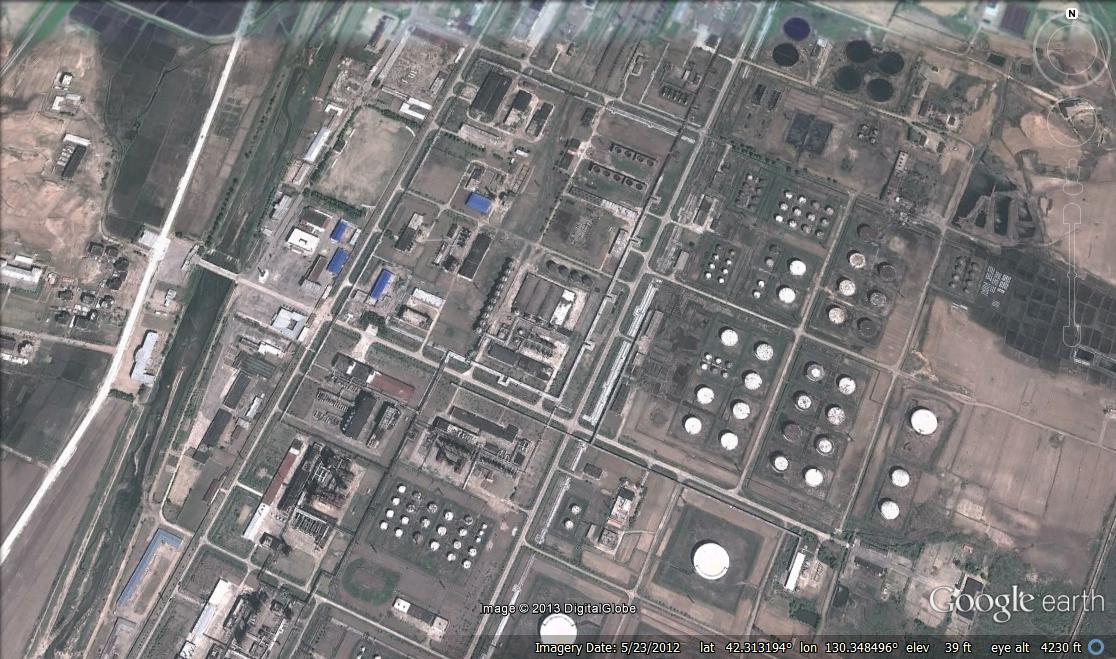
singri-refinery-2012-5-23

Pictured above (Google Earth): The Victory (Sungri) Refinery in Rason, North Korea.

UPDATE 2 (2016-3-25): NK News reports that HBOil refutes the claim in the Joong Ang Daily:

“HBOil JSC … hereby refutes the South Korean publication known as ‘KOREA JOONGANG DAILY’, for irresponsible reporting and dissemination of erroneous news on 23 March 2016; asserting that HBOil JSC has withdrawn from its joint venture in the Democratic People’s Republic of Korea,” the statement read.

HBOil also confirmed, “that it remains fully committed to its joint venture with Korea Oil Exploration Corporation (“KOEC”) of the DPRK, and continues its tenacious efforts to progress the joint venture’s ambition for exploration and development of hydrocarbon resources onshore North Korea.”

HBOil entered into a joint venture with North Korea in 2013 and has attempted to make inroads into North Korea’s undeveloped oil and gas sector.

The company has since invested in projects that could give it access to upstream oil and gas production and downstream refinery capacity in the coming years. However there has not been much reported movement on their North Korean project, and the outlook will not have been improved by a 70 percent drop in oil prices since last year.

While the statement affirmed HBOil’s belief that North Korea represents an “exceptional business opportunity” it also stated that the company are reviewing the implications of the recently adopted UN Security Council resolution against the country.

UPDATE 1 (2016-3-23): The Joong Ang Daily reports that HBoil is pulling out of North Korea:

A Mongolian oil company recently decided to withdraw from North Korea, a South Korean government source said, amid growing pressure from the international community after North Korea recently conducted nuclear tests and long-range missile launches.

HBOil JSC, an oil trading and refinery company based in Ulaanbaatar, Mongolia, acquired 20 percent of the North Korean entity Sungri refinery in June 2013, valued at roughly $10 million. In May 2014, the company opened a joint venture in Pyongyang.

The ex-communist country established bilateral ties with the North in 1948, but after this recent decision, the already impoverished North Korea will be further isolated from the international community.

“Mongolia is sending a message to North Korea: don’t fall down the wrong path,” said Nam Sung-wook, professor at Korea University’s Department of North Korean Studies.

North Korea formerly attracted foreign investment to resume operations of the Sungri refinery, which stopped running in 2009, in order to push for economic development. The deal with Mongolia, begun almost three years ago, was taken as evidence that North Korea wass seeking further investment partners-in addition to China.

However, the North Korean government continually delayed the inland oil development project, failing to provide reasonable explanations. Mongolia may therefore have concluded that there was no practical benefit to continuing the project.

Bilateral ties between the two countries recently turned bitter when Mongolian president Tsakhiagiin Elbegdorj said Mongolia could not endure the North’s tyranny forever, a remark made during his speech at Kim Il-sung University in Pyongyang at the end of October 2013.

“No tyranny lasts forever. It is the desire of the people to live free, that is the eternal power,” the president said in his speech. After his remarks, North Korean leader Kim Jong-un expressed disappointment and refused to hold meetings with the Mongolian president.

ORIGINAL POST (2013-6-13): Clarification:   “HBOil has 20% of a state-dominated joint venture called Korean Oil Exploration Corp. International, and a formal commitment with Sungri has yet to be made. Another option is to invest in a refinery on the west coast of the DPRK.”

According to Bloomberg:

HBOil JSC, an oil trading and refining company based in Ulaanbaatar, Mongolia, said it acquired 20 percent of the state-run entity operating North Korea’s Sungri refinery, according to an e-mailed statement yesterday. It intends to supply crude to Sungri, which won’t be fully operational for up to a year, and export the refined products to Mongolia.

“Mongolia has had diplomatic relations with North Korea for many years,” Ulziisaikhan Khudree, HBOil’s chief executive officer, said in a June 12 interview in Ulaanbaatar. “There are certain risks, but other countries do business with North Korea so I am quite optimistic the project will be successful.”

The investment comes as ex-communist Mongolia seeks to power its mining-led boom while offering sanctions-hit North Korea a bridge to economic reforms. Since Swiss-educated Kim Jong Un took over the leadership of the totalitarian regime in December 2011, Mongolia has pledged to help its Soviet-era ally implement an economic transition similar to its own of the 1990s.

Under the transaction, worth as much as $10 million, the Mongolian Stock Exchange-listed HBOil would swap shares for full ownership of Ninox Hydrocarbons (L) Berhad, a private Malaysian company that owns 20 percent of KOEC International Inc., and issue convertible notes to fund investment at Sungri.

The rest of KOEC International is held by North Korea’s national oil company, Korea Oil Exploration Corp., which also has oil production and exploration rights in North Korea.

“This is a chance to take an equity holding in a foreign entity, and will allow us to import petroleum products, which could be lower than the current price,” said HBOil’s Khudree.

HBOil jumped by the daily limit of 15 percent to close at 253 tugrik (18 cents) on the Mongolian stock exchange today.

The deal will be the first purchase by a Mongolian-listed company of a foreign asset, according to Joseph Naemi, chief executive officer of the Ninox parent, Ninox Energy Ltd. The company is in compliance with international sanctions levied against North Korea, he said.

“If the sanctions change, and if they target the oil and gas industry, that would put us out of business, and we will have to comply,” Naemi said. “That is a risk one takes.”

Naemi said he had briefed his North Korean partners on the transaction and that “they are supportive.” No one was available to speak about the deal at North Korea’s embassy in Ulaanbaatar, which is in the middle of a renovation.

North Korea has three onshore oil basins with “proven working petroleum systems” and the country is conducting exploration for new fields, BDSec brokerage, Mongolia’s largest and the underwriter of the bonds HBOil plans to offer, said in a note to investors yesterday.

The Sungri refinery, located in the Special Economic Zone of Rason City in North Korea’s northeast, has a refining capacity of 2 million tons a year and is connected to the Russian railways system, HBOil said in its release.

Read the full story here:
Mongolia Taps North Korea Oil Potential to Ease Russian Grip
Bloomberg
Michael Kohn and Yuriy Humber
2013-6-18

Share

New developments at Hwanggumphyong

Monday, June 17th, 2013

38 North has published new satellite imagery of Hwanggumphyong that shows new construction taking place on the island.

We can now identify the groundbreaking ceremony stone, management committee building, electricity infrastructure, and construction equipment.

Check it out here.

Previous posts on Hwanggumphyong and Sinuiju SEZ here.

Share

Wonsan-Mt. Kumgang International Tourist Zone

Wednesday, June 12th, 2013

UPDATE 4 (2014-10-2): North Korea reveals Wonsan-Mt. Kumgang International Tourism Zone development blueprints (IFES):

North Korea recently released blueprints for a new tourism zone in the Kangwon area, which is designated as the location for the national goal of developing a global tourist attraction. This area has been officially named as the “Wonsan-Mt. Kumgang International Tourism Zone.” The Wonsan District Development Company, an affiliate of North Korea’s Ministry of External Economic Affairs, introduced large-scale development plans for the Wonsan-Tongchon-Mt. Kumgang “tourism belt” to a crowd of over 200 members of the World Federation of Overseas Korean Traders Association (World-OKTA) at an investment forum held in Dalian, China on September 20, 2014.

At the investment forum, North Korean representatives emphasized that the focus city of this project, Wonsan (population 360,000), is merely 1 to 2 hours away from neighbors China and Japan, and is within a three-hour plane ride from over 40 other cities each with populations of over 1 million. The nation anticipates that, provided tourism infrastructure developments are completed according to plan, the Wonsan-Mt. Kumgang International Tourism Zone could potentially attract up to 1 million visitors annually.

North Korea marked the fourth quarter of 2013 with the opening of the Masikryong Ski Resort and the remodeling of the Songdowon International Children’s Union Camp as iconic projects leading the development of the Wonsan-Mt. Kumgang area. Representatives were quoted as saying, “The Masikryong Ski Resort enjoyed incredible popularity during its opening season last winter, attracting more tourists than hotel facilities could accommodate. . . . The Masikryong Ski Resort has become a huge asset to our nation’s tourism industry, capable of entertaining tourists even during the winter off-season.” Increasing hotel and lodging facilities were emphasized as the next most urgent task.

The Masikryong Ski Resort, located 25 kilometers from the city of Wonsan, was introduced as a resort capable of competing in the international market with its 49.6 kilometers of slopes, outdoor ice rink and swimming pools, and hotel accommodations for up to 360 guests. In addition to accommodation facilities for 12,000 people in Wonsan, 7,000 in Tongchon, and 14,000 people in the Mt. Kumgang area, North Korea also revealed plans for new and additional construction of infrastructure facilities in the Wonsan area—including airports, ports, railroads, roads and electricity—and for expansion of recreational facilities such as golf courses and casinos.

More specifically, construction is planned for a large-scale airport in the Kalma (Galma) Peninsula area of Wonsan which will be able to accommodate thousands of passengers per day [Learn more here and here]. Once completed, foreign tourists will be able to visit the Wonsan-Mt. Kumgang zone directly, with no need to pass through Pyongyang. While the most important project is to repair and expand the roadways connecting inner Wonsan with the Masikryong Ski Resort, Ullim Waterfall, Sokwangsa and Mt. Kumgang areas, North Korea also plans to construct or remodel service facilities within inner Wonsan such as hotels, exhibition centers, athletic facilities, and other business and commerce services necessary to satisfying the needs of tourists.

Overseas investors’ requests to visit the Wonsan-Mt. Kumgang International Tourism Zone for inspection and consulting can be processed within ten days, and North Korea is planning to invite potential investors to an on-site investment briefing to be held in April 2015.

UPDATE 3 (2014-7-29): According to the Pyongyang Times:

Thongchon to be developed as tourist zone

A project is to be launched to develop an international tourist zone in Thongchon County, Kangwon Province, which has lots of tourist resources.

The project is part of the development plan for the Wonsan-Mt. Kumgang International Tourist Zone, according to a decree released on June 11 by the Presidium of the Supreme People’s Assembly.

Thongchon County is situated 52 km south of Wonsan, the capital city of Kangwon Province.

The county boasts Chongsokjong—a group of basaltic stone columns which is known as one of the eight scenic beauties in the northeastern part of Korea, four picturesque lakesides, six sand beaches, nine scenic sites and a treatment mud resource of over 3 280 000 cubic metres.

The tourist zone area covers well over 9 000 hectares.

Tourist facilities for sea bathing and boating will be added to Chongsokjong so that visitors could enjoy sightseeing day and night.

Accommodation facilities with a capacity of over 5 600 people are to be built in the area of Lake Tongjong while the Lake Sijung area will turn into a health and treatment hub with an accommodation capacity of over 1 000 people and a sanatorium equipped with health and fitness facilities.

Detailed plans are being mapped up.

UPDATE 2 (2014-6-12): KCNA has formally announced the Wonsan-Mt. Kumgang International Tourist Zone:

Pyongyang, June 12 (KCNA) — The world-class Masikryong Ski Resort and Songdowon International Children’s Camp were successfully built and areas of Wonsan, Ullim Falls, Sokwang Temple and Thongchon are being peculiarly spruced up as cultural recreation grounds for people in Wonsan-Mt. Kumgang area under the wise guidance of the Workers’ Party of Korea. Koreans and world people are showing ever-growing expectation and interest in world famous Mt. Kumgang and other scenic spots. 

The DPRK decided to set up Wonsan-Mt. Kumgang International Tourist Zone in Wonsan-Mt. Kumgang area in Kangwon Province to reenergize the international tour of scenic spots in the area of Wonsan and scenic spots on the east coast now in the process of turning into world famous tourist destinations.

The international tourist zone includes areas of Wonsan, Masikryong Ski Resort, Ullim Falls, Sokwang Temple, Thongchon and Mt. Kumgang.

The Wonsan area comprises some parts of Wonsan City and Anbyon County, the ski resort area includes some parts of Wonsan City and Popdong County, the area of Ullim Falls comprises some parts of Munchon City and Chonnae County, the area of Sokwang Temple includes some parts of Kosan County, the Thongchon area comprises some parts of Thongchon County and the area of Mt. Kumgang includes the international tourist special zone and some parts of Kosong County and Kumgang County.

The DPRK law on Mt. Kumgang International Tourist Special Zone, the law on economic development zone and the laws related to foreign investment are applied to the relevant areas and objects in the Wonsan-Mt. Kumgang International Tourist Zone.

The DPRK decided to increase new tourist destinations, depending on the progress made in the development of the Wonsan-Mt. Kumgang International Tourist Zone and tour.

The Presidium of the DPRK Supreme People’s Assembly promulgated a relevant decree on June 11.

UPDATE 1 (2013-6-27): The JoongAng Ilbo claims to have a North Korean document called “General blueprint for the Wonsan District”. This document has not been made public, so I cannot vouch for its authenticity or content. However, as reported in the paper, the contents seem fairly congruent with established facts.

According to the article:

According to a document entitled “General blueprint for the Wonsan District” obtained exclusively by the JoongAng Ilbo on Tuesday, North Korea is in the process of constructing three special districts in Wonsan: a financial district, an entertainment and sports area and a tourist destination.

The report says Kim is planning to develop Songdowon Beach in Wonsan into a holiday destination for summers and a ski resort on Mount Masik for winters. Mount Masik is about 20 kilometers (12.4 miles) from Wonsan.

Sources in Seoul say the plan to develop the eastern naval city was actually his father’s.

In fact, in the transcript of the 2007 inter-Korean summit that was declassified Monday, Kim told former South Korean President Roh Moo-hyun that “Wonsan is a holiday destination,” rejecting Roh’s proposal to develop the city into an industrial park like the Kaesong Industrial Complex.

“Wonsan is a bay,” Kim said. “Waste comes into the bay and it can’t be properly managed because of Masik Mountain behind the city. So we will shut down all of the factories and shipyards in Wonsan right away.”

Sources said Jong-un might have decided to turn the city into a tourist resort based on the Kumgang resort, which was jointly run with the South but has been closed since July 2008.

“In Wonsan, there are a series of heavy industry factories, such as automobile plants and shipyards,” a source said. “But North Korea has a plan to close the aging factories and turn the city into a resort.”

Sources told the JoongAng Ilbo in March that North Korea appeared to have moved their MiG jet fighters from an airfield in Wonsan to a frontline unit in Kuup. They also reportedly shut down some factories in the city.

Still, the plan obtained by the JoongAng Ilbo didn’t elaborate on the length of construction or the cost.

“North Korea is hoping to lure investment of more than $1 million from a company in Singapore [for the project],” the source said. “Completion of the project relies on whether they attract foreign investment.”

North Korea has already started construction at Mount Masik, starting with a ski slope, three lifts, an office for ski rentals and a hotel. In phase two, it will build a larger slope, a gas station and a golf course.

ORIGINAL POST (2012-2-24): North Korea planning special economic zone in Wonsan and Mt. Kumgang regions
Institute for Far Eastern Studies (IFES)

North Korea announced plans to develop a special tourism zone in the Mount Kumgang region and recently established detailed plans to connect five countries in the Northeast Asian region by land, sea and air routes. In particular, it specified construction plans for the Tongchon Special Economic Zone (SEZ) in Tongchon County of Kangwon (Gangwon) Province.

Currently, there are four SEZs in North Korea: Rajin-Sonbong (Rason) SEZ, Hwanggumpyong SEZ, the Kaesong Industrial Complex, and Mt. Kumgang Tourism Zone. Tongchon will be a special case where a free economic trade zone will be located within the Mt. Kumgang Tourism Zone linking the areas of Wonsan and Mt. Kumgang.

Growing attention is being paid to the “Tongchon Special Economic Zone in the Mt. Kumgang Tourism Zone.” Industrial service facilities will be built in the Tongchon SEZ along the coastline including, “comprehensive industrial, merchandise, and communication service center zone,” “international multipurpose building zone,” “international finance, trade, and business center,” and a golf course.

Construction inland is currently underway for regular and high-tech industrial complexes in the following areas: IT, LCD, and electronics; home electronics; automobile; new energy and environmental protection; and biomedical and breeding.

Tongchon Port is equipped to accommodate 100,000-ton vessels and there are plans of constructing beaches, a marine park, hot springs, and luxury hotels, and vacation homes in the vicinity.

According to a five-page blueprint for the “Choson Wonsan-Mt. Kumgang Development Plan” (in Chinese), North Korea has set 10 million tourists per year as its goal and is preparing to attract large investment of over 10 billion USD over the next ten years.

Although it is unclear who has prepared the blueprint, it is most likely that North Korea has prepared the plan in Chinese to promote the SEZ internationally. North Korea recently distributed briefing materials in Chinese at the 7th China Jilin-Northeast Asia Investment and Trade Expo (JNIT), which was held last September.

The report included plans of constructing Wonsan International Airport at an estimated cost of 150 million USD.

The ten-year development plan is further divided into three periods: October 2011 to December 2013 (short-term); 2014 to 2016 (mid-term); and 2017 to 2020 (long-term).

In addition, the report included the detailed plans of road and facility renovations. The Pyongyang-Wonsan-Mt. Kumgang highway that stretches 310 km will be renovated with investments worth around 150 million USD. A four-lane highway will also be added. The seaside areas of Wonsan and Mt. Kumgang and the tourism zone will be reconstructed with major facilities and electricity worth 10 billion USD and a new town is also being designed to accommodate a population between 800,000 and 1 million people.

The report “Establishment of International Travel between Mt. Kumgang and Five Countries in Northeast Asia” included details of 18 air routes from Beijing, Changchun, and Shenyang to Wonsan International Airport; 8 sea routes to Nampo Port and the routes from South Korea, Japan, Russia, and the Northern Pacific rim using the port in Mt. Kumgang. In addition, a land route connecting Dandong of China to Mt. Kumgang is also included in the plan, via Shinuiju.

It is designed to develop Mt. Kumgang into an international tourism zone making it accessible by land, sea, and air transportation to South Korea, China, Russia, and Japan.

Specifically, Niigata Port of Japan, Vladivostok Port of Russia, and Jeju, Busan, and Sokcho Ports of South Korea were mentioned as the major ports for the sea travel to North Korea.

Travelers from China will be connected to Mt. Kumgang by rail (from Wonsan to Mt. Kumgang) and by sea (from Rajin-Sonbong Port to Mt. Kumgang Port).

Interestingly, no land route was designated for travel from South Korea. The previously used Donghae Line to travel from Kosung to Mt. Kumgang by road and railroad was omitted from the plan.

Additional information:

1. Check out previous posts on the DPRK’s “Law on Economic Development Zones“.

2. You can read about the DPRK’s plans for a new Wonsan International Airport in this article and in this article with James Pearson.

Read the full story here:
North is building ski, beach resorts in Wonsan
JoongAng Daily
2013-6-27

Share

North Korea making visible progress towards economic reforms

Friday, June 7th, 2013

Institute for Far Eastern Studies (IFES)
2013-6-7

Under the new leadership of Kim Jong Un, North Korea has been making gradual changes with new economic measures. Last year, task force was installed at a state level to configure new economic measures and details are being released one by one.

Details confirmed thus far include the authorities of the administrators of cooperative farms and enterprise are being expanded, which include surpluses can be disposed at the discretion of the administrators of individual organizations. This means voluntary incentives can be now paid to workers to increase production.

The North’s key industries of agricultural and industrial sectors were first to implement such change. The AP reported on April 1, the administrators of cooperative farms and factories were granted the discretionary rights for the promotion of production.

Specifically, the cooperative farms installed smaller work units and each unit of the organization are directly responsible for all the harvest. Whereas all the harvest were required to be sent to the state in the past, surpluses are now can be stored, sold, or exchanged with other goods.

In the case of factories and enterprises, worker’s wages were strictly controlled by the state but after the change, each factory and enterprise can now pay incentives to workers depending on the production results.

Professor Ri Ki Song at the North Korea’s Academy of Social Sciences stated, “individual workers are able to work more to earn more,” and “such policy decision was enforced from April 1 after a period of trial operation.”

New economic measures by the cooperative farms, factories and enterprises that granted each organizations the rights to freely dispose its surpluses is analyzed as an effort to increase production by granting incentives to workers. Increased production is expected to attract active participation of the people in the new economic measures, to achieve a ‘virtuous cycle’ in production.

The increase in goods exchanged between people is changing the existing distribution structure. North Korea is making efforts to ease the planned economy structure in commercial and distribution sectors. In other words, the number and variety of products distributed domestically is increasing and the state is intervening to amend the existing distribution system and strengthen the discretion rights of commercial and industrial institutions.

North Korea’s release of this information regarding the new economic measures to AP and other foreign media after it gained the confidence to properly manage the new economic measure from the successful pilot projects of the new economic measures. However, information released to the foreign media is still limited and changes in other areas including banking and finance sectors remain unknown.

Share

China building new railway lines to DPRK border

Thursday, June 6th, 2013

According to the Wall Street Journal:

On a vast construction site outside this northeastern Chinese city, engineers are working around the clock on a project that could transform the economic—and geopolitical—dynamics of the region: a 223-mile, high-speed rail link to the North Korean border.

The $6.3 billion project is one of three planned high-speed railways designed to bring North Korea closer into China’s economic orbit, even as Beijing supports sanctions aimed at Pyongyang. China is also sinking millions of dollars into new highways and bridges in the area, and the first cross-border power cable.

China’s vision for closer economic integration with North Korea runs counter to a U.S. strategy aimed at piling pressure on Pyongyang to abandon its nuclear-weapons program and refrain from further threats.

(more…)

Share

DPRK seeks to alter commercial distribution system

Sunday, June 2nd, 2013

According to Yonhap:

North Korea is pushing to give greater autonomy to its distribution sector, a senior Pyongyang official said, in what is seen as another sign of the communist country loosening its tight grip on the planned economy.

In an interview with a monthly magazine published by the pro-Pyongyang General Association of Korean Residents in Japan (Chongryon), Oh Young-min, a director of the North’s Ministry of Commerce, said the ministry will overhaul the way wholesalers distribute consumer goods.

“Wholesalers will offer information on all goods — those manufactured under a government plan, surplus products and unplanned goods — and deliver them after receiving orders from unspecified retail networks,” Oh said in the June edition of the magazine obtained by Yonhap News Agency on Sunday.

The ministry is drawing up a detailed plan to revolutionize the commerce and distribution network in order to meet the needs of the new century, the official said, adding that an order system should be implemented thoroughly in order to boost the efficiency of the distribution sector.

In a planned socialist economy, an order system refers to one where goods are produced and distributed based on the amount of orders from users.

The North’s push is widely deemed a follow-up on the country’s new economic management system, which was announced in late June last year.
“In line with the June measure, North Korea appears to be seeking a change of course by granting individuals greater authority in the distribution of goods,” said Cho Bong-hyun, an analyst at the IBK Economic Research Institute.

The move to overhaul the distribution system also comes two months after North Korea reportedly gave greater leeway to managers of cooperative farms and factories in an effort to boost production.

Last year’s reform drive is seen as a step forward from the country’s similar reformist efforts in 2002, when wages and rice prices were sharply lifted to match market levels. Increased money supply following the wage and rice price hikes triggered severe inflation, causing the reform drive to fail, according to experts.

Read the full story here:
N. Korea seeks to ease state grip on distribution
Yonhap
2013-6-2

Share

KoryoLink reportedly reaches 2m customers

Friday, May 31st, 2013

According to Yonhap:

The number of mobile phone owners in North Korea has exceeded the 2 million level, a report said Friday, indicating that one out of every 12 North Korean citizens are using wireless telephone services.

Washington-based Radio Free Asia reported the information, citing a statement released on Wednesday by Naguib Sawiris, the chairman of Orascom Telecom Holding.

The number of wireless phone users stood at around 100,000 in 2009 and 500,000 in mid-2011 before jumping to the 1 million level in February 2012 and the 1.5 million mark in November of the same year.

The Egyptian firm currently provides third-generation wireless service covering 15 major North Korean cities, including Pyongyang, as well as 100 other smaller cities in the communist country with a population of about 24 million.

Read the full story here:
Number of N. Korean mobile phone users tops 2 mln: report
Yonhap
2013-5-31

Share

North Korea promoting extensively for the international product exhibition

Thursday, May 30th, 2013

Institute for Far Eastern Studies (IFES)
2013-5-30

North Korea currently under robust international sanctions has put on extensive advertising campaign for the recent International Product Exhibition [Spring International Trade Fair] held in Pyongyang.

A week has passed since the 16th Pyongyang International Spring Product Exhibition (May 13-16), but the Choson Sinbo, the bulletin of the Japan-based Chosen Soren, continues to run daily articles on the products displayed in the exhibition.

The products displayed at the Pyongyang International Spring Product Exhibition, which is North Korea’s largest trade exhibition, provided a peak at the country’s current industrial trends. Moreover, this year’s exhibition introduced a number of products which are used in the daily lives of North Koreans.

The (North) Korean United Trading Company exhibited over fifty categories of products including colored metal products and a variety of lubricants and ball bearings. Groups including the Sungri Economic Trade Alliance, the State of the Art Technology Development and Exchange Center, the (North) Korean Hard Glass Company, the Pyongjin Bicycle Joint Venture Company, etc. entered products which contribute to improving the lives of North Koreans. The Chosun Sinbo introduced various new products displayed at the exhibition, including shoes was introduced which treats athlete’s foot and dissipates odors with substances such as nano silver as well as complex lactic acid products and other pharmaceutical products made at the Pyongchon Koryo Pharmaceutical Factory.

North Korea also focused on advertisement for automobiles and electronics. Pyonghwa Motors introduced over 30 new models at the exhibition, with the increase in demand. It also boasted that the new models were equipped with lower fuel consumption, reduced by two-thirds.

North Korean media also praised computer products introduced by the (North) Korean Computer Center for its rise in popularity and international competitiveness. The Ryongak Computation Information and Technology Exchange Center introduced a new tablet PC which it dubbed the ‘Yongheung.’ It was reported that buyers welcomed the site for portable profile projectors which had TVs for viewing and allowed for comfortable exhibition of mass media materials.

To overcome the current international sanctions imposed on North Korea, the exhibition is likely to be intended to increase its economic cooperation with the outside world. On May 22, the Chosun Sinbo reported that despite the United States-led economic sanctions on North Korea, many foreign enterprises participated in the exhibition in the hopes of expanding trade with North Korea. It highlighted that the Rason Comet Trade Corporation which is located in China and North Korea’s joint Rason Special Economic District, participated this year for the first time in the Pyongyang International Spring Merchandise Exhibition. The article explained that the Rason Comet Trade Corporation is exporting clothing including t-shirts and athletic wear to Indonesia, Thailand, China, etc. Pyonghwa Motors which exhibited 36 varieties of cars, passenger vans, and buses at the outdoor exhibition center, benefited from meetings with several foreign companies as well as North Korean trade and economic agencies.

The 16th annual Pyongyang Spring Product Exhibition was held from the 13th to 16th of this month and companies from North Korea, Germany, Malaysia, Mongolia, Switzerland, Singapore, Australia, Italia, Indonesia, China, Poland, and Taiwan participated at the event with various products including machineries, electronics, light industry, foods, medical, and chemicals.

Share

DPRK in default on ROK food loans

Friday, May 24th, 2013

UPDATE 2 (2013-5-24): South Korea has again requested that the DPRK repay past food loans. According to Yonhap:

South Korea again called on North Korea Friday to repay millions of dollars in loans provided in the form of food since 2000, the Unification Ministry said.

The impoverished North missed the June 7, 2012 deadline to repay South Korea US$5.83 million in the first installment of the $724 million food loan extended to the North in rice and corn. The latest call is the South’s fifth demand made on the North to repay its debt.

Seoul’s state-run Export-Import Bank (Eximbank) sent a message on Thursday to Pyongyang’s Foreign Trade Bank, calling for the repayment, Unification Ministry spokesman Kim Hyung-suk said in a briefing.

The South Korean bank also sent another message the same day, notifying the North of its forthcoming June 7th deadline to repay the second installment of $5.78 million, the spokesman said.

“North Korea should faithfully abide by what they previously agreed to with the South,” Kim said, calling for the repayment of food loans.

Amid a conciliatory mode under the liberal-minded late President Kim Dae-jung, Seoul started to provide food loans to the famine-ridden country, providing a total of 2.4 million tons of rice and 200,000 tons of corn from 2000-2007.

Under the deal, the North is required to pay back a total of $875.32 million by 2037.

Read the full story here:
S. Korea again asks North to repay food loans
Yonhap
2013-5-24

UPDATE 1 (2012-7-15):  South Korea claims the DPRK missed a deadline for explaining how it intended to repay South Korean “loans”. According to Yonhap:

North Korea missed the deadline Sunday for notifying South Korea of how it will repay millions of dollars in loans provided in the form of food in 2000, resulting in Seoul having the right to declare Pyongyang has defaulted on its debt, an official said.

South Korea sent the North a message on June 15 that the communist nation was supposed to have paid back US$5.83 million in the first installment of a 2000 food loan worth $88.36 million by June 7. The North was required to respond to the message in 30 days.

That deadline passed on Sunday with the North remaining silent, giving South Korea the right to declare the North has defaulted on the debt, according to a government official in Seoul.

But South Korea is unlikely to go ahead with the declaration any time soon as it would have little effect on the North. The communist nation remains largely outside of the international financial system and the prospect of national default is unlikely to force it to repay its debt.

Officials said they are considering sending Pyongyang a message again calling for debt repayment.

Widespread views are that it won’t be easy for the North, which is still struggling with food shortages, to pay back its debt, but officials said the country could repay the debt in kind as it did before. In 2007 and 2008, the North repaid some debt with $2.4 million worth of zinc ores.

After the two Koreas held their first-ever summit in 2000, South Korea provided the North with a total of US$720 million in loans of rice and corn until 2007. Including interest accrued on the loans, the North is required to repay some US$875 million by 2037.

Such aid has been cut off after the South’s President Lee Myung-bak took office with a pledge to link any assistance to the North to progress in international efforts to end Pyongyang’s nuclear weapons programs.

The Daily NK also covered the story.

ORIGINAL POST (2012-6-8): According to Yonhap:

North Korea has not shown any signs of repaying the loans South Korea extended in food grains since 2000 although the initial day of the scheduled repayment passed as of Thursday. The South Korean government provided North Korea grain loans worth US$725 million for seven years until 2007, including 2.4 million tons of rice and 200,000 tons of corn. The total principal and interest North Korea should repay for the next 20 years is estimated at $875.32 million.

North Korea was scheduled to pay South Korea $5.83 million by Thursday for the loans extended to it in 2000. Korea Eximbank, which is in charge of trade finance with the North, notified its counterpart the Chosun Trade Bank of North Korea of the repayment obligation Monday but North Korea had not responded of Friday.

The former South Korean governments led by President Kim Dae-jung and Roh Moo-hyun provided an estimated 1 trillion won (US$850 million) to North Korea from 2000 to 2007 under the sunshine policy. South Korea provided an additional 1.37 trillion won to North Korea to finance the construction of a light water reactor in order to suspend North Korea’s nuclear development. All the loans to the North were taxpayer’s money.

North Korea should show sincerity in the repayment of these loans for the sake of its future. If it fails to do so, the North will encounter substantial difficulties in accessing further loans from the international community. North Korea also has failed to repay loans it borrowed from the old Soviet Union. Russia reportedly had to reduce 90 percent of the Norths loans, worth $11 billion.

If North Korea has difficulties repaying its debts to South Korea in cash, it should sincerely discuss alternative measures to repay the loans with the South Korean government.

The South Korean government should positively consider measures to get the money back in kind, such as in mineral resources. North Korea should understand that if it fails to show the minimum sincerity on the repayment of its debts, it will experience much more difficulty in attracting economic assistance from the outside world.

The Choson Ilbo reports this additional information:

In 2007 and 2008, South Korea also gave the North $80 million worth of raw materials to produce textiles, shoes and soap. At the time, North Korea repaid 3 percent of the loan with $2.4 million worth of zinc ingots. Repayments of the remaining $77.6 million become due after a five-year grace period, so North Korea must start repaying $8.6 million a year every year for 10 years starting in 2014.

Seoul also loaned Pyongyang W585.2 billion (US$1=W1,172) from the Inter-Korean Cooperation Fund so it could re-connect railways and roads with the South that were severed in the 1950-53 Korean War. And it provided W149.4 billion worth of equipment to the North. The North must repay that loan in 20 years with a 10-year grace period at an annual interest of 1 percent.

It also seems unlikely that South Korea will be able to recoup W1.37 trillion plus around W900 billion in interest it provided North Korea through an abortive project by the Korean Energy Development Organization to build a light-water reactor.

The loans amount to a total of around W3.5 trillion, which the South will probably have to write off.

The Daily NK also reported on this story.

Read the full story here:
North Korea should show sincerity in repaying South Korea loans
Yonhap
2012-6-8

N.Korea Misses 1st Loan Repayment Deadline
Choson Ilbo
2012-6-8

Share

Inter-Korean trade tumbles

Tuesday, May 21st, 2013

According to Yonhap:

Trade between South and North Korea tumbled last month after the North shut down the jointly run industrial park in its border town of Kaesong, government data showed Tuesday.

The monthly inter-Korean trade volume came to US$23.43 million in April, down 88 percent from $194.27 million recorded the previous month, according to the data from the Ministry of Unification in charge of inter-Korean affairs.

The April figure is almost similar to the average monthly trade volume of $23.94 million registered in 1995.

In early April, the North banned the entry of South Korean workers and materials into the Kaesong Industrial Complex and withdrew all North Korean workers employed by South Korean firms there in protest against Seoul’s joint military exercises with the U.S. in March.

Trade between the two countries, which remain technically at war since the 1950-53 Korean War ended in an armistice, had steadily increased since late in the 1980’s to register an annual record of $1 billion in 2005.

Read the full story here:
Tnter-Korean Trade Tumble
Yonhap
2013-5-21

Share
