Archive for the ‘Economic reform’ Category

DPRK Economic Development Commission

Friday, September 6th, 2013

UPDATE 5 (2013-10-31): North Korea Opens Fourteen Special Economic Zones Nationwide (IFES):

North Korea announced that it has opened fourteen special economic zones (SEZs) in various provinces this year.

The Rodong Sinmun, official newspaper of the Workers’ Party of Korea (WPK) covered the news about the Pyongyang International Conference on Special Economic Trade Zone held from October 16 to 17, 2013. This conference was convened by the Korean Economic Development Commission.

According to the newspaper, a law professor from Kim Il Sung University, Dr. Kang Jong Nam, presented at the conference and said, “There are four well-known special economic zones in our country: the Rason Economic and Trade Zone, Hwanggumpyong and Wiwha Islands Economic Zones, Kaesong Industrial Complex, and Mount Kumgang International Tourism Zone. But from this year, fourteen new economic zones were established.” However, details on where these fourteen new SEZs are located were not disclosed.

Kang added, “To meet the growing demands for development, operation and management of new economic development zones, increasing legal measures are being taken to reinforce the development with establishment of new laws or amendment of existing laws.”

North Korean leader and Chairman of the National Defence Commission Kim Jong Un made a statement at the WPK Central Committee meeting in early March, saying that economic development zones be established in each province, taking into consideration the special characteristics of each region.

Experts confirmed that North Korea has officially announced its plans to develop Wonsan and Chilbosan as tourism zones this year. SEZ development of Kangryong District in Southern Hwanghae Province began from last July.

In addition, the Korean Central News Agency announced on October 17 that ‘Kaesong High-Tech Industrial Park’ will be jointly developed by North Korea and foreign consortium, and this is likely to be one of the new fourteen SEZs built this year.

North Korea is actively hosting international forums targeted to attract foreign investment into the country, with experts from Canada, Malaysia, the United States and other foreign countries attending.

The Rodong Sinmun also quoted Director Choe Hyon Chol of the Korean Association of Economic Development: “It is crucial to educate and train experts to work in the economic zones and this will be the next step for the development of SEZs.” He also said that “We are willing to participate in various functions such as international forums, investment briefings, and exhibitions to encourage more international investment and cooperation.”

Meanwhile, on October 21 the KCNA reported on the extended cabinet plenary meeting. At the meeting, reports were given on the performance of the third quarter of the national economic plan and measures to successfully implement the plans for the fourth quarter. The central agenda for the last quarter is increasing production of coal and steel products and improving agricultural and light industries to resolve the shortage of food and consumer goods for the people. In addition, improvement in education, health services, and sports sectors were named as imperative areas to recover the country’s status as a powerful socialist nation. Specific tasks and strategies of the fourth quarter were presented at the meeting for the implementation of the national budget.

UPDATE 4 (2013-10-31): Rodong Sinmun follows up on the Economic Development Commissions’ conference on Special Economic Zones:

On Oct. 16 KCNA reported that the Pyongyang International Conference on Special Economic Zone (SEZ) development opened. Many foreign sources conveyed the news, each with their own comments.

Economic experts from without were not many in number, but each of the attendants was a specialist who had either been involved in successful development of SEZ in Asia and the rest of the world or rich in relevant research experience.

Among the organizers of the conference was Prof. Kyung Ae Park, director of the Center for Korean Research, University of British Columbia, who played a big role in inviting experienced specialists and scholars to the conference.

The first foreign speaker on the first item on the agenda was professor of the Chinese University of Hong Kong.
Exchanged at the conference were experience on SEZ development in Vietnam, Malaysia, India and many other Asian countries.

Economists and specialists from Canada and the U.S. also spoke at the conference.

Many speakers expressed their unusual feeling of having the opportunity of academic exchange on SEZ development in the city of Pyongyang.

Impressions on Pyongyang were in some points common to all. They said in one voice that Pyongyang, the capital of the DPRK, is beautiful and peaceful, and that Korean economists and specialists were very sincere and enthusiastic in their attitude to the SEZ development.

All the attendants of the conference, both from within and without, expressed thanks to the Korean Economic Development Society, the sponsor, and Kyung Ae Park, organizer, of the conference, which was conducive to seeking a new way of economic development that suits the needs of the 21st century.

UPDATE 3 (2013-10-24): North Korea Launches New Economic Development Organizations (IFES, 2013-10-24)

North Korea announced that it had installed the State Economic Development Commission to oversee the national economic development.

The Korean Central News Agency (KCNA) reported on October 16 that preamble to raise the existing General Bureau for State Economic Development to State Economic Development Commission was adopted at the recent Presidium of the Supreme People’s Assembly. Details for appointment of officials and function of the commissionareyet to be announced.

The bureau was established in 2011 to design and carry out the 10-year plan for the development of the national economy. The elevation of this institution from bureau to commissioncan be interpreted as increasing emphasis on economic development.

In particular, the State Economic Development Commissionis likely to serve as the control tower, overseeing the development of special economic zones and the 10-year economic plan.

The KCNA also reported on the establishment of a non-state organization called the Korean Economic Development Association. As the news explained, this organization was installed for the purpose of “attracting interests of economic, business, and academic communities from abroad in special economic zones (SEZs)” and “to promote SEZs to companies and organizations of other countries to draw investments for development in these areas.”

The association is expected to organize and provide support services to foreign investors and coordinate debates, conferences, exhibitions, economic information exchanges, and provide advisory services, in accordance with government mandates and investment agreements. Essentially, the association’s chief focus is to attract foreign investments into SEZs and provide various services to assist their activities in the economic zones.

The news reported the first project of the association was the organization of the “Pyongyang International Conference on Special Economic Zones (SEZ) Development,” held at the Yanggakdo International Hotel. The conference brought together economic experts from North Korea, the United States, Canada, India, and Malaysia. The association’s contact information (phone and fax numbers;email address)were also released.

The launch of a non-state organization for the promotion of SEZs is a first for North Korea. This is considered as a follow-up measure to the Law on Economic Development Zones, which was enacted in June 2013.

UPDATE 2 (2013-10-23): Rodong Sinmun follows up on the Economic Development Commissions’ conference on Special Economic Zones and reports that there will be 14 Economic Development Zones:

An International Conference on Special Economic Zone (SEZ) Development was held in Pyongyang, the beautiful capital of Juche Korea on Oct. 16 and 17 under the sponsorship of the Korea Economic Development Association. It proceeded in an amicable atmosphere with the participation of competent economic professors and experts of Canada, Malaysia, U.S., Vietnam, India and China, economists and researchers of the Korea Economic Development Association, Kim Il Sung University, University of National Economics, Wonsan Jong Jun Thaek University of Economics and Academy of Social Sciences and officials of various fields who were striving to develop regional economy in Rason City and other areas.

The conference heard first the speeches of Vice-chairman of Korea Economic Development Association Ri Chol Sok and Prof. Kyung Ae Park from University of British Columbia, who was the organizer of the conference. It discussed 6 themes. The matter of primary concern at the conference was the actual situation and prospect of special economic zone development in the DPRK and the legal system related to it. Officials of the Korea Economic Development Association and professors of Kim Il Sung University spoke of this matter.

Thanks to the measures of the DPRK government, Rason Economic Trade Zone, Hwanggumphyong-Wihwado Economic Zone, Kaesong Industrial Zone and Mt. Kumgang International Tourist Special Zone have already been created and this year witnessed the establishment of 14 economic development zones. In conformity with this, legal measures for development, management and operation of the special economic zones were newly taken and the existing laws are being revised and supplemented.

At the session held on the theme “Next Steps for DPRK Economic Zones” held prior to the closing ceremony, Choe Hyon Chol, director of the Korea Economic Development Association, explicated the prospects for development of the special economic zones in our country and hoped for broad and positive international cooperation.

The Pyongyang International Conference on Special Economic Zone Development held under tense situation was an important occasion showing the peace-loving stand and policy of the WPK and DPRK which are concentrating efforts on the development of economy and improvement of people’s living standard.

Here is coverage of this report in Yonhap.

UPDATE 1 (2013-10-17): In September, IFES reported the creation of the DPRK’s Economic Development Commission” (See original post below). It appears that KCNA has finally announced its creation. According to KCNA in two different articles:

General Bureau for State Economic Development Renamed

Pyongyang, October 16 (KCNA) — The DPRK decided to rename the General Bureau for State Economic Development the State Economic Development Commission.

A decree of the Presidium of the DPRK Supreme People’s Assembly was promulgated on Wednesday in this regard.

And…

Economic Development Association Organized in DPRK

Pyongyang, October 16 (KCNA) — The Economic Development Association was organized in the Democratic People’s Republic of Korea.

As a non-governmental organization, it helps foreign businesses and entities to get a better knowledge of special economic zones in the DPRK and to make investments in them.

It is also working to assist business activities of foreign investors in the zones.

As part of its first work, it hosted the Pyongyang International Conference on Special Economic Zone (SEZ) Development in Pyongyang starting from Wednesday, attended by economists from Canada, Malaysia and the United States.

The details to contact with the association are as follows:
Tel: 00850-2-381-5912
Fax: 00850-2-381-5889
E-mail Address: [email protected]

Here is the Korean version of the articles:

국가경제개발총국을 국가경제개발위원회로 하기로 결정

(평양 10월 16일발 조선중앙통신)조선에서 국가경제개발총국을 국가경제개발위원회로 하기로 결정하였다.

이와 관련한 조선민주주의인민공화국 최고인민회의 상임위원회 정령이 16일 발표되였다.(끝)

조선경제개발협회 조직

(평양 10월 16일발 조선중앙통신)조선경제개발협회가 조직되여 자기 활동을 시작하였다.

협회는 다른 나라의 기업들과 단체들이 조선의 특수경제지대들에 대하여 잘 알게 하고 그 진출을 협력해주는 민간급단체이다.

조선의 특수경제지대개발에 도움이 되는 투자토론회, 상담회, 전시회, 경제정보교류, 자문봉사, 정부의 위임에 따르는 투자합의, 투자가들의 기업활동방조 등 다양한 봉사를 제공하고있다.

협회는 앞으로 조선의 특수경제지대개발에 관심을 가지거나 투자에 참가하는 여러 나라 경제계와 기업계, 학계의 광범한 인사들의 리익을 도모하기 위해 자기의 역할을 끊임없이 높여나가게 된다.

조선경제개발협회는 첫 사업으로서 카나다와 말레이시아, 미국을 비롯한 여러 나라의 경제전문가들을 초청하여 16일부터 특수경제지대개발에 관한 평양국제토론회를 주최하고있다.

협회는 전화 00850-2-381-5912와 확스 00850-2-381-5889, 전자우편 [email protected]로 기업, 단체들과 련계하고있다.(끝)

I am unsure of the difference between the “Economic Development Commission” and the “Economic Development Association”, but they appear to be the same organization. The same name difference is apparent in the Korean articles as well: 조선국가경제개발총국, 조선경제개발협회. I also assume this is the same “Economic Development Commission” reported by IFES in September and posted below.

The first high profile event of the Korea Economic Development Association/Commission was an event: The Pyongyang International Conference on Special Economic Zone (특수경제지대, SEZ) Development. Below are articles on the event:

KCNA (2013-10-16):

International Conference on SEZ Development Opens in DPRK

The International Conference on Special Economic Zone (SEZ) Development opened at the Yanggakdo International Hotel in Pyongyang on Wednesday, with economists from the Democratic People’s Republic of Korea, Canada and other countries in attendance.

In this regard, KCNA met Ri Chol Sok, vice-president of the Korea Economic Development Association.
Ri said:

The conference takes place at a time when the DPRK is paying deep attention to developing special economic zones in local areas, as the Rason Economic and Trade Zone.

The conference deals with present-day situation and prospect of the special economic zones in the DPRK and its laws for SEZs, characteristics of special economic and exports processing zones in China and Vietnam as well as the experiences gained in developing them.

It also introduces the roles the zones play in the economic development in each country.

The DPRK has constituted a series of laws for ensuring free business activities in the zones.

Meanwhile, the country is making efforts to improve economic management methods, while consolidating the socialist economic system.

This conference will mark a good occasion in promoting international exchange and cooperation and in developing the economy of the country.

Xinhua:

The Democratic People’s Republic of Korea (DPRK) said Wednesday it would establish special economic zones open to investment from “any country.”

Ri Chol Sik, deputy head of the Korea Economic Development Association (KEDA), told the first international conference on Special Economic Zone (SEZ) development here that the DPRK was preparing to open many SEZs at provincial level, with legal protection and preferential policy already set up.

“Policies and regulatory environment and their implementation are critical to the success of SEZs,” said Bradley Babson, chair of the DPRK Economic Forum at the U.S.-Korea Institute at John Hopkins School of Advanced International Studies.

A DPRK professor with Kim IL Sung University told Xinhua the seminar was “a great opportunity for our people to learn from other countries’ successful experience on SEZs.”

The seminar, sponsored by KEDA and co-hosted by Park Kyung Ae, director of the Canada-DPRK Knowledge Partnership Program (KPP) at the University of British Columbia, Canada, was attended by DPRK scholars and officials and dozens of foreign economic specialists from countries such as the United States, Canada, China, Vietnam, India, and Malaysia.

Park told Xinhua it was a chance to exchange ideas and promote cooperation between DPRK and the outside world. She has been engaging for years in a KPP academic exchange program, which sends DPRK professors to study and do research in Canada.

KEDA, a newly formed non-government organization, aims to support activities by foreign businesses and scholars interested in the country’s special zones, said KCNA, DPRK’s official news agency.

The non-governmental association, the first of its kind in DPRK, arranges meetings, supports business activities and offers information and consulting to prospective investors.

Also on Wednesday, the National Economic Development General Bureau was renamed the National Economic Development Committee, KCNA said.

And from KCNA on 2013-10-17:

Ri Chol Sok, vice-president of the Korean Economic Development Association (KEDA), said in his closing address at the Pyongyang International Conference on Special Economic Zone (SEZ) Development that other countries’ experience would be helpful to the DPRK seeking to create economic development zones in its localities.

The conference was held at the Yanggakdo International Hotel on October 16-17, with the attendance of KEDA officials, professors of Kim Il Sung University, University of National Economy, Academy of Social Sciences and other related institutions and economists of the DPRK and experts of academic and economic circles of different countries, including University of British Columbia in Canada, Chinese University of Hong Kong, University of Delhi in India, Planning & Economic Research in Malaysia and University of Wisconsin in the United States.

It focused on such matters as the features of SEZ planning and the study of its examples, management and investment in SEZ and development course of SEZ.

Its participants presented papers on experience and lessons of some countries and valuable propositions and exchanged their views on the prospect of SEZ development in the DPRK and international cooperation in this respect.

Professor Pak Kyong Ae of University of British Columbia in Canada recalled that the conference was conducive to establishing and putting into practice the strategy of comprehensive economic development including the creation of SEZs.

The professor hoped that the good ties forged between the participants through the conference would lead to continuous exchange.

And from Xinhua (2013-10-17):

The Democratic People’s Republic of Korea is hosting an international conference to explore ways of developing its economy. Earlier this year, the country announced a new law governing new economic zones.

A sign of new climate in economic development, thirteen foreign academics and experts from countries including the US, Canada, India, China, Malaysia and Vietnam gathered in Pyongyang on Wednesday for an international economic conference.

They joined about 60 economists from the Kim Il Sung University, the Academy of Social Sciences, and other local institutions.

The conference comes as economic zones are starting to be created all over the country. On June 5th, the DPRK’s state news agency KCNA announced a new law governing special economic zones. Foreigners can now invest in the new economic zones with preferential conditions for land-use, employment and tax.

The DPRK has experimented with special economic zones for years. In the early 1990s, the DPRK set-up the Rason Special Economic Zone in the far northeast, but it made little progress until recently being reinvented as a joint project with China.

Another DPRK-China joint economic development project on the border between the two countries at Hwang-gum-pyong is still at a much earlier stage of development.

The joint industrial zone with South Korea at Kaesong has not long reopened after a months-long shutdown earlier this year due to tensions on the peninsula.

The new law on special economic zones is one of a number of signs that the DPRK may be seeking to speed up its economy.

Here is coverage in Yonhap (2013-10-16):

North Korea has established a private organization to develop special economic zones, its media said Wednesday, following toughened business sanctions slapped on the communist country for its nuclear weapons test earlier in the year.

The organization, dubbed the Korean economic development federation, aims to support activities of foreign businesses and scholars interested in the special zones in North Korea, the Korean Central News Agency (KCNA) said.

The regime’s news wire added that the organization will arrange meetings, support business activities and offer consulting and information to prospective investors.

As part of its first official activity, the federation arranged an international conference attended by United States, Canadian and Malay economists that kicked off earlier in the day in Pyongyang, the KCNA said.

North Korea observers said that the creation of a civilian entity to manage a handful of special zones is a first for the communist country and that it follows the revision of related laws in late May aimed at fueling growth and attracting more foreign investors.

“The federation seems to be a copy of similar private sector organizations in capitalist countries and shows the importance placed on pulling off economic growth by the Kim Jong-un government,” said Lim Eul-chul, a research professor at Kyungnam University in South Korea.

Other experts said with the toughened sanctions from the United Nations, the North may be seeking to circumvent the existing business and trade restriction by creating a private body.

Here is coverage in the Daily NK:

According to an October 16th report by Chinese news agency Xinhua’s correspondent in Pyongyang, Yoon Yong Suk, who is in charge of the Chosun Economic Development Committee, recently spoke at the “Pyongyang International Symposium on Special Economic Zone Development,” held at the Yanggakdo Hotel. He said, “We are actively preparing to establish special economic zones in all provinces and introduce foreign capital.” Chosun Economic Development Committee is a “non-state” institution established for the purpose of developing special economic zones.

He explained, “At the Central Committee meeting last March, it was decided that special economic zones should be established in each province, and tourist areas, too, in order to invigorate the tourist industry, and bring about greater diversity in international trade. Currently, each province is moving forward with the establishment of development zones and the task of attracting foreign currency, in accordance with the plan.”

“It is the consistent policy of our country to develop the Rason Special Economic Zone, the Hwangguempyeong and Wihwa Island areas, Mt. Geumgang International Tourist Area, and economic development zones in each province,” he added. “We will find practical and logic means by which to expand economic, trade and scientific exchanges, as well as enhance understanding, exchanges and contacts with governments, private industry, and private groups.”

On October 1st, Daily NK reported that economic officials in provincial areas of North Korea had been ordered to formulate plans for the designation of two candidate cities for development, and that legal and systemic modifications were being investigated, in order to try and ensure interest from foreign capital.

According to Daily NK’s information, the profit derived from joint ventures would be shared 50-50; owever, foreign companies would only have to cover the cost of land use and wages.

Naenara, one of the DPRK’s official web portals, has also posted lots of content on the meeting. See here, here, here, here, here, and here. I have compiled all these articles into this PDF.

Read full story here:
N. Korea sets up civilian body for special economic zones
Yonhap
2013-10-16

ORIGINAL POST (2013-9-6): On May 29, the Presidium of the Supreme People’s Assembly promulgated the “DPRK Law on Economic Development Zones“. Now it appears they have named a body to administer the law. According to the Institute for Far Eastern Studies (IFES):

DPRK Economic Development Committee launched: Special economic and tourism zones to be named (IFES)

In the wake of normalizing the Kaesong Industrial Complex (KIC) agreement, North Korea has announced that it had installed the Economic Development Committee and named special economic and tourism zones, as well as newly appointed officials in charge. In the near future, North Korea has plans to announce specific special economic zones in Sinuiju, Nampo, and Haeju, along with tourism zones in Mount Baekdu, Wonsan, and Chilbosan. The head and director-level executives for the Economic Development Committee are likely to be appointed from the Joint Venture Investment Committee. The head of the Tourism Development is reported to be the former director of Korea Tourism Administration.

Meanwhile, North Korea has released the preamble of the economic development law adopted at the recent Presidium of the Supreme People’s Assembly held on May 29. As inter-Korean relations are progressing with the plans of restarting the Kaesong Industrial Complex and the reunion of separated families moving forward, North Korea’s economic development law is drawing attention once again.

In principle, the selection process for the special economic zones must possess these following elements: Area must 1) be in a favorable location for foreign economic cooperation and exchanges; 2) contribute to the economic and science and technology development; 3) be at a fixed distance from the residential areas; and 4) be at a location that does not intrude in the state protected areas (Article 11). This can be interpreted as the North’s effort to segregate the existing residential areas with the special economic zone similar to the Kaesong Industrial Complex so as to minimize the political and social impact of these zones.

The newly confirmed information for the new Economic Development Law is the list of development activities. “Investors from other countries are permitted to develop economic zones either alone or in collaboration after obtaining state approval (Article 20).” Evidently, North Korean institutions and enterprises may also develop economic zones after receiving approval from the state.

In addition, the law granted comprehensive property rights to the development companies. It states that “Companies have the right to sell, re-lease, bequeath, or transfer the ownership of the buildings and land lease” and “the selling or re-lease price shall be determined by the development company” (Article 29).

As for recruitment of workers, there is a provision that states “our country’s labor force must be given preferential consideration” (Article 41), and “the minimum wage for the employees of the Economic Development Zone shall be determined by central guidance organization of special economic zone” (Article 42). This poses some concern as the employee wage at the Economic Development Zone could be compared to that of the KIC, which could lead to wage disputes after the KIC begins to implement its internationalization process.

Another noteworthy change is the currencies permitted at the zone: “currency for circulation and payment must be Korean Won (KPW) or other specified currency” (Article 46), suggesting that other currencies such as the US dollar and euro will be allowed.

Furthermore, the Act specifies that “Companies in the economic development zone will decide on the commodity and service prices, and all the prices in the Economic Development Zone between institutions, enterprises and organizations shall be determined by the international market price based on agreement of all the parties” (Article 43). This suggests that the products produced in the zone may be traded domestically in North Korea.

In this Act, corporate income tax rate was set at 14 percent of profits and “Economic Development companies that operate for more than 10 years will be considered for a tax cut or exemption from the corporate income tax.” Article 58 grants “communication guarantees” for the usage of mail, telephone, and fax services, but did not include the use of the Internet.

Posts on the DPRK Law on Economic Development Zones can be found here.

Share

North Korea enthusiastically promoting tourism industry to attract foreign investments

Thursday, August 29th, 2013

Institute for Far Eastern Studies (IFES)
2013-8-29

The Korean Central News Agency reported on August 24 that a tourism briefing session was held in Pyongyang for the purpose of attracting foreign investment.

The state-run Korea International Travel Company (KITC) opened a briefing session at the Yanggakdo International Hotel to explain the preferential treatment for foreign investments. Officials from various embassies, along with Chinese, English, and German travel agency representatives were present at the briefing session.

Cho Song Gyu, president of Korea International Travel Company, said that “tourism districts will be operated as special tourism zone and all management activities such as customs, tax, communication, and investment protection will be guaranteed in accordance with the special zone law and international standards.” It was said that investments of foreign owned enterprises and joint venture companies are to be given priority.

President Cho added, “There are plans to invite foreign experts to improve other special tourism zones such as Wonsan and Mount Chilbo districts.”

North Korea recently disclosed plans of developing mountains Baektu, Kumgang, and Chilbo, with plans of constructing ski resorts in these areas.

In addition, North Korea’s tourism policy is rapidly changing and significant ease on restrictions can be observed on foreign tourists. Unlike in the past, tourists are now allowed to travel to North Korea at any time of the year, with fewer date restrictions.

Meanwhile, North Korea’s economic journal is attracting attention as it argues for the diversification of foreign investment. This call for diversification might reflect a North Korean concern about China’s growing investment in North Korea’s resource sector.

In the current issue of Kyongje Yongu (Economic Research, July 30 issue), North Korea’s quarterly economic journal, it was stated that “Foreign companies in our country are heavily concentrated in joint ventures with domestic companies in the collection industries and their main interest is in developing natural resources.”

The article analyzed that investments by foreign companies are largely concentrated in natural resources development, as they are trying to secure raw materials necessary for production activities. In addition, the article called for improvements in the method and diversification of foreign investment as it stressed that without any intervention, the situation could lead to negative results.

Most of the foreign investment in North Korea is known to be from China. Last year, gold mining companies and Chinese enterprises signed joint venture agreements one after another, displaying Chinese companies’ growing interest in North Korean mines.

Here is the story from KCNA:

Tourism-related Explanation Session Held in DPRK

Pyongyang, August 24 (KCNA) — A tourism-related explanation session, sponsored by the International Travel Company of the DPRK, took place at the Yanggakdo International Hotel here Saturday.

Present at the session on invitation were staff members of foreign embassies in DPRK and representatives of travel companies from China, Britain, Germany and other countries.

Addressing the session, Jo Song Gyu, head of the International Travel Company of the DPRK, referred to the development of tourism in the DPRK and its policy on tourism.

Mts. Paektu, Kumgang and Chilbo, Wonsan City and other scenic spots and areas in the country have turned into recreation grounds and tourist resorts and a brisk drive is being conducted to further develop them, he noted.

The tourist resorts will be run in the form of special zone for tourism and all the management activities such as passage through boundaries, customs, taxes, communications and investment protection will go by the DPRK’s relevant law on special zones as well as the international rules, Jo said.

He further said that businesspersons and investors of any countries and regions interested in tourism of DPRK would be welcomed and preference be given to private and joint-venture and collaboration businesses.

He also mentioned a plan to invite foreign experts needed for the development and management of the tourist resorts in various parts of the country including Wonsan City and Mt. Chilbo.

Share

DPRK develops tourism as one of its “major industries”

Wednesday, August 28th, 2013

According to KCNA (2013-8-28):

The Democratic People’s Republic of Korea is directing big efforts to developing tourism as one of major industries.

In this regard, KCNA met Jo Song Gyu, director of the International Travel Company of the DPRK.
Jo said:

Consistent is the policy of the Workers’ Party of Korea and the DPRK government to develop tourism in the country.

Abundant in tourism resources, the country has a bright future to develop tourism.

Regular air route will be opened between Pyongyang, Lake Samji and Wonsan for local and foreign tourists.

The country also plans to open air routes between Pyongyang and Chinese cities like Shanghai and Yanji.
Air services will also be available for people in Southeast Asia and Europe to come to DPRK for sightseeing.

Wonsan and Mts. Paektu and Chilbo areas are likely to be linked with other countries and regions by air services.

Economic development zones to be built in each province will serve as tourism destinations.

Hotels in Pyongyang City are being renovated at the world’s level.

A number of fitness centers, service complexes and souvenir and duty-free shops will be built for tourists.

The government will allow foreigners to launch independent business or joint venture in the country to invest in tourist resorts and economic development zones and construct and manage hotels, shops and other tourist facilities.

It will render preferential treatment to foreign businesses which come to the DPRK before others so that they can begin making profits as early as possible.

It is also inviting foreign tourist experts for development of tourist resorts and operation of hotels, restaurants, etc.

Read the full story here:
DPRK to Develop Tourism as One of Major Industries
KCNA
2013-8-28

Share

3rd Rason International Trade Fair (UPDATED)

Wednesday, August 21st, 2013

UPDATE 1 (2013-8-27): Chinese auto manufacturer announces plans for Rason plant. According to Yonhap:

A major Chinese automaker has expressed its intention to invest in a project to build a car manufacturing factory in North Korea, the North’s media said Tuesday.

FAW Group Corp., a Chinese state-owned automotive manufacturing firm, signed a letter of intent last week with North Korea’s Rason regional government to invest in the construction of the factory, the North’s Korean Central News Agency (KCNA) reported.

The agreement is a preliminary step to conclude an official deal for the investment.

The deal was made during the third round of the exhibition for international goods held in the North Korean city last week, according to the KCNA.

The impoverished communist country designated Rason, located on its northeastern tip, as a special economic zone and has been actively seeking an overseas investment in the region.

During the exhibition, China’s Heilongjiang regional committee on trade promotion and Rason’s economic committee signed an agreement to boost cooperation. Heilongjiang province is located in the northeastern part of China.

Stressing Chinese firms’ investment in the Rason region, an unidentified official from the Chinese body vowed “to transport goods from its region to Shanghai via Rason ports,” according to the report.

ORIGINAL POST (2013-8-21): According to KCNA:

3rd Rason Int’l Trade Exhibition under Way

Pyongyang, August 21 (KCNA) — The 3rd Rason International Trade Exhibition is going on in the Democratic People’s Republic of Korea.

The exhibition in the Rason Economic and Trade Zone bordering China and Russia is attended by more than 120 entities from countries and regions, including the DPRK, China, Russia, Germany, the U.S., and Japan.

On display at the exhibition are some 78 000 items of exhibits in 410 kinds, covering machinery, steel, electrical, electronic and chemical products, foodstuffs, medicines, building materials, vehicles and sundries.

In this regard, KCNA met Hwang Chol Nam, vice-chairman of the Rason City People’s Committee.

Hwang said:

The Rason City has laid definite institutional guarantee and legal foundations for jointly developing the economic and trade zone and has made a big stride in building infrastructure, paving a way for foreign businesses to smoothly carry on production and trade in the zone.

During the days of the exhibition, foreign businessmen will witness the situation of the developing zone.

Ho Myong Ho, director of the Rason Exhibition Corporation, told KCNA that the current exhibition is the biggest in scale and he believes that it will serve as an occasion for making the trade in the zone gain momentum.

The exhibition will run until August 23.

The Rason Economic and Trade Zone is a special economic zone in the DPRK, where preferential treatment is available.

The zone has developed into a hub for transit transport, trade and investment and financial and tourism service.

2013-8-20 evening news coverage of the opening ceremony can be seen here.

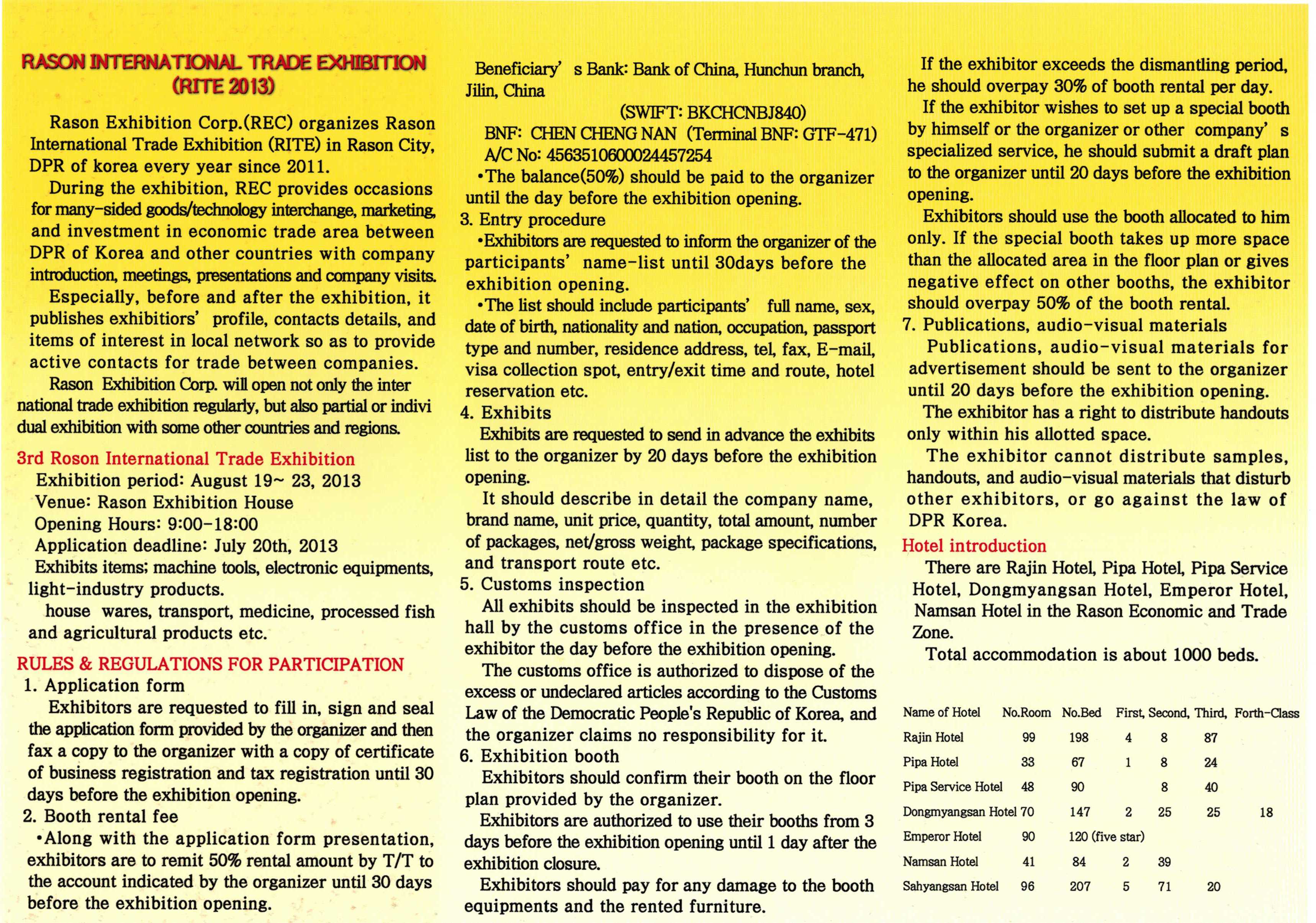
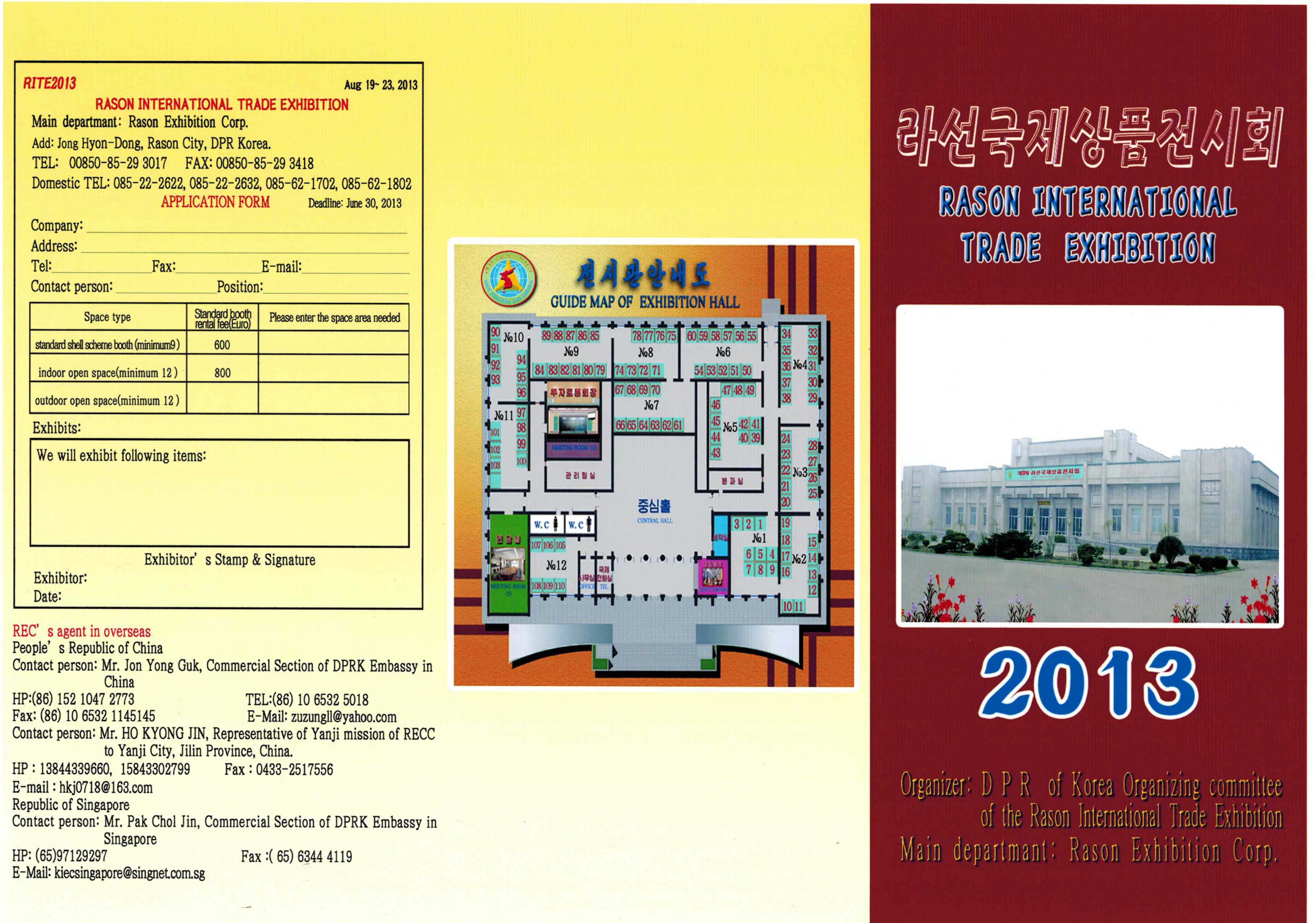
Dr. Bernhard Seliger posted the application form for the trade fair:

2013-rason-trade-fair-1


2013-rason-trade-fair-2


Previous posts on the Rason International Trade Fair can be found here.

Share

“Hoeryong Food Street” reopens

Friday, August 16th, 2013

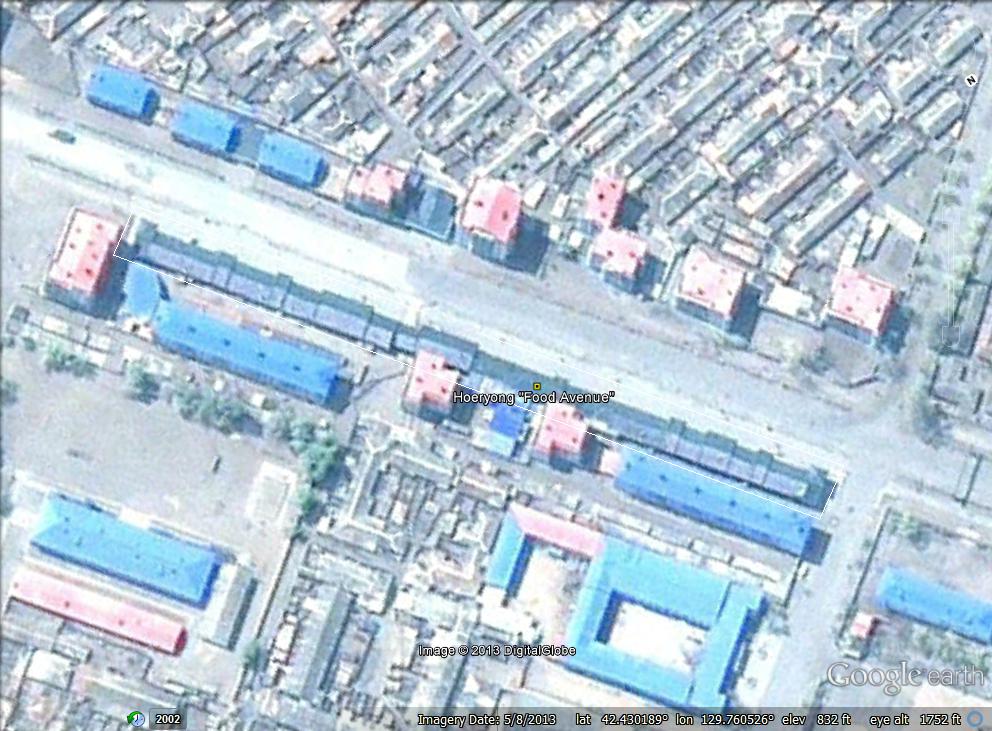
Hoeryong-food-avenue

Pictured Above: The Hoeryong Food Avenue (Google Earth)

According to Radio Free Asia:

A shuttered special food court established by former North Korean leader Kim Jong Il as a showcase for “high quality dishes at reasonable prices” has reopened and is being allowed to operate independent of the government in a rare move seen by some as reflecting economic reforms.

The center in Hoeryong city in North Hamgyong province bordering China was closed several months after its opening in November 2010 because the management faced financial problems as it could not meet production costs based on food sold to the public at prices dictated by the authorities, sources said.

North Hamgyong authorities recently allowed the Hoeryong Special Food Court to reopen and operate on an “autonomous” basis under new economic management methods introduced last year by Kim Jong Il’s son, Kim Jong Un, who took over after his father’s death in December 2011, the sources told RFA’s Korean Service.

“In order to meet the demands of the New Economic Management System, [the ruling] Workers Party provincial offices allowed the restaurant owners at Hoeryong Special Food Court to operate on an autonomous management basis,” one source in North Hamgyeong province said.

But some observers said the authorities had no choice but to allow the food center to set prices on its own to keep the operations alive, adding that any reform excuse was just an eyewash.

North Korea raced to build the food court after Kim Jong Il proposed it during a visit to his mother’s home town in 2009. He directed government funding of U.S. $800,000 for the project, which was completed in November 2010.

When he inspected the food court a month later, he ordered that it serve people with “high quality dishes at reasonable prices,” asking it to follow in the footsteps of another food outlet, Okryu Restaurant, in Pyongyang.

Operating cost

The source in North Hamgyong province said that the Hoeryong Special Food Court tried to adjust its prices to keep in tandem with those of Okryu Restaurant but could not cope with operating costs.

“During the initial months of operations, the North Korean authorities [subsidized prices] but soon after, the restaurants lost support from the government, thus it went out of business,” another source in the province said.

Even though the authorities did not provide support, they continued to regulate the food prices to make them 75 percent cheaper than those of regular restaurants,” the source said. “Therefore, the owners were suffering from financial difficulties.”

Some sources complain that under the new management of the Hoeryong Special Food Court, food prices have shot up rapidly. In addition, food that is not on the menu is served.

For instance, a seafood specialty restaurant serves steak while a steak house offers noodles, one source complained.

“Before at Hoeryong restaurant, cold noodles were 1,000 North Korean won (about 17 cents), and one bottle of Korean distilled spirits was 800 won (about 10 cents), but after the owners got authority to manage independently, the price of cold noodles went up to 4,000 won (about 68 cents) and one bottle of Korean distilled spirits up to 2,000 won (about 34 cents).

Read the full story here:
Special North Korean Food Court Allowed to Operate Independently
Radio Free Asia
Sung Hui Moon
2013-8-16

Share

Report: Korean Workers’ Party sets up Economy Department

Friday, July 12th, 2013

According to Radio Free Asia:

The party has created a centralized department with branches throughout the nation to formulate and oversee policies ranging from appointment of top economic officials to approval of companies and implementation of foreign exchange controls, a source from Jagang province, near the border with China, told RFA’s Korean Service.

The Party’s Department of Economy was set up last month.

“From last June, each [Party] committee in the provinces and cities established a [a branch of the] Department of Economy,” the source said on condition of anonymity.

“It will further strengthen the control and management of the Party,” he said.

The move by the Workers’ Party Central Committee was part of a shakeup within the Party and led to several branches of existing departments being transferred to the Department of Economy, he said.

A source in Yanggang province, also along the Chinese border, told RFA that the newly-formed department would wield as much power as the Department of Organization Management, which oversees the entire Workers’ Party.

“From now on, all officials in charge of economic matters have to be approved by the Department of Economy, while all companies also require approval from the department when they are established, shut down, or merged,” the Yanggang source said.

The Department of Economy also has the power to punish and appoint officials in charge of economic matters, he said, adding that he expects it to become “the strongest department in the Party.”

Even if the North Korean military, judicial agencies, and the Cabinet—or executive branch of the government—seek to establish new units for earning foreign currency or production, they are required to obtain permission in advance from the department, he said.

“Establishing the Department of Economy is related to the so-called ‘reformed economic management system,” the source in Yanggang province said, referring to a new policy announced in June last year which grants individuals greater authority in the distribution of goods.

“It means the Party never wants to lose its control over the economy, even though the ‘reformed system’ takes place everywhere,” he added.

The source said that the lack of central control had led to situations in which bogus companies and organizations were running businesses and generating foreign currency revenue without reporting them, creating a need for the Party to more efficiently oversee these groups.

For example, he said, several companies and restaurants which were established under the guise of being welfare organizations to feed and clothe the poor are really generating foreign currency for the North Korean Cabinet.

But he noted that even as the Department of Economy sought to rein in these businesses, it would inevitably generate conflict within the Party as it grew in power, leading different factions to jockey for control.

“[Some of] the functions of [the Party’s] Department of the Executives and Department of Organization Management were already taken away by the Department of Economy, and also the Department of Administration has seen interference from the department as well,” the source said.

“In the future, the scope of Department of Economy’s activity will surely conflict with other departments of the Workers’ Party.”

Read the full story here:
North Korea’s Workers’ Party Takes Economic Control
Radio Free Asia
Sung Hui Moon
2013-7-12

Share

Foreign direct investment in DPRK up for 3rd year

Thursday, July 4th, 2013

According to Yonhap (via Global Post):

Foreign direct investment (FDI) in North Korea has steadily increased over the past three years, but the investment amount still remains at one of lowest levels in the world, a news report said Thursday.

North Korea attracted US$79 million in FDI in 2012, up 41 percent from a year earlier, the Washington-based Voice of America said, citing an annual world investment report by the United Nations Conference on Trade and Development.

In 2009, a total of only $2 million flowed in to the North, but the number jumped to $38 million the next year, according to the report.

Despite the latest three-year growth, the amount marks one of lowest levels in the world and the majority of the FDI inflow represents investment from China, by far North Korea’s biggest ally, the report said.

A few countries in sub-Saharan Africa or small countries in the Oceania and the Caribbean logged FDI smaller than North Korea, the report noted.

As of the end of 2012, the total inflow of FDI to the North stood at $1.61 billion, it also said.

Although the article does not mention it, the information comes from the “World Investment Report: 2013” (PDF).  Some of the data comes from a table on page 214. The report was published by the United Nations Conference on Trade and Development.

Lots of other economic statistics on my Economic Statistics Page.

Read the full story here:
Foreign direct investment in N. Korea gains for 3rd year
Yonhap (via Global Post)
2013-7-4

Share

DPRK lending farmland to city workers to increase food supply

Wednesday, June 26th, 2013

According to Yonhap (via Global Post):

North Korea has started to lend state-owned farmland to city laborers as part of efforts to solve chronic food shortages, a local group said Wednesday,

“Since mid-May, the North started to lend state-owned cooperative farmland to city workers as part of its various efforts to solve serious food shortage problems for city workers,” the North Korea Intellectuals Solidarity said in a press conference, citing inside sources in the North.

City laborers are bearing the brunt of food shortages in the North while farming workers have easier access to farm produce, the group said.

North Korean leader Kim Jong-un is well aware of growing indignation among citizens over food shortages and in order to quell their anger, the leader is drawing a variety of ideas to help them feed themselves, it said.

The latest farmland renting plan is one of the North’s ideas to help solve food shortages, according to the study group.

Under the plan, one plant worker or state firm employee can borrow up to 826.5 square meters of land belonging to state-owned cooperative farms and they are required to pay about 25 kilograms of corn or 12.5 kg of beans in rent, the group said.

The country is promoting the plan as an effective way to encourage workers to raise self-sufficiency as well as to increase national agricultural output, it said, adding that some citizens are pessimistic about the plan because of the shortages of seeds, fertilizer and other tools needed for farming.

Read the full story here:
N. Korea starts to lend farmland to city workers to solve food shortage
Yonhap (via Global Post)
2013-6-26

Share

DPRK Law on Economic Development Zones Enacted

Monday, June 24th, 2013

UPDATE 4 (2013-9-6): On May 29, the Presidium of the Supreme People’s Assembly promulgated the “DPRK Law on Economic Development Zones“. Now it appears they have named a body to administer the law. According to the Institute for Far Eastern Studies (IFES):

DPRK Economic Development Committee launched: Special economic and tourism zones to be named (IFES)

In the wake of normalizing the Kaesong Industrial Complex (KIC) agreement, North Korea has announced that it had installed the Economic Development Committee and named special economic and tourism zones, as well as newly appointed officials in charge. In the near future, North Korea has plans to announce specific special economic zones in Sinuiju, Nampo, and Haeju, along with tourism zones in Mount Baekdu, Wonsan, and Chilbosan. The head and director-level executives for the Economic Development Committee are likely to be appointed from the Joint Venture Investment Committee. The head of the Tourism Development is reported to be the former director of Korea Tourism Administration.

Meanwhile, North Korea has released the preamble of the economic development law adopted at the recent Presidium of the Supreme People’s Assembly held on May 29. As inter-Korean relations are progressing with the plans of restarting the Kaesong Industrial Complex and the reunion of separated families moving forward, North Korea’s economic development law is drawing attention once again.

In principle, the selection process for the special economic zones must possess these following elements: Area must 1) be in a favorable location for foreign economic cooperation and exchanges; 2) contribute to the economic and science and technology development; 3) be at a fixed distance from the residential areas; and 4) be at a location that does not intrude in the state protected areas (Article 11). This can be interpreted as the North’s effort to segregate the existing residential areas with the special economic zone similar to the Kaesong Industrial Complex so as to minimize the political and social impact of these zones.

The newly confirmed information for the new Economic Development Law is the list of development activities. “Investors from other countries are permitted to develop economic zones either alone or in collaboration after obtaining state approval (Article 20).” Evidently, North Korean institutions and enterprises may also develop economic zones after receiving approval from the state.

In addition, the law granted comprehensive property rights to the development companies. It states that “Companies have the right to sell, re-lease, bequeath, or transfer the ownership of the buildings and land lease” and “the selling or re-lease price shall be determined by the development company” (Article 29).

As for recruitment of workers, there is a provision that states “our country’s labor force must be given preferential consideration” (Article 41), and “the minimum wage for the employees of the Economic Development Zone shall be determined by central guidance organization of special economic zone” (Article 42). This poses some concern as the employee wage at the Economic Development Zone could be compared to that of the KIC, which could lead to wage disputes after the KIC begins to implement its internationalization process.

Another noteworthy change is the currencies permitted at the zone: “currency for circulation and payment must be Korean Won (KPW) or other specified currency” (Article 46), suggesting that other currencies such as the US dollar and euro will be allowed.

Furthermore, the Act specifies that “Companies in the economic development zone will decide on the commodity and service prices, and all the prices in the Economic Development Zone between institutions, enterprises and organizations shall be determined by the international market price based on agreement of all the parties” (Article 43). This suggests that the products produced in the zone may be traded domestically in North Korea.

In this Act, corporate income tax rate was set at 14 percent of profits and “Economic Development companies that operate for more than 10 years will be considered for a tax cut or exemption from the corporate income tax.” Article 58 grants “communication guarantees” for the usage of mail, telephone, and fax services, but did not include the use of the Internet.

Posts on the Economic Development Commission can be found here.

UPDATE 3 (2013-8-30): In August, the Pyongyang Times issued the following information on the DPRK’s Law on Economic Development Zones:

New law friendly towards investment

The law on economic development zone was enacted and promulgated in the DPRK on May 29.

The Pyongyang Times staff reporter Kim Rye Yong interviewed Kang Jong Nam, PhD and researcher at Law College of Kim Il Sung University, about the law.

What is the difference between this law and other laws that are in force in such special zones as Rason Economic and Trade Zone, Hwanggumphyong and Wihwado Economic Zone and Kaesong Industrial Park?

The recent law is applied to economic development zones to be newly established.

According to the law, an economic development zone is the area where investors receive preferential treatment in their economic activities in line with the legislation specially laid down by the state. Such a zone includes industrial, agricultural, tourist, exports processing and cutting-edge technology development areas. It is a principle to establish such a zone in the area which is favourable for external economic cooperation and exchange, conducive to the development of the country’s economy, science and technology and somewhat distant from residential areas and reserves.

Foreign investors may develop the zone singly or jointly and DPRK institutions and enterprises may be developers.

The zone shall be invested by foreign bodies corporate, individuals (natural persons) and economic groups and overseas Koreans.

The law defines that the investors’ rights, interests, properties and lawful profits are under protection by law. The state shall not nationalize or expropriate their properties. Should unavoidable circumstances make it necessary to expropriate or temporarily use their properties for the public good, it shall inform them of this in advance and make a full and timely compensation for this.

The personal safety of investors is also protected by law. Without legal grounds they will not be subjected to detention or arrest and their residences will not be subjected to search.

Where there are treaties concluded between the DPRK and foreign countries as regards personal safety, they shall prevail.

How is an economic development zone managed?

It is managed by the economic development zone management body under the guidance and with the assistance of the central special economic zone guidance organ and the people’s committee of a relevant province or a municipality directly under the central authority.

The management body carries out assignments given by the central organ and the people’s committee including the formulation of rules of the development and management of the zone, creation of investment environment and invitation of investment, licensing of the establishment of enterprise and its registration and the licensing, supervision and cooperation related to the construction, management and operation of project.

The law stipulates that an investor can lease land for a maximum of 50 years and, if need be, continue to use the land by renewing the contract before the expiry date.

The enterprise income tax rate shall be 14 per cent of settled accounts profits and that in encouraged sectors 10 per cent, a very low rate. An enterprise that operates in the zone for over ten years shall enjoy the benefit of exemption from or reduction of taxes. Where an investor reinvests profits to increase registered capital or sets up a new enterprise to operate it for over five years, he shall be paid back 50 per cent or 100 per cent of the income tax.

Tariff in the zone is preferential.

The prices of goods and services dealt between enterprises in the zone and those of goods dealt between the enterprises in the zone and the Korean economic organizations outside the zone shall be fixed by mutual consent between the parties proportionate to international market prices.

UPDATE 2 (2013-6-24): The Institute for Far Eastern Studies (IFES) offers information on the new law:

North Korea passes economic development zone law
Institute for Far Eastern Studies (IFES)
2013-6-14

Since the start of Kim Jong-un regime, internal economic management measures continue to be established. Recently, a new law was enacted for the establishment of economic development zones.

The KCNA reported on June 5 that a law for economic development zones was adopted and “in this regard, ordinance of the DPRK Supreme People’s Assembly’s Standing Committee was promulgated at the session on May 29.”

This legislation is a follow up to the decision reached on April 1 this year by the Supreme People’s Assembly for the creation of economic development zones.

The legislation is composed of 7 chapters and 62 sections, which cover matters such as configuration, development, management, conflict resolution, and so forth.

The report added that “Economic development zones, in accordance with the regulations set forth by the state, are entitled to various privileges as special economic zones.”

In addition, “Foreign corporations, individuals, economic organizations, and overseas Koreans are able to invest in the economic development zones, and can freely engage in economic activities including establishment of businesses, branches, and offices.” It also indicated that “the state will provide preferential terms to investors in areas such as land usages, recruitment, and tax payments.”

The details of the rights granted to investors were expounded, emphasizing that economic development zone is a special zone, and provides legal safeguards to protect the rights, investment properties and legitimate profits of foreign investors.

According to the KCNA, the economic development zones will include various economic and science and technology sectors such as industrial development, agricultural, tourism, export processing, and high-tech development zones.

Chairman Kim Jong-un delivered a speech at the WPK’s Central Committee Meeting entitled “Economic Development Zones Must Be Created in Every Province Reflecting the Regional Characteristics,” hinting at the state’s policy to attract more foreign investment to accelerate the development of the economic zones.

In particular, investments in infrastructure construction, state-of-the-art science and technology sector, and production of goods highly competitive in the international market were especially encouraged.

The management of these economic development zones will be separated into local-level and central-level zones, indicating that economic development zones will be established in all parts of the country.

However, this law does not apply to the preexisting economic and trade zones in Rason, Hwanggeumpyeong, Wihwa Island, Kumgang and Kaesong. The new legislation indicates that North Korea is committed to economic development regardless of the tense relations on the Korean Peninsula.

UPDATE 1 (2013-6-23): Yonhap offers new details of the legislation not published by KCNA:

North Korea will offer a maximum 50 year lease on land for the economic development zones it wants to set up across the country to spur outside investment, an analysis of a propaganda magazine monitored in Seoul showed Sunday.

Close examination of the May 29 edition of the Tongil Sinbo, a weekly magazine that highlights activities taking place in the isolationist country, revealed the lease system.

The 50-year scheme for development zones is on par with land lease favors offered by Pyongyang to businesses operating in the Kaesong Industrial Complex and the Rason Economic and Trade Zone. The plan can offer assurances to investors, which can be a critical incentive.

Kaesong is on the west coast just north of the demilitarized zone, while Rason is located in the country’s northeastern region near the border with China and Russia.

In addition, the weekly said companies will be able to freely buy and sell rights on buildings and land in the economic zones and even hand over property deeds with a clause being fixed that can allow the present rights holder to release it to a third party.

Development of land leased can be assisted by North Korean state organizations and companies.

The weekly said Pyongyang has set corporate tax rates for these zones at 14 percent of earnings after the settlement of accounts, with the government pledging the safety of all foreigners in the special zones under North Korean law.

In regards to where the development zones will be set up, the weekly said the North will give priority to areas that can trade easily with the outside world, a region that can contribute to the advancement of the national economy, and a location that is separate from local residences.

The report said that all authority for the new development zones will be given to a centralized economic oversight organization to make it easier for investors to talk to authorities and receive administrative assistance.

Read the full story here:
N. Korea to offer max 50 years lease on land in economic development zones
Yonhap (via Global Post)
2013-6-23

ORIGINAL POST (2013-6-5): According to KCNA (2013-6-5):

DPRK Law on Economic Development Zones Enacted

Pyongyang, June 5 (KCNA) — The DPRK enacted a law on economic development zones.

A decree on the law was promulgated by the Presidium of the Supreme People’s Assembly of the DPRK on May 29.

The law has seven chapters (62 articles) and additional rules (two articles).

The law deals with fundamentals of the law, establishment, development and management of economic development zones, economic transactions in the zones, their encouragement, preference and settlement of complaints and disputes.

According to the law, economic development zones are special economic zones in which preference is granted as for economic activities under the laws and regulations specially provided for by the state.

The economic development zones include industrial development zone, agricultural development zone, tourism development zone, exports processing zone, ultra-modern technological development zone and other development zones in the fields of the economy and science and technology.

The state will assort the economic development zones into local-level economic development zones and central-level economic development zones and manage them according to their affiliations.

Foreign corporate bodies, individuals and economic organizations and overseas Koreans can invest in the economic development zones and also set up businesses, branches and offices and conduct free economic activities.

The state shall provide investors with conditions for preferential economic activities regarding the use of land, employment of labor, payment of taxes, etc.

The state shall specially encourage investment in the fields of infrastructural construction and ultra-modern science and technology and in the field producing goods with high competitiveness in international market in the economic development zones.

Rights granted to investors and investment properties and legal income are protected by law in the zones.

The law on economic development zones and regulations and rules for its enforcement will be applied as for economic activities like development and management of the economic development zones and the operation of businesses.

This law is not applied to the Rason Economic and Trade Zone, Hwanggumphyong and Wihwado economic zones, Kaesong Industrial Zone and Mt. Kumgang Tourist Special Zone.

Here is the Korean version of the article from KCNA (2013-6-5):

경제개발구법 채택

(평양 6월 5일발 조선중앙통신)조선에서 경제개발구법이 채택되였다.

이와 관련한 조선민주주의인민공화국 최고인민회의 상임위원회 정령이 5월 29일에 발표되였다.

법은 7개의 장(62개조)과 부칙(2개조)으로 구성되여있다.

경제개발구법의 기본, 경제개발구의 창설, 개발, 관리와 경제개발구에서의 경제활동, 장려 및 특혜, 신소 및 분쟁해결에 대해 서술되여있다.

법에 의하면 경제개발구는 국가가 특별히 정한 법규에 따라 경제활동에 특혜가 보장되는 특수경제지대이다.

경제개발구에는 공업개발구, 농업개발구, 관광개발구, 수출가공구, 첨단기술개발구 같은 경제 및 과학기술분야의 개발구들이 속한다.

국가는 경제개발구를 관리소속에 따라 지방급경제개발구와 중앙급경제개발구로 구분하여 관리하도록 한다.

다른 나라의 법인, 개인과 경제조직, 해외동포는 경제개발구에 투자할수 있으며 기업, 지사, 사무소 같은것을 설립하고 경제활동을 자유롭게 할수 있다.

국가는 투자가에게 토지리용, 로력채용, 세금납부 같은 분야에서 특혜적인 경제활동조건을 보장한다.

경제개발구에서 하부구조건설부문과 첨단과학기술부문, 국제시장에서 경쟁력이 높은 상품을 생산하는 부문의 투자를 특별히 장려한다.

경제개발구에서 투자가에게 부여된 권리, 투자재산과 합법적인 소득은 법적보호를 받는다.

경제개발구의 개발과 관리, 기업운영같은 경제활동에는 이 법과 이 법에 따르는 시행규정, 세칙을 적용한다.

라선경제무역지대와 황금평, 위화도경제지대, 개성공업지구와 금강산국제관광특구에는 이 법을 적용하지 않는다.

Share

Inter-Korean trade dries up in May

Monday, June 24th, 2013

According to Yonhap (via Global Post):

Trade between South and North Korea came to virtually zero in May after inter-Korean tensions led to the shutdown of the Kaesong Industrial Complex seen as the last symbol of bilateral economic cooperation, the government said Monday.

The volume of inter-Korean trade reached only US$320,000 last month, which accounts for just over 1 percent of the $23.4 million recorded in April, according to the Unification Ministry, which handles inter-Korean affairs.

The majority of the May trade represents electricity costs the South spent to maintain the plant facilities in the factory park in the North Korean border city of Kaesong, according to the ministry. The South exported about $260,000 worth of electricity while importing $60,000 worth of periodicals from the North last month, the ministry said.

Inter-Korean exchange came to an abrupt halt in mid-April as the North withdrew North Korean workers employed by South Korean firms in the Kaesong industrial zone in protest against South Korea’s joint military drills with the U.S. in March.

The joint factory park made up almost all of the inter-Korean trade as chilly relations cut off other exchanges.

The number of cross-border trips permitted during May came to only seven, the ministry said, adding that they were the last batch of the seven South Korean workers who returned to the South after the closing of the Kaesong complex.

As inter-Korean relations remain frosty, the hiatus in inter-Korean trade is expected to continue, analysts said.

Read the full story here:
Inter-Korean trade comes to almost naught in May
Yonhap (via Global Post)
2013-6-24

Share