Archive for the ‘Economic reform’ Category

DPRK Won exchange rate data

Friday, October 18th, 2013

DPRK-won-JA-Ilbo-2013-10

According to the JoongAng Ilbo:

The value of the North Korean won has plummeted against the Chinese yuan in the last three years, hit by a continual series of crises, a South Korean ruling party lawmaker said.

Representative Yoon Sang-hyun of the Saenuri Party, a member of the National Assembly’s Foreign Affairs and Unification Committee, said at a parliamentary hearing Wednesday, “Through some sources in North Korea and from the government, we have analyzed the fluctuation of the North Korean currency for the last three years.

“The value of the Chinese yuan has surged in North Korean territory amidst a series of crises: military provocations, power succession and natural disasters,” Yoon said.

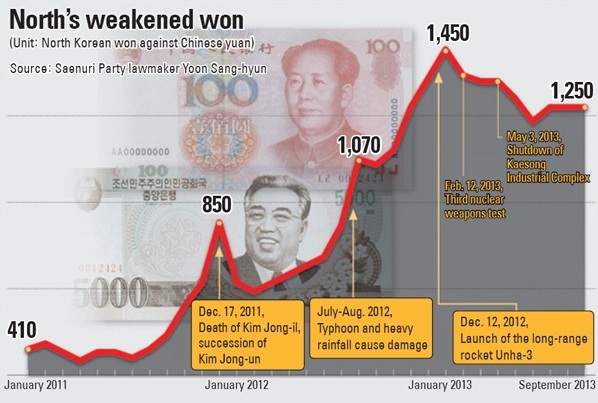
According to Yoon, the exchange rate of North Korean currency on the black market was around 400 won ($0.38) to the Chinese yuan between January and September 2011. But it rose to 560 won against the yuan in October 2011, 640 won in November and 850 won in December. That was a precarious time, Yoon says, with rumors that leader Kim Jong-il was sick. On Dec. 17, 2011, Kim died and was succeeded by his youngest son, Kim Jong-un.

In July and August 2012, when heavy rainfall battered North Korea, the won weakened more, reaching 1,000 won against the yuan. In December 2012, when North Korea successfully launched a long-range missile, its currency dipped to 1,350 won to the yuan from 1,250 won in November.

Ahead of its third underground nuclear weapons test on Feb. 12 of this year, the won fell close to 1,450 won against the yuan, the lowest level ever.

The currency became stronger when Pyongyang went off its highest level of military readiness last May, and its value returned to 1,200 won to the yuan. The won is currently trading at around 1,250 won against the yuan, Yoon said. The yuan has appreciated 171.7 percent against the won from two years ago.

“In 2009, when North Korean botched its currency renomination, anxiety spread that the local currency would become ‘paper money,’?” Cheong Seong-chang, a senior fellow at the Sejong Institute in South Korea, said. “Officials in North Korea prefer to receive bribes in yuan, not in won.

“When tensions escalate in North Korea, demand for the more stable yuan increases,” Cheong said. “And whenever North Korea makes an attack or other kind of provocation, the Chinese government tightens up procedures for visas and customs regulations on North Korean products.

That makes trade with China more difficult, resulting in a shrinkage in the supply of yuan into the country.”

Representative Yoon said the popularity of the yuan in North Korea also suggests more capitalist activity going on. “In a society that strictly bans the circulation of foreign currency, a wide range of individual transactions using a foreign currency is happening,” Yoon said.

“In some border regions with China, commercial transactions are increasing. The so-called Yuanization phenomenon – in which the yuan replaces a local currency – is happening in North Korea.”

Analysts in Seoul say the influence of China on the North Korean economy is ever expanding. “A strong yuan in North Korea indicates the regime is heavily dependent on the Chinese currency,” Kim Yong-hyun, a professor of North Korean affairs at Dongguk University, said. “That means that if China imposes economic sanctions on the regime, it would be a big blow to its economy.”

“As North Korea has no credit policies or system for financial transaction, residents are dependent on foreign currency for commercial activities,” Yoon said.

“As provocations by North Korea are putting its economy at risk, North Korea should stop all provocations, restore the value of its weak currency and stabilize its market.”

The Daily NK tracks the exchange rate of the DPRK won here.

Read the full story here:
North’s won tumbled against yuan, says Rep
JoongAng Ilbo
Kim Kyung-jin
2013-10-18

Share

2nd annual China-DPRK Economic, Trade, Culture and Tourism Expo

Thursday, October 10th, 2013

UPDATE 1 (2013-10-15): Yonhap reports on the activities carried out at the expo:

North Korean companies participating in an annual trade fair with China signed a total of 93 preliminary deals worth US$1.6 billion at the event, China’s state media reported Tuesday.

North Korea and its economic lifeline, China, wrapped up the trade expo, the second of its kind, on Monday in the Chinese border city of Dandong with some 130 North Korean firms attending the five-day exhibition.

The North Korea-China Economic, Trade, Culture and Tourism Expo came as China has been deepening its economic ties with the North even though Beijing appears to have become increasingly frustrated with Pyongyang’s nuclear weapons program.

During the trade fair, preliminary investment deals worth $510 million and export deals worth $1.09 billion were signed, the official China News Service reported.

North Korea and China held the inaugural trade fair last year, with $1.26 billion worth of preliminary deals signed.

In the first eight months of this year, two-way trade between North Korea and China stood at $4.09 billion, compared with $4.1 billion for the same period last year, South Korean government data showed.

ORIGINAL POST (2013-10-10): According to Yonhap:

An annual trade fair between North Korea and China kicked off in the Chinese border city of Dandong on Thursday, with some 130 North Korean firms attending the five-day exhibition, organizers said.

The North Korea-China Economic, Trade, Culture and Tourism Expo, the second of its kind, comes as China is deepening its economic ties with the North even though Beijing appears to have become increasingly frustrated with Pyongyang’s nuclear weapons program.

About 500 North Koreans, including a 115-member propaganda troupe, joined the exhibition that features 700 booths for products ranging from foods and garments to mining and machinery equipment, according to the China Council for the Promotion of International Trade (CCPIT), which organized the event.

Of the booths, about 200 were allocated to buyers from Pakistan, Malaysia, India, Russia, Hong Kong and Taiwan, a Dandong branch of the CCPIT said.

North Korea and China held the inaugural trade fair last year, with US$1.26 billion worth of preliminary deals signed.

According to Xinhua:

The second China-DPRK economic, trade, culture and tourism expo has opened in the border city of Dandong in Northeast China’s Liaoning province.

The DPRK’s National Folk Art Troupe performed its ethnic dances at the opening ceremony on Thursday. A 500-member delegation from the DPRK is attending the expo which lasts from Thursday to Monday.

The expo is by far the largest foreign economic and trade event for the DPRK. And more than 90 percent of the country’s foreign trade companies have sent their representatives. Meanwhile there are over 10,000 traders from China.

The expo also attracts companies from Malaysia and Thailand. There are 16 events including promotion of China-DPRK commodities, and DPRK tourism. The DPRK’s investment policies are also to be introduced to attract investors.

The first such expo was held in 2012 with 72 agreements of cooperation signed. They have a combined value of over 1 billion US dollars.

According to KCNA:

The 2nd DPRK-China Economic, Trade, Cultural and Tourism EXPO opened on Thursday with due ceremony in Dandong, China.

Colorful events are to be held during the EXPO including trade fair, fine art exhibition, exhibition of photos on tourism and art performance.

Present at the ceremony were officials of the party and government of Liaoning Province and the city and those in the field of culture, economy and trade including Bing Zhigang, vice-governor of the province, citizens in Dandong, Liu Hongcai, Chinese ambassador to the DPRK, and his embassy members and diplomatic envoys of different countries to the DPRK.

Also present there were members of the delegation of the 2nd DPRK-China Economic, Trade, Cultural and Tourism EXPO led by Hong Kil Nam, vice-chairman of North Phyongan Provincial People’s Committee, Kim Kwang Hun, DPRK consul general to Shenyang, and Choe Un Bok, chairperson of the General Association of Koreans in China.

An opening speech was made there, which was followed by congratulatory speeches.

The speakers said that the EXPO will be a good opportunity to swap the successes and experience gained in various fields and boost the cooperation between the two countries.

They expressed the conviction that it will contribute to deepening the mutual understanding and trust and promoting the friendly and cooperative relations between the peoples of the two countries.

An art performance was given by the National Folk Art Troupe on the same day.

Prior to this, a reception was given for the participants of the Expo.

Xinhua also published this helpful advice for North Korean policy makers:

China-DPRK economic cooperation is important for maintaining peace and stability in Northeast Asia. China has a long history of investment in the DPRK, and is the country’s biggest trade partner. So what’s it like to do business in the DPRK?

Economic cooperation between China and the DPRK has strengthened as tons of goods are coming in and out the border each day. And the scale of their trade and investment has expanded over the past few decades. But the rapidly developing China-DPRK economic relations have certain problems that need to be solved. Many concerns have been raised in regards to the risk factor when investing in the country.

Today, China’s investment in the DPRK is mainly concentrated on minerals and other strategic resources. And many investors claimed that the main difficulties when they set up businesses in the DPRK is to cope with the country’s frequent policy changes.

Many Chinese companies and manufacturers have come to the exhibition hall for trade talks with the DPRK, and to have a better understanding of the country in which they have invested or intend to invest. The best way to find out the business environment there is to speak with someone who has been there long enough.

“You need to have certain knowledge about the rules and regulations in the DPRK before conducting investments there. A thorough business plan is a good start, and it’s crucial to have a business partner from the DPRK with a strong background,” said Ma Pengxiu, general manager of Dandong Hantong Trading company.

Some Chinese companies that have invested in the DPRK reportedly suffered losses, for which they blame the investment environment in that country. It’s true that enterprises cannot be certain of making profits, no matter which country they invest in they need to cope with local laws and regulations to avoid risks. But it’s also true that the DPRK has to improve its investment environment and make its policies more stable.

“There were companies and individuals who have experienced failures in the investments in the DPRK, so investors in these days are more concerned about the relevant protections from the DPRK side; my advise is to protect your business with a written wontract always,” said Ma.

Needless to say the DPRK delegation at the EXPO this year was well prepared and ambitious in seeking cooperation opportunities with the outside world. The country is keen on drawing investments to beef up its industries. In the meantime the DPRK still needs to take measures to ensure a stable business environment to make it easier for investors to thrive in the country.

Here is a link to the inaugural trade fair post.

Read the full stories here:
N. Korea, China kick off annual trade fair
Yonhap
2013-10-10

2nd China-DPRK Expo opens in Dandong
Xinhua
2013-10-11

Share

ROK sets aside funds for DMZ Peace Park

Thursday, September 26th, 2013

According to Yonhap:

The government set aside 40.2 billion won (US$37.3 million) in next year’s budget proposal for a project calling for the establishment of a peace park in the Demilitarized Zone (DMZ) on the border with North Korea, according to the draft budget Thursday.

The DMZ peace park project is one of President Park Geun-hye’s outreach projects to North Korea. She first unveiled the vision during her visit to the United States in May and formally proposed the project on August. But questions persist about its possibility due to tensions with Pyongyang.

According to the government’s budget proposal, which is subject to changes and requires approval from the National Assembly, the unification ministry’s total budget was set at 1.34 trillion won, up 20.9 billion won or 1.6 percent from this year’s budget.

Of the 40.2 billion won set aside for the peace park project, 24 billion was designated for use in removing landmines strewn throughout the DMZ, while the rest was allocated for research and other purposes, according to the budget proposal.

The budget for humanitarian assistance to North Korea fell slightly to 680.2 billion won from this year’s 724 billion won. But officials said the decline is because of a fall in prices for rice and fertilizer and the government plans to keep the amount of aid at this year’s level of 400,000 tons of rice and 300,000 tons of fertilizer.

Read the full story here:
S. Korea sets aside 40.2 billion won for DMZ peace park project
Yonhap
2013-9-26

Share

Ruediger Frank on the DPRK economy

Tuesday, September 24th, 2013

Ruediger Frank writes in the East Asia Forum:

After decades of being divided into a population of a small and mostly invisible elite and everyone else, a middle class of about 2 million people is on the rise. These are the people who have mobile phones, use taxis and show a remarkable diversity in clothing and accessories. The local 7-inch tablet computer, ‘Samjiyŏn’, sells for US$180 and comes with the Android operating system and a number of apps such as a dictionary, changgi (Korean chess), and a collection of the works of the two deceased former leaders, Kim Il-sung and Kim Jong-il.

The quality of life in the capital differs significantly from the rest of the country. Some observers believe this will increase discontent; but it also smartly diverts attention away from the shiny examples of foreign metropolises spread on pirated DVDs and USB sticks, and offers the population a domestic Xanadu. The key question for social stability is thus not what peasants in the countryside dream about, but what middle-class Pyongyangites aspire to. Meanwhile, the number of solar panels and small windmills is rising, which is the countryside’s solution to having less privileged access to power.

Despite all the changes, many of the old problems remain unsolved. Prices rise, speculation is rampant and frustration grows in sync with corruption and an ever-more obvious gap between the poor and the new middle class. It would be unrealistic to imply that Kim Jong-un even theoretically had the chance to improve the lives of the majority of his people significantly within a year of taking over. But he has not been idle. Inequality in North Korea is a sign of deepening change. A growing income and welfare gap between individuals indicates that the economy is on the move away from socialist egalitarianism towards capitalist diversity.

Read the full report here:
North Korea’s rolling economic reforms
Ruediger Frank
East Asia Forum
2013-9-24

Share

Russia – Rason railway (RasonKonTrans)

Tuesday, September 24th, 2013

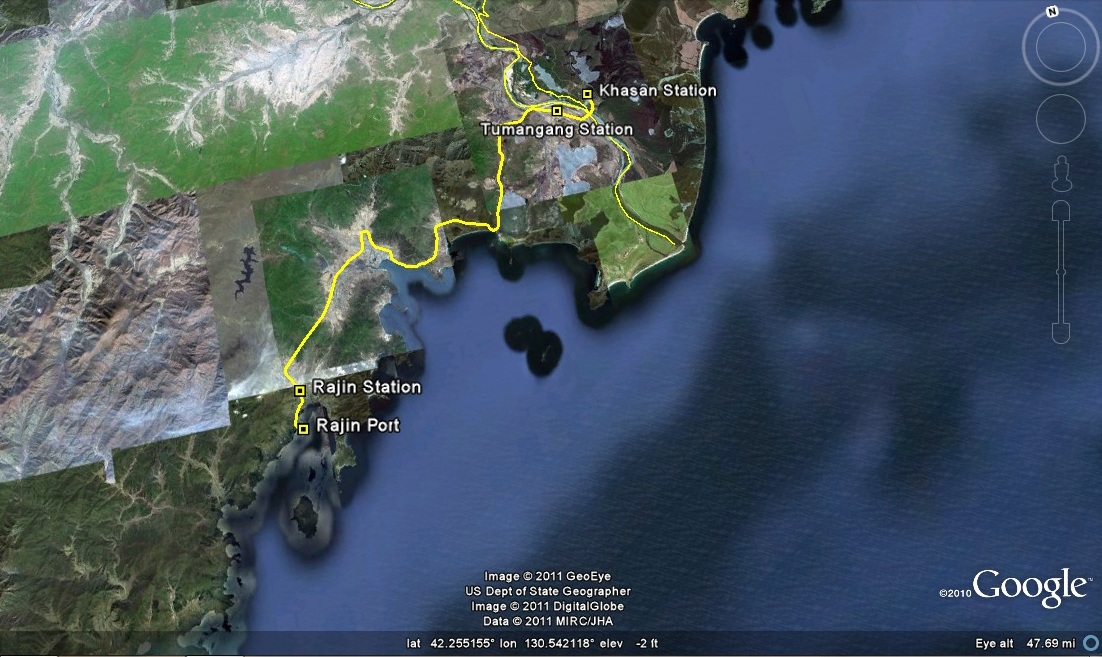
Pictured above (Google Earth): A map of the Khasan-Rajin Port rail service.

UPDATE 15 (2014-4-30): According to a new article in Yonhap, the new railway line is not really being used:

Russia appears to be preparing for a test operation of its newly renovated railway linked to North Korea, but the economic feasibility of South Korea’s joining the logistics project remains to be seen, a Seoul diplomat said Wednesday.

“I have been sensing that Russia is preparing to export its coal through the Rajin-Khasan railway in the near future as part of an experiment,” Lee Yang-goo, council general in Vladivostok, told reporters. “But it seems that there is no substantial demand for the rail line now.”

The project is part of Russia’s ambition to set up a rail road linking Asia to the Eurasian region. Last year, South Korea agreed with Russia to extend the track to South Korea.

Seoul officials said that they may be able to finish linking the rail to South Korea’s southern port city of Busan and put it into operation as early as next year, but experts have said feasibility of the plan remains to be seen.

Several factors, including economic and technological ones, should be taken into account before South Korean firms can join the logistics project, the council general said. “The economic feasibility should be reviewed foremost.”

UPDATE 14 (2014-4-9): Russians test coal shipment to Rason. According to the International Railway Journal:

RUSSIAN Railways (RZD) has commenced testing of freight traffic on the reopened link from the Khasan border station of the Trans Siberian Railway in western Siberia to the port of Rason, North Korea.

Two freight trains consisting of 65 wagons containing Kuzbass coal are taking part in the trials, which are intended to test the recently redeveloped railway infrastructure, as well as customs practices and freight handling at the port.

The project is being carried out by the RasonKonTrans joint venture, which was formed in 2008, and is held by RZD Trading House (70%) and the port of Rason (30%). Work involved the reconstruction of the Tumangang – Rason railway in North Korea, which included the introduction of 54km of dual-gauge (1520mm and 1435mm) track, as well as the reconstruction of 18 bridges, 12 culverts, and three tunnels with a total length of more than 4.5km.

The railway was officially opened on September 22, 2013, and was funded through RasonKonTrans’ authorised capital and loans. The joint venture has also invested to improve capacity at the port, including the addition of connecting tracks, dredging and construction of a new quay wall.

RZD says the project will attract additional traffic to the Trans-Siberian Railway, with around 4 million tonnes of freight expected to use the Khasan – Rason link per year.

According to the Moscow Times:

Russian Railways has put to use the North Korean port it helped to upgrade recently.

The state-owned railway operator said Tuesday it had started carrying Siberian coal to the port of Rajin, in what may be the first attempt to utilize the harbor after it reopened in September.

“The company has started to provide a full suite of services to ship coal through Rajin to Asia-Pacific countries,” said a statement from Russian Railways logistics subsidiary, RZhD Logistika.

A joint venture between Russian Railways and the North Korean Ministry of Railways has rebuilt one of the port’s wharfs and a rail link connecting it to Russia in a rare example of foreign involvement in the economy of the isolated dictator state. The joint venture, RasonKonTrans, where Russia holds 70 percent, sought to relieve the congestion at Russia’s Pacific ports.

Coal miner and steelmaker Mechel is the sender of the coal consignments, according to Nadezhda Malysheva, chief editor of port industry portal PortNews.

Both Mechel and RzhD Logistica spokespersons declined to comment.

Russian Railways chief Vladimir Yakunin traveled to Rajin for a grand opening of the rail service and the wharf in September. The company invested 9 billion rubles ($250 million) to upgrade both. Russian engineers supervised the work, while Koreans largely contributed with unskilled labor.

The Russian terminal at Rajin, Asia’s most northerly all-year ice-free port, will at first handle just coal freight from Russia to ship it further to China’s eastern and southeastern provinces. Further plans are to equip it to be able to provide container services.

RZhD Logistika loaded a total of 9,000 metric tons of coal on two freight trains of 130 cars each to carry to Rajin at the end of last month, it said in the statement. The cargo will next go to China’s ports of Shanghai, Lianyungang and Guangzhou.

Current load capacity of port Rajin is 4 million tons of coal a year.

Russia’s biggest coal export port, Vostochny, which sits on the Pacific coast, has the capacity to handle 18 million tons a year, Malysheva said. It and the other key coal port of Vanino operate at the top of their capacity, as exports of the fuel to Asia have increased, she said.

Coal remains the principal fuel for electricity generation at power plants in China. But its coal price declined 10 percent last year because of strong rivalry among Russian suppliers and competition from Australia, the RZhD Logistika statement said.

Even so, the government last week backed a plan to boost development of the coal-mining industry in the country’s Far East to cater to Asian markets. The idea is to have a shorter transportation leg for the shipments, compared with the distance that the coal travels from Siberia.

This Russian-language source has additional information.

Read the full story here:
First Russian Coal Heads to North Korean Port
Moscow Times
Anatoly Medetsky
2014-4-8

UPDATE 13 (2014-4-8): Business organization information. According to the Moscow Times:

A joint venture between Russian Railways and the North Korean Ministry of Railways has rebuilt one of the port’s wharfs and a rail link connecting it to Russia in a rare example of foreign involvement in the economy of the isolated dictator state. The joint venture, RasonKonTrans, where Russia holds 70 percent, sought to relieve the congestion at Russia’s Pacific ports.

Russian Railways chief Vladimir Yakunin traveled to Rajin for a grand opening of the rail service and the wharf in September. The company invested 9 billion rubles ($250 million) to upgrade both. Russian engineers supervised the work, while Koreans largely contributed with unskilled labor.

UPDATE 12 (2013-9-23): Rajin-Khasan Railway Section Opens for Service. According to KCNA:

The Rajin-Khasan railway section has been successfully rebuilt in line with the DPRK-Russia Moscow Declaration, signed in August 2001. The section was opened for service on Sunday.

Its opening serves as a landmark in promoting the friendly and cooperative relations between the DPRK and Russia, strengthening the economic and cultural ties in the Asia-Pacific region and ensuring the common prosperity of regional countries.

In the first year of the new century, historic meeting and talks were held between Kim Jong Il, leader of the Democratic People’s Republic of Korea, and V.V. Putin, president of the Russian Federation, resulting in the adoption of the DPRK-Russia Moscow Declaration.

The declaration expressed the will of the two countries to make every possible effort to carry into practice a plan for opening railway transit linking the DPRK, Russia and Europe. Such plan was the first phase for wide-ranging cooperation between the two countries, which came under spotlight of the world.

At that time some forces criticized the plan as a “daydream”, displeased with significant cooperation between the two countries as well as peace and prosperity of the Korean Peninsula.

However, the project plan went into practice in October 2008 on the eve of the 60th anniversary of the establishment of the bilateral diplomatic relations thanks to the unshakable will of the two countries and the active cooperation of their railway workers.

At the ground-breaking ceremony for the project, which was held in front of the DPRK-Russia Friendship Pavilion in the area of Tumangang Railway Station in Rason City, V. I. Yakunin, president of the Russian Railways Company, said that the world would soon witness the longest railway transit, extending more than 10 000 km, through which 100 000 containers would be transported annually from 2013.

At last, the Rajin-Khasan railway section has been successfully rebuilt this year marking the 65th anniversary of the establishment of diplomatic relation between the DPRK and Russia. This would bring a large-scale cooperation project between the two countries into practice, ensuring their and regional development and interests.

The railway section from Rajin to Khasan will be helpful to the economy, transport service and people’s wellbeing of the two countries. It can also develop into an international transit between Asia and Europe.

The facts show the vitality of cooperation documents of the two countries, including the DPRK-Russia Moscow Declaration, and the noble idea carried in them.

The friendly and cooperative relationship between the DPRK and Russia will grow stronger with the geopolitical importance of Northeast Asia.

Choson Exchange offers additional detail and other news from Rason here.

UPDATE 11 (2013-9-22): It appears that Russia – Rajin rail service has been launched (again). According to KCNA:

Rajin-Khasan railway section has been successfully rebuilt and opened for service with due ceremony in Rajin on Sunday.

The opening of the section will greatly contribute to developing the friendly and cooperative relations between Russia and the DPRK.

Present at the ceremony from the DPRK side were Jon Kil Su, minister of Railways, O Ryong Chol, vice-minister of Foreign Trade, Ri Chol Sok, vice-chairman of the State Commission for Economic Development, Jo Jong Ho, chairman of the Rason City People’s Committee, Im Chon Il, consul general of the DPRK to Nakhodka, officials in the field of railways and people in Rason City.

Present there from the Russian side were V. I. Yakunin, president of the “Russian Railways” Company, Alexei Tsijenov, vice-minister of Transport, Sergey Sidorov, first vice-governor of the Maritime Territory Administration, Alexandr Timonin, Russian ambassador to the DPRK, Vyacheslav Tsupikov, consul general of Russia to Chongjin, and Russians including those concerned with the railways.

Diplomatic envoys to the DPRK also attended.

V. I. Yakunin in the opening ceremony said the section has opened for service under Russia-DPRK Moscow Declaration signed by the top leaders of the two countries in 2001.

To press for the renovation of the railways running through the land of Korea will be of great contribution to the development of economic cooperation in the Asia-Pacific region in the future, he stressed.

Minister of Railways of the DPRK in his speech said that the plan of linking DPRK-Russia railways serves as a model of wide-ranging bilateral cooperation which meets the common progress and interests of the two peoples.

He expressed the conviction that the operation of the opened railways section will be successful as it was made on the principle of mutual respect and cooperation between the railway transportation fields of the two countries.

There were congratulatory speeches.

The ceremony ended with the playing of national anthems of the two countries. It was followed by a reception.

According to Yonhap:

After years of work to directly connect railway tracks between Russia and North Korea, a 54-kilometer section linking border areas of the two countries reopened Sunday with a ceremony in Rason, a special economic zone in northeastern North Korea.

A special train carrying a group of reporters arrived at Rajin Port in Rason from Khasan in the Russian Far East, making it the first train to travel between the two countries without changing bogies at the border.

Trains had traveled on the section since the Soviet era. But given differences in track width between the Russian side and the North Korean side, workers had to change bogies every time a train crossed the border.

With the end of overhaul work, North Korea appears poised to promote the development of its special economic zone, while Russia seeks to revitalize the Trans-Siberian Railway by linking it, in the future, to a railway system that would run through the Korean Peninsula.

In 2008, the two countries started work to lay Russia-sized railway tracks from the Russian border area to Rajin Port after Russian President Vladimir Putin and then North Korean leader Kim Jong Il agreed in August 2001 to directly connect the two railway systems.

Moscow shoulders 70 percent of 8.3 billion ruble, or 25.8 billion yen, in costs to lay the new tracks and build the North Korean port, while Pyongyang covers the remainder.

The two countries conducted a trial run on the section using a freight train in October 2011. They initially planned to launch commercial runs in autumn last year, but the plan was delayed until now.

Bloomberg adds the following data:

Initially, the 54-kilometer (33-mile) line will transport Russian coal to markets in the Asia-Pacific region, OAO Russian Railways Chief Executive Officer Vladimir Yakunin said at the ceremony in Rajin. The second phase of the project will involve the construction of a container-handling facility and potentially an oil terminal at the North Korean site, he said.

“Our common objective is for this link and port to be a pilot scheme for the restoration of a single transport system in North and South Korea that would link the peninsula to countries that gravitate to this region, to Europe via Russia,” Yakunin said. The CEO said he hopes the plan will help promote peace between the two Koreas, which remain technically at war following the conflict 1950-53 that divided the countries.

The route is part of a larger project, dubbed the Iron Silk Road, that would connect Russia’s Trans-Siberian Railway to South Korea via the North for an overland route cutting transportation costs to Europe. Success depends on improved ties between South Korea and its isolated Communist neighbor.

Reuters adds the following data:

Yakunin said the railway and container terminal, a project worth 9 billion roubles ($283 million), would work at a capacity of 4 million metric tons a year within two years.

Here is some additional background information:

Practical implementation of the project began in 2008, when RZD and North Korea’s Ministry of Railways signed a cooperation agreement. In October of that year, Tumangan station saw the ceremonial laying of the first link of the rails and sleepers that marked the beginning of the reconstruction of the Khasan – Rajin railway section.

In 2009, a joint venture, RasonKonTrans, was set up by Russian Railways Trading House, a subsidiary of RZD, and the port of Rajin, in order to implement the project. RasonKonTrans has in turn concluded a 49-year leasing arrangement of the railway line between Tumen – Rajin with the Donghae company of North Korea’s Ministry of Railways. The work was financed from RasonKonTrans’ share capital, as well as by funds the joint venture was able to borrow based on the project’s business plan. More than 5.5 billion roubles had been invested in the reconstruction of the Khasan – Rajin railway line and 3.5 billion roubles in the port terminal.

The final construction phase to create a universal intermodal exchange terminal at the port of Rajin has now begun, including a range of measures ranging from dredging, building a new quay wall and equipping storage yards, through the construction of industrial and office buildings and facilities to laying railway lines within the terminal itself. Yakunin continued:

“The port is designed to handle transhipment volumes of 4 million tonnes of cargo, but that is not the limit. We are confident that the cargo base will expand and that containers will be shipped through the port. The construction of the port terminal is almost complete, and we are already seeing interest from international customers and partners.”

Officials from both countries say they are working together to finalise the timetable and the joint regulations which will govern the movement of trains on this section. To ensure the interoperability of the new line with both North Korea’s railway network and the Russian rail network, there are plans to create a single control centre with the participation of experts from the RasonKonTrans joint venture and the Donghae transport company of North Korea’s Ministry of Railways.

More from RT here.

UPDATE 10 (2013-6-25): It appears that regular rail service never materialized. According to Siberian Times:

Talks in Moscow between Vladimir Yakunin, President of Russian Railways, and Jeong Gil Soo, North Korea’s Minister of Railways (MOR) agreed the final details on the Khasas-Rajin link.

The project is being implemented in accordance with agreements reached in 2000 by Russian President Vladimir Putin and then North Korean leader Kim Jong Il. It is linked to cooperation between the two countries and forms part of a project to restore traffic on the entire Trans-Korean Main Line.

‘Over the long term, this will allow most traffic between South Korea, Europe, Russia and the CIS countries to be sent by rail by the Trans-Siberian Railway,’ said one report.

The new agreement allows for a single control centre ‘with the participation of experts from the joint ventures RasonKonTrans and ZHTK Donghae MOR from North Korea to handle traffic management and facilitate collaboration with the entire railway network in North Korea. The parties also agreed to develop instructions for the movement of trains and a train timetable’, stated RIA Oreanda.

The project involves reconnecting the combined dual-track railway with 1520 mm and 1435 mm gauges on the stretch from the Russian border to the port of Rajin in North Korea, a distance of 54 km. This includes the reconstruction of three tunnels, the repair a border railway bridge and construction of a freight terminal with an annual capacity of 4 million tons at Port Rajin.

The report continued:’The project is being implemented by the joint venture RasonKonTrans, which was specially set up in 2008 and is owned by OAO RZD Trading House and the port of Rajin.

‘The stretch between Rajin and Tuman stations is estimated at 99.8% complete. Work on commissioning the signalling, centralisation and blocking equipment has been completed along the entire section with the exception of Rajin station.

‘The tunnels are now fully ready. As of mid-May 2013, all the work to replace the timber on the Korean border bridge ‘Friendship’ has been carried out. Currently, work is underway to finish the bridge and install the railing.

‘At the port of Rajin, concrete is being laid and building foundations are being installed at the administrative and amenity building, repair shop and spare parts warehouse, work has begun on laying and ballasting the railway lines within the terminals and utility lines are being laid.

‘Equipment continues to be installed at the harbour wall. Work on installing outdoor lighting and fencing the port terminal’s territory is also ongoing’.

UPDATE 9 (2012-4-2) : DPRK and Russia to start cross-border freight train service in October. According to KCNA:

Rajin-Khassan Cargo Train Service to Begin in October

Pyongyang, April 2 (KCNA) — A Rajin-Khassan cargo train service will run from October this year.

Kim Chang Sik, a department director of the DPRK Ministry of Railways, told KCNA that the laying of railroad and renovation of railway stations, tunnels and communications facilities are now under way in the section.

The railway project was highlighted in the historic DPRK-Russia Moscow Declaration, which was signed in August 2001, he said, adding:

In line with the declaration, a cooperation agreement between the DPRK Ministry of Railways and the Russia Railway Holding Corporation was concluded in April 2008 to be followed by an agreement on joint venture between Rajin Port and the Corporation.

A contract on the lease of the Rajin-Tumangang railway was made between the Ministry’s Eastern Railway Ryonun Company and the Rason International Joint Venture Container Terminal, under which the 54 km-section has been rebuilt into a mixed track from October 2008.
A trial train service took place in October 2011 between Rajin of the DPRK and Khassan of Russia.

At least 100,000 containers will be yearly carried along the line.

This section will serve as an international railway container transport line linking Northeast Asia with Europe.

KCNA also offered this video.

Yonhap also reported:

North Korea and Russia will start a cross-border cargo train service in October, Pyongyang’s state media reported Monday, in a move that could make a North Korean port a regional hub for Europe-bound shipments.

The announcement came more than three years after the two countries launched a project to rebuild two rail lines between Russia’s Far Eastern border town of Khasan and North Korea’s northeastern port city of Rajin.

The North designated Rason, which includes the Rajin port, as a special economic zone in 1991 and has since striven to develop it into a regional logistics hub close to both China and Russia.

In October, North Korea and Russia held a test run on the 54-kilometer-long railway line.

The proposed cargo service can handle 100,000 shipping containers each year, the North’s official Korean Central News Agency said in a dispatch.

The renovation project, if completed, will offer a new route of container transportation between Northeast Asia and Europe, the dispatch said, and could significantly reduce shipping time and costs.

The freight service could also help boost relations between North Korea and Russia, including their economic cooperation, the dispatch said.

The trade volume between North Korea and Russia stood at US$110 million in 2010, the latest year for which statistics are available, according to South Korea’s state-run Korea Trade-Investment Promotion Agency.

Russia maintains friendly ties with North Korea, though its leader Dmitry Medvedev has strongly denounced North Korea’s rocket launch set for sometime between April 12 and 16.

Medvedev made the remarks during summit talks with South Korean President Lee Myung-bak in Seoul last month on the sidelines of an international nuclear summit, according to Lee’s office.

Historical posts on this topic below:

(more…)
Share

9th Autumn Pyongyang International Trade Fair

Monday, September 23rd, 2013

UPDATE 1 (2013-10-1): Briefing session for investors held at the Pyongyang International Product Exhibition
Institute for Far Eastern Studies (IFES)
2013-10-1

North Korea recently held a briefing session for foreign investors at the 9th Pyongyang Autumn International Products Expo.

According to Choson Sinbo, pro-North Korean Newspaper in Japan, the expo was held from September 23 to 26, 2013 and many foreign businessmen took part in this event at the Koryo Hotel in Pyongyang.

The briefing sessions for investors was organized by the Korea Foreign Economic Cooperation Committee. An official from the joint venture investment committee, which is responsible for attracting foreign investment, announced that North Korea has great interest in expanding economic cooperation with other nations and working to promote a favorable investment environment.

North Korean government is reported to be welcoming foreign investments and is taking actions to establish protection of foreign investors’ legal rights and interests, and stressed that various tax incentives and benefits for foreign businesses will be granted.

Choson Sinbo reported foreign businesses listened with great interest and expressed hope in investing in North Korea.

The Expo consisted of participants from twelve countries and 226 trading companies with over 800 participants. Out of the total companies, 118 were foreign companies, mostlyfrom China. The number of Chinese companies participating at the Fall Expo increased greatly compared to the Spring Expo where participation of Chinese businesses drastically decreased against the previous year. This increase is attributed to the improved relations between the two allies.

North Korea hosts the Pyongyang International Product Exhibition twice a year — spring and autumn — for the purpose of attracting foreign investments. At this recent event, North Korean machinery, electronics, light industrial goods and food products were on display. There were over 2,400 different items and a total of 57,000 products.

The president of the Korea International Exhibition, Kim Ung Sik, delivered a speech at the opening ceremony saying, “North Korea is working to improve investments, trade, and tourism with many countries in wide-ranging areas and we are hopeful that this exhibition will contribute to the expansion of economic and trade relations with foreign countries and contribute to regional economic development.”

ORIGINAL POST : According to KCNA (2013-9-23):

The 9th Pyongyang Autumn International Trade Fair was opened with due ceremony at the Three-Revolution Exhibition House on Monday.

Present there were Kang Sok Ju, vice-premier of the Cabinet, officials in the trade field, delegations of foreign countries and regions, diplomatic envoys of different countries here and their embassy officials.

Pak Ung Sik, director of the Korean International Exhibition Corporation, made an opening address. Then followed a congratulatory speech by So Kil Bok, vice-minister of Foreign Trade.

The speakers said that the trade fair will offer a good occasion in promoting friendship and unity and boosting broad and multi-faceted economic trade, introducing goods and conducting scientific and technological exchange among countries.

They expressed their will to steadily expand and develop bilateral and multilateral cooperation in the fields of the economy and trade with foreign countries and regions on the principle of equality and mutual benefit.

Then the participants went round products displayed by companies of different countries and regions including the DPRK, Germany, Russia, Malaysia, Mongolia, Singapore, Italy, China, Cuba, Turkey and Taipei of China.

The trade fair will last till Thursday.

On 2013-09-24, KCNA reported the following:

Taking part in it are more than 220 trading companies from 10-odd countries and regions, mostly from Beijing, Dandong, Dalian, Shenyang and other areas of China.

Popov Sergey, commercial director of Russia’s Maritime Territory Confectionary Company, told KCNA that he hoped for strengthened economic cooperation between the DPRK and Russia, expecting products of his company to be favored by Korean people.

Juana Navarrete Mendoza, a section chief of Cuba’s LABIOFAM Enterprise Group, said it was honor for them to attend the excellent fair with main products of the Group.

On display at the fair are more than 57,000 products of 2,400-odd kinds, including machinery, electric and electronic appliances, light industrial goods, foodstuffs, medical instruments, medicines, building materials, chemicals and vehicles.

On 2013-9-26 KCNA reported the following:

The 9th Pyongyang Autumn International Trade Fair is going on with attendance of many foreign companies.

Among them is the Beijing Bridge International Trading Company Ltd. of Germany, which has been strange to Korea. The company, founded in Juche 97 (2008), engages itself in sale of Germany-made foodstuffs and electronic appliances in China.

On 2013-9-26 KCNA also reported the following:

Li Nan, general manager of the Shenyang International Exhibition Corporation of the Shenyang Sub Council of China Council for the Promotion of International Trade, said:

President Kim Il Sung was the great leader of the Korean people and a close friend of the Chinese people.

He made a great contribution to the victory of the Chinese revolution.

The Chinese people will always remember his exploits.

Li Yongjian, manager of overseas business of the Beijing Purkinje General Instrument Co., Ltd., said that the President dedicated all his life to the prosperity of the country and the happiness of its people, adding that he was a great revolutionary and a peerless patriot.

Martyn Williams tracks down other participating companies here.

Share

DPRK border security affecting smuggling (not just defections)

Tuesday, September 17th, 2013

According to the Daily NK:

Following the formal tightening of controls along the Sino-North Korean border for much of this year, it has emerged that smugglers have been suffering at the hands of the National Security Agency (NSA) [More properly Ministry for State Security-MSS]*. NSA officers have been described as engaging in “excessive” interrogation techniques in order to build their credentials and improve their bribe-taking, a source inside North Korea claims.

“A week ago, someone from a family that smuggles second-hand clothes with Chinese merchants was caught by a border patrol as he was receiving the goods, and is now getting interrogated by the NSA,” a North Korean source based in Yangkang Province reported to Daily NK on September 16th. “When I went to meet him at the NSA, I found that his limbs had been broken with a piece of wood. His face was so beaten up I couldn’t even recognize him.”

According to the source, people caught smuggling used items along the border with China used to pay a bribe of around 1000 Yuan approx. $160) to secure their release, but now that has risen to 5000 Yuan (approx. $800). The rise in beatings is believed to have occurred because smugglers are unable to pay the higher bribe rate.

“If smugglers are detained by border guards they are supposed to pay 5,000 won now, and if they don’t have the money they get handed over to the NSA,” the source confirmed. “If that happens they have to pay 5,000 to 10,000 Yuan, but poorer ones find it impossible to do that.”

“To a smuggler living off selling used clothes, 10,000 Yuan is an very large amount of money,” continued the source. “While smugglers’ families may do everything they can to raise the money to pay for the release, selling everything they have wouldn’t make that amount of money.”

“As Chuseok approaches there is a rise in smuggling activity, and this is being used by the border patrols and NSA to make a killing off ordinary people,” the source went on to allege. “Some particularly unsavoury NSA agents first show the relatives the broken limbs of a family member prior to demanding money.”

*Added by NKeconWatch

Read the full story here:
Smugglers Facing Big Fines and Beatings
D
Kang Mi Jin
2013-9-17

Share

DPRK’s Minister of Trade releases information on recent foreign economic cooperation at forum in China

Thursday, September 12th, 2013

Institute for Far Eastern Studies (IFES)
2013-9-12

After North Korea’s launch of a long-range rocket in December 2012 and third nuclear test in February 2013, China endorsed UN sanctions against North Korea. Consequently, North Korea appears to be increasing its economic cooperation with Mongolia and Russia.

On September 6, the 7th annual Northeast Asia joint high-level forum was held in Changchun (Jilin Province), China. Ku Bon Tae of the DPRK Ministry of Trade is reported to have been present and to have delivered a presentation on North Korea’s recent economic cooperation activities.

Ku stated, “Currently, cooperation between North Korea and Mongolia is making positive progress,” and “the international freight transport coordination issue and Mongolian corporate investments, telecommunications and other cooperation issues at the Rason Special Economic Zone are at the final stages of agreement.”

He added, “We hope more Northeast Asian nations will actively take part in the Rason Special Economic Zone.”

In May, a Mongolian oil companies HB Oil JSC acquired 20 percent stake in North Korea’s state-run Sungri oil refinery. In July, the two countries signed an agreement on information and communication cooperation and exchanges. In addition, Mongolian experts in the field of livestock are said to be involved in North Korea’s Sepho tableland (Gangwon Province) reclamation project, which seeks to create a large stockbreeding complex.

As for economic cooperation with Russia, the Khassan–Rajin railway — part of an international container rail transport line connecting Russia and North Korea and linking Northeast Asia to Europe — has its opening ceremony scheduled for this month after having received extensive reconstruction. Russia also has a long-term lease on Rajin Port’s pier No. 3. Russia has been renovating the pier, and renovations are expected to be completed by the end of this year.

North Korea and Russia plan to develop Khassan–Rajin rail line and Rajin Port in order to transport cargo from Asia to Europe: as containers arrive at Rajin Port, they are moved to the Khassan-Rajin railway and then transferred to the Trans-Siberian Railway (TSR), headed for Europe.

Ku further added, “After the projects are completely finished friendly cooperation between Russia and North Korea and international transport pathway will be opened connecting Asia to Europe through the development of economic and trade relations between the two countries.”

In Ku’s speech, the public economic cooperation with regards to China was covered briefly, and exclude the recent progress made. He commented only on the establishment of Joint Management Committees in Rason and Hwanggeumpyeong economic zones and that banks of the two countries are in the process of negotiating the usage of Chinese renminbi as the currency of trade.

Ku emphasized, “As with our past, our Republic hopes to promote independence, peace and friendship between Northeast Asian countries in the future, based on our foreign policy and will make every effort to further develop and expand this friendly cooperative relationship.”

The 9th China–Northeast Asia Expo opening ceremony was also held (in Changchun) on the same day as the forum. Political and business leaders from China, South and North Korea, Russia, Japan, and Mongolia were present at the event.

Share

North Korea’s minister of trade releases information on recent foreign economic cooperation at forum in China

Thursday, September 12th, 2013

Institute for Far Eastern Studies (IFES)
2013-9-12

After North Korea’s launch of a long-range rocket in December 2012 and third nuclear test in February 2013, China endorsed UN sanctions against North Korea. Consequently, North Korea appears to be increasing its economic cooperation with Mongolia and Russia.

On September 6, the 7th annual Northeast Asia joint high-level forum was held in Changchun (Jilin Province), China. Ku Bon Tae of the DPRK Ministry of Trade is reported to have been present and to have delivered a presentation on North Korea’s recent economic cooperation activities.

Ku stated, “Currently, cooperation between North Korea and Mongolia is making positive progress,” and “the international freight transport coordination issue and Mongolian corporate investments, telecommunications and other cooperation issues at the Rason Special Economic Zone are at the final stages of agreement.”

He added, “We hope more Northeast Asian nations will actively take part in the Rason Special Economic Zone.”

In May, a Mongolian oil company HB Oil JSC acquired 20 percent stake in North Korea’s state-run Sungri oil refinery. In July, the two countries signed an agreement on information and communication cooperation and exchanges. In addition, Mongolian experts in the field of livestock are said to be involved in North Korea’s Sepho tableland (Gangwon Province) reclamation project, which seeks to create a large stockbreeding complex.

As for economic cooperation with Russia, the Khassan–Rajin railway — part of an international container rail transport line connecting Russia and North Korea and linking Northeast Asia to Europe — has its opening ceremony scheduled for this month after having received extensive reconstruction. Russia also has a long-term lease on Rajin Port’s pier No. 3. Russia has been renovating the pier, and renovations are expected to be completed by the end of this year.

North Korea and Russia plan to develop Khassan–Rajin rail line and Rajin Port in order to transport cargo from Asia to Europe: as containers arrive at Rajin Port, they are moved to the Khassan-Rajin railway and then transferred to the Trans-Siberian Railway (TSR), headed for Europe.

Ku further added, “After the projects are completely finished friendly cooperation between Russia and North Korea and international transport pathway will be opened connecting Asia to Europe through the development of economic and trade relations between the two countries.”

In Ku’s speech, the public economic cooperation with regards to China was covered briefly, and exclude the recent progress made. He commented only on the establishment of Joint Management Committees in Rason and Hwanggeumpyeong economic zones and that banks of the two countries are in the process of negotiating the usage of Chinese renminbi as the currency of trade.

Ku emphasized, “As with our past, our Republic hopes to promote independence, peace and friendship between Northeast Asian countries in the future, based on our foreign policy and will make every effort to further develop and expand this friendly cooperative relationship.”

The 9th China–Northeast Asia Expo opening ceremony was also held (in Changchun) on the same day as the forum. Political and business leaders from China, South and North Korea, Russia, Japan, and Mongolia were present at the event.

Share

Pyongsu to open new pharmacy in Phyongsong

Sunday, September 8th, 2013

According to Yonhap:

A joint venture between North Korea and Switzerland will open its first chain drugstore in a provincial city in the communist country by the end of this year, according to the company’s website Sunday.

The new store will be situated in Pyongsong, South Pyongan Province, where many of the North’s well-off people who can afford medicine live, the Pyongsu Pharma J-V Co. said.

Launched in 2004 as a joint venture between Parazelsus, a Swiss investment and management company with a focus on healthcare, and Pyongyang Pharmaceutical Factory under the North’s health ministry, Pyongsu Pharma has since opened nine chain stores in Pyongyang to provide North Koreans with essential medicine, such as aspirin and digestive aids.

Pyongsong, located just north of Pyongyang, is the capital of North Pyongan Province. It was developed into a science-research city, housing many research institutes in the 1960s, but now is a hub of logistics for distributing everyday goods all over the country.

Last month, the North Korean authority opened the city to foreign tourists, according to a Chinese tourism agency specializing in tours to the North.

“Since medicine is as precious as rice in North Korea, Pyongsong will be crowded with people coming to buy medicine from other parts of the country if a drug store opens in the city, which has a relatively well-developed traffic network with other cities,” a source well informed on North Korea said.

Read the full story here:
N.K.-Swiss joint venture to open drugstore in N.K. provincial city
Yonhap
2013-9-8

Share