Archive for the ‘Foreign direct investment’ Category

N Korea worker killed in Kaesong

Thursday, July 17th, 2008

From the BBC:

A North Korean worker was killed and four others were injured in an accident in the Kaesong industrial complex in North Korea, Southern officials said.

It happened when a steel frame collapsed at a factory owned by a South Korean company, Pyeongan, on Wednesday.

An investigation into the cause of the accident is reportedly under way.

Two of the four injured are in critical condition, a spokesman for South Korea’s Unification Ministry said, according to Associated Press.

They are all being treated in a hospital in the zone.

Read the full story here:
N Korea worker killed in Kaesong
BBC
7/17/2008

Share

GPI Consultancy: Economic Mission to North-Korea

Wednesday, July 16th, 2008

Netherlands Centrum voor Handelsbevordering
27 September – 4 October 2008  
View the information flyer with more information here: it-tour_dprk.pdf

For the past decades, the Democratic People’s Republic of Korea (DPRK) also known as North-Korea has been one of the most isolated countries in the world. Until recently, foreign companies could hardly enter this country. Inspired by the economic successes of its neighbouring country China, North-Korea has since a few years opened its doors for foreign enterprises. The DPRK established several free trade zones to attract foreign investors. In 2002 North Korea started to experiment with the Kaesong Industrial Region, near the South-Korean border. Moreover, other areas were designated as Special Administrative Regions, such as Sinŭiju near the border with China.
 
Currently, China and South-Korea are the most important trade partners of North-Korea; their mutual trade is growing fast. Also for European companies there are many opportunities to trade with North-Korea. During the recent seminar: ‘Doing Business with North-Korea’ (The Hague, 30 May) the representative from North-Korea highlighted that there are business opportunities in several fields, including Textile Industry, Shipbuilding, Agro Business, Logistics and Information Technology.

DPRK finds itself at the beginning of a new era of openness. In North-Korea there is a need for many foreign products and investments. The Chamber of Commerce Amsterdam, GPI Consultancy and the Netherlands Council for Trade Promotion are organizing an economic mission to investigate the business opportunities for foreign companies in this country. This unique economic mission to North-Korea will take place from 27 September to 4 October 2008. Our partner in North-Korea is the Pyongyang Chamber of Commerce. Mr. Renze Hasper, Member of the Board of the Chamber of Commerce Amsterdam, will be the mission leader of this economic mission. 
 
The program includes individual matchmaking, company visits, network receptions and dinners. Furthermore, a visit is being planned tot the Kaesong Industrial Region.

GPI Consultancy is responsable for the IT-program of the mission. As an example, the program for the IT-delegates has been attached; they will visit firms in Pyongyang in the field of software development, animation, cartoons, computer games and BPO (Business Process Outsourcing). Similar matchmaking visits will be arranged for delegates from other business sectors.
  
The mission is open for participants from other countries as well.
If you are interested in joining this trade mission, please contact:

Paul Tjia
GPI Consultancy
P.O. Box 26151,
3002 ED Rotterdam,
The Netherlands
E-mail: [email protected]
tel: +31-10-4254172 
fax: +31-10-4254317
Website: www.gpic.nl 

Share

Pyongyang wants McDonald’s franchise?!?

Wednesday, July 9th, 2008

Incredible! 

Burger Chain ‘Rebuffed N.Korean Overtures’
Choson Ilbo
7/10/2008
 
Influential North Koreans tried to bring McDonalds into the country, but the fast-food chain declined citing lack of profitability, Radio Free Asia reported Wednesday. RFA quoted Nancy Mazeska at MacDonald’s International Franchise Division as saying the person who contacted the chain probably had “political connections” and a “history of success in North Korea.” But due to the poor infrastructure and distribution network and probable lack of demand, McDonalds decided to take a rain check.

McDonalds at one point thought about letting its franchise in South Korea handle North Korean operations, she said. She did not comment further on who the businessman was and when he contacted the company. According to North Korean press, mass-produced hamburgers were distributed in universities in Pyongyang in September 2000 at the orders of North Korean leader Kim Jong-il.

Many thoughts are running through my head:

1.  Can you imagine?  The “golden arches” right next to the Arch of Triumph in Pyongyang.  Of course the North Koreans would make sure that their “golden arches” were the largest in the world—3 meters taller than the ones in America.

2. Rumor has it that no two countries with a McDonald’s in them have ever attacked each other…with one recent exception: the bombing of Serbia in the 1990s.  Despite the fact that McDonald’s is frequently targeted by anti-American activists, the opening of a franchise in Pyongyang would in fact be a great symbol of hope.

I remember visiting the first McDonald’s in the Soviet Union just after it opened in Moscow.  I stood in line for hours to eat food that tasted exactly like it did in America (of course I was living in England at the time and their food didn’t taste much better than the Soviets’).  The reason I stood in line for so long is because so many Russians wanted to try it as well, and it was finally considered politically acceptable.  The same would probably be true of Pyongyang residents, and the line out the door would be telling.

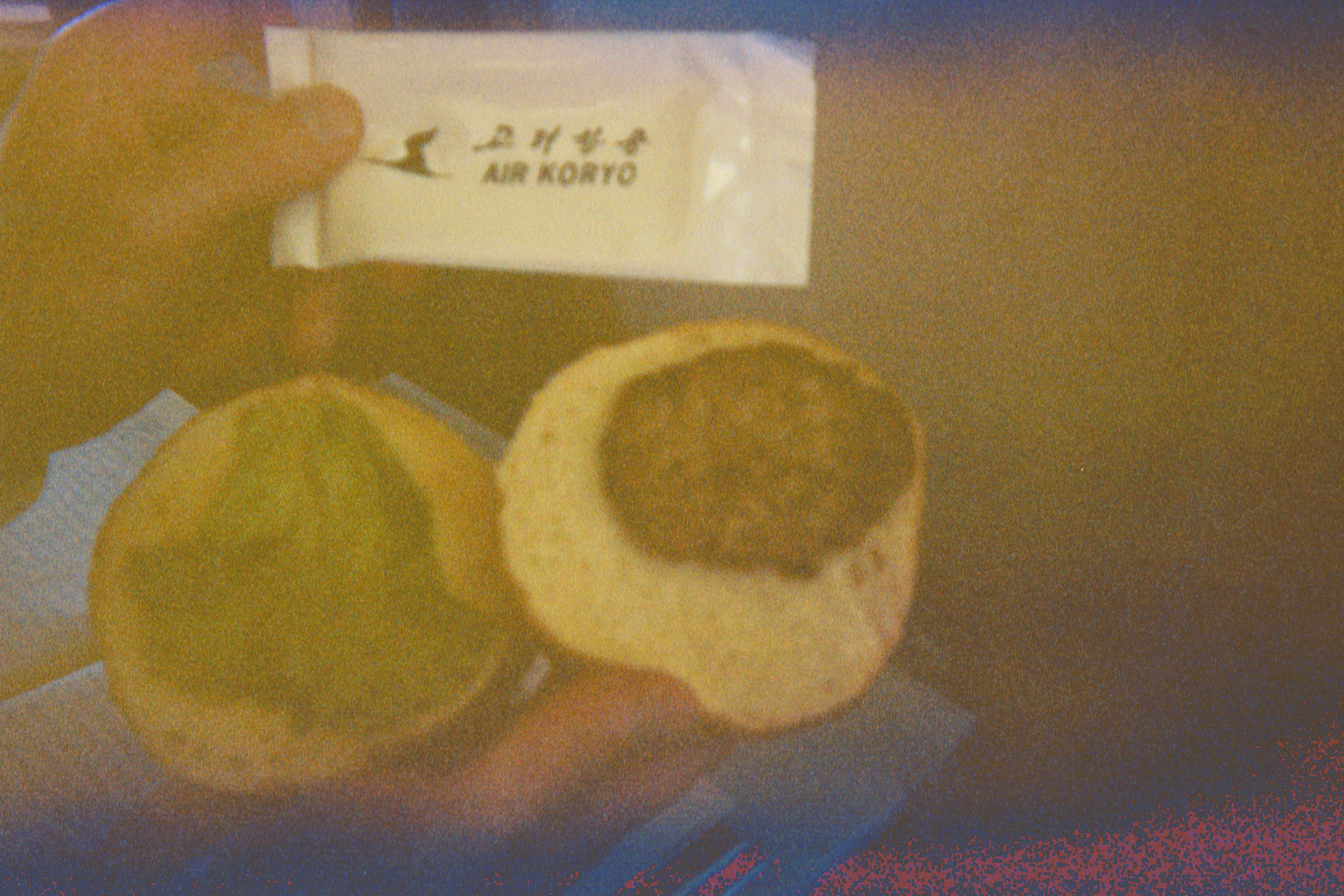
3.  The hamburger is not entirely unknown to North Koreans.  All outbound flights on Air Koryo serve a hamburger (or at least it is some kind of meat patty in a much larger bun with a piece of lettuce).  In business class, you get it on a plate.  I don’t think it is that great, but it is made in the DPRK.  Here is a bad photo I took of the alleged burger.

UPDATE: 4. ROK Drop wonders if they would have used US beef! 

Share

Noko Jeans

Tuesday, July 8th, 2008

Some enterprising Swedes are attempting to manufacture and export jeans from North Korea.  As far as western countries go, Sweden has been one of the leaders in commercial interaction with the DPRK.  Although, according to Erik Cornell, they were frequently burned. 

The project, Noko Jeans, would be the first jeans manufacturer in North Korea.  Here is some info from their website:

Noko Jeans – jeans from North Korea

Noko Jeans began with an e-mail sent to North Korea, fueled by the enthusiasim of being able to contact the country directly. We thought Noko Jeans would end there, before it even began. It didn’t. Instead, and despite our lack of experience in international trading, it swiftly grew to a much more serious level.

Initiated and managed by three Swedes with a background in advertising and PR, Noko Jeans is our attempt to approach and get closer to North Korea, and it is our attempt to answer the question: is it possible to do what no one has ever done before? Is it possible to design, produce and import jeans from North Korea?

Greetings from North Korea!

After months of research, loads of headache and, lastly, several meetings with North Korean government representatives, we are finally allowed into the country. As official visitors, and by invitation of the state. Take off: 27th of July.

We are just now beginning to sense that this experiment actually might come true. Please stay with us as we tell you the unique process – and story – that is Noko Jeans.

Share

Pyongyang Autumn International Trade Fair announced

Tuesday, July 8th, 2008

From the European Business Association (EBA) web site:

4th Pyongyang Autumn International Trade Fair
September 22nd – 25th, 2008, 9:30am-6:00pm
Further details here

Information flyer here: eba.pdf
Registration flyer here: registration.doc

The European Business Association (EBA) in Pyongyang issues this bulletin in order to inform about special conditions for participation by European businesses in the upcoming international trade fair in Pyongyang.

EBA Pyongyang and Korea International Exhibition Corporation (KIEC) will co-organise a special collective booth to host European businesses for the third time.

European companies interested in taking advantage of this opportunity are invited to visit the EBA website www.eba-pyongyang.org to see reports about the EBA booths in October 2007 and May 2008, which both were very successfull. Please also click through to membership and consider becoming a member of EBA.

The collective EBA booth has proven to be a convenient and cost-effective way to introduce European companies to the North Korean market. The participation fee is 600 or 700 Euro.

Share

(Updated) Inter-Korean trade up this year

Tuesday, July 8th, 2008

According to Yonhap (citing a Ministry of Unification report), trade volume between the two Koreas increased 23% to US$880 million (up from $718.2 million) in the first half of 2008.  This is due to an increase in commercial trade (not official exchanges), which were up 47% to $823.6 million from $558.7 million.  Commercial trade comprises 94% of trade volume, up from 78% last year. The number of firms conducting inter-Korean trade reached 526, up from 324, and and they manufactured 736 items (up from 686).

Goods traded in larger volume than a year ago: plate glass, clams, brackens and textiles from the Kaesong complex.

(UPDATE) Much of this is due to brisk activity in the Kaesong Industrial Zone, which employs 30,084 North Koreans (as of July 4, 2008), up from 225 in 2004.  The zone comprises 72 South Korean firms. 

Total production at the complex has been on a steady rise from US$15 million at the end of 2005 to $373.8 million as of the end of May, up 147 percent from last year, the Kaesong Industrial District Management Committee said.

“Such a rise in production is notable in that 33 of the 72 firms in the complex are start-ups operating there for less than one year,” said Kim Min-kyong, a public relations official of the committee.

To learn more, read the full articles below:
Number of N.K. workers at Kaesong complex tops 30,000
Yonhap
Shim Sun-ah
7/8/2008

 Inter-Korean trade rises sharply in first half despite political chill
Yonhap
Shim Sun-ah
7/7/2008

Share

Interview with president of Nosotek, JV company in DPRK

Tuesday, July 1st, 2008

Via Interview Blog:

UPDATE: Here is an interview with Jürgen Bein about the Kaesong Industrial Zone (In German)

Klaus-Martin Meyer: Mr. Eloesser, you recently became the President of Nosotek Joint Venture Company in Pyongyang, the capital of North Korea. In which the field of business is Nosotek operating?

Volker Eloesser: We do general IT outsourcing. This includes data base applications, 3D technology development as well a games production. Nosotek’s customers come from all over the world and some of our products are even used in the US.

Klaus-Martin Meyer: According to your CV, before you were heading to North Korea, you’ve been the general manager of Elocom, a subsidiary of a German Joint Venture between News Corporation (NWS.A) and Verisign (VRSN). It’s quite unusual for a high-ranking manager of a US based public company to move to North Korea.

Volker Eloesser: That’s true. But I don’t see my job as a political mission. At Elocom, I was managing a company producing mobile phone software technology. Neither my old job nor my new one is a political one.

Klaus-Martin Meyer: What’s your opinion about the demolition of the nuclear cooling tower in Yongbyon and the announcement of the US President George W. Bush to remove the country from the terrorism blacklist?

Volker Eloesser: This was great news. I think that both parties, the Korean and US government, took wise decisions which hopefully help giving peace a chance through diplomacy. For our business, lifting the sanctions will have a very positive impact, as well as for the People in the DPRK. North Korean Companies, domestic and foreign-invested, were suffering a lot under the sanctions. Foreign trade was very difficult and many potential customers feared to get trouble when making business with the DPRK.

Klaus-Martin Meyer: When did you first get interested into the DPRK? Did you already do active business with North Koreans before?

Volker Eloesser: Of course I did. In the beginning of 2005, I held lectures at the Pyongyang Business School. The Korean participants of my lectures were great people really interested into international business.

Klaus-Martin Meyer: Who are the shareholders of Nosotek? Is it a state-run company?

Volker Eloesser: Nosotek is a joint-venture between a European owned private holding company and the General Federation of Science and Technology of DPRK, a non-government organization.

Klaus-Martin Meyer: Along being the president of Nosotek, you are Chairman of the Supervisory Board of Next Generation Entertainment N.V. (NGE), a Dutch public company. Are there any links between NGE and North Korea?

Volker Eloesser: NGE’s management is highly interested in investing into the DPRK software industry. The CEO Dr. Stefan Heinemann believes that the DPRK will become a very important sourcing market in the near future, which has many advantages over China and India. Having this in mind, it makes a lot of sense for NGE to have a board member with experience in dealing with North Koreans.

Klaus-Martin Meyer: How would you describe the difference of outsourcing software in the DPRK compared to China or India?

Volker Eloesser: The DPRK’s software industry is already very well developed, but only for the demands of the domestic market. Although the skill level of the engineers is as high as the skill level in China or India, most DPRK software companies never made successful international business in large scale. The Korean engineers usually have no experience with western culture, habits and taste. But of course you’ll experience the same, when working with some small Indian or Chinese companies. One major advantage of the Korean engineers is that they don’t move to a new job frequently, like the Chinese. In this matter, you can compare the Koreans with Japanese staff, who usually never leave the company to move to another job. The result is obvious: the experience and knowledge stays within the company and there is no risk of IP leak.

Klaus-Martin Meyer: Are you personally living in North Korea or can you do your job remotely?

Volker Eloesser: It’s definitely required to have western management in a company dealing with western customers. Every attempt of people trying to do this remotely has failed. I’m planning to live in Pyongyang most of the year. I have a nice apartment in the city centre.

Klaus-Martin Meyer: Living in Pyongyang sounds hard. How are the living conditions for foreigners in Pyongyang? What about your family?

Volker Eloesser: Well, it’s not as hard as western readers may think. Of course the hardest thing is to live separated from my wife, but she promised to visit me frequently. Generally, the living conditions for westerners in Pyongyang are good: The air is totally clean, there is no risk of becoming a crime victim, there is a lot of green in the city and the Korean people are generally very friendly .

Klaus-Martin Meyer: Usually, western media has almost no idea about the real working and living conditions of the people in North Korea. Can you tell us something about the working conditions of your local staff?

Volker Eloesser: One of my goals is to achieve working conditions according to German standard. The staff is equipped with the latest computer hardware and enjoys a lot of incentives from the company to make their live comfortable. For example, the company is providing free lunch for the whole staff, which is delicious and nutritious. I myself have lunch together with my engineers every day, and I like it very much. Additionally to the large number of public holidays, the company even sponsors a one-week holiday trip. This is the way we appreciate the performance on the job.

Klaus-Martin Meyer: What are the most difficult obstacles, western managers are facing in the DPRK? Do you stuffer from political pressure?

Volker Eloesser: I’ve not yet experienced any political pressure, but of course you need to get used to the local security regulations and bureaucracy. When you behave politely, don’t do derogative statements about politics and respect the Korean culture, you won’t face any serious problems. The most difficult obstacle is the absence of international experience of the software engineers, combined with the cultural differences typical to Asian countries.

Klaus-Martin Meyer: How many European businesspeople like you have discovered the DPRK as tomorrow’s sourcing market?

Volker Eloesser: Actually, not many so far. The European community in Pyongyang is very small. After a few weeks, you know every foreigner. Most Europeans who do business in the DPRK are organized in the European Business Association. But I feel that the community is growing since business managers are more and more recognising that doing business in and with the DPRK is of course working with a frontier framework but also with a great potential of highly-skilled people with an impressive work ethic and an attractive cost-performance ratio – and also an emerging domestic market.

Klaus-Martin Meyer: What drives you personally to go there and build up an internationally operating company?

Volker Eloesser: Leading a foreign invested company in North Korea is a great challenge for me. During my lectures at the Pyongyang Business School, I realized that the skilled North Korean IT engineers have a huge potential for successful software development. This potential is almost unrecognized in the world and therefore unused. I like to be the pioneer who builds up this new outsourcing destination. I believe that economic progress will lead to a general improvement of the people’s living conditions and IT business is a key to economic progress. If you ask me, I would tell you that my work will have a greater impact on improving the North Korean living conditions then just sending bags of rice.

Klaus-Martin Meyer: Do you experience economic progress or political changes in North Korea?

Volker Eloesser: The question about political changes should better be answered by the politicians. But indeed you can see economic progress: Compared to my first visit in 2005, there are now much more cars in the street and the number of foreign investment seem to have significantly grown. A group from Hong Kong is building a large shopping and business area along the Taedonggang river and Orascom from Egypt is continuing the Ryugyong Hotel construction as well as investing into a modern mobile phone network. And recently the German-based Prettl Group (Automotive industry) announced that it will be the first foreign non-Korean company to build a factory in Kaesong.

Klaus-Martin Meyer: Nosotek is located in Pyongyang. Do you think things could be easier for companies operating out of the Kaesong free trade zone?

Volker Eloesser: I’ve never been in Kaesong myself. From what I’ve heard, the free trade zone, which has been build with ROK investment, is a modern factory area, mostly targeted to low-cost production of shoes or textile. I don’t know of any software development in Kaesong. Pyongyang, being the economic and cultural centre of the DPRK with large universities, offers a huge number of qualified engineers.

Klaus-Martin Meyer: What are your plans for Nosotek’s future? How do you see your company in five years? What is your strategy?

Volker Eloesser: My plan for Nosotek is a constant growth. First of course, everybody in Nosotek has to understand the demands of our customers; not only the technical demands but also the usual communication style and habits of the western world. At the moment, we’re only fifty people and I’m starting to build up a powerful middle management, who knows their customer’s expectations. After this has been done, we can begin scaling the business volume.

Klaus-Martin Meyer: Are there other western IT companies having operations in the DPRK?

Volker Eloesser: Nosotek still is the only one. But according to Paul Tjia of GPI Consultancy who organizes business missions to the DPRK, the number of people interested into software development in the DPRK is constantly growing. I hope that Paul will bring more people here to operate software companies. With other Foreigners here, working in the same or similar field of business we together can help strengthening the DPRK to become a better known source for software development. Bangalore is still far, but I’m sure the quality delivered by the Korean IT engineers will be convincing, not only to grow Nosotek, but also to grow the country itself as an outsourcing destination.

Klaus-Martin Meyer: Mr. Eloesser, thank you for the interview.

Share

Chinese invest in DPRK mining

Sunday, June 29th, 2008

Michael Rank, a China/North Korea specialist based in London reports:

A Chinese company has opened a joint venture iron mine in North Korea with registered capital of €36 million ($57 million), a Chinese website specialising in North Korea reports (link here).

The Chinese partner is S Group, whose main aim includes developing magnesite mines in North Korea, but for some reason it switched from magnesite to iron mining.

The mine in Ongjin-gun (gun=county), Hwanghaenam-do (South Hwanghae, do=province), south of Pyongyang, has been in operation since the second half of last year, and the company running it is the Xihai/Seohae (West Sea) Joint Enterprise, the website says, but gives no further details.

The Chinese report erroneously places Ongjin-gun in Hwanghaebuk-do (North Hwanghae) but it is confirmed as being in Hwanghaenam-do by  조선지도첩 (Joseon Jidocheop, Atlas of Korea, Pyongyang, 1997), p. 45. I have not been able to find any other reference to a Chinese mining company called S Group.

Chinese steel company Tonggang (Tonghua Steel), based in the northeastern province of Jilin, was reported by a Chinese newspaper in January 2006 to be spending four billion yuan ($506 million) to develop the Musan iron mine in Hamgyeongbuk-do (North Hamgyong province), said to be North Korea’s largest iron deposit – and the biggest in Asia, according to some estimates.

Magnesite (magnesium carbonate) is used in protecting the linings of steel furnaces, in the production of synthetic rubber and in making fertilisers.

Share

POSCO looks north

Thursday, June 26th, 2008

Kim Dong-Jin, head of South Korean steel company POSCO‘s China branch, visited Pyongyang Tuesday for talks on purchasing more of the DPRK’s coal, iron ore, and other raw materials.

According to the AFP

POSCO, the world’s fourth largest steelmaker, has imported 200,000 tons of coal from North Korea every year.

South Korea’s investment in the North’s rich mineral resources has been sluggish due to the standoff over the North’s nuclear programme and mixed views on whether such investment can be profitable.

North Korea has promoted raw material exports as a means of generating much needed hard currency for some time.  Unfortunately, this development strategy will bring the fewest benefits to the North Korea people. Look at any oil-exporting country for comparison.  Raw materials exports generally enrich the politically connected—and workers, who in North Korea are unable to leave their jobs or negotiate their wages, generally (pun alert) get the shaft.

South Korean firms operating in the North, however, do tend to offer better working conditions than North Korean or Chinese firms.  If POSCO launches operations in North Korea, hopefully public pressure and the profit motive will see an increase in productivity, wages, and working conditions for the DPRK’s miners.

South Korea apparently also operates a graphite mine in North Korea.  If anyone has any information on this, please send it my way.

Read the full story here:
POSCO eyes NKorea raw materials
AFP
6/25/2008

Share

South Korea to ease regulations on DPRK ventures

Thursday, May 22nd, 2008

Institute for Far Easter Studies (IFES)
NK Brief No. 08-5-22-1
5/22/2008

Earlier this month, the South Korean government announced that it would seek to relax regulations concerning cooperative ventures and exchanges with North Korea. Currently, South Korean companies, organizations or individuals wishing to enter into business agreements with North Korean partners were required to get government permission not only for the project, but for the individuals involved in the project.

On May 8, the Ministry of Unification announced plans to abolish the system granting (or denying) permission to individuals involved in these ventures, and to maintain only the system through which it grants authority to carry out specific projects.

Cross-border traffic faced similar red tape, as permission was required not only for goods being imported or exported, but for the importers and exporters themselves. The new plan includes measures for these import and export regulations to be loosened so that it is only the goods that need review, not the people involved in the trade. In addition, trucks and other equipment used to carry goods across the border will be certified for a period of five years, more than twice as long as the current two-year licensing system.

The government is also moving to ease requirements calling for South Korean citizens to report all contact with North Koreans, and instead to require reports on conversations only if the topic falls outside that of the approved project.

Reflecting the growing amount and diverse nature of inter-Korean cooperative projects, and the ROK government’s policy of encouraging such exchange, this new proposal is aimed at reducing the red tape and paperwork hassles necessary to launch and carry out these projects by reducing the amount of information required by the applicant and the volume of cross-checking required by government offices. At the same time, the proposal calls for the introduction of fines for those found to be filing false applications or reports.

If this proposal does not get mired in the Cabinet or other committees, it is expected to reach the floor of the National Assembly sometime in June.

Share