Archive for the ‘Central Committee’ Category

KCC finding creative ways to earn hard currency

Thursday, August 4th, 2011

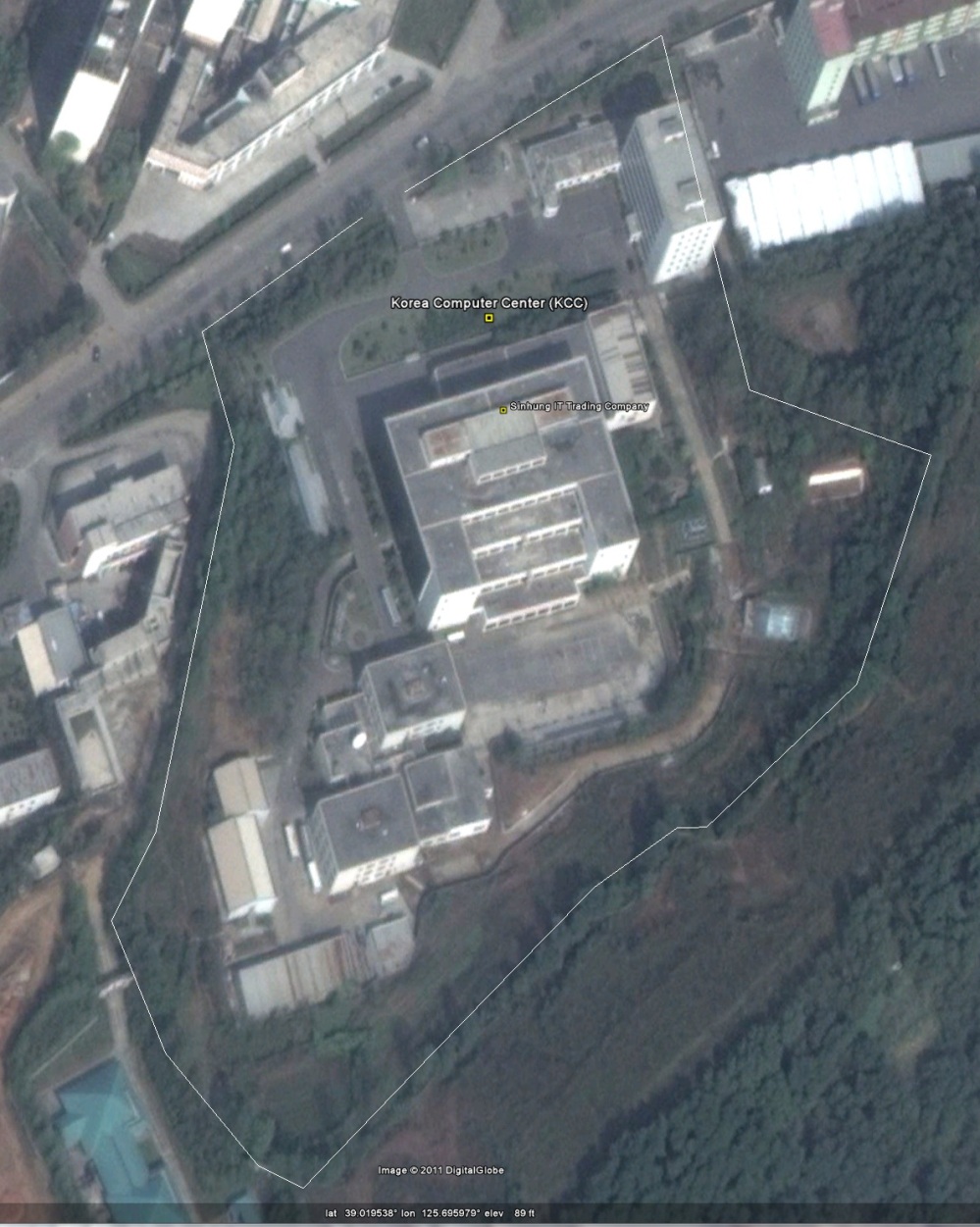
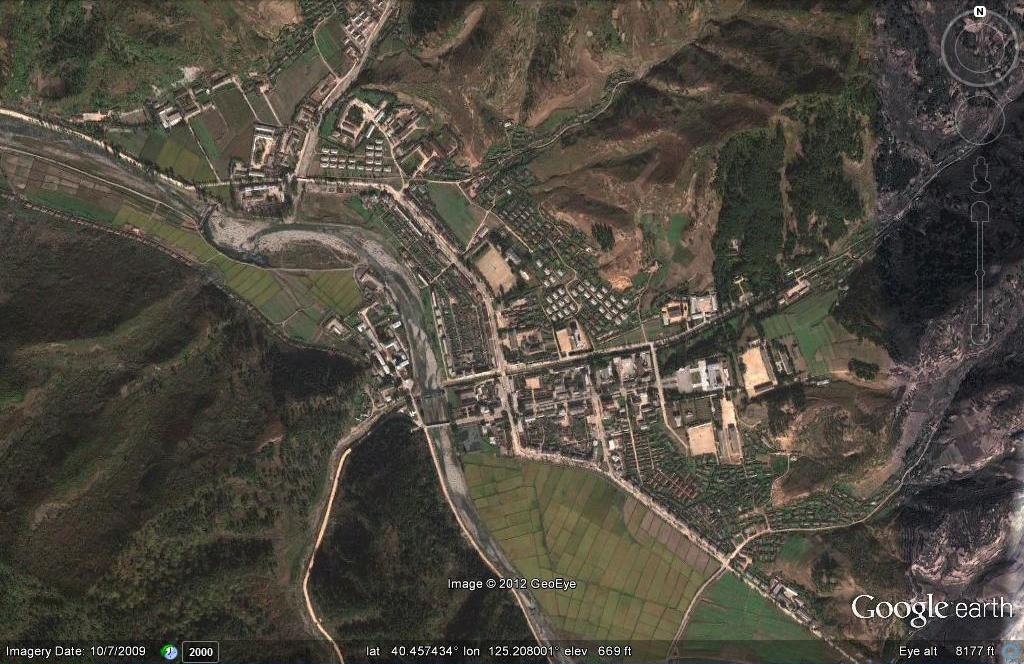
Pictured above (Google Earth): Korea Computer Center

According to the Associated Press (Via Washington Post):

South Korean police said Thursday they have arrested five people who allegedly collaborated with elite North Korean hackers to steal millions of dollars in points from online gaming sites.

The five, including a Chinese man, were arrested and another nine people were booked without physical detainment after they worked with North Koreans to hack South Korean gaming sites, the Seoul Metropolitan Police Agency said in a statement.

Members of the hacking ring, which included North Korea’s technological elite, worked in China and shared profits after they sold programs that allowed users to rack up points without actual play, police said.

The points were later exchanged for cash through sites where players trade items to be used for their avatars. The police said the ring made about $6 million over the last year and a half.

A police investigator, who declined to be identified because the investigation was under way, said North Korean hackers were asked to join the alleged scheme because they were deemed competent and could help skirt national legal boundaries.

The police pointed to North’s Korea Computer Center as the alleged culprit. Set up in 1990, the center has 1,200 experts developing computer software and hardware for North Korea, the police said.

The National Intelligence Service, South Korea’s spy agency, was heavily involved in the investigation, the police said. Investigators suspect the hackers’ so-called “auto programs” could be used as a conduit for North Korean cyberattacks.

South Korean authorities have accused North Korea of mounting cyberattacks in the past few years. Prosecutors said earlier this year that the North hacked into a major South Korean bank’s system and paralyzed it for days. The North is also accused of mounting attacks on U.S. and South Korean websites. Pyongyang has denied the charges.

The New York Times adds the following details:

In a little less than two years, the police said, the organizers made $6 million. They gave 55 percent of it to the hackers, who forwarded some of it to agents in Pyongyang, the capital of North Korea. “They regularly contacted North Korean agents for close consultations,” Chung Kil-hwan, a senior officer at the police agency’s International Crime Investigation Unit, said during a news briefing.

Mr. Chung said the hackers, all graduates of North Korea’s elite science universities, were dispatched from two places: the state-run Korea Computer Center in Pyongyang and the Korea Neungnado General Trading Company. The company, he said, reports to a shadowy Communist Party agency called Office 39, which gathers foreign hard currency for Mr. Kim through drug trafficking, counterfeiting, arms sales and other illicit activities.

Read the full story here:
South Korean police say they’ve cracked down on ring working with North Korean hackers
Associated Press (Via Washington Post)
2011-8-4

Share

South Korean churches change DPRK strategies

Thursday, June 23rd, 2011

According to the Daily NK:

For the ten years from 1995 to 2004, churches in South Korea sent a total of 270 billion South Korean won in aid to North Korea’s Chosun Christians Federation to fund projects including the building of an orphanage.

This money represented fully 77% of all private donations sent to North Korea in the same period. However, the truth is that nobody knows how the money has been spent, or by whom.

Such religiously motivated support for the Chosun Christians Federation results in not only problems for other missionary work, but also prolongs the suffering of the people, according to Yoo Suk Ryul, the director of Cornerstone Church, an active missionary group working along the North Korean-Chinese border. He has just released a new book, ‘The Collapse of the Kim Jong Il Regime and North Korean Missionary Work.’

In it, Yoo writes, “The Chosun Federation first came to our attention as an association affiliated to the United Front Department of the Chosun Workers’ Party so, to that extent, funds from missionary organizations are obviously propping up the Kim Jong Il regime.”

“The rebuilding of the church should not be done through an organization affiliated to the Kim Jong Il regime or the Chosun Workers’ Party,” Yoo therefore asserts. Rather, he believes assistance should be rendered to underground churches, to begin the spread of the gospel from the bottom up.

In addition, “To date, Chinese-Koreans and our defector brethren have received training in China, and through this indirect method have entered North Korea to establish underground churches.” However, “North Korea’s situation both at home and abroad is change rapidly now, so missionaries need to turn to a strategy that is more direct.”

Additionally, he goes on, “The Bible, radio, TV and DVDs should continue to be sent by balloon, along with all other methods of advancing the spread of the gospel,” and explained, “This is a strategy to force Pyongyang’s fall through the gospel.”

Yoo has invested much time and effort into persuading Korean churches to end their existing missionary work in North Korea, and follow a new path. “Missionary work in North Korea is not something that can be accomplished with a strategy of passion alone,” he writes, “This missionary strategy does not grasp the essence of the North Korean system; it is a house of cards.”

Read the full story here:
New Religious Strategy Is Needed
Daily NK
Cho Jong Ik
2011-6-22

Share

KWP worried about deterioration of information controls…

Tuesday, May 24th, 2011

According to the Daily NK:

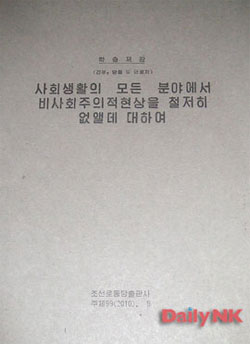
…Now, The Daily NK has confirmed the existence of this initiative to control information circulation in the form of an education document for Party cadres, ‘On thoroughly eliminating anti-socialist phenomena in every area of community life’.

The 15-page document appears to have been published by the Chosun Workers’ Party’s own publishing house in advance of the Party Delegates’ Conference in September last year for circulation by the Propaganda and Agitation Department of the Workers’ Party.

In it, the Party states three broad goals: “We must pull out the roots of individualism and selfishness, and firmly arm ourselves with group awareness”; “We must thoroughly eliminate the illusion of money and the illusion of foreign currency”: “We must battle fiercely against the invasion of imperialist ideology and culture.”

The document even outlines the schedule and approach which should be adopted for lectures on the subject, ordering that Party cadres receive a 90-minute and Party members and laborers a 60-minute lecture on these ‘anti-socialist phenomena’ occurring both in the community and in their specific work area, methods of discovering those phenomena and ways of eliminating them.

“You must find and explicate cases of the phenomenon of failing to concentrate on the revolutionary mission and trading for the purposes of earning money; the phenomenon of diverting state organ and enterprises’ materials and products or focusing solely on the organ, the phenomenon of working-age women who fail to attend work in order to trade etc.”

It states, “Now, cadres and laborers are getting caught up in the illusion of money and foreign currency, meaning that their economic activities, morals, and worse still their ideology, are lacking.”

This frank admission of the problems being caused by illicit capitalist trade and the need to stop it are clear evidence of the worries felt by the authorities.

It states, “We must absolutely not allow the selling in markets of items which encroach upon the state or public good, including those which spread undesirable trends, products produced by state factories and enterprises, products unhygienic or otherwise threatening to human health.”

“Transferring imported goods to private traders and earning money through their sale in the market on the part of trade and foreign currency earning enterprises, which also helps the market to develop, must be eliminated, and selling by the entire state sector must be reinvigorated.”

Again, later, it reaffirms, “The phenomena of promoting the transferring of products to private traders, thereby earning money secretly and promoting this secret trade, must be thoroughly eliminated.”

This, the documents claim, are serious issues because the outside world is striving to undermine the socialist system of the country, with the ‘imperialists’ ideological and cultural invasion capturing the people and leaving them “ugly beings knowing nothing but themselves and nothing but money, an animalistic existence.”

Elsewhere, the document also attacks the circulation of foreign information, asserting, “Here the important thing is to thoroughly eliminate the circulation of, watching of and listening to of these foul recordings. In particular, we must avert the eyes of housewives and young people.”

The circulation of such information, it alleges, must be stopped “so as not to become tangled in the enemies’ psychological scheming” and to cease the “circulation of capitalist ideology and culture.”

To which end, it concludes, “The role and responsibility of the Party and enterprise cadres must be enhanced, while community watch guards and security under people’s units must be strengthened.”

Read the full story here:
Party Reveals Worries over Foreign Wind
Daily NK
Choi Cheong Ho and Jeong Jae Sung
5/25/2011

Share

ROK denies labor groups’ visit to DPRK

Thursday, April 28th, 2011

According to Yonhap:

South Korea has turned down a request by two umbrella labor unions to visit North Korea for talks with their counterparts, an official said Thursday, attesting to ongoing hostilities between the sides.

South Korea’s two main umbrella unions — the Korean Confederation of Trade Unions (KCTU) and the Federation of Korean Trade Unions — applied for permission earlier this week to send four of their members to the North Korean border town of Kaesong for talks with their northern counterparts. They hoped to discuss possibilities for another general meeting among their members, the last of which was held in 2007 before inter-Korean relations grew tense.

South Korea’s Ministry of Unification, which handles inter-Korean affairs, rejected the visit planned for Thursday, citing a breach of regulations enforced after last year’s deadly sinking of a South Korean warship. Seoul blames Pyongyang for the March torpedo attack that killed 46 South Korean sailors, an allegation that the North vehemently denies.

“Not only is it required by law to apply for permission at least a week in advance, but our nationals are currently prohibited from visiting North Korea” under a set of post-attack measures that also ban cross-border trade, a ministry official said on customary condition of anonymity.

The two labor groups were informed of the decision on Wednesday, he added.

In protest, the KCTU held a rally outside the main government complex in Seoul earlier in the day, saying the ministry denied “the earnest request of workers from the South and North who long for peace on the Korean Peninsula.”

“We will achieve a South-North workers’ general meeting at all costs even if we can’t be together in one place,” the KCTU said in a statement, indicating it may issue a joint statement with its North Korean counterparts after holding separate meetings in Seoul and Pyongyang.

The South Koren government has been allowing some private aid to be delivered to th DPRK.

Read the full story here:
Gov’t rejects labor groups’ request to visit N. Korea
Yonhap
4/28/2011

Share

North Korea Resumes Military Rice Procurement Drive from January

Wednesday, March 23rd, 2011

Institute for Far Eastern Studies (IFES)
NK Brief No. 11-03-23
3/23/2011

A nationwide drive for military rice procurement was reported to have resumed from January this year in North Korea. The DPRK authorities halted the collection of rice for the military early last year with a sharp decrease in food production after suffering from repeated flood damages. However with their efforts to find aid from China and other foreign means to little avail, restarted the military procurement from early this year, collecting 2 to 3 USD worth of rice per person on a national level. North Koreans are reported to be strongly against the resurgence of the collection.

According to the Daily NK, sources from Pyongyang revealed that “Orders came from the Central Committee of the Party last December to begin a nationwide collection from January on the grounds of deficient military food supply. Although the order encouraged the drive to be voluntary and not obligatory, the department in charge of procurement is placing pressure on merchants and workers and officials of various corporations for donation.”

The Pyongyang source added, “In the case of Jung District Market (Jungguyeok Market) [satellite image here], the merchants were coerced into paying additional forty to fifty thousand KPW per person. The police are pressuring people that those who fail to pay will be forced to leave their lucrative spot in the market and replaced by those that paid.” Given the price of rice at the end of February was 1,900 KPW per/kg, each merchants was donating about 20 to 25kg of rice to the military.

On the other hand, workers in corporations were paying about 10 kg/person while the cadres were instructed to pay 30 kg/person. “The authorities did not hesitate to criticize and condemn those who dawdled on paying,” the source disclosed.

Another source from Sariwon in North Hwanghae Province also confirmed the account, “The Central Committee instructed the donations to be based on people’s consciences, but local authorities are demanding ‘each person must give specified kilos of rice,’ and ‘those that paid over a ton (1,000 kg), were given party membership right there and then with no inquiries about the source of the rice.”

Thus far, two people were reported to have given ten tons of rice and corn each, 50 people offered two tons of rice, and 200 people donated one ton of rice.

The source further added, the Party’s original target of 800 tons of rice for Sariwon was exceeded by a large margin, reaching over 2,400 tons.

However, disgruntled voices of North Koreans are also reported to be heard for the half-forced “military rice procurement drive,” raising questions about “where the food was going,” and “unhappy about taking rice for the military when there are no food rations for the people and factories no longer in operation.”

Previous stories on the DPRK’s food situation this year can be found here.

Share

Office 38 reportedly back in business–and other changes

Sunday, February 20th, 2011

UPDATE 4 (2/20/2011): Kim Tong-un (김동은) named Kim Jong-il’s fund manager.  According to Yonhap:

A senior official of North Korea’s ruling party has been named to lead a special party bureau, code-named Office 38, that oversees coffers and raises slush funds for its leader Kim Jong-il and the ruling elites, a source on North Korea said Sunday.

Kim Tong-un, formerly head of Office 39 in the Workers’ Party of Korea, assumed the post in May last year, when North Korea revived Office 38, which was merged with Office 39 in 2009, the source said on condition of anonymity. Office 39 is believed to be another organ that governs a wide network of business operations both legal and illegal.

Both Offices 38 and 39 belong to the Secretariat of the Workers’ Party, which Kim Jong-il chairs, according to a diagram of the North’s power structure released by the Unification Ministry, which handles inter-Korean affairs. Last year, the ministry had only included Office 39 in a similar diagram.

In a meeting with reporters last week, a ministry official said Office 38 has been spun off from Office 39 and is now running on its own again. The official, who would speak only on the condition of anonymity citing the sensitive nature of his comments, described “a stream of information” that has come through since mid-2010.

Office 38 mainly oversees transactions involving foreign currency, hotels and trade, the official said, while Office 39, headed by Jon Il-chun, drives revenue by dealing in narcotics, arms, natural resources and others.

The North’s revival of Office 38 is interpreted as an effort to cover the increasing cost of leader Kim Jong-il’s ceding of power to his youngest son, Jong-un.

The story was also reported in Yonhap.

UPDATE 3: Here are links to the Ministry of Unification‘s English language organization charts of the North Korean leadership in which some of the changes mentioned below are listed (though not all): Workers’ Party, State Organs, Parties and Organizations

UPDATE (2/15/2011): According to the Daily NK:

The number of Special Departments under the Secretariat of the Chosun Workers’ Party has been increased from 18 to 20, a move that includes the revival of the No. 38 Department, which previously served as Kim Jong Il’s private bank vault, and the foundation of a film department.

The Ministry of Unification revealed the news yesterday in its 2011 North Korean Power Structure and Index of Figures, Agencies and Organizations. It incorporates North Korean changes from December, 2009 up to the present day, completed after consultation with relevant agencies and experts.

The revival of the No. 38 Department and founding of a film department

The report states, “The No. 38 Department, which was merged with the No. 39 Department in 2009, was spun off again last year. Kang Neung Su, who was appointed Deputy Prime Minister in June of 2010, was introduced as head of the film department at the same time. The exact foundation date of the film department is unknown; however, it appears to be newly established.”

No. 38 and No. 39 Departments are directly controlled by Kim Jong Il and serve as a private vault for his ruling funds. The No. 38 Department manages hotels, foreign currency stores and restaurants etc, while illegal weapons trading through foreign trade companies, the smuggling of gold, illegal trade in drugs and the distribution of counterfeit dollars, so-called supernotes, are handled by the No. 39 Department.

“They combined two offices which had different functions, and it appears that this did not result in the intended efficiency,” a knowledgeable source commented.

Meanwhile, on the establishment of a film department, the source added, “North Korea’s cultural art is a political means by which to carry out Party policy and a policy tool to implant policy in the North Korean citizens.”

Among the reshuffled special departments, the existing ‘Munitions Industry Department’ has been renamed the ‘Machine Industry Department’, and the ‘Administration and Capital Construction Department’ has been scaled back to simply ‘Administration Department’.

Elsewhere, the existing National Resources Development and Guidance Department under the Ministry of Extractive Industries has been promoted to National Resources Development Council and, as reported, the Joint Investment Guidance Department rose to become the Joint Investment Committee, while the National Price Establishment Department became the National Price Establishment Committee. Again, as reported, the ‘People’s Safety Agency’ under the Cabinet became the People’s Safety Ministry under the National Defense Commission, while the Capital Construction Department was downsized to become the General Bureau of Capital Construction.

The Central Court and Central Prosecutors Office were also renamed the Supreme Court and Supreme Prosecutors Office respectively.

The Ministry of Unification report also notes that North Korea added Nampo City to its list of eleven cities and provinces, increasing the total number to twelve.

The newly designated Nampo City includes five former parts of South Pyongan Province; Gangseo, Daean, Oncheon, Yonggang, and Chollima districts. Previously, Nampo was under the direct control of the central government as part of South Pyongan Province proper.

At the same time, North Korea also transferred the existing Kangnam-gun, Joonghwa-gun, Sangwon-gun, and Seungho-district, all formerly southern sections of Pyongyang City, to North Hwanghae Province.

Military Commission placed under the Central Committee of the Party

The relationship of the Central Committee and Central Military Commission, which was formerly said to be in parallel, has been changed, reflecting the idea that the Military Commission is now under the Central Committee of the Party.

The Ministry of Unification commented, “By revising the Party regulations, the Central Military Commission and Central Committee were marked as parallel in 2009 and 2010. However, after confirming the revised Party regulations at the Chosun Workers’ Party Delegates’ Conference on September 28th last year, this relationship was adjusted, and an election is now held for the Central Military Commission via a plenary session of the Central Committee.”

Also, the ‘Bureau of General Staff’ under the National Defense Commission was judged to be below the Ministry of the People’s Armed Forces, but is now shown to be in a parallel relationship with the Ministry of the People’s Armed Force and ‘General Political Department’.

ORIGINAL POST (2/14/2011): According to Yonhap:

North Korea has revived a special party bureau, codenamed Office 38, that oversees coffers and raises slush funds for its leader Kim Jong-il and the ruling elites, South Korea said Monday in its annual assessment of the power structure in the communist country.

In 2009, the bureau had been merged with Office 39, another organ that governs a wide network of business operations both legal and illegal, according to the Unification Ministry in Seoul.

In a meeting with reporters, however, a ministry official said Office 38 has been spun off from Office 39 and is now running on its own again. The official, who would speak only on the condition of anonymity citing the intelligence nature of his comments, cited “a stream of information” that has come through since mid-2010.

The official would not elaborate on how the information has been obtained, only saying the ministry works closely with “related government bodies” to outline the North’s power structure.

Office 38, whose chief remains unknown, mainly oversees transactions involving foreign currency, hotels and trade, the official said, while Office 39, headed by Jon Il-chun, drives revenue by dealing in narcotics, arms, natural resources and others.

A source privy to North Korea matters said the spin-off suggests that North Korea has been experiencing difficulties in earning foreign currency since merging the two offices.

“Efficiency was probably compromised after the two, which have different functions, were combined,” the source said, declining to be identified citing the speculative nature of the topic. “More importantly, it seems related to the current state of foreign currency stocks. The North is apparently trying to address those difficulties.”

In August last year, the United States blacklisted Office 39 as one of several North Korean entities to newly come under sanctions for involvement in illegal deeds such as currency counterfeiting.

North Korea is also believed to have been hit hard financially after South Korea imposed a series of economic penalties last year on Pyongyang when the sinking of a warship was blamed on it.

Both Offices 38 and 39 belong to the Secretariat of the Workers’ Party, which Kim Jong-il chairs, according to a diagram of the North’s power structure released by the Unification Ministry. Last year, the ministry had only included Office 39 in a similar diagram.

Both offices have often been referred to as Kim Jong-il’s “personal safes” for their role in raising and managing secret funds and procuring luxury goods for the aging leader.

Read the full story here:
North Korea Splits No. 38 and 39 Departments Up Again
Daily NK
Kim So Yeol
2/15/2011

N. Korea revives ‘Office 38’ managing Kim Jong-il’s funds: ministry
Yonhap
Sam Kim
2/14/2011

Share

DPRK, NGO to film Paek Son Haeng film

Monday, January 17th, 2011

Pictured above: Paek Son Haeng Memorial Hall, Pyongyang (Google Earth)

According to the Daily NK:

North Korea has apparently agreed to accept foreign funding to produce a movie which shows Christians in a positive light. It will be the first movie made in North Korea to show the life story of a Christian.

An activist working in New Zealand for “Team and Team International”, a South Korean NGO working on international disaster relief, reported today, “A North Korean movie import-export company (Chosun Movie Company) has decided to produce a movie, ‘Paek Sun Haeng’, with the support of an organization from New Zealand,” and added, “They are at the last stage of working on the scenario and plan to start filming this coming September.” A budget production, it will cost a reported $1.5 million.

The activist said that the two sides have agreed to show the movie in movie theaters across the country and on Chosun Central TV. The purpose behind the investment is apparently to depict the positive side of Christianity and Christians to the North Korean people.

He explained, “Based on the idea that the figure, Baek Sun Haeng, has been defined as a good capitalist in North Korea, the organization has been negotiating production of a movie about her with North Korea since 2008.” Additionally, he said “They will describe fully the image of Baek as a philanthropist as well as a Christian in the movie.”

The scenario was reportedly written by the head of Chosun Movie Company, Choi Hyuk Woo, but there has been conflict over the degree of Christian content.

The source explained, “Problems when the North Koreans tried to change one line or scene have not been small.” However, “They were able to persuade the North Korean staff by sticking stubbornly to the fact that it would have been impossible to invest in the movie without Christian content.”

North Korea’s bad situation vis a vis foreign currency may have influenced the North’s decision-making, the source agreed, saying, “I am aware that North Korea’s internal capital situation is rather difficult. That economic difficulty may have influenced this contract somewhat.”

Chosun Movie Company oversees the export and import of movies under the Culture and Art Department of the Propaganda and Agitation Department, which is within the Central Committee of the Party.

The activist emphasized, “Aid activities for North Korea should give dreams and hope for new things to the North Korean people through diverse cultural approaches beyond food or essential aid.”

The movie’s main character, Baek Sun Haeng (1848-1933) is a well-known philanthropist in North Korea who has been mentioned in North Korean textbooks, in Kim Il Sung’s memoirs and elsewhere.

After her husband died when she was 16 years old, she is said to have accumulated wealth relentlessly. After that, she built both “Baek Sun Bridge” across the Daedong River and a three-story public meeting hall in Pyongyang. She also donated real-estate for Pyongyang Gwangsun School and Changdeok School.

Baek, as the deaconess of a church, also contributed to the education of Korean Christians by donating capital and land for Pyongyang Presbyterian Church School, which was built by Rev. Samuel Austin Moffett, the then-reverend at the First Church of Pyongyang, and Soongsil School, the forerunner to Soongsil University in Seoul, which was established by Dr. W. M. Baird, an American missionary, in Pyongyang on October 10th, 1887.

Additionally, she dedicated all of her property to an organization dedicated to the relief of poverty in 1925, so the Japanese government general tried to present her with a commendation, but she refused it. Therefore, she has been praised highly as a “people’s capitalist” in North Korea.

In 2006, the North Korea media reported that an existing monument to Baek had been restored and moved into “Baek Sun Haeng Memorial Hall” in Pyongyang on the instructions of Kim Jong Il.

Read the full story here:
Christian Movie Being Shot inside North Korea
Daily NK
1/17/2011

Share

Worker’s Party regulations revised

Thursday, January 6th, 2011

According ot Yonhap:

In an apparent bid to facilitate its hereditary power succession, North Korea has rewritten major regulations governing its ruling party, allowing its leader-in-waiting to take full control of the state with greater ease, a government source said Thursday.

The revisions were approved at the landmark convention of the top Workers’ Party delegates in September, during which Kim Jong-un, the youngest son of leader Kim Jong-il, rose as a vice chairman of the Central Military Commission, the source said.

“The revisions paved the way for the Kims to monopolize every part of the North Korean system while making it official that the country is a dynasty,” the source said, asking not to be named because of the intelligence nature of the documents he cited.

North Korea removed a clause that made it mandatory for the party to hold a general convention every five years, the source said. Instead, the party can now elect senior members and revise its regulations just by holding a top delegates’ meeting.

“Another measure that makes it easy for Kim Jong-un to take power is to automatically appoint the party secretary as head of the Central Military Commission,” the source said, adding that the move suggests Kim Jong-un, a four-star general, may be on track to succeeding his father as party secretary.

“This allows Kim Jong-un to control both the party and the military just by rising to the top of the party, the source said.

Kim is believed to be no older than 28. His birthday is this Saturday, Jan. 8.

The Central Military Commission within the party has also been given more power, the source said, as it now “governs all defense and military programs conducted between each party convention.”

The revision signals that the commission may grow more powerful than the National Defense Commission, the highest seat of power headed by Kim Jong-il but not yet joined by Kim Jong-un, he said.

Read the full story here:
N. Korea rewrites party regulations to boost hereditary power succession: source
Yonhap
Sam Kim
1/6/2011

Share

Pyongyang 1946 and today

Sunday, January 2nd, 2011

I recently came across this map of Pyongyang printed in 1946:

Click map to see full size version

According to the map, it is “For use by War and Navy Department Agencies only.  Not for sale or distribution”.

I thought it would be fun to add the map to Google Earth so I could compare the pre-Korean War city infrastructure with what we see today.  Some interesting information emerges:

1. The Omura Silk Mill is now the Kim Jong Suk Pyongyang Silk Mill. Satellite image here.

2. The Kanegajuchi Spinning Mill is now the Pyongyang Textile Mill.  Satellite image here.

3. Fuji Iron Works is now the Pyongyang Cornstarch Factory. Satellite image here.

4. What was the Pyongyang Airport is now Taedonggang-district in East Pyongyang.

5. Much of what we call the  “Forbidden City” (Korean Workers Party Offices) were military barracks.

6. The former Pyongyang Medical College is now … the Kim Il-sung University College of Medicine. Satellite image here.

7. The Supreme People’s Assembly sits on the grounds of the former Pyongyang Women’s Prison.

8. The Namsan School was torn down and is now either the Organization and Guidance Department (according to one defector) or the Democratic Women’s Union Hall. Satellite image below:

I also might have discovered several Japanese colonial-era prisons that may very well still be prisons and/or factories. According to the map, this was the shape of the Pyonysang (Heijo) Prison:

There are a handful of buildings in the DPRK which still retain this distinctive shape (or the obvious remnants of this shape)—as well as walls and guard towers.  They are in Phyongsong, Hamhung, and Sariwon:

I have made the 1946 map available as a Google Earth download. You can obtain the KMZ file by clicking here. Please let me know if you make any interesting discoveries of your own.

By coincidence, Andrei Lankov wrote an article about the history of Pyongyang last week in the Korea Times (as I was comparing the maps). According to the article:

Pyongyang enjoyed boom in colonial era
Korea Times
Andrei Lankov
12/30/2010

This city is long gone. No, it is still on the maps, and all our readers know its name ― Pyongyang, the capital of the Democratic People’s Republic of Korea.

But the Pyongyang of the Kims’ dynasty does not have much to do with the old city, wiped out in the social turmoil of the late 1940s and inferno of the American bombing of the early 1950s.

People who nowadays inhabit the North Korean capital, are overwhelmingly newcomers, and not much physical evidence is left from the city past.

It was once a capital of Goguryeo, one of the three ancient kingdoms which fought over the domination of the Korean Peninsula in the first centuries of the Christian era. Pyongyang remained important for centuries. During the Joseon Kingdom (1392-1910) it was the second or third largest city in the entire country.

The city remained surrounded by the stone walls which by the 1890s had been in a state of disrepair for a long time (they had lost any military significance since a much earlier date, one has to admit). The majestic Taedong Gate, facing the river, was seen as a masterpiece of traditional architecture.

Throughout the colonial period, the city’s population increased from 40,000 around 1910 to 285,000 in 1940. It was roughly one third of the then size of Seoul, but this still made Pyongyang one of the largest cities in the nation.

As was the case with nearly all major cities of both the to-be North and to-be South, the railway was instrumental in Pyongyang’s growth.

Pyongyang was located straight on the Busan-Seoul-Sinuiju line, built in the early 1900s. This line became a backbone of the country’s transportation network, and old cities which were bypassed by this railway, eventually went into decline. Pyongyang was lucky to avoid such a fate.

Nowadays Pyongyang Station is located close to the center of the North Korean capital. However, in the early 1900s it was located some distance away from the old walled city, so the space between the station and walls became a new part of Pyongyang, with rectangular grid of streets and the numerous houses of the Japanese settlers who comprised about 13 percent of the city population in 1945.

The army barracks and a large military area appeared near the station as well. Meanwhile, the Koreans were left within the space once occupied by the old walled city.

The fast growth of the city made public transportation necessary, and indeed in May 1923 a tram service ― or “streetcars” as Americans would say ― was introduced, to remain in operation until the autumn of 1950 (the present-day tram system was built anew in the early 1990s, and has no continuity with the old trams of the colonial era).

Since time immemorial and until the late 1920s, Pyongyang was located on the eastern (left) bank of the Taedong River, but from the late 1920s the city crossed to the opposite bank as well.

In 1921, an airfield was built there, to be used by both the Japanese air forces and civilian planes which landed there for re-fueling on their way from Japan to China and back. This airfield, located roughly where the “embassies quarter” is now, remained in operation until the late 1950s, if not longer.

Pyongyang underwent a major industrial boom in the colonial era. Huge coal deposits were discovered around the city, so by the 1920s the mines of the Pyongyang area provided about a half of all coal produced in Korea. This economy of the era was largely an economy of coal and steel, so these mines attracted heavy industry.

The Mitsubishi Group built a large steel mill in Nampo, not far away from Pyongyang. Another major consumer of high-quality coal was the Imperial Navy ― and the ship engines of the era were very demanding when it came to the coal quality.

Pyongyang itself also had a number of smaller businesses, including textile and footwear factories. Their presence also meant a presence of powerful labor unions, so Pyongyang was a place of some of the largest strikes of the period.

For the Koreans of the colonial time, Pyongyang was a city of Christianity. Indeed, Protestants constituted up to 25-30 percent of its population.

In a time when nationwide the share of Christians did not exceed 1 percent, this was a truly remarkable figure. This implied a large missionary presence but also existence of first-class educational facilities: Protestant schools played a major role in introducing modern science and technology to Korea.

The result was strength of the nationalist movement then closely associated with Christianity. Contrary to what one might expect, prior to 1945 Pyongyang was a stronghold of the nationalist Right while the Communists position appeared much stronger in Seoul.

The city also boasted a number of museums, including a large archeological museum with the findings made during the excavations of the 1920s.

Not much is left of that city. Most of Pyongyang’s population left in 1945-53, fleeing either religious persecution by the new regime or U.S. bombing raids. These raids virtually wiped the city off the face of earth, so in the mid-50s Pyongyang was built anew without any references to the then rejected past.

A few historical monuments of ancient times have been restored (or rather built), but almost nothing has survived from the colonial era Pyongyang. Only the old Taedonggyo Bridge still crosses the river, handling a large part of very heavy Pyongyang traffic.

Share

Daedong Credit Bank Press Release

Monday, December 20th, 2010

On November 18, 2010, the US Treasury Department issued the following press release:

Treasury Designates Key Nodes of the Illicit Financing Network of North Korea’s Office 39

WASHINGTON – The U.S. Department of the Treasury today designated Korea Daesong Bank and Korea Daesong General Trading Corporation pursuant to Executive Order (E.O.) 13551 for being owned or controlled by Office 39 of the Korean Workers’ Party.  Office 39 is a secretive branch of the government of the Democratic People’s Republic of Korea (North Korea) that provides critical support to North Korean leadership in part through engaging in illicit economic activities and managing slush funds and generating revenues for the leadership. Office 39 was named in the Annex to E.O. 13551, issued by President Obama on August 30, 2010, in response to the U.S. government’s longstanding concerns regarding North Korea’s involvement in a range of illicit activities, many of which are conducted through government agencies and associated front companies. Korea Daesong Bank is involved in facilitating North Korea’s illicit financing projects, and Korea Daesong General Trading Corporation is used to facilitate foreign transactions on behalf of Office 39.

“Korea Daesong Bank and Korea Daesong General Trading Corporation are key components of Office 39′s financial network supporting North Korea’s illicit and dangerous activities,” said Under Secretary for Terrorism and Financial Intelligence Stuart Levey.  “Treasury will continue to use its authorities to target and disrupt the financial networks of entities involved in North Korean proliferation and other illicit activities.”

E.O. 13551 targets for sanctions individuals and entities facilitating North Korean trafficking in arms and related materiel; procurement of luxury goods; and engagement in certain illicit economic activities, such as money laundering, the counterfeiting of goods and currency, bulk cash smuggling and narcotics trafficking. As a result of today’s action, any assets of the designated entities that are within U.S. jurisdiction are frozen and U.S. persons are prohibited from conducting financial or commercial transactions with these entities.

You can learn more about the Treasury’s press release here.

Here is the US Treasury Department’s new North Korea resource page.

In response, the Daedong Credit Bank issued the following press release:

FOR IMMEDIATE RELEASE:

US Treasury Press Release 18th November 2010

London UK/Pyongyang DPRK, December 20th 2010

Daedong Credit Bank (DCB) has noted the press release of 18th November 2010 by the US Treasury and makes the following comments:

1.    Korea Daesong Bank (KDB) is a 30% shareholder in DCB.  DCB is not, and never has been, aware of any activity by KDB which is in breach of any of its obligations, domestic or international.  In particular, DCB is not aware of KDB having acted in breach of any sanctions.  DCB is not aware of any cause of concern about the conduct of KDB.

2.    KDB has no executive control of DCB.

3.    DCB is majority owned by overseas investors and is foreign-managed.

4.    DCB does not act and has never acted in breach of any of its domestic or international obligations.  DCB acts in a manner consistent with domestic and international law.

5.    DCB is apolitical and promotes foreign investment in the DPRK as a positive development.

The Daedong Credit Bank looks forward to playing a significant part in facilitating normal commercial relationships between the DPRK and the international business community.

About Daedong Credit Bank

Daedong Credit Bank is a joint venture retail bank based in Pyongyang. It was established in 1995 as “Peregrine Daesong Development Bank”. The Bank underwent a change of name and foreign ownership in 2000.

Daedong Credit Bank is the first, by fifteen years, foreign majority held bank in the DPRK. DCB considers itself a flagship successful joint venture in the DPRK, and a key part of the infrastructure needed to assist the foreign-invested ventures, which drive the country’s economic reforms.

The bank’s principal function is to offer normal “high street” banking facilities in hard currency to; foreign companies, joint ventures, international relief agencies and individuals doing legitimate business in the DPRK.

Daedong Credit Bank was the first bank in the DPRK to introduce, and vigorously implement, a comprehensive set of anti-money laundering procedures. DCB’s anti-money laundering procedure manual was introduced seven years ago, and subsequently updated based on anti-money laundering guidelines provided by the Asian Development Bank. The manual has been sent to, and accepted by, DCB’s international correspondent banks.

Daedong Credit Bank also maintains strict procedures for the detection and rejection of counterfeit bank notes; it uses regularly updated note checking machines, and has personnel with over 10 years’ of experience of handling notes. DCB have encountered and impounded the so-called ‘superdollar’ notes, proving that these notes (despite media misconceptions) are not undetectable.

The wealth of experience garnered over Daedong Credit Bank’s 15 years of successful operation is unrivaled.

Daedong Credit Bank has a significantly strong position in relation to the future economic development of the DPRK and, being the oldest established foreign invested commercial bank in the DPRK, it is the intention of the bank to capitalise on these advantages.

CONTACT INFORMATION:

Daedong Credit Bank office address in Pyongyang is:

Daedong Credit Bank
401, Potonggang Hotel
Ansan-dong
Pyongchon District
Pyongyang
Democratic People’s Republic of Korea

Phone Switchboard  +850 2 381 2228/9    ext 401
Direct line     +850 2 381 4866
Mobile          +850 193 801 8400 *
*Note, the mobile number may not be obtainable from certain countries (eg UK and Hong Kong).
Corporate Website www.daedongcreditbank.com

FOR IMMEDIATE RELEASE:

US Treasury Press Release 18th November 2010

London UK/Pyongyang DPRK, December 20th 2010

Daedong Credit Bank (DCB) has noted the press release of 18th November 2010 by the US Treasury and makes the following comments:

1. Korea Daesong Bank (KDB) is a 30% shareholder in DCB. DCB is not, and never has been, aware of any activity by KDB which is in breach of any of its obligations, domestic or international. In particular, DCB is not aware of KDB having acted in breach of any sanctions. DCB is not aware of any cause of concern about the conduct of KDB.

2. KDB has no executive control of DCB.

3. DCB is majority owned by overseas investors and is foreign-managed.

4. DCB does not act and has never acted in breach of any of its domestic or international obligations. DCB acts in a manner consistent with domestic and international law.

5. DCB is apolitical and promotes foreign investment in the DPRK as a positive development.

The Daedong Credit Bank looks forward to playing a significant part in facilitating normal commercial relationships between the DPRK and the international business community.

About Daedong Credit Bank

Daedong Credit Bank is a joint venture retail bank based in Pyongyang. It was established in 1995 as “Peregrine Daesong Development Bank”. The Bank underwent a change of name and foreign ownership in 2000.

Daedong Credit Bank is the first, by fifteen years, foreign majority held bank in the DPRK. DCB considers itself a flagship successful joint venture in the DPRK, and a key part of the infrastructure needed to assist the foreign-invested ventures, which drive the country’s economic reforms.

The bank’s principal function is to offer normal “high street” banking facilities in hard currency to; foreign companies, joint ventures, international relief agencies and individuals doing legitimate business in the DPRK.

Daedong Credit Bank was the first bank in the DPRK to introduce, and vigorously implement, a comprehensive set of anti-money laundering procedures. DCB’s anti-money laundering procedure manual was introduced seven years ago, and subsequently updated based on anti-money laundering guidelines provided by the Asian Development Bank. The manual has been sent to, and accepted by, DCB’s international correspondent banks.

Daedong Credit Bank also maintains strict procedures for the detection and rejection of counterfeit bank notes; it uses regularly updated note checking machines, and has personnel with over 10 years’ of experience of handling notes. DCB have encountered and impounded the so-called ‘superdollar’ notes, proving that these notes (despite media misconceptions) are not undetectable.

The wealth of experience garnered over Daedong Credit Bank’s 15 years of successful operation is unrivalled.

Daedong Credit Bank has a significantly strong position in relation to the future economic development of the DPRK and, being the oldest established foreign invested commercial bank in the DPRK, it is the intention of the bank to capitalise on these advantages.

CONTACT INFORMATION:

Daedong Credit Bank office address in Pyongyang is:

Daedong Credit Bank
401, Potonggang Hotel
Ansan-dong
Pyongchon District
Pyongyang
Democratic People’s Republic of Korea

Phone

Switchboard +850 2 381 2228/9 ext 401
Direct line
+850 2 381 4866
Mobile
+850 193 801 8400 *
*Note, the mobile number may not be obtainable from certain countries (eg UK and Hong Kong).

Corporate Website www.daedongcreditbank.com

#004

Share

An affiliate of 38 North