Archive for the ‘State Offices’ Category

“North Korea Must Increase Transparency to Enlarge International Aid.”

Thursday, June 14th, 2007

Daily NK
6/14/2007

At the North and South Korea’s agricultural cooperation-related symposium sponsored by World Vision, in commemoration of the opening of the North Korea Agricultural Research Institute (Chief Park Hyo Geun), the Senior Researcher of Korea Rural Economic Institute Agricultural Researcher Kwon Tae Jin emphasized, “North Korea’s action, while ignoring the reality of aid organizations, of requesting or intervening in aid for development is an action which ignores international norms and processes.”

Researcher Kwon did acknowledge the necessity of change from an emergency aid form to aid for development.

However, he insisted, “If it is doubtful whether or not North Korea, while requesting a conversion to aid for development, is truly prepared to receive development aid, then the propriety of such aid and transparently showing the goal and content in addition to the process and means of monitoring as well as institutional equipping for evaluating the results should take place.”

Researcher Kwon pointed out that support to North Korea has played a positive role in preserving supply and demand of food provisions and the open and reform of North Korea, but the problem of not providing sufficient information to patrons and the failure to promise transparency has been exposed.

Further, regarding support for North Korea, he maintained that our government has caused tension by pursuing aid projects while failing to solidify the chemistry of citizens and choosing means of pursuing projects sporadically according to political reasoning.

On one hand, Researcher Park Hyo Geun pointed out, “The principal issue of North Korean agriculture is that the poor are not able to escape the cycle of poverty. The weakening of productivity of labor is sustaining the cycle of poverty of the destitute.”

Chief Park pressed, “When the February 13 agreement is actualized and the North Korean nuclear issue becomes resolved, domestic support for North Korea will increase epochally. The influence that support for North Korea will have on South Korea’s agricultural industry should greatly be considered.”

Share

Buddhist Ceremony

Monday, June 11th, 2007

China Daily
6/8/2007
praying.jpg

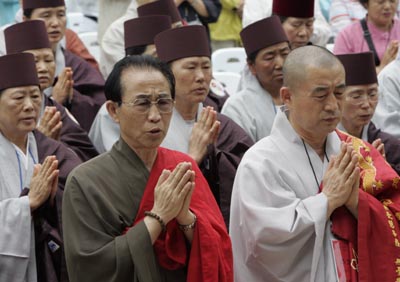
South Korean monk Joo Jeong-san (R), head of the Chontaejong, a branch of Buddhism, and Sim Sang-jin (L front), vice chairman of North Korea’s Buddhist Alliance, participate in a Buddhist ceremony celebrating the third anniversary of restoration of the Ryongtong temple, which was established in 1027, in Kaesong, North Korea, about 70 km (45 miles) northwest of Seoul June 8, 2007.


Pilgrimage, with U.S. dollars, to North Korea temple
Boston Globe
Jack Kim
6/11/2007

In a rare nod to religion, communist North Korea has welcomed 500 Buddhist monks and followers from the South to a temple dating from the 11th century when Kaesong was capital of a unified peninsula.

The visit offered an unusual glimpse of the hermit state where references to the divine, at least in the official media, are normally limited to Kim Il-sung, who became the reclusive state’s eternal president on his death in 1994, and Kim Jong-il, his son and the current leader.

North Korean officials were quick to stress that this month’s nine-hour visit to the picturesque Ryongtong temple on the outskirts of Kaesong was strictly religious fare.

“We are opening the door wide open for pilgrimages to answer the wish of Buddhist believers in the South,” Ri Chang-dok, from the North’s Council of National Reconciliation, told a small group of reporters traveling with the Buddhists.

The pilgrimage marking the restoration of the temple was the first in a series that will see more than 2,000 South Korean Buddhists travel across the heavily fortified border that has divided Korea for more than half a century.

“There won’t be any sightseeing,” Ri insisted.

North Korea watchers and critics say the hardline Pyongyang government persecutes religious followers and the only practices tolerated are carefully choreographed displays for outsiders.

FREEDOM OF RELIGION

Not so, the Council’s vice-chairman, Jong Tok-gi, told Reuters after a Buddhist service at Ryongtong.

“We have freedom of religion.”

But when a North Korean Buddhist leader spoke at the service, his words had the clear ring of politics and Pyongyang’s official obsession with one day ending the divide on the Korean peninsula.

“I have no doubt that if we make this pilgrimage a regular event and allow South Korean believers to come to the temple, North-South cooperation will deepen and that will open a shortcut to the unification of the fatherland,” said Sim Sang-jin, vice-chairman of the North’s Korea Buddhists Federation.

The North Korean Buddhists, with full heads of hair and colorful costumes looked anything but the typical monks of the South with their shaven heads and austere grey robes.

Despite Ri’s assurances that this was a strictly spiritual affair, the visitors’ buses made several stops at tourist sites in the cash-strapped state to give them the chance to buy souvenirs.

“Have you bought anything? Come on, go and buy something,” a North Korean guide urged his visitors, pointing to stalls where young women in traditional costume offered local goods ranging from mushrooms and fake Viagra to books of teachings by the country’s father-and-son leaders — all for U.S. dollars.

“We’re not going to hide anything,” said another guide, who declined to give his name, as the buses maneuvered their way through Kaesong’s residential streets where disheveled locals flashed startled looks at the gleaming vehicles.

“We have the discipline, the intelligence and the will (to make ties with the South work),” he said. All that was needed was for the wealthy South to deliver on its commitments to invest in the North.

ANCIENT CAPITAL

The birthplace of the small Chontae Buddhist sect, Ryongtong was raised from the rubble of a 17th century fire in 2005 at a cost of 5 billion won ($5.4 million) donated by its South Korean chapter.

“Kaesong was the seat of the Goryeo dynasty (918-1392) for 500 years,” said Ju Jung-san, a senior monk from the South. “It should now be the place of national love to lay the ground for unification.”

With such high aims, an indignant Ri dismissed criticism from some in the South that charging each visitor 170,000 won for the relatively short trip was excessive.

“I fail to understand just who these people are who are talking about money when what we have here is a pilgrimage to such a holy temple, the Ryongtong Temple.”


Share

To be or not to be the N.K. foreign minister

Sunday, June 10th, 2007

Korea Herald
Lee Joo-Hee
6/11/2007

Following the death of former foreign minister of North Korea Paek Nam-sun this January, eyes and ears are open to who would succeed him.

While in most countries, being named the next foreign minister would be a coveted honor, it was the opposite in North Korea.

Kang Sok-ju, the first vice foreign minister, indeed, has tried with all his means not to be named the new foreign minister, according to sources familiar with the North Korean system.

“North Korea designated Kang as the successor of late Paek, but he somehow dodged the actual appointment citing his illness, possibly arthritis,” a source was quoted as saying by Yonhap News.

Instead, former ambassador to Russia Pak Ui-chun was named to the seat on May 18 after it was vacant for four months.

Whether it was possible for Kang to “dodge” the appointment remains unconfirmed, the situation is quite understandable considering how North Korea bestows actual authority on the No. 2 man while the more public figure takes on the official top seat. Kang, seeking to remain in a position of real power, may have wanted to stay where he is.

The clearest example of this power ranking system is Kim Yong-nam, who, as head of the Presidium of the Supreme People’s Assembly, is the formal president of North Korea. North Korea is, however, ruled by Kim Jong-il, whose official title is the chairman of the National Defense Commission.

“We deem that Kang believed becoming a foreign minister could mean going on all the official and open duties but being distanced from being one of the close confidantes of Kim Jong-il,” the source was quoted as saying.

Kim Jong-il, with intense interest in relations with the United States, reportedly has talked directly with Kang instead of the foreign minister to discuss pending issues since the 1990s.

A possible threat to Kang’s status could now be North Korea’s chief nuclear negotiator Kim Kye-gwan, according to sources quoted by Yonhap. Kim Kye-gwan was reportedly a candidate to succeed Kang if Kang was to be named the foreign minister.

Kim Kye-gwan earned the trust of the communist leader by successfully negotiating the lift of the freeze of North Korean funds at Banco Delta Asia in Macau, the sources said.

He was recently allowed to move into “the club,” a luxurious villa compound located in Pyongyang for some 30 households in which Kim Jong-il’s close confidantes reside.

Share

International Day of Biodiversity Observed in DPRK

Tuesday, May 22nd, 2007

KCNA
5/22/2007

May 22 is the International Day of Biodiversity.

The global ecosystem has been seriously destroyed, rapidly decreasing the bio-resources needed for the life of the people. The actuality has risen as an urgent problem to protect the biodiversity in recent years.

According to the data released by the World Conservation Union, biological species which have been extinguished total over 1,000 and those on the brink of extermination far exceed 10,000.

The DPRK is abundant in biodiversity compared with the size of its territory. Under the correct nature preservation policy of the government, the work for protecting ecological diversity have been undertaken as an affair of the state and all people from long ago.

Lots of nature reserves including the Mt. Oga nature reserve, natural parks including Mt. Myohyang and Mt. Kumgang, reserves for native animals, plants and birds and their habitation, reserves for natural products and reserves for natural resources have been set to protect ecological diversity.

The Paektusan biosphere reserve has been preserved and managed amid the special concern of the Korean people from long ago. It was registered as an international biosphere reserve in April Juche 78 (1989).

The biological resources have been protected and increased by various methods including recovery of ecosystem and enhancement of biological function outside the reserves.

The production units such as forestry, agriculture and fishing industry are protecting the biodiversity through development and application of new science and technologies and, at the same time, are taking measures to ensure their sustainable utilization.

The relevant units including the Ministry of Land and Environment Conservation and the DPRK Natural Conservation Union have worked out strategies and action programs for biodiversity and are directing primary efforts to protecting and propagating indigenous species, those in a crisis and rare ones.

The state is pushing ahead with the protection of biodiversity through the institution of laws and regulations and the establishment of administrative and technical management systems. And it does not stint investment to the development of management technologies for analyzing, removing or minimizing the threat to the biodiversity.

And the state is turning the protection of biodiversity into the work of popular masses through the education and propaganda.

It is also taking positive measures for strengthening the international exchange and cooperation as an important part of the international efforts to ease the ecological crisis.

Share

Distributions Increased in South Hamkyung To Boost Birthrate

Wednesday, May 9th, 2007

Daily NK
Han Young Jin
5/9/2007
“If you have a second child, your rations become equivalent to a family of 4”…citizens respond apath 
 
North Korean authorities have been scrutinizing over the decreasing number of birthrates by young couples and as a result have proposed to increase the amount of rations to families having children.

If a couple gives birth to a second child in the district of Hamheung, South Hamkyung, the whole family will receive 6 months worth of distributions, a source informed. If a third child is born, the rations increase all the more.

After giving birth to a child in a hospital, a married woman from Hamheung can obtain a birth certificate, which is then submitted to the local district office, to receive distributions equivalent to a family of 4. These proposals resemble policies implemented by local district offices in South Korea.

Though Hamheung city has made efforts to increase the birthrate with distributions, the people’s response is all but cold, the source said. How many people would really have a second child just to scavenge off a few months worth of distributions.

One of the main reasons that the birthrate is decreasing in North Korea is due to the fact that women are avoiding giving birth, informed the source.

The source said, “Nowadays, North Korean women engage in businesses and are the breadwinners of the family. They are not satisfied with just having children and bringing them up” and added, “Everyone knows that it is hard enough to live and even harder if you have a lot of children.”

North Korea’s birthrate has continued to decline since the late 1990’s. The average birthrate in North Korea in 1993 was 2.1 births per family and in 2002, 2.04. Comparatively, in South Korea the birthrate per family in 1970 was 4.53 and 1.19 in 2003. Within a period of 33 years, the number of childbirths per family had reduced to 3.34 persons.

In an interview with the Jochongryeon last December, Kang Nam Il, head of the North Korea Population Research Center said, “The decrease of birthrates in our country (North Korea) is no different to that of other nations” and remarked, “Women want to have 2 children, though in the cities women have either 1 or 2 children.”

The source said, “There may be slight differences in each district. Nonetheless, most of the larger cities have adopted this proposal” and added, “This policy was implemented as North Korean authorities are finding it difficult to reach the quota for conscription and the number of students enrolling in schools.”

Share

National Scientific and Technological Festival Held

Tuesday, May 8th, 2007

KCNA
5/8/2007

The national scientific and technological festival commemorating the 95th birth anniversary of President Kim Il Sung was held from May 3 to 7 at the Three-Revolution Exhibition. 

The 22nd festival of this kind took place in the forms of a symposium on latest scientific and technological achievements, a presentation of results of scientific researches, a presentation of achievements in technical innovation and a diagram show. 

Officials, scientists, technicians and working people across the country presented achievements, experiences and many scientific and technical data attained in the course of the massive technical innovation movement at local scientific and technological festivals. 

At least 570 items of data of scientific and technological results highly appreciated there were made public at 18 sections of the national festival. 

During the festival the participants introduced achievements in agriculture and light industry and valuable scientific and technological data helpful to revitalizing the national economy and lifting to a high level the technical engineering of such major fields as IT and nanotechnology, bioengineering and basic sciences and widely swapped experiences. 

Five persons carried away special prize and 53 top prize at the festival. 

The closing ceremony of the national festival took place on Monday. Present there were Choe Thae Bok, secretary of the C.C., Workers’ Party of Korea, Ro Tu Chol, vice-premier of the Cabinet, Pyon Yong Rip, president of the State Academy of Sciences, and others. 

The decision of the jury of the festival was made public at the closing ceremony and the festival cups, medals and diplomas were awarded to those highly appraised. And prize of scientific and technological merits went to seven officials who had given precious help to scientists and technicians and presented materials of new research results to the festival. 

A closing speech was made by Pak Yong Sin, secretary of the Central Committee of the Korean General Federation of Science and Technology.

Share

N. Korea, Switzerland try new bank program to help N.K.’s farmers

Monday, April 30th, 2007

Yonhap
4/30/2007

Years of efforts to cultivate North Korea’s mountainous farmland is beginning to yield results, and Swiss and Korean officials are testing a bank credit program for the farmers in the Asian country, a Swiss aid office said on Sunday.

North Korea is showing “many promising signs of changes in progress,” including the emergence of consumer markets that are now established as part of the country’s economic system, Adrian Schlapfer, assistant director-general of the Swiss Agency for Development and Cooperation (SDC), said on the agency’s Web site.

Schlapfer was comparing the current situation to that during his previous visit to Pyongyang four years ago.

“The farming land in which the starving people started to work back then is now recognized as providing scope for agricultural initiative,” he wrote.

“The SDC, together with North Korea’s Central Bank, is therefore in the process of testing a micro-credit program to encourage farmers to base their investment decisions on economic feasibility considerations — an innovation for North Korea,” he said.

But North Korea still suffers from food scarcity, and aid is still essential, he said.

The SDC, an agency of the Swiss Foreign Ministry, has maintained an office in Pyongyang since 1997, focusing on agricultural programs to improve food production and on supporting domestic reform. The Swiss government started providing humanitarian assistance to North Korea in 1995.

Schlapfer described North Korea as the most little-known and enigmatic partner of the SDC, and acknowledged there are constant doubts on whether Swiss engagement there will yield results.

“Are there any meaningful approaches for long-term development partnership in this country with its planned economy, backwardness and secretiveness? Given the context, is it at all possible to initiate change?” he asked.

Pyongyang is “not an easy partner,” he said. “The key values, priorities and methods of Switzerland’s development cooperation have to be repeatedly insisted upon.”

“However, the projects implemented over the past 12 years are encouraging,” Schlapfer added.

Share

A Mission to Educate the Elite

Friday, April 13th, 2007

Science Magazine
Vol. 316. no. 5822, p. 183
DOI: 10.1126/science.316.5822.183
Richard Stone
4/13/2007

In a dramatic new sign that North Korea is emerging from isolation, the country’s first international university has announced plans to open its doors in Pyongyang this fall.

Pyongyang University of Science and Technology (PUST) will train select North Korean graduate students in a handful of hard-science disciplines, including computer science and engineering. In addition, founders said last week, the campus will anchor a Silicon Valley-like “industrial cluster” intended to generate jobs and revenue.

One of PUST’s central missions is to train future North Korean elite. Another is evangelism. “While the skills to be taught are technical in nature, the spirit underlying this historic venture is unabashedly Christian,” its founding president, Chin Kyung Kim, notes on the university’s Web site (www.pust.net).

The nascent university is getting a warm reception from scientists involved in efforts to engage the Hermit Kingdom. “PUST is a great experiment for North-South relations,” says Dae-Hyun Chung, a physicist who retired from Lawrence Livermore National Laboratory and now works with Roots of Peace, a California nonprofit that aims to remove landmines from Korea’s demilitarized zone. To Chung, a Christian university is fitting: A century ago, Christianity was so vibrant in northern Korea, he says, that missionaries called Pyongyang “the Jerusalem of the East.”

The idea for PUST came in a surprise overture from North Korea in 2000, a few months after a landmark North-South summit. A decade earlier, Kim had established China’s first foreign university: Yanbian University of Science and Technology, in Yanji, the capital of an autonomous Korean enclave in China’s Jilin Province, just over the border from North Korea. In March 2001, the North Korean government authorized Kim and his backer, the nonprofit Northeast Asia Foundation for Education and Culture (NAFEC), headquartered in Seoul, to establish PUST in southern Pyongyang. It also granted NAFEC the right to appoint Kim as PUST president and hire faculty of any nationality, as well as a contract to use the land for 50 years.

NAFEC broke ground in June 2002 on a 1-million-square-meter plot that had belonged to the People’s Army in Pyongyang’s Nak Lak district, on the bank of the Taedong River. Construction began in earnest in April 2004. That summer, workers–a few of the 800 young soldiers on loan to the project–unearthed part of a bell tower belonging to a 19th century church dedicated to Robert Jermain Thomas, a Welsh Protestant missionary killed aboard his ship on the Taedong in 1866.

NAFEC’s fundraising faltered, however, and construction halted in fall 2004. The group intensified its Monday evening prayers and broadened its money hunt, getting critical assistance from a U.S. ally: the former president of Rice University, Malcolm Gillis, a well-connected friend of the elder George Bush and one of three co-chairs of a committee overseeing PUST’s establishment. “He made a huge difference,” says Chan-Mo Park, president of Pohang University of Science and Technology (POSTECH), another co-chair. South Korea’s unification ministry also quietly handed PUST a $1 million grant–more than it has awarded to any other North-South science cooperation project. This helped the school complete its initial $20 million construction push.

At the outset, PUST will offer master’s and Ph.D. programs in areas including computing, electronics, and agricultural engineering, as well as an MBA program. North Korea’s education ministry will propose qualified students, from which PUST will handpick the inaugural class of 150. It is now seeking 45 faculty members. Gillis and other supporters are continuing to stump for a targeted $150 million endowment to cover PUST operations, which in the first year will cost $4 million. Undergraduate programs will be added later, officials say. PUST, at full strength, aims to have 250 faculty members, 600 grad students, and 2000 undergrads.

PUST hopes to establish research links and exchanges with North Korea’s top institutions and with universities abroad. “It is a very positive sign,” says Stuart Thorson, a political scientist at Syracuse University in New York who leads a computer science collaboration between Syracuse and Kimchaek University of Technology in Pyongyang. “Key to success will be achieving on-the-ground involvement of international faculty in PUST’s teaching and research.”

Some observers remain cautious, suggesting that the North Korean military could use the project to acquire weapons technology or might simply commandeer the campus after completion. A more probable risk is that trouble in the ongoing nuclear talks could cause delays. At the moment, however, signs are auspicious. Park, who plans to teach at PUST after his 4-year POSTECH term ends in August, visited Pyongyang last month as part of a PUST delegation. “The atmosphere was friendly,” he says. “The tension was gone.” The Monday prayer group continues, just in case.

Share

Supreme People’s Assembly’s 2007 Budget… Financial Estimate $3.1bn

Friday, April 13th, 2007

Daily NK
4/14/2007
Park Hyun Min

Changes to the North Korean Cabinet Ministry, Kim Young Il elected as the new Prime Minister, Kim Young Choon as Vice-Chairman of the National Defense Commission

At the 5th round of the 11th Supreme People’s Assembly announced on the 5th, the change in economic policies that would in future concentrate on the people’s livelihood and suspend the advancement of technological skills.

In the report, the deputy Prime Minister revealed that the major economic task for the upcoming year included light industries and agriculture, which had already been completed, and the improvement of the people’s livelihood. He said that the issue of social economic management had been discussed and that it would be resolved “our way.”

The 2007 report by the Supreme People’s Assembly proposed to, i) improve the basic standards of living in relation to agriculture and light industries, ii) enhance the manufacture of potential energy starting with the prioritizing the department into 4 divisions, iii) modernization of public economy and iv) manage sosicalistic economy through the our own.

Furthermore, foreign collaboration was proposed to further investments into advanced technology. In relation, the third phase proposal was made over a 5 year period (`08~`12) to improve technological skills such as the advancement of basic skills, high technology and software.

In contrast to last year, North Korea estimated an increase in revenue at 433.2bn won ($30.9bn, $1=141won). Last year, 5.9% were considered the public revenue, whereas this year, this figure was raised to 7.1%.

As for tax resources, national business gains tax was increased to 6.4%, cooperative organizations fund set at 4.5%, depreciation amount 9.6%, real estate fees 15.4%, and social welfare tax at 15.1%

Regarding expenses, science-technological skills among people’s economic expense increased to 60.3%, net business income is estimated to be 2% which will aid new measures to develop enterprise skills. In addition, proposals were made to increase agricultural expenses to 8.5%, light industries to 16.8%, energy, coal, metalwork and railroad to 11.9%

In relation to this, a South Korean governmental official revealed, “At this Supreme People’s Assembly, economic improvement proposal was mainly revealed without any announcement on foreign policies or sort of legislation of reform or openness.

Since last year, there have been rumors that a change in government would occur amidst the North Korean Supreme People’s Assembly. While Park Bong Joo stepped down from his position, Kim Young Il, formally in charge of transportation was elected as the new prime minister. It has been three and half years since Park Bong Joo first took his prime ministerial post at the first round of the 11th Supreme People’s Assembly in September 2003.

Former Prime Minister Park is known to have ceased his duties since last year June. He has been suspected of transferring money from the agriculture’s oil funds. At the 20th High Level Cabinet Talks in Pyongyang in February, a South Korean representative did mention that Prime Minister Park had made a welcoming speech. However, it seems that he has been ousted from his position.

Additionally, with the death of Yeon Hyung Mook in October 2005, Kim Young Choon is known to have succeeded the position of Vice Chairman as well as taking on the role of military counselor.

Regarding, the new appointments, a governmental official said that the Cabinet’s Prime Minster, Kim Young Il would aim to solve the economic issue while Kim Young Choon as the new Vice Chairman would aim to organize the structure of the ministry and strengthen the military.

While Kim Jong Il did not attend the last round of meetings, the fact that he participated in the recent meeting has also gathered much interest.

Share

China Investing Heavily in N.Korean Resources – Report

Thursday, April 12th, 2007

Choson Ilbo
4/12/2007

Last year a Chinese company took a 51-percent stake in Hyesan Youth Cooper Mine in Yanggang Province, North Korea. Hebei-based Luanhe Industrial Group now has the right to develop the mine for the next 15 years.

North Korea also sold a 50-year development claim to the Musan iron mines, Asia’s largest open-air mine, to China’s Tonghua Iron & Steel Group. Since 2006, North Korea has sold the rights to develop more than 10 mines to Chinese firms.

KDB Research Institute, an affiliate of Korea Development Bank, has raised concerns with a report released Wednesday that details China’s intensive investment in North Korean natural resources. According to the report, since 2002 China has invested US$13 million (US$1=W932), more than 70 percent of its total investment in North Korea, in iron, copper and molybdenum mines.

The major investors come from the three northeast provinces of Heilongjiang, Jilin and Liaoning. They have moved the focus of their investment from small-scale, commercial opportunities to strategic deals to secure energy resources, the report said.

According to the report, China’s Wukang Group bought the rights to dig the Yongdeung mine, North Korea’s largest hard coal mine, and another Chinese company invested in a North Korean project to develop an oil field in the West Sea. The North has also allowed Chinese fishermen to fish off the coast of Wonsan, a North Korean port city on the east coast, in return for 25 percent of the catch.

Since North Korea lacks funds while China suffers from a shortage of natural resources the two are forming joint development projects, said KDB Research Institute researcher Chung Eui-jun, the writer of the report.

Andrei Lankov, a North Korea expert at Kookmin University in Seoul, said in the Wall Street Journal last July that the Chinese government seems to have made a strategic decision to encourage Chinese firms to invest in North Korea as a way to maintain its influence with its long-time ally in the post-Kim Jong-il era.

Share