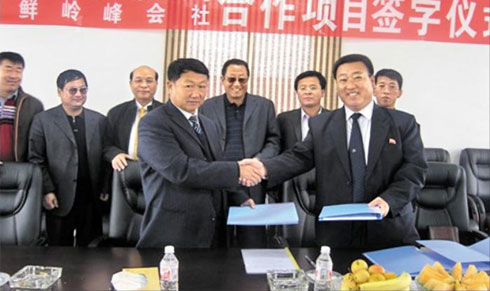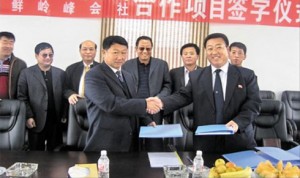
Pictured above: the signing of the contract between Xiyang Group and Ri Seong-kyu (리성교). Image source here.
UPDATE 6 (2012-9-17): Andrei Lankov writes a good summary of events.
UPDATE 5 (2012-9-7): The Global Times (PR China) reports on the Xiyang affair:
Wu Xisheng, vice general manager of the Xiyang Group, told the Global Times Thursday that the company’s partner in North Korea was an enterprise affiliated with the Korean Workers’ Party, instead of what the country called a private entity.
Wu also said Xiyang is one of dozens of Chinese companies who have been cheated by North Korea.
Hu Chenpei, a diplomat with the business section of the Chinese embassy in Pyongyang, told the Global Times that it is “an isolated case of business disputes,” adding that both sides of the story are true.
“We have been in contact with related departments in North Korea, hoping the two sides could iron out their disputes through rational discussions,” said Hu.
However, Wu insisted that the North should repay their losses or the group will reveal further details about “how Pyongyang cheated it.”
When contacted by the Global Times, a diplomat with North Korea’s embassy in Beijing said he had never heard of the Xiyang Group and refused to comment.
The North Korean spokesperson also said his government will continue improving its investment environment to further draw international investment, and protect the legitimate rights and interests of international investors who follow the principles of mutual respect, equality and mutual benefit as well as observing laws.
Liu Ming, a researcher with the Shanghai Academy of Social Sciences, said the disputes have dealt a blow to Chinese enterprises’ confidence in North Korea.
UPDATE 4 (2012-9-5): In a Reuters article, Xiyang responds to the KCNA statement:
Xiyang told Reuters in an interview after the North’s statement that it had been “cheated” and it lambasted Beijing’s policy of propping up North Korea’s unreformed regime which it said that it was done for geo-political reasons.
“It (Xiyang) has carried out only 50 percent of its investment obligations though almost four years have passed since the contract took effect,” KCNA quoted a spokesman for North Korea’s Commission for Joint Venture and Investment as saying.
Xiyang refused to curb its criticism of North Korea when it spoke to Reuters, suggesting that Beijing was doing little to help companies that ran afoul of what it viewed as arbitrary rulings by North Korean officials.
“This isn’t just about us – it is about all companies investing in North Korea,” Wu Xisheng, vice general manager of Xiyang told Reuters.
“They just don’t have the conditions for foreigners to invest. They say they welcome investment but they don’t have the legal or social foundations.”
UPDATE 3 (2012-9-5): KCNA has issued an official comment on the xian affair:
Media Should Maintain Impartiality in Report about DPRK
Pyongyang, September 5 (KCNA) — A spokesman for the DPRK Commission for Joint Venture and Investment on September 5 issued the following statement:
The Xiyang Group of the Haicheng City, Liaoning Province of China on August 2 posted on its Internet website an article criticizing the DPRK over the disputes that cropped up between the Group and the Korean Ryongbong Corporation in the course of implementing a joint venture contract for the development of magnetite concentrated ore.
After the article was published, some media echoed it before and after the report about the results of the third meeting of the DPRK-China Guidance Committee for developing two economic zones was made public.
They added their own analyses to the article posted by the Group. They even aired what the anti-DPRK hostile forces reported in the past to malignantly slander the inviolable social system and policy of the DPRK.
Generally, it is international usage and commercial ethics to settle disputes that occurred in the course of economic relations in line with the relevant arbitration item of the contract.
But the media have kicked off massive propaganda campaign, defying international usage and commercial order. This cannot be interpreted otherwise than an act of fanning up the dishonest forces in their moves to drive a wedge between the two countries in their economic cooperation and chill the atmosphere for investment.
As far as the procedures for the signing and implementation of the contract between the DPRK Ryongbong Corporation and the Steel Co. Ltd., of the Group and the bilateral disputes are concerned, the Group is also to blame for the abrogation of the contract. In the light of the process of implementing the obligations under the contract, the Group is chiefly to blame from the legal point of view.
It has carried out only 50 percent of its investment obligations though almost four years have past since the contract took effect.
So the two contracting parties again sat together only in vain over the timeline for the completion of the first-phase investment and commissioning.
As for 16 provisions which the Group set forth as the major issue of the disputes, it is the legal obligation of the Group related to the contract to implement them according to the mutual contract in which both sides agreed on the article that “two sides sign it on the basis of the DPRK Law on Joint Venture”.
As regards the dealing of sales price of trial products, the Group insisted on its self-opinionated proposal for settling its debts within the boundary of China, in disregard of the procedures in price dealing pursuant to the relevant financial management norms.
Media should comply with the standards for fairness and objectivity, create an atmosphere helpful to settling the disputes between the two contracting parties and refrain from an act that can be misused by the hostile forces for their vicious propaganda.
We will in the future, too, improve and round off the investment environment to further expand the international investment relations to meet the demand of the developing times and the lawful requirement of the international investment relations under the condition that the security of the country is guaranteed by dint of Songun. We will also ensure the legitimate rights and interests of all investors willing to develop international investment relations on the principles of mutual respects, equality, reciprocity and law-observance.
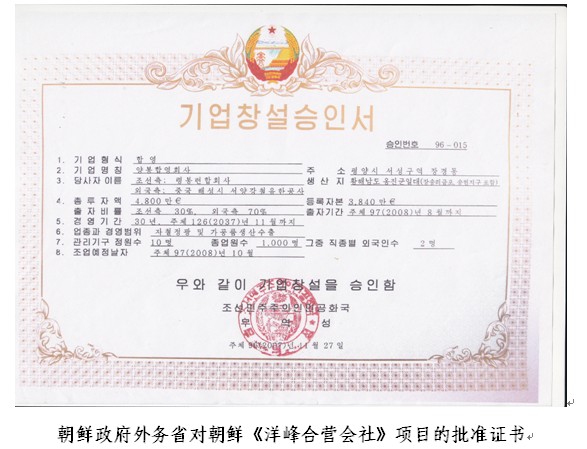
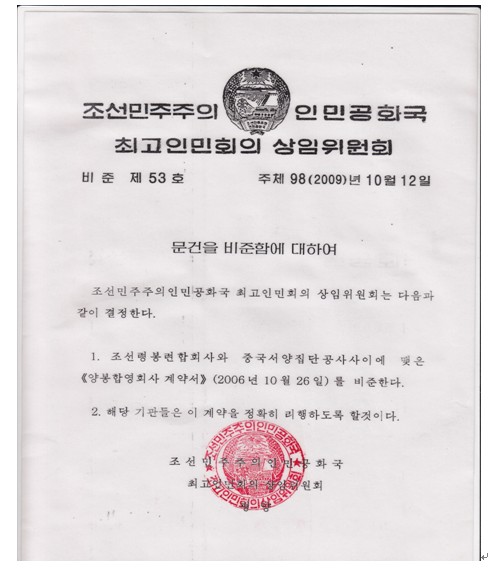
UPDATE 2 (2012-8-17): Michael Rank sent over the photos below which the Xiyang Group published (source here). I had a Korean friend (thx Angela) look over these and give me an idea of what they say:
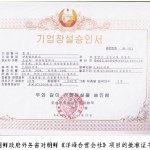
This appears to be the DPRK business license or registration. It claims that the Korea Ryongbong Ryonhap Company (조선령봉련합회사) and the Chinese Soyang Jipdan Corporation (중국서양집단공사사) “merged” to form the Yangbong Hapyong Company (양봉합영회사). The new firm is made up of 1,000 local employees and two foreigners. The investment terms also appear to be denominated in Euros.
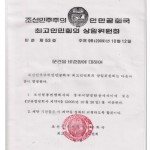
This image appears to be the cover sheet to the agreement between the two firms. The cover sheet states that this agreement has been approved at the highest levels and that both firms agree to be bound by its terms.
UPDATE 1 (2012-8-15): Michael Rank has followed up on the Xiyang Group story in the Asia Times:
China likes to claim that its relations with North Korea are “as close and lips and teeth” but those teeth are infected with a poisonous abscess so far as one Chinese company is concerned.
In an extraordinary attack, a Chinese mining company has accused the North Koreans of tearing up a multi-million-dollar deal, intimidating its staff, imposing outrageous extra charges and cutting off its power and water, as well as of corruption and demanding prostitutes whenever their North Korean counterparts visited China.
“Xiyang Group’s investment in North Korea was a nightmare, and we were taking our lives in our hands when we entered the tiger’s lair,” the company says.
Xiyang Group, based in the northeastern province of Liaoning, says it was the biggest single Chinese investor in North Korea, having in 2011 signed a 240 million yuan (US$38 million) deal to form a joint venture iron mine that was to produce 500,000 tonnes of iron powder a year.
A few months after the contract was signed, the North Koreans made a series of extraordinary demands that led to the Chinese walking out in fury and to launching what must surely be the fiercest public attack they have ever made on their supposed close ally. [1]
The company aims much of its invective at a particular North Korean official, who, it says, is “the leader of the criminal gang who deceived Xiyang, this great plotter and fraudster …” The official, Ri Seong-kyu, was the North Korean side’s faren, or legal representative, in the deal and he is blamed for everything that went wrong.
When negotiations began in 2006 the plan was for the Chinese company to take a 75% stake in the venture, but it turned out that North Korean policy stipulated that a foreign firm could own no more than a 70% stake in a natural resources company such as a mine.
Xiyang says Ri, “violating the North Korean national investment law”, nevertheless signed a joint venture contract in which the Chinese side took a 75% stake, “forging an investment certification document in order to gain Xiyang’s confidence”.
He later told the Chinese company that the document was null and void because of the stipulation that the North Korean side must have at least a 30% stake, but Xiyang did not realise his deception until September 2011.
Xiyang says it first became interested in investing in North Korea in 2005 in response to the Chinese government’s call for Chinese companies to “venture out” and invest abroad, “but we had heard that North Koreans do not keep to their word, national laws are not strong and it is easy to be cheated, so we were extremely cautious in our investigations.”
It also notes the secrecy that pervades business dealings in North Korea, which prevented Xiyang from sending ore samples back to China for testing, but despite all this the company “took the great risk of investing”.
“North Korea’s system of doing business is [based on] government departments’ secrecy in relation to foreigners, and they do not allow foreigners to visit government departments to do business,” the online report complains.
It says there were “all kinds of unimaginable serious problems” in reaching an agreement, but after years of negotiations production finally began in April 2011. However, the North Koreans unilaterally annulled the agreement last February, when they “used violent methods” against Xiyang staff, cutting off their water, electricity and communications and smashing the windows of their living quarters.
At 2am on March 3, a group of 20 armed police and security officials led by a North Korean company official woke up the sleeping Chinese and told them the North Korean premier had annulled the deal and they were to leave the country immediately.
Ten senior Xiyang employees, who seem to have been the only ones remaining in North Korea out of over 100 originally sent, were “treated as enemies”, put on a bus and deported via the border city of Sinuiju.
The statement includes a highly personal attack on Ri, who, it says, has a huge paunch and is “North Korea’s number one fat man”, weighing 108 kilograms. “Everybody knows North Korea is suffering grain shortages and ordinary people do not have enough to eat, so North Koreans are quite thin but Ri Seong-kyu’s unusual fatness fully reveals what a luxurious life he leads … When people like Ri Seong-kyu go to China they let down their country and themselves and make all kinds of demands, for money, gifts, food, drink, girls …”
Xiyang said it had paid over US$800,000 in kickbacks to corrupt North Korean officials, including $80,0000 for a Hummer for Ri in 2008 and $100,000 in 2009 for a construction project in which he was involved in South Hwanghae province. In addition, Ri and his cronies would demand gifts of laptops, cellphones and vast amounts of booze, and to be provided with masseuses.
“Sometimes the Chinese would not provide any girls, so they would get them themselves and put it on their room bill,” expecting Xiyang to pay for all their personal expenses, bringing the bill to over 200,000 yuan per person.
This was not all – they would demand a receipt for their expenses that had been paid for by Xiyang, so they could claim the same costs when they returned to North Korea, according to the Xiyang statement.
Xiyang officials, on the other hand, had to pay all their own expenses in North Korea, were only allowed to eat in certain restaurants and were followed 24 hours a day by security officials. Even when Ri invited the president of Xiyang to his home, his host charged $2,000 for the privilege.
The report says the crunch came in September 2011 when the North Koreans made 16 demands that violated the terms of the contract, including a 4-10% sales levy, a one euro (US$0.17) per square metre per year rent charge, a hike in electricity prices and a charge of one euro per cubic metre of sea water consumed.
They also banned the company from releasing waste water, or even clean water, into the sea, which “amounted to the North Koreans forcibly halting production”.
The most serious act by the North Koreans was a ban on sales, the document states, which was clearly aimed at ensuring an end to the joint venture. “Ri Seong-kyu claimed all these [regulations] were included in North Korea’s national joint venture law, and we could not sell the 30,000 tonnes of iron powder that had been produced. In these circumstances, if Xiyang had carried on investing and manufacturing [in North Korea], we would have been the biggest fools in the world.”
Many of Xiyang’s complaints will sound all too familiar to anyone who has visited North Korea. The document tells how Xiyang staff were at first banned from buying food in so-called free markets. After much pleading the authorities finally agreed to this, but each person had to be accompanied by two minders and the route had to be approved by the security police.
Although the mine was only 500 meters from the sea, staff were banned from taking strolls along the shore.
Quite why the North Koreans acted with such prejudice against Xiyang isn’t clear, but part of the reason may lie in the location of the mine. It is in Ongjin county on the west coast, a highly sensitive area ever since this small peninsula ended up in North Korea after the Korean war even though it lies below the 38th Parallel. (It is also close to the port of Haeju, from where the iron was to have been exported).
The Chinese government may wish to dismiss this as a spat between a little known Chinese company and a single corrupt North Korean official, but it has brought into the open the deep suspicion that exists between the two countries.
The Chinese have long felt unable to trust the North Koreans with their xenophobic, quasi-Maoist personality cult, while the North Koreans are equally suspicious of the emerging superpower on their doorstep eagerly eyeing the smaller country’s natural resources.
Change may now be in the air, and the more open leadership style of North Korea’s young Kim Jong-eun has sparked speculation of economic reform and a fresh approach to foreign investment in his country, but horror stories such as this may indicate Kim’s style may be just that – all style and no substance.
ORIGINAL POST (2012-8-10): JVIC is the DPRK’s Joint Venture Investment Committee. You can read previous posts about the JVIC here.
According to Yonhap:
North Korea has recently signed a deal with China to jointly develop three mines in the North, a North Korean investment firm said Thursday, as the cash-strapped country steps up attempts to earn hard currency from overseas.
A Beijing unit of North Korea’s Committee of Investment and Joint Venture struck the joint development deal with a Chinese international trading company in Beijing on June 9, according to the unit’s Chinese-language Web site.
“The China firm’s president and his parties conducted field inspections into one (North Korean) gold mine and two iron ore mines and confirmed the investment and development scheme,” the Web site said. “Facility building is now well underway for the project,” it said.
Details on the terms of the deal were not provided.
Experts said the deal is the first foreign investment deal announced by the Beijing unit, which is run by the Committee of Investment and Joint Venture in charge of luring overseas capital and investment into the North.
The joint North-China mining venture also illustrates growing exports of underground resources from the North to China, its closest ally and a major source of foreign currency.
Exports of mineral resources to China reached 8,420,000 tons during the first nine months of 2011, growing sharply from the annual volume of 4,799,000 tons in 2010 and 2,480,000 tons for the whole of 2008.
Although Yonhap does not report the Chinese company’s identity, the IBTimes reports that it is named “Baoyuanhengchang”. According to the article:
Baoyuanhengchang confirmed the plans to develop the mines, as per its pronouncement, noting both parties had conducted field inspections.
“Facility building is already underway and everything is going as planned,” it said. No details of the terms, however, were provided.
The pronouncement has been considered a milestone as this was the first time that North Korea publicly announced its efforts in enlisting foreign investors to help develop its potentially vast mineral wealth, Arirang News reported.
I have yet to determine in which specific projects Baoyuanhengchang is investing.
The two most high-profile Chinese mining investments in the DPRK remain the Hyesan Youth Copper Mine (US$860 million, it now holds a 51% ownership) and the Musan Mine (50year lease). The original Musan deal may have fallen through, however, and could possibly be one of the deals included in the Baoyuanhengchang agreement.
However, a warning to the Chinese investors can be found below. According to the Donga Ilbo:
A Chinese conglomerate that tried to advance into the North Korean mining industry has been forced out of the Stalinist country due to contract cancellations.
Calling its past five-year investment in the North “a nightmare,” Xiyang Group has filed for arbitration with the Chinese government.
Based in Liaoning, China, the group said Wednesday that it had set up a joint venture with North Korea in March 2007 to build a plant there that extracts iron from ore. Of the paid-in capital of 47.52 million U.S. dollars, the company put up 75 percent of the amount in cash and North Korea 25 percent for land and mine exploration and also managerial rights for 30 years.
Xiyang company invested 37.14 million dollars, the biggest investment for a Chinese private company in North Korea. Pyongyang approved the incorporation in April 2007.
With a target of 500,000 tons of ore dressing per year, Xiyang sent about 100 workers to North Korea and produced 30,000 tons in April last year. In September last year, however, Pyongyang requested modification of 16 items on the contract including a demand of 4-10 percent of sales of products for using raw materials; 1.24 dollars for every square meter of land leased, and 17 cents per cubic meter of sea water for industrial use.
Xiyang said the demands were not included in the original contract, which was ratified by the North Korean parliament in October 2009.
The conglomerate refused modification of the contract, prompting Pyongyang to suspend the effectuation of the contract and cancel corporate establishment Feb. 7. North Korea also suspended power, water and communication supply at the plant.
Xiyang said that on March 3, North Korean police and 20 security guards went to where the Chinese workers were staying and forced them to ride a bus to deport them outside the Chinese border.
The group said the North requested modification of the contract to steal the ore dressing facility that the country lacked in capital and technology to introduce.
A Xiyang source said, “When our company was established in 2007, North Korea had a law restricting a foreign company`s stake in a joint venture to now more than 70 percent. But the North said the law will be revised soon and requested a 75-percent stake. Eventually, this was a drag.”
“Not only North Korean authorities but also the North Korean company we established ties with had a high-end attitude, including a request for money in U.S. dollars.”
Xiyang Group explained the violation of the contract and put it on the Internet to complain of the injustice. Its complaint is titled “Nightmare in North Korea Investment.”
So the North Koreans are violating a contract which was ratified by the Supreme Peoples’ Assembly? That does not inspire confidence.
Via Choson Exchange, here is a link to Xiyang’s official statement. You can read it in English via Google Translate here. In case the web site is taken down, I have created a PDF of it which you can see here.
It is not really worth the time speculating on the politics behind the scenes. The Daily NK, however, points out that the KPA’s privileges with respect to mineral exports are being curtailed.
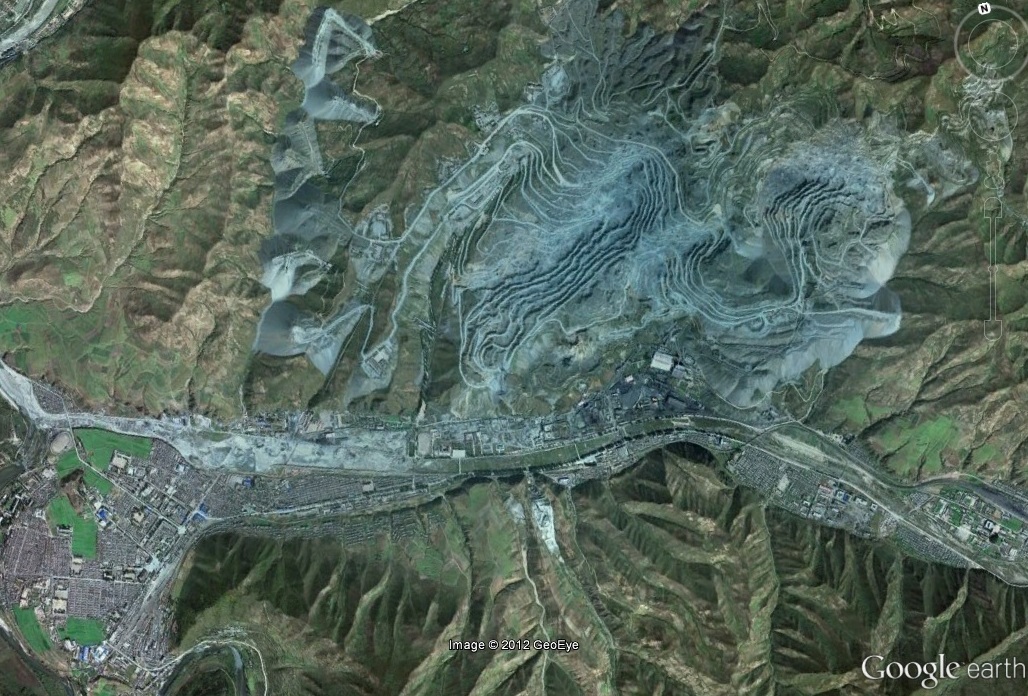
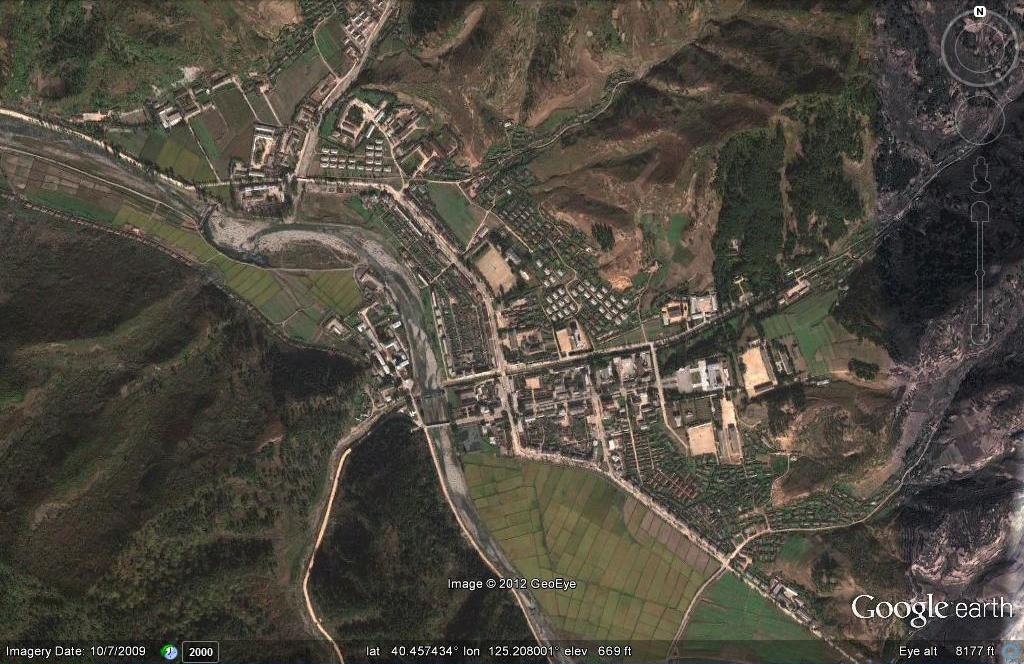
In 2007 Xiyang set up the Sohae Joint Venture Company to work the Ongjin Iron Mine (Google Earth coordinates: 37.960294°, 125.368651°) and the Xiyang Paekgumsan Joint Venture (aka Soyang Paekgumsan Joint Venture Co.) to work in haevy industry and construction. Although the story does not mention it, I believe the problems are at the Ongjin Mine. I am unsure of the status of the Paekgumsan Joint Venture.