Archive for the ‘DPRK organizations’ Category

DPRK promotes environemntal efforts

Wednesday, June 23rd, 2010

According to Reuters:

There are no private cars in North Korea and countless factory chimneys have not belched smoke in years, but state media said on Tuesday scientists were inventing new ways to cut air pollution and protect the environment.

The country “has directed a great effort” to research environmental protection, the state news agency KCNA reported.

“Researchers have developed a new material for removing exhaust fumes from automobiles so as to cut the greenhouse gas emissions and reduce air pollution 35-40 percent,” it said, without elaborating.

It also said “units” in the capital, Pyongyang, that caused pollution had been registered, suggesting that dirty industries were under pressure to get clean.

“They are now developing a gas and dust arrester necessary in production processes and new materials needed to secure environmental safety of products,” it said.

The isolated communist country’s state-run media periodically boasts revolutionary innovations in science and technology, despite a moribund economy and chronic food shortages.

Perhaps the most visible in recent years have been related to the relatively well-funded — and well-fed — military. North Korea has conducted two nuclear tests since 2006 and several missile launches, upsetting its neighbours.

North Korean scientists also invented a device using “locally available materials” to incinerate hospital waste, KCNA said, and the Environmental Protection Institute of the Ministry of Land and Environmental Conservation had intensified research into pollution-free vegetable production.

Here is the original KCNA story:

Scientific Achievements of Environmental Protection
 
Pyongyang, June 22 (KCNA) — The Democratic People’s Republic of Korea has directed a great effort to scientific researches for environmental protection.

Researchers have developed a new material for removing exhaust fumes from automobiles so as to cut the greenhouse gas emissions and reduce air pollution 35-40 percent.

They have also put the environmental management of industrial establishments on IT basis.

Meanwhile, they have registered units causing environmental pollution in Pyongyang and confirmed methods and procedures for preventing pollution. They are now developing a gas and dust arrester necessary in production processes and new materials needed to secure environmental safety of products.

Besides, they have invented a new device to destroy by fire such wastes from hospitals as contaminated injector and bandage with locally available materials.

Scientists of the Environmental Protection Institute of the Ministry of Land and Environmental Conservation have intensified a research in pollution-free vegetable production.

Read the full Reuters story here:
N.Korea says puts “great effort” into environment
Reuters
6/22/2010

Share

DPRK abandons food rations, orders self-sufficiency

Thursday, June 17th, 2010

Institute for Far Eastern Studies (IFES)
NK Brief No. 10-06-17-1
6/17/2010
 
As North Korea’s food shortages worsen and reports of starvation continue to grow, the Workers’ Party of Korea have acknowledged the failure of the central food ration program. Since the end of May, the Party has permitted the operation of 24-hour markets, and the regime has ordered the people of the North to provide for themselves.

The human rights organization Good Friends reported this move on June 14. According to Good Friends, the Workers’ Party organization and guidance bureau handed down an order on May 26 titled ‘Relating to Korea’s Current Food Situation’ that allowed markets to stay open and ordered North Koreans to purchase their own food. This order, recognizing that the food shortages in the North have continued to worsen over the last six months, since the failed attempts at currency reform, acknowledged the difficulty of providing government food rations. It calls on those who were receiving rations to now feed themselves, while also calling on the Party, Cabinet, security forces and other relevant government agencies to come up with necessary countermeasures. Now, authorities officially allow the 24-hour operation of markets, something that most had already tacitly permitted, and encourage individuals, even those not working in trading companies, to actively import goods from China.

It has been reported that government food rations to all regions and all classes of society, even to those in Pyongyang, were suspended in April. The last distribution of food was a 20-day supply provided to each North Korean on April 15, the anniversary of the birth of Kim Il Sung. Because of the difficulty of travelling to markets, the suspension of rations caused many in farming communities to starve to death. When Kim Jong Il’s recent visit to China failed to secure expected food aid, the Workers’ Party had no choice but to hand down the ‘May 26 Party Decree’. While the suspension of rations has considerably extended the economic independence of North Korean people, the regime has significantly stepped up other forms of control over society. Public security officers have begun confiscating knives, saws and other potential weapons over 9 centimeters long in an effort to stem murder and other violent crimes. Additionally, state security officials are cracking down on forcefully resettling some residents of the age most likely to defect, while sending to prison those thought to have contacted relatives in South Korea.

According to Daily NK, North Korean security officials are pushing trading companies to continue trading with China, while calling on Chinese businesses to provide food aid. It also appears that North Korean customs inspections along the Tumen River have been considerably eased, and there is no real attempt to identify the origin or intended use of food imported from China. Sinheung Trading Company has asked Chinese partners investing in the North to send flour, corn and other foodstuffs. The Sinheung Trading Company is operated by the Ministry of State Security, and is responsible for earning the ministry foreign capital. It appears that food acquisition is now a matter of national security, as North Korea is expecting South Korea and the rest of the international community to economically isolate the country.

Share

DPRK shakes up elite in order to meet 2012 “strong and prosperous” goal

Tuesday, June 15th, 2010

Institute for Far Eastern Studies (IFES)
NK Brief No. 10-06-14-2
6/14/2010

During the third session of the 12th Supreme People’s Assembly, convened on June 7, Kim Jong Il promoted his brother-in-law Jang Sung Thaek to vice-chairman of the National Defense Commission (NDC), named a new premier, and replaced several department heads and ministers. This appears to be an attempt to shore up the regime as it seeks to “open the door to a strong and prosperous nation” by 2012, the 100th anniversary of the birth of Kim Il Sung. Kim Jong Il made a personal appearance at this latest assembly meeting, unlike the SPA meeting held in April. The leader’s presence hints at the importance of the latest gathering.

This promotion of Jang Sung Thaek and shake up of Cabinet positions appears to be part of efforts to realize the quickly approaching goal of establishing a ‘strong and prosperous nation’ by 2012, assigning those most able to positions of responsibility, regardless of age or experience. Most notably, Jang, widely thought to be second-in-command in North Korea, was promoted to vice-chairman of the NDC. He was first appointed to the NDC at the first meeting of the 12th SPA in April 2009, making his climb to vice-chairman in a mere 14 months.

Before the latest promotion, Jang held the position of vice-director of the Workers’ Party of Korea, a newly created position that he was the first to hold. In this position, Jang oversaw national security offices, police, and the courts, putting him in a position of power difficult for anyone else to achieve. Having traveled to both South Korea and China, Jang Sung Thaek was likely promoted to present the image of a strong military and, at the same time, establish stable relations with the international community in order to ensure a smooth transition of power as well as to resurrect the economy by 2012. When Kim Jong Il led a delegation to China last May, the Chinese government treated Jang very well, ignoring standard protocol for someone in his position.

In addition, Choe Yong Rim was named the North’s new premier, and eight new vice-ministers were appointed. Regional Party secretaries were allowed to participate directly, allowing those who are most knowledgeable of local conditions to impact the decisions of the administration. Most of the new appointments were very experienced elites, including Choe Yong Rim (80) as premier, and Kang Neung Su (80), Kim Rak Hui (77), Ri Thae Nam (70), and Jun Ha Chul (82). The regime is promoting a number of veterans who are making their “last stand for the motherland” as part of the effort to ensure stable transformation of power after Kim Jong Il.

With Kim Rak Hui’s appointment as vice-premier and new appointments to the Ministry of Foodstuff and Daily Necessities Industry as well as the head of the Light Industry Ministry, North Korea seems to be pursuing the improvement of standards of living promised in the 2010 New Year’s joint editorial. Pyongyang Party officials appear to be attempting to reassert a centrally planned economy in the aftermath of botched currency reform efforts; however those witnessing regional economic conditions appear much more able to come up with appropriate economic policies. North Korea has been unable to make any significant progress in resolving its food shortages or its inability to provide daily necessities to the public, leading the regime to scapegoat some high-ranking officials. Now, many in and outside of North Korea are watching closely to see if the regime can launch economic efforts capable of successfully ‘opening the door to a Strong and Prosperous Nation’ in the next two years.

Share

Lankov on succession

Tuesday, June 15th, 2010

Writing in the Asia Times

A few days ago, a new session of the Supreme People’s Assembly – North Korea’s rubber-stamp parliament – was convened in Pyongyang. In most cases, such sessions do not attract much attention outside a tiny circle of the full-time Pyongyang watchers: few people would be excited by the sight of monotonously and tastelessly dressed men and women sitting in rows and raising their hands to signal their unanimous approval of the laws and resolutions that – as everybody understands – seldom bear any relation to reality.

However, this time observers suspected that something unusual was going to happen. The assembly’s last session took place in April, and was not supposed to meet again so soon. As we learned on June 7, parliament was convened to authorize (with the expected 100% approval rate) a major reshuffle of the North Korean leadership – and, judging by the urgency of gathering, this reshuffle was seen as a pressing matter.

A few days earlier, on June 3, the official North Korean wire agency reported that one day before, Yi Che-kang, the first deputy chairman of the ruling Korean Workers’ Party, had been killed in a traffic accident. The victim of a car crash was, formally speaking, second only to Dear Leader Kim Jong-il in the party hierarchy.

This news had to be suspicious: North Korea’s traffic is arguably the thinnest in Asia, but the country has a long tradition of traffic incidents taking the lives of high officials. The first such incidents occurred in the early 1970s, during the transition of power from the country’s founding father Kim Il-sung to his son.

Nowadays, the new dynastic transition is unrolling. In early 2009, after long delays and much hesitation, Kim Jong-il decided that his youngest son, Kim Jong-un, would become the next great leader of the country. So far, no reference to the “Young General” has appeared in the open media, but one can come across accolades to his greatness and superhuman wisdom in classified materials that are published for the benefit of officials (and distributed widely).

The events of the past week allow us to surmise how the power structure of North Korea will look like in the first years after Kim Jong-il’s death. It seems that North Korean political heavyweights have finally begun to prepare for the unthinkable – the demise of the Dear Leader.

The choice of Kim Jong-un as a heir designate serves, above all, the interests of the North Korean elite, so one can even suspect that the choice was somehow pushed on Kim Jong-il by his entourage. The “Young General” really is young, being merely 27 or 28 years old. Even North Korean propaganda mongers find this embarrassing, so they insist General Kim is in his early 30s.

The choice of such an exceptionally young candidate serves, above all, the interests of the old guard, Kim Jong-il’s own entourage. A young crown prince has no power base and no allies. Thus, even if he technically becomes the supreme leader, he will have no choice but to follow the advice of his father’s entourage, that is, people who are running the country now. He is doomed to become a puppet – at least for some while.

However, a weak crown prince will require an able prince regent. For the past few years, most Pyongyang watchers agreed that the most likely candidate to take such a position is Jang Song-taek, a brother-in-law of Kim Jong-il.

Born in 1946, he is 64 and hence young by the standards of North Korea, where a majority of the top leaders are in their 70s and 80s. The recent Supreme People’s Assembly session confirmed these speculations. At the session, Jang was appointed vice chairman of the National Defense Commission. The North Korean constitution stipulates that the chairman of this body is head of the state, and Kim Jong-il runs the country exactly in this capacity. Therefore, Jang officially became the second-placed person in the country.

The car incident that killed Yi Che-kang was also timely for Jang Song-taek. Yi was widely believed to be a rival of Jang. Now, with Yi dead, Jang seems to have no serious rivals left. The recent assembly session also appointed a new head of the North Korean cabinet. In North Korea, the prime minister is essentially a top technocrat, but it is still significant that this position went to Choe Yong-rim, who is rumored to be close to Jang.

Jang’s position remains precarious: Kim Jong-il is still the supreme leader, and in North Korea even blood connections with the highest family do not always secure a person from august wrath. In the past, family members have been exiled a number of times, and in one case a young relative of the Dear Leader was assassinated in Seoul, where he had defected. A few years ago, Jang Song-taek disappeared from public sight for a year, and he is widely believed to have spent this time in exile.

At any rate, the North Korean elite – with at least tacit approval of Kim Jong-il – began to work on the architecture of a post-Kim Jong-il regime. It seems that the future power structure will consist of Kim Jong-un, a much extolled Star of Revolution and Shining Comrade (or whichever flowery titles they will invent) who will essentially be a powerless puppet while real authority will dwell with a council of technocrats and generals presided over by Jang Song-taek. In all probability, it means that the death of Kim Jong-il will not bring about much change: for a while the country will be steered by the same people who have been running it for the past two or three decades.

However, power transitions do not always go as intended. To start with, Kim Jong-un’s personality cult is still in its infancy, and it will take few years to develop it to the usual North Korean levels. We are yet to see pages of all newspapers filled with countless stories of the “Young General’s benevolence”. However, before the personality cult is developed enough, not only Kim Jong-un’s position but the entire system will remain insecure. We do not know whether Kim Jong-il and his old guard have enough time at their disposal: at the latest Supreme People’s Assembly session the Dear Leader did not look particularly well.

It is also possible that after Kim Jong-il’s death some cracks in the top leadership, now invisible, will lead to intense infighting and thus undermine the cohesion that is essential for the stability of the system.

And even if the transition goes smoothly enough, the resulting system will remain inherently unstable. Kim Jong-un might be young, inexperienced and compliant now, but he will get stronger and wiser, and in all probability will not be too happy about the control of the old dignitaries. Many young kings ended up challenging and removing their regents.

On the other hand, the likely members of the future regent council are quite old, with an average age of 75 or so, hence in a decade many of the present-day top dignitaries will be dead from natural causes (and, perhaps a car crash or two).

Finally, Jang Song-taek might be tempted into assuming all power for himself. Nasty things are known to have happened to young crown princes in the past – from food poisoning to riding incidents and, perhaps, even good old car crashes.

But, whatever happens, the first days of June saw the contours of post-Kim Jong-il North Korea emerge.

Read the full story below:
Son rising for a post Dear Leader era
Asia Times
Andrei Lankov
6/16/2010

Share

DPRK allegedly halts rations

Monday, June 14th, 2010

According to the AFP:

North Korea has completely cut off state food rations after China failed to supply the impoverished communist country with extra cereals, a welfare group said Monday.

The ruling communist party announced in a directive on May 26 that there would be no state rations for a while, said South Korea’s Good Friends group which has contacts in the North.

People were authorised to buy food supplies through private markets, it said, adding the directive was due to delayed shipments of food from China.

“The directive was unavoidable” because China failed to send the aid which had been anticipated after leader Kim Jong-Il’s trip to Beijing in early May, group president Pomnyun, who uses just one name, told reporters.

Private markets are now open around the clock across the North, he said.

The North suffered famine in the mid-1990s which killed hundreds of thousands and it still grapples with severe food shortages. The UN children’s fund estimates one third of children are stunted by malnutrition.

The state food distribution system collapsed during the famine. Free markets sprang up and were condoned for a time.

Since 2005 the regime has been reasserting its grip on the economy, with controls or outright bans on the private markets.

A currency revaluation last November, designed to flush out entrepreneurs’ savings, backfired disastrously, fuelling food shortages as market trading dried up and sparking rare outbreaks of unrest.

The North was forced to suspend its campaign to curb the private markets.

Read the full story here:
N.Korea completely cuts off state rations: aid group
AFP
6/14/2010

Share

The DPRK’s internet, business, and radio wars

Friday, June 11th, 2010

Martyn Williams releases three DPRK stories this week all covering interesting issues…


North Korea Moves Quietly onto the Internet

North Korea, one of the world’s few remaining information black holes, has taken the first step toward a fully fledged connection to the Internet. But a connection, if it comes, is unlikely to mean freedom of information for North Korea’s citizens.

In the past few months, a block of 1,024 Internet addresses, reserved for many years for North Korea but never touched, has been registered to a company with links to the government in Pyongyang.

The numeric IP addresses lie at the heart of communication on the Internet. Every computer connected to the network needs its own address so that data can be sent and received by the correct servers and computers. Without them, communication would fall apart.

It is unclear how the country’s secretive leadership plans to make use of the addresses. It seems likely they will be assigned for military or government use, but experts say it is impossible to know for sure.

North Korea’s move toward the Internet comes as it finds itself increasingly isolated on the world stage. The recent sinking of a South Korean warship has been blamed on the insular country. As a result, there are calls for tougher sanctions that would isolate North Korea further.

“There is no place for the Internet in contemporary DPRK,” said Leonid A. Petrov, a lecturer in Korean studies at The University of Sydney, referring to the Democratic People’s Republic of Korea. “If the people of North Korea were to have open access to the World Wide Web, they would start learning the truth that has been concealed from them for the last six decades.”

“Unless Kim Jong-Il or his successors feel suicidal, the Internet, like any other free media, will never be allowed in North Korea,” he said.

The North Korean addresses were recently put under the control of Star Joint Venture, a Pyongyang-based company that is partly controlled by Thailand’s Loxley Pacific. The Thai company has experience working with North Korea on high-tech projects, having built North Korea’s first cellular telephone network, Sunnet, in 2002.

Loxley acknowledged that it is working on a project with Pyongyang, but Sahayod Chiradejsakulwong, a manager at the company, wouldn’t elaborate on plans for the addresses.

“This is a part of our business that we do no want to provide information about at the moment,” he said.

A connection to the Internet would represent a significant upgrade of the North’s place in cyberspace, but it’s starting from a very low base.

At present the country relies on servers in other countries to disseminate information. The Web site of the Korea Central News Agency, the North’s official mouthpiece, runs on a server in Japan, while Uriminzokkiri, the closest thing the country has to an official Web site, runs from a server in China.

North Korean citizens have access to a nationwide intranet system called Kwangmyong, which was established around 2000 by the Pyongyang-based Korea Computer Center. It connects universities, libraries, cybercafes and other institutions with Web sites and e-mail, but offers no links to the outside world.

Connections to the actual Internet are severely limited to the most elite members of society. Estimates suggest no more than a few thousand North Koreans have access to the Internet, via a cross-border hook-up to China Netcom. A second connection exists, via satellite to Germany, and is used by diplomats and companies.

For normal citizens of North Korea, the idea of an Internet hook-up is unimaginable, Petrov said.

Kim Jong-Il, the de-facto leader of the country, appears all too aware of the destructive power that freedom of information would have to his regime.

While boasting of his own prowess online at an inter-Korean summit meeting in 2007, he reportedly rejected an Internet connection to the Kaesong Industrial Park, the jointly run complex that sits just north of the border, and said that “many problems would arise if the Internet at the Kaesong Park is connected to other parts of North Korea.”

Kim himself has made no secret of the Internet access that he enjoys, and famously asked then-U.S. Secretary of State Madeleine Albright for her e-mail address during a meeting in 2000.

The government’s total control over information extends even as far as requiring radios be fixed on domestic stations so foreign voices cannot be heard.

The policy shows no signs of changing, so any expansion of the Internet into North Korea would likely be used by the government, military or major corporations.

The World’s Most Unusual Outsourcing Destination

Think of North Korea, and repression, starvation and military provocation are probably the first things that come to mind. But beyond the geopolitical posturing, North Korea has also been quietly building up its IT industry.

Universities have been graduating computer engineers and scientists for several years, and companies have recently sprung up to pair the local talent with foreign needs, making the country perhaps the world’s most unusual place for IT outsourcing.

With a few exceptions, such as in India, outsourcing companies in developing nations tend to be small, with fewer than 100 employees, said Paul Tija, a Rotterdam-based consultant on offshoring and outsourcing. But North Korea already has several outsourcers with more then 1,000 employees.

“The government is putting an emphasis on building the IT industry,” he said. “The availability of staff is quite large.”

At present, the country’s outsourcers appear to be targeting several niche areas, including computer animation, data input and software design for mobile phones. U.S. government restrictions prevent American companies from working with North Korean companies, but most other nations don’t have such restrictions.

The path to IT modernization began in the 1990s but was cemented in the early 2000s when Kim Jong Il, the de-facto leader of the country, declared people who couldn’t use computers to be one of the three fools of the 21st century. (The others, he said, are smokers and those ignorant of music.)

But outsourcing in North Korea isn’t always easy.

Language can be a problem, and a lack of experience dealing with foreign companies can sometimes slow business dealings, said Tija. But the country has one big advantage.

“It is one of the most competitive places in the world. There are not many other countries where you can find the same level of knowledge for the price,” said Tija.

The outsourcer with the highest profile is probably Nosotek. The company, established in 2007, is also one of the few Western IT ventures in Pyongyang, the North Korean capital.

“I understood that the North Korean IT industry had good potential because of their skilled software engineers, but due to the lack of communication it was almost impossible to work with them productively from outside,” said Volker Eloesser, president of Nosotek. “So I took the next logical step and started a company here.”

Nosotek uses foreign expats as project managers to provide an interface between customers and local workers. In doing so it can deliver the level of communication and service its customers expect, Eloesser said.

On its Web site the company boasts access to the best programmers in Pyongyang.

“You find experts in all major programming languages, 3D software development, 3D modelling and design, various kind of server technologies, Linux, Windows and Mac,” he said.

Nosotek’s main work revolves around development of Flash games and games for mobile phones. It’s had some success and claims that one iPhone title made the Apple Store Germany’s top 10 for at least a week, though it wouldn’t say which one.

Several Nosotek-developed games are distributed by Germany’s Exonet Games, including one block-based game called “Bobby’s Blocks.”

“They did a great job with their latest games and the communication was always smooth,” said Marc Busse, manager of digital distribution at the Leipzig-based company. “There’s no doubt I would recommend Nosotek if someone wants to outsource their game development to them.”

Eloesser admits there are some challenges to doing business from North Korea.

“The normal engineer has no direct access to the Internet due to government restrictions. This is one of the main obstacles when doing IT business here,” he said. Development work that requires an Internet connection is transferred across the border to China.

But perhaps the biggest problem faced by North Korea’s nascent outsourcing industry is politics.

Sanctions imposed on the country by the United States make it all but impossible for American companies to trade with North Korea.

“I know several American companies that would love to start doing IT outsourcing in North Korea, but because of political reasons and trade embargoes they can’t,” Tija said.

Things aren’t so strict for companies based elsewhere, including those in the European Union, but the possible stigma of being linked to North Korea and its ruling regime is enough to make some companies think twice.

The North Korean government routinely practices arbitrary arrest, detention, torture and ill treatment of detainees, and allows no political opposition, free media or religious freedom, according to the most recent annual report from Human Rights Watch. Hundreds of thousands of citizens are kept in political prison camps, and the country carries out public executions, the organization said.

With this reputation some companies might shy away from doing business with the country, but Exonet Games didn’t have any such qualms, said Busse.

“It’s not like we worked with the government,” he said. “We just worked with great people who have nothing to do with the dictatorship.”

Radio Wars Between North and South Korea (YouTube Video)

Share

The effects of the DPRK’s currency revaluation

Thursday, June 10th, 2010

The New York Times published a lengthy article on the DPRK’s currency reform effort launched last year.  Excerpts below:

Like many North Koreans, the construction worker lived in penury. His state employer had not paid him for so long that he had forgotten his salary. Indeed, he paid his boss to be listed as a dummy worker so that he could leave his work site. Then he and his wife could scrape out a living selling small bags of detergent on the black market.

It hardly seemed that life could get worse. And then, one Saturday afternoon last November, his sister burst into his apartment in Chongjin with shocking news: the North Korean government had decided to drastically devalue the nation’s currency. The family’s life savings, about $1,560, had been reduced to about $30.

Last month the construction worker sat in a safe house in this bustling northern Chinese city, lamenting years of useless sacrifice. Vegetables for his parents, his wife’s asthma medicine, the navy track suit his 15-year-old daughter craved — all were forsworn on the theory that, even in North Korea, the future was worth saving for.

“Ai!” he exclaimed, cursing between sobs. “How we worked to save that money! Thinking about it makes me go crazy.”

North Koreans are used to struggle and heartbreak. But the Nov. 30 currency devaluation, apparently an attempt to prop up a foundering state-run economy, was for some the worst disaster since a famine that killed hundreds of thousands in the mid-1990s.

(more…)

Share

DPRK market price of grains stabilizing

Thursday, June 10th, 2010

According to the Daily NK:

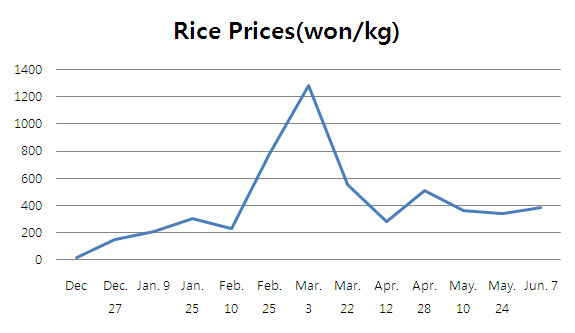
rice-price-6-7-2010.jpg

Today, the North Korean markets seem to have returned to the days before the currency redenomination. The price of rice appears to be rather stable, especially when compared with that of February or March. Especially, following Kim Jong Il’s trip to China, rumors indicating that food would be imported began to circulate, and this has made declining prices even more marked.

According to inside sources, the price of rice in Hoiryeong, North Hamkyung Province is now 480 won per kilo (June 4th), 420 won in Sinuiju (June 7th), 360 won in Sunam-district of Pyongyang (June 2nd), and 380 won in Sariwon (June 7th). The price of corn is approximately 50% that of rice, although recently in Hwanghae Province, households using corn as feed for pigs drove an unusual situation where the corn price reached almost 70% that of rice.

The exact nature of Chinese support for North Korea cannot be confirmed officially, however, the North Korean regime’s encouraging foreign currency earning enterprises to import food from China since March seems to have contributed to rice price stabilization.

One inside source added that the “reactivation of food smuggling on the border between North Korea and China” has also helped.

However, the main overall reason for the failure of the initial prediction, “When the farm hardship period comes in May and June, food prices will skyrocket” appears to have been the normalization of the market.

The source commented, “Compared with the situation prior to the currency redenomination, trading in industrial goods has decreased slightly, however, it is close to its previous condition. Since buyers and sellers can access that market any time, price volatility is not that great anymore.”

That being said, the opening hours of the market have been reduced since the authorities handed down a “rice planting battle order” in early May which stated, “Everyone must participate in the rice planting battle. The market should only be used for the purchase of food, side dishes and those necessities required for the day.”

The source explained, “Markets everywhere now open between 2 and 4 P.M. and close at sunset,” adding that there are small differences depending on the particular market. In North Hamkyung Province, the market normally closes at sunset; however, markets in Hwanghae Province and Pyongan Province, which are under heavier pressure due to the rice planting, close earlier, at around 6 P.M.

But concerns about food will not be solved even if the price of rice remains stable. Merchants are still watching prices with a concerned look since rumors constantly assert that food prices will increase again in July. The North Hamkyung Provincial Party Committee held a cadres meeting last May in which it released news that food distribution for the months from July to October must be prepared by each unit individually, meaning that the central authorities have no plans to assist.

The agricultural situation is one concern. North Korea has been suffering from a severe fertilizer crisis since the beginning of spring farm preparations. After Kim Jong Il’s visit to China, Chinese fertilizer was imported which temporarily alleviated the situation, but the rumor is that fertilizer for the summer has yet to arrive.

Recently, Kim Jong Il visited a domestic fertilizer production facility, Namheung Youth Chemical Works in Anju City, South Pyongan Province. There, he complimented factory management, saying, “It is a relief to know that fertilizer is being produced in Namheung.” The incident displays North Korea’s concerns about fertilizer.

Other factors which destabilize food prices are the icy inter-Korean relationship and international community sanctions.

Recently, around the North Korean market, the number of street vendors, so-called ‘grasshoppers’ has greatly increased. One source explained, “This situation has been caused by the middle class being demoted to the lower classes due to the big damage they incurred during the currency redenomination.”

Sharply decreasing trade in higher priced goods like home appliances and furniture is derived from the same source.

The tumbling credibility of the North Korean currency is another ongoing worry, as is a lack of small denomination bills. One source explained, “If you purchase a 30,000 won jumper from Sungyo Market in Pyongyang, the cost is $30 (market exchange rate, the equivalent of 27,000 won on the day), but it is 30,000 won if you pay in North Korean currency.” That’s a ten percent mark-up for people using local currency, the material representation of a lack of trust in the won.

In areas of Pyongyang, Wonsan, Sariwon, and Haeju, dollars and then Euros are preferred over won, but in Jagang Province, Yangkang Province, and North Hamkyung Province, Yuan are preferable to dollars. Places where all four; U.S. dollars, Yuan, Euros and won are being used are Sinujiu and the port city of Nampo on the west coast. One source explained that due to this situation, high-priced products like televisions, DVD players and refrigerators are being sold only for U.S. dollars or Yuan.

Also, he added, “There is a shortage of small bills which is causing some inconveniences in market trading.”

At the time of the currency redenomination, North Korea displayed 7 kinds of small bills and coins; 1 chon, 5 chon, 10 chon, 50 chon, 1 won, 5 won, and 10 won. The source explained that demand for the ‘chon’ unit coins is practically non-existent; the problem is that 1 won, 5 won, and 10 won are frequently used in market trading but a shortage of bills is causing inconvenience. Merchants are setting the price of goods mostly in increments of 10 won and 50 won as a result.

Read the full story here:
Everything Is Stable, But for How Long?
Daily NK
Park In-ho
6-9-2010

Share

Political Life Launched by Chosun Children’s Union

Tuesday, June 8th, 2010

Daily NK
Min Cho Hee
6/7/2010

On June 6, 1946, the Chosun Children’s Union was founded. The Children’s Union, an organization for all children between seven and fourteen, is guided politically by the Science Education Department of the Central Committee of the Party.

Its hierarchical structure consists of a number of levels populated by students, including section committees of class and school, provincial and local school committees, and the national coalition of the Children’s Union. Within the structure, there is one head and two vice-heads of the Union in each school, one school committee member from each classroom, one head and two vice-heads of a section committee which exists within each class, and three to five committee members of each section committee.

The teacher who takes responsibility for the Children’s Union in a school is known as the Children’s Union Instructor, while the homeroom teacher of each class is generally also the section committee instructor. Based on the notion that a student’s political and organization life should be divided from his or her general school life, the teacher undertakes homeroom tasks and Children’s Union tasks under two different official positions.

Members of the Children’s Union must act according to the “regulations and obligations of the Chosun Children’s Union.” In order to “do good works,” part of the social activities of the Union, Union members make a “Kid’s Plan,” which specifies the kind and scale of the activities the member intends to carry out, be it collecting scrap iron, copper or paper, raising rabbits, participating in propaganda choirs or being a children’s watch guard (someone who monitors the activities of other students).

The symbols of the Children’s Union are the red scarf, like that of Young Pioneer organizations in other communist states, a badge showing a torch, and the greeting and slogan of the Union, “Let’s always be ready to become workers in the construction of socialism!” in long form, or, more pithily, “Always ready!”

Every student has to take part in one of three Union entrance ceremonies during their second year of elementary school.

The first entrance ceremony is held on Kim Jong Il’s birthday, February 16, the second on Kim Il Sung’s birthday on April 15, and the last one on June 6, the date of the organization’s founding. Model students who have a good family background can join the Union on Kim Jong Il’s birthday with his or her homeroom teacher’s recommendation, the next political class of students enter it on April 15 and the rest of students joint en masse on June 6th.

Entrance ceremonies are held regionally. First on the agenda at the ceremony is to recite the entrance oath; next, Union officials give badges and ties to new members; then the children shout the Union slogan with right arm aloft in salute.

The main concern of parents is the day of their child’s entrance ceremony. Students who are permitted to join on Kim Jong Il’s birthday have the best prospects, with a high possibility of becoming Union leaders of one kind or another. Activities within the Union are, of course, noted, so it is important to be successful from the beginning.

Therefore, the position of homeroom teacher of a second-year elementary class is desirable, since it allows the teacher access to bribes of money, clothes, rice and more from parents keen to see their child enter the Union on February 16.

Until the early 1990s, when the authorities stopped provided students with school uniforms, the red scarf was also provided by the state, but now, as with so much, it is the duty of parents.

Therefore, from February to June demand for the ubiquitous red scarf of the Children’s Union increases in North Korean markets. In the Sunam market in Chonjin, the red scarf of the Union sells for between 500 and 1200 won.

Yet even in the simple red scarf there is a symbol of inequality. Children from the upper classes have silk scarves manufactured in China, while the other students use cheap nylon versions or receive them from siblings.

Share

CanKor on DPRK-Canadian assistance

Sunday, June 6th, 2010

According to CanKor Report #323, 2 June 2010:

North Korea began opening up to nongovernmental organizations in the 1990s, when severe food shortages forced it to seek outside aid. While both the famine of the mid-90s and the efforts to alleviate it got a good deal of press at the time, attention to this aspect of North Korea has fallen off in recent years as most press coverage now deals with the nuclear issues or questions of leadership succession. But while NGO activities may have dropped off over the last decade, a select few groups continue in their efforts to better the lives of ordinary North Koreans, despite all the limitations and difficulties they face in doing so.

CanKor has collected a partial list of nongovernmental organizations from the non-six-party talk countries currently engaged in humanitarian activities in North Korea. While some have been left out at their own request due to the politically sensitive nature of their work, we will endeavour to present regular updates on current or new projects in the DPRK. Readers are encouraged to write in and inform us of any activities we may report.

Featured Project:  Mennonite Central Committee

MCC has been engaged in the DPRK since the mid 1990s, the earlier years through the Canadian Food Grains Bank (CFGB) in partnership with other organizations to support the Food Aid Liaison Unit (FALU), and also together with other non-resident NGOs such as Caritas International, American Friends Service Committee (AFSC), and Foods Resource Bank/Church of the Brethren Global Foods Crisis Fund to support sustainable agriculture and provide humanitarian assistance. Between 1995 and 2006, approximately $15 million in food and other material resources was sent to the DPRK by MCC.

Since 2006 and the dissolving of FALU, MCC has worked in the DPRK through its MCC NE Asia office. MCC has continued to send food and material resources to orphanages, initially via First Steps, and eventually in direct relationship. Soymilk production equipment was also provided to assist orphanages and soymilk production facilities to increase production of their own nutritional needs. MCC also sends food and material resources to tuberculosis hospitals and rest homes through its partnership with Christian Friends of Korea. Greenhouses have also been provided to enable these facilities to raise more of their own food needs.

Here   is a story on MCC’s partnership with First Steps in sending soybeans to orphanages in the DPRK and

Here   is a story on MCC’s cooperation with Christian Friends of Korea in sending food and other material resources to TB facilities.

Beginning in 2009, MCC is partnering with the Ministry of Agriculture in the DPRK on a three- year food security project. Given the success of conservation agriculture in other climatically-similar districts around the world, including Asia and Canada, this project aims to build longer-term food security at three cooperative farms and surrounding areas by increasing the scale of conservation agriculture practiced on each farm.

This is being done through the provision of technical support, training, specialized equipment and inputs. The program will benefit 12,287 residents on the three project farms. The total budget for the 3-year project is U.S.$1 million, with approximately 75% of the funding provided through CFGB and the remainder through individual donations to MCC. Click here   for a news release about the conservation agriculture project. In the interest of further engagement, MCC has also hosted delegations from the DPRK in both the U.S. and Canada, most recently an agricultural delegation to Canada in the fall of 2008. MCC also looks for ways to advocate DPRK engagement with Canadian and American governments. MCC seeks to share its resources in the name of Christ with those in need, placing emphasis on people-to-people relationships.

CanKor has more on NGOs here.

Share