Although KoryoLink’s corporate performance no longer appears in Orascom shareholder reports, Naguib Sawiris has given an interview in Forbes in which he offers some business details:
Sawiris has a 75% stake in Koryolink via his Orascom Telecom Media & Technology (OTMT) unit, with the remainder held by a company under the Ministry of Post & Telecommunications. He says revenues in 2012 should reach around €186 million ($145 million), with an average revenue per user of €8.6. The network only permits domestic calls and locally hosted data services. A separate cell network is available for foreigners in North Korea.
…
FORBES: How many subscribers does Koryolink have? How extensive is your coverage in DPRK?
NAGUIB SAWIRIS: Koryolink currently has more than 1.5 million subscribers. Coverage includes the capital Pyongyang in addition to 15 main cities, more than 100 small cities, and some highways and railways. Territory coverage is around 14%, and more than 90% population coverage. The subscriber base has been increasing at a very healthy rate from 950,000 at [year-end] 2011 to an estimated 1.7 million at [year-end] 2012.
FORBES: Under your joint venture with the Ministry of Telecommunications, when will Koryolink lose its exclusivity? What will happen after this period ends?
NS: Exclusivity was granted for a period of 4 years from launch. After the expiry of exclusivity in Dec. 2012, Koryolink received written confirmation that for an additional period of 3 years (until 2015) no foreign investors will be allowed in the mobile business. However, we are continuing to expand our network and services to further solidify our position [in order] to be ready for any possible competition.
FORBES: What is your role in the construction of the Ryugyong Hotel? What other real estate interests do you have in DPRK?
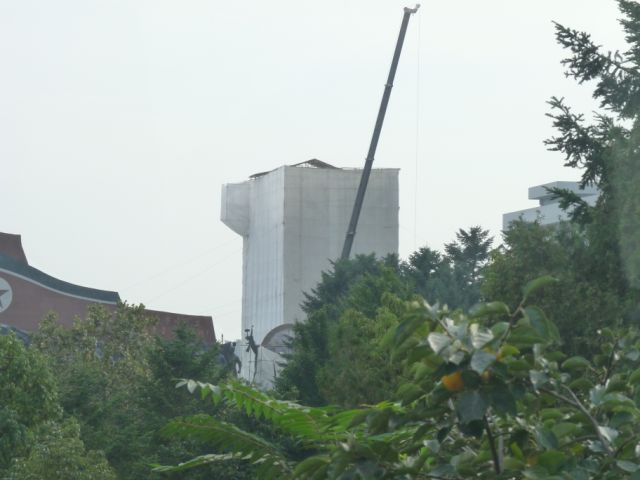
NS: This is a special investment that we are maintaining through our banking subsidiary in the DPRK, where Orascom has the right to operate this facility. The construction, repair and facade installations have all been completed last summer. We are planning to relocate Koryolink headquarters into the tower very soon to bring life to the building. There are no other real-estate investments in the DPRK, however, Orabank, our banking arm in DPRK, is actively working towards developing mobile-related businesses and projects.
Chris Green offers some great information (about which I have long wondered) on the process required to acquire a cell phone:
First, the individual wishing to obtain a cell phone must go to his or her local Communications Technology Management Office (통신통화관리국 or CTMO; in provincial capitals only) or a subordinate arm of the same (in smaller cities) to obtain a three page application form. This form, once filled in, must be stamped by the Ministry of Public Security officer assigned to the individual’s workplace or, for those without official workplaces, attached to his or her local people’s unit.
Having paid off the public security official in cigarettes or cash (more often the former, according to this author’s sources, because it arouses less friction) he or she must submit the stamped form to the CTMO or equivalent, whereupon it is sent, with all the speed one would expect of the North Korean transportation network, to the Ministry of Communications in Pyongyang. At this point there is little else to be done but go away and pitch the proverbial tent, because at best it takes a month for the staff in the revolutionary capital to process the application.
Assuming, and it should not be assumed, that those checks done in Pyongyang don’t yield any incriminating evidence of wrongdoing (don’t forget, the North Korean legal system makes every adult a criminal in one way or another, something which can come back and haunt any individual whenever “rents” are desired), the individual will eventually be ordered back to his local communications office, whereupon he will be handed a payment form. He or she must then take this form to a bank, and engage with the separate, and no less inefficient, bureaucracy therein in order to pay the majority (though not all) of the cost of a phone and Koryolink network activation fee.[1]
The payment form, duly stamped by a functionary at the bank, must then be taken back to the CTMO or equivalent, whereupon it can be exchanged for half the stamped application form originally sought from the ministry in Pyongyang. Here, finally, the individual reaches a watershed moment: this form can actually be exchanged for a cellular telephone!
However, the pain is actually quite a long way short of being over. In a moment of uncharacteristic efficiency, the actual cell phone shop is often directly outside the communications office, but in a moment of karma-balancing inefficiency, it doesn’t open much, carries a limited amount of product and is pitifully understaffed. As a result, queues are long, as are waits. Assuming an individual lives long enough to reach the front of such a queue, he or she is finally offered the opportunity to hand over another $70-$100 and depart the scene with a brand new phone.
Writing in the Daily NK, Kim Kwang-jin explains how people are getting around this burdensome regulatory process:
Therefore, the source said, “Middlemen in larger cities are getting multiple phones activated in random people’s names and then taking them to smaller cities to sell. Alternatively, households that don’t have any problem getting that kind of approval are mobilizing the names of their entire families to get phones, which they are then selling on to the middlemen.”
“The end users are buying these cell phones for $300 to $500 from the middlemen or from private sellers. This saves them having to go to the trouble of applying to Koryolink,” he added.
A basic Koryolink phone can be purchased officially for roughly $270- $300, excluding bribes and extraneous costs. The price of one of these semi-legal phones depends on duration of use and model. The best product, the T1, a clamshell design, is the latest and costs more than $500. The next mid-range model is the T3, another clamshell; there is also a similarly priced phone with a slide design. The budget offerings are the T95 and T107. Differences in price are mostly attributable to differences in sound quality rather than the designs, sources assert.
In addition, there are also phones available for use within individual provinces. These products, which are similar to the so-called “city phones” that were briefly permitted in the late 90s but soon got withdrawn, cost just $70 at the time of writing.
Geoffrey See of Choson Exchange also offers some insight on Ora Bank’s mobile-related business projects:
However, it appears that Naguib, Chairman of Orascom, might have other ideas. In his words, “Orabank, our banking arm in DPRK, is actively working towards developing mobile-related businesses and projects.” The 3G network provides a platform for a range of other services that emerging market economies would need including remittances and payments through mobile banking and mobile payments. Given the primitive development of the services sector, mobile provides an opportunity for Orascom to upend the services industry in North Korea.
This was something I was originally looking at in North Korea. Payments are currently messy in the country. On a previous trip, I remembered an account of a North Korean trying to pay the handphone bill. Apparently the payment went to the wrong account, and the North Koreans spent the morning calling and shouting at some people to make the mistaken beneficiary return the money so that the payment could go to the right account. For what mobile banking and payments could potentially look like in North Korea, check out M-pesa.
Read the full story here:
Pyongyang Calling For Egyptian Telecoms Tycoon Naguib Sawiris
Forbes
Simon Montlake
2012-11-18