Last week the Daily NK reported that the DPRK had been distributing enough rice to lower the price. It is still unclear if this practice will continue. This week the Daily NK reports that the DPRK has stepped up travel restrictions along the Chinese border:
The North Korean authorities are operating enhanced controls on transit through the region of the country closest to China, including close checks on the documentation of travellers passing through in the direction of the Sino-North Korean border.
Part of the process means it has become more difficult to obtain travel permits. Although the issuance of such permits was recently resumed following months of combat mobilization and other activities that limited movement, the process of traveling through the border is making life difficulties.
A North Hamkyung Province source told Daily NK on the 26th, “The issuance of travel permits resumed on the 21st of last month, but the procedure when moving in the border region has gotten more demanding than ever. Travel permits need to be approved with not just the signature but also the seal of a person’s local PSM (Ministry of People’s Safety), relevant security agency and workplace, and if the trip is for a traditional ceremonial occasion such as a funeral then they must get a further confirmation letter saying so.”
“In the past, they did not ask for the confirmation letter, or the seal of the local security forces and NSA (National Security Agency, the state security organ) for that matter. But now they are asking for this and that certificate; it’s as if travellers are criminals,” the source said, recalling, “We used to be able to easily get travel permits by bribing people or having close associates in certain positions.”
Even for those with a permit there are still multiple layers of security and checks on the way to the border.
“Even after you get a travel permit by paying bribes, there are still the PSM agents on the trains and railway staff doing hourly checks,” the source said. “People say it is worse than the customs checks on the border.”
“Stations are being locked down by soldiers and then intensive body and baggage checks are taking place at Gomusan (the station before Musan and Hoiryeong on the Musan Line (train 9-10) and Sariwon-Rajin Line (train 113-114)) and at Huchang (the station before Rajin on the Pyongyang-Tumen River Line (train 7-8)),” the source noted. “They even have magnetic detectors for the body checks.”
Travellers ensnared by the checks are supposed to be detained locally until a security agent from his or her area of residence arrives to deal with the case. However, payments of 50,000 to 100,000 Won are apparently sufficient to attain release for those who simply don’t have the right transit permits. The only ones whose release cannot be obtained so easily are those caught with South Korean materials in their baggage; they face re-education or labor camp sentences, sources say.
Read the full story here:
Strain on the Border Trains Daily NK
Choi Song Min
2013-4-29
UPDATE 2 (2013-4-25):Yonhap reports on the DPRK’s plans for the Tanchon Port:
North Korea is scurrying to develop the resources-rich city of Tanchon on the east coast as part of the country’s efforts to make it a source of foreign currency income, recent news reports from the North showed.
Tanchon will become a key transit point in shipping goods to and from Russia’s Siberia, the northeastern part of China and Mongolia, said the Wednesday issue of the Choson Sinbo, a Korean language newspaper published by North Korean nationals in Japan.
The newspaper, a mouthpiece of North Korea, said the port city of Tanchon should become the source of finance for the country’s broader policy line of pursuing both economic development and nuclear capacities.
In a bid to boost exports, the country completed the construction of a port in May last year in the city with rich reserves of magnesite, zinc and other mineral resources, which sits about in the middle of the country’s east coast line. the Choson Sinbo said the city has about 5.4 billion tons of magnesite deposit, possibly the third biggest reserve in the world.
The news outlet also highlighted the country’s planned ways to increase earnings in the resources-rich city from which the country used to export mineral resources to China for meager profits.
“North Korea will move to manufacture processed magnesite goods in order to make high-value added goods,” the Choson Sinbo noted. “To that end, many plants will be built in the Tanchon region and the areas will become a new industrial zone.”
North Korean leader Kim Jong-un has also underlined the country’s plan to boost profits from the Tanchon development, saying in a national meeting of light industrial workers last month that profits from Tanchon development should be exclusively used to prop up the livelihood of North Korean people.
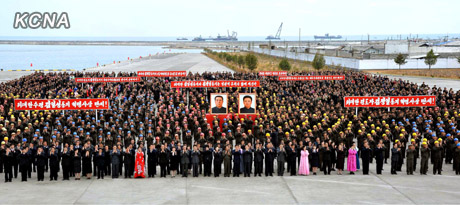
UPDATE 1 (2012-5-3): KCNA announces the completion of the Tanchon Port:
A modern trading port made its appearance in the area of Tanchon in South Hamgyong Province on the occasion of the 100th anniversary of President Kim Il Sung’s birth.
The construction of the port with a cargo traffic capacity of millions of tons provides a guarantee for greatly contributing to developing the nation’s foreign trade and improving the people’s living standard.
A ceremony for the completion of the construction was held on the spot Thursday.
Present there were Choe Yong Rim, Kwak Pom Gi, Ro Tu Chol and other officials concerned, officials of the Ministry of Land and Marine Transport, builders and working people of industrial establishments in Tanchon City.
Read out there was a joint congratulatory message sent by the Central Committee of the Workers’ Party of Korea and the Cabinet of the DPRK to the officials and members of shock brigades who performed labor feats in the construction of the port.
The message highly praised them for successfully building another giant structure in the era of Songun greatly conducive to building an economic power true to the life-time desires and last instructions of President Kim Il Sung and leader Kim Jong Il.
It expressed belief that they would perform greater feats in the efforts for the country’s prosperity united close around the WPK Central Committee headed by the dear respected Kim Jong Un.
Minister of Land and Marine Transport Kang Jong Gwan, in his speech made for the occasion, said the construction of the port was a brilliant fruition of the wise leadership of Kim Jong Il who initiated the construction of the port and worked heart and soul to translate the desire of the President into a reality till the last moments of his revolutionary life and the clear-sighted guidance and meticulous care of Kim Jong Un.
Speakers at the ceremony pledged themselves to carry out their tasks including dredging in a short span of time in the same spirit as displayed in the construction of the port.
At the end of the ceremony the participants looked round different places of the port.
Just a few days ago, the Choson Sinbo reported the following (via Yonhap):
The North is estimated to have 15 billion tons of anthracite coal, a key mineral Pyongyang uses to produce steel, the Choson Sinbo newspaper said.
The North also has an estimated 5.4 billion tons of magnesite in Tanchon, a home to mines in South Hamgyong province, and other areas, according to the newspaper.
North Korea is set to open Tanchon as a modern trade port, the newspaper said, without giving any specific time frame for the opening.
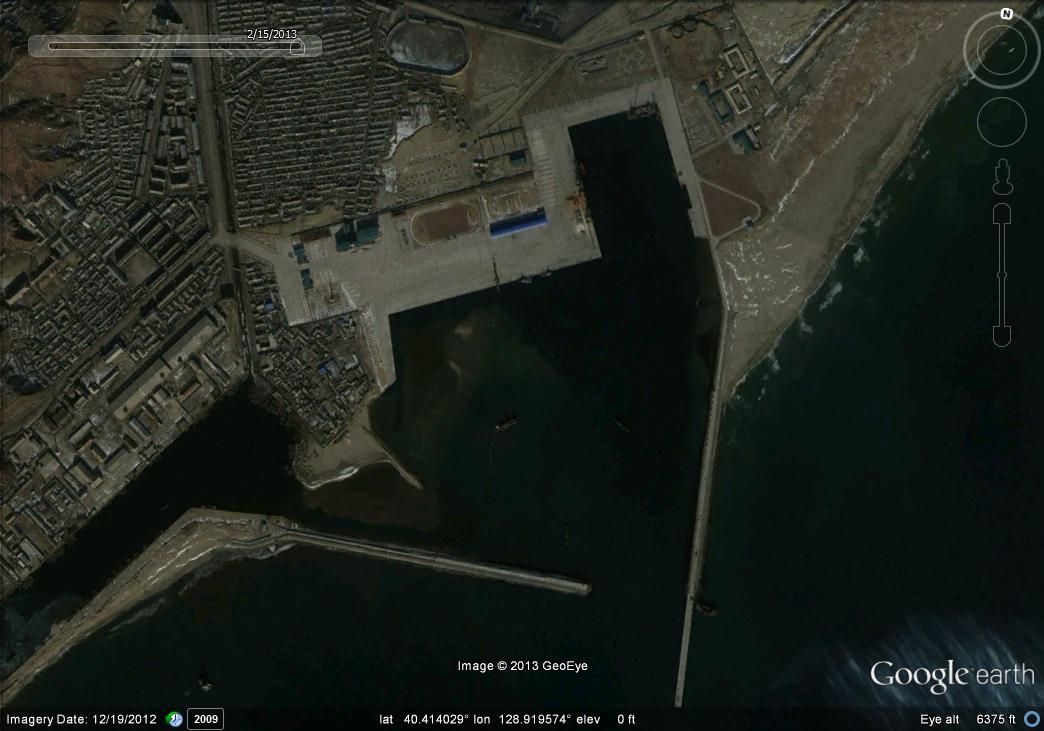
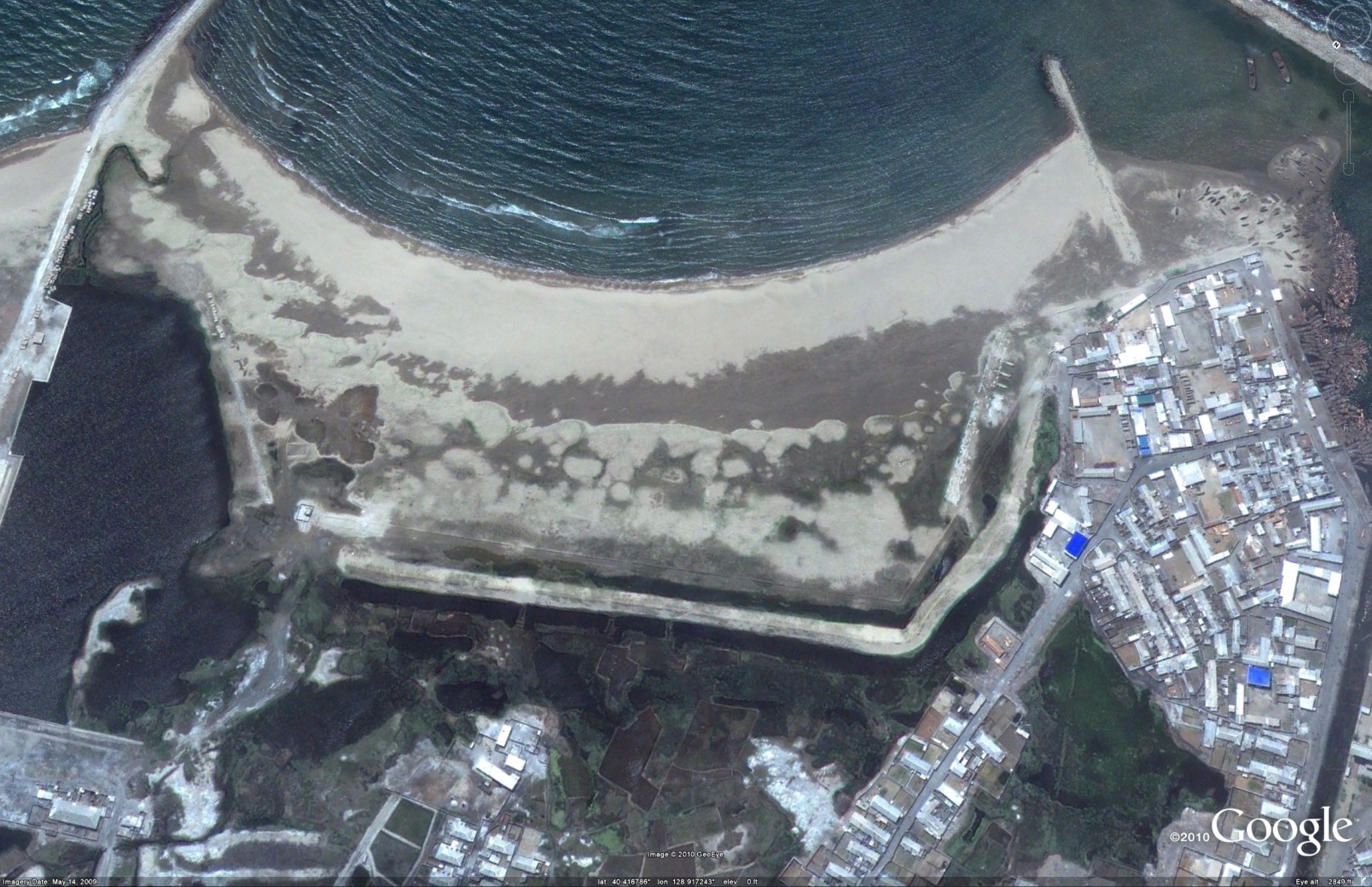
ORIGINAL POST (2010-12-9): On December 2, KCNA announced that Kim Jong-il visited the port in Tanchon County, South Hamgyong County (40.412522°, 128.917731°) where he gave guidance on the port’s reconstruction.
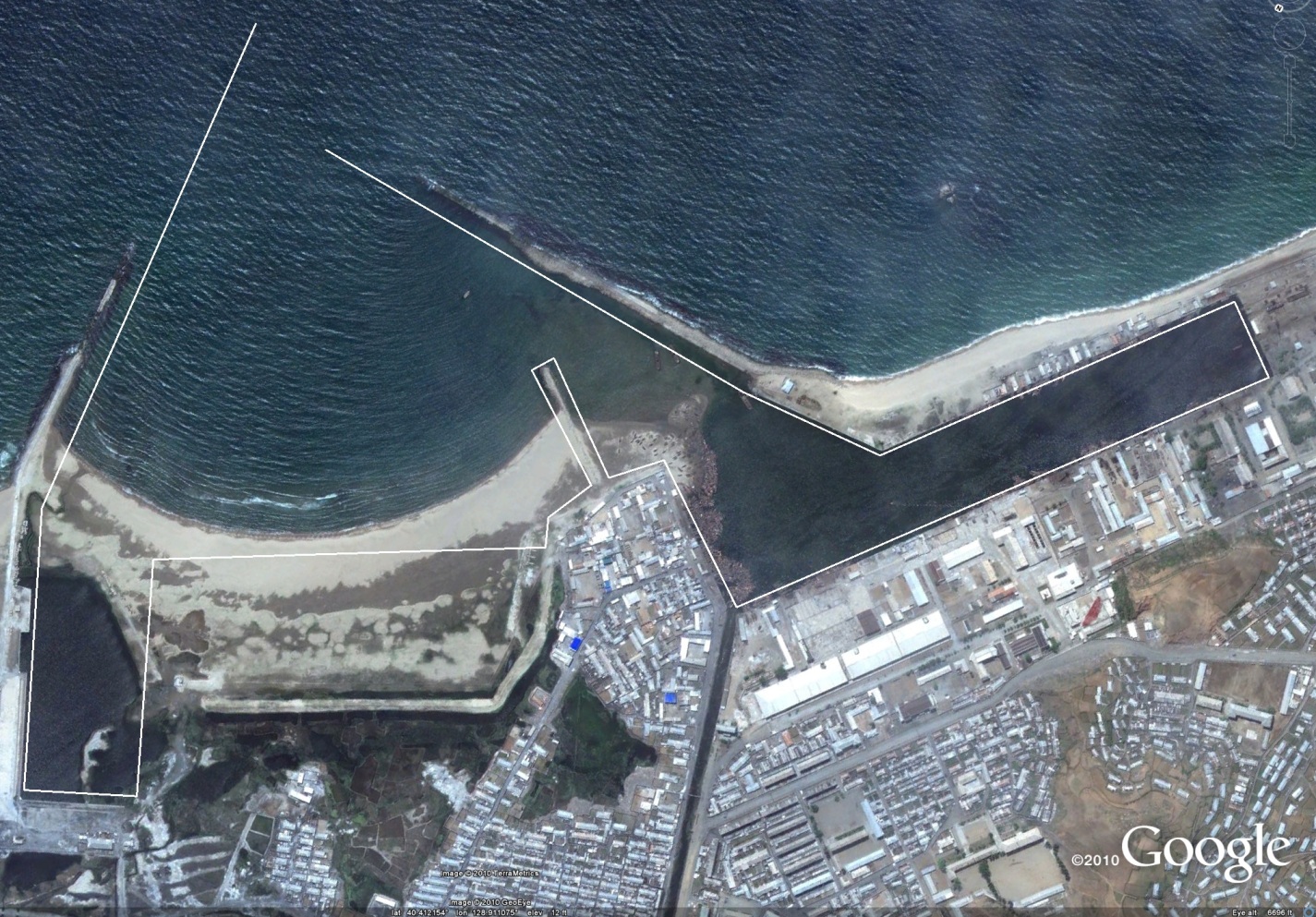
Judging by the satellite imagery of the area on Google Earth, it appears that the project had already begun by May 13, 2009, where we can see concrete blocks ready to be used to extend the jettys (breakwaters). I have outlined the proposed port project on Google Earth imagery below and provided a picture of the completed project from KCTV:
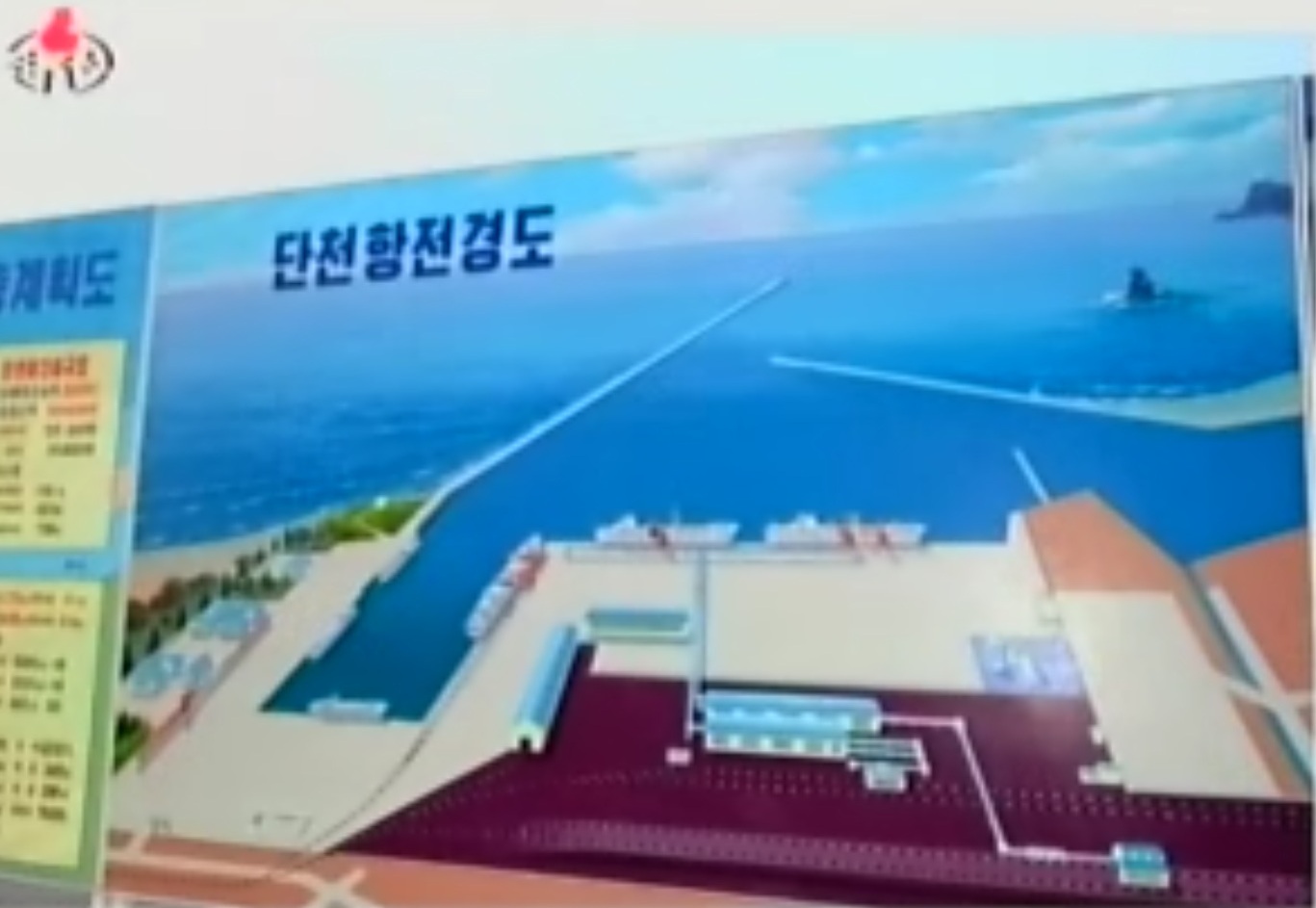
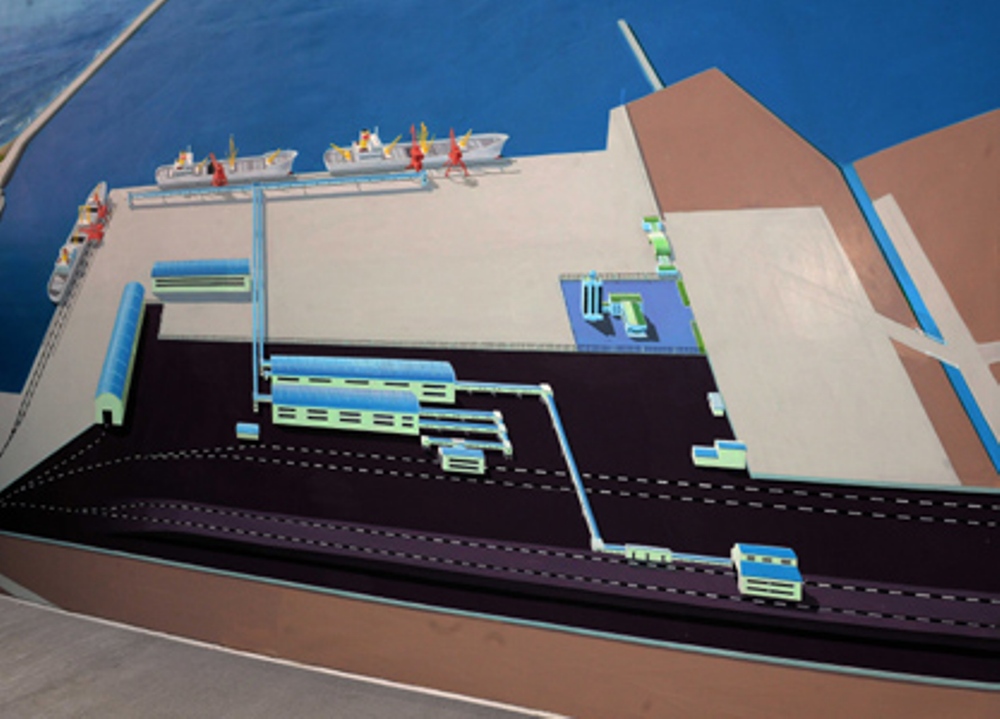
After the jettys are extended, the major construction work and dredging can begin. Below are images of the port’s main construction site as it appears on Google Earth and a prediction of the project’s conclusion from KCNA:
It appears from the picture that the port will be connected to the railway system—likely via the nearby Tanchon Smeltery and Magnesia Plant (both recently renovated) whose products will probably be exported from the port.
Tanchon is also home to the DPRK’s Komdok and Taehung Youth Hero Mines (among others). As is well known to readers, raw materials exports are the DPRK’s most significant (legal and transparent) source of hard currency. According to Yonhap’s North Korea Handbook 2002:
Geomdeok [Komdok] Mine is a special company in Bonsan-dong, Dancheon, South Hamgyeon Province, and is very famous for about 300 million tons of deposited leads and zincs. This mine annually produces 52,000 tons of lead, 124,000 tons of zinc, both of which account for 47% of total production in North Korea, and more than twice as much as the production of Eunpa Mine, North Korea’s second largest mine, in Eunpa-gun North Hwanghae Province. Concentrates of lead and zinc produced from Geomdeok Mine are processed into electric zinc at Dancheon refinery. Opened in 1932, this mine produces 14,200 tons of raw ore annually with three ore dressing plants. Annual production capacity can reach up to 11 million tons. The first dressing plant was completed in July 1953, near the end of the Korean War. It now processes a million tons of ore a year. The second dressing plant was opened with a production capacity of 3,200 tons of ore. The third one constructed in September 1983 can process 10 million tons of ore.
Rice prices in North Korean markets have fallen dramatically after the authorities increased levels of food distribution in major urban areas like Pyongyang and Sinuiju, part of state policy of “normalizing” public distribution. Most people are undecided about the policy, but the reality is that grain has been provided by the state both last month and into this, and this is having an effect on market grain prices.
A Pyongyang source told Daily NK on the 21st, “There was five days of distribution in the first part of last month and ten days in the last part, then a further five days at the start of this month, so rice prices fell. The authorities are saying that they are going to give ten days of distribution per month until September, then normalize it completely after that.”
Ten days of distribution at North Korea’s own mandated levels means 4.5kg for workers and a further 2kg for dependent family members.
“When they first heard about [the policy of distribution normalization] they didn’t believe it, but after getting fifteen days distribution last month and another five days this, people are wondering whether this time it could be different,” the source said. “Even last month most people said ‘this will only last for this month,’ but now they have done it this month as well the number of expectant people is rising.”
The source also revealed data on the drop in market grain prices, saying that at one point the price of rice in Pyongyang had declined from 6500-7000won/kg, the approximate price point since the start of the year, to 4500won. “Although it has since climbed back up through the 5000won barrier, it is holding steady,” she added.
However, “From the middle part of April the price started slowly rising again,” she went on, conjecturing, “If distribution is achieved next month as well then it should stay below 6000won, perhaps even staying at around 4000-5000won.”
Aware that Pyongyang is a unique case in the North Korean context, Daily NK has also been checking conditions in other parts of the country, including along the Sino-North Korean border, and has learned that there has been distribution in the North Pyongan Province city of Sinuiju, the Yangkang Province city of Hyesan, and Heoiryeong and Chongjin in North Hamkyung Province, raising the possibility, which sources have echoed, that distribution is occurring nationwide. All the areas checked by Daily NK have also seen rice prices falling sharply thanks to the state distribution.
One Sinuiju-based source explained the situation there, saying, “As far as I know, the official policy of normalizing distribution is not just for our region but all other regions, too. They recently gave us ten days of rice here, so the price in the jangmadang (market) has fallen below 5000won.”
Sources report that between April 14 and 17 the price of rice has fallen to 5400won in Hyesan, 5100won in Hoiryeong, 5200won in Chongjin, and 5000won in Saebyeol County.
A source from Chongjin explained, “On or around April 10th it was selling for 4800won, but has since gone back over 5000won. They have given distribution but exchange rates are not falling, so if distribution ceases at any point, prices will have to rise again.” The same source noted, however, that in Hyesan prices fell, but when the authorities then stopped importing rice from China, they rose again, reaching 6400won. “Rumor has it that they will allow imports again,” the source noted, “but nobody knows when so prices remain high.”
Read the full story here:
Rice Prices Fall on State Distribution
Daily NK
Kim Yong Hun
2013-4-21
On March 31, KCNA reported on the recent plenary meeting of the Korean Worker’s Party:
The historic March, 2013 plenary meeting of the Central Committee of the Workers’ Party of Korea took place at the building of the WPK Central Committee, supreme staff of the Korean revolution, on Sunday.
First Secretary of the WPK Kim Jong Un guided the meeting.
Present at the meeting were members and alternate members of the WPK Central Committee and members of the Central Auditing Commission of the WPK.
Present there as observers were senior officials of ministries, national institutions, provincial, city and county committees of the WPK, complexes, major munitions factories and enterprises.
The participants paid silent tribute to President Kim Il Sung and leader Kim Jong Il.
Taken up for discussion at the meeting were the following agenda items “1. On tasks of our Party on bringing about a decisive turn in accomplishing revolutionary cause of Juche as required by the present situation and the developing revolution”, “2. On personnel affairs issue to be submitted to the 7th Session of the 12th Supreme People’s Assembly” and “3. On organizational matter”.
Kim Jong Un made a report and concluding speech on the first agenda item.
The plenary meeting set forth a new strategic line on carrying out economic construction and building nuclear armed forces simultaneously under the prevailing situation and to meet the legitimate requirement of the developing revolution.
This line is a brilliant succession and development onto a new higher stage of the original line of simultaneously developing economy and national defence that was set forth and had been fully embodied by the great Generalissimos.
It was stressed at the meeting that the party’s new line is not a temporary countermeasure for coping with the rapidly changing situation but a strategic line to be always held fast to, in the supreme interests of the Korean revolution.
The nuclear weapons of Songun Korea are not goods for getting U.S. dollars and they are neither a political bargaining chip nor a thing for economic dealings to be presented to the place of dialogue or be put on the table of negotiations aimed at forcing the DPRK to disarm itself.
The DPRK’s nuclear armed forces represent the nation’s life which can never be abandoned as long as the imperialists and nuclear threats exist on earth. They are a treasure of a reunified country which can never be traded with billions of dollars.
Only when the nuclear shield for self-defence is held fast, will it be possible to shatter the U.S. imperialists’ ambition for annexing the Korean Peninsula by force and making the Korean people modern slaves, firmly defend our ideology, social system and all other socialist treasures won at the cost of blood and safeguard the nation’s right to existence and its time-honored history and brilliant culture.
When the party’s new line is thoroughly carried out, the DPRK will emerge as a great political, military and socialist economic power and a highly-civilized country which steers the era of independence.
The meeting set forth tasks for carrying out the new line and ways for doing so.
All the officials, party members and other people should wage bold offensive and all-people decisive battle with faith in sure victory and strong determination and thus make the flame of miracle and innovation sweep all fields of national economy.
The pilot fields of the national economy, the basic industrial fields should be drastically developed and production be increased to the maximum. Forces should be directed to agriculture and light industry, key fields in building an economic power to improve and put on a stable basis the people’s living standard at the earliest possible date.
The self-reliant nuclear power industry should be developed and the work for developing light water reactor be dynamically promoted to actively contribute to easing the strain on the electricity problem of the country.
Spurs should be given to the development of space science and technology and more advanced satellites including communications satellites be developed and launched.
The country’s economy should be shifted into knowledge-based economy and the foreign trade be made multilateral and diversified and investment be widely introduced.
The economic guidance shall be fundamentally improved as required by the new situation and Korean-style advantageous economic management methods be completed by embodying the Juche idea.
The DPRK’s possession of nukes should be fixed by law and the nuclear armed forces should be expanded and beefed up qualitatively and quantitatively until the denuclearization of the world is realized.
The People’s Army should perfect the war method and operation in the direction of raising the pivotal role of the nuclear armed forces in all aspects concerning the war deterrence and the war strategy, and the nuclear armed forces should always round off the combat posture.
As a responsible nuclear weapons state, the DPRK will make positive efforts to prevent the nuclear proliferation, ensure peace and security in Asia and the rest of the world and realize the denuclearization of the world.
Institutions in charge of security and safeguard, judicial and prosecution and people’s security and the Korean People’s Internal Security Forces should resolutely foil the vicious moves of the imperialist reactionaries and class enemies, devotedly defend the party, social system and people and surely guarantee the new line of the party with arms and by law.
The party and working people’s organizations and power bodies should increase their militant function and role in every way in the struggle for implementing the party’s line.
The meeting entrusted the Presidium of the SPA and the Cabinet with the matters of taking legal, administrative and technical measures for implementing the tasks.
At the meeting a decision on the first agenda item “On carrying out economic construction and building nuclear armed forces simultaneously and thus bringing earlier the final victory in the cause of building a thriving socialist nation” was adopted with unanimous approval.
The second agenda item, personal affairs issue to be submitted to the 7th Session of the 12th SPA, was discussed and decided at the meeting.
The meeting also dealt with an organizational matter, its third agenda item.
Members of the Presidium of the Political Bureau of the WPK Central Committee, members and alternate members of the Political Bureau were recalled and new ones were elected to fill vacancies.
Pak Pong Ju was elected to fill a vacancy of a member of the Political Bureau of the WPK Central Committee.
Hyon Yong Chol, Kim Kyok Sik and Choe Pu Il were elected to fill vacancies of alternate members of the Political Bureau of the WPK Central Committee.
Members and alternate members of the WPK Central Committee were recalled and new ones were elected to fill vacancies.
Upon authorization of Kim Jong Un, Paek Kye Ryong was appointed as director of the Light Industrial Department of the WPK Central Committee and Yun U Chol as editor-in-chief of Rodong Sinmun, organ of the WPK Central Committee.
Members of the Central Auditing Commission of the WPK were also recalled and new ones were elected to fill vacancies.
Central Committee of the Workers’ Party of Korea Stresses Development of Agricultural, Light, and Nuclear Industries
Institute for Far Eastern Studies (IFES)
2013-4-4
The Korean Central News Agency (KCNA) reported on March 31 that a plenary meeting of the Central Committee of the ruling Workers’ Party of Korea was held. At the meeting, a new strategic line was announced to have been set, which called for building a stronger economy and nuclear arsenal. This meeting is drawing attention as it is suspected that Pyongyang will pursue a new economic policy.
The news described the new strategic line as, “most revolutionary and people oriented policy for the construction of a powerful socialist nation by consolidating defense capacity through development of defensive nuclear weapons and economic construction.”
It stressed that this policy is significant as a “creative and parallel policy for defense and economy continuing the policies of Kim Il Sung and Kim Jong Il, which must be adopted as a permanent strategy.”
At the plenary meeting, the main agendas for the parallel policy of economy and defense were announced as: 1) Improvement of the production of people’s economy and capacity enhancement for agricultural and light industries to stabilize prices to improve the lives of the people; 2) development of self-reliant nuclear power industry and light water reactors; 3) development and launch of more satellites including communication satellites through advancement in space science and technology; 4) transition to knowledge economy and diversification of foreign trade to vitalize foreign investments; and 5) establish legislation to be recognized as a nuclear state and develop nuclear arsenal both in quantity and quality until denuclearization is realized worldwide.
At the plenary, the new parallel policy was commended, “The supremacy of the policy is demonstrated by expanding capability in war deterrence and national defense without increasing defense budget and enabled concentration on economic development and improvement of the lives of the people.”
The statement released by the KCNA stated that the plenary meeting’s emphasis on transition to knowledge economy and diversification of foreign trade as the main tasks and appears to be pursuing a “fundamental improvement in economic leadership.”
In addition, the plenary assigned the presidium of the Supreme Peoples’ Assembly and the Cabinet to serve as the economic control tower to oversee the future projects decided at the plenary meeting.
North Korea is continuing to place emphasis on light and agricultural industries. The Kim Jong Un regime entered its second year. The leader was reported to have attended the light industry conference, which was held for the first time in ten years and underscored the importance of concentrating on development of the capacity of light industry.
The new Korean line, 병진 (Pyongjin, Byungjin) is the simultaneous development of nuclear weapons and the economy. Learn more about it here.
Following the central committee plenary meeting, the 7th Session of the 12th Supreme People’s Assembly was held. According to KCNA:
The Seventh Session of the 12th Supreme People’s Assembly (SPA) of the DPRK took place at the Mansudae Assembly Hall Monday.
Kim Jong Un, first secretary of the Workers’ Party of Korea, first chairman of the National Defence Commission of the DPRK and supreme commander of the Korean People’s Army, was present at the session.
Present there were deputies to the SPA.
Also present there as observers were officials of party, armed forces and power bodies, public organizations, ministries and national institutions and those in the fields of science, education, literature and art, public health and media.
All the participants observed a moment’s silence in memory of President Kim Il Sung and leader Kim Jong Il in humblest reverence.
The session decided the following agenda items of the Seventh Session of the 12th SPA of the DPRK:
1. On amending and supplementing some contents of the Socialist Constitution of the DPRK
2. On adopting the DPRK Law on the Kumsusan Palace of the Sun
3. On adopting the ordinance of the SPA of the DPRK “On Consolidating the Position of Nuclear Weapons State for Self-Defence”
4. On adopting the DPRK Law on Developing Space
5. On adopting the decision of the SPA of the DPRK “On Setting up the DPRK State Space Development Bureau”
6. On the work of the DPRK Cabinet for Juche 101 (2012) and its tasks for Juche 102 (2013)
7. On the review of the fulfillment of the DPRK’s state budget for Juche 101 (2012) and state budget for Juche 102 (2013)
8. Organizational matter
The session discussed the first and second agenda items.
Deputy Kim Yong Nam, president of the Presidium of the DPRK SPA, made a report on amendment and supplement to some contents of the Socialist Constitution of the DPRK and on adopting the law on the Kumsusan Palace of the Sun.
Then followed speeches on the first and second agenda items.
Deputy Kim Ki Nam, secretary of the WPK Central Committee, spoke on behalf of the WPK, Deputy Choe Ryong Hae, director of the General Political Bureau of the KPA, on behalf of the KPA and Deputy Jon Yong Nam, chairman of the C.C., the Kim Il Sung Socialist Youth League, on behalf of the youth.
The speakers fully supported and approved of deliberation and adoption of the draft amendment and supplement to the Socialist Constitution of the DPRK and the law on the Kumsusan Palace of the Sun at the current SPA session reflecting the unanimous feelings of all party members, service personnel and youth across the country.
The ordinances of the SPA of the DPRK “On Amending and Supplementing Some Contents of the Socialist Constitution of the DPRK” and “On Adopting the DPRK Law on the Kumsusan Palace of the Sun” were adopted at the session with the approval of all deputies.
The session discussed the third, fourth and fifth agenda items.
The ordinances of the SPA of the DPRK “On Consolidating the Position of Nuclear Weapons State for Self-Defence” and “On Adopting the DPRK Law on Developing Space” and the decision of the SPA of the DPRK “On Setting Up the DPRK State Space Development Bureau” were adopted at the session with the approval of all deputies.
Deputy Choe Yong Rim, premier of the Cabinet, made a report on the sixth agenda item.
Deputy Choe Kwang Jin, minister of Finance, made a report on the seventh agenda item.
Then followed speeches on the sixth and seventh agenda items. Written speeches were presented at the session.
The speakers noted that the Cabinet work and the fulfillment of the state budget for last year were correctly reviewed and summed up, clear tasks of the Cabinet were set forth to meet the requirements of the general offensive to open an epochal phase in building an economic power at the final stage of the all-out action against the U.S. and the state budget was correctly shaped. They expressed full support and approval of them.
They expressed their determination to reenergize the overall economy of the country, step up the grand advance for improving the standard of people’s living to make loud shouts of hurrah for the Workers’ Party and socialism heard this year marking the 65th anniversary of the DPRK and the 60th anniversary of the victory in the Fatherland Liberation War, true to the historic New Year Address of Kim Jong Un and the decision of the March, 2013 plenary meeting of the WPK Central Committee.
The decision of the SPA of the DPRK “On Approval of the Report on the Work of the DPRK Cabinet and the Review of the Fulfillment of the State Budget for Juche 101 (2012)” and the ordinance of the SPA of the DPRK “On the DPRK’s State Budget for Juche 102 (2013)” were adopted at the session with the approval of all deputies.
The session discussed the organizational matter.
At the session Deputy Choe Yong Rim was recalled from the post of premier of the DPRK Cabinet and Deputy Pak Pong Ju was elected premier of the DPRK Cabinet at the proposal of the WPK Central Committee.
Choe Yong Rim was elected honorary vice-president of the Presidium of the DPRK SPA.
Deputies Kim Jong Gak and Ri Myong Su were recalled from the posts of member of the DPRK National Defence Commission (NDC) due to the transfer to other jobs.
Deputies Kim Kyok Sik and Choe Pu Il were elected members of the DPRK NDC to fill vacancies at the proposal of the WPK Central Committee and the WPK Central Military Commission.
Deputy Thae Hyong Chol was recalled from the post of secretary general of the Presidium of the DPRK SPA and Deputy Hong Son Ok was elected secretary general of the Presidium of the DPRK SPA.
Some members of the Cabinet were relieved of their posts and appointed at the session.
Deputy Pak Pong Ju, premier of the DPRK Cabinet, took an oath at the SPA.
KCNA also issued several reports that stemmed from the SPA meeting:
Report on Adopting Draft Amendment and Supplement to Socialist Constitution and Law on Kumsusan Palace of Sun
Pyongyang, April 1 (KCNA) — Kim Yong Nam, president of the Presidium of the Supreme People’s Assembly, made a report on adopting the draft amendment and supplement to the Socialist Constitution of the DPRK and the law on the Kumsusan Palace of the Sun.
According to the report, the draft amendment and supplement to the Socialist Constitution and the law on the Kumsusan Palace of the Sun to be submitted to the session for discussion will legalize the plan and intention of the Workers’ Party of Korea to fix by law the shining achievements made in accomplishing the cause of perpetuating the memory of the leaders and complete it on a new higher stage.
To be supplemented to the preface of the Socialist Constitution is the sentence which says that the Kumsusan Palace of the Sun where President Kim Il Sung and leader Kim Jong Il lie in state is a grand edifice for the immortality of the leaders, a symbol of the dignity of the whole Korean nation and its eternal sacred temple.
The law on the Kumsusan Palace of the Sun specifies that its noble mission is to preserve and glorify forever the palace, which is the supreme temple of Juche, as the eternal temple of the sun of the entire Korean nation.
The law stipulates that Kim Il Sung and Kim Jong Il will be held in high esteem forever as in their lifetime at the Kumsusan Palace of the Sun and that it is the obligation of all the Koreans to regard the Palace as a symbol of dignity and a great pride of the nation.
It also specifies the state duty to spruce up the Palace in a sublime and perfect way with the state, all-people and nationwide efforts and devotedly safeguard the Palace in every way so that no one can violate.
Also stipulated in the law are matters for carrying out the work of eternally preserving the Palace as the most important state work with consistency, organizing the committee for the eternal preservation of the Palace and preserving for photos, train coaches, cars, boat and other relics and orders which represent the noble lives of the great Generalissimos.
Orders were also set so that Korean people, overseas Koreans and foreigners can pay respects to the great Generalissimos at the Kumsusan Palace of the Sun.
Also mentioned in the law are the matters of establishment of special sanctuary of the Palace for its protection and management as well as the management of buildings in the premise of the palace, park, arboretum, outdoor lighting and lighting facilities and orders concerning the operation of the plaza and the park of the Palace.
It was specified in the law that electricity, facilities, materials and other supplies needed for the Palace shall be planned separately and be provided without fail on a top priority basis. The law also set the duty to be fulfilled by relevant institutions to strictly supervise and control on a regular basis the work for safeguarding, eternally preserving and providing the conditions for the management and operation of the Palace.
The reporter said that the law on the Kumsusan Palace of the Sun is the unique code for the immortality of the leaders, adding that it is the biggest honor for the army and people of the DPRK to have the legal weapon for the immortality of the leaders.
The adoption of the law will serve as a historic occasion for defending and further glorifying the idea on perpetuating the memory of the leaders clarified by the dear respected Kim Jong Un, he stressed.
The reporter said that the Presidium of the Supreme People’s Assembly of the DPRK submits the draft amendment and supplement to the Socialist Constitution and the draft law on the Kumsusan Palace of the Sun to the SPA session for discussion according to Article 95 of the Socialist Constitution.
And…
DPRK’s Law on Kumsusan Palace of Sun Adopted
Pyongyang, April 1 (KCNA) — The DPRK’s Law on the Kumsusan Palace of the Sun was adopted.
The ordinance of the DPRK Supreme People’s Assembly on it was promulgated Monday.
The Kumsusan Palace of the Sun where President Kim Il Sung and leader Kim Jong Il lie in state is the
eternal temple of the sun of the whole Korean nation.
The ordinance says that the SPA decides to adopt this law to eternally preserve and glorify forever the
Kumsusan Palace of the Sun as a grand edifice for the immortality of the leaders symbolic of Kim Il Sung’s and Kim Jong Il’s Korea.
And…
Law on Consolidating Position of Nuclear Weapons State Adopted
Pyongyang, April 1 (KCNA) — A law on consolidating the position of nuclear weapons state for self-defence was adopted in the DPRK.
An ordinance of the Supreme People’s Assembly of the DPRK in this regard was promulgated on Monday.
The ordinance said as follows:
The DPRK is a full-fledged nuclear weapons state capable of beating back any aggressor troops at one strike, firmly defending the socialist system and providing a sure guarantee for the happy life of the people.
Having an independent and just nuclear force, the DPRK put an end to the distress-torn history in which it was subject to outside forces’ aggression and interference and could emerge a socialist power of Juche which no one dares provoke.
The Supreme People’s Assembly of the DPRK decides to consolidate the position of the nuclear weapons state as follows:
1. The nuclear weapons of the DPRK are just means for defence as it was compelled to have access to them to cope with the ever-escalating hostile policy of the U.S. and nuclear threat.
2. They serve the purpose of deterring and repelling the aggression and attack of the enemy against the DPRK and dealing deadly retaliatory blows at the strongholds of aggression until the world is denuclearized.
3. The DPRK shall take practical steps to bolster up the nuclear deterrence and nuclear retaliatory strike power both in quality and quantity to cope with the gravity of the escalating danger of the hostile forces’ aggression and attack.
4. The nuclear weapons of the DPRK can be used only by a final order of the Supreme Commander of the Korean People’s Army to repel invasion or attack from a hostile nuclear weapons state and make retaliatory strikes.
5. The DPRK shall neither use nukes against the non-nuclear states nor threaten them with those weapons unless they join a hostile nuclear weapons state in its invasion and attack on the DPRK.
6. The DPRK shall strictly observe the rules on safekeeping and management of nukes and ensuring the stability of nuclear tests.
7. The DPRK shall establish a mechanism and order for their safekeeping and management so that nukes and their technology, weapon-grade nuclear substance may not leak out illegally.
8. The DPRK shall cooperate in the international efforts for nuclear non-proliferation and safe management of nuclear substance on the principle of mutual respect and equality, depending on the improvement of relations with hostile nuclear weapons states.
9. The DPRK shall strive hard to defuse the danger of a nuclear war and finally build a world without nukes and fully support the international efforts for nuclear disarmament against nuclear arms race.
10. The related institutions shall take thorough practical steps for implementing this ordinance.
And…
DPRK Law on Developing Space Adopted
Pyongyang, April 1 (KCNA) — The Law on Developing Space was adopted in the DPRK.
The ordinance of the DPRK Supreme People’s Assembly on it was promulgated Monday.
And…
DPRK SPA Decides to Set Up State Space Development Bureau
Pyongyang, April 1 (KCNA) — The DPRK decided to set up the State Space Development Bureau.
The decision of the Supreme People’s Assembly (SPA) of the DPRK promulgated on Monday said:
The DPRK is a full-fledged satellite manufacturer and launcher.
It is an invariable stand of the DPRK to develop the country into a world-class space power by exercising its legitimate right to space development for peaceful purposes.
To step up economic construction and improve the people’s standard of living by radically developing the space science and technology of the country and guide and manage all the space activities of the DPRK in a uniform way, the SPA decides as follows:
1. The DPRK State Space Development Bureau shall be set up.
2. The bureau is a state central institution which guides and manages the supervision and control over the working out of a space development program and its implementation and space development work in a uniform way.
3. The Cabinet of the DPRK and other institutions concerned shall take practical measures to implement this decision.
And…
Work of Cabinet for Last Year and Tasks for This Year
Pyongyang, April 1 (KCNA) — At the 7th Session of the 12th Supreme People’s Assembly held on Monday, Deputy and Premier Choe Yong Rim made a report on the last year’s work of the DPRK Cabinet and this year’s tasks.
According to the report, last year electricity and coal production and the volume of railway freight transport increased amid the endeavors to shore up the four pilot fields of the national economy. Increase was also made in the production of a variety of industrial goods, the report said, and went on:
The Kumsusan Palace of the Sun was remodeled to be the supreme temple of Juche, the National Gifts Exhibition House, Pyongyang Folklore Park, Changjon Street, Rungna People’s Pleasure Park and other big edifices in the era of Songun have been built.
Big industrial projects such as the Huichon Power Station, Tanchon Port, Taedonggang Building Materials Factory were completed and technological updating and modernization of major factories and enterprises in the field of metal, machine, chemical and light industries have been pushed forward, consolidating the material and technological foundation of the national economy.
Satellite Kwangmyongsong 3-2 was successfully manufactured and launched and the third underground nuclear test by the use of smaller and lighter A-bomb of great explosive power was successfully conducted.
The bases for the production of cutting-edge technical goods were built and projects for the development of science and technology have been successfully carried out and the modernization of the information and communications field have been stepped up.
A law on the enforcement of the universal 12-year compulsory education was promulgated. This paved a wide avenue for consolidating the socialist education system and raising the quality of education.
In the field of health care, a telemedicine service has been successfully introduced. The DPRK’s players glorified the honor of the country at major international sports events including the 30th Olympic Games and other signal achievements were made in the field of cultural construction.
The reporter said that this year’s tasks are to realize at an early date the lifetime desire of President Kim Il Sung and leader Kim Jong Il, who devoted their whole lives to putting the country’s economy on the level of a prosperous and powerful country and to making the people live with no more to desire in the world.
According to the report, this year the Cabinet will organize the economic work with a main emphasis on solving issues arising in the people’s living by shoring up the pilot fields, the basic industrial field, consolidating the springboard for building an economic power and concentrating all efforts on agriculture and light industry while regarding coal industry and metal industry as key fields.
It is necessary to increase the production of coal.
Technological updating and modernization of iron works and steel works will be stepped up while improving the bases for the production of Juche iron which have already been built in the field of metal industry. Strict measures for supplying raw materials and fuel should be taken to increase the production of rolled steel more than 3.5 times as compared with last year and thus meet the need for steel.
The field of railway transport will ease strain on transport by consolidating the material and technical foundation of railways.
The grain production plan for this year should be carried out without condition.
The whole country should make efforts for the reclamation of Sepho Tideland and the construction of stock-breeding bases and thus complete the creation of grassland within this year.
The production should be put at a high rate at major chemical factories and the percentage of locally available raw materials should be significantly increased. The production at mines, factories and enterprises in Tanchon area should be increased and exports be boosted to ensure in a responsible manner funds for improving the people’s living standard.
Big efforts should be directed to the construction of dwelling houses. Wonsan area should turn into a world-level resort and tourist destination and living environment and conditions be improved in provinces, cities and counties.
The state investment in the field of science and technology should be increased and the flame of industrial revolution in the new century be raised so as to bring about a decisive turn in building an economic power by dint of science and technology.
Ultra-modern technological goods of high competitiveness should be massively researched and developed. Scientific and technological issues arising in the technological updating and modernization of the national economy should be satisfactorily solved.
The state investment will be increased in education and the preparations for enforcing the universal 12-year compulsory education system be rounded off within this year and fresh progress be made in education, public health, literature, arts, sports and all other fields of cultural construction.
All the fields and units of the national economy should build under a long-term plan export bases for producing second-stage and third-stage processed goods and finished goods of high competitiveness at international markets by relying on locally available resources and indigenous technology. Latest scientific and technological achievements should be positively introduced to increase the varieties of exports and remarkably raise their quality.
Trade should be made diversified and multilateral while conducting a variety of trade activities. The joint venture and collaboration should be actively promoted and the work for setting up economic development zones be pushed forward.
And…
Review of Fulfillment of State Budget for Last Year and State Budget for This Year
Pyongyang, April 1 (KCNA) — Deputy Choe Kwang Jin, minister of Finance, made a report on the review of the fulfillment of state budget for last year and the state budget for this year at the 7th Session of the 12th Supreme People’s Assembly held on Monday.
According to the report, the state budgetary revenue last year was over-fulfilled by 1.3 percent, an increase of 10.1 percent over the previous year.
The plan for local budgetary revenue was carried out at 113.8 percent.
The state budgetary expenditure was implemented at 99.6 percent, an increase of 9.7 percent over that in the previous year.
44.8 percent of the total state budgetary expenditure for the economic development and improvement of people’s living standard was used for funding the building of edifices to be presented to the 100th birth anniversary of President Kim Il Sung, the consolidation of the material and technological foundation of Juche-based, modern and self-supporting economy and the work for face-lifting the country.
38.9 percent of total expenditure was spent for enforcing popular policies and measures for social culture under socialism such as the universal free compulsory education system, free healthcare, social insurance and social security, recuperation and relaxation systems as well as those for development of literature and art and building of a sports power.
Some of the total state budgetary expenditure went to national defence.
According to the report, this year’s state budgetary revenue and expenditure have been shaped in such a way as keeping the overall economy afloat and bringing about a decisive turn in stabilizing and improving the standard of people’s living.
The state budgetary revenue is expected to increase 4.1 percent over that last year.
Out of this, the transaction tax, main source of budgetary revenue, is expected to grow 3.5 percent, the revenue from the profits of state enterprises 6 percent, revenue from the profits of cooperative enterprises 5.3 percent, the revenue from the depreciation 2.8 percent and revenue from real estate rent 3.4 percent.
In the total state budgetary revenue, national budgetary revenue will account for 83 percent and local budgetary revenue 17 percent.
Provinces, cities and counties are envisaged to ensure expenditure with local import and put a huge amount of fund into national budget.
The state budgetary expenditure is expected to grow 5.9 percent over last year.
It was decided to increase expenditure in the field of coal, electricity, metal and railway transport 7.2 percent, the field of agriculture and light industry 5.1 percent, basic investment in capital construction and big overhaul 5.8 percent, the field of science and technology 6.7 percent, the field of education 6.8 percent, the field of public health 5.4 percent, the field of social insurance and security 3.7 percent, the field of sports 6.1 percent and the field of culture 2.2 percent.
Some of the total state budgetary expenditure will go for national defence.
A large amount of educational aid fund and stipends will be sent for the education of Korean children in Japan to promote the development of the democratic national education of the General Association of Korean Residents in Japan.
The reporter called for working hard to glorify this significant year marking the 65th anniversary of the DPRK and the 60th anniversary of the victory in the Fatherland Liberation War as a year of gigantic creation and innovations, in hearty response to the historic New Year Address by Kim Jong Un and the decision made at the March, 2013 plenary meeting of the WPK Central Committee.
Here is what Yonhap had to say about the DPRK’s defense budget:
North Korea is expected to spend 16 percent of its budget on national defense in 2013, up 0.2 percentage point from the year before, the country’s state media said Tuesday.
According to the Rodong Sinmun, an organ of the North’s ruling Workers’ Party, Finance Minister Choe Kwang-jin reported to a meeting of the Supreme People’s Assembly in Pyongyang on Monday that the money is needed to effectively cope with “indiscriminate” provocations by the United States and its followers.
The paper, however, did not disclose the exact size of the defense budget, although South Korea’s unification ministry speculated that last year’s military budget totaled US$910 million.
The proportion of the spending plan compared to the overall budget, is the highest tallied since 1998, according to South Korean analysts.
From 1998 through 2002, the North is estimated to have spent 14.4 percent to 14.5 percent of its annual budget on defense, with numbers going up and being fixed at 15.8 percent in the 2007-2012 period, they said.
Additional information:
1. Here and here is KCTV footage of the SPA meeting.
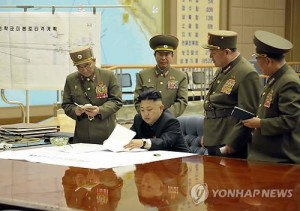
Media coverage of an emergency military meeting convened by North Korean leader Kim Jong-un on Friday shows an overview of its major weapons system, giving a rare glimpse of the isolated communist country’s armed forces.
…
The list shows that North Korea has 40 submarines, 13 landing ships, six minesweepers, 27 support vessels and 1,852 aircrafts [sic], with some of the numbers covered by senior officials.
Military officials in Seoul said the figure is similar to the defense ministry’s estimation of North Korea’s weapons system, though there are some differences.
According to the 2012 defense white paper, the North is estimated to have 70 submarines and midget subs, 260 landing ships, 30 mine sweepers, 30 support vessels, 820 fighter jets, 30 surveillance aircrafts, 330 parachute drop aircrafts and 170 training jets.
While there are some disparities between the list and Seoul’s assessment, the number of midget subs seems to have been excluded from the list disclosed in the photo, military officials said.
As Pyongyang has never disclosed its weapon system in the past, outside watchers speculate that the North Korean military has mistakenly disclosed the confidential information.
“It may have been leaked accidently,” said a senior military official, who asked to remain anonymous. “It could have been unveiled as the North hurriedly reported the emergency meeting.”
Others said the photo may be aimed at stoking tensions by showing that Kim is mulling ways to strike the U.S., considering the operational map that has several lines between the Korean Peninsula and the U.S. Its details were not recognizable in the photo.
The Washington Post has offered some additional data in a follow up article on 4-25-2013:
South Korea says North Korea has more than 13,000 artillery guns, and its long-range batteries are capable of hitting the capital Seoul, a city of more than 10 million people just 30 miles (50 kilometers) from the border.
“North Korea’s greatest advantage is that its artillery could initially deliver a heavy bombardment on the South Korean capital,” Mark Fitzpatrick, a former U.S. State Department official now with the International Institute for Strategic Studies, said in an email.
South Korea’s defense minister estimates that 70 percent of North Korean artillery batteries along the border could be “neutralized” in five days if war broke out. But Sohn Yong-woo, a professor at the Graduate School of National Defense Strategy of Hannam University in South Korea, said that would be too late to prevent millions of civilian casualties and avert a disastrous blow to Asia’s fourth-largest economy.
…
Seoul estimates North Korea has about 200,000 special forces, and Pyongyang has used them before.
In 1968, 31 North Korean commandos stormed Seoul’s presidential Blue House in a failed assassination attempt against then-President Park Chung-hee. That same year, more than 120 North Korean commandos sneaked into eastern South Korea and killed some 20 South Korean civilians, soldiers and police officers.
In 1996, 26 North Korean agents infiltrated South Korea’s northeastern mountains after their submarine broke down, sparking a manhunt that left all but two of them dead, along with 13 South Korean soldiers and civilians.
…
North Korea has 70 submarines while South Korea has 10, according to Seoul’s Defense Ministry. The most menacing threats from the North’s navy are small submarines that would deposit commando raiders along the South Korean coast, said John Pike, head of the Globalsecurity.org think tank.
North Korea also has 820 warplanes, more than South Korea, though Seoul is backed up by American air power. The South says most of the North’s aircraft are obsolete. North Korea also suffers chronic fuel shortages that have forced its air force to cut sorties, experts say.
“North Korea would not be able to prosecute a full-fledged war for very long,” Fitzpatrick said. “Its biggest problem is that North Korea would quickly lose control of the skies because of the vastly superior (South Korean) and U.S. air forces. The reported number of North Korean aircraft is meaningless, because many of them cannot fly, and North Korean pilots have little training in the air.”
…
Pyongyang is believed to have enough weaponized plutonium for four to eight nuclear bombs, according to Siegfried Hecker, a nuclear expert with Stanford University’s Center for International Security and Cooperation.
But he doubts Pyongyang has mastered the technology to tip a missile with a nuclear warhead. “I don’t believe North Korea has the capacity to attack the United States with nuclear weapons mounted on missiles and won’t for many years,” he said on the website of Stanford University’s Freeman Spogli Institute for International Studies this month.
…
orth Korea denies it runs any chemical and biological weapons programs. South Korea claims that Pyongyang has up to 5,000 tons of chemical weapons.
The IISS says that although the figures are “highly speculative,” the North probably does possess chemical and biological arms programs.
“Whatever the actual status of North Korea’s chemical and biological capabilities, the perception that it has, or likely has, chemical and biological weapons contributes to Pyongyang’s interest in creating uncertainties in Washington, Seoul and Tokyo and raises the stakes to deter or intimidate potential enemies,” it said on its website. North Korea is not a signatory to the Chemical Weapons Convention, but it has acceded to the non-binding Biological and Toxin Weapons Convention.
Read the full stories here:
N. Korea’s photo offers glimpse of major weapons Yonhap
Kim Eun-jung
2013-3-29
A look at the strengths and weaknesses of North Korea’s military
Washington Post (Associated Press)
2013-4-25
North Korea revised its trade and customs laws last year to give its cabinet more power over the economy, a copy of the revised laws showed Monday.
The booklet on North Korea laws concerning external economic activities, secured by Yonhap News Agency, showed that the country revised its trade laws in April last year, a first since the previous revision in March 2007.
The revision newly requires trade institutions and other sub-trade groups to have their monthly plans reviewed and approved by the central trade supervision agency, according to the copy of the booklet.
The country’s customs law, also revised in April 2012, indicate that the government has increased its supervision of the customs sector compared with 2007 when the corresponding law was last modified.
The government is also said to be seeking to foster customs specialists and establish an ad hoc committee to review customs affairs.
Analysts said the latest law change suggests that the cabinet’s role in the economic sector has been enhanced compared to the military, which is known to have exerted a strong hold over state affairs reflecting late leader Kim Jong-il’s military-first ideology.
The timing of the revision coincides with incumbent leader Kim Jong-un’s emphasis on the importance of the cabinet in leading national policies. Kim Jong-un took power after the sudden death of his father in late 2011.
“North Korea’s trimming of the trade and customs laws indicates its intention to fasten up the central (government’s) previously loose supervision of trade and customs affairs,” said Im Eul-chul, a research professor of Far Eastern Studies at Kyungnam University. “It is also related with strengthening the role of the cabinet in the economic sector.”
The monthly management of trade performance, envisioned in the revision, reflects the leader’s plan to boost the trade sector as a means of earning more foreign currency, local experts also said. The military’s and the governing Workers’ Party of Korea’s tight hold on economic affairs are widely believed to have posed obstacles in the country’s economic performance.
The booklet, meanwhile, showed that the country rewrote its immigration law last April, doing away with the clause requiring state permission for foreign travelers wanting to travel outside of the capital of Pyongyang. Such a move could allow more freedom of movement by foreign tourists inside the communist country.
Read the full story here:
NK trade-cabinet
Yonhap (Via Global Post)
2013-3-18
North Korea is emphasizing the importance of science and technology in the agricultural sector.
The Rodong Sinmun, the official newspaper of the Workers’ Party of Korea (WPK), recently featured an article written by Ri Yong Gu, director of the Ministry of Agriculture, titled “Key Issues to Pay Attention for Introducing Technology Products in Farming Operations.” The article emphasized the importance of science and technology in the WPK’s policies and claimed technology products, such as farm machineries, fertilizer, pesticides, and soil conditioners must be introduced to promote agricultural production.
In addition, the article called for accurate assessment of economic benefits to be gained by introduction of technology products and for evaluation of scientists, technicians, and farmers to mobilize the public and to integrate science and technology with production in all units of the agricultural sector.
Technology products were explained as an important factor for reducing agricultural production costs, making crucial the selection of appropriate technology based on the experience and skill level of farmers and soil conditions of each farm.
Choson Sinbo, the Japan-based pro-North Korean newspaper, featured an article on February 27 that scientific farming methods were incorporated in the Samji River Collaborative Farm that linked with the Center for Agricultural and Technology Dissemination through a computer network.
It is not new for North Korea to emphasize the use of science and technology in agriculture; however, in recent years, more emphasis is being placed on this factor.
In the 2013 New Year’s speech by North Korean leader Kim Jong Un, agricultural and light industries were named as the frontline industries for economic construction. In the speech, Kim stressed that “incorporating science and technology into agricultural production and increasing the level of integration must be accomplished in order to reach wheat production target for this year.”
In time for rice planting season in May, North Korea is hoping to increase fertilizer production and to promote agricultural technology in order to boost production countrywide.
This emphasis is in line with the successful launch of the long-range rocket launch last December, preferential atmosphere toward scientists, and promotion of science and technology in the economic sector.
Increased grain production last year may be due to improved fertilizer supply. Production is expected to improve this year as scientific farming continues to be emphasized.
The tiny South Pacific island nation of Kiribati issued passports to North Korean businessmen until 2004 as a “means of generating revenue,” its president has admitted.
There had been speculation for some time that North Koreans engaged in illicit activities such as arms deals were illegally obtaining passports from small countries.
Appearing recently on Australian radio, Kiribati President Anote Tong said he was embarrassed that the passports were reportedly related to international crime. “I can assure you that we had corrected that situation in 2004 when we stopped issuing these passports,” he said.
Late last year, a Japanese activist group said two agents from North Korea, Han Chol [한철] and Ju Ok-hui [주억희), used passports issued by Kiribati and the Seychelles.
They are board members of North Korea’s Tongsin International Trading Corporation, an agency suspected of illegally exporting weapons to Burma and other countries, the group added.
Both Han and Ju were given passports by the Kiribati government in 1996 and by the Seychelles in 2007. The countries reportedly sold passports to foreign businessmen but abandoned the practice due to mounting worries about illicit activities.
A Foreign Ministry official in Seoul said, “Kiribati has been neutral since it won independence from the U.K. in 1979. “It would have been easier for the North Korean agents to travel with those passports rather than with North Korean ones.”
Read the full story here:
South Pacific Island Admits Selling Passports to N.Koreans Choson Ilbo
2013-3-13
Treasury Sanctions Bank and Official Linked to North Korean Weapons of Mass Destruction Programs 3/11/2013
WASHINGTON – To impede North Korea’s ballistic missile and weapons of mass destruction (WMD) programs, the U.S. Department of the Treasury today designated the Foreign Trade Bank (FTB), North Korea’s primary foreign exchange bank, pursuant to Executive Order (E.O.) 13382, which targets proliferators of weapons of mass destruction (WMD) and their supporters. Treasury is also designating Paek Se-Bong, the chairman of North Korea’s Second Economic Committee (SEC) under E.O. 13882.
North Korea’s nuclear and missile proliferation activities violate the UN Security Council regime, comprised of resolutions 1718 (2006), 1874 (2009), 2087 (2013), and 2094 (2013), destabilize the region, and undermine the global nonproliferation regime. The international community has condemned North Korea’s WMD proliferation activity, most recently in last week’s UN Security Council Resolution 2094. Today’s designations of FTB and a senior member of the North Korean government linked to the DPRK missile program, follow actions taken March 7, 2013 by the Treasury Department against China-based representatives of the Korea Mining Development Corporation (KOMID) and Tanchon Commercial Bank (TCB).
“North Korea uses FTB to facilitate transactions on behalf of actors linked to its proliferation network, which is under increasing pressure from recent international sanctions. The United States will take strong measures to protect its financial system from this type of illicit activity, and we urge financial institutions around the world to be particularly wary of the risks of doing business with FTB,” said Under Secretary for Terrorism and Financial Intelligence David S. Cohen.
The U.S. Department of State is today also designating Pak To-Chun, Chu Kyu-Chang, and O Kuk-Ryol. To view the release, click here.
By designating FTB, the Treasury Department is targeting a key financial node in North Korea’s WMD apparatus, and cutting it off from the U.S. financial system. FTB is a state-owned bank established in 1959. FTB acts as North Korea’s primary foreign exchange bank and has provided key financial support to the Korea Kwangson Banking Corporation (KKBC). KKBC was designated under E.O. 13382 in August 2009 for providing financial services in support of the previously designated entities TCB and the Korea Hyoksin Trading Corporation (Hyoksin). Hyoksin used its connections to KKBC to purchase dual-use equipment in 2008.
FTB has also facilitated millions of dollars in transactions that have benefited KOMID—North Korea’s premier arms dealer—and its financial arm, TCB. North Korea’s Second Economic Committee oversees the production of North Korea’s ballistic missiles and directs the activities of KOMID. TCB, KOMID and Hyoskin were designated by the UNSCR 1718 Committee in April 2009.
Paek Se-Bong is the chairman of the SEC. The SEC, which oversees the production of North Korea’s ballistic missiles and directs the activities of KOMID, was previously designated by the U.S. State Department in August 2010. Paek Se Bong is also an alternate member of the Central Committee of North Korea’s Workers Party and a member North Korea’s National Defense Commission.
This designation generally prohibits transactions between the designees and any U.S. person, and freezes any assets they may have under U.S. jurisdiction.
Identifying information:
Name: Foreign Trade Bank of the Democratic People’s Republic of Korea
AKA: North Korea’s Foreign Trade Bank
Location: FTB Building, Jungsong-dong, Central District, Pyongyang, North Korea
SWIFT/BIC: FTBD KP PY
Name: Paek Se-Bong
AKA: Paek Se Pong
DOB: 21 March 1938
Title: Chairman, Second Economic Committee
The number of North Korean made products is increasingly on the rise at North Korean department stores. Reportedly, 70 percent of the merchandise on the shelves in North Korea’s largest department store, Pyongyang Department Store No. 1, is North Korean made.
Japan-based pro-North Korean newspaper Choson Sinbo reported on February 13 that the bestselling item is apple juice made from the Taedong River Combined Fruit Farm, sold from the kiosk located on the first floor of Pyongyang Department Store No. 1. Sonhung Food Factory products, especially bread and confectionaries, are also said to be very popular.
The newspaper commented that the regularly held product exhibition shows at the department store have created competitive environment for local factories and companies and contributed to the production of high-quality products. They also emphasized that exhibition of products began on account of recommendations of the former North Korean leader, Kim Jong Il.
It further added, “The product exhibition invites participation from light industry factories and enterprises and its affiliated units from central and regional areas as well as department stores in Pyongyang and general stores that sell industrial products.” It commended the expos to be well received by the local people for filling the shelves with local products.
The first exhibition began in December 2010, and the second and third exhibitions were held in July 2011 and January 2012, respectively. Selling of Taedong River Combined Fruit Farm products began from the third exhibition.
In an interview with Choson Sinbo, Kim Miyoung, commerce director of Pyongyang Department Store No. 1, said the following: “Employees of the department stores and our patrons never imagined a day like this would come where our department store shelves are filled with North Korea made products, especially when we were going through the difficult economic times.”
The news also reported the opening of North Korea’s first 24-hour pharmacy. Pyongsu Pharmaceutical, a joint venture company between North Korea and Switzerland, has claimed to have opened North Korea’s first 24-hour pharmacy, called Taedongmun Pharmacy, in Pyongyang last August. Pyongsu pharmaceutical joint venture company was established from September 2004 between InterPacific Group of Switzerland and Pyongyang Pharmaceutical Factory under the Ministry of Health of the DPRK. They both produce and sell pharmaceutical products in Pyongyang. Its homepage introduces nine operating pharmacies in Pyongyang. (See Pyongsu’s website for details: www.pyongsu.com.)
The first pharmacy by Pyongsu was built near the Pyongyang’s Arch of Triumph in 2006 and expanded the number of pharmacy to nine, including the Taedongmun Pharmacy. In addition, Kangan Pharmacy was highlighted in its website, boasting that all the pharmacists working at this pharmacy are graduates of Kim Il Sung University. It also boasts that it is the first pharmacy to have been equipped with blood testing equipment.