Archive for the ‘South Korea’ Category

Unification Ministry Lax in North Korean Aid Monitoring

Wednesday, July 11th, 2007

Donga
7/11/2007

When natural hazards like floods occur in North Korea, the South Korean government sends “humanitarian assistance.” But it has turned out that the government failed to monitor whether the emergency relief aid was being used appropriately.

The government spent 221 billion won (229 million dollars) from August last year to June this year to help North Korea repair damage from last July’s flood. But the Ministry of Unification said on July 10 that the after-monitoring of its use has not yet started.

After a massive flood hit North Korea last year, the ministry announced a plan to send relief aid to the North. At that time, the ministry pledged to visit the affected areas from time to time and see whether the sent items are used for the right purposes. The pledge has not yet been delivered.

The items that the government sent to Pyongyang via the Korean Red Cross include: 100,000 tons of rice, 100,000 tons of cement, 5,000 tons of iron reinforcing rods, 210 relief machines, 80,000 blankets, 10,000 emergency kits, and medicines.

“While sending the relief aid, Pyongyang conducted the nuclear test, so we had to stop; assistance was resumed this year. Due to this change in schedule, it was difficult for us to monitor the use of the aid. We will continue to negotiate with the North regarding field monitoring and access to their rationing lists,” said one official at the unification ministry.

However, many think that the monitoring, in effect, will be of no use, since the rationing of the relief aid might have already been finished.

After a railway station explosion had occurred in Ryongchon in North Pyongan Province in April 2004, the ministry also sent relief aid such as rice and cement. But the monitoring was done one year after the delivery, drawing criticism from the public.

Some point out that we should strengthen the monitoring of our rice aid, which is provided in return for Pyongyang’s scrapping of its nuclear program.

Seoul and Pyongyang made an agreement to visit three places on the east coast and two places on the west coast to oversee the allocation of aid whenever Seoul sends 100,000 tons of rice. The World Food Program, however, has an office in Pyongyang and monitors whether North Korean officials are making disproportionate allocations to the military.

In the meantime, the government sent 10 billion won (10.87 million dollars) worth of road paving materials to help proceed with the Mt. Baekdu tour project planned by Hyundai Asan and the Korea Tourism Organization. However, its usage has not yet been confirmed.

A total of 16,000 tons of materials were sent to the North in August 2005 and March 2006, but Pyongyang has not responded since July last year. Currently, the project is on hold.

“To push the project forward, we are contacting the North via several channels. But because there has not been any response from the North, we are having difficulties,” said one unification ministry official.

Share

Some rice will be sent by rails to Pyongyang

Tuesday, July 10th, 2007

Joong Ang Daily
7/10/2007

South Korea will start sending 50,000 tons of rice aid to North Korea by road next week, as part of its promised loan of 400,000 tons of rice, officials said yesterday.

While 350,000 tons of rice will be delivered by sea, 30,000 tons will be delivered via rail in the west of the Korean Peninsula, and another 20,000 tons will be delivered via an east coast rail line, a Unification Ministry official said.

The two Koreas conducted a historic test of the reconnected railways across the border in mid-May.

South Korea resumed shipping rice aid to North Korea in late June after more than a year’s hiatus, as the North took steps toward nuclear dismantlement. The aid, which consists of 250,000 tons of imported rice and 150,000 tons of domestic rice, will be made over the next five months.

“The rice aid to North Korea via the overland route will be made over five weeks starting next Friday,” the official said.

North Korea is supposed to pay back the $152-million rice loan over 20 years after a 10-year grace period at an annual interest rate of 1 percent.

South Korea resumed shipments of fertilizer and other emergency aid to the North in late March, but withheld the loan of 400,000 tons of rice as an inducement for North Korea to start implementing a landmark agreement reached in the six-nation talks in February.

In early June, inter-Korean ministerial talks ended without tangible results after North Korea protested the South’s decision to withhold rice aid until the North took steps toward nuclear dismantlement.

South Korea suspended all food and fertilizer aid to North Korea after the North conducted missile tests in July.

Resumption of aid was stymied due to the North’s nuclear bomb test last October, but the two sides agreed to put inter-Korean projects back on track in early March. The last rice shipment was made in early 2006.

A poor harvest in 2006, disastrous summer flooding and a 75 percent fall in donor assistance from abroad have dealt severe blows to the impoverished North, according to World Food Program officials.

A recent think tank report said North Korea could run short of up to one-third of the food it needs this year if South Korea and other countries withhold aid. Data from the WFP and the Unification Ministry show that the North will need between 5.24 million tons and 6.47 million tons of food this year.

Share

Gov’t signs contract with refinery SK for fuel oil aid to N. Korea

Tuesday, July 10th, 2007

Yonhap
Sohn Suk-joo
7/10/2007

South Korea has signed a contract with a local refinery to provide heavy fuel oil to North Korea for shipment next week as part of a multilateral aid-for-disarmament deal, the Unification Ministry said Tuesday.

The contract comes on the heels of international nuclear watchdog monitors preparing for entry into the North next week for verification of the North’s shutdown of its nuclear facilities. Reports also said China is planning to host a fresh round of six-party talks on the North’s denuclearization next Wednesday.

“On Monday, the government signed a contract with SK Energy to provide 50,000 tons of heavy fuel oil to North Korea valued at 22.2 billion won (US$22 million),” Unification Ministry spokesman Kim Nam-sik said. The contract includes transportation fees and insurance premiums.

The first shipment of 6,200 tons will be sent to North Korea next Thursday as part of a six-party deal calling for the communist state to take steps to denuclearize in exchange for economic rewards and other incentives.

The date of delivery, originally set for July 14, has been advanced as North Korea is moving to shut down its main nuclear reactor under the Feb. 13 agreement with South Korea, the United States, China, Japan and Russia. The five regional players have engaged North Korea in the six-party nuclear disarmament talks since 2003.

With the earlier than expected oil delivery, South Korea expects that North Korea will accelerate its process of shutting down its nuclear reactor at Yongbyon, about 90 kilometers north of Pyongyang.

North Korea is entitled to one million tons of heavy fuel oil as a reward for a series of steps to shut down and disable its key nuclear facilities. South Korea is responsible for the first shipment of 50,000 tons.

In late June, working-level officials from the two Koreas agreed on the shipping arrangements. The South Korean portion of the aid should be sent within two weeks. The remaining 950,000 tons, to be split equally between the five parties involved in the six-way talks, will be given when the North takes further steps to disarm.

The cost of the aid is to be shouldered equally by the other nations in the six-party talks. But Japan has vowed not to provide any assistance to the North until the decades-old issue of Japanese citizens abducted by Pyongyang is resolved.

Implementation of the February deal had been delayed pending resolution of a banking dispute over US$25 million of the North’s funds that were frozen in a Macau bank. The issue was resolved in June after the money was transferred to Pyongyang with the help of the U.S. and Russian central banks.

Share

Koreas agree to cooperate in light industry sector

Sunday, July 8th, 2007

Korea Herald
7/8/2007

South and North Korea on Saturday agreed on ways to cooperate in light industry and natural resource exploration.

The two Koreas announced they would carry out the written agreement following talks held in the North Korean border city of Gaeseong from Friday, Yonhap News Agency reported.

The talks came as North Korea moves closer to shutting down its main nuclear facilities.

“It took quite a long time for the two sides reach a compromise on prices on a list of items,” a Unification Ministry official said.

In Friday’s overnight talks, North Korea agreed to accept the materials at the price South Korea suggested. The North will pay the costs for transportation, cargo working and demurrage, while the South is to bear all the costs for shipping, insurance and using ports.

The South Korean side estimated these incidental expenses would be less than $4 million equivalent to five percent of the total cash price of items to be supplied to North Korea.

Share

Construction of S. Korean-funded elementary school in Pyongyang to begin next month

Thursday, July 5th, 2007

Yonhap
7/5/2007

The construction of a Pyongyang elementary school, funded by South Korean citizens, is to begin next month, officials said Thursday.

The project of reconstructing one of the four elementary schools in Pyongyang is being carried out at the North’s request, an official of the South Gyeongsang provincial government said.

“We have successfully collected contributions of a total amount of 987,000,000 won (US$1,070,500) from people of the province for building a Pyongyang elementary school,” the official said. “We are going to send the building materials soon to start the construction next month. We are aiming to complete it by the end of the year.”

South Gyeongsang Province has been cooperating with North Korea, especially in the agricultural area.

Governor Kim Tae-ho went to North Korea in April and took part in the ground-breaking ceremony for the school.

Share

Kim Yun-kyu Resumes N. Korean Business

Tuesday, July 3rd, 2007

Korea Times
Yoon Won-sup
7/3/2007

Kim Yun-kyu, who stepped down as vice president of Hyundai Asan, South Korea’s operator of inter-Korean business and tourism, due to illegal use of corporate funds in October 2005, is resuming work with North Korea.

Kim set up his own company for North Korean business last year, dubbed Acheon Global Corp., which imported 531 kilograms of caviar from North Korea via the East Coast train on June 21, and entered the Gaeseong Industrial Complex, according to the Unification Ministry.

The importing of the caviar is Acheon’s first business transaction with North Korea, which was finalized by Kim’s aide Yuk Jae-hee, vice president of Acheon and former executive of Hyundai, during Yuk’s visit to Mt. Geumgang in North Korea June 18 to 20.

Kim will visit Mt. Geumgang Thursday, the first time since his resignation, to discuss additional imports with North Korean government officials. His North Korean counterpart is a business association in charge of fisheries.

Kim is reportedly seeking to bring North Korean sand to the South. Accordingly, he visited Gaeseong June 19, and Yuk plans to visit Gaeseong soon for further discussion on sand importing.

However, the two CEOs of Acheon are not likely to meet senior North Korean government officials, though they previously have met with and will, again, meet with working-level officials on inter-Korean affairs, in Gaeseong and Mt. Geumgang.

“Kim got approval from North Korea to visit the country for trade of agricultural and fishery projects, and the discussion has been conducted according to the purpose of his visit to North Korea,” a South Korean government official said on condition of anonymity.

Kim already discussed imports of North Korean fisheries and sand to the South and the establishment of an office in Gaeseong, with Choi Seung-chul, vice chairman of Asia Pacific Peace Committee of North Korea.

In line with Kim’s plan, Acheon signed a contract with the Korea Land Corp. to rent 1,400 square meters of land in the Gaeseong complex.

A building is to be set up there to accommodate restaurants, coffeehouses and other facilities for workers in Gaeseong, but it is not yet decided what kind of facilities will be built by Acheon. A permanent office of Acheon also is likely to be set up in Gaeseong.

Some observers say Kim’s resumed activity may lead to competition with Hyundai Asan regarding inter-Korean business, but the dominant opinion is that the chance is slim for the time being.

Kim led the inter-Korean business with Mt. Geumgang tourism and Gaeseong complex under the confidence of late Hyundai Group founder Chung Ju-yung and his late son Mong-hun, former president of Hyundai Asan. Now Hyun Jung-eun, widow of Chung Mong-hun, leads Hyundai Asan.

Share

S. Korea to contribute US$20 million to WFP to help N. Korea

Monday, July 2nd, 2007

Yonhap
7/2/2007

South Korea said Monday it will provide US$20 million worth emergency food aid to North Korea through the U.N. World Food Program.

The latest South Korean Korean food aid to North Korea through the Rome-based U.N. agency is separate from 400,000 tons of rice it plans to ship to its communist neighbor in the coming months, the Unification Ministry said.

The list and amounts of the South Korean aid, fixed after consultations with the WFP, includes 12,000 tons of corn, 12,000 tons of bean, 5,000 tons of wheat, 2,000 tons of flour and 1,000 tons of powdered milk, the ministry said in a statement.

“We will make efforts to facilitate food aid to North Korea via WFP and improve efficiency through assessment,” it said.

It is the first time since 2004 that South Korea has decided to provide food aid to the North via the WFP. International tension over the North’s nuclear has discouraged South Korea and other countries to help the North.

South Korea resumed shipment of fertilizer and other emergency aid to the North in March. In late June, it sent 10,500 tons of rice to the North as part of its promise last year to help the North recover from flood damage.

South Korea suspended all types of food and fertilizer aid to North Korea after the North conducted missile tests in July and a nuclear bomb test in October. But in high-level talks in March, the two sides agreed to put all inter-Korean projects back on track.

Inter-Korean relations have gotten a new boost from North Korean moves to honor its side of a Feb.13 six-party agreement to denuclearize itself. Last week, it invited back U.N. nuclear inspectors to discuss measures to monitor its planned shutdown of its weapons-related nuclear facilities.

A weak harvest in 2006, disastrous flooding and a 75 percent fall in donor assistance have combined to deal a severe blow to the North’s chronic food shortages, WFP officials said.

According to outside analysts, North Korea’s food supplies may fall one third of its needs this year if South Korea and other countries withhold aid.

Data from the WFP and South Korea’s Unification Ministry show that the North will need between 5.24 million tons and 6.47 million tons of food this year. Depending on the weather, the availability of fertilizer and other factors, the country may only be able to produce 4.3 million tons of food by itself in 2007, the report said.

Share

Defectors given right to divorce

Saturday, June 23rd, 2007

Joong Ang Daily
6/23/2007

In a landmark ruling, a court in Seoul yesterday cleared the way for North Korean defectors who left spouses in their communist homeland to remarry in the South.

The Seoul Family Court accepted requests by 13 defectors to divorce their spouses in North Korea.

Married North Korean defectors have so far been legally barred from remarrying in South Korea because they are already married in the North.

Under a new law on the protection of North Korea defectors revised in January, people who have obtained South Korean citizenship after defection now can file for divorce “if it is unclear whether their spouse lives in the South.”

The test case is the first of 429 lawsuits that have been lodged with the same court on the issue since 2003.

Judge Lee Heon-yeong said North Koreans have a legitimate reason for being unable to continue marriages formed in North Korea, since the current inter-Korean division is unlikely to change in the near future.

The ruling is expected to speed up the process and to increase the number of similar applications.

The number of divorce suits has grown since March, 2003 as the defectors were required to report the name of their spouse for census registration.

Share

Inter-Korean trade up by 300%

Tuesday, June 19th, 2007

Joong Ang Daily
Hwang Young-jin
6/19/2007

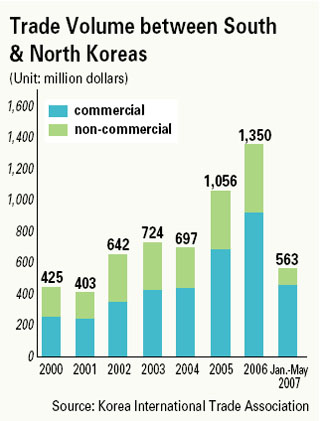
graph.jpgTrade volume between North and South Koreas has increased more than threefold since the historical June 15 Declaration in 2000.

With an average increase of 24.3 percent, annually, the total amount will reach $1.7 billion by the end of the year, according to the report on inter-Korean Trade from the Korea International Trade Association, also known as KITA.

Annual trade volume in 2000 was $425 million, which increased to $1.3 billion last year. Trade volume so far this year until May has already reached $563 million, which is a 31.3 percent increase year-on-year.

Besides the overall growth, what is healthy about the trade quality is that commercial trade accounts for almost 70 percent of the total trade. That figure was below 60 in 2000, according to the report. Non-commercial trade refers to aid including items such as rice, clothing and fuel. In other words, they are products that were sent to North Korea free of charge.

“The success of the Kaesong Industrial Complex is the biggest reason [for the rise],” said Roh Sung-ho, head of the Inter-Korean trade support team at KITA. “We are accepting bids for additional space at the Kaesong complex, and three times more companies bid than there are lots available.”

With more and more companies establishing factories in Kaesong, more material is exported from the South, and more manufactured goods return, said Roh.

The value of goods leaving South Korea was higher than the value of goods returning. However, about 30 percent of those goods were aid and were given free of charge. When that is taken into account, the North made more money from its exports to the South than the South made in exports to the North.

This allows the North to record a profit in trade account books.

“The nuclear incident last year, didn’t affect inter-Korean trade. There might be minor falls, but I expect trade volume between the two Koreas to increase for the time being,” Roh said.

Share

S. Korea set to ship US$20 million in food aid to N. Korea via WFP

Thursday, June 14th, 2007

Yonhap
6/14/2007

South Korea will take steps to send food aid worth some $20 million to North Korea at the request of a United Nations food agency, the country’s point man on the North said Thursday.

“This is totally different in nature from the provision of rice to the North in the form of a loan,” Unification Minister Lee Jae-joung said in a press briefing, conscious of mounting criticism of what it appears to be the government’s sudden about-face in food aid to the North.

South Korea will consult with the World Food Program (WFP) to determine the proposed list and amount of food aid items, which include 24,000 tons of corn, 12,000 tons of bean, 5,000 tons of wheat, 2,000 tons of flour and 1,000 tons of powdered milk, Lee said. It will be the first time since 2004 that South Korea will provide food aid to the North via the WFP.

South Korea resumed shipments of fertilizer and other emergency aid to the North in late March, but withheld the loan of 400,000 tons of rice as an inducement for North Korea to start its nuclear dismantlement under a landmark February 13 agreement.

Besides, the South also decided to send 10,500 tons of rice to the North soon as part of a promise made last year to help the North recover from flood damage, Lee said. “I think it is right to push for this in consideration of cooperation with the North,”

South Korea suspended all types of food and fertilizer aid to North Korea after the North conducted missile tests in July. Resumption of the aid was stymied due to the North’s nuclear bomb test in October, but the two sides agreed to put all inter-Korean projects back on track in early March. Emergency rice aid for flood relief has also been put on hold in tandem with the suspension of the rice loan.

A weak harvest in 2006, disastrous summer flooding and a 75 percent fall in donor assistance have dealt severe blows to the impoverished nation, according to WFP officials.

According to a recent think tank report, North Korea could run short of up to one third of the food it needs this year if South Korea and other countries withhold aid.

Data from the WFP and the Unification Ministry show that the North will need between 5.24 million tons and 6.47 million tons of food this year. Depending on the weather, the availability of fertilizer and other factors, the communist state may only be able to produce 4.3 million tons of food by itself, the report said.

Share
