Archive for the ‘International Governments’ Category

South Korean families file suit against Kim Jong-il

Monday, August 30th, 2010

According to KBS:

Families of South Koreans abducted by North Korea are seeking to file a complaint against North Korean leader Kim Jong-il with the South Korean prosecution for crimes against humanity.

The head of the organization of the abductees’ families said that his organization recently obtained a government document proving that North Korea abducted South Korean nationals.

He added that his organization will seek the indictment of the North Korean leader in South Korea. If that is impossible, the organization will sue the North Korean leader via the International Criminal Court.

Meanwhile, a South Korean civic organization, the Crime against Humanity Investigation Committee, sued the North Korean leader with the Hague-based International Criminal Court last month.

Established in 2002, the International Criminal Court is an independent international organization seeking to help end impunity for perpetrators of crimes against humanity. It has 111 member countries.

Read the full Story here:
Families of S.Korean Abductees to File Complaint against Kim
KBS
8/30/2010

Share

US State Department issues warning about illegal entry into DPRK

Monday, August 30th, 2010

According to CBS News (8/29/2010):

As soon as Carter cleared the airspace of the repressive communist dictatorship with freed American prisoner Aijalon Mahli Gomes, who was granted amnesty after being sentenced to eight years hard labor for entering the country illegally, the State Department issued a travel warning telling Americans to stay away, CBS News’ State Department Reporter Charles Wolfson reports.

The travel warning tells U.S. citizens not to enter the country without “explicit official permission and an entry visa from the Government of North Korea.”

“The North Korean government will prosecute and sentence those who enter the DPRK without proper documentation,” the State Department notes, in an apparent attempt to reach the few Americans for whom Gomes’ story was somehow not enough warning. “North Korea’s penalties for knowingly or unknowingly violating North Korean laws are much harsher than are those in the United States for similar offenses.”

“Travel by U.S. citizens to North Korea is not routine, and U.S. citizens crossing into North Korea without proper documentation, even accidently, have been subject to arrest and long-term detention,” the warning adds. “Since January 2009, four U.S. citizens have been arrested for entering North Korea without the necessary documents. Three were charged with illegal entry and ‘crimes against the State.'”

It goes on to note that the United States does not maintain diplomatic relations with North Korea, limiting what it can do for citizens detained or injured there. It says even if you have a valid passport and visa to enter the country “you may be expelled, arrested, or imprisoned” for doing so.

The warning would seem to serve two purposes. One, simply to remind Americans of what they should already know: That North Korean is not going to welcome them with open arms if they elect to enter the country illegally, as Gomes and fellow Christian Robert Park did. And two, to make it clear that Carter’s trip to made nice with the leaders of the repressive regime in order to recover an American citizen doesn’t signal any sort of thaw in diplomatic relations.

As far as enterning the country legally you will be just fine–in fact probably safer than traveling almost anywhere else.

Share

Japanese spy satellite breaks down

Monday, August 30th, 2010

According to the Global Times:

One of Japan’s four spy satellites orbiting Earth, in part to monitor activities in North Korea, has broken down, Japanese media quoted government sources as saying Saturday.

According to the Yomiuri Shimbun newspaper, Japan’s Cabinet Satellite Intelligence Center said it detected a glitch in the satellite’s radar system Monday and began remote operations to restart the system.

However, an official of the center said the outlook for recovery was “extremely grim,” the newspaper said.

The No. 2 radar satellite, which was put into orbit in February 2007, appeared to have run into trouble related to its electrical power supply, the center said. The satellite was designed to work in space for five years and should have completed its mission in 2012.

The remaining three satellites, all optical ones, are working to minimize the effect of the radar satellite’s malfunction, the Kyodo News Agency quoted a defense ministry source as saying.

Japan decided to deploy spy satellites to keep an eye on developments in North Korea after Pyongyang launched a ballistic missile in 1998, part of which flew over the Japanese archipelago and fell into the Pacific Ocean.

A set of four satellites – two radar orbiters and two optical orbiters – can gather imagery of any place in the world within a 24-hour period while in their polar orbit at an altitude of 400- 600 kilometers, the paper said.

Intelligence-gathering satellites are a precious source of information for Japan and “serve as a deterrent by monitoring any kind of activity,” one high-ranking defense official told the paper.

The paper also noted that the breakdown has occurred at the most inopportune time, as North Korea continues to develop missile and nuclear programs and as China expands its military capabilities.

Read the full story here:
Japanese spy satellite over North Korea breaks down
Global Times
8/30/2010

Share

South Korean religious organizations donate flour to DPRK

Friday, August 27th, 2010

According to Yonhap:

A joint delegation of five major religious organizations in South Korea traveled to North Korea Friday to deliver food aid, the second civilian visit to the communist state since Seoul imposed a travel ban in May.

The nine-member delegation of the Catholic, Protestant, Cheondo, Buddhist and Won-Buddhist orders drove to the North from this western border town of Paju, Gyeonggi Province, accompanied by about a dozen trucks carrying 300 tons of flour.

The 250 million won (US$209,170) worth of aid was the second inter-Korean assistance since Seoul imposed a North Korea travel ban in May in protest of the sinking of a South Korean warship two months earlier. North Korea denied involvement in the sinking that killed 46 sailors.

Seoul allowed the first civilian visit on Aug. 17, in which an aid organization delivered 400 million won worth of anti-malaria aid to North Korea.

“The denuclearization of the Korean Peninsula is important, but the lives of the people on the Korean Peninsula take priority over any other issue,” the group said in a joint statement at a ceremony attended by some 150 people, ahead of its departure. “We religious communities from the left and the right are taking a step toward opening the door for reconciliation and peace in the inter-Korean relations.”

During its one-day visit, the delegation will deliver the flour to Kaesong, just north of the inter-Korean border, which will be distributed to inhabitants in the border town and counties in North Hwanghae Province.

Read the full story below:
S. Korea’s pan-religious delegation travels to N. Korea with flour aid
Yonhap
8/27/2010

Share

China sends emergency flood/food aid to DPRK

Thursday, August 26th, 2010

According to the AFP (h/t NKnews.org):

North Korea will receive emergency aid from China amid reports that the impoverished country’s food crisis would worsen this year.

China has decided to provide an unspecified amount of “emergency relief materials” to North Korea, its official Korean Central News Agency (KCNA) said late today.

“This measure will encourage the Korean people in their efforts to recover from the flood damage as early as possible and more energetically step up the building of a thriving nation,” it said.

The report followed a message of sympathy from China’s president Hu Jintao to North Korean leader Kim Jong-Il.

In the message, quoted by KCNA, Hu expressed deep sympathy and consolation over “the sad news that some parts of your country were hit by severe flood recently, causing causalities and property losses”.

The North has reported widespread flooding this summer which washed away homes, roads, railways and farmland, causing an unspecified number of deaths.

Heavy downpours last week swelled the Yalu river, which forms part of the border between China and North Korea, sending water spilling over its banks on both sides and inundating homes, roads and farmland.

After decades of deforestation, the North is particularly vulnerable to flooding. In 2007, it reported at least 600 people dead or missing from devastating floods.

Aid groups warned that this year’s flooding would aggravate the North’s chronic food shortages.

The North suffered a famine in the mid-1990s which killed hundreds of thousands. The UN children’s fund estimates one third of children are stunted by malnutrition.

A bungled currency revaluation last November, designed to flush out entrepreneurs’ savings, backfired disastrously, fuelling food shortages and sparking rare outbreaks of unrest.

In 2008 South Korea suspended an annual rice shipment to its impoverished neighbour as relations soured.

For its part, South Korea has also offered to send assistance.  According to Yonhap:

South Korea’s Red Cross on Thursday proposed providing aid to North Korea to help the communist neighbor recover from recent flood damages, an official said.

The proposal was made in a message delivered to a inter-Korean office in the North Korean border town of Kaesong, a Unification Ministry official in Seoul said, declining to be identified.

The ministry said earlier in the day that it was considering allowing emergency relief assistance to North Korea, but did not elaborate. The North, which remains technically at war with the South, had to evacuate a large number of people when heavy rains raised the level of rivers on its border with China and flooded its towns earlier this month.

“It’s not just the people in the Sinuiju border area that we’re considering providing aid to,” a Red Cross official said by phone, declining to be named. “We will follow the examples of 2006 and 2007 when we provided help, but the scale of aid this year will be determined upon exact assessments.”

“The emergency aid will mainly consist of noodles, water, milk and the likes,” the ministry official said, ruling rice out.

The aid, if accepted, could open room for improvement in the inter-Korean relations, which have soured since South Korea blamed North Korea in May for the sinking of its warship. Pyongyang denies involvement in the sinking that killed 46 sailors.

Read the full stories here:
North Korea to receive aid from China
AFP
8/26/2010

S. Korea’s Red Cross proposes sending flood aid to N. Korea
Yonhap
Sam Kim
8/26/2010

Share

World Food Program donations to DPRK shrink

Thursday, August 26th, 2010

According toYonhap:

The World Food Program is struggling to keep its project of feeding malnourished children in North Korea from shrinking, its director for the communist state said in an interview on Thursday.

Torben Due, who represents the WFP office in Pyongyang, said his organization set out to raise US$500 million two years ago to provide basic nutrition for North Korean children.

In reality, what the WFP ended up with was $100 million. Due said his team in Pyongyang has re-designed its operation for the next two years to value at $96 million because of grim expectations for funding.

“The most difficult obstacle is that we don’t get the resources we need. We don’t get the money we need,” said Due, who was in Seoul this week to meet with government officials to discuss food needs in North Korea.

“We had to reduce (our program) because we could see we would not get the money. We had to design a program small and realistic in terms of what we would be able to do,” he said.

The WFP is a U.N. organization heavily dependent on donation. In North Korea, it supplies cereal-type food mixed with soybeans, milk powder, sugar and others rich in protein and minerals, specifically aimed to fight nutritional deficiencies in growing children.

“The child who is chronically malnourished will be damaged in a way that lasts a whole life. He will be physically stunted, and mental and intellectual development will also be harmed,” Due said, adding North Korean children “particularly” like biscuits.

Due said political tensions appear to be one reason why the WFP operation is not receiving enough donations for North Korea, which has conducted two nuclear tests since 2006, defying warnings.

“This is a pure humanitarian issue. Children suffer more than anybody else if there is no food,” he said, adding that the WFP office in Pyongyang had to cut the number of counties it was supporting from 130 to 65 this year.

“You are talking about roughly a third of the population that has problems with insufficient food intake, both in terms of quantity and quality. What we’re providing is supplement for a small part of the population. The problem is much bigger than what the WFP program is about,” he said.

North Korea has a population of about 24 million. Due said quantity matters as much as quality when it comes to helping North Korean children.

“If you have a country with 5 million children, if you want to contribute and solve the problem, you must think in terms of what is needed,” he said.

Due declined to disclose his discussions with the South Korean government officials he met here. South Korea has suspended sending large-scale food aid to North Korea unless Pyongyang moves to denuclearize under a multinational agreement.

North Korea has relied on international handouts since it suffered massive famine in the 1990s, when as many as 2 million people reportedly died.

The country is vulnerable to natural disasters. Earlier this month, heavy rains along its border with China raised the level of rivers and led to the evacuation of 23,000 North Koreans, Due said.

“In the areas affected, it’s quite devastating,” he said. But Due said North Korea had yet to appeal for international assistance as “the impact is very limited” and “localized.”

“The government can probably handle it themselves. We are, along with the Red Cross, providing some items,” including 1,300 tons of food, he said, adding he had no knowledge of human losses yet.

Earlier Thursday, South Korea’s Red Cross proposed sending aid to North Korea to help it recover from the flooding.

Read the full story here:
WFP feeding fewer N. Korean children as donation shrinks: director
Yonhap
Sam Kim
8/26/2010

Share

Jimmy in DPRK—KJI in China

Thursday, August 26th, 2010

UPDATE 4: Chinese government confirms Kim Jong-il visit.  According to Evan Ramstad in the Wall Street Journal:

North Korean dictator Kim Jong Il met Chinese President Hu Jintao during his five-day visit to northeast China, the Chinese government confirmed Monday night as Mr. Kim left the country, in a surprise get-together that underscored their solidarity as they cope with pressure from the U.S. and other countries to act more responsibly.

The announcement was the climax of what appeared to be a coordinated public-relations push by China on Monday, beginning with stories in several media outlets praising the China-North Korea relationship while also saying Beijing shouldn’t be held responsible for Pyongyang’s provocative actions.

The meeting happened Friday, though China, as it has done with Mr. Kim’s previous visits, waited until he left the country to say he had been there.

In the initial reports confirming the meeting between Messrs. Kim and Hu, China’s state media said that Mr. Kim wanted a resumption of the six-nation talks aimed at striking a bargain for denuclearizing North Korea. They also hinted that Mr. Kim was interested in the economic overhauls that opened China to the world, though they didn’t say he endorsed or would follow them.

Mr. Kim for years has resisted requests of Chinese leaders to open up North Korea’s economy. Late last year, his regime tried to clamp down on market activities but halted the effort when the government couldn’t feed people.

Mr. Hu said on state TV that China should expand its economic cooperation with North Korea. Since Mr. Kim’s entourage was spotted in China on Thursday, analysts have speculated that one reason he made the trip was to seek more money and assistance for the impoverished North.

Analysts also speculated that Mr. Kim brought his expected heir-apparent, son Kim Jong Eun, to meet Chinese officials ahead of a political meeting in Pyongyang next week that may be the son’s public debut in North Korea. The Chinese news reports about the visit did not mention the son, however.

“I think there are other two issues Kim wants to talk about with China,” said Jin Hanyi, head of Northeastern Asian Research Institute at Yanbian University in Jilin. “North Korea recently had a bad flood and, with international sanctions against it and the failure of monetary reform, Kim wants to discuss how to deal with these awful messes,” Mr. Hanyi said. “Second, North Korea will hold a Workers’ Party meeting next month and he wants support from China for new policies.”

Mr. Kim’s entourage twice during the trip stopped in places associated with his father, North Korean founder Kim Il Sung, moves that are likely to be portrayed in North Korea as highlighting the importance of the Kim family as another potential succession looms.

For outside diplomats, the greatest significance of the trip is the symbolism of Messrs. Kim and Hu going to great lengths to meet each other in the aftermath of criticism both countries took following the sinking of a South Korean earlier this year, an incident that South Korea, the U.S. and others blame on a North Korean attack.

China has refused to blame North Korea publicly for the sinking, which killed 46 South Korean sailors, or to examine the results of the South Korea-led investigation.

Instead, North Korea and China have, since late May when the investigation first produced the accusation against North Korea, called for the resumption of the six-party denuclearization talks. The talks began in 2003, producing two agreements that North Korea dragged out and ultimately failed to keep. Pyongyang formally walked away from them last year.

Japan, South Korea and the U.S. have said North Korea damaged the potential for the talks with its attack on the South Korean ship.

The message to restart the talks was also given last week by a different North Korean official to former U.S. President Jimmy Carter when Mr. Carter went to Pyongyang to retrieve an American teacher who entered North Korea illegally in January. Mr. Kim skipped the opportunity to meet Mr. Carter to go to China instead.Mr. Kim doesn’t like to fly and travels by train that is easily monitored by satellite by foreign governments. His entourage is then tracked on the ground by reporters who follow the highly visible security cordons that go up along his route.

On Monday, South Korean and Japanese news agencies reported the action as Mr. Kim took his specially outfitted train from Harbin, the capital of China’s most northeastern province Heilongjiang, to a smaller city called Mudanjiang and then down to the border crossing at Tumen.

Mr. Kim called himself a “witness” to the success of China’s “reform and opening up,” Chinese television reported, but it was unclear whether that meant the North would follow that model. Last year, Chinese Premier Wen Jiabao, in a visit to Pyongyang, proposed development projects valued at several billion dollars to North Korea, but none have gotten off the ground.

Early Monday, Chinese state media rang with praise for North Korea but also tried to draw a line in the two countries’ relationship.

The state-run Xinhua news agency published a commentary talking about Chinese men who sacrificed their lives for North Korea, during the Korean War of the 1950s and afterward. Its latest example was the tale of a Chinese man who drowned this month after rescuing three North Korean girls adrift at sea.

The man’s “sacrifice led us again to recollect the long history of friendship between the two peoples,” Xinhua wrote.

Another nationalist newspaper, Global Times, wrote an editorial that called the China-North Korea relationship both “special” and “normal.”

“The biggest negative impact the China-North Korea relationship has on China is that the U.S, Japan and South Korea all request that China be responsible for North Korea’s ‘irrational behaviors,'” the newspaper wrote. “However, China has no ability to shoulder such responsibility.”

UPDATE 3: Kim Jong il departs from Harbin and returns home.

UPDATE 2: Kim Jong-il in Changchun. According to Yonhap:

North Korean leader Kim Jong-il arrived in a Chinese industrial city Friday, a day after making a pilgrimage to sites bearing footmarks of his late father, on an abrupt trip seen as related to his leadership succession plan.

A convoy of some 30 vehicles, believed to be carrying the reclusive leader, arrived at the South Lake Hotel in the northeastern Chinese city of Changchun, about an hour and a half after leaving the nearby city of Jilin.

Earlier in the day, Kim’s convoy appeared to be traveling to a Jilin train station, where security was heavy, to allow the leader to board his personal armored train to Changchun. However, instead of stopping, the convoy took a highway to the capital city of Jilin province. About 10 police vehicles provided escort for the group of limousines and mini-buses.

Kim’s stay in Changchun is expected to include a tour of advanced industrial facilities.

Kim, 68, began the latest secrecy-shrouded trip a day ago, crossing into China around midnight Wednesday aboard his luxurious special train.

The trip was a surprise because it came as former U.S. President Jimmy Carter was in Pyongyang for a widely speculated meeting with him. It was also Kim’s second visit to China in about three months, an unusual move for the isolated leader who rarely travels abroad.

Carter arrived in Pyongyang Wednesday to win the release of an American citizen detained in the North since January for illegal entry. Carter headed home Friday with the freed American, Aijalon Mahli Gomes, Pyongyang’s Korean Central News Agency said.

It was apparent that he failed to meet with Kim Jong-il.

On Thursday, Kim paid a visit to Jilin’s Yuwen Middle School, which his father and national founder, Kim Il-sung, attended for two and a half years starting in 1927. Kim also visited Beishan Park in the city of Jilin where the remains of anti-Japanese independence fighters are buried.

North Korea has lavishly lauded Kim Il-sung for his anti-Japanese activities during the 1910-45 colonial rule. The late leader, who founded North Korea in 1948, is still revered as eternal president and is subject to a strong cult of personality even after his death in 1994.

Kim’s move suggests that he visited the two sites considered sacred to his family dynasty ahead of handing power over to his youngest son, Jong-un, analysts said. Unconfirmed reports said the heir-apparent could be accompanying his father on the rare trip.

North Korea’s ruling Workers’ Party is scheduled to convene a rare leadership meeting early next month in which the younger Kim could be given a key position in the run-up to formally taking over the communist dynasty.

On Thursday, Pyongyang’s state media reported that the country has started holding lower-level meetings of party delegations in the run-up to next month’s conference.

“The meetings were unanimous in saying that the WPK conference … will be a significant conference which will be a landmark of an epochal turn in strengthening the party and a great jubilee of great significance in ushering in a new surge in the revolution and construction,” the KCNA said.

Kim’s trip came as tensions still run high in the wake of the March sinking of a South Korean warship and China pushes to jump start six-nation talks on ending North Korea’s nuclear programs.

Beijing’s chief nuclear envoy has been in Seoul for talks on his trip to North Korea last week.

China is pushing for a “three-step” proposal for resuming the nuclear talks.

The proposal calls for Pyongyang and Washington first holding bilateral talks before all six parties hold an informal preparatory meeting and then an official session. The talks, which involve the two Koreas, China, Japan, Russia and the U.S., have been stalled since late 2008.

South Korea has expressed its reluctance to reopen the dialogue unless the North shows a “responsible” attitude over the sinking and proves through action that it is serious about abandoning its nuclear programs.

UPDATE 1: Here is KCNA coverage of Cater’s visit to secure the release of Gomes

ORIGINAL POST: Former President Jimmy Carter is in Pyongyang to secure the release of American Aijalon Gomes.  Past stories about his detention can be found here. President Carter last traveled to Pyongyang in 1994  and met with Kim Il-sung (the North Koreans made a propaganda video out of the trip which they sell to foreigners), and discussed terms to freeze the country’s nuclear program. Many were speculating that President Carter might meet with Kim Jong-il while in the DPRK, but Kim appears to be in China.

According to the New York Times:

The man Mr. Carter is seeking to free is Aijalon Mahli Gomes, a 30-year-old Christian from Boston who was arrested in January for crossing into North Korea and sentenced in April to eight years of hard labor and fined $700,000. Last month, North Korea said he tried to kill himself out of “frustration with the U.S. government’s failure to free him.”

The visit by Mr. Carter, an evangelical Christian, is the second to North Korea by a former American president in a year on what the United States described as a private humanitarian missions. Last August, Bill Clinton flew there and met with the reclusive North Korean leader, Kim Jong-il, to secure the release of two American journalists held for five months for illegal entry.

The Obama administration kept its distance, emphasizing that Mr. Carter not an envoy. “I’ll just say that President Carter is on a private humanitarian mission and I’m not going to comment more beyond that,” said Mark Toner, a State Department spokesman.

But as with Mr. Clinton’s visit, Mr. Carter’s has deeper diplomatic undercurrents. The North Koreans have used the captive Americans as bargaining chips, promising to release them in exchange for visits from specific high-profile Americans. North Korea can portray the meetings domestically as evidence of its international importance, while the United States has a high-level direct encounter that it cannot officially engage in.

But Mr. Carter has a long history as an independent agent, and some administration officials worried that he might undercut their policy in some way and make it harder to keep up the pressure on Pyongyang to give up its nuclear program.

It was not immediately clear who among the North Koreans would meet with Mr. Carter. The North Korean media reports said that he was greeted at the airport in Pyongyang, the capital, by Kim Kye-gwan, a senior diplomat who has been the North’s main envoy to the six-nation talks on its nuclear weapons program. The talks have been stalled for more than two years, but the North recently said it was willing to return to the discussions.

Higher-level meetings would appear to be likely, since Mr. Carter’s visit comes at a fraught time for North Korea. Its economy remains deeply troubled, and its ravaged agricultural sector has been further damaged by recent flooding. A March torpedo attack that sank one of the South’s warships, killing 46 sailors, drove inter-Korean relations to their lowest point in years and added to tensions with the United States. In addition, there may be a struggle over succession within the government of Kim Jong-il, who has had serious health problems.

The case of Mr. Gomes also touches on efforts of Christians in South Korea and the United States on behalf of North Koreans. His illegal entry was made in support of Robert Park, a fellow Christian from the United States who crossed from China in December to call attention to the dismal conditions in the North’s prison camps. Mr. Park was expelled after about 40 days.

Mr. Carter has been a contentious figure among South Korean conservatives. “Carter is idealistic, not realistic when it comes to North Korea,” said Hong Kwan-hee, director of the Institute for Security Strategy in Seoul. “North Korea always has tried to use prominent Americans, preferably Democrats, as a medium to engage the United States and drive a wedge between Seoul and Washington.

In another development, the South Korean authorities on Thursday morning were looking into indications that Mr. Kim, the North Korean leader, might be visiting China, an official in the presidential office of South Korea said. News media in South Korea, including the national news agency, Yonhap, and the mass-circulation daily, Chosun, reported the same on their Web sites.

“We have signs that Kim Jong-il is visiting China,” said the official, who spoke on condition of anonymity, citing the sensitivity of the matter. “It’s unclear whether he has arrived or is still on the move.”

If true, this would be Mr. Kim’s sixth trip to China and his second in three months. North Korea and China usually do not confirm a trip by Mr. Kim until after it is over. His previous trips were often preceded by weeks of media speculation. Many journalists waited on the Chinese side of the border to wait for his train to cross. This time, there was no such activity.

According to Bloomberg:

Carter yesterday also met with Kim Yong Nam, president of the Presidium of the Supreme People’s Assembly of North Korea, KCNA said. The pair had a “cordial talk” in the Mansudae Assembly Hall, the official news agency said.

Regarding Kim Jong-il’s visit to China, I turn to the Los Angeles Times:

In a trip shrouded in mystery and speculation, North Korean leader Kim Jong Il traveled to China by train with his youngest son, according to two South Korean government officials.

An official in the South Korean Blue House confirmed late Thursday that Kim’s train had crossed the border into China around midnight Wednesday, but said the North Korean leader did not take the usual route through the city of Dandong.

We “detected indications a few days ago,” the official told reporters, asking not to be named. “Chairman Kim’s special train has been confirmed to have left Manpo for China’s Jilin around midnight Wednesday.”

Another official, who asked not to be named because he was not authorized to discuss the matter, said earlier that intelligence had detected movement by the reclusive Kim.

South Korea’s Yonhap news service quoted an official speculating that the trip might be associated with the anticipated handover of power in the secretive regime.

“Signs have been detected that Chairman Kim visited China early Thursday morning,” the second unnamed official told the agency. “We are still trying to grasp his exact destination and the purpose of the visit.”

This was Kim’s second trip to China since May, when he embarked on a five-day journey for a summit with Chinese President Hu Jintao.

The Chinese government Thursday had no immediate comment on the visit. Because of security concerns, Kim’s rare trips outside North Korea to the ally nation are publicly confirmed only after they end.

The Yalu River crossing between North Korea and the Chinese city of Dandong was badly flooded last weekend, disrupting the railroad lines over which Kim normally travels in an armored, luxury train, reportedly equipped with conference rooms, bedrooms and high-tech communication facilities.

Shi Yinhong, a professor at Beijing’s Renmin University, speculated that Kim “must need China’s help in reducing tensions and ensuring a good environment for the succession of his son.”

The visit may signal that North Korea is prepared to return to six-party talks hosted by China on its nuclear program. North Korea also badly needs humanitarian assistance as a result of a series of economic blunders, as well as poor harvests and damage to cropland caused by the recent flooding.

Kim, who is 68 and in poor health after suffering a stroke in 2008, is in the process of naming his youngest son, the little-known Kim Jong Eun, 26, as his successor, a decision which should be announced at a special congress next month of North Korea’s ruling Workers’ Party.

“It’s likely that Kim Jong Il wants to end the debate on the succession issue in Pyongyang ahead of a meeting next month of the North Korea’s Workers’ Party,” said Yang Moo-jin, a professor at the University of North Korean Studies in Seoul.

“There’s been plenty of succession talk between working-level and senior-level officials in Beijing and Pyongyang where they have failed to reach an agreement. Kim Jong Il now seems to be taking matters into his own hands.”

Kim Jong Eun, who was educated in Switzerland and speaks several languages, did not accompany his father during the previous trip to China in June. His presence on this visit might be something of a courtesy call to introduce the future leader to the Chinese.

“China will have no choice but to deal with Kim Jong Eun. Their regime is traditionally a family dynasty and, like it or not, if you deal with North Korea, you have to deal with their ruler,” said Shi.

Kim Jong Il assumed power in North Korea with the death of his father, Kim Il Sung, in 1994.

The rumors come amid tensions on the Korean Peninsula following the deadly sinking of a South Korean warship in March. The south has blamed North Korea for an unprovoked torpedo attack.

The trip also comes the day after former U.S. President Jimmy Carter arrived in Pyongyang to secure the release of a U.S. citizen imprisoned for illegally entering the country.

Here is the original Yonhap story.

Here is more in the New York Times.

Here is more in the Los Angeles Times.

The Road less taken: DPRK railway crossings into China

Click image for larger version

The DPRK does not have many railway crossings into China. From West to East: Sinuiju, Sakju, Manpho,  and Namyang.  Historically there were additional crossings at the Unbon Dam,  Hyesan, and Saepyol, but these do not appear to be used anymore.  Namyang is in the furthest reaches of North Hamgyong Province, so if Kim is going to cross into China by rail, he has to do so from Sinuiju, Sakju, or Manpho.  Coincidentally, he has a private railway station and secure residential compound near each of these border crossings–though the closest leadership compound and train station to Manpho is in nearby Kanggye and the closest compound to the Sakju Bridge is in Changsong County.

Given that the Sinuiju crossing is most convenient, it is a bit of a mystery why he chose to cross at Manpho when Sakju/Changsong is so much closer.  Maybe the Sakju/Changsong railway crossing is not as convenient for some unknown reason?  Maybe the “smaller” Kanggye leaderhip compound is more exclusive and Kim prefered hiding this trip from as many of his cohorts as he could?  Maybe the Changsong elite compound (which is also on the water) is also flooded?  I do not know the reason, but there has to be one…

Share

Chinese investment blurb

Monday, August 23rd, 2010

According to an article in the Korea Times:

Approximately 100 small Chinese companies out of 150 that have investments in North Korea are based in Jilin and Liaoning Provinces near the northeastern border with the North.

Read the full story here:
Investments in NK limit China’s policy choices
Korea Times
Kang Hyun-kyung
8/20/2010

Share

First half of 2010 sees record inter-Korean trade

Thursday, August 19th, 2010

Institute for Far Eastern Studies (IFES)
NK Brief No 10-08-19-1
8/19/2010

Despite the ongoing inter-Korean tensions, and the stand-off over the Cheonan incident in particular, the first two quarters of 2010 saw an all-time record of 980 million USD-worth of inter-Korean exchange. However, with the South Korean government ceasing all inter-Korean trade outside of the Kaesong Industrial Complex in reaction to the investigation results finding North Korea responsible for the sinking of the South Korean naval corvette Cheonan, cross-border trade between the North and South has fallen and is expected to remain approximately 30 percent lower during the second half of the year.

According to South Korean customs officials, inter-Korean trade in the first half of the year was worth 983.23 million USD, with ROK imports worth 430.48 million USD and exports worth 552.75 million USD; a 122.27 million USD trade surplus. This is a 52.4 percent rise over last year’s first two quarters of trade, worth 645 million USD. In the first six months of 2009, South Korea exported 259.91 million USD (66%)-worth of product, and imported 385.1 million USD (44%) in goods. This year’s trade volume was nearly 100 million USD higher than the previous record, set in 2008, of 884.97 million USD. It was also around six times more than the 161.63 million USD recorded in 1999, when inter-Korean trade first became significant.

In 1999, North-South trade totaled 328.65 million USD. Despite rocky inter-Korean relations at the time, cross-border trade continued to grow, and with the expansion of the Kaesong Industrial Complex and other projects, first topped one billion USD in 2005, squeezing above the marker at 1.08872 billion USD. This growth continued in the latter half of the decade, hitting nearly 1.38 billion USD in 2006, 1.795 billion USD in 2007, and 1.82 billion USD in 2008. Repercussions from the North’s second nuclear test in 2009 caused trade to fall off to 1.666 billion USD in 2009.

On May 24, the South Korean government announced that all inter-Korean trade outside of the Kaesong Industrial Complex would be halted due to North Korea’s sinking of the Cheonan. If this trade ban continues, cross-border trade during the second half of the year is expected to be down 30 percent. The inter-Korean project in Kaesong makes up 70 percent of inter-Korean trade, so that other individual projects add up to only about one third. It is the suspension of these projects that is lowering North-South exchanges by 30 percent.

Actually, there was a decline in trade during the first six months of the year. In June, exports totaled 56.88 million USD, while imports were worth 66.18 million USD (total: 123.06 USD). This is 21 percent (33.31 million USD) less than in May. Exports were down 4 percent and imports dropped by 32 percent. Compared to trade prior to the ROK government’s measures, the trade of electric and electronic goods, transportation, and other capital goods actually raised from 19.31 million USD to 21.21 million USD, while mined goods and other consumables dropped from 76.81 million USD to 36.86 million USD.

Share

Dandong launches DPRK trade program

Thursday, August 19th, 2010

According to Reuters:

A northeast Chinese border city that is a key portal with isolated neighbour North Korea has launched a pilot scheme to settle export deals in China’s yuan currency, the city’s official newspaper said on Thursday.

North Korea’s struggling economy has come under greater strain after a chaotic attempt to re-denominate its currency last year hurt private traders and alarmed Chinese merchants.

The yuan’s trial use appears intended to boost Chinese exporters’ confidence in doing more above-the-table deals with the North, often a perilous gamble even in smoother times.

Many Chinese traders doing business with the North already use the yuan, dollar, euro in cash or even barter to settle export of food, clothes, appliances and other cheap goods in often informal or convoluted transactions. Smuggling and illicit deals are common along the border, marked by the Yalu River, a few dozen metres (feet) wide in many parts.

The Dandong Daily reported that approved exporters in Dandong will be able officially to carry out business in yuan.

The Chinese government announced in June that all of its trading partners would be able to invoice and settle imports and exports in yuan, but so far such transactions have been primarily confined to trade between China and Hong Kong.

“This means that state-designated export businesses in Dandong that engage in external trade can use the renminbi to settle transactions,” said the Chinese-language Dandong Daily (www.ddrb.cn) of the scheme, which began on Wednesday.

The renminbi is another name for the yuan.

“This will reduce exchange rate risks and the costs of doing business, and smooth out enjoying export tax rebate policies, as well as improving capital utilisation,” said the report.

The scheme will also cover approved small-scale exports passing through customs posts at Dandong, it said.

The new scheme will allow exporters to enjoy rebates and other benefits for trade, but will also depend on North Korean importers being allowed to deal legally in yuan.

Dandong lies on the Yalu, and at night its neon-lit riverfront faces the darkness of the electricity-starved North.

North Korea’s dependence on Chinese goods and aid has deepened as Pyongyang’s ties with South Korea have frayed.

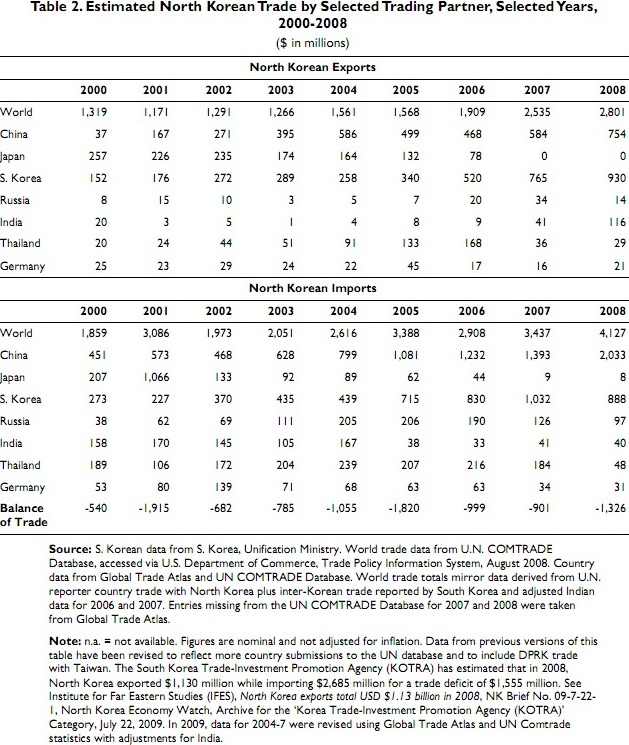
According to Chinese customs data, in the first six months of 2010, China’s trade with North Korea was worth $1.3 billion (835.6 million pounds), a rise of 15.2 percent on the same time last year.

China’s exports to the North grew by a quarter, but its imports fell by 4.8 percent, the customs data show. As much as 70-80 percent of that trade passed through Dandong, according to earlier Chinese news reports, citing local customs officials.

Read the full story here:
China city launches yuan trade scheme with North Korea
Retuers
8/19/2010

Share

An affiliate of 38 North