Archive for the ‘International Governments’ Category

Number of South Koreans in Kaesong zone increases

Sunday, May 8th, 2011

According to Yonhap:

A daily average of more than 600 South Korean workers are currently staying at the Kaesong Industrial Complex in North Korea, up from the 500-level in the past several months, according to a Seoul ministry Sunday.

The increase reflects a reduction in military tensions between the two Koreas, officials at the Unification Ministry that handles inter-Korean affairs said.

The ministry’s data showed that around 650 South Koreans stay at the industrial park, located just north of the inter-Korean border, per day starting last month.

“With regard to the number of production-related manpower, we are granting permission to stay (there) with more flexibility starting in the middle of April,” a ministry official said, requesting anonymity. “The number is expected to gradually increase down the road as well.”

He said the ministry’s flexible stance is attributable to petitions from companies in the Kaesong complex and the alleviation of security concerns of South Korean workers as inter-Korean tensions have eased a bit.

Read the full story here:
Number of S. Koreans at Kaesong rebounds amid letup in tension
Yonhap
2011-5-8

Share

100,000 Chinese visit Sinuiju in past year

Friday, May 6th, 2011

According to Yonhap:

The number of Chinese visitors to North Korea’s border town of Sinuiju has reached 100,000 over the past year after Beijing lifted a four-year ban on Chinese group tours from the Chinese border city of Dandong, a news report said Friday.

Dandong, which borders Sinuiju, is a major trade route between North Korea and China.

The Chinese government resumed the group tours to Sinuiju from Dandong in April last year, a Dandong newspaper said, adding the number of Chinese tourists to Sinuiju is likely to go up in the coming months.

The one-day group tour program allows the Chinese to visit Sinuiju without visas.

China is the North’s last remaining ally and benefactor.

Read the full story here:
Chinese visitors to N. Korean border city top 100,000 in one year
Yonhap
2011-5-6

Share

Migration to Thailand on rise

Friday, May 6th, 2011

According to the Bangkok Post:

Thai authorities have rejected South Korea’s proposal to build a coordination centre to deal with North Koreans illegally entering the country over concerns that it might encourage more inflows of migrants from the communist nation.

South Korea reportedly asked the government early this year to build the centre in Chiang Rai province, a popular entry point for illegal North Korean immigrants into Thailand.

Most of the immigrants have escaped economic hardship in North Korea and travelled to Thailand for temporary refuge in the hope of being able to resettle in third countries, usually South Korea, a source at the Internal Security Operations Command (Isoc) said.

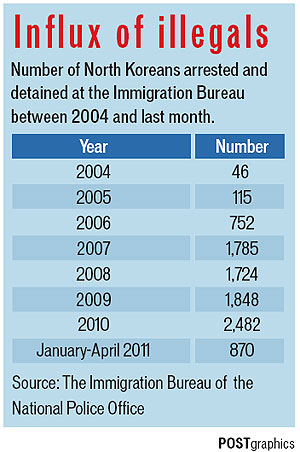
From October last year until April this year, 899 North Koreans were arrested for illegal entry, said Isoc spokesman Maj Gen Dithaporn Sasamit. The source said South Korea had offered to pay to take care of the illegal migrants. However, the government had turned down the proposal because it had no policy to open a new refugee centre.

The South Korean government has played an important role in helping North Koreans by allowing them to resettle in its country.

Pol Maj Gen Phansak Kasemasanta, deputy chief of the Immigration Bureau, said that North Koreans illegally entering Thailand would be arrested.

After being tried in court, the immigrants would be detained at the Immigration Bureau while awaiting deportation.

The immigrants normally protest at being sent back to North Korea, allowing South Korean officials to step in and help, Pol Maj Gen Phansak said.

He added that instead of building a new centre for the North Korean migrants, South Korea could help improve the present detention centre at the Immigration Bureau.

North Koreans could stay there along with other illegal immigrants from other nations, he said.

According to the Isoc and the Immigration Bureau, North Koreans are normally helped by human trafficking gangs to travel to China.

They are then put on board Chinese cargo boats to Laos before boarding smaller boats or travelling on foot to Chiang Rai’s Chiang Saen and Chiang Khong districts.

“The trips are arranged by gangs made up of North Korean, Chinese and Thai nationals,” said Maj Gen Thawip Bunma, a senior Isoc official.

The Isoc and the Immigration Bureau have been tracking down people involved in the human trafficking gangs.

However, Pol Maj Gen Phansak said police still have no evidence to confirm that Thais were involved.North Korean migrants who have been arrested have told officials that they had to pay at least 100,000 baht to the gangs to help arrange their trips to Thailand.

Most of the migrants were willing to turn themselves in to Thai authorities, seeing it as the first step for them to travel on to the third countries they ultimately wish to settle in.

Read the full story here:
Illegal North Korean migrants on rise
Bangkok Post
2011-5-6

Share

Remains of British pilot killed in Korean war handed over at Panmunjom

Wednesday, May 4th, 2011

By Michael Rank

The remains of a British pilot who was killed in the Korean war have been handed over to British officials at Panmunjom, after being buried for several years near Pyongyang.

The North Korean news agency KCNA said the body of Desmond Hinton had been disinterred at the request of his family, who in March “asked for bringing his remains back home.”

“Authorized by the DPRK government, the Panmunjom Mission of the Korean People’s Army conducted a series of survey which led to accurately unearthing and ascertaining the remains of Hinton and relics left by him and buried them on the spot with care as requested by his bereaved family and provided the family members with facility so that they might visit his grave,” it added.

Several years ago Desmond Hinton’s brother David, relying on reports of how Desmond was shot down over Pyongyang on January 2, 1952, managed to track down his remains and, with the help of the North Korean army and the British embassy, arranged for them to be buried near where his aircraft came down. He visited the site in 2004 and told me he was content for his brother’s remains to lie buried in North Korea.  I reported on this remarkable story in some detail here.

But the family have apparently had a change of heart recently about leaving Desmond’s remains in North Korea, although none of them was immediately available for comment.

Although Desmond was a flight lieutenant in the Royal Air Force he was one of 41 RAF pilots flying for the United States Air Force when he died.

A British Ministry of Defence spokesman said it could not be confirmed that the remains were those of Desmond Hinton, and that they would be subject to DNA testing.

“We can confirm that the Democratic People’s Republic of Korea has passed remains to the British authorities. We are unable to confirm the nationality or identity of the remains at this time. A detailed forensic analysis will now take place. We are very pleased with the cooperation we have received from the authorities of the Democratic People’s Republic of Korea,” he said in a statement.

The spokesman said that as far as he was aware no family members were present at the handing over of the remains at Panmunjom. He added that it would be usual for the remains to be buried in the United Nations Memorial Cemetery in Busan, South Korea, but it was up to the family to make the final decision once identity had been confirmed. Some 885 British troops lie buried at Busan, more than any other nation.

KCNA said this was the second set of British remains to be sent across the DMZ. It said that “The remains of J. Edmuns, a second class private of the British Army, were handed to the British side on October 30, 1995” but gave no details. The British Defence Ministry spokesman said he also had no details of this, although a British diplomat said he was aware of such an event in the 1990s.

KCNA said in an unusually conciliatory report, “Expressing deep gratitude to the government of the DPRK for having made every sincere effort for this humanitarian undertaking, the British side predicted that such cooperation would mark a good occasion in developing the relations between the two countries.

“The Panmunjom Mission of the KPA clarified the stand to render positive cooperation in the future, too in unearthing and sending back remains, the humanitarian work for healing the wounds caused by the past Korean War. ”

Additional information:
This story was covered in The Guardian, Daily Mail, and Yonhap.

Mr. Hinton’s remains were buried in Kuso-ri near the Sunan Airport. You can see a satellite image of the village here: 39°14’26.55″N, 125°42’58.17″E

Share

Recent articles on Rason’s future

Wednesday, May 4th, 2011

According to the Hankyoreh:

China is stepping out into the Pacific through the gates of North Korea’s Rason Special District. North Korea, which has been declaring its aim of creating a “strong and prosperous nation by 2012,” is actively welcoming the move from China.

A number of sources, including officials with the Jilin Province government in China, reported that a groundbreaking ceremony is to be held on May 30 for a highway linking the North Korea cities of Wonjong and Rason, bordering directly on Quanhe in Hunchun, Jilin Province. A number of leaders from both countries are scheduled to attend the ceremony, which is to take place in Rason (Rajin-Sonbong), North Korea.

A Chinese official working on preparations for the project said in a recent interview with the Hankyoreh that the event would be “an occasion for declaring North Korea-China economic cooperation and North Korean openness to the world.” The official added that dozens of officials from the Chinese central government would be attending, including a number of leaders.

The construction effort is a signal announcing the opening of Rason and large-scale economic cooperation between North Korea and China. In addition to the groundbreaking ceremony for the highway, which is to be a major channel tying North Korea and China together economically, efforts to develop China’s Rajin Harbor and transport large amounts of coal through it are beginning in earnest.

The Rason development effort is taking place according to China’s “blueprints” in everything from the planning to investment and management. Local sources said that China and North Korea have already formed a special joint steering committee for the district, and that it has been decided that the chairman will be from China.

The Rason urban development plan jointly drafted by China and North Korea includes the development of international freight brokerage, export processing, and financial regions. According to a North Korean video, models for the plan include Dalian and Tianjin, which Kim Jong-il inspected in 2010 during a visit to China.

An official with the Yanji city government said, “North Korea is also aware that keeping its doors closed will only lead to death, but it is concerned that the regime will be destabilized if it opens up all at once, so it plans to first open up Rajin and develop it as a ‘test region.’”

“They are adopting the Chinese model, learning from China about legislation, taxes, and benefits to lure businesses,” the official added.

The effort is being pursued promptly, in contrast with previous North Korea-China economic efforts, which tended to amount to little more than words. The reason for this is that the central governments in Beijing and Pyonyang are directly taking care of economic cooperation through the medium of Rason’s development.

A Chinese government official reported that Chinese Minister of Commerce Chen Deming traveled to North Korea to sign a memorandum of understanding, and that China and North agreed on a plan for joint investment in and administration of Rason’s highway, port, and industrial park construction. The official added the Chinese Prime Minister Wen Jiabao personally signed policy documents upgrading Hunchun to a special economic district in line with the Rason development plans.

Meanwhile, North Korea formed an office in its central government to directly administer Rason Special City, replaced old officials who failed to make progress with Rason’s development over the years, and sent in young officials from the central government, including Rason Special City secretary Im Kyong-man, sources reported.

China needs the Rason development to ensure the success of its current national development plan for Changchun, Jilin, and the Tumen River basin, while North Korea decided to cooperate with China to address its economic problems and stabilize its succession framework. Analysts say North Korea hopes to tout successful development of Rason as an achievement of Kim Jong-un.

The development project is proceeding in a very specific and far-reaching way. “This is Korean land, but the industrial complex is being operated as Chinese and will hire North Korea workers to earn foreign currency” for North Korea, said an official with a Chinese company in charge of a large-scale construction effort in Rason.

The electricity shortage issue, which had previously been a major stumbling block to investment, has been resolved by China. A source in Hunchun said, “Plans are being examined to either send surplus power from Hunchun’s thermoelectric power plants to Rason, or for a company in Jilin Province to retrofit an old Soviet crude oil plant in the Sonbong region into a coal-burning power plant.”

Even Chinese officials have been astonished at the active measures from Pyongyang. A Rajin representatives’ office opened in downtown Yanji, the seat of the Yanbian Korean Autonomous Prefecture, is hard at work drawing in investment.

“If Chinese investors want to take a look at Rason, they can drive their cars in for themselves with an invitation from the Rajin representatives,” explained a source in Yanbian.

In the border city of Hunchun, money and people have begun shifting toward the North Korean side. Construction of 500 apartments for Chinese people working in Rason began in late March, according to officials at a construction company commissioned to carry out the project. Capital and labor investment for the Hunchun-Rason highway construction is coming entirely from China, and a number of the roughly 500 Chinese workers needed to begin have already arrived in Rason with six-month passes issued by North Korea. Large Chinese corporations such as Changli, Shangdi Guanquan Investment, and FAW are known to be undertaking investment in Rason.

According to the Korea Herald:

Despite its reputation as one of the most closed nations in the world, North Korea is, at least partly, opening up to market economy conventions, evident in its effort to cultivate its specially designated economic zone.

North Korea designated Raseon the country’s first free trade zone, as a “special city” in January 2010. The city, which borders both China and Russia, was dubbed a free trade zone along with nearby Sonbong in 1991, even though foreign investment never materialized.

In recent years, the North has tried to reinvigorate the trade zone, signing an accord with Russia to restore railways that could help rejuvenate the port there. Russia invested 140 million euro ($202 million) in the Rason project in late 2008.

In recent months, North Korea appears to have initiated a media campaign for Rason, beckoning foreign investors as Pyongyang struggles to resuscitate its moribund economy, according to informed sources and media reports.

According to a source familiar with North Korean affairs, the city has seen both new factories built and upgrades of previous ones.

A couple of large Chinese companies have also reportedly signed deals on either providing construction parts or investments in the region’s resources development.

Chinese commerce officials from the central government and the nearby Jilin Province have also reportedly held talks with their Pyongyang, Rason counterparts regarding such business transactions.

The city is also becoming more urbanized, according to sources. Apartments and road construction repairs are sprouting, while the number of daily logistics traffic across the nearby North Korea-Chinese border has nearly doubled to some 200 trucks in late April, compared to some 100 trucks just three months ago.

The North Korean leader Kim Jong-il recently traveled to the city, a move that analysts see as underlining the regime’s desire to promote the trade city to lure foreign investment.

The KCNA reported on April 22 that Kim visited the city’s Rajin Shipyard where he was briefed on different processes of shipbuilding. There he highlighted the importance of the shipbuilding industry and urged for the introduction of new production technology.

It was the first time that the North’s tightly controlled media reported the name of the shipyard and Kim’s visit there. Known as one of three major shipyards in North Korea, the Rajin Shipyard is believed to have built warships and submarines, according to sources in Seoul.

Increasing media reports from North Korea on Rason also seems to back claims that the country is putting its weight behind the city.

On April 19, the KCNA filed a profile report on Rason’s tourism industry, touting its historic relics, cultural facilities and fantastic seascape “and introducing tourist hot spots in and near the city.

In an earlier, March 30 report, the KCNA said that the city has adopted “a preferential tariff system” for foreign investors and traders.

“Choe Kwang-nam, an official in charge of economic cooperation of the Rason City People’s Committee, told the KCNA that the zone provides favorable business conditions to foreign investors through the preferential tariff system,” it said.

“Foreign investors and businesses are allowed to conduct diverse economic and trade activities and have a free choice of investment forms and business,” it quoted Choe as saying.

Read the full stories here:

N.Korea’s Rason Special District could open country to China
Hankyoreh
Park Min-hee
2011-5-4

Investment, projects seemingly brim in N. Korea border city
Korea Herald
2011-5-4

Share

Two decades of economic reforms in North Korea and Cuba

Sunday, May 1st, 2011

The Korea Economic Institute has published the latest in its Academic Paper Series:

“Similar Policies, Different Outcomes: Two Decades of Economic Reforms in North Korea and Cuba”
Dr. José Luis León-Manríquez, Universidad Autonoma Metropolitana

North Korea and Cuba benefitted economically from Soviet Union support, but after the collapse of the Soviet bloc, both countries had to reexamine their policies. Since 1990, these two countries have tried various economic reforms under their centrally planned economies. Which country has been more effective in their efforts? As the two nations are both undergoing leadership transitions, how likely are further economic reforms?

Download the paper (PDF) here. Listen the presentation here.  See the presentation video here.

Share

UN WFP / UNICEF launch DPRK program

Sunday, May 1st, 2011

UPDATE 1 (2011-5-3): The Korea Herald offers some more information on the mission:

The World Food Program will increase its personnel residing in North Korea to tighten monitoring of the distribution of donated food, a U.S.-funded radio station reported Tuesday.

The plan comes as the U.N. agency prepares to launch an emergency operation to help feed 3.5 million starving North Koreans by providing 310,000 tons of food within the next year.

The WFP plans to keep 59 agents in the North, an increase from the previous 10. Up to 60 percent of these agents will be tasked with checking whether the food goes to ordinary people rather than the military in the impoverished state, according to the Voice of America.

Pyongyang’s reclusive Kim Jong-il regime has often refused to let outsiders monitor its food distribution process, triggering suspicions that most of the outside aid is being used to feed its army and political elite.

Apparently getting more desperate for outside assistance, the North has agreed to let the WFP agents monitor its food situations in some 400 regions every month, the U.N. body said.

South Korea and the U.S., which remain lukewarm toward resuming full-scale food aid to Pyongyang, suspect that the Kim regime may be stockpiling rice to prepare for potential war or to release on the 100th anniversary of its late founder Kim Il-sung next year.

While the WFP has been calling on the international community to donate 434,000 tons of food to feed starving North Koreans, the two traditional allies also question the accuracy of the assessment made based on Pyongyang’s own statistics on its harvest and rationing.

Among the newly dispatched agents, 12 can speak fluent Korean, the U.S. radio station said, quoting WFP officials.

A total of seven offices, including one in the capital Pyongyang, will open during the emergency operation period, with food being distributed in eight provinces and 109 districts in the North, it added.

In a recent statement, the WFP had stressed that the aid operation in the authoritarian single-party state “will include the highest standards of monitoring and control to ensure that food gets to where it is needed.”

ORIGINAL POST (2011-5-1): According to the UN press release:

The United Nations World Food Programme (WFP) and the UN Children’s Fund (UNICEF) today announced plans to introduce emergency operations in the Democratic People’s Republic of Korea (DPRK) to feed an estimated 3.5 million people in desperate need after crop losses and a particularly bitter winter.

Women and children will be the focus of the one-year WFP operation, which follows an assessment by several aid agencies of food security inside the DPRK, according to a press release issued by the agency. The operation is expected to cost just over $200 million.

UNICEF has launched a $20 million appeal to fund assistance programmes in the five DPRK provinces with the highest rates of malnutrition and in other counties with similar problems.

Although WFP said overall rates of acute malnutrition have not yet reached crisis levels, it warned that the situation could deteriorate rapidly if there is any further reduction in the food intake of those in need.

Many families have already resorted to cutting out the size or number of meals each day, and Government-supplied rations provide only about half of a person’s daily food needs.

“We face a critical window to get supplies into the country and reach the millions who are already hungry,” said Amir Abdulla, WFP’s Deputy Executive Director and Chief Operating Officer.

“Our primary concern is for those who are most vulnerable to shocks in the food supply – children, mothers, the elderly and large families.”

WFP spokesperson Emilia Casella told reporters in Geneva that the assessment found that the severe winter this year had damaged a large proportion of the seed potato stocks needed to plant the next crop.

The vegetable harvest late last year was also down 44 per cent on the expected volume, she said.

Under the operation WFP will provide cereals and the ingredients for the local production of such foods as corn-soy milk, rice-milk blend and high-nutrient biscuits through a public distribution system.

International staff working for the agency will make more than 400 visits each month to provincial markets and distribution points during the operation, and will only have to give 24 hours’ notice to local authorities.

The operation will continue through the harvest expected in October, with specialized nutritious products expected to be distributed then. WFP aims to procure food from neighbouring countries so that it can be distributed as fast as possible.

“WFP has worked in the DPRK for 15 years and we will be drawing on all that experience and expertise to ensure this operation provides vital, timely food and nutrition to those who cannot support themselves through these difficult months,” Mr. Abdulla noted.

UNICEF’s assistance programme will tackle behavioural and structural issues, such as hygiene, infant feeding practices, water and sanitation, as well as direct nutritional needs, agency spokesperson Marixie Mercado said.

Its operation will target more than 400,000 young children and an estimated 165,000 pregnant or lactating women, regarded as among the most vulnerable groups in the current crisis.

Ms. Mercado said the programme will also aim to help children living permanently in institutions as they do not have extended families from which to draw support.

A survey carried out in 2009 found that 32 per cent of DPRK children were stunted, with even higher rates in some rural areas.

Additionally, Greta Van Susteren (Fox News) has announced that she is returning to the DPRK soon.  She always travels with Samaritan’s Purse, so they will probably be launching a program in the DPRK as well. (SMALL UPDATE: Samaritan’s Purse announced they are launching a program)  Wouln’t it be nice if they got get to see Jun, the American detained in the DPRK–reportedly for clandestine evangelism.

The South Korean and US governments have hesitated in providing food aid this spring but they seem to be allowing limited private aid.

There is some debate as to how severe the food shortage is and what should/could be done about it.  Articles from all sides of the debate are cataloged here.

Share

SPA designates Kumgang resort intl tourism center

Friday, April 29th, 2011

UPDATE: DPRK to Set Up Special International Tour Zone at Mount Kumgang
Institute for Far Eastern Studies (IFES)
NK Brief (11-05-2)
2011-5-3

According to KCNA news agency, the Presidium of the DPRK Supreme People’s Assembly issued a decree on April 29 to set up a special zone for international tours at Mount Kumgang. It reported the special zone in Kangwon Province would include Kosong-eup and Onjong-ri of Kosong County; Samil-po, Hae-Kumgang, and Nae-Kumgang areas in Kumgang County, and Thongchon County.

The Central Tourist Guidance Agency expressed its intentions of increasing new tourist destinations depending on the progress made in the special zone. In addition, it also announced the annulment of October 2002 decree on the Kumgang Special Tourism Zone, which rescinded the exclusive rights of Hyundai Asan.

Previously on April 8, the DPRK’s Korean Asia-Pacific Peace Committee (KAPPC) informed Hyundai Asan that it would retract the monopoly rights of Hyundai. Instead, it expressed plans of entrusting the tours from the North through foreign businesses while Hyundai will continue to lead the tours from the South. The North announced the Mt. Kumgang tours will be renewed through appropriate national measures.

The KCNA explained, “The DPRK’s sovereignty will be exercised in the special tour zone.” Additionally, the DPRK is encouraging free investment in the special zone by corporations, individuals and other economic bodies and such investments are protected by law.

On the May issue of South Korean monthly magazine Minjog 21, the Committee of Investment and Joint Ventures of the DPRK and Kempinski Group was reported to have reached an agreement on its entrance into the Kumgang tourism project. The magazine also reported the Kempinski Group’s plans of modernizing the Wonsan Airport, development of Wonsan City into a resort town, and building roads connecting Wonsan with Kumgang.

Kempinski Hotels is a luxury hotel group known for its five-star hotels and resorts and recently expanded into Asia with current projects underway with India and China. Kempinski is majority owned by the Crown Property Bureau of Thailand and the royal family in Bahrain. Once the Kempinski Hotel is completed in Wonsan, it is expected to become an international resort town linked with Mt. Kumgang Special Zone.

The Mt. Kumgang tours from the North are expected to be managed by the Kempinski Hotels while the tours from the South will be still managed from Hyundai. An interview on April 13 by Ri Jong Hyok, vice-chairman of the KAPPC commented, “The buildings and facilities built by Hyundai will come to ruins if left at its current unoccupied stage. This is the reason why we are attempting to restart the tours, but only until the South decides to resume the tours.”

The Committee of Investment and Joint Ventures was upgraded from Joint Venture and Investment Guidance Bureau last July, becoming a central state organization in charge of all projects related to investments and joint ventures from overseas.

ORIGINAL POST: According to Yonhap:

North Korea’s rubber-stamp parliament said Friday that it will set up a special zone for international tours of the country’s troubled mountain resort in an apparent move to induce foreign investment.

The North “will encourage free investment in the development of the special zone by corporate bodies, individuals and other economic bodies and will protect by law the invested capital and properties and income and other profits to be gained through business,” the North’s Supreme People’s Assembly said in a decree carried by the country’s official Korean Central News Agency (KCNA).

The legislature said North Korea’s sovereignty will be exercised over the zone that includes several areas on Mount Kumgang, a scenic resort on the country’s east coast.

It also said the agency in charge of tourism will take relevant measures to increase new tourist destinations, depending on the progress in the special zone development. No details were provided.

Lee Jong-joo, a spokeswoman for South Korea’s Unification Ministry handling inter-Korean affairs, said the North’s move appears to be aimed at attracting foreign capital to develop the resort.

A spokesman for Hyundai Asan, a key South Korean tour operator in the mountain resort, said his company had no immediate comment on the North’s announcement. He asked not to be identified as he was not authorized to speak to media.

The decree came weeks after Pyongyang terminated exclusive tourism rights for Hyundai Asan, citing skepticism over the resumption of the joint venture.

The two Koreas launched the joint tour program in 1998 as part of moves to boost cross-border reconciliation and cooperation, providing a legitimate source of hard currency to the cash-strapped North.

However, Seoul suspended the tour program in 2008 when a female South Korean tourist was shot dead after straying into an off-limits military zone near the resort.

Pyongyang claims it has done everything to shed light on the shooting and guarantee the safety of future tourists, but Seoul says it has yet to receive a formal apology for the shooting or government-to-government promises to enhance safety.

Here is the KCNA statement:

Pyongyang, April 29 (KCNA) — A special zone for international tour of Mt. Kumgang will be established in the DPRK.

A decree on this decision was issued by the Presidium of the DPRK Supreme People’s Assembly on Friday.

According to the decree, the special zone is to be set in the area of Mt. Kumgang in Kangwon Province and the zone will include the township and some areas of Onjong-ri in Kosong County, Lagoon Samil, Sea Kumgang area, Inner Kumgang area of Kumgang County and some areas of Thongchon County.

The DPRK sovereignty will be exercised over the zone.

The DPRK will encourage free investment in the development of the special zone by corporate bodies, individuals and other economic bodies and protect by law the invested capital and properties and income and other profits to be gained through business.

The Central Tourist Guidance Agency shall take relevant measures to increase new tourist destinations, depending on the progress made in the SZ development.

The decree of the SPA Presidium on “Setting Up Mt. Kumgang Tourist Zone in the DPRK” issued on Oct. 23, 2002 is no longer valid.

Aside: So there are two DPRK agencies that deal with tourism: KITC and the “Central Tourist Guidance Agency”?

Historical information:

The Kumgangsan resort was the scene of a terrible tragedy, the shooting of a South Korean tourist.  Allowing a joint-Korean investigation of the murder became a precondition by the South Korean government for resuming tourism to the resort.

On March 4th 2010, the DPRK first threatened to revoke contracts with the South Korean Hyundai-asan stating that a future guarantee of safety was sufficient for resuming tourism.

Later in th month, Hyundai-asan’s chief offered to resign.

In April 2010, the DPRK “seized” the Hyundai properties in the Kumgangsan resort.

Shortly afterwards, Chinese tourists began arriving at the resort (here and here).

The Donga Ilbo reported that the NDC took over the properties and put them in the Korea Taepung International Investment Group portfolio.  If the property was under Taepung control and has now been put under normal ministerial control, then this signals that Taepung’s sun might have set.

If possible, I would expect that Hyundai-asan will attempt to bring suit in South Korea against whichever company chooses to set up in the zone.

Read the full sotry here:
N. Korea to set up special int’l tour zone at Mount Kumgang
Yonhap
2011-4-29

Share

PRC claims to have helped build Pyongyang Metro

Thursday, April 28th, 2011

According to the Choson Ilbo:

China said that North Korea has been at the forefront of its international foreign aid efforts which it has been carrying out for the past 60 years.

Speaking at a press conference on Tuesday, China’s Vice Commerce Minister Fu Ziying spoke in detail for the first time about the aid his country has given to the North.

He said that China helped to build Pyongyang’s public infrastructure such as its subway system, but he emphasized that no cash aid has been given.

Beijing issued a white paper last week that outlines its foreign aid policy to Africa and Asia.

Read the full story here:
China Releases Details on Aid to N.Korea
Choson Ilbo
4/28/2011

Share

ROK denies labor groups’ visit to DPRK

Thursday, April 28th, 2011

According to Yonhap:

South Korea has turned down a request by two umbrella labor unions to visit North Korea for talks with their counterparts, an official said Thursday, attesting to ongoing hostilities between the sides.

South Korea’s two main umbrella unions — the Korean Confederation of Trade Unions (KCTU) and the Federation of Korean Trade Unions — applied for permission earlier this week to send four of their members to the North Korean border town of Kaesong for talks with their northern counterparts. They hoped to discuss possibilities for another general meeting among their members, the last of which was held in 2007 before inter-Korean relations grew tense.

South Korea’s Ministry of Unification, which handles inter-Korean affairs, rejected the visit planned for Thursday, citing a breach of regulations enforced after last year’s deadly sinking of a South Korean warship. Seoul blames Pyongyang for the March torpedo attack that killed 46 South Korean sailors, an allegation that the North vehemently denies.

“Not only is it required by law to apply for permission at least a week in advance, but our nationals are currently prohibited from visiting North Korea” under a set of post-attack measures that also ban cross-border trade, a ministry official said on customary condition of anonymity.

The two labor groups were informed of the decision on Wednesday, he added.

In protest, the KCTU held a rally outside the main government complex in Seoul earlier in the day, saying the ministry denied “the earnest request of workers from the South and North who long for peace on the Korean Peninsula.”

“We will achieve a South-North workers’ general meeting at all costs even if we can’t be together in one place,” the KCTU said in a statement, indicating it may issue a joint statement with its North Korean counterparts after holding separate meetings in Seoul and Pyongyang.

The South Koren government has been allowing some private aid to be delivered to th DPRK.

Read the full story here:
Gov’t rejects labor groups’ request to visit N. Korea
Yonhap
4/28/2011

Share