Archive for the ‘International Governments’ Category

ROK historians visit Kaesong to study Manwoldae renovation

Sunday, November 13th, 2011

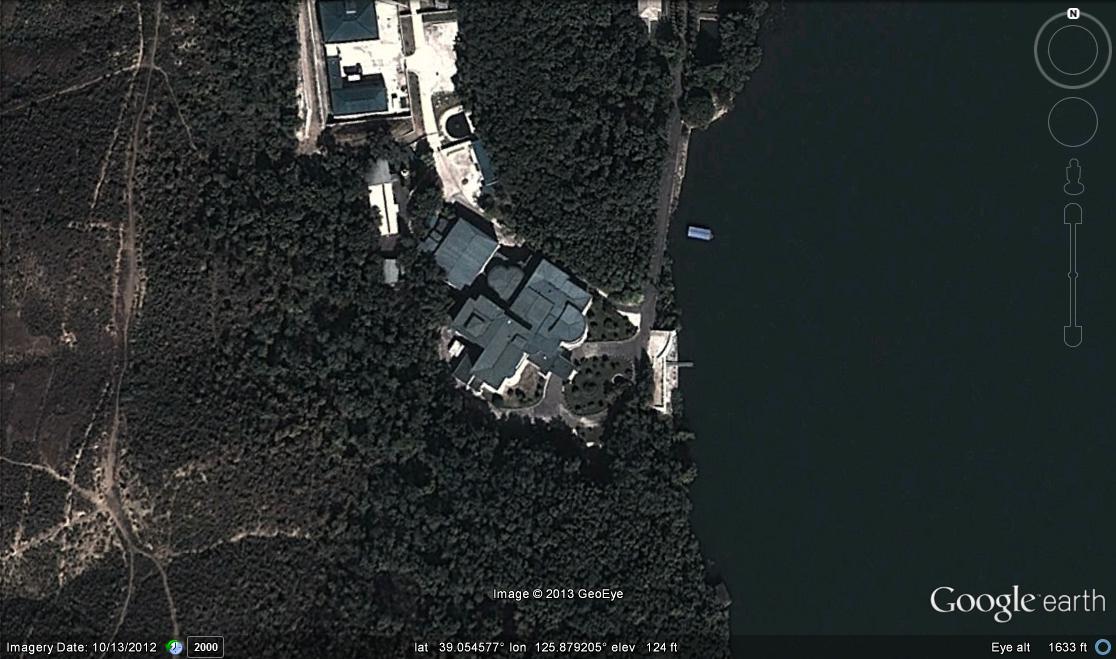
Pictured above (Google Earth): Manwoldae Palace in Kaesong, DPRK. See in Google Maps here.

According to Yonhap:

South Korea’s Unification Ministry said Sunday it has allowed a group of historians to visit North Korea this week for the resumption of a long-stalled joint project to excavate an ancient royal palace site.

The approval is another sign of lessening tensions on the divided Korean Peninsula, as Seoul is easing restrictions on civilian contact with Pyongyang following a year of animosity caused by the North’s deadly military attacks on the South.

On Monday, 14 South Korean historians will travel to the North’s border city of Kaesong, the site of Manwoldae, the royal palace of the Goryeo Dynasty that ruled the Korean Peninsula from 918 to 1392.

During their 10-day stay in Kaesong, the South Korean experts will conduct a safety survey on the site with their North Korean counterparts, a ministry official said.

“Based on the results of the safety survey, the joint excavation work will begin on Nov. 24 for one month,” the official said on the condition of anonymity.

The two Koreas launched the excavation project in 2007, but South Korea halted it last year as part of its sanctions against Pyongyang for the March sinking of a South Korean warship blamed on the North.

Seoul’s new Unification Minister Yu Woo-ik, who took office in September, has said he would consider “flexibility” in dealing with North Korea. The ministry is in charge of North Korea policy.

Kaesong served as the capital for most of Goryeo’s reign. Now it is home to an industrial complex run by both Koreas.

The Choson Ilbo also covered this story.

Read the full story here:
S. Korea OKs historians’ visit to N. Korea
Yonhap
2011-11-13

Share

Air Koryo launches/cancels Kuwait service

Thursday, November 10th, 2011

UPDATE 3 (2011-11-15): NK News has more on the unofficial Air Koryo Facebook Page here.

UPDATE 2 (2011-11-12): The unofficial Air Koryo Facebook Page posted the following comment in response to a question about service to Kuwait (thanks to a reader for the pointer):

It is not canceled. It is restricted bookings just like Moscow services.

The comment is followed by this one:

Kwang-tae Kim: I am a reporter of South Korea’s Yonhap news agency. Can u elaborate on why bookings are restricted and when bookings will be resumed? Some people speculated that it could be North Korea’s attempt to prevent the news of popular uprisings in the Arab world from reaching North Korea. Do u have any comment? Thanks

UPDATE 1 (2011-11-12): According to Yonhap:

North Korea’s flag carrier has canceled an air route to Kuwait, Airline Route blog says, in what could be Pyongyang’s latest attempt to prevent the news of popular uprisings in the Arab world from reaching the isolated country.

The move came less than six months after Air Koryo started a weekly direct flight service between Pyongyang and Kuwait City, Airline Route said Monday on its Web site, citing the carrier’s planned winter operation.

In late May, Air Koryo announced the service on its Facebook page, adding that a large number of North Koreans work in the Middle East.

The North’s airline has not yet commented on the reported cancellation of the service on its Facebook page, which was last updated late in October.

Here is the source information for this story:

As per 07NOV11 GDS timetable display, the following is North Korean flag carrier Air Koryo’s planned Winter 2011/12 operation.

Pyongyang – Bangkok
JS153 FNJ1020 – 1420BKK T20 4
JS154 BKK1220 – 2000FNJ T20 4

Pyongyang – Beijing
JS151 FNJ0900 – 0955PEK T20 26
JS251 FNJ1030 – 1130PEK T20 4

JS152 PEK1255 – 1600FNJ T20 26
JS252 PEK1405 – 1710FNJ T20 4

Pyongyang – Kuala Lumpur
JS159 FNJ1340 – 2000KUL T20 14
JS160 KUL2300 – 0730+1FNJ T20 25

Pyongyang – Kuwait Service Cancelled

Pyongyang – Shenyang
JS155 FNJ1200 – 1210SHE T20 36
JS156 SHE1500 – 1710FNJ T20 36

Pyongyang – Vladivostok
JS271 FNJ0830 – 1220VVO T20 5
JS272 VVO1830 – 1820FNJ T20 5

On an similar note, according to the Air Koryo Facebook page (Oct 28):

Air Koryo 2012 European Charters:

We are glad to announce to our European Union fans that Air Koryo will indeed be operating a seasonal service to Germany with a service from Pyongyang’s Sunan to Berlin’s Schonefeld airport. The serivces will operate from April till May 2012 and will operate weekly. Service dates are currently listing as first departure of 12 April and final flight 3 May. All service will be operated by Tupolev Tu-204 aircraft.

More information including timetable and official route i.e. non-stop or one stop will be released soon.

The flight will operate via Moscow Sheremetyevo Airport, the flights will operate on alternate dates to the weekly direct flight to Moscow. Note that the flight to Berlin will be a direct flight, and not non-stop. The service will be operated by the larger Tu-204-100E

ORIGINAL POST (2011-6-1): According to an online aviation forum:

Air Koryo are opening a new route to Kuwait City, to operate once a week.

Outbound (Tue, day 2): JS 161 FNJ 1800 / KWI 0110+1
Return (Wed, day 3): JS 162 KWI 1400 / FNJ 0500+1
Aircraft: Tupolev Tu-204-300

From the schedule it is obvious that the aircraft parks for thirteen hours, enabling the crew to have an eight hour sleep before operating the machine back to Pyongyang.

The Tu-204-300 is the long haul, “SP” version of the 204, and the Air Koryo machine (they have just the one, plus a pair of regular -200s) is the only airframe of the type exported from Russia. It is also used on flights to Moscow, plus Beijing of course.

It is an interesting choice of route out of the hermit kingdom. The airline says, “We are glad to announce Air Koryo has started serving Kuwait City, the capital of the Arabic nation of Kuwait, with a weekly Tupolev Tu-204-300 serivce. The route offers many connections onto the Middle East, Iran, Africa and offers business links in the region.”

A reader in the comments points out that one of the DPRK’s new Tupolevs was in Kuwait on March 25, 2011 at 10:54 CET, so the route may already be in use.

In April 2011, Air Koryo announced regular service to Kuala Lumpur.

UPDATE: This was apparently picked up by VOA and Yonhap.

Share

DPRK highlights friendship with China through new stamps

Monday, November 7th, 2011

KCNA posted some new commemorative stamps today highlighting the friendship felt between fraternal socialist leaders (click images to see larger versions):

Kim Il-sung with Mao Zedong (L) and Deng Xiaopeng (R)


Kim Jong-il with Jiang Zemen (L) and Hu Jintao (R)


Chairman Mao as a youth

According to KCNA:

Pyongyang, November 7 (KCNA) — The DPRK State Stamp Bureau has published four sheetlets and an individual stamp to mark the anniversaries of the establishment of diplomatic relations between the DPRK and China and the entry of the Chinese People’s Volunteers into the Korea front.

Printed in the sheetlets are Korean and Chinese letters “DPRK-China Friendship” and “DPRK-China Friendship Is Everlasting”, as well as flags of two countries.

Seen in the sheetlets are portraits of President Kim Il Sung and leader Kim Jong Il and photos of Chinese leaders Mao Zedong, Deng Xiaoping, Jiang Zemin and Hu Jintao.

The stamps also carry pictures of Kim Il Sung and Kim Jong Il meeting with Chinese leaders.

The individual stamp contains an oil painting portraying Chairman Mao Zedong.

Share

Japan – DPRK football match 2011

Sunday, November 6th, 2011

UPDATE 1 (2011-11-6): According to the Wall Street Journal:

Japanese football fans are scrambling to secure one of the few seats available on an organized spectator tour to watch the national football team’s World Cup qualifying match against North Korea in Pyongyang on Nov. 15.

It is the first time Japan will play against its enigmatic neighbor on the latter’s home soil in 22 years.

The absence of diplomatic ties between Japan and North Korea has turned coordinating plans into a logistical workout for the Japan Football Association. It has also put a high premium on the 150 tickets available to Japanese citizens, according to the limit imposed by North Korea. The JFA said it is still negotiating with North Korea to try to raise that number.

Just 65 tickets are available for the official tour package. Ticket sales opened Tuesday, sold via Tokyo-based Nishitetsu Travel Co. The travel agency was already taking down names for a waiting list by the following morning.

The three-day, two-night excursion is priced at about ¥288,000, or roughly $3,700. Because there are currently no direct flights to Pyongyang, a special charter was arranged.

Even then, the trip was almost called off. The Japanese government only gave its formal approval Tuesday in support of the team, JFA officials and fans visiting the country: Tokyo has strongly discouraged residents from visiting North Korea citing economic sanctions imposed by Tokyo after a missile launch in 2006. (North Koreans are banned from entering Japan)

Meanwhile, another 65 tickets that were available for the trip were sold. Seats for a choice of two packages to Pyongyang sold out last month, according to Serie Co., a Tokyo-based travel company that organizes football tours. While there was more interest in attending this game compared to past qualifying matches, company president Masashi Tokuda said, there was also more anxiety. Following numerous inquiries, Mr. Tokuda and other employees went to North Korea to inspect the destination spots that would be on the tour—Kim Il-Sung Stadium where the match will be held, restaurants, hotel and sightseeing areas. The company posted its findings on its website.

While Japan isn’t alone in its strained relations with North Korea, traces of the two countries’ unique history has materialized on the football field. North Korea’s national team draws a lot of its power from a clutch of players who are ethnically Korean, but were born and raised in Japan and identify themselves as North Korean. Now playing in Japan’s professional football league, they are third- or fourth-generation Koreans who migrated or were forcefully moved to Japan when the Japanese colonized the country from 1910-1945.

As for the match itself, Japan will be a heavy favorite, ranked No. 17 in FIFA’s world rankings to North Korea at No. 124.

And the Samurai Blue most recently defeated North Korea 1-0 in September in Saitama, Japan.

But, as sports fans know all too well, home-team advantage can be a game-changer. North Korea won 2-0 the last time the two countries faced off in Pyongyang in June 1989.

Win, lose or tie, Japan fans making the trip should bear one other thing in mind: Both tour companies said bringing noise makers and team banners to North Korea is prohibited.

ORIGINAL POST (2011-11-2): First of all, Japan is going to allow a delegation to visit the DPRK for a World Cup qulaifying match.  According to the Mainichi Daily News:

Japan will allow supporters of the national soccer team along with accompanying press to visit Pyongyang to watch a World Cup qualifier against North Korea later this month, top government spokesman Osamu Fujimura said Tuesday.

The decision is an exceptional measure to be taken by Japan, which has asked its nationals to refrain from visiting North Korea as part of sanctions imposed following North Korea’s missile launch in July 2006.

The chief Cabinet secretary said at a news conference that the exception will only apply for members of the national team, and accompanying reporters and supporters who register for official tours organized by the Japan Football Association to attend the Nov. 15 qualifier for the 2014 FIFA World Cup.

Fujimura said the government decided to make an exception for the match because there is “great national interest.” He also said the government believes it should avoid any negative feedback on Japan’s bid to host international competitions such as the Olympics by not having politics interfere in sports activities.

According to JFA vice president Kozo Tashima, North Korea plans to only allow up to 150 Japanese supporters to enter the country. The JFA will continue to negotiate with North Korea about increasing the number, Tashima said.

The JFA, after discussing the matter with the government, initially asked the North Korean soccer association to arrange for the entry of 200 to 300 people. But the request was rejected because of limited capacity at hotels and on chartered flights, according to Tashima.

The JFA said the official tour led by Nishitetsu Travel Co. will offer 65 places and its application process will last until Friday. About 10 JFA officials are expected to join the tour.

The government will ban travelers from carrying goods to or from North Korea and ask them to notify the government if they intend to take over 100,000 yen in cash.

In August, Japan allowed the North Korean national team to enter the country for a World Cup qualifying match, in a similar exception to the ban in principle on North Koreans coming to Japan that was imposed in protest at Pyongyang’s nuclear weapons testing in October 2006 among other bilateral issues.

Read the full story here:
Japan to allow supporters to visit N. Korea for World Cup qualifier
Mainichi Daily News
2011-11-2

Share

US State Department issues new DPRK travel warning

Saturday, November 5th, 2011

According to the State Department web page (November 3):

Travel Warning
U.S. DEPARTMENT OF STATE
Bureau of Consular Affairs
Korea, Democratic People’s Republic of

November 03, 2011

The Department of State continues to warn U.S. citizens about travel to North Korea (Democratic People’s Republic of Korea, or DPRK). The North Korean government will detain, prosecute, and sentence those who enter the DPRK without first having received explicit, official permission and an entry visa from its government. Travel by U.S. citizens to North Korea is not routine, and U.S. citizens crossing into North Korea, even accidently, have been subject to arrest and long-term detention. Since January 2009, four U.S. citizens have been arrested for entering North Korea illegally. In 2010, a fifth U.S. citizen, who had a valid DPRK visa in his U.S. passport, was arrested inside North Korea on unspecified charges.

The Government of North Korea imposes heavy fines and long prison sentences with hard labor on persons who enter the country without a valid passport and a North Korean visa. If you travel unescorted inside North Korea without explicit official authorization, North Korean security personnel may view your actions as espionage.

Security personnel may view any unauthorized attempt you make to talk to a North Korean citizen as espionage. North Korean authorities may fine or arrest you for unauthorized currency transactions or for shopping at stores not designated for foreigners.

It is a criminal act in North Korea to show disrespect to the country’s current and former leaders, Kim Jong Il and Kim Il Sung. North Korean authorities have threatened foreign journalists who questioned the policies or public statements of the DPRK or the actions of the current leadership

North Korean government authorities may also view taking unauthorized pictures as espionage, confiscate cameras and film, and/or detain the photographer. DPRK border officials routinely confiscate visitors’ cell phones upon arrival, returning the phone only upon departure. Foreign visitors to North Korea may be arrested, detained, or expelled for activities that would not be considered criminal outside the DPRK, including involvement in unsanctioned religious and political activities, engaging in unauthorized travel, or interaction with the local population.

The United States and the DPRK do not have diplomatic and consular relations. Since the United States does not maintain diplomatic or consular relations with North Korea, the U.S. government cannot provide normal consular services to its citizens in North Korea. The Swedish Embassy, the U.S. Protecting Power in the DPRK capital of Pyongyang, provides limited consular services to U.S. citizens traveling in North Korea who are ill, injured, arrested, or who have died while there. However, the Protecting Power cannot get U.S. citizens out of jail or pay their criminal fines.

U.S. citizens who plan to travel to North Korea are strongly encouraged to contact the U.S. Embassy in Beijing, China about their trip by enrolling in the State Department’s Smart Traveler Enrollment Program. If you have received official permission and are going to visit North Korea by transiting China, please take the time to tell the U.S. Embassy in Beijing, China, about your trip. If you check in, we can keep you up to date with important safety and security announcements. You will also help your friends and family get in touch with you in an emergency. By enrolling, you make it easier for the U.S. Embassy or Consulate to contact you in case of an emergency. Here is the link to the State Department’s Smart Traveler Enrollment Program.

China residents can contact U.S. Embassy Beijing directly:

U. S. Embassy Beijing: The Embassy is located near the Ladies’ Street (Nuren Jie) and Laitai Flower Market, opposite the Kempinski Hotel and Lufthansa shopping Center.

U.S. Embassy Beijing
American Citizens Services Unit
No. 55 An Jia Lou Road
Chaoyang District

Beijing, China 100600
Telephone: (86-10) 8531-4000
Facsimile: (86-10) 8531-3300
Email: amcitbeijing@state.gov
Emergency after-hours telephone: (86-10) 8531-4000

You may also wish to contact the Embassy of Sweden by telephone or email about your trip:

The Embassy of Sweden Pyongyang (U.S. Protecting Power) in North Korea.
Munsu-Dong District
Pyongyang, DPRK
Telephone: (850-2) 3817 485 (reception)
Telephone: (850-2) 3817 904, (850-2) 3817 907 (First Secretary)
Telephone: (850-2) 3817 908, (850-2) 3817 905 (Ambassador)
Facsimile: (850-2) 3817 663
Email: ambassaden.pyongyang@foreign.ministry.se

U.S. citizens should also consult the Department of State’s Country Specific Information for North Korea, and the current Worldwide Caution, which are located on the Department’s Internet travel website. U.S. citizens can obtain current information on safety and security conditions by calling 1-888-407-4747 toll-free in the United States and Canada or, from outside the United States and Canada, +1-202-501-4444. These numbers are available from 8:00 a.m. to 8:00 p.m. Eastern Time, Monday through Friday (except U.S. federal holidays).

Share

Seoul to begin Kaesong road repair

Thursday, November 3rd, 2011

According to Yonhap:

South Korea will next week start repairing a road used by North Korean commuters to reach an inter-Korean industrial complex in the North, an official said Thursday amid signs of a thaw in bilateral relations.

The 4.5-kilometer road linking North Korea’s border city of Kaesong to the nearby industrial park is used by more than 47,000 North Korean workers who are employed by some 120 South Korean firms operating in the zone. South Korean officials earlier said the road was damaged in summer’s torrential rains, prompting the South to conduct an on-site survey.

“After signing an agreement (with the North), we expect to start repair work next week,” said an official at the Unification Ministry, which handles inter-Korean relations in the South.

“It will likely take about three months to complete the work, unless the weather becomes too cold, and cost us around 1.8 billion won (US$1.59 million),” the official said, speaking on condition of anonymity.

The repairs will involve restoring damaged paved sections and filling in holes on unpaved sections. Repairing the road is expected to save time for North Korean commuters and reduce traffic accidents.

The Daily NK offers some additonal information:

A government official explained today that the decision was made pursuant to agreement between the Kaesong Industrial Complex Management Committee, LH Construction and the North Korean authorities.

“The agreement has not yet been signed, but we are hoping to start the construction at the beginning of next week,” the official explained.

“Our side has taken on responsibility for planning the road repairs and supervising the construction,” he went on. “The weather could change things, but the construction should require three months and is expected to cost 1.8 billion South Korean won.”

Aside from the aforementioned construction, there are also plans to reconstruct two turning points for buses serving the complex. The human resources for the construction will be provided by North Korea.

There are plans to extend bus service to cover the areas of Pongchon (봉천), Kumchon (금천), and Phyongsan (평산). However, the roads to these areas are unpaved and extension of transportation services to these areas will require negotiations with the North Korean authorities.

Read the full story here:
Seoul to start repairing road leading to Kaesong complex next week
Yonhap
2011-11-3

Share

China-DPRK consternation over Hyesan-China bridge

Tuesday, November 1st, 2011


Pictured above: (L) A low-resolution image of the Hyeasn-China bridge (Google Earth) (R) A ground level photo of the bridge.

According to the Daily NK:

Construction work on a bridge connecting Hyesan in Yangkang Province and Changbai in China’s Jilin Province is raising hackles in the corridors of Sino-North Korean economic cooperation.

According to a source in China, both China and North Korea recognize that the existing ‘Friendship Bridge’ spanning the Yalu River between the two cities cannot handle increasing trade volumes. In particular, increasing copper ore production from Hyesan Youth Mine (which has been developed with Chinese capital) is putting it under unsustainable strain.

However, while China wants North Korea to expand and reinforce the existing bridge, North Korea is apparently pushing for the construction of an entirely new bridge in a different location using Chinese capital.

North Korea’s reason is supposedly one of revolutionary history. According to the source, “Chosun is opposed to the expansion of the bridge because right next to the bridge on the Hyesan side there is a stone commemorating a visit by Kim Jong Il.”

The 5m x 2m granite stone in question was set in place to commemorate the time on June 5th, 1956 when Kim Jong Il and his Pyongyang No. 1 Senior Middle School comrades stopped there during a trip to Mt. Baekdu and looked around an old royal building.

However, money also appears to be an issue. “In particular,” according to the source, “they are stubbornly insisting that ‘if you need a bridge, you should bear the burden of its construction.’”

In any case, the limitations of the bridge in its current condition are perfectly clear. It only has one lane, meaning that transit in both directions is impossible, and, though only built in 1985, there are very real concerns that its concrete structure cannot handle the Chinese heavy vehicles transporting copper ore away from the mine.

One other problem for North Korea is that the bridge is connected to Hyesan Customs House; the road off the bridge passes through the middle of the blue-roofed customs house, while the second floor houses the customs office itself. Therefore, expansion of the bridge would also involve redesigning the customs house. Due to fast flowing waters to the east, the only direction in which it is possible to expand is to the west; however, that is exactly where the commemorative stone is. Not only that, it is also the location of the local Kim Il Sung Revolutionary History Museum and Kim Jong Suk Art Theater.

Therefore, the source said North Korea has put forward an area around 4km east of the existing Hyesan Customs House as a possible candidate location for a new bridge. However, the suggested area is relatively unfavorable in terms of river width and topography, which would drive up construction costs. Given that North Korea is demanding that China bear the weight of these costs, it seems unlikely that agreement will be reached under the current conditions.

In the words of the source, “Chosun is making totally nonsensical demands. No conclusion is likely for the time being.”

This is not the first time that bridges spanning the Sino-North Korean border have been a source of friction between the two countries. Following a similar spat in 2005, China simply completed reinforcement work on its own half of a bridge between Hoiryeong and Sanhe, leaving the other half in its original state.

Related material:
1.  A Chinese company has mad a substantial investment into the Hyesan Youth Mine.

2. China is building a new bridge to the DPRK just west of the bridge linking Dandong and Sinuiju.

Read the Daily NK story here:
A Troubled Bridge between Friends
Daily NK
By Kang Mi Jin
2011-11-1

Share

China – DPRK tourism and trade stats

Sunday, October 30th, 2011

Visits: According to the Daily NK, 116,400 North Koreans have visited China this year:

116,400 North Koreans visited China officially between January and September, 2011, according to new statistics released by the National Tourism Administration of China.

The statistics reveal that 55,000 of them visited to find work; 27,000 for a business trip; 3,000 were tourists; and 100 were visiting relatives. 24,000 did not record the purpose of their visit.

45,000 of them traveled by boat; 24,900 by airplane; 14,300 by train and 3,700 entered on foot.

The largest proportion was between the ages of 45 and 64 (52,000); 47,000 were between 24 and 44. 95,000 were men, and 14,900 were women.

According to the same statistics, the highest number of visitors to China in the same period came from South Korea (3.2 million trips), followed by Japan (2.6 million trips). Overall, North Korea ranks 11th out of the 15 countries in Asia.

Trade: According to the Associated Press:

China’s trade with its close ally North Korea nearly doubled in the first seven months of the year compared with the same period in 2010, state media reported Sunday.

The 87 percent increase to $3.1 billion was announced at the start of a visit to the North by Chinese Vice Premier Li Keqiang that reaffirms strong ties between the communist neighbors.

North Korea relies heavily on China for food and fuel aid and many consumer products. Chinese companies are the main investors in North Korean mining, and the sides recently signed agreements on road building and jointly developing an industrial park on an island near the Chinese city of Dandong.

“The economic and trade cooperation between the two countries has shown great potential, with bilateral trade and investment volume reaching new highs,” Xinhua said, citing the Chinese ambassador to Pyongyang, Liu Hongcai.

Bilateral trade between China and North Korea still is dwarfed by economic ties between China and South Korea. China is South Korea’s largest trade partner.

Trade between Beijing and Seoul rose more than 20 percent in the first eight months of the year to $159 billion and is expected to hit about $250 billion for all of 2011.

It should go without saying that officially reported merchandise trade between the PRC and DPRK understates the economic relationship between the two nations.   What goes unreported is illicit border trade, aid, military assistance and other forms of financial support.

Read the full stories here:
China says trade with NKorea has nearly doubled
Associated Press
2011-10-22

Share

Multidrug-resistant tuberculosis health risk in DPRK

Thursday, October 27th, 2011

According to Yonhap:

Multidrug-resistant tuberculosis has emerged as a major public health problem for North Korea, a private foundation said Thursday, calling for public donation to help combat the highly contagious disease.

Stephen W. Linton, chairman of the Eugene Bell Foundation, said his foundation currently treats some 600 multidrug-resistant patients in six medical centers in the North, but hundreds of people are still on the waiting list.

You can read more about the Eugene Bell Foundation’s work in the DPRK here.

Previous posts on the Eugene Bell Foundation here. Their web page is here.

Read the Yonhap story here:
Multidrug-resistant tuberculosis poses public health risk in N. Korea
Yonhap
2011/10/27

Share

On the DPRK and Libya in 2011

Wednesday, October 26th, 2011

Pictured above: (L) Kim Il-Sung and Muammar Gaddafi attend a Mass Games performance in Kim Il-Sung Stadium, (R) Muammar Gaddafi gives an award to Kim Il-Sung

Pictured above (Google Earth): DPRK-Libya Friendship Farm at Jangchon-dong (장천동: 38.987331°, 125.842014°).  More background here.

UPDATE 6 (2011-10-26): Yonhap offers more details on the North Koreans who remain in Libya:

North Korea has banned its citizens in Libya from returning home in an apparent attempt to prevent the popular uprisings in the Arab world from reaching the isolated regime, a source said Wednesday.

About 200 North Koreans have been left in limbo in the war-torn country as Pyongyang ordered them not to return home, the source familiar with the issue said.

The North Korean doctors, nurses and construction workers were sent to the African nation to earn hard currency for their impoverished communist country.

North Korea has also taken similar steps for its officials in Libya, Egypt and other countries, said the source.

UPDATE 5 (2011-8-30): According to the Korea Times:

North Korea has not yet officially recognized the rebel National Transitional Council (NTC) in Libya as the North African nation’s legitimate governing authority, said an official at the North Korean Embassy in Tripoli, Monday.

Asked whether Pyongyang has granted recognition to Libya’s NTC, the official was quoted as saying by Yonhap News Agency, “Not yet … (we’ll have to) wait and see.” The official, who wished to remain unidentified, was speaking to reporters at the North Korean Embassy in Tripoli.

The official also confirmed reports that some 200 North Koreans are currently working in Libya as doctors, nurses and construction workers. With regard to their safety, the official said some have returned home, although others have not been able to leave due to difficulties in transit.

“We will deal with them depending on the circumstances,” the official was quoted as saying.

The North Korean Embassy building has not been looted or damaged in the six-month-long conflict, the official added. In the past week, the South Korean Embassy building and ambassador’s residence in Tripoli were attacked by armed robbers, although no one was hurt in either incident.

Pyongyang has yet to send a new ambassador to Tripoli, after the previous envoy returned to North Korea upon completing his term, the official said.

Between the two Koreas, Pyongyang was the first to establish diplomatic relations with Tripoli in 1974.

“We hope for peace and stability (in Libya),” the official said, adding that future relations between the nations will depend on the North African nation’s stability.

Some 50 to 60 countries, including South Korea, have recognized the NTC since its formation by rebel forces against the regime of Moammar Gadhafi in February.

Read the full story here:
North Korea yet to recognize Libya’s rebel NTC
Korea Times
Philip Iglauer
2011-8-30

UPDATE 4 (2011-5-16): According to the Daily NK, NATO denies hitting the embassy:

“It has been alleged that NATO attacked the embassy; this is simply not true,” NATO said in a statement released on Friday, “While we are aware of media reports that there was damage to the North Korean embassy, we have no knowledge of possible collateral damage.”

The statement came following one released Thursday by the Libyan Ministry of Foreign Affairs, stating North Korean claims that it had incurred damage as a result of a “barbaric, indiscriminate air raid” by NATO.

It described how a bomb exploded in the vicinity of the embassy during the night of May 9th, releasing shrapnel that penetrated the ceiling of the building and broke car windows.

While NATO conceded that it was targeting a bunker in central Tripoli that night, it said that “the embassy was located some 500 meters from the target we struck.”

“Our strikes are precise and while the possibility of collateral damage will always exist, we go to great lengths to reduce such possibilities,” it went on.

Earlier, Libya national television also reported that the North Korean embassy in Tripoli had been damaged during an air raid.

UPDATE 3 (2011-5-12): Libya and China’s Xinhua are reporting that NATO damaged the DPRK embassy in Tripoli. KCNA has not said anything as of now.  According to Xinhua:

Libya’s state television said on Thursday a NATO air strike damaged the DPRK embassy in the capital Tripoli without giving more details.

Earlier reports indicated that the staff of the embassy has been unable to return home during the uprising.

Here is video footage of the embassy.

UPDATE 2 (2011-5-8): North Korea exported nuclear materials to Libya (Korea Herald and VOA):

The nuclear materials found in Libya in 2004 were highly likely to have been produced by North Korea, U.S.-funded broadcaster Voice of America said Saturday, citing an interview with a former senior official of the U.N. nuclear watchdog.

In the interview, Olli Heinonen, the former deputy director general of the International Atomic Energy Agency, said uranium hexafluoride, or UF6 ― used in uranium enrichment in Libya ― was very likely to have been made by the communist state.

Heinonen made the allegations based on North Korea’s purchase of parts to develop nuclear capabilities, information provided by Pakistan and other pieces of evidence.

To the question of whether there is any connection between the North and Syria with regard to nuclear technology developments, he said that that should be further investigated. He added that a nuclear reactor in Syria, which Israel destroyed, was very similar to North Korean reactors, indicating the possible connection between the two states.

The former deputy director general also said there was a good chance that North Korea has uranium enrichment facilities in areas other than the Yongbyon nuclear complex, stressing that IAEA inspectors should visit those facilities, provided they are allowed to do so.

Touching on the possibility of the North abandoning its nuclear programs, Heinonen said that the North could renounce them if the abandonment would lead to its economic development and security assurance.

The six-party talks aimed at denuclearizing the North have been suspended since 2008. China, the host of the multilateral talks, has been seeking to establish a mood for the dialogue while the South is apparently reluctant to see the resumption of the talks immediately as inter-Korean issues, including two deadly attacks last year, have yet to be addressed.

UPDATE 1 (2011-4-10): The DPRK has apparently ordered many of its citizens to remain in Libya and other Arab nations.  According to Yonhap:

North Korea has ordered its people in Libya not to return home, apparently out of fear that they will spread news of the anti-government uprisings in the African nation, a source said Sunday.

In a letter sent to the North Korean embassy in Libya, Pyongyang ordered its people to “follow the measures of the Libyan government” and not return home, said the source familiar with North Korea affairs.

The move sharply contrasts with other countries’ efforts to evacuate their people from strife-torn Libya and demonstrates the Pyongyang regime’s fear of possible revolts triggered by the African nation’s pro-democracy protests of the past few months, according to the source.

More than 200 North Koreans are believed to be living in Libya to earn foreign cash while working as doctors, nurses and construction workers.

Between the two Koreas, Pyongyang was first to establish diplomatic relations with Tripoli in 1974, followed by a cooperation pact signed by Libyan leader Moammar Gadhafi during his visit to the North in 1982.

North Koreans in Middle Eastern nations such as Saudi Arabia, Kuwait and the United Arab Emirates also appear unlikely to be able to return home while anti-government protests continue in the region.

Sources say the North Korean government in recent months has tightened control over the flow of information by strictly monitoring the use of computers, mobile phones, USB memory sticks and other IT equipment.

ORIGINAL POST (2011-3-29): Andrei Lankov writes in the Korea Times about the effects NATO military intervention in Libya might have on the DPRK’s medium-term international relations strategies. According to his article:

Kim Jong-il right now may feel very happy about his wisdom which he demonstrated by stubbornly rejecting denuclearization proposals. Colonel Gadhafi in 2003 did exactly what Kim said he would never do ― Gadhafi agreed to swap his nuclear weapons program for better relations with the West and economic rewards. As we see, it did not help the eccentric strongman. Once his subjects rose in rebellion, the West intervened and chose its military might to assist the rebels.

In private conversations, North Korean officials often say: “Had Sadam had nukes he would still be in his palace right now.” From now on, they probably will add: “And had Gadhafi not surrendered his nukes, nobody would have intervened when he was exterminating the rebels.”

But what is the likely overall impact of such thinking on the North Korean actions? If anything, it increases the already high probability of another nuclear test and/or missile launch. The preparations for such undertakings have been underway for some time. Now, North Korean leaders might believe that this is a good time to show off their steadily growing nuclear and missile capabilities. This is a way to send a message to the Obama administration, and the message will read like this: “Mr. President, we are dangerous and its better not to get involved with us even if we do something which is not to your or anybody’s liking”.

At the same time, it’s now less likely that North Korea will attempt a major provocation aimed at South Korea. Until recently, one could be almost certain that in the near future (in April or May, perhaps), the North would repeat what they did with frigate Cheonan and Yeonpyeong Island. Now they will probably think twice before making another attack.

While the attacks on Cheonan and Yeonpyeong Island are usually described as “provocations” this is essentially a misnomer. “Provocation” describes an act whose goal is to elicit an irrational and/or excessive reaction from the target of the incident. It was clearly not the case with the Cheonan or Yeonpyeong attack. The North attacked under the assumption that the South would not react in a meaningful way and would be incapable of inflicting any serious damage on assets valuable to the North Korean leadership (the lives of rank-and-file soldiers do not belong to this category).

North Koreans are aware that currently the South Korean public and government are in an unusually bellicose mood. They therefore expect a massive retaliation to follow in the event of another attack. Until recently the North Korean leadership probably anticipated that the South Korean retaliation would be limited, since neither the South nor its major ally, the United States, would do anything which might lead to an escalation of an exchange of fire on the border to a full scale war.

Therefore from Pyongyang’s point of view, another military operation made perfect sense. It would be a good way to demonstrate that North Korea is not going to be quiet when ignored. They wanted to show that for Seoul and Washington, it’s essentially cheaper to pay some protection money to Pyongyang (in the shape of aid and concessions) than to deal with the ever-present possibility of a North Korean attack and related sense of tensions and instability.

However, the recent developments in Libya might have changed the equation ― for a while, at least. Libya shows that under certain circumstances the U.S. and its major allies may indeed choose to launch a large-scale military operation. The assumption that Seoul and Washington will avoid escalation seems still to be true, but Pyongyang may have started to have grave doubts about this.

So it is quite possible that the coming spring will be quieter than the present author (and many of his colleagues) have until recently expected. This does not mean that North Korea has turned into a pacifist state, but from the vantage point of Pyongyang it makes sense to postpone their operations against the South and wait for the dust to settle. And of course, by being quiet for a while they can save resources which will be needed to better prepare the next missile launch and next nuclear test.

Though Lankov refers to North Korean officials in “private conversations,” the North Korean foreign ministry made essentially the same claim in a public statement on March 22 (KCNA):

The present Libyan crisis teaches the international community a serious lesson.

It was fully exposed before the world that “Libya’s nuclear dismantlement” much touted by the U.S. in the past turned out to be a mode of aggression whereby the latter coaxed the former with such sweet words as “guarantee of security” and “improvement of relations” to disarm itself and then swallowed it up by force.

It proved once again the truth of history that peace can be preserved only when one builds up one’s own strength as long as high-handed and arbitrary practices go on in the world.

The DPRK was quite just when it took the path of Songun and the military capacity for self-defence built up in this course serves as a very valuable deterrent for averting a war and defending peace and stability on the Korean Peninsula.

Since then, they have published 16 stories about Libya: Demonstration Staged in Russia against US Military Operation against Libya, US Involvement in Libya Protested, AU Chairperson Rejects Military Intervention in Libya, Indiscriminate Use of Arms against Libya Assailed, Algeria Opposes Military Intervention in Libya, Military Operation in Libya Condemned in Russia , Venezuelan President Censures West’s Attack on Libya, Iranian Foreign Ministry Assails West’s Military Operation against Libya, Ugandan President Blasts West for Double Standards,  India Regrets Air Strikes on Libya, AU Demands Stop to Attack on Libya , Russian PM Brands Military Operation against Libya as Invasion, Russia Assails Military Attack on Libya , China Concerned about Libyan Crisis, Russia Opposes Military Attack on Libya , Foreign Forces’ Armed Intervention in Libya Assailed in Cuba.

In fact, there are hundreds of KCNA stories about Libya.  Check them out here (STALIN Search Engine).

The Daily NK, however, reminds us of one the the most important aspects of the DPRK-Libya relationship:

Libyan leader Colonel Muammar Qadhafi has been using weapons purchased from North Korea in his faltering attempt to suppress anti-government protests.

As revealed by South Korean television broadcaster SBS on the 28th, boxes containing rockets and clearly bearing the name North Korea were found in Ras Lanuf following the retreat of pro-Qadhafi forces under NATO air strikes.

The boxes were disguised as parts for bulldozers.

Elsewhere, “64 Machine gun” was found written in Korean on an anti-aircraft heavy machine gun. A similar model of machine gun has been seen many times in images released by the North Korean authorities.

Check out the article for pictures.

UPDATE: Writing at the Wall Street Journal Blog, Evan Ramstad gets a quote from Bruce Bechtol:

“It just goes to show how deeply involved in the arms market (in the Middle East and Africa) North Korea is,” said Bruce Bechtol, a former intelligence officer with the Defense Intelligence Agency in the U.S. who is now a professor at San Angelo State University.

“Their WMD [weapons of mass destruction] proliferation gets lots of attention, but folks often forget that they also engage in a plethora of conventional arms sales,” he said.

Would it be a stretch to assume that The DPRK and Libya have been trading oil for weapons?

Previous posts about the DPRK and Libya here.

This was picked up by RFA.

Share

An affiliate of 38 North