Archive for the ‘International Governments’ Category

North Koreans working in China (2013 and 2014)

Tuesday, November 11th, 2014

UPDATE 1 (2014-11-11): Yonhap has now published some more realistic numbers of North Koreans working in China:

The number of North Koreans going to China to find work rose an average 20 percent annually in the last three years, reaching a record 93,000 in 2013, a report by a local international traders association said Tuesday.

These North Koreans are usually paid barely more than half what Chinese workers get, according to the findings by the Korea International Trade Association (KITA).

The report said the rate of workers’ increase is more than twice as high as the 9.1 percent in overall rise of migrant workers entering China in the same period.

For 2014, 44,000 North Koreans have arrived in the world’s second largest economy to find jobs, roughly on par with figures from the year before.

KITA said the number of North Korean workers entering China constitutes 47.8 percent of North Koreans visiting the neighboring country as a whole. Last year some 207,000 North Korean nationals entered China, up sharply from 116,000 in 2010.

“The increase seems to be a win-win arrangement for both sides since workers send back money, which is an easy way for the cash-strapped communist country to get hard currency, while China benefits from cheap labor,” the trade association said.

North Korean workers are usually paid 260,000-280,000 won (US$238-256) per month, which is much less than 440,000-530,000 won that businesses pay Chinese citizens.

In particular, KITA said that agreements signed between Pyongyang and Liaoning, Jilin and Heilongjiang provinces and other regional authorities in the North Korea-China border areas in 2012 is effectively fueling the influx of cheap workers.

The agency said South Korean companies, however, that have set up operations in China are barred from using North Korean workers due to opposition from Pyongyang.

“There is a need to get North Korea to lift its ban on allowing its workers who can benefit these firms to be employed by a South Korean company,” a KITA official said. He said in the long term, it may be feasible to use North Korean workers, with their cheap labor costs, to allow South Korean firms to make inroads into China’s domestic consumer market.

Read the full story here:
Influx of N. Korean workers into China jumps 20 pct annually in 3 years
Yonhap
2014-11-11

ORIGINAL POST (2014-10-14): According to Yonhap:

About 7,000 North Koreans are estimated to be working in China’s border cities with the North, bringing hard foreign currency to the cash-strapped regime, a senior South Korean diplomat said Tuesday.

“We have estimated that there are around 2,500 North Korean workers in Dandong and some 4,500 North Korean workers in Yanbian Korean Autonomous Prefecture,” said Shin Bong-sup, consul general at the South Korean Consulate in the northeastern Chinese city of Shenyang.

Dandong is a Chinese border city where more than 70 percent of bilateral trade between North Korea and China is conducted. Yanbian, home to ethnic Koreans in China, also borders North Korea.

Shin gave the estimated number of North Korean workers in the Chinese border cities during an annual parliamentary audit in Beijing.

This number is much lower than I would have expected. In 2012, Yonhap reported that there were 4,000 North Koreans in Kuwait. Additionally, two stories in 2012 (see here and here) put the number of workers at 20,000-40,000.

However a recent report in the Daily NK indicates that cross-border family visits (which often involve significant business activity) are also on the decline this year.

Read the full Yonhap story here:
About 7,000 N. Koreans work in Chinese border cities: diplomat
Yonhap
2014-10-14

Share

North Koreans working on Qatar construction projects

Friday, November 7th, 2014

According to The Guardian:

In the sprawling construction zone that will eventually become Qatar’s gleaming $45bn (£28bn) Lusail City, where the 2022 World Cup final will be held, four construction sites are said to be using North Korean workers, although there is no suggestion they are involved in building World Cup stadiums.

On one site, North Koreans battled biting desert sands and searing heat to construct a luxury residential tower. They laboured on as day turned to night, long after workers from other nationalities had left the site.

One North Korean worker helping to build the high-rise said: “People like us don’t usually get paid. The money does not come to the person directly. It’s nothing to do with me, it’s the [North Korean recruitment] company’s business.”

A project manager of the lavish development said the workers “don’t have a single rial themselves” and “borrow money from us if they need small things like cigarettes”.

“The descriptions of the conditions North Korean workers endure in Qatar – abuse of vulnerability, withholding of wages and excessive overtime – are highly indicative of state-sponsored trafficking for forced labour,” a modern form of slavery, said Aidan McQuade, the director of Anti-Slavery International.

Sources in Qatar estimate there may be as many as 3,000 North Koreans working on projects across the emirate. They are part of an army of workers the North Korean regime exports around the world to bring in much-needed foreign currency. According to defectors’ groups, there may be as many as 65,000 North Koreans abroad, mainly working in Russia, China, Mongolia and the Middle East.

Kim Joo-il, a former army officer who escaped North Korea in 2005, estimates that the Pyongyang government typically takes 70% of the total salary of workers abroad, and that after all “fees”, notionally for food and accommodation, have been paid, workers will be left with only 10% of their salary.

Two employees of state-run North Korean recruitment firms operating in Qatar admitted that their workers do not receive their salaries in person, but insisted a proportion of their wages are sent back to the workers’ families in North Korea.

A spokesperson from the ministry of labour and social affairs said: “We take all issues around worker payment extremely seriously. There are currently 2,800 North Korean guest workers registered in Qatar and we have no recorded complaints about their payment or treatment. Qatar is determined to continually improve labour conditions for all who work in the country, and will continue to work with NGOs, businesses and other governments to achieve this.”

North Koreans are alleged to have participated in construction of facilities at South Africa’s World Cup as well.

Here are previous posts involving Qatar.

You can read the full story here:
North Koreans working as ‘state-sponsored slaves’ in Qatar
The Guardian
2014-11-7

Share

DPRK oil imports from China in 2014 (UPDATED)

Tuesday, November 4th, 2014

UPDATE 8 (2014-11-14): Yonhap speculates on Chinese oil exports to the DPRK:

China appears to be continuing to provide North Korea with crude oil, contrary to its customs data, officials here said Friday.

China exported not a single drop of crude oil to North Korea in the first nine months this year, according to formal data.

If true, it might reflect widespread speculation that the relations between the communist allies have been strained to some extent due to Pyongyang’s repeated provocative acts.

South Korean officials, however, believe China is continuing to send crude oil to North Korea either in hidden trade or in the form of aid.

“Without China’s provision of crude oil, the operation of many of North Korea’s industrial facilities and vehicles would be suspended. But there has been no such indication yet,” an intelligence official said.

Beijing may be deliberately excluding its crude oil shipments to Pyongyang from the customs data in a bid to give the world the impression that it is joining the international community’s efforts to put pressure on it, another government official said.

He dismissed the view that the North has replaced China with Russia as its main source of crude oil imports.

“North Korea has brought in more crude oil from Russia this year, but the total amount is still less than 100,000 tons,” he said.

North Korea used to import an annual average of half a million tons of crude oil from China. (Yonhap)

UPDATE 7 (2014-11-4): According to Yonhap, North Korea’s jet fuel imports from China have begun to rebound this year.

North Korea imported 13,000 tons of jet fuel from China between January and September, a sharp rise from 359 tons in the same period last year, the unification ministry official told reporters.

But the amount is still far short of past tallies: 38,000 tons in the same period of 2011 and 39,000 tons in that of 2012, he noted, citing formal data from China’s customs authorities

UPDATE 6 (2014-8-23): For what it is worth, China recorded zero oil exports to North Korea in July. According to Yonhap:

According to the Chinese data analyzed by the Beijing unit of the Korea Trade and Investment Promotion Agency, there were no shipments of crude oil from China to North Korea from January to July.

Diplomatic sources with knowledge of the matter cautioned against reading too much into the official trade figures because China has been providing crude oil to North Korea in the form of grant aid and such shipments have not been recorded on paper.

In the first seven months of this year, China’s exports to North Korea rose 1.8 percent from a year ago to US$1.95 billion, while imports fell 4.3 percent to $1.57 billion, according to the data.

UPDATE 5 (2014-8-4): The Hankyoreh weighs in on Chinese oil exports to the DPRK:

However, there are also other experts who counter that suspending the supply of crude oil ought not to be read as a sign of deteriorating relations between North Korea and China. They say that, while the statistics read zero, the supply of crude oil is actually continuing. In fact, the price of gasoline and other petroleum products in North Korea remains stable, reports have indicated.

Radio Free Asia reported that gasoline was selling recently for around 10 to 11 won per kilogram at North Korea’s markets, around the same as the 11 won price from 2012. The price of diesel also remained steady at 6 to 7 won, the broadcaster said.

The South Korean government believes that while China may have reduced its crude oil exports, it is continuing to supply North Korea with oil as a form of aid. “China has been supplying North Korea with 500,000 tons in trade, along with a similar amount of free oil. It appears to be providing North Korea with enough crude oil to prevent problems from occurring in North Korean society,” said a senior Ministry of Unification official on condition of anonymity.

But many experts believe that relations between North Korea and China are not in such a bad state that China would shut off the supply of crude oil. “Relations between North Korea and China are not normal, but they should not be seen as especially bad, either. From the viewpoint of a superpower, China appears to be steadily observing North Korea’s behavior, without grief or joy,” said Lee Hui-ok, professor at Sungkyunkwan University.

Indeed, aside from interaction between senior officials, other sectors appear to be operating normally without any major disturbances. Trade between North Korea and China in the first half of the year remained at levels similar to 2013. Chinese exports to the North from January to May of this year were US$1.27 billion, down slightly from US$1.33 billion last year. But a big rebound in June brought the first half figures up to US$1.58 billion, nearly the same as the US$1.59 billion posted last year.

In the area of tourism, China also appeared to be taking a more aggressive attitude in the first half of the year than in 2013, running new tourism programs using bicycles and trains, reports said. In the area of personnel exchange, working-level contact is continuing, despite the lack of meetings between senior officials.

“There are virtually no senior political officials from North Korea visiting China. However, technical and economic officials continue to visit China for inspections and training,” said an official at the South Korean embassy in China, on condition of anonymity.

“It is dangerous to read too much into the temporary fluctuations and the sluggish mood recently affecting relations between North Korea and China. That would be a false diagnosis of their relationship,” said Lee Nam-ju, professor at Sungkonghoe University.

“Since North Korea and China understand each other, it does not appear likely that their relations will be suddenly damaged,” Lee said.

UPDATE 4 (2014-7-14): NK News reports on Chinese petrol exports to the DPRK:

China has increased deliveries of oil products to North Korea during the first five months of 2014 according to the latest Chinese customs data, which also confirms the widely reported halt in crude oil shipments.

However, data from the Chinese General Administration of Customs shows that the oil-products being delivered to North Korea only cover a fraction of the supplies of crude once shipped, with total deliveries falling by over 60 percent.

Experts were unsure over whether this constituted a warning from Beijing in response to North Korea’s regional provocations or whether the slow-down was due to the DPRK’s aging refineries. Crude oil must be refined into petroleum products such as fuel oil, diesel and aviation fuel before being used.

In total, China exported more than 88,000 tons of refined products to the DPRK between January and May 2014, with more than half of the growth caused by spikes in gasoline and kerosene shipments. Gasoline, is primarily used as a fuel for motor vehicles, while kerosene is used to power jet engines and as a heating fuel in North East Asia.

“[This] is somewhat over half of the recorded exports from China to the DPRK in 2010, and somewhat over a quarter of the net petroleum products imports that we estimated for the DPRK from all nations in 2010.  So there may be a real shift in petroleum products exports going on,” David Von Hippel a Senior Associate at the Nautilus Institute for Security and Sustainability told NK News.

Kerosene, used as an aviation fuel, saw the sharpest spike in exports increasing by 5131% when compared to the same period last year. The North Koreans imported more than a hundred thousand barrels, mostly in one bulk shipment in March, amidst news published in early July by Reuters that the DPRK was looking to restart domestic flights.

Gasoline exports also rose by 84% to approximately 280 thousand barrels when compared to the  January – May period in 2013.

DPRK imports of diesel rose to 63,000 barrels and mark the first time China has exported the petroleum product since 2011, although no data is available before this point. The exports remain at a low level however, representing only a few percent of total DPRK yearly usage.

China also upped exports of Butane by 28%, which is used primarily as fuel gas or in gasoline blending. “[Butane] is more likely used as an input to bottled gas (for example, liquefied petroleum gas, LPG), which is, we have heard, increasingly used for cooking in urban households that can afford it in the DPRK.” Von Hippel told NK News.

UPDATE 3 (2014-5-24): This Daily NK article further highlights why we should be skeptical of official reports of the DPRK’s oil imports from China:

Daily NK has confirmed that China is currently supplying oil to North Korea through a pipeline running between the two. Though there have been cases where Beijing has suspended such shipments in response to North Korean intransigence, particularly over nuclear issues, but this has not happened recently.

On April 10th, Daily NK visited an oil storage and pipeline facility in Dandong. There, our team interviewed Chinese Ministry of Public Security officials guarding the facility, which is owned by a subsidiary of China National Petroleum Corporation, or CNPC.

When asked about oil assistance to North Korea, one of the officers acknowledged, “We are continuously supplying oil (to North Korea),” but “cannot say how much we send each month or how much remains as of now.”

Oil deliveries to be transferred to North Korea are received at this facility from a larger nearby facility, Basan, and then are shipped to a partner storage facility at Baekma in Pihyun Couunty, North Pyongan Province. The pipeline is 11km long.

According to sources, these deliveries are not recorded in Chinese customs data, or in foreign trade statistics. The oil from the pipeline is rather characterized as de facto aid, either in the form of low interest loans or free of charge.

This is why, on April 24th, Korean agency KOTRA released a figure of ‘zero’ for oil exports from China to North Korea for the first quarter of 2014, basing it on Chinese customs data. The data says zero for commercial transfers; however, supplies in the form of aid and assistance may not have stopped at all.

In this regard, a diplomatic source said, “China has the ability to stop the oil supplies whenever they want, but they’ve never done so for a long period of time.” He went on, “Above all, China places as much importance on security as North Korea places on nuclearization, and it doesn’t want to see disorder in the North Korean regime. This explains why China keeps providing this assistance.”

Meanwhile, Chinese trade statistics show that 520,000 tons of oil was exported to North Korea every year from 2009 to 2012. Mostly small North Korean tankers shipped this oil.

UPDATE 2 (2014-5-26): The DPRK officially did not import any oil from China as of April 2014. According to Yonhap:

China sold no crude oil to North Korea in the first four months of this year, data compiled by South Korea’s government trade agency showed Monday, in an unusual four-month absence of oil shipments amid the North’s threats of a nuclear test.

The Beijing unit of the South’s Korea Trade and Investment Promotion Agency (KOTRA) said in a report, citing data from China’s customs authorities, that there were no oil shipments from China to North Korea from January to April this year.

A four-month absence of oil shipments from China to North Korea was also reported in 2009, when the North conducted its second nuclear test.

However, a diplomatic source in Beijing cautioned against reading too much into the official trade figures.

“The Chinese side has provided crude oil to North Korea in the form of grant aid, which is not recorded on paper,” the source said on condition of anonymity.

North Korea also appears to have been trying to diversify its source of oil imports, through countries such as Russia, the source said.

UPDATE 1 (2014-4-24): DPRK official imports from China in Q1 of 2014: zero.

According to Yonhap:

China did not export any crude oil to North Korea in the first three months of this year, data compiled by South Korea’s government trade agency showed Thursday, in an unprecedented three-month absence of oil shipments amid North Korea’s threats of a nuclear test.

Monthly shipments of crude oil from China to North Korea were absent in February, June and July last year, but it was the first time that China apparently stopped exports of crude oil to North Korea for three consecutive months.

The Beijing unit of the South’s Korea Trade and Investment Promotion Agency (KOTRA) said in a report, citing data it collected from China’s customs authorities, that there were no oil shipments from China to North Korea from January to March this year.

“To my knowledge, it is the first time that China did not export crude oil to North Korea for three consecutive months and that would impact the North Korean economy,” a diplomat at the South Korean Embassy in Beijing said on the condition of anonymity.

Also worth highlighting from the report:

China’s total trade with North Korea fell 2.83 percent to US$1.27 billion in the January-March period, compared with the same period a year ago, according to the KOTRA report.

Additional information:

1. DPRK – China trade statistics following the Jang Song-thaek purge.

2. DPRK – China trade at all time high in 2013.

3. DPRK diversifying energy sources.

4. DPRK does not import any oil from China in January 2014.

Read the full Yonhap story here:
China didn’t export crude oil to N. Korea in Q1
Yonhap
2014-4-24

ORIGINAL POST (2014-3-10): DPRK oil imports from China in January 2014: Zero!

According to Yonhap:

North Korea did not import any crude oil from China in January, marking the first absence of monthly deliveries from China in five months, a Seoul government report showed Monday.

It was not immediately clear whether the January absence of crude shipments to North Korea from China was linked to Beijing’s growing frustration with Pyongyang over its nuclear program, but it followed the execution of the once-powerful uncle of North Korean leader Kim Jong-un last December.

Last year, monthly shipments of crude oil from China to North Korea were absent in the months of February, June and July. However, annual shipments of crude oil to North Korea from China rose 11.2 percent on-year to 578,000 tons in 2013.

Read the full story here:
No crude import from China to N. Korea in Jan.: report
Yonhap
2014-3-10

Share

DPRK visitors to China in 2014

Thursday, October 30th, 2014

According to Yonhap:

The number of North Korean visitors to China fell more than 6 percent on-year in the first nine months of this year, a U.S. news report said Thursday, in an apparent sign of chilled relations between the two ideological neighbors.

Some 139,800 North Koreans traveled to China between January and September this year, down 6.5 percent from the same period last year, Radio Free Asia reported, citing China’s National Tourism Administration.

It marked the first decline in three years, possibly due to frayed ties between the two countries.

The figure rose 18.6 percent in 2012 and continued to grow 14.4 percent last year.

Employment was the most common reason to travel to China this year with 47 percent, followed by conferences and business with 19 percent. Less than 1 percent went there for tourism.

The vast majority, or 113,000, of them were men, compared with just 26,800 women, according to the report.

Read the full story here:
N. Korean visitors to China drop 6.5 pct in 2014
Yonhap
2014-10-30

Share

Russian investment into DPRK railway

Sunday, October 26th, 2014

Most of Russia’s current investment in the DPRK has been limited to Rason: Rason Port, Rason-Russia Railway. But there has been movement in bilateral relations this year.

In March of 2014, the North Koreans and the Russians announced bilateral trade would be conducted in Rubles and they discussed additional economic opportunitiesInter-Korean transportation, gas pipeline, and the Kaesong Industrial Complex.

On October 20, 2014, ITAR TASS reported the following:

Russian construction compnay NPO Mostovik has developed a plan of designing and upgrading railways and ore enriching plants, as well as developing and processing natural resources in North Korea, CEO Vladimir Shishov told PRIME on Monday.

“These are two interconnected and quite complex processes. But the NPO has lots of experience in designing, and we will promote our experience and technologies in this region,” Shishov said.

About 7,000 kilometers of North Korean railways require modernization, and 3,500 kilometers of them must be modernized urgently.

North Korea “has a large industrial and economic potential, the realization of which requires solving infrastructural problems.” Without the development of railways and roads and electrification, “it is impossible to solve the whole range of tasks, connected with the development of North Korea’s economy,” he said.

KCNA followed up on October 23:

Talks Held between DPRK Minister of External Economic Relations and Minister of Development of Far East of Russia

Pyongyang, October 23 (KCNA) — Talks between Minister of External Economic Relations Ri Ryong Nam who doubles as chairman of the DPRK side to the Inter-Governmental Committee for Cooperation in Trade, Economy, Science and Technology between the DPRK and Russia and Minister of Development of Far East of Russia Alexandr Galushka who doubles as chairman of the Russian side to the committee were held here on Thursday.

Present there from the DPRK side were Ju Jae Dok, vice-minister of Railways, and officials concerned and from the opposite side were the party of the minister of Development of Far East, Alexandr Timonin, Russian ambassador to the DPRK, and a staff member of his embassy.

Discussed at the talks were the issues of boosting the economic and trade cooperation between the two countries.

And on October 26:

Delegation of Ministry of Railways Back Home

Pyongyang, October 26 (KCNA) — The delegation of the Ministry of Railways led by Minister Jon Kil Su returned home Sunday after taking part in an international seminar held in Sochi, Russia.

However, while North Korea’s foreign minister and railway minister were in Russia, the North Koreans and Russians held a ground-breaking ceremony to announce the rebuilding of the Jaedong-Kangdong-Nampho railway line. According to KCNA:

A ground-breaking ceremony of rebuilding the section of Jaedong-Kangdong-Nampho railway stations took place at East Pyongyang Railway Station Tuesday.

Present there were Minister of External Economic Relations Ri Ryong Nam who doubles as chairman of the DPRK side to the Inter-Governmental Committee for Cooperation in Trade, Economy, Science and Technology between the DPRK and Russia, officials concerned and working people in the city.

Also on hand were Minister of Development of Far East of Russia Alexandr Galushka who doubles as chairman of the Russian side to the Inter-Governmental Committee for Cooperation in Trade, Economy, Science and Technology between the DPRK and Russia, and his party, Alexandr Timonin, Russian ambassador to the DPRK, staff members of his embassy and foreign diplomatic envoys here.

Oleg Shishov, director general of the Russian Bridzh Group, and Won Phil Jong, senior vice-minister of Railways of the DPRK, made speeches at the ceremony.

They said that they were pleased that the ceremony of weighty significance in economic development between the two countries was being held in Pyongyang this year marking the 66th anniversary of the establishment of diplomatic relations between the DPRK and Russia.

The project for remodeling railways, the first stage of realizing the large-scale cooperation project which is in line with the common development and interests of the peoples of the two countries, marked an important occasion in developing economic cooperation between the two countries, they noted.

Alexandr Galushka and Ri Ryong Nam made congratulatory speeches.

They said that Marshal Kim Jong Un is paying deep attention to boosting the bilateral friendly relations.

The relations of economic cooperation between the two countries are growing stronger with each passing day, they said, hoping for bigger successes in the work to develop the bilateral cooperative relations in the future, too.

A reception was given that day.

According to supplementary information in Yonhap:

A Russian broadcaster earlier reported that Pyongyang and Moscow signed a US$25 billion deal to modernize a combined 3,500-kilometer stretch of railways in North Korea. If confirmed, it would cover 60-70 percent of the North’s railways.

Russia Beyond the Headlines reports the following information:

The implementation of the Russian-North Korean project Pobeda (Victory) will make it possible for North Korea to start exporting metallurgical coal in 2015, one of the participants in the project, LLC NPO Mostovik CEO Oleg Shishov believes.

“We’re already discussing this with the North Korean government, that everything will go to [third countries], and they agree. The volume is tens of millions of tonnes at the initial stage, and then we’ll see. Let’s take the first step,” Shishov told reporters.

He said the North Korea stands out by its almost complete absence of sulfur. “This is a very important indicator for metallurgical production, particularly for production of high quality steels,” Shishov said.

“Mining is already underway there, only with such methods that little is being mined. the methods are very inefficient, unproductive. Modern mining equipment will be delivered there and this will increase production manifold. The reserves there are huge,” Shishov said.

He did not specify who would be investing in the development of North Korean coal fields or the countries that would be importing the coal.

Russia and North Korea are now beginning to implement the Pobeda project, which calls for the development of mineral resources and comprehensive reconstruction of North Korea’s railway network. A number of Russian companies are participating in the project, including Mostovik. The other participants have not been named.

Here is a Google Earth image of the proposed train route:

Jaenam-Nampho-Railway-GE

The total length of this route is approximately 175km.

Here is the proposed route relative to other railway lines in the area:

Railway-line-vs-whole-railway

The obvious interpretation of the image is that the railway renovations will be used to facilitate coal exports. Jaenam Station exclusively serves the Sinchang Youth Coal Mine under the Sunchon Area Youth Coal Mine Complex Enterprise. Additoinally, the area surrounding Jaenam Station is doimated by coal mines. The Kangdong Station is not in the town of Kangdong, but just to the east where it services the Kangdong Area Coal Mine Complex Enterprise. Coal in these areas will supposedly be carried more efficiently to the port of Nampho where a coal terminal already exists.

Nampho-coal-port

If indeed this is the primary purpose of the project, then the obvious loser will be China (on multiple fronts). Currently Chinese state-owned mining companies are the only serious investors in North Korea’s extraction industries. Because of their unique relationship with and proximity to the DPRK, they are able to purchase coal and other resources at a bargain price (monopsony). North Korea can only strengthen its bargaining position with these companies by finding other buyers of its produce. Russia’s investment could help them accomplish this goal.

However there are two domestically-related uses that renovation of this railway route could facilitate.

The first is domestic steel production. Russian sources highlight the importance of sulfur-free coal for the production of steel, and this railway line passes directly by the Chollima Steel Mill, one of the largest smelters in the country. Increased steel production has long been a goal of North Korea’s economic policymakers going back to the “heavy-industry” days of the 1950s. With a renovated railway track that connects the correct kind of coal with Chollima Steel Mill, the DPRK may be able to produce more steel for both domestic use or for export.

A second potential domestic use could be the increase in energy supply to Pyongyang. As I highlighted in 38 North, the DPRK is constructing a new coal power plant in Kangdong. This new power plant, as well as the Pyongyang and East Pyongyang Thermal Power Plants lie along the Jaenam-Nampho line. Increased coal supplies to these mills could have significant impact on power supply in Pyongyang.

Are there any other potential uses? Maybe, but these are more difficult to see right now and may only become evident at a later date. After examining the composition of facilities along the track between Pyongyang and Jaenam, I cannot identify any other specific industries that may benefit, other than potential military factories that lie along the route. These, of course, are worth of examination, but I am not the most qualified to carry that out.

On November 6, 38 North Published this article on DPRK-Russia relations.

Share

Smuggling between China and North Korea still prevalent

Wednesday, October 22nd, 2014

Institute for Far Eastern studies (IFES)

On October 15, 2014 Chinese media reported that smuggling along the China-North Korea border, which responds sensitively to North Korea’s situation, is still prevalent and that no particular changes have been detected internally within North Korea.

According to Huanqiu, the website of the Chinese nationalistic tabloid The Global Times, smuggling along the borders of the Liaoning and Dandong provinces has continued to persist in spite of recent flurry of rumors over Kim Jong Un’s whereabouts.

A source familiar with the smuggling situation on the border was quoted as saying, “If tensions were truly rising within North Korea, the very first thing to react would be the border guards, quickly followed by the suspension of smuggling activities.” The source continued, “However, smuggling has so far been unaffected.”

The newspaper captures the scene of a smuggling operation which took place on the night of the 13th near Wollyang Island, a small island on the Yalu (Amnok) River between Dandong and the North Korean city of Sinuiju. North Korean residents send signals to the Chinese on the other side of the river with a red light, to which the Chinese fishing boat responds with a green light. After exchanging signals back and forth, the two parties meet and the deal is finished quickly.

Smuggling along the China-North Korea border has been occurring for quite some time. Besides the smuggling of drugs, which the Chinese government punishes severely, trade products such as food and other daily necessities dear to the North Korean lifestyle have been overlooked for the most part.

Previously, commonly smuggled goods consisted of cooking oil, rice, clothes, and used electronics. However, according to the Huanqiu news, products such as cellphones, PCs, washing machines and refrigerators are also being traded for.

Local sources explained that high ranking “level 1” officials at the provincial and county levels are mainly responsible for ordering these types of products, and that many of the tablet PCs used by high level executives in Pyongyang have been smuggled in through China.

Huanqiu news also introduced another source, who was quoted as saying, “Pyongyang officials are involved in all large scale trade operations along the border. We have connections to high officials in North Korea’s State Security Department, but without them, we cannot do anything.”

Despite the fact that smuggling has been occurring for quite some time, there was a brief slowdown after border security was strengthened immediately following the execution of Jang Song Thaek, former vice chairman of the National Defense Commission in late 2013.

Meanwhile, Huanqiu news also reported that the Third Annual North Korea-China Economic, Trade, Culture and Tourism Expo opened as planned from October 16 – 20 in China’s Dandong province. It was also reported that both legal trade between the two nations and Chinese tourism to North Korea are progressing normally, regardless of recent speculations.

Share

3rd annual North Korea-China Economic, Trade, Culture and Tourism Expo

Thursday, October 16th, 2014

UPDATE 4 (2014-10-23): Here is coverage in the Choson Ilbo:

North Korea signed US$1.3 billion worth of investment deals with Chinese businesses at a trade fair in the Chinese border city of Dandong last week.

China’s Xinhua news agency on Monday quoted one of the organizers of the trade fair as saying, “North Korean and Chinese businesses signed letters of intent covering 60 trade and investment pacts amounting to $1.26 billion.

“Another eight letters of intent were signed between North Korea and businesses in other countries involving $11.6 million worth of trade and $100 million worth of investments.”

Around 500 North Korean officials attended the trade fair, including those in charge of economic development.

But the amount of deals struck was smaller than last year (93 deals worth $1.6 billion), due to deteriorating relations between Beijing and Pyongyang.

Skeptics also point out there is no guarantee that the letters of intent will materialize into concrete investments.

UPDATE 3 (2014-10-20): Here is additional coverage by Yonhap:

In an apparent bid to lure Chinese investors, North Korea has publicized somewhat detailed information about its workforce during an annual trade with China, boasting of a well-educated pool of labor.

The North’s National Economic Development General Bureau released a booklet to show off its labor force at the five-day trade fair, which ended on Monday in the Chinese border city of Dandong.

According to the booklet, North Korea’s total population stood at 24.34 million as of last year. About 12.17 million people constituted a “prepared labor force that can adapt to randomly-chosen professions,” according to the booklet.

North Korea also boasted that it extended compulsory education by one year to 12 years from this year.

“In our country, the level of education is high and the potential of intellectual capability is solidly prepared,” the booklet said. “There is no unemployment, labor striking or sabotage in our country.”

North Korea sent 68 business entities to this year’s North Korea-China Economic, Trade, Culture and Tourism Expo, the third of its kind, down about 30 percent from last year.

The decline in North Korea’s participation at this year’s show underscored the continued strain in bilateral relations, particularly since the North’s third nuclear test in February last year and the execution of the North Korean leader Kim Jong-un’s once-powerful uncle, Jang Song-thaek, who had close ties with Beijing.

UPDATE 2 (2014-10-20): Here is coverage from Xinhua:

A 500-strong trade delegation from the Democratic People’s Republic of Korea (DPRK) is promoting the country’s investment opportunities at a four-day expo in China’s border city of Dandong, Liaoning Province.

The third China-DPRK Economic, Culture and Tourism Expo, closing on Tuesday, has seen 70 million yuan (about 11.6 million U.S. dollars) of trading, agreements on eight investment contracts worth 100 million U.S. dollars, and 60 trade agreements worth 1.26 billion U.S. dollars in total.

Shi Guang, mayor of Dandong, said the expo has drawn 100 DPRK exhibitors, 96 companies from Russia, India, China’s Taiwan and Hong Kong, as well 210 companies from the Chinese mainland. About 250,000 visitors from 20 countries and regions have attended.

The DPRK is developing a Special Economic Zone to help implement its opening-up policy.

Kim Jong Sik, an official with the DPRK Economic Development Association,ssaid the zone is open up to any countries interested in establishing economic and trade relations with the DPRK.

The zone will be dedicated to external trade, assimilating foreign investment and improving the country’s economy, he said.

According to the official, the DPRK has clinched bilateral trade and investment protection agreements with more than 30 countries and mapped out an economic structure including metallurgy, mining, production of construction materials, machinery, garment making, shipbuilding, agriculture and aquaculture.

Kim said the country’s human resources, environment and tourist resources are key factors to appeal to foreign investment. It has been working to optimize investment laws.

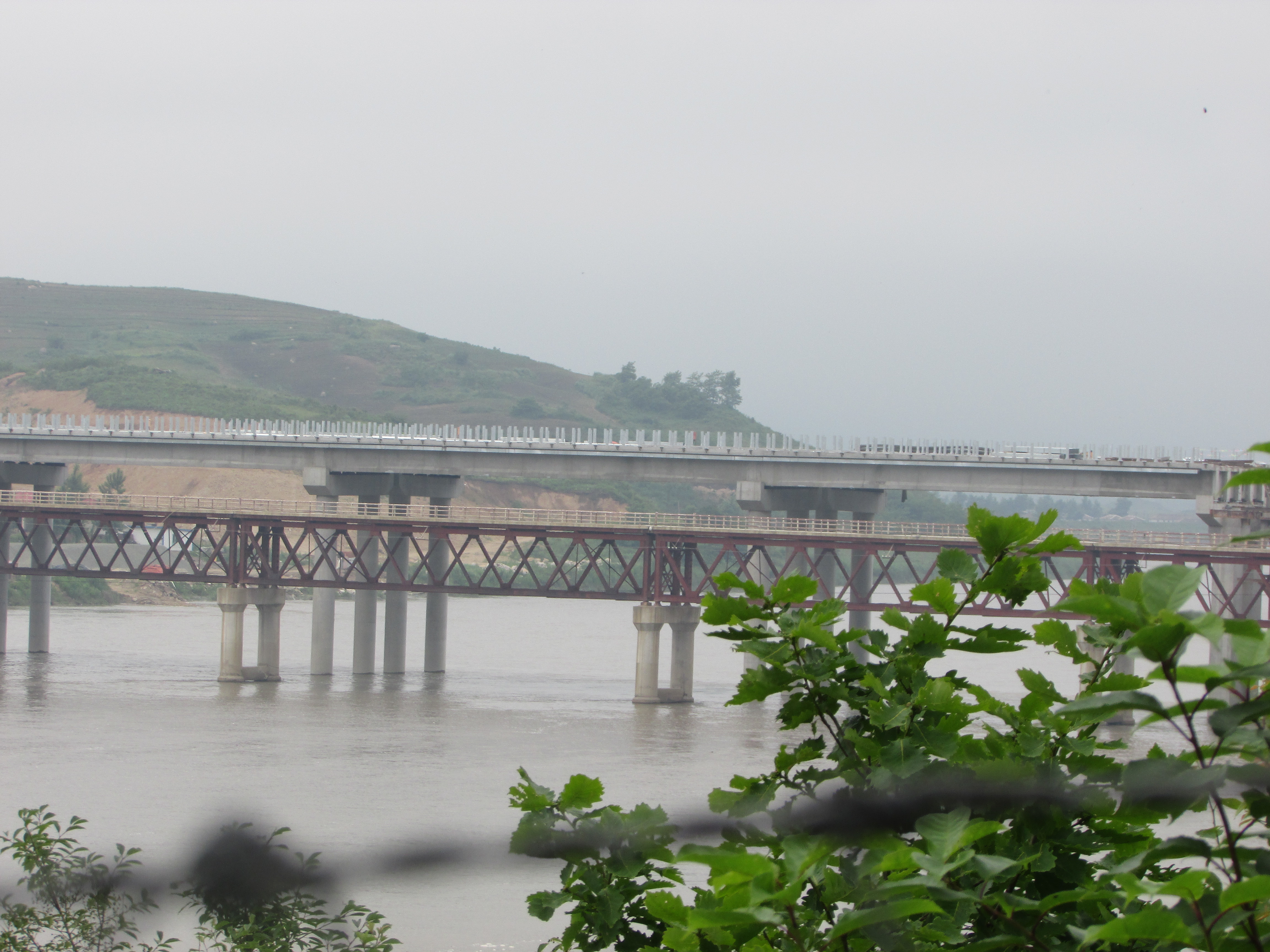
The city of Dandong faces the DPRK across the Yalu River. Construction of a bridge linking both sides has been basically completed. It is expected to help facilitate the DPRK’s exchanges with the outside world.

UPDATE 1 (2014-10-18): According to Yonhap:

North Korea is still showing off its products at an annual trade fair with China, but the number of North Korean business entities attending the event this year was about 30 percent less than last year.

The mood is subdued at the five-day trade fair in the Chinese border city of Dandong, reflecting strained political ties between North Korea and China amid Beijing’s signals of displeasure with Pyongyang’s nuclear ambition.

Organizers had said that about 100 North Korean business entities would attend the annual exhibition, but only 68 of them actually attended this year’s event. About 100 North Korean business entities attended last year’s exhibition.

The crowd was also noticeably smaller than it was last year.

“This year, we didn’t bring many products. Instead of selling products, we come here with hopes to meet with Chinese people who want to invest in our factory,” said an official at a North Korean trading firm who spoke on the condition of anonymity.

The decline in North Korea’s participation at the North Korea-China Economic, Trade, Culture and Tourism Expo, which began its five-day run Thursday, underscored the continued strain in bilateral relations, particularly after the North’s third nuclear test in February last year and the execution of the North Korean leader Kim Jong-un’s once-powerful uncle, Jang Song-thaek, who had close ties with Beijing.

In what many analysts believe was a message to North Korea, Chinese President Xi Jinping paid a two-day visit to South Korea in July this year, breaking a long-standing tradition by Chinese heads of state of visiting Pyongyang before Seoul.

North Korea’s bilateral trade with China stood at US$4.05 billion in the first eight months of this year, down 1.1 percent from the same period last year, according to Chinese customs data.

Economic development, along with the expansion of its nuclear capability, has been a new focus of North Korea’s policy under young leader Kim Jong-un, who took over in late 2011 after his father, Kim Jong-il, died.

North Korea, beset by poor infrastructure and international sanctions over its nuclear and missile programs, has announced plans to set up an economic development zone in each of its provinces.

Despite sanctions that discourage foreign investment, Kim Jong-sik, an official at the North’s National Economic Development General Bureau, told an audience at the exhibition that Pyongyang would set up a “one-stop service” that makes it easier for foreigners to invest in the country.

“With regard to economic development zones, we will simplify immigration procedures and build a one-stop service, which has been widely introduced around the world, to try to fully guarantee conveniences of foreign investors,” Kim said.

ORIGINAL POST (2014-10-16): According to Yonhap:

North Korea and China kicked off an annual trade exhibition on Thursday, with about 2,000 Chinese companies attending, organizers said.

The five-day trade fair in the Chinese border city of Dandong, where more than 70 percent of bilateral trade between the two nations is conducted, suggests economic ties between Beijing and Pyongyang remain largely unaffected despite the North’s nuclear and missile programs.

About 100 North Korean business entities will attend the North Korea-China Economic, Trade, Culture and Tourism Expo, the third of its kind.

At last year’s exhibition, North Korea and China signed 93 preliminary deals worth US$1.6 billion. It has not been confirmed whether the deals usually lead to actual shipments.

Besides North Korea and China, companies from Hong Kong, Russia, Thailand and Taiwan will join this year’s exhibition, organizers said.

North Korea’s bilateral trade with China stood at US$4.05 billion in the first eight months of this year, down 1.1 percent from the same period last year, according to Chinese customs data.

North Korea’s exports to China declined 0.8 percent on-year to $1.84 billion during the eight-month period, while imports fell 1.2 percent to $2.21 billion, the data showed.

Here is coverage of the first and second expo.

Read the full story here:
N. Korea, China kick off annual trade fair
Yonhap
2014-10-16

Share

Sharp increase in grain imports from China in second half of 2014

Thursday, October 16th, 2014

Institute for Far Eastern Studies (IFES)

It appears that North Korea has drastically increased Chinese grain imports in the months of July and August compared to the first half of 2014. Up until June, North Korea had imported a total of 58,387 tons of grain from China at nearly 10,000 tons per month. However, in July and August, North Korea imported 19,559 tons and 25,217 tons of grain, respectively. August showed the largest amount of grains imported per month so far this year, and the combined figures of July and August are equal to an astonishing 77 percent of the total amount of grains imported in the first six months of 2014.

The large increase in grain imports beginning in July is interpreted as an early move by North Korea to secure grain supplies for the winter after a double-crop harvest in June which failed to reach expected quantities, and a lackluster fall harvest compared to the previous year.

The grains North Korea has imported so far this year consist of flour (46.6 percent), rice (42.3 percent), and corn (8.9 percent), with flour and rice being the main imports. Compared to 2013, corn imports are down, but have been replaced by an increase in rice imports. Despite the sharp increase in grain imports during recent months, it appears that the overall food situation in North Korea has actually improved. North Korea imported a total of 103,163 tons of grain from January to August of 2014, a mere 59 percent of the 174,020 tons of grain imported during the same time period last year.

Chemical fertilizer imported from China up until August of this year has also decreased by an estimated 37 percent compared to the previous year, from 183,639 tons to 115,337 tons. This decrease in imported fertilizer is thought to be due to improvements made in fertilization equipment, leading to an overall higher rate of operation. It appears that the total amount of fertilizer used by North Korea this year should not differ greatly from the amount used last year, and fertilizer shortage is not expected to cause a major decrease in grain production.

Share

DPRK imports from Switzerland in 2014

Wednesday, October 15th, 2014

According to Yonhap:

The communist country’s imports of Swiss tobacco machinery components reached US$180,000 in the January-June period, far more than the $24,000 worth of imports recorded for all of 2013, according to the report by the Korea Trade-Investment Promotion Agency (KOTRA).

The latest spike is seen as indicating North Korea’s growing interest in investing in the country’s cigarette industry.

According to a previous KOTRA report, North Korea’s cigarette imports far exceeded its exports last year.

The country imported $65.28 million of tobacco in 2013, about 77.8 times what the country sold overseas, the report showed.

Another academic report showed that the smoking rate among North Korean men aged 15 or more stood at 45.8 percent, while the global average was 31.1 percent.

Meanwhile, the latest KOTRA report said North Korea’s imports of Swiss watches and related watch components fell to zero in the first six months of this year. The country imported $116,000 worth of Swiss watches and related goods for the whole of 2013.

Read the full story here:
N. Korean imports of Swiss tobacco machinery parts jump in H1
Yonhap
2014-10-15

Share

ROK-KIC road reportedly in bad shape

Tuesday, October 14th, 2014

ROK-KIC-Road-2013-10-13


Pictured Above (Google Earth): The road linking the KIC and South Korea

According to the Daily NK:

A bridge and northern parts of a road and connecting South and North Korea built by Pyongyang, for which Seoul provided 25.3 billion KRW [23.6 million USD] worth construction materials and equipment, are in decrepit conditions, according to documents obtained by a South Korean lawmaker.

“A strip [5km] of the northern side of the road connecting to the Kaesong Industrial Complex and parts of Tongil Bridge [220m] are extremely run-down, with cracks and severe forms of distortion,” representative Ha Tae Keung from the ruling Saenuri Party said, citing data submitted by Korea Land and Housing Corporation and Korea Expressway Corporation on Thursday. “However, the southern part of the project [5.1km], which cost us 68 billion KRW [63 million USD] is in good condition,” he stated.

“According to safety tests, the bridge and road are expected to progressively deteriorate, raising concerns of a major accident,” Ha said. “We may face another disaster such as the Seongsu Bridge collapse [in South Korea in 1994].”

The connecting road from South Korea to the inter-Korean Kaesong Industrial Park in the North began in September 2002 and was completed in 14 months. Seoul put 68 billion KRW [63 million USD] behind the project for its side and provided 25.3 billion KRW [23.6 million USD] worth of construction materials and equipment for Pyongyang to build its section.

Read the full story here:
Dilapidated Roads to Kaesong a Major Safety Concern
Daily NK
Lee Sang Yong
2014-10-14

Share

An affiliate of 38 North