Archive for the ‘International Governments’ Category

DPRK acknowledges spread of swine flu

Wednesday, December 9th, 2009

UPDATE:  According to AFP:

South Korea is preparing to ship medical supplies worth more than 15 million dollars to help North Korea fight an outbreak of swine flu, officials said Monday.

The unification ministry, which handles cross-border ties, said the shipment would include antiviral drugs for 500,000 patients — Tamiflu for 400,000 and Relenza for 100,000 — and sanitation supplies.

The aid will cost an estimated 17.8 billion won (15.3 million dollars), which will be financed by a state fund for inter-Korean cooperation, it said.

Spokesman Chun Hae-Sung said Seoul would send the shipment as soon as possible, and definitely by the end of the year. But the North, which had accepted the offer, had not yet set a firm date.

The drugs shipment will be the first direct South Korean government aid since relations soured last year, although Seoul has funded assistance to Pyongyang through private groups.

North Korea Wednesday reported nine cases of (A)H1N1 in the capital Pyongyang and the city of Sinuiju bordering China. No death toll was given.

Observers say the virus could pose a particular threat to the North because of malnutrition amid persistent food shortages and a lack of drugs such as Tamiflu.

Good Friends, a Seoul-based welfare group with cross-border contacts, quoted an unidentified Sinuiju city official as saying more than 40 people had died of the swine flu in the border city alone.

The World Health Organization, however, told Yonhap news agency that all nine North Korean patients have recovered.

Yonhap quoted Suzanne Westman, coordinator of outbreak alert and response at the WHO’s New Delhi office, as saying no additional cases were reported in the isolated communist country.

The first of the patients, all children aged between 11 and 14, was discovered on November 25 and the last case on December 4, she said, adding that three of the infections were in Pyongyang with the other six in Sinuiju.

“All contacts have been identified, put in isolation and treated,” she told Yonhap, adding that North Korea had a solid surveillance system and a sufficient number of physicians is believed to be able to handle the outbreak.

ORIGINAL POST: According to KCNA:

Anti-A/H1N1 Flu Campaign Intensified

Pyongyang, December 9 (KCNA) — New Influenza A/H1N1 broke out in some areas of the DPRK amid the growing of its victims worldwide.

According to the Ministry of Public Health, nine cases were reported from Sinuiju and Pyongyang.

The relevant organ is further perfecting the quarantine system against the spread of this flu virus while properly carrying on the prevention and medical treatment.

The State Emergency Anti-epidemic Committee has taken steps to enhance the role of prevention and treatment centers at all levels and increased checkup stations across the country while directing efforts to the medical treatment of its cases.

According to Yonhap:

The World Health Organization (WHO) is working “closely” with the North Korean government to help stem the spread of an Influenza A outbreak there and assess the scope of flu infections among North Koreans, a WHO spokesperson said Wednesday.

North Korea said earlier in the day that it has confirmed nine domestic cases of H1N1 virus infections. The highly infectious disease may be particularly dangerous to the North Korean people, who are mostly undernourished and may have weakened immune systems.

“We are working closely with the (North Korean) government to see what is required and if they need any assistance from WHO,” Aphaluck Bhapiasevi, a WHO spokeswoman on the H1N1 pandemic, said over the telephone.

Bhapiasevi also said there are likely more cases of the H1N1 virus than announced, as people who have mild symptoms are not tested.

“In any country, there may be more cases than have been laboratory-confirmed,” she said. “They may not reflect actual number of the cases.”

In May, WHO provided 35,000 Tamiflu tablets each for North Korea and about 70 other underdeveloped countries to help fight possible outbreaks. Seoul officials say the North would need millions of tablets to safeguard its 24 million people.

Through its office in North Korea, the world health body has been making “preliminary assessments” of the scope of the outbreak, she said. “We have been discussing support that would be required.”

According to the AP, the DPRK will accept ROK assistance as well:

North Korea agreed Thursday to accept medicine from South Korea to fight an outbreak of swine flu, a Cabinet minister said, in a development that could improve relations between the nations after a deadly maritime clash.

“Today, the North expressed its intention to receive” the medical aid, Unification Minister Hyun In-taek told reporters.

North Korean state media reported Wednesday that there were nine confirmed swine flu cases in the country. South Korea plans to send the antiviral Tamiflu to the North, Health Ministry spokesman Lee Dong-uk said, without giving specifics.

South Korea’s Yonhap news agency said South Korea plans to send enough doses of Tamiflu for about 10,000 people. It cited a government official it did not identify.

The move came two days after South Korean President Lee Myung-bak offered unconditional aid to North Korea to help contain the virus — the government’s first offer of humanitarian aid since Lee took office in early 2008 with a hard-line policy toward the North.

(h/t NK Leadership Watch)

Share

Friday Grab Bag: NOKO Jeans go on sale; Korea Today turns 60

Thursday, December 3rd, 2009

UPDATE 2: NOKO Jeans are on sale here and here.

UPDATE : It looks like the NOKO Jeans launch did not go off as expected. The Swedish department store in which the jenas were to go on sale has pulled the plug on NOKO’s retail space at the last minute.  According to the AFP (Via Singapore’s Straits Times):

A SWEDISH department store on Saturday cancelled what was to be the sale of the ‘first ever’ brand of jeans made in North Korea, the Swedish company behind the communist-made dark denims said.

‘Apparently PUB has censored our exhibition/store by shutting it down and ‘confiscating’ the jeans because of the ‘working conditions in North Korea’,’ Jakob Ohlsson of company Noko Jeans told AFP in an email. ‘At first i thought it was a joke but everything has been removed from the store,’ he added.

Mr Ohlsson, along with Jacob Aastroem and Tor Rauden Kaellstigen – all under the age of 25 and with no previous experience in business or fashion – started Noko Jeans in mid-2007, prompted by a desire to enter in contact with isolationist North Korea.

Their designer jeans were to be sold starting on Saturday at Aplace, a boutique that is a tenant of the trendy PUB department store in central Stockholm. ‘A half-hour before opening, we got a call from the head of the department store and he explained to me… that PUB cannot sell the Noko Jeans,’ Kalle Tollmar, the founder and CEO of Aplace told AFP.

‘The explanation I got was that (the store’s management) had taken the decision… that PUB is not the right place, or platform, for this kind of political discussion,’ he said, confirming his store was hoping to continue distribution of the controversial duds at another location.

The Noko sales space at PUB was deserted on Saturday, the jeans removed and and surrounding photo exhibition taken down by the department store’s security. ‘They have it in a locked room at PUB but we have been promised to get everything back on Monday, it’s only for security reasons, they don’t want us to sell the jeans,’ Ms Tollmar said. — AFP

According to the AP:

A Stockholm department store says it won’t carry a new line of North Korean-made designer jeans because it doesn’t want ties to the isolated communist nation.

PUB store spokesman Rene Stephansen says it is “a political issue that PUB doesn’t want to be associated with.”

The Noko Jeans line is the brainchild of three Swedish entrepreneurs who hoped to help break North Korea’s isolation through increased trade with the West.

A spokesman for the retail space where Noko Jeans was selling its product says the jeans were taken off shelves early Saturday.

Noko Jeans spokesman Jacob Astrom says he regrets the decision is looking for a new shop location. The jeans will be available online.

The NOKO web page says that the jeans will be available on Monday, but in Sweden, Monday has nearly come and gone and the jeans are still not for sale on the web.

ORIGINAL POST: NOKO Jeans go on sale today.  According to Reuters:

Designer jeans labeled “Made in North Korea” will go on sale this Friday at a trendy department store in the Swedish capital, marking a first foray into Western fashion for the reclusive communist state.
The jeans, marketed under the “Noko” brand, carry a price tag of 1,500 Swedish crowns ($215) and will share shelf space at Stockholm’s PUB store with brands such as Guess and Levi’s.

Noko’s founders told Reuters they had spent over a year trying to gain access to factory operators in North Korea, and struggled with poor communications and an unfamiliar approach to doing business once inside the country.

“There is a political gap, there is a mental gap, and there is an economic gap,” said Jacob Astrom, one of three Swedish advertising executives behind the project. “All contacts with the country are difficult and remain so to this day.”

The idea for the project was born out of curiosity for North Korea, which has grown increasingly isolated in recent years under Western criticism of its human rights record and nuclear ambitions.

“The reason we did this was to come closer to a country that was very difficult to get into contact with,” Astrom said.

North Korea, a country better known for its reclusive nature than fashionable clothes, rarely allows outsiders within its borders and has virtually no trade or diplomatic relations with most Western countries. Sweden, one of only seven countries to have an embassy in North Korea, is an exception.

But the process of agreeing a deal to produce just 1,100 pairs of jeans — the first ever produced by the country, according to the founders — often proved baffling. E-mails vanished into a void and communications were strained.

At one point they were asked to bring a zinc smelting oven into the country, and a trade representative once asked them to help him find a pirated version of the computer program Adobe Acrobat so he could read files they were sending him.

“Everyone is a manager. Even our chauffeur was some sort of manager,” said founder Jakob Ohlsson, adding that North Korean titles were often confusing.

After being turned down by North Korea’s largest textile company, the group managed to secure a manufacturing deal with its largest mining company, Trade 4, which also happens to run a small textile operations on its site.

“This is often the way it works in North Korea,” said Ohlsson. “Companies seldom specialize and therefore often manage several operations that differ completely from one another.”

During the summer, the trio traveled to the factory in North Korea to oversee the production process and ensure that workers there were treated according to Noko’s guidelines.

“We were forced to operate by micro-management,” Ohlsson said, referring to his experience on the factory floor.

Fashionable novelty seekers can order Noko jeans from the company’s website www.nokojeans.com after December 4, but you are not likely to see a pair on the streets of Pyongyang, North Korea’s capital, anytime soon.

Socialist dress code forbids them.

According to the BBC:

Mr Ohlsson explained black denim was chosen because North Koreans “usually associate blue jeans with America. That’s why it’s a little taboo”.

But the high ticket price for the jeans is not simply aimed at finding an exclusive niche in the market.

Mr Ohlsson admitted: “The reason they are so expensive is that we didn’t have any experience in fashion, trading, or anything like that.”

Read previous NOKO Jeans posts here, here, here and here.

Korea Today Turns 60.  According to Korea Today:

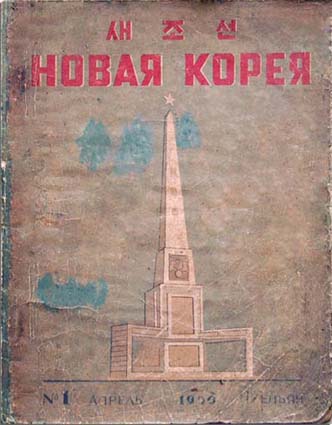
korea-today.jpgDecember 4 this year marks the 60th founding anniversary of The Foreign Language Magazines, DPRK.

On the occasion we extend heartfelt gratitude to our readers.

We began to publish our journal, titled New Korea, in January 1950, hoping to help the readers understand how the Koreans had lived before they got free from the Japanese colonial rule and engaged in building a sovereign independent state, what they were aspiring after and what course they would take in the future.

Later the title changed to Korea Today.

The monthly magazine has so far carried policies the Workers’ Party of Korea set forth in each stage of socialist construction, achievements the Korean people made in their implementation, independent and creative life of the working masses and their happiness as well as the history, geography and culture of Korea.

Also introduced are the struggle of the Koreans and other progressive people for reunifying the nation that has been divided into the north and the south for over 60 years and building a new independent world—in various styles and methods.

Published in Russian alone in the initial years, the monthly is now available in English, Chinese, French, Spanish and Arabic, too.

You can get access to Korea Today on the Naenara site.

We’ll do our best to help you know the realities of Korea where building of a thriving nation is on its height, the efforts of the Korean people for national reunification and the struggle of Koreans and other progressive people around the world for a new, free and peaceful world.

It is interesting that Korea Today would remind everyone that their first publications were in Russian and featured Pyongyang’s  Liberation Tower (located here) on the cover.  It removes all doubt about who was actually in control at the time (i.e. not Kim Il Sung). (Новая Корея=New Korea).

Korea Today is full of all sorts of interesting and useless tid-bits on the DPRK–such as this.

Korea Today, Korea, and Kumsukangsan are all published by the Pyongyang Foreign Languages Printing House (also turning 60) located here.

The Soviet equivalent of Korea Today, named Soviet Russia Today, published a piece about the early days of the DPRK by American communist Ana Louise Strong, who was one of the first Americans allowed into the country.  Learn more here.

Share

Goethe Institute opens-closes library in Pyongyang

Wednesday, December 2nd, 2009

UPDATE: In 2004 Germany’s Goethe Institut opened a reading room in Pyongyang (see Choson Sinbo article below). This week it was closed. According to Deutsch Welle:

After five and a half years in operation, the Goethe-Institut in North Korea has said it will close its reading room in the capital city of Pyongyang due to censorship concerns.

The institute, a non-profit organization that promotes the study of German language and culture in 91 countries, opened the reading room in June 2004. It was the first and only Western cultural institution to establish itself in the communist country.

Raimund Woerdemann, director of the Goethe-Institut in Seoul, told Deutsche Welle that, contrary to an agreement made with the North Korean government, access to the center was often hindered.

“The building in which the reading room was located was often locked from the front,” he said. “There was a permanent construction site in front of the back entrance: not a welcoming situation.”

To his knowledge, there has never been an Internet connection in the Pyongyang center, said Woerdemann, and attempts to establish an Intranet connection with other North Korean educational institutions were interrupted on multiple occasions.

The reading room is slated to close in summer 2010. Woerdemann added, however, the Goethe-Institut would make an effort to maintain positive relations with North Korea through participation in the North Korean-German Friendship Society, the Committee for Cultural Relations Abroad and other partnerships.

Criticism from Berlin

The decision to close the reading room has met with strong criticism from the German parliament. Phillip Missfelder, parliamentary foreign policy spokesman for Chancellor Angela Merkel’s CDU issued a statement Wednesday, calling the closure “a bitter experience and a big disappointment for everyone who has stood up against resistance to cultural exchange and for the gradual opening of communist North Korea.”

The move represented “the end of an important aspect of German foreign policy in the areas of culture and education, which was a ray of light in the darkness of the repressive, totalitarian government in North Korea.”

In the statement, Missfelder said the CDU parliamentary group takes the closure “very seriously” and would make every effort to reverse the decision.

The center in Pyongyang was founded with the aim of reducing the information deficit in the country, offering unrestricted access to the Internet and free press, networking with South Korea and other countries, and promoting literature.

The Pyongyang reading room has been removed from the Goethe Institute’s web page, although not all of the links have been removed.

The reading room was located near Tae Mun and the DPRK’s Ministry of Culture in Pyongyang here.

UPDATE 1: According to Korea.net, the Goethe Institut plans to expand Pyongyang reading room:

On the sidelines of the International Federation of Library Associations and Institutions (IFLA) conference last week, a German cultural institution reaffirmed its commitment to promote freedom and democracy in North Korea.

The Goethe Institute, an NGO sponsoring German language and culture worldwide, said it is ready to expand its collection of media resources in North Korea.

The institute opened a reading room in Pyongyang in 2004 where North Koreans can freely access a variety of German media, including books, newspapers, and music. The content is completely uncensored and accessible to all North Koreans. That was the condition under which Goethe Institute agreed to open the reading room, said Jurgen Keil, director of the Goethe Institute in Seoul.

“The reading room has been received very positively by North Koreans. We hope that it can contribute to normalizing North Korea’s relations to the outside world,” Keil said.

The efforts mirror a similar German diplomatic strategy in the 1970s when then West German Chancellor Willy Brandt pursued a policy of “Change through Rapprochement” of easing ties with East Germany through a series of reconciliatory measures.

Former President Kim Dae-jung made reference to this strategy when he formulated the South Korean “Sunshine Policy.”

Claudia Lux, IFLA president-elect, stressed that “knowledge is always a step toward freedom.”

Keil added that many North Koreans can speak German. Until German reunification in 1989, a great number of North Koreans were living and working in East Germany.

North Korea was eager to establish the reading room in order to boost its international diplomatic profile, even though the content available there undercuts the strict censorship imposed by the country.

The reading room in Pyongyang currently holds 4,000 items. Keil said it plans to gradually increase the number to 8,000 in the coming years.

ORIGINAL POST: From the Choson Sinbo (August 14, 2004):

A library of German science books was opened in central Pyongyang on June 2, as the first institution where people can freely read foreign books.

The library was opened in cooperation between Pyongyang’s DPRK-Germany Friendship Association and Germany’s Goethe Institute.

The library has 4,000 scientific books in natural and social sciences and leading German newspapers and magazines. In addition, the library has various kinds of movie tapes, music CDs and cassette tapes and audiovisual education aids for German language study.

It is the first time that the DPRK has opened a library of scientific books of a specific Western country.

An official concerned with the library said that the institute aims at introducing advanced science and technology of Western countries and at promoting mutual understanding between the DPRK and Germany by spreading Germany’s scientific books in the DPRK.

The library introduces German books to libraries of domestic universities and research institutes while allowing people to freely read German books, newspapers and magazines. It lends books to users.

Accepting users’ requests the library orders books from the Goethe Institute, a nongovernmental cultural organization of Germany. Pyongyang’s counterpart offers requested books to the library free of charge.

The library has plenty of natural science books, such as books of medical science, information technology, geology, physics, architecture, chemistry and biology. In addition to natural science books, there are books of German literature, art, philosophy and books of social science including law and history.

According to an official concerned, main users of the library are university students, researchers and scholars.

Officials said that a delegation of the Goethe Institute plans to visit Pyongyang in September to provide 4,000 more books to the library. The Goethe Institute also plans a training course for librarians to staff the library.

Kim Mun Ik, 57, an official of the Association of External Cultural Liaison, said, “The DPRK is not an ‘exclusive country.’ The library is a clear indication that we have been open to the outside, receiving foreign things as far as these are useful for us and now we are making every effort to develop relations with foreign countries, even with Western countries.”

Share

Syria’s Tishreen War Panorama

Wednesday, December 2nd, 2009

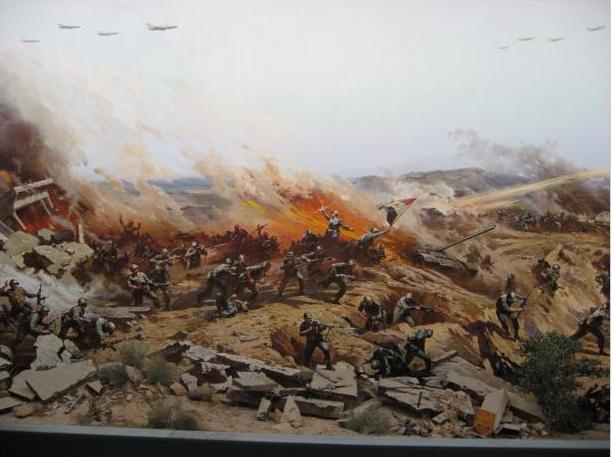
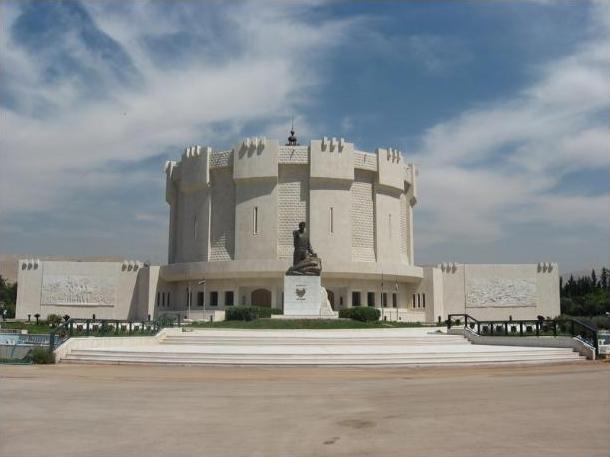
Visitors to Pyongyang’s Victorious Fatherland Liberation War Museum (Location here) will be interested to know that the DPRK has exported its museum technology to Syria’s Tishreen War Panorama (Location here).

syria-museum.JPGsyria-museum2.JPGsyria-museum3.JPG

The images are from this web page.

According to an official web page (I think), the panorama dimensions are 129.5m x 7.8m.  It was painted by Kim Sing Chol, O Kwang Ho, Ri Jae Su, Ri Kap Il, Kim Chol Jin, Choe Song Sik, Ri Jong Gap, Kim Ki Dok, Cha Yo Sang, Ri Yon Nam, and it opened on 6th October 1999.  These artists are employees of the Mansudae Overseas Development Group (Art Studio).

I thank a reader for sending me this information.  I have been mapping North Korean projects in Africa, Asia, and the Middle East on Google Earth.  Here are some I have blogged about: Monument to African Renaissanace, Zimbabwe Hero’s Park, Ethiopia’s Derg Monument, Kinshasa Kabila Statue, and quite a few more.  If you are aware of any North Korea projects in your area please let me know.

UPDATE: Cairo’s October War Panorama is also built by the North Koreans.   It appears to have nearly identical architecture.  It is located here.

Share

China plans cruises to North/South Korea, Russia and Japan

Tuesday, December 1st, 2009

By Michael Rank

China is planning cruises to North and South Korea, Russia and Japan from the northeastern border city of Hunchun 珲春, according to a Chinese-language report.

Ports of call will include Raseon (Rasŏn/Naseon/Nasŏn) 라선 on North Korea’s northeast coast, Sokcho 속초 in South Korea, just south of the DMZ, and Vladivostok, the report says, quoting Jilin province officials.

“There are still a number of questions to be resolved concerning the cruises, such as different visa requirements among the five countries concerned,” it quotes a Jilin  tourism official as saying. But he also says tourism officials from the five countries have “decided to take joint action and are making great efforts to open this tourist route.”

The head of the Jilin tourism bureau, He Baiping, is quoted as saying Jilin has seven border crossing points and that the number of tourists visiting Russia and North Korea is on the increase, which is good for the local economy.

The report gives no more details, but notes that Hunchun is close to the borders with North Korea and Russia and says the cruises will promote tourism in northeast Asia.

Share

Samtaesong fast food restaurant in Pyongyang

Tuesday, December 1st, 2009

UPDATE 6 (October 15, 2010): The restaurant has opened a second branch in the Kaeson Youth Park.  This Voice of America article reports on the restaurant’s popularity and offers a bunch of other information that I do not necessarily see at accurate.

UPDATE 5 (November 29):  The origins of the project were featured in a recent article in the Straits Times:

It began two years ago when Mr Quek, managing director of the Aetna Group, which deals in metal and minerals, was approached by his North Korean business partners to invest in the country.

His company has been trading with the North Koreans in steel and minerals for more than 25 years.

Mr Quek then roped in his business friend Mr Tan, whom he had met eight years ago in Shanghai.

Together, they set up Sinpyong International to invest in North Korea.

Asked if he was worried about investing in North Korea, Mr Tan admitted that he prepared himself mentally for red tape.

Initially, the two men mulled over business ideas such as opening a supermarket. But after market research, they were drawn to the idea of a fast-food restaurant.

‘There was nothing like that there at that time. It was probably the only country in the world that doesn’t have fast food,’ said Mr Tan.

Despite neither of them having any experience in the fast-food business, the pair quickly got down to work.

They roped in a third person, Mr Patrick Soh – who holds the franchise in several Asian countries for Waffletown USA – to help them set up the operation and train the local staff in Pyongyang.

Waffletown USA is not a big regional player and it currently has only two franchise outlets in Singapore, in Balmoral Plaza and in Ngee Ann Polytechnic.

Samtaesong, however, is not a Waffletown franchise, Mr Quek stressed. ‘We borrowed the concept and menu, and tapped Mr Soh’s expertise, but it’s not a Waffletown franchise,’ he said.

Early this year, a four-man team from North Korea discreetly came to Singapore to sample the fare at the Balmoral Plaza outlet in Bukit Timah.

‘They tried the food and especially liked the waffle, burgers and fried chicken,’ said Mr Soh, 56, beaming.

Mr Quek said the restaurant’s site was picked by his North Korean business partners. Located in the heart of Pyongyang, it is next to a subway station and within walking distance of various universities and foreign embassies.

In November last year, the Singaporean partners began making trips to North Korea to set up the 246 sq m restaurant. It occupies one floor in a twostorey building and can seat about 80 people.

Furniture, styled after fast-food joints in Singapore, was shipped in from China.

Kitchen equipment and ingredients, such as the seasoning for the fried chicken and the waffle mix, were flown in from Singapore.

The beef and the chicken are sourced in North Korea, while a local factory supplies the burger buns and patties according to Mr Soh’s recipe.

In all, Mr Quek and Mr Tan spent about US$200,000 (S$276,500) to set up the shop.

Mr Soh let on that the menu was modified to appeal to North Korean tastebuds. For instance, the side dish coleslaw was substituted with kimchi, the

spicy pickled cabbage popular among Koreans. The burgers also come with more vegetables.

‘They don’t like the idea of junk food, so we made the menu more healthy,’ Mr Soh said.

Local draught beer is also served along with soft drinks like Coke.

The restaurant has 14 staff members, mostly young women, who don colourful aprons while flipping burgers and cooking french fries.will promote tourism in northeast Asia.

Download a PDF of the Straits Times article here.

Read previous posts about this restaurant below:

(more…)

Share

China approves Tumen border development zone

Monday, November 23rd, 2009

UPDATE:  China plans development zone on North Korean border
By Michael Rank

China is planning a major new development zone along the North Korean border aimed at boosting trade with its reclusive neighbour and throughout northeast Asia, a Chinese-language website reports.

The plan is to come to fruition under two separate deals: the border cities of Dandong in Liaoning province and Tonghua in Jilin province have signed an (unpriced) “development and opening up vanguard zone cooperation agreement” as well as a 440 million yuan ($64 million) “six-party cooperation agreement” with the Shenyang Railway Bureau, Changchun Customs, Dandong Port Group and Tonghua Steel (Tonggang) to build a “Tonghua inland port” with a duty-free zone, warehouses and international transit facilities that will be ready in 2012.

The Tonghua-Dandong Economic Zone will apparently stretch over most of the western half of the Chinese-North Korean border, a distance of around 350 km. The city of Tonghua is in fact some 80 km north of the border, but the report says the new zone will include the border post of Ji’an which is administered by Tonghua.

It gives few further details, but notes that when Premier Wen Jiabao visited North Korea last month he signed an agreement on building a new bridge across the Yalu river which would further boost Chinese-North Korean trade.

It also quotes the acting mayor of Tonghua, Tian Yulin, as saying that the new zone will transform the city from “inland” to “coastal” and “will promote trade between the inland cities of the northeast and North Korea and with the whole of northeast Asia.” The report adds that almost 60% of China’s trade with North Korea passes through Dandong.

This is not the only new development zone in China’s rustbelt northeast, which has been in severe economic decline in recent decades: a separate Chinese report announces the creation of another zone in Jilin, stretching from the capital Changchun in the centre of the province to the city of Jilin (or rather just part of it, for some unstated reason) as far as Yanbian on the North Korean border. This report does not mention North Korea directly but says the new zone will make the eastern border city of Hunchun an “open window” for regional trade, with Changchun and Jilin city “important supports.”

One-third of Jilin’s 26 million population live in the zone and it accounts for half of the province’s economic output, the report adds. See also this English-language report.

State-owned Tonghua Steel’s involvement in the Tonghua-Dandong zone is somewhat surprising as the ailing company has been rocked by unrest following an abortive attempt at a takeover deal by rival company Jianlong earlier this year. There was strong opposition to the deal on the part of workers who feared they would lose their jobs, and their fears turned to violence last July when a senior manager was murdered in mysterious circumstances.

The Chinese business magazine Caijing told how “the man’s death at the hands of unidentified killers uncovered an often antagonistic network of competing business interests and investors involved in Jianlong’s botched attempt to buy Tonggang.”

Tonghua Steel was in 2005 planning to sign a 7 billion yuan ($865 million), 50-year exploration rights deal with a North Korean iron ore mine, said to be the country’s largest iron deposit. The Chinese company was hoping to receive 10 million tonnes of iron ore a year from the Musan mine as part of its plans to increase steel production from a projected 5.5 million tonnes in 2007 to 10 million tonnes in 2010.

Tonggang boss An Fengcheng said at the time that agreement had already been reached with China Development Bank on 800 million yuan worth of soft loans and 1.6 billion yuan of hard loans, while “the remaining investment will come in in stages”. But it seems that the deal was never signed.

Caijing told how An, the steel mill’s chairman and Communist Party secretary, had “basically unlimited managerial control of Tonggang” and that the takeover by Jianlong was cancelled just a few hours after the murder of the manager Chen Guojin, who had come from Jianlong and was one of two Jianlong representatives on the board of Tonghua.

“There is no evidence to suggest An’s involvement in Chen’s death. But two weeks after the incident, he was sacked and stripped of all power by the Jilin provincial government. No other details of his removal were announced,” the magazine added.

ORIGINAL POST: According to the P.R. of China’s Global Times (Xinhua) via Adam Cathcart:

The Chinese government has approved a border development zone in the Tumen River Delta to boost cross-border cooperation in the Northeast Asian region, the provincial government of Jilin announced on Monday.The information office of the government said the pilot zone covering 73,000 square kilometers involved the cities of Changchun and Jilin as well as the Tumen River area.

Han Changbin, governor of Jilin, said the Changchun-Jilin-Tumen pilot zone was China’s first border development zone.

It is expected to push forward cross-border cooperation in the Tumen River Delta.

The delta, a 516-kilometer-long river straddling the borders of China, Russia and North Korea, was set up as an economic development zone in 1991 by the United Nations Development Program (UNDP) to promote trade.

In 1995, five countries – China, Russia, North Korea, South Korea and Mongolia – ratified the agreement on the Establishment of the Cooperation Commission for the Tumen River Economic Development Area (web page here). Japan participated in the program as an observer.

In 2005, the five signatories agreed to extend the agreement for another 10 years.

They also agreed to expand the area to the Greater Tumen Region and to further strengthen cooperation for economic growth and sustainable development for the peoples of Northeast Asia.

“Before the Changchun-Jilin-Tumen pilot zone was initiated, the Chinese part of the Tumen River area was mainly Huichun, a port city in Jilin, that has involved in the cross-border cooperation,” said Zhu Xianping, director of the Northeast Asia Research Institute of Jilin University in Changchun.

The 5,145-square-kilometer port city with a 250,000 population had limited industrial development capacity to develop infrastructure projects that will match the cross-border cooperation, he said.

Du Ying, deputy director of the National Development and Reform Commission, said that by bringing the two cities of Changchun and Jilin into the border zone, the zone could serve as a strategic platform to support the cross-border cooperation in the Greater Tumen Region.

Zhao Zhenqi, an assistant to the Jilin governor, said the central government has allowed the pilot zone to try new land use and foreign financing methods, such as sharing ports and sea routes with other countries in the region and setting up free trade zones.

Under the initiative of the pilot zone, local governments in the region could better interact to tackle development bottlenecks, he said.

The Northeast China region, rich in natural resources including coal and oil, is China’s traditional heavy industry base and granary. However, it also faces the challenges of industrial upgrading, resource depletion and financing bottlenecks.

Random thoughts and links:
1. The challenge facing north east China (as they see it) is the lack of a port city on the East Sea (or the Sea of Japan if you prefer).  This is where North Korea comes in.  China and Russia have long been trying to establish  use rights and/or control of Rason and Chongjin.  Russia recently built a “Russia-gague” railroad line from Rason to the DPRK-Russian border. The Chinese have been busy building roads.

2. (speculation) China is the DPRK’s largest trading partner.  International sanctions have given China monopsony power vis-a-vis the DPRK.  This means the Yuan goes farther in the DPRK than in other countries and it gives the PRC a financial incentive in the continued economic isolation of the DPRK.

3. Here is CCTV video.

4. Forbes covers this story here.

Share

Noko Jeans

Sunday, November 22nd, 2009

Some enterprising Swedes had some jeans manufactured in North Korea (where they can’t be worn in public) to be sold in the west.  The brand name is Noko Jeans.

The fist shipment  of appx 1,000 jeans arrived in Sweden on November 11, and the goods will go on sale December 4, 2009.

Here is a photo of the Noko jeans team with their shipment.

Here is a photo of all the  official stamps and approvals on the shipment.

IHere is their official web page: http://www.nokojeans.com/

Share

DPRK diplos arrested for smuggling (again)

Sunday, November 22nd, 2009

UPDATE:  According to the Boston Herald, the diplomats were sentenced to eight months in prison.

ORIGINAL POST: It is no secret that North Korean diplomats and embassies are self-financing.  In fact, they are profit earning and they must remit funds back to Pyongyang.  While this means that DPRK diplomatic relations are not a drain on the treasury, as is typically the case with other countries, it does mean that the DPRK’s official representatives are more likely to make headlines for their business dealings rather than political statements.

And so here is the latest installment in this saga from Reuters:

Swedish police have arrested two North Korean diplomats on suspicion of smuggling 230,000 cigarettes into the Nordic country, the Swedish Customs Office said Friday.

The pair, a man and a woman who have diplomatic status in Russia, were stopped by Swedish customs officers Wednesday morning as they drove off a ferry from Helsinki, the Finnish capital.

Customs officials discovered Russian cigarettes in the car driven by the couple, Swedish Customs spokeswoman Monica Magnusson told Reuters.

The two North Koreans claimed diplomatic immunity.

“They were accredited as diplomats in Russia, but had no accreditation in Sweden,” she said. “They were arrested on suspicion of smuggling.”

Magnusson added that the pair were still being held by Swedish police and that she was not aware of them having any contact with North Korean officials since their arrest.

Sweden’s Foreign Ministry said it had been informed of the arrests but would not comment directly on the matter, saying it was a criminal case and was being handled by the police.

Foreign Ministry spokeswoman Cecilia Julin said foreign diplomats are only immune from criminal prosecution in countries where they have been accredited with the authorities.

“If you come to Sweden and commit a crime, you’re just like any other foreign national,” she said.

Sweden is one of only seven countries to have an embassy in North Korea, treated by much of the world as a rogue state due to human rights abuses and its possession of nuclear weapons despite opposition by the international community.

The Foreign Ministry said the arrests were primarily a police matter, but that the North Korean embassy in Sweden was in contact with the ministry over the matter.

An official at the North Korean embassy in Stockholm said earlier he had no knowledge of the arrests.

North Korean diplomatic staff were expelled from Sweden and two other countries in 1976 after a “massive” smuggling scheme was uncovered.  According to Time Magazine (in 1976):

Not in years have so many diplomatic persona suddenly been declared non grata. In Oslo, members of North Korea’s diplomatic mission—three bureaucrats and a chauffeur—were given six days to pack up and get out. Foreign Ministry officials frostily informed North Korea’s Ambassador to Stockholm, Kil Jae Gyong, who is also accredited to Oslo, that he was no longer welcome in Norway. Similar scenes took place in Helsinki and Copenhagen, and as of last week, twelve North Korean embassy staffers had been unceremoniously ordered home to Pyongyang.

International politics had nothing to do with the abrupt action by the Scandinavian governments. What had happened was that North Koreans in all three countries* had been caught red-handed in a massive smuggling racket involving liquor, cigarettes and dope —apparently instigated by the financially hard-pressed government of President Kim II Sung. Officials in Norway estimated that their branch of the Kim gang had smuggled into the country at least 4,000 bottles of booze (mostly Polish vodka) and 140,000 cigarettes, which were then given surreptitiously to Norwegian wholesalers for distribution on the black market. In Denmark, the illegal goodies impounded so far included 400 bottles of liquor, 4.5 million cigarettes and 147 kilos of hashish, which police confiscated two weeks ago from two Danes who had just bought the drug from North Korean embassy staffers.

Personal Use. How long the North Koreans have been into smuggling as a sideline remains unclear, but Scandinavian officials have been closely watching their business dealings for about five months. In Norway, neighbors of the neat brick North Korean embassy in Oslo’s West End had long been puzzled by the constant movement of cars in and out of the compound and by the sight of mission staffers struggling in the backyard with huge mysterious boxes. In Denmark, customs officials got suspicious last month when the North Koreans imported 2.5 million duty-free cigarettes, allegedly for the “personal use” of one staffer.

The discovery of illegal activity by the North Koreans in Scandinavia may be only the iceberg’s tip. Five months ago in Cairo, Egyptian officials caught two North Korean diplomats with 400 kilos of hashish in their luggage. A North Korean official assigned to Malaysia has also been recalled after dealing in smuggled goods.

The North Koreans have protested their innocence, and mission staffers in Finland insisted that they would not leave the country. Nonetheless, Scandinavian officials have little doubt that the smuggling was ordered by Pyongyang as a desperate measure to help resolve the government’s horrendous financial crisis. Western experts estimate that North Korea, with a G.N.P. of only $4.5 billion, has a foreign debt of more than $2 billion, at least $500 million of which is owed to the capitalist world. North Korea not only maintains some 60 expensive missions abroad but also buys millions of dollars’ worth of advertising space in newspapers round the world every year to publicize the latest speeches of Kim II Sung. Faced with a severe shortage of hard Western currency, officials speculate, North Korean diplomats turned to smuggling to support their missions and pay for the ads, sending any excess profits home to Pyongyang.

The DPRK embassy has also been accused of smuggling in Pakistan.

Sometimes the DPRK embassy staff make “good” business decisions.

Good article here with further info (h/t OneFreeKorea).

2007 CRS report: Drug Trafficking and North Korea: Issues for U.S. Policy

You could probably write a series of books on the DPRK embassies in Russia and  China.

And just for the record: Sweden–the North Koreans are not the only ones doing this–everyone is.  When I lived in Europe over 15 years ago I talked with fellow teenagers about doing this!  If you want to increase people’s incomes, increase tax receipts, and lower the incomes of mobsters and bootleggers–lower your cigarette taxes!

Read the full stories here:
Diplomats arrested for cigarette smuggling
Reuters
Jens Hansegard
11/20/2009

SCANDINAVIA: Smuggling Diplomats
Time Magazine
11/1/1976

Share

Battle for North Korea’s Resources

Sunday, November 22nd, 2009

Radio Free Asia
Song-wu Park
11/19/2009

North Korea is pulling back from Chinese mining investments in an effort to independently develop its industry and use the profits to create a self-reliant economy, according to a well-informed North Korean defector.

But analysts say it is unlikely that North Korea will be able to lock China out completely, because it lacks the infrastructure and capital needed to develop the country’s vast mineral resources.

The defector, who said he had worked as the director of a state trading agency controlled by the military in a major North Korean city, refuted South Korean news reports that suggested China was taking control of North Korea’s underground natural resources.

“Such statements are exaggerated and different from the truth,” the defector, who uses the pseudonym Kim Ju Song, said in an interview.

Kim attended closed-door sessions with U.S. legislators and congressional staff in Washington on Wednesday.

Several South Korean news organizations, including the Yonhap news agency, recently reported that China has increased its investment in North Korea, established firm control over North Korea’s underground natural resources, and plans to utilize North Korea as its “natural resource base.”

The reports said Beijing had laid out a U.S. $1.2 billion investment plan for North Korean mine development and that Chinese firms had bid for the long-term rights to mine anthracite, iron ore, and molybdenum deposits in the country.

But Kim Ju Song called the reports “distorted,” adding that the North Korean regime is averse to such investments because its current objective is to create a “self-reliant” economy.

“With its own style of self-reliant national economy as the foundation, North Korea hopes to develop and employ its own technologies to extract and process its underground natural resources, prior to selling them on the world markets,” Kim said.

“However, under the current circumstances, simply selling those natural resources at a bargain price would not earn North Korea that much money,” he said.

Kim said that while North Korea will sell China minerals that it is unable to exploit due to technological limitations, “it would be inconceivable for the North Korean regime to cede its mines to China.”

John Park, a senior research associate at the Washington-based United States Institute of Peace, said it is unlikely that North Korea will be able to effectively develop its mineral industry independent of China.

“It’s a chronic issue for the North Koreans to develop the transportation infrastructure that links up their mines,” Park said.

He added that much of North Korea suffers from shortages of the electricity required to develop profitable mines.

Park added that mining requires a “tremendous” amount of startup capital in order to purchase the equipment needed for mine development and mineral extraction.

“The Chinese state-owned enterprise model is so interesting is because of their government funding…These types of state-owned enterprise vehicles can actually sustain these early stage losses that private sector firms cannot,” Park said.

“From that functional capability standpoint the Chinese state-owned enterprise is one of the very, very few that can partner up [with North Korea],” he said.

Jennifer Lee, a researcher with the Peterson Institute for International Economics in Washington, said she doesn’t see North Korea “significantly” backing away from Chinese investment.

“But I can see why North Korea might want to lessen China’s near-monopoly state in that industry … with their Ju’che ideology and all,” Lee said, referring to the official state ideology of North Korea that roughly translates as “the spirit of self-reliance.”

Lee said she had heard reports that one of a group of North Korean delegates that visited New York last month was “eager to attract foreign investment other than from China.”

“I believe that they’re concerned that they are depending way too much on China alone,” she said.

But she acknowledged that North Korea lacks the infrastructure to refuse Chinese investment, particularly in light of international sanctions leveled against Pyongyang following testing of missiles and a nuclear weapon earlier this year.

Lee added that Beijing would be unwilling to allow North Korea to shrug off Chinese interests.

“They’re hungry for North Korean resources, especially because they can get [them] cheaper—being the only country with proper access to [North Korea],” she said.

‘Wary of Chinese influence’

Andrei Lankov, a Seoul-based North Korea expert who works as a commentator for RFA, said that while talks of a “Chinese takeover” are not unfounded, they may be exaggerated.

“North Korean leaders … certainly would not welcome an excessive growth of Chinese influence inside North Korea,” he said.

He called North Korea’s leaders “ethnic nationalists of a rather extreme kind” who dislike foreign influence over their domestic affairs.

“Some contacts are taking place and some agreements have been concluded,” Lankov said.

“North Korean feels ambivalent about these contacts—it needs Chinese money, but is wary of Chinese influence,” he said.

Park called Chinese premier Wen Jiabao’s October visit to the North Korean capital Pyongyang “the culmination of a Chinese process to rebuild the bilateral relationship” between the two countries, noting that Wen had presented a comprehensive package of suggested partnerships to North Korea’s leadership.

“But with all things related to North Korea, it’s up to North Korea if they want to accept it or what portions of it they want to accept,” Park said.

“North Korea does have a record of renegotiating, which has definitely scared off other foreign investors in the past,” he said.

Lee added that even if North Korea decides to lessen China’s impact on its mining industry, such a decision would not involve a significant break with its northern neighbor.

“It would probably go towards the diversification route, trying to attract other foreign investors and possibly replacing some of the Chinese investment in the long run.”

She said North Korea now thinks of its mining industry as a “cash cow” and is working towards making it more attractive to foreign investors through development and a crackdown on corruption.

Share