Archive for the ‘China’ Category

Chinese companies requesting more North Korea guest workers

Friday, February 5th, 2016

By Benjamin Katzeff Silberstein 

Demand is increasing for North Korean guest workers among Chinese companies in the Sino-Korean border region, reports Joongang Ilbo. The Chinese labor force increasingly migrates to other regions for better wages and working conditions, and one company looking to recruit North Korean employees says one third of their Chinese workers left last year to find better-paying jobs elsewhere:

Companies in three northeastern Chinese provinces are vying to recruit as many North Korean workers as they can to capitalize on cheap labor costs – moves that run counter to the international community’s efforts to impose further economic sanctions on North Korea following the country’s fourth nuclear test early this month.

Chunwoo Textile, a company based in Dandong, Liaoning Province, lost 100 of some 300 workers last year to factories operating in other provinces because wages were much higher there.

China’s northernmost provinces of Liaoning, Jilin and Heilongjiang reputedly offer much cheaper wages for labor-intensive workers compared to other regions.

In Dandong, the average monthly wage stands at 2,843 Chinese yuan ($431.90), much less than the 5,313 yuan offered in Guangdong Province.

In 2012, North Korea and China agreed that 40,000 North Korean workers would come to China on industrial training visas.

Full article:
China seeks more workers from north
Ko Soo-suk and Kang Jin-kyu
Joongang Ilbo
01-27-2016

Share

North Korea’s nuclear test and trade with China: no discernable impacts so far

Tuesday, January 19th, 2016

By Benjamin Katzeff Silberstein

North Korea’s nuclear tests aren’t usually met with any drastic economic measures from China. So far, the supposed-but-not-really-hydrogen bomb test hasn’t been an exception. According to a piece in Asia Times Online, traders in Dandong have barely noticed any impacts from the latest test. Though fewer North Korean traders appear to be present in Dandong, nothing seems to be greatly out of the ordinary:

According to Initium reporters,  two-way trade in Dandong,  a prefecture-level city China’s  southeastern Liaoning province that sits astride the Chinese-North Korean border, hasn’t been affected. Merchants in the key trade hub told Initium that fewer North Korean merchants had been seen in Dandong recently, but they said this could be tied to a change in procedures with the possibility of a rebound in trade in February.

The piece also contains a look back at what’s happened (and not happened) after North Korea’s previous nuclear tests, though I suspect that isolating the specific causes for any changes in trade is next to impossible:

The North’s second nuke test in 2009 had the gravest impact on bilateral trade. The trade volume decreased by 8.9%. In October of that same year, then Chinese Premier Wen Jiabao visited the North and crafted a set of bilateral cooperation agreements, including the development of special border zones and the construction of the new cross-border Dandong-Yalu River bridge. These efforts led to the best 2 years for the China-DPRK relationships since the end of the Cold War, with then DPRK leader Kim Jong-il visiting China twice. Trade also surged.

After Kim Jong-il’s death in December 2011, bilateral trade lost some steam. But overall volume remained stable. Good times returned and continued until 2013, when the trade volume between the two countries reached $6.545 billion, which was 77% of the DPRK’s total foreign trade.

Read the full article here:

Weighing data: Will North Korea’s nuke test impact trade with China? 
Qin Xuan
Intium Media (and Asia Times Online)
2016-01-18

Share

North Korean workers ordered home after Moranbong debacle

Friday, December 18th, 2015

By Benjamin Katzeff Silberstein

According to Daily NK, North Korean authorities have ordered workers in China home following the cancelled Moranbong Band concert:

Just five days after North Korea canceled Moranbong Band’s Chinese tour and ordered an immediate return of the band back home, the authorities issued an order to all sojourning employees in China, most of whom are employed at trading companies, to report to Pyongyang.

On the 16th, our Daily NK reporter spoke with a source residing in Pyongyang, who informed us that no concrete reason had been given along with the order. And so on the 16th, agricultural workers, forestry workers, traders, and workers affiliated with Mansudae Art Studio boarded a train to return back to North Korea.

This was corroborated by an additional source in the capital.

Our source expressed concern over the drastic measure, wondering if the issue of the Moranbong Band’s canceled tour might be exploding into a bigger issue. “When you call back scores of workers abroad, that’s a pretty big deal,” she pointed out.

One has to wonder whether all workers in China could really have been recalled home, given their substantial numbers. Just to give a sense of the size of this labor force, in 2013 the number of North Korean workers that entered China was around 93,000, according to South Korean statistics. Most likely only a small share was stationed permanently in the country, but even so, recalling each and every one on such short notice sounds like a logistically implausible operation.

Read the full article:
NK orders workers in China back home
Kang Mi Jin
Daily NK
2015-12-18

Share

Rajin – South Korea water shipment

Monday, December 7th, 2015

According to Yonhap:

Containers carrying bottled water produced near North Korea arrived in South Korea on Monday via a North Korean port as part of a three-way logistics project involving the two Koreas and Russia, government officials said.

Ten containers full of bottled water produced at Erdaobaihe in northeastern China arrived at Busan, South Korea’s southeastern port city, earlier in the day after leaving from the North Korean city of Rajin bordering Russia, officials said.

The mineral water was produced at a factory run by Nongshim, South Korea’s largest noodle maker, in Erdaobaihe, a town close to Mount Baekdu in North Korea, the highest peak on the Korean Peninsula.

The shipment is part of the two Koreas’ third pilot operation of the project, which calls for shipping some 120,000 tons of Russian coal to three South Korean ports from the North Korean port city of Rajin.

The coal, which was transported from Russia’s border city of Khasan on a re-connected railway, arrived in South Korea in late November.

The so-called Rajin-Khasan logistics project is a symbol of three-way cooperation and an exception to Seoul’s punitive sanctions against Pyongyang following the North’s deadly sinking of a South Korean warship in 2010.

In November 2014, the first shipment carrying 40,500 tons of Russian coal arrived in South Korea without incident in the first test run of the project. The second test was conducted in April.

The project is also part of President Park Geun-hye’s vision for a united Eurasia, known as the Eurasia Initiative, which calls for linking energy and logistics infrastructure across Asia and Europe.

Read the full story here:
Containers carrying bottled water arrive in S. Korea via N. Korean port
Yonhap
2015-12-7

Share

DPRK food imports from China down

Tuesday, December 1st, 2015

According to UPI:

North Korea drastically reduced grain imports from China in 2015, and a South Korean analyst said the decrease is a sign North Korea’s food situation could be improving.

Kwon Tae-jin, director of East Asia research at GS&J Institute in South Korea, said grain imports were down 71 percent between January and October 2015, Voice of America reported.

South Korean newspaper Segye Ilbo reported Kwon used data from China’s customs authorities – which indicated imports of Chinese corn, rice, flour and soybeans had fallen to 42,000 tons, down from 144,000 tons in 2014.

Soybeans, or legumes, were the only category of grain imports that did not register a decrease, tripling in volume to 5,640 tons in 2015. Wheat flour imports dropped 80 percent, but it was unclear why some imports were more in demand than others.

The value of total grain imports was down 72 percent from the prior year, to $2.04 million, according to Kwon.

Imports of fertilizer used to grow crops also were down 41 percent between January and October, a trend that shadowed overall China-North Korea trade and investment activities, which have declined for two consecutive years, VOA reported.

China is North Korea’s No. 1 trading partner, but Pyongyang has been working to move away from economic dependency.

Kwon said that inside North Korea grain prices are very stable, and the food supply situation is not bad, judging by the numbers.

“This year [North Korea] did not need to import much grain, or receive a lot of support from the international community, in order to stabilize food prices,” Kwon said.

The South Korean analyst said the stable prices could be a sign the North Korean market has confidence in the regime in Pyongyang. The drop in demand for imported grain also indicates the supply situation is quite stable in North Korea.

Kwon said that North Korea’s dry spell in 2015 could have had a negative impact on the country’s harvest, but overall the situation is “probably not as dire as many fear.”

The researcher said the market also prices in future uncertainty into grain value, and stable prices indicate buyers are less concerned about future scarcity.

Here is similar coverage in NK News.

Read the full story here:
North Korea imports of Chinese grain decline 70 percent
Elizabeth Shim
UPI
2015-12-1

Share

Sinuiju International Economic Zone

Tuesday, December 1st, 2015

No sooner do I publish an article on the Sinuiju International Economic Zone (read it here at 38 North) than the DPRK releases more information on it.

In the December issue of Foreign Trade (2015 No.4), the DPRK includes information on the zone, including this map:

Sinuiju-SEZ-Foreign-Trade-2015-4-scan

UPDATE: Dr. Haggard uploaded a nicer version of the image which you can see here.

The map indicates that the downtown area of Sinuiju and the western coast down to the new Amnok River Bridge will constitute the first phase of development. Space has been allocated for trade, industry, sewage, warehousing, and other designated areas. The map also indicates a new road is to be built linking the Wihwado Economic Zone (to the north east of the Sinuiju SEZ) with the new Yalu River Bridge (which has yet to be opened for business) and Ryongchon County.

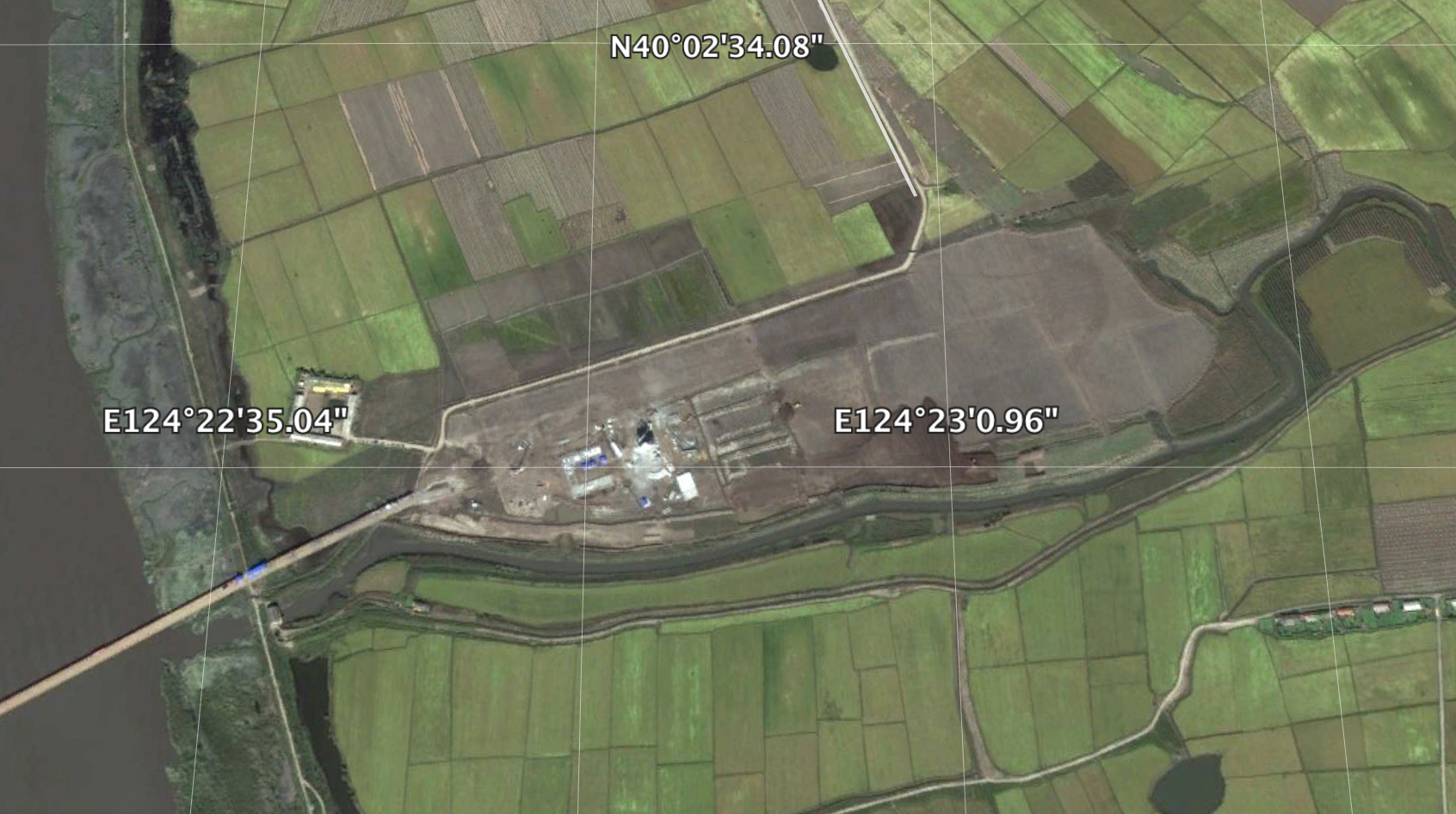
Here is a satellite image of the specific areas being designated for the first phase of the zone with proposed roads added for visual effect:

Sinuiju-SEZ-Google-Earth-2015-12-1

This is what the article had to say about the zone:

Sinuiju International Economic Zone

Located in a border area, the zone has a bright prospect for the development of water and marine transport. Its development area is 40km2.

The Zone is a flat area composed of deposits of organic fine sand in the mouth of the Amnok. The average height of ground inside the bank is 45m, geomorphology is 0-.7% and the average height above the sea level is up to 100m.

Its annual average duration of sunshine 2,427 hours, annual percentage of sunshine is 58% and annual average precipitation is 1001.5 mm.

The first and second annual main winds are northeast and and north winds respectively. It has the northeast and north winds in winter and southwest wind in summer in the main.

The Sinuiju International Economic Zone will provide opportunity for bonded processing, bonded transportation, trade and financial business, tourism, hi-tech industry, and various other business activities.

To this end, it is planned to develop the zone into a comprehensive economic zone with a large-sized latest IT industry area, competitive production area, exports processing area, cargo area, trade and financial area, public service area, tourist area and a bonded port, and into an international city with an airport and trade port.

Encompassing the whole of Sinuiju and two ri surrounding it, the zone is already furnished with infrastructure. However, it is necessary to upgrade the existing infrastructure and expand its capacity and build in its suburbs on a preferential basis.

The items of the construction of infrastructure include port, airport, railways, roads, power station, heating, and gas-supply system, telecommunications (international, domestic, mobile and computer network), and water supply, sewage-treating and garbage disposing systems.

As the zone has rich and good workforce whose education level is higher than secondary education, and many competitive heavy- and light-industry factories and enterprises around it, the investment by foreign business will be cost-effective and conducive to its development.

Previous posts on the Sinuiju International Economic Zone can be found here. Previous posts on the Sinuiju Special Administrative Region can be found here.

The North Koreans have also set up the Sinuiju-River Amnok Tourist Zone which you can read about here.

The JoongAng Ilbo has additional information here.

Share

DPRK-China trade through 2014

Thursday, October 29th, 2015

Stephan Haggard posted some charts of DPRK-China trade taken from KOTRA:

North-Korean-China-Trade-from-KOTRA

North-Korean-Trade-including-North-South-Trade

North-Korean-Exports-and-Imports-from-KOTRA


Share

DPRK used as Chinese smuggling route

Friday, October 23rd, 2015

According to the Siberian Times:

SWAT team ambush illegal cargo at night in open seas off coast of the Democratic People’s Republic.

The high-quality jade from the Republic of Buryatia was being exported to China without export documents. Its value was put at 50 million roubles or $800,000. Customs spokeswoman Tatiana Shichanina said: ‘We had a tip off that the smuggling was planned and decided to arrange ambush.’

The operation was led from customs vessel ‘Petr Matveev’. Officers seized ten sacks of jade. The crew were detained and taken to Vladivostok.

In China, this mineral is considered a ‘sacred rock’ and it can command a higher price than gold. The value of the ornamental rock in China encourages criminal gangs to collect and smuggle it.

Read the full story here:
Customs seize 3 tons of Siberian jade being smuggled by sea to North Korea en route to China
Siberian Times
2015-10-23

Share

KOTRA data on DPRK-China trade

Wednesday, October 14th, 2015

Below are charts published by KOTRA of North Korea – China trade.

North-Korean-China-Trade-from-KOTRA

North-Korean-Exports-and-Imports-from-KOTRA

North-Korean-Trade-including-North-South-Trade

Here is the source.

Share

4th annual China-DPRK Economic, Trade, Culture and Tourism Expo

Sunday, October 11th, 2015

UPDATE 3 (2015-10-22): According to Yonhap (via the Korea Herald):

 North Korea and China signed preliminary trade deals worth $1.6 billion at their annual trade fair, a roughly 10 percent gain compared to deals signed at last year’s exhibition, according to a Chinese official on Thursday.

North Korea and China have jointly held the trade fair in October since 2012 in the Chinese border city of Dandong, and this year’s four-day fair ended on Sunday. Last year, the two nations inked trade deals worth $1.36 billion.

Pan Shuang, deputy mayor of Dandong, told the International Business Daily newspaper that about 100 North Korean business entities attended the North Korea-China Economic, Trade, Culture and Tourism Expo.

The number of North Korean business entities attending this year was similar to last year, but Pyongyang sent trade officials and diplomats to this year’s exhibition, Pan said.

At this year’s fair, North Korea and China also agreed to launch new tour routes linking the North’s border town of Sinuiju and Dandong, Pan said.

North Korea and China “further solidified their trade bridge through a wide range of exchange and cooperation” during the trade fair, Pan said.

China is North Korea’s economic lifeline and diplomatic backer, although their political ties remain strained over the North’s defiant pursuit of nuclear weapons.

Political relations between North Korea and China showed signs of a thaw after Liu Yunshan, the Chinese Communist Party’s fifth-ranked official, held talks with North Korea’s young leader Kim Jong-un earlier this month in Pyongyang.

UPDATE 2 (2015-10-11): According to Xinhua:

A 400-strong delegation from the Democratic People’s Republic of Korea (DPRK) will attend the fourth China-DPRK expo scheduled next week, said organizers.

The China-DPRK Economic, Trade, Cultural and Tourism Expo will be held from Oct. 15 to 18 in northeast China’s Dandong City, with more than 100 exhibition booths for DPRK companies.

China and the DPRK will also discuss the launch of new tourism projects to DPRK during the expo, according to organizers.

Firms from Russia, Mongolia, Pakistan, Thailand, Vietnam, Egypt as well as Hong Kong and Taiwan regions will seek business opportunities at the expo.

Dandong is a key hub for trade, investment and tourism between China and the DPRK. There are more than 600 border trade enterprises in the city, and trade with the DPRK accounts for 40 percent of the city’s total trade turnover.

The Guomenwan trade zone in Dandong is expected to open soon to boost bilateral economic cooperation.

UPDATE 1 (2015-10-2): Yonhap reports on the expo:

North Korea and China will launch a joint trade fair on Oct. 15, with some 400 Chinese companies expected to attend the annual exhibition, according to Chinese media on Friday.

North Korea and China have jointly held the annual trade fair in October since 2012, but the number of North Korean business entities attending the event last year was about 30 percent less than 2013.

About 100 North Korean business entities will take part in the four-day trade fair, which will be held in the Chinese border city of Dandong, according to Chinese media reports.

Besides North Korea and China, companies from Hong Kong, Vietnam, Mongolia and Thailand will join this month’s North Korea-China Economic, Trade, Culture and Tourism Expo.

In the latest sign that Pyongyang and Beijing are trying to increase economic cooperation despite strained political ties, North Korea and China will launch a border trade zone in Dandong on Oct. 15 when the trade fair opens.

The Guomenwan trade zone in Dandong, where more than 70 percent of bilateral trade between the two nations is conducted, would cost a total investment of 1 billion yuan (US$157 million), state-run Xinhua news agency reported in August.

ORIGINAL POST (2015-7-12): Adam Cathcart informs us that the fourth China-DPRK Economic, Trade, Culture and Tourism Expo will be held this year. Info on the first, second, and third expos here.

Here is the website for the event (in Chinese).

According to Cathcart:

The going-forward of the 2015 fair was announced in Dandong at a hotel by the city’s vice-mayor; no North Koreans were listed as attending. Nor were any DPRK officials in attendance[.]

Share

An affiliate of 38 North