Archive for the ‘China’ Category

Hermit economics hobbles Pyongyang

Wednesday, March 31st, 2010

Aidan Foster-Carter writes in the Financial Times about some poor decision-making coming out of Pyongyang:

Great Leader? Pyongyang’s fawning hagiography not only grates, but is singularly unearned. Even by its own dim lights, North Korea’s decision-making is going from bad to worse.

Last year saw two spectacular own goals. Missile and nuclear tests were a weird way to greet a new US president ready to reach out to old foes. The predictable outcome was condemnation by the United Nations Security Council, plus sanctions on arms exports that are biting.

Domestic policy is just as disastrous. December’s currency “reform” beggars belief. Did Kim Jong-il really fail to grasp that redenomination would not cure inflation, but worsen it? Or that brazenly stealing people’s savings – beyond a paltry minimum, citizens only got 10 per cent of their money back – would finally goad his long-suffering subjects into rioting? Forced to retreat, officials even apologised. One scapegoat was sacked – and possibly shot.

By his own admission, Mr Kim does not do economics. In a speech in 1996, when famine was starting to bite, the Dear Leader whined defensively that his late father, Kim Il-sung, had told him “not to get involved in economic work, but just concentrate on the military and the party”.

That awful advice explains much. Incredibly, North Korea was once richer than the South. In today’s world, this is the contest that counts. “It’s the economy, stupid” is no mere slogan, but a law of social science.

Having taken an early lead, Kim senior threw it all away. He built the world’s fourth largest army, crippling an economy that he refused to reform, viewing liberalisation as betrayal. His own personality cult was and is a literally monumental weight of unproductive spending.

Used to milking Moscow and Beijing, in the 1970s North Korea borrowed from western banks – and promptly defaulted. That was not smart; it has had to pay cash up front ever since.

Pyongyang also resorts to less orthodox financing. In 1976 the Nordic nations expelled a dozen North Korean diplomats for trafficking cigarettes and booze. In December a Swedish court jailed two for smuggling cigarettes. More than 100 busts worldwide over 30 years, of everything from ivory and heroin to “supernotes” (fake $100 bills), leave scant doubt that this is policy.

Yet morality aside, it is stupid policy. Pariahs stay poor. North Korea could earn far more by going straight. The Kaesong Industrial Complex (KIC), where South Korean businesses employ Northern workers to make a range of goods, shows that co-operation can work. Yet Pyongyang keeps harassing it, imposing arbitrary border restrictions and demanding absurd wage hikes.

Now it threatens to seize $370m (€275m, £247m) of South Korean assets at Mount Kumgang, a tourist zone idle since a southern tourist was shot dead in 2008 and the north refused a proper investigation. Even before that, Pyongyang’s greed in extorting inflated fees from Hyundai ensured that no other chaebol has ventured north. Contrast how China has gained from Taiwanese investment.

In this catalogue of crassness, the nadir came in 1991 when the dying Soviet Union abruptly pulled the plug on its clients. All suffered, but most adapted. Cuba went for tourism; Vietnam tried cautious reform; Mongolia sold minerals. Only North Korea, bizarrely, did nothing – except watch its old system crumble. Gross domestic product plunged by half, and hunger killed up to a million. Now famine again stalks the land. The state cannot provide, yet still it seeks to suppress markets.

All this is as puzzling as it is terrible. China and Vietnam show how Asian communist states can morph towards capitalism and thrive. Kim Jong-il may fear the fate of the Soviet Union if he follows suit. True, his regime has survived – even if many of its people have not. Yet the path he is on is patently a dead end. Mr Kim’s own ill-health, and a belated bid to install his unknown third son as dauphin, only heighten uncertainty. Militant mendicancy over the nuclear issue – demanding to be paid for every tiny step towards a distant disarmament, then backsliding and trying the same trick again – will no longer wash. North Korea has run out of road; the game is finally up.

What now? A soft landing, with Mr Kim embracing peace abroad and reform at home, remains the best outcome. But if he obdurately resists change, we need a plan B. The US and South Korea have contingency plans for the north’s collapse. So does China, separately. Tacit co-ordination is urgent, lest future chaos be compounded by a clash of rival powers – as in the 1890s. Koreans have a rueful proverb: when whales fight, the shrimp’s back is broken.

But Beijing will not let it come to that. China is quietly moving into North Korea, buying up mines and ports. Some in Seoul cry colonialism, but it was they who created this vacuum by short-sightedly ditching the past decade’s “sunshine” policy of patient outreach. President Lee Myung-bak may have gained the Group of 20 chairmanship, but he has lost North Korea.

Nor will Mr Kim nuzzle docile under China’s wing, though his son might. As ever, North Korea will take others’ money and do its own thing. In early 2010 new fake “super-yuan” of high quality, very hard to detect, started appearing in China. They wouldn’t, would they?

Read the full article here:
Hermit economics hobbles Pyongyang
Financial Times
Aidan Foster-Carter
3/30/2010 

Share

Some Chinese weary of supporting Pyongyang

Wednesday, March 31st, 2010

According to Voice of America:

Peking University Professor Zhu Feng, one of the forum participants, issued a frank warning to the North not to expect any large handouts from China.

“Bailing out North Korea’s economy [is] easy.  We have the capability.  We have no intention,” said Zhu.

Three decades after opening its economy and encouraging market activity, Beijing is one of the three largest economies in the world.  In November, Pyongyang enacted what economists say is the mirror opposite of the Chinese reforms; clamping down on markets, and extinguishing the savings of small traders with a surprise currency revaluation.

Reports from North Korea indicate the measures strangled economic activity and sparked hyperinflation in prices for basic foods.

Zhu says Pyongyang needs to adjust its course, and unless it does, China will not help.

“Offering North Korea sizable aid, and keeping it [afloat], without any change to their very bizarre policy, is detrimental to the China national interest,” said Zhu.

Soon after North Korea invaded the South in 1950, China sent hundreds of thousands of troops to aid the North.  In the past, the two countries have said their relationship was as close as “lips and teeth.”  Zhu says times have changed.

“The Korean War is over.  Beijing changed tremendously.  Our relation also altered almost completely,” he said.

Zhu says China will continue to engage with the North on humanitarian issues to prevent mass starvation.  However, he says Beijing’s North Korea policy is not centered on preserving Kim Jong Il’s rule.

“China is now ready for any form of very substantive change in North Korea – including collapse,” he said.

It is not clear if the Chinese government backs Zhu’s comments. But such blunt language from China about North Korea is unusual. Beijing has been Pyongyang’s biggest economic supporter for nearly 20 years, and, regional security experts say, it wants to avoid an economic collapse in North Korea that would send hundreds of thousands of refugees across the border.

Read the full story here:
Chinese Continued Financial Support of N. Korea Questioned
Voice of America
Kurt Achin
3/31/2010

Share

DPRK food imports from China triple in January

Friday, March 12th, 2010

According to Yonhap:

North Korea brought in 13,834 tons of grain from the neighboring ally in January, a 3.6-fold increase from 3,869 tons in January last year, said Kwon Tae-jin, a senior researcher on the North’s agricultural sector at the South’s Korea Rural Economic Institute in a posting on his blog.

Rice accounted for about 61 percent or 8,425 tons of the North’s grain import from China, followed by corn with 3,448 tons, beans with 1,553 tons and wheat with 304 tons, Kwon said, citing data from the Korea International Trade Association.

“The big rise in imports of corn and beans, which the North didn’t bring in last year, appears to be not only because corn harvests were not good, but it also suggests the North increased imports over concerns about possible food shortages,” he said.

Kwon also said that the North’s regime could have increased imports to enlarge state food rations after last year’s currency reform caused strains on the country’s food supply system.

North Korea has relied on foreign handouts to feed its 24 million population after natural disasters and mismanagement devastated its economy. The situation worsened in recent years as South Korea halted regular food aid to the North after President Lee Myung-bak took office in early 2008 under a policy to link aid to Pyongyang’s process in ending its nuclear weapons programs.

… 

The U.N. food agency, Food and Agriculture Organization, said early this month that the North is expected to be short of about 1-1.2 million tons of food this year.

I think the data for this story came from this KITA web page, but I can’t be sure since my Korean is exceptionally limited. Here is a description of the KITA page in English.

On a personal note, I wish the major South Korean media outlets  would get into the habit of posting links to their sources.  It is not difficult to do this.  

Read the full article here:
N. Korea’s food imports from China more than triple in January: expert
Yonhap
3/12/2010

Share

China border tourism to North Korea set to rise, South Korean airlines may be involved

Thursday, March 11th, 2010

By Michael Rank

Chinese officials have announced plans to increase the number of Chinese tourists visiting North Korea from the border region of Yanbian 延边 and are hoping to involve South Korean airlines and to include Vladivostok on the itinerary, a Chinese website reports.

The head of the Yanbian tourism bureau, Jin Chengwen 金成文 (Kim Seong-mun), was quoted as saying they were investigating plans for tours starting in the main city in the region, Hunchun 珲春, which would take in the Russian Pacific port of Vladivostok and Baekdusan 백두산, a mountain on the Sino-Korean border that is the purported birthplace of leader Kim Jong-il, as well as tours from the North Korean port of Rajin 라진 to Pyongyang and Panmunjom.

He said he hoped Korean Air and other South Korean and Chinese airlines would become involved, but gave no details. It was hoped that Chinese tourists would not need passports to visit North Korea, he added.

Another Yanbian tourism official said there were already tours from the border town of Sanhe 三合 to the industrial city of Chongjin 청진 and Baekdusan and to Samji lake (Samjiyeon 삼지옌), a scenic spot near Baekdusan, and Pyongyang, and they were hoping to add a Rajin-Pyongyang-Panmunjom tour. “North Korea is hoping more Chinese tourists will come and tour their country,” he added.

The report said the tourism plans were connected to an agreement announced this month under which China gained the use of a pier at the port of Rajin 라진 for 10 years to help the development of the border region and give Jilin province access to the Pacific.

As NKEW reported last year, Chinese officials are also talking about cruises from Hunchun to the North Korean port of Raseon 라선 (Rasŏn/Naseon/Nasŏn) (which somewhat confusingly seems to be the same as Rajin), Sokcho 속초 in South Korea, just south of the DMZ, and Vladivostok.

North Korea is also hoping to attract tourists from southern China, and has cast its eye on Guangdong province as well as Shanghai.

Also see “China to Offer Railway Tours to N.Korea” in the Choson Ilbo:

A new train service is being offered in China for tours to North Korea. One news website based in China’s Zhejiang Province reported on Wednesday that a large travel agency in the region will offer railway trips from Hangzhou to Sinuiju from April 20.

The trains have 14 sleeper carriages and can transport 800 passengers. They pass Beidahu in Hebei Province and Dandong, Liaoning Province before arriving in Sinuiju, where Chinese passengers will transfer to a North Korean train and embark on an 11-day tour that includes stops in the border truce village of Panmunjom, Mt. Myohyang and the childhood home of former North Korean leader Kim Il-sung. The tours will cost 5,280 yuan for first-class compartments and 4,680 yuan for regular ones.

“Until now, people in Zhejiang Province visited North Korea by flying from Hangzhou either to Beijing or Shenyang and transferring to trains,” said a spokesman for the tour agency. “But the train tours are both cheaper than existing options and offer more sightseeing stops including Beidahu and Dandong, so more than 300 people have signed up already.” China halted tours to North Korea in February of 2006 but decided to start them again this year.

Chinese tourists will not be able to bring mobile phones into North Korea and will also be banned from carrying cameras with zoom lenses and face restrictions on traveling alone in the communist country.

Finally, more information on Chinese tourism has been published in the Donga Ilbo:

Tours of North Korea for Chinese tourists resuming next month have started to be sold in Beijing and Guangdong province, the China Daily said yesterday.

Five to six licensed tour agencies are recruiting Chinese tourists for travel in North Korea in mid-April. As many as 200 people from Beijing alone will visit next month, the daily said.

A few tour packages are up for grabs. A Chinese state-run travel agency is offering a six-day package and a three-day package. For both, tourists will travel by plane but must do so via Hangzhou, Beijing, the North Korean capital of Pyongyang, and Shenyang, so two full days will be needed to get to and from North Korea.

The three-day package is a brief visit to Pyongyang and costs 3,380 yuan (495 U.S. dollars). The six-day tour costing 6,280 yuan (920 U.S. dollars) covers many parts of North Korea. Tourists will visit the day after their departure Mansudae Grand Monument and Chollima Statue in Pyongyang. From the third day, they will go to Panmunjom in Kaesong, beaches in Wonsan, Mount Kumgang, and then back to Pyongyang.

The six-day package could also include a tour to Mount Myohyang. Tourists can also choose to attend a performance celebrating the birthday of North Korea’s late leader Kim Il Sung April 15.

The tourists will also receive a long list of “don’ts.” They will be banned from making noise, mimicking Kim’s postures in front of his statue, and commenting on North Korea’s leaders, politics, military and economy.

Another big no-no is the taking of photos on the trip from Shinuiju to Pyongyang, streets and markets, and images conveying a negative impression of the communist country.

Tourists also must call South Korea “South Korea” instead of the Republic of Korea. They will also be required to leave at immigration offices mobile phones, products with the South Korean or U.S. flag and other symbols of these nations on them, and magazines with open covers upon entering North Korea.

The list also says few public phones are on North Korean streets, adding tourists can make phone calls only at hotels for 16 yuan (2.30 dollars) per minute.

Share

DPRK seeks foreign capital through Rajin Port Development

Wednesday, March 10th, 2010

Institute for Far Eastern Studies (IFES)
NK Brief No.10-03-11-1
3/11/2010

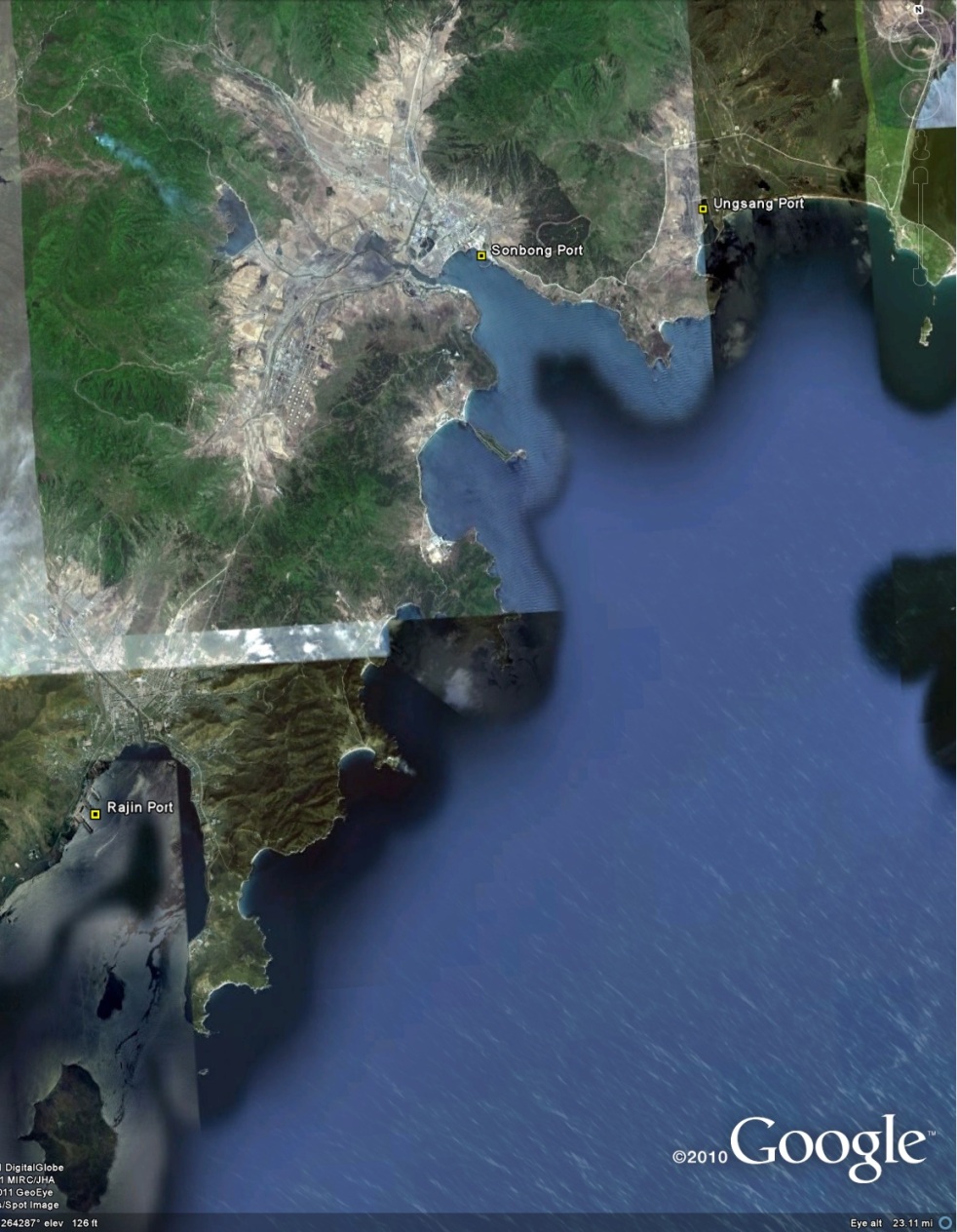
North Korea is actively looking into further development of Rajin Port by extending China’s lease on port facilities for another decade, and granting Russia 50-year rights to Rajin port facilities, as well. Li Longxi, a deputy of the National People’s Congress and head of Jilin Province’s Yanbian Korean Autonomous Prefecture, revealed to a Yonhap News reporter in Beijing on March 8, “The North gave Russia the right to use Pier 3 for 50 years, and is actively looking into extending the right to use Pier 1 granted to China in 2008 for another 10 years.”

Rajin Port has five piers, with Pier 3 being larger than Pier 1. The rights to Pier 1 were granted to the Changli Group, which specializes in the manufacture of environmental materials in Dalian. 10-year use and development rights had already been granted to this company. Deputy Li explained, “China gained rights to Pier 1 in 2008, and is now in negotiations with North Korea over extending those rights for 10 years.” Therefore, if this agreement is reached, China will have exclusive rights to the pier until 2028.

Li added, “Currently, China is in the process of constructing the facilities necessary to use the pier, and will begin to move goods through the port when construction is complete.” It appears China has invested tens of millions of Yuan into this project. Li also pointed out that by being able to use Rajin Port, Yanbian, currently lacking export avenues, will be able to transport Jilin Province’s abundant coal resources, not only through the Yellow Sea to Shanghai and other domestic cities, but to Japan and other countries in the Asia Pacific region.

On February 28, Sun Zhengcai, CCP Secretary of Jilin Province met with North Korean Kim Yong Il, head of the Korean Workers’ Party International Department, and introduced to him China’s ‘Greater Tumen Initiative’ development project. At the time, it was reported that Sun explained to Kim that Jilin provincial authorities had reached an agreement with North Korea for joint venture to construct a network of roads and basic infrastructure facilities. Jilin provincial and city officials, as well as Changchun city representatives, are involved in the project. China is focused on the Tumen river basin and Rajin Port because of their strategically valuable economic role in developing the country’s straggling northeast region.

Russia is also eyeing Rajin Port, because if the port is developed, it could serve as an outlet to export Sakhalin and Siberian crude oil and natural gas to neighboring countries. In July of last year, Russia and North Korea reached an agreement to repair the rail connection between Rajin and Hasan and to improve Rajin Port facilities, investing 1.4 billion Euros. Japanese newspaper Sankei Sinbun quoted a source within North Korea as reporting that Jang Song Thaek, Party administrative chief and brother-in-law of Kim Jong Il, had recently travelled to Rasun (Rajin + Sunbong) and declared that the area would be fully developed within the next 6 months.

The Korea Daepung International Group, serving as North Korea’s window to foreign capital, is said to have a plan to entice international investment in order to support the Tumen river development plan, and plans to develop Rasun Special City and Chongjin Port into key outlets for DPRK-PRC-Russian trade and commerce in Northeast Asia. However, the participation, and investment, of private-sector enterprises will likely depend on the success of the Rajin Port development.

Share

China leases Rason port for 10 years

Monday, March 8th, 2010

UPDATE:  According to Defense News:

Fears that China will establish a naval presence at a port facility at North Korea’s Rajin Port appear unfounded.

An agreement with a Chinese company to lease a pier at Rajin for 10 years was reported by the Chinese state-controlled Global Times on March 10.

The Chuangli Group, based at Dalian in China’s Liaoning province, invested $3.6 million in 2009 to rebuild Pier No. 1 and is constructing a 40,000-square-meter warehouse at the port. The leasing agreement has given way to suggestions China could be attempting to establish its first naval base with access to the Sea of Japan.

The North Korean Navy does use Rajin as a base for smaller vessels, such as mine warfare and patrol vessels, but for the time being, it appears economics are the primary motivation for the Chinese company’s presence there, said Bruce Bechtol, author of the book “Red Rogue: The Persistent Challenge of North Korea.”

“Chinese investment has increased a great deal in North Korea in the past five years,” he said. “It would not be a military port for the Chinese – as the North Koreans would be unlikely to ever allow such a thing.” He noted there are no Chinese military installations in North Korea.

The Rajin facility will give Chinese importers and exporters direct access to the Sea of Japan for the first time. “It is the country’s first access to the maritime space in its northeast since it was blocked over a century ago,” the Global Times reported.

China lost access to the Sea of Japan during the Qing Dynasty in the 19th century after signing treaties under duress from Japan and Russia.

Various media in Japan and South Korea have suggested the lease might give China an opportunity to place a naval base at Rajin, but Bruce Klingner of the Heritage Foundation in Washington, D.C., also downplayed the notion, saying North Korea’s negative attitudes toward China and a fear of excessive Chinese influence would negate any chance Beijing could establish a naval presence there.

Klingner also said he doubts North Korea would make a success out of the agreement. “Pyongyang’s aversion to implementing necessary economic reform and its ham-fisted treatment of investors suggests the new effort to turn Rajin into an investment hub will be as much a failure as the first attempt in the 1990s.”

ORIGINAL POST: According to the Choson Ilbo:

China has gained the use of a pier at North Korea’s Rajin Port for 10 years to help development of the bordering region and establish a logistics network there.

Lee Yong-hee, the governor of the Yanbian Korean Autonomous Prefecture in China’s Jilin province, made the announcement to reporters after the opening of the People’s Congress at the Great Hall of People in Beijing on Sunday.

He was quoted by the semi-official China News on Monday as saying, “In order for Jilin Province to gain access to the East Sea, a private company in China in 2008 obtained the right to use Pier No. 1 at Rajin Port for 10 years. Infrastructure renovation is currently underway there.”

In an interview with Yonhap News on Monday, Lee said, “We’re considering extending the contract by another 10 years afterward.”

Jilin abuts the mouth of the Duman (Tumen) River in the southeast but its access to the East Sea is blocked by Russia and North Korea. “We hope that an international route to the East Sea will be opened via Rajin Port,” he added.

Lee did not specify which Chinese company obtained the right and which North Korean agency awarded the concession. The Chinese Foreign Ministry on Feb. 25 said business investment in the North Korea-China border area is a normal business deal and does not therefore run counter to UN sanctions against the North.

According to Yonhap:

South Korea is keeping a close watch over North Korea’s efforts to draw greater foreign investment to one of its ports, as the move might indicate Pyongyang is opening up to the outside world and signal its return to stalled international nuclear talks, officials said Tuesday.

The North has agreed to give a 50-year lease on its Rajin port to Russia, and the country is also in talks with a Chinese company on extending its 10-year lease by another decade, according to an official from China’s Jilian Province, currently in Beijing for the National People’s Congress.

The North’s opening of the port on its east coast has a significant meaning for China as it will give the latter a direct access to the Pacific, but it also means millions of dollars, at the minimum, in investment for the cash-strapped North.

Officials at Seoul’s foreign ministry said the North’s opening of its port or its economy was a positive sign, but that it was too early to determine whether the move will also have a positive effect on international efforts to bring North Korea back to the nuclear negotiations.

“We are trying to confirm the reports, though they appear to be true because they were based on China’s official announcement,” an official said, asking not to be identified due to the sensitivity of the issue.

“We are trying to find out the exact details of the contracts (between North Korea and Russia and China),” the official added.

Additional information 

1. A previous report indcated that there were 250 Chinese companies registered in Rason.  The North Koreans reportedly closed out the insolvent and inoperable businesses. I do not know how many are there now. Read more here.

2. The Russian government recently built a Russian-gauge railway line from Kashan to Rason. Read more here.  It will be interesting to see if China upgrades roads and railways which could connect Rason to China.

3. Rason is sealed off by an electric fence. Read more here.

4. Many other stories about Rason here.

Read the full stories here:
China’s Jilin Wins Use of N.Korean Sea Port
Choson Ilbo
3/9/2010

Seoul closely watching N. Korea’s opening of port to China: officials
Yonhap
Byun Duk-kun
3/9/2010

Share

Chinese lamps popular in DPRK

Sunday, March 7th, 2010

According to the Choson Ilbo

Chinese-made solar reading lamps are selling like hot cakes in North Korea. According to a North Korean source, the reading lamps sell for 10,000 to 20,000 North Korean won, a price several times the average monthly wage.

The customers are chiefly parents with children preparing for college entrance exams. Due to do the poor power supply, North Korea except for some parts of Pyongyang is plunged into pitch darkness every night, making it impossible to study. The solar-powered reading lamps provide a measure of independence from the power grid.

In the North, background determines if youngsters can enter college, and not all parents can afford to concentrate their energy on their children’s education. But relatively well-to-do families provide tutoring for their children by employing students of prestigious universities, such as Kim Il Sung University or Pyongyang University of Foreign Studies, in efforts to prepare their children for college entrance exams.

Read the full article here:
N.Korean Parents ‘Zealous’ About Children’s Education
Choson Ilbo
3/8/2010

Share

N.Korea received 300,000 tons of food aid in 2009

Wednesday, February 24th, 2010

According to the Choson Ilbo:

North Korea is believed to have been given 300,000 tons of food either on credit or as aid last year, mostly from China, the Unification Ministry told the National Assembly’s Foreign Affairs, Trade and Unification Committee on Tuesday. That is enough to feed the entire population of North Korea for a month.

The UN Food and Agriculture Organization on Monday said North Korea faces a shortage of 1.25 million tons of food, but that did not take into account the amount provided by China and other countries. Unification Ministry Hyun In-taek said, “North Korea has been suffering from problems in food supply and distribution since its currency reform and has been taking measures to deal with the situation.”

Read the full article here:
N.Korea Took 300,000 Tons of Food Aid Last Year
Choson Ilbo
2/24/2010

Share

China to send $10 billion investment to DPRK

Tuesday, February 16th, 2010

UPDATE: According to the Daily NK, South Korea’s National Intelligence Service (NIS) claims $10 billion transfer is not likely:

The director of the NIS, Won Sei Hoon passed on the confirmation to a closed-door meeting of the Intelligence Committee of the National Assembly on Tuesday, after which members Chung Jin Suk of the Grand National Party and Park Young Sun of the Democratic Party revealed it to the press.

According to the two lawmakers, Won told the Committee, “Although North Korea is likely going around trying to invite 10 billion dollars of foreign investment, it seems that they have not attracted that much capital,” before predicting, “Unless the North solves the nuclear problem, it will be almost impossible to attract that much capital.”

He did add, however, “The Cabinet, Workers’ Party, military authorities and National Defense Commission have all seemingly been moving to try and obtain foreign capital. The appeasement attitude shown to the international community may be a part of their efforts to solve the problem of a lack of foreign currency.”

During the closed-doors meeting, Won also gave his opinion on a wide range of other issues pertaining to North Korea, including the inter-Korean dialogue and the truth of Kim Jong Il’s health status.

“It is not a deadlock situation because there is still dialogue,” Won said of the inter-Korean relationship. However, “Since North Korea’s attitude has not changed yet; it will take more time to resume the tours of Mt. Geumgang and Kaesong.”

Commenting on Kim Jong Il’s probable health condition, Won revealed that Kim has been making an effort to appear healthy, for example by removing age spots on his face, but, “While he has been visiting industrial sites, he has expressed nervousness about current issues and economic problems, and has a sharpened temper. His tendency of relying on old acquaintances and family members has been increasing.”

However, “I believe there is zero possibility of a coup. For the time being, it seems that the North Korean leadership can control its domestic society.”

ORIGINAL POST: According to Yonhap:

During his four-day visit to Pyongyang, the source said [Wang Jiarui, head of the international department of the Communist Party of China] held in-depth discussions about investments by Chinese companies via Daepung Group, an investment company that works to attract overseas capital to the communist state.

Total investments are expected to exceed the $10 billion mark, with a signing ceremony planned by North Korea’s State Development Bank in mid-March that is to be attended by foreign investors from involved nations, the source said.

“Over 60 percent of total investments, which will be announced next month, will come from China,” the source added, suggesting the Chinese government’s close involvement in building railways, ports and houses in North Korea.

China is North Korea’s biggest trading partner and an important provider of food and fuel. North Korea remains isolated from most of the world and has received virtually no foreign investment. The North’s GDP was estimated at around $26.2 billion in 2008 compared with $1.3 trillion for the South, according to the U.S. State Department.

Read more about the Korea Taepung International Investment Group and the DPRK State Development Bank here.

Read the full story below:
N. Korea draws US$10 billion in foreign investments: source
Yonhap
2/15/2010

Share

Primer on the Tumen Area Development Project

Monday, February 1st, 2010

Northeast Asia Matters posted a very helpful background paper on the Tumen Area Economic Development Project. According to Northeast Asia Matters:

Many in Northeast Asia wish to see the Tumen Basin develop into a place for economic cooperation and competition. One such plan is the Greater Tumen Initiative (GTI), formerly known as Tumen River Area Development Project (TRADP), being carried out under the auspices of the United Nations Development Programme (UNDP). The 20-year 80 billion USD plan calls for the creation of port facilities and transportation infrastructure in the region to support a multinational trading hub. Countries participating in the GTI are China, Mongolia, North Korea, Russia and South Korea.

The goal of GTI is to make the area into a free economic zone for trade to prosper and attract investment into the area. For China, the project would give traders in Northeast China easier access to major international ports without having to circumnavigate the Korean Peninsula and thus stimulating growth in China’s northeast rustbelt. For Russia, the project would give the ability to better exploit resources in Siberia and allow easier access to North Korea’s resource-rich hinterland; the area just to the south of the Tumen contains reserves of oil, minerals, coal, timber, and abundant farmland.

Development of the Tumen River area and North Korea’s participation in this project means inflow of hard foreign currency, improvements in infrastructure, and possible increase in industrial capacity. North Korea, with its bleak economy, therefore, will most likely continue to support the development of Tumen River area and increase its future involvement in the project as it seeks to break the economic isolation and hardship it has suffered since the collapse of most of its communist allies and the implementation of international sanctions.

Read the full paper here.

Share

An affiliate of 38 North