Archive for the ‘China’ Category

New papers on the DPRK’s markets and Chinese investment

Friday, February 4th, 2011

In addition to the Haggard/Noland book release, there were a couple of other interesting North Korea events in Washington DC this week that I wanted to point out:

1. Korea Economic Institute: The Markets of Pyongyang
John Everard, UK Ambassador to the DPRK (2006-2008)

-Read his paper here (PDF).
-See his power point presentation here (PDF).
-See his full presentation in three parts: Part 1, Part 2, Part 3.

2. US-Korea Institute at SAIS: Silent Partners: Chinese Joint Ventures in North Korea
Drew Thompson, Director of China Studies and Starr Senior Fellow at The Nixon Center

-The event web page is here.
-Read an executive summary here
-Read the paper here.

Both papers are well worth reading.

Share

North Korea increasing coal production – seeking to ease power shortages and boost exports

Wednesday, February 2nd, 2011

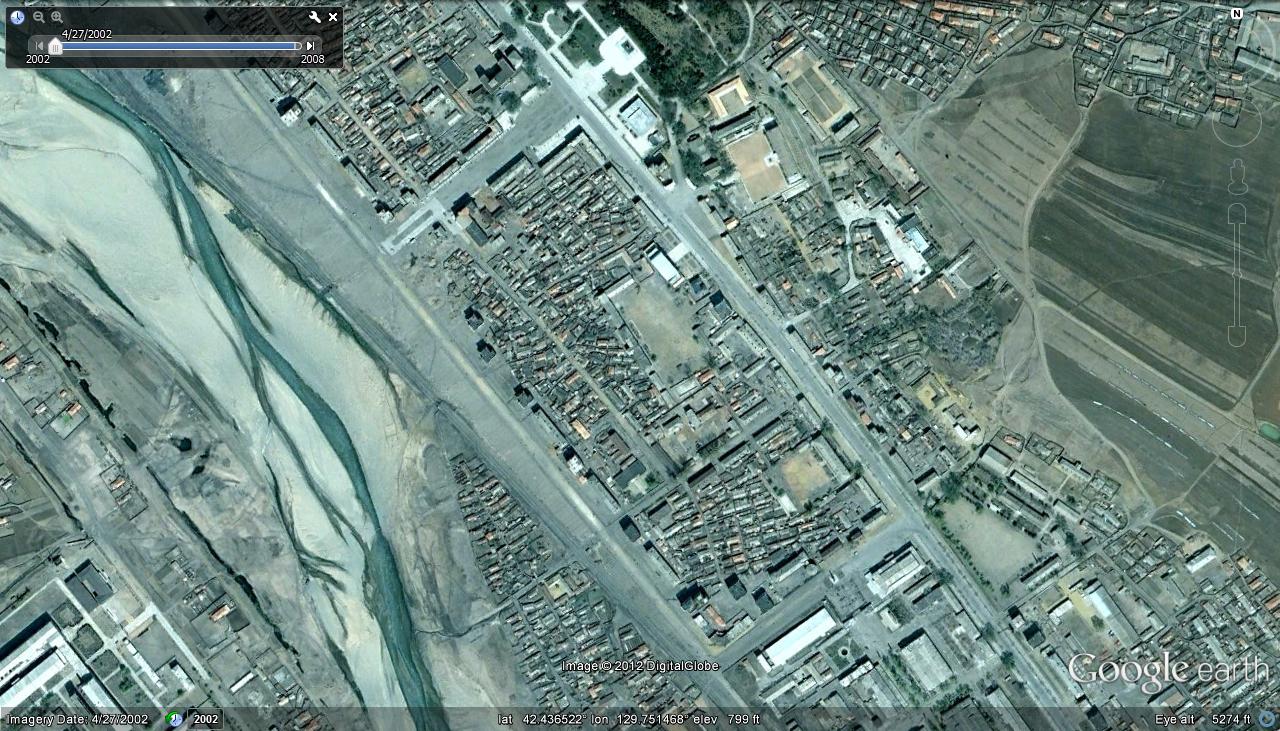
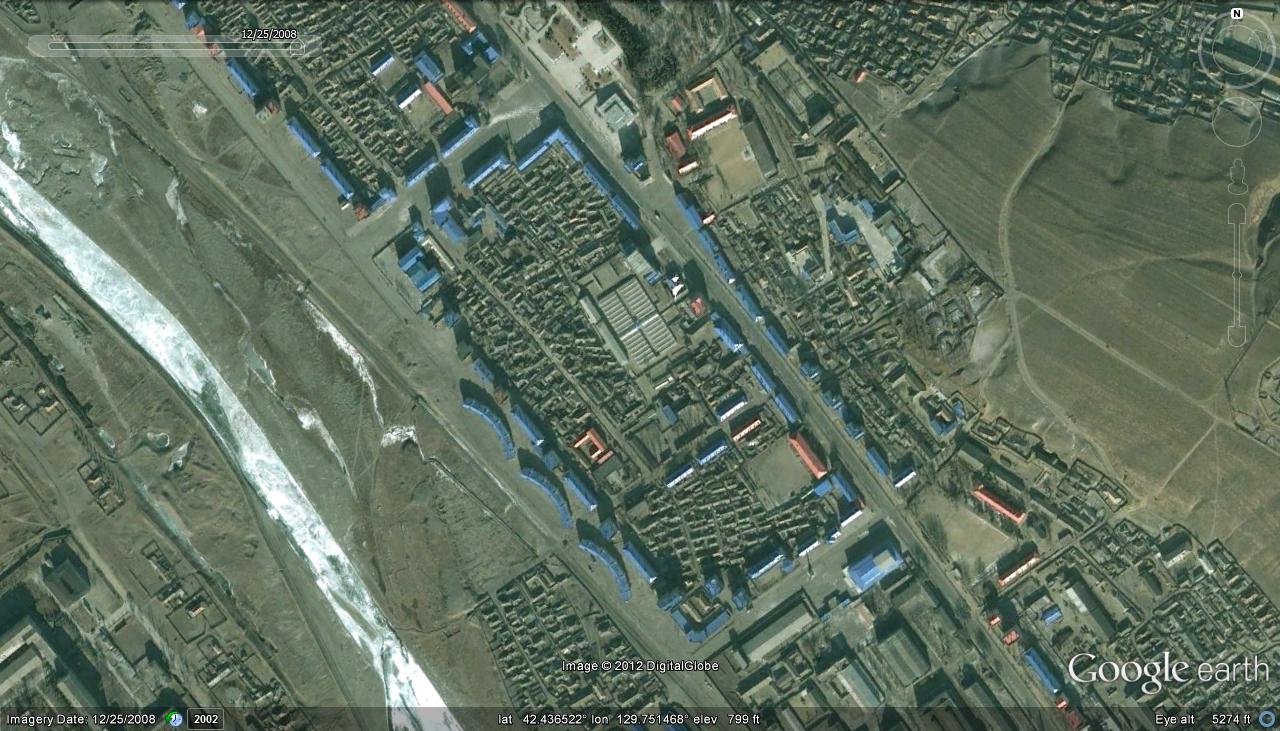
Pictured Above: Pongchon Coal Mine (Google Earth)

Institute for Far Eastern Studies (IFES)
NK Brief No. 11-01-18
1/28/2011

The DPRK Workers’ Party’s newspaper, the Rodong Sinmun, recently featured a front-page editorial urging the North Korean people to increase coal production. On January 26, the KCNA reiterated the call, reporting that the newspaper editorial highlighted fertilizer, cotton, electricity, and steel as products suffering from a lack of coal, and that “coal production must be quickly increased in the Jik-dong Youth Mine, the Chongsong Youth Mine, the Ryongdeung Mine, the Jaenam Mine, Bongchon Mine [Pongchon Mine] and other mines with good conditions and large deposits.”

The editorial also emphasized that “priority must be placed on the equipment and materials necessary for coal production,” and, “the Cabinet, national planning committee, government ministries and central organizations need to draft plans for guaranteeing equipment and materials and must unconditionally and strongly push to provide,” ensuring that the mines have everything they need. It also called on all people of North Korea to assist in mining endeavors and to support the miners, adding that those responsible for providing safety equipment for the mines and miners step up efforts to ensure that all necessary safety gear is available.

In the recent New Year’s Joint Editorial, coal, power, steel and railways were named as the four ‘vanguard industries’ of the people’s economy. Of the four, coal took the top spot, and all of North Korea’s other media outlets followed up the editorial with articles focusing on the coal industry. On January 15, Voice of America radio quoted some recent Chinese customs statistics, revealing that “North Korea exported almost 41 million tons of coal to China between January and November of last year, surpassing the 36 million tons exported [to China] in 2009.” It was notable that only 15.1 tons were exported between January and August, but that 25.5 tons were sent across the border between August and November.

North Korea’s coal exports to China earned it 340 million USD last year, making the coal industry a favorite of Pyongyang’s economic and political elites. Increasing coal production is boosting output from some of the North’s electrical power plants, while exports to China provide much-needed foreign capital. However, even in Pyongyang, where the electrical supply is relatively good, many houses lack heating and experience long black-outs. Open North Korea Radio, a shortwave radio station based in the South, reported on January 24, “As electrical conditions in Pyongyang worsen, now no heating is available.” Farming villages can find nearby timber to use as firewood, but because prices are so high in Pyongyang, even heating has become difficult. Some in the city even wish for rural lifestyles, just for the access to food and heat.

Share

DPRK selling defective Chinese arms

Wednesday, February 2nd, 2011

According to Reuters:

North Korea was the supplier of a cache of defective weapons sold to Burundi’s army by a Ukrainian firm, said Western diplomats familiar with the case that has riled Burundi’s anti-corruption body.

The weapons deal with Burundi appeared to be a violation of the international ban on North Korean weapons exports which the U.N. Security Council imposed on Pyongyang in June 2009 after its second nuclear test, the diplomats told Reuters on condition of anonymity.

The case involved the supply of some 60 Chinese-made .50-calibre machine guns to Burundi by a Ukrainian firm called Cranford Trading, the diplomats said. The weapons, which were defective, were sold to the firm by North Korea, they added.

Diplomats say Pyongyang continues to try to skirt the arms embargo. Last year South Africa informed the Security Council’s sanctions committee about a seizure of North Korean arms bound for Central Africa.

The expanded sanctions were aimed at cutting off North Korea’s arms sales, a vital export that was estimated to earn the destitute state more than $1 billion a year.

Some facts about the Burundi weapons deal became known late last year when the country’s anti-corruption watchdog went public about irregularities it found. It said that the arms had been defective and that Burundi had been overcharged.

A report on a state audit of the deal, seen by Reuters, concluded that Cranford Trading provided Burundi’s army defective military material with the complicity of former Defense Minister Germain Niyoyanka, current army chief Godefroid Niyombare and his deputy Diomede Ndegeya.

The auditors’ report said that the bidding offer was $3.075 million, while the amount in the contract was for $3.388 million. A further $1.186 million was paid in transport fees, even though such fees were not agreed in the contract.

The auditors concluded that the defense ministry had spent a great deal of money on defective material and recommended the prosecution of all people involved on suspicion of graft.

North Korea was not mentioned in the auditors’ report.

Several officials at Burundi’s U.N. mission in New York declined to comment when contacted by Reuters.

NO CERTIFICATE OF ORIGIN

“The weapons were transferred by China to North Korea, which then sold them to Cranford,” a diplomat said, adding that the official documentation for the deal had been incomplete.

“There was no certificate of origin of the weapons, which is necessary to comply with international conventions,” the diplomat added. Another diplomat confirmed the remarks.

The contract between Burundi’s defense ministry and Cranford Trading covered the period between October 2008 through 2010. It was not clear how much North Korea would have received when it sold the defective arms to Cranford Trading.

It was not possible to track down Cranford Trading in Ukraine, since the company was not readily accessible in any public lists. Ukraine’s U.N. mission did not respond to an e-mailed query about Cranford and the arms transaction.

It was not clear when China transferred the weapons to North Korea, or who in China was responsible, or whether the Chinese government had knowledge of the deal.

The U.N. arms embargo does not ban the sale of small arms to Pyongyang, though it does require exporters to notify the Security Council’s North Korea sanctions committee in advance about any small-arms sales to Pyongyang.

If the transfer took place after the latest round of U.N. sanctions were approved in June 2009, the exporter would have been required to notify the sanctions committee.

A spokesman for China’s U.N. mission was not available for comment.

The diplomats said the sanctions committee has not been notified about the Burundi case.

Read the full story here:
Defective Burundi weapons came from N.Korea
Reuters
Louis Charbonneau
2/1/2011

Share

DPRK working to avoid ROK trade restrictions

Tuesday, January 25th, 2011

According to Choson Ilbo:

North Korean products are being sold in South Korea labeled as Russian after the South stopped all cross-border trade in May last year. The North is desperate to unblock the flow of hard currency and is pushing for resumption of dialogue over the Kaesong Industrial Complex and lucrative package tours to Mt. Kumgang.

The Unification Ministry has released a list of the top 10 North Korean agricultural and fisheries imports, which show that the South brought in around 310,000 tons between 2006 to 2010. Imports totaled US$677 million tons, which worth $135 million a year. Over the last decade, North Korea also earned more than $500 million from the Mt. Kumgang tours, while the Kaesong Industrial Complex brought in $50 million annually.

Shellfish exports made the most money for the North, totaling 171,533 tons worth $268 million, followed by dried fish ($78.76 million), processed fish products ($76.02 million) and other seafood ($67.42 million).

Before the South halted trade following the sinking of the Navy corvette Cheonan, most North Korean shellfish was brought into the port city of Sokcho on the east coast. South Korean importers paid in U.S. dollars in Sokcho after signing contracts in the Chinese border town of Dandong with North Korea’s official economic cooperation agency.

But since trade was halted, North Korean shellfish has been labeled in Dandong as Chinese in origin and apparently sent to the western port city of Incheon. North Korean fisheries products are also apparently loaded on to Chinese vessels in the West Sea and brought into South Korea. As the pressure to bring in more dollars increases, chances have risen that the North’s agricultural and fisheries products are being falsely labeled.

A South Korean businessman who trades with North Korea, said, “Since trade was halted, North Korea has been trying to sell its products to South Korea labeled as Chinese or Russian in origin. This shows just how desperate North Korea is for dollars.”

The alternatives would be to sell the goods to China, the North’s largest trading partner, but prices have to be slashed and it costs more to transport them. Most of the dollars North Korean makes from selling goods to South Korea appear headed straight for leader Kim Jong-il’s coffers and used to prop up his rule. Kim’s funds are divided into local and foreign currencies and the latter, raised by selling farm and fish products, account for a key portion. Products such as shellfish and mushrooms that can bring in the most foreign currency are controlled by the Workers Party or the military, making it hard for the money to be used to boost the welfare of the North Korean people.

“North Korea uses a lot of the money it makes from trade to fund its rule, either buying gifts for government officials or building luxury homes,” said Cho Myung-chul, a professor at the Korea Institute for International Economic Policy, who taught economics at Kim Il-sung University in North Korea. “North Korea desperately needs money to win the hearts and minds of the public and gain support for the hereditary transfer of power. That’s why it’s seeking talks with South Korea, so it can find a way to sell its products.”

South Korea is also prosecuting South Korean firms suspected of trading with the DPRK.

Read the full story here:
N.Korea Sells Products in South Under False Labels
Choson Ilbo
1/22/2011

Share

China seeks to station troops in DPRK?

Sunday, January 16th, 2011

UPDATE: China denies sending troops to the DPRK.  According to the Global Times:

A Chinese government official Sunday dismissed a report by a South Korean newspaper that China was sending troops to North Korea.

“China will not send a single soldier to other countries without the approval of the UN,” an official at the Chinese Ministry of Defense told the Global Times on condition of anonymity, citing China’s basic policy on troop deployment.

ORIGINAL POST BELOW: According to the AFP:

China is in discussions with North Korea about stationing its troops in the isolated state for the first time since 1994, a South Korean newspaper reported Saturday.

The Chosun Ilbo newspaper quoted an anonymous official at the presidential Blue House as saying that Beijing and Pyongyang recently discussed details of stationing Chinese soldiers in the North’s northeastern city of Rason.

The official said the soldiers would protect Chinese port facilities, but the location also gives access to the Sea of Japan (East Sea), while a senior security official was quoted as saying it would allow China to intervene in case of North Korean instability.

A spokeswoman for the Blue House said she had no information, while China’s defence ministry declined comment to AFP on the matter this week.

“North Korea and China have discussed the issue of stationing a small number of Chinese troops to protect China-invested port facilities” in the Rason special economic zone, the unnamed official was quoted as saying.

“The presence of Chinese troops is apparently to guard facilities and protect Chinese nationals.”

China reportedly gained rights in 2008 to use a pier at Rason, securing access to the Sea of Japan (East Sea), as North Korea’s dependence on Beijing continues to grow amid a nuclear stand-off with the United States and its allies.

The last Chinese troops left the North in 1994, when Beijing withdrew from the Military Armistice Commission that supervises the truce that ended the 1950-53 Korean war.

Seoul’s International Security Ambassador Nam Joo-Hong told the Chosun Ilbo that China could now send a large number of troops into the North in case of instability in the impoverished communist state.

“The worst scenario China wants to avoid is a possibly chaotic situation in its northeastern provinces which might be created by massive inflows of North Korean refugees,” Nam was quoted as saying.

“Its troops stationed in Rason would facilitate China’s intervention in case of contingencies in the North,” he said.

Here is the original report in the Choson Ilbo (in Korean).

UPDATE: The Choson Ilbo posted a story in English which claims the Chinese soldiers are already in North Korea:

Chinese troops have been stationed in the special economic zone of Rajin-Sonbong in North Korea, sources said Friday.

This would be the first time since Chinese troops withdrew from the Military Armistice Commission in the truce village of Panmunjom in December 1994 that they have been stationed in the North.

“Pyongyang and Beijing have reportedly discussed the matter of stationing a small number of Chinese troops in the Rajin-Sonbong region to guard port facilities China has invested in,” a Cheong Wa Dae official said. “If it’s true, they’re apparently there to protect either facilities or Chinese residents rather than for political or military reasons.”

How many of them are there is not known. The move is unusual since North Korea is constantly calling for U.S. forces to pull out of South Korea and stressing its “juche” or self-reliance doctrine.

A China-based source familiar with North Korean affairs said, “In the middle of the night around Dec. 15 last year, about 50 Chinese armored vehicles and tanks crossed the Duman (Tumen) River from Sanhe into the North Korean city of Hoeryong in North Hamgyong Province.”

Residents were woken up by the roar of armored vehicles. Hoeryong is only about 50 km from Rajin-Sonbong. Other witnesses said they saw military jeeps running from the Chinese city of Dandong in the direction of Sinuiju in the North at around the same time.

“The Chinese armored vehicles could be used to suppress public disturbances and the jeeps to round up on defectors from the North,” the source speculated.

Nam Joo-hong, the ambassador for international security, said, “What China is most worried about in case of a sudden change in the North is mass influx of defectors, which would throw the three northeastern Chinese provinces into confusion. With its military presence in Rajin-Sonbong, there is a likelihood that China could intervene in Korean affairs by sending a large number of troops into the North under the pretext of protecting its residents there in an emergency.”

The North and China have engaged in lively military exchanges since two visits to China by North Korean leader Kim Jong-il last year. Guo Boxiong, the top Chinese military officer and vice chairman of the Chinese Central Military Commission, visited the North in late October last year and met with leader Kim Jong-il and his son and heir Jong-un. In the meeting, Kim senior emphasized “blood ties” between the two countries.

A Chinese mission has been stationed in Rajin-Sonbong since last December. China is transporting natural resources from its northeastern region to the south via Rajin-Sonbong Port, which has recently been renovated.

According to China’s official Xinhua news agency on Jan. 3, China first used the port on Dec. 7, when it transported 20,000 tons of coal from a mine in Hunchun, Jilin Province to southern parts including Shanghai. There is speculation that China will supply its own electricity to Rajin-Sonbong from April.

Quoting an internal North Korean source, the online newspaper Daily NK said the North and China in December signed an investment pact on building three more piers at the port and building a highway and laying a railroad between Quanhe in Jilin and Rajin-Sonbong.

The number of Chinese people arriving in the special zone has grown as a result of the North’s quest for investment, observers said.

“The North Korean State Security has more or less stopped checking Chinese people,” another source said. “The North has apparently concluded that it is unavoidable to accept the Chinese military presence on its land to woo Chinese investment, even if it’s not happy about it.”

Read the full story here:
China to station troops in N. Korea: report
AFP
1/16/2011

Share

DPRK trade falls in 2009 – reliance on China remains high

Sunday, January 9th, 2011

According to Yonhap:

North Korea’s external trade fell in 2009 with its economic reliance on China staying significantly high, a report showed Sunday, underscoring the need for Pyongyang to diversify its industry structure and open its market for survival.

According to the report by the Korea Finance Corporation, North Korea’s total trade amounted to US$3.41 billion in the cited year, down 10.6 percent from a year earlier. The trade decrease was the largest since 1998.

Exports dropped 6 percent to $1.06 billion, while imports fell 12.5 percent to $2.35 billion over the same period, the report showed, bringing the North’s trade deficit to $1.29 billion.

With international sanctions in place for its nuclear ambitions and its reluctance to open up its economy, the North’s dependence on China stayed quite high at 80.4 percent in 2009, the report showed. Its trade deficit with Beijing totaled $1.1 billion.

The report said that the North should open its market and diversify its industry structure currently focused on producing weapons, while improving overall infrastructure such as power generation facilities, should it seek to revive its economy.

It also emphasized the need for resumption of inter-Korean trade and an increase in international aid for the North’s survival.

“For the North Korean economy to get back on track, inter-Korean trade has to be resumed and aid from the international community should also be expanded,” said an official of the state-run corporation.

South Korea’s economic relations with the North have remained frozen since Seoul cut almost all inter-Korean trade in May 2010 after it found Pyongyang was behind the deadly attack of its naval ship in March that killed 46 sailors.

The move led to a drop of around 30 percent in inter-Korean trade last year, according to the latest report by Seoul’s customs office. South Korea is one of the North’s major trade partners, although the two remain technically at war as their 1950-53 conflict ended in a truce, not a peace treaty.

If a reader can send me a link to the actual report, I would appreciate it.

The Los Angeles Times also covered the report.

Read the full story here:
N. Korea’s trade falls, reliance on China remains high in 2009
Yonhap
1/9/2011

Share

Chinese to boost investment in Rason

Friday, January 7th, 2011

UPDATE  1 (2011-1-19): According to the Wall Street Journal:

A Chinese firm has signed a letter of intent to invest $2 billion in a North Korean industrial zone, representing one of the largest potential investments in Kim Jong Il’s authoritarian state and a challenge to U.S. policy in the region.

The agreement was signed with little fanfare in Pyongyang on Dec. 20—a day otherwise marked by pitched tension on the Korean peninsula following the North’s shelling of a South Korean island—according to documents viewed by the Wall Street Journal. Confirmation of the deal comes as Chinese President Hu Jintao visits Washington this week in a bid to forge closer security and economic ties with the U.S.

U.S. officials said the administration is aware of the possible Chinese investment, but noted that previous projects haven’t gone anywhere. “No investment project will enable North Korea to meet the needs of its people as long as its government continues its destabilizing behavior,” said a senior administration official.

The letter of intent involves China’s Shangdi Guanqun Investment Co. and North Korea’s Investment and Development Group. An assistant to the managing director of Shangdi Guanqun, who identified himself only by his surname, Han, said his company’s planned investment is focused on the Rason special economic zone, situated near North Korea’s border with Russia.

The zone was called Rajin-Sonbong when it was established in 1991, but failed to attract sufficient investment. It was revived, and re-named Rason, following a visit there in 2009 by Mr. Kim.

Mr. Han said the plan is to develop infrastructure, including docks, a power plant and roads over the next two to three years, followed by various industrial projects, including an oil refinery, over the next five to 10 years. He said the company was waiting for a response from the North Korean government before applying for approval from China’s Ministry of Commerce.

“It’s all pending at this stage, and it’s really up to the Korean side to make the decision,” Mr. Han said. He added that the $2 billion figure was what the North Korean side had hoped for, not necessarily what his company could deliver.

The company’s Web site says the company was “under the administration” of a state-owned enterprise, Shangdi Purchase-Estate Corporation. Mr. Han, however, said his company was “100 percent private.”

For the Obama administration, securing China’s cooperation in restraining North Korea’s military and nuclear-proliferation activities is a cornerstone of a warmer bilateral relationship. But the potential investment is a reminder of possible limits of Chinese cooperation.

The U.S. wants to step up sanctions to force Kim Jong Il to give up his nuclear-weapons arsenal and military activities. China, meanwhile, is increasingly promoting business projects and direct investment to influence the North, say Chinese and American analysts, arguing financial pressure hasn’t worked.

China is North Korea’s biggest trading partner and aid donor, but the scale of this deal raises concerns in Seoul that Beijing is running its own version of the “Sunshine” policy under which the South boosted investment in the North from 1998 to 2008.

This policy disconnect is expected to be one of the issues Chinese and U.S. officials discuss this week. “These types of deals pursued by China generally present a real challenge to the sanctions” being effective, said Victor Cha, a North Korea expert who helped oversee Asia policy in George W. Bush’s National Security Council. “The net effect is that it does make it more difficult for these sanctions to have the desired effect.”

Such deals have emerged in the past and have come to nothing, analysts said, and it is possible this one, too, could peter out. A number of similar North Korean economic zones have failed to live up to their billing because of poor infrastructure and corruption, and a lack of economic reform. News of the deal was first reported in the Korean-language press, including the Voice of America’s Korean service.

It is unclear how long the agreement has been in the works. But its Dec. 20 signing came on the day South Korea conducted a closely watched artillery test from Yeonpyeong Island near North Korea.

The test marked a high point in tensions after North Korea’s surprise late November shelling of Yeonpyeong, which killed four South Koreans. Pyongyang had threatened a swift military response should Seoul carry out an announced artillery test on Dec. 20. But the day’s drill came and went amid high security in the South, with the North saying in a statement it “did not feel any need to retaliate.”

Top administration officials have recently both praised and chided the Chinese over the North. On a trip to China last week, Defense Secretary Robert Gates commended the Chinese for their “constructive” role in reducing tensions on the peninsula after Pyongyang’s recent shelling of a South Korean island. Secretary of State Hillary Clinton in a Friday speech pressed China to be more aggressive in helping tamp down the North’s nuclear program.

The proposed investment is among the strongest evidence yet of China’s strategy of using direct investment rather political pressure to push for change in North Korea. Chinese experts say that after North Korea’s first nuclear test in 2006, China tried to make improved bilateral relations dependent on Pyongyang dismantling its nuclear program. But after a second test in 2009, China changed tack.

Beijing now believes, according to Chinese experts, that the North Korean regime won’t respond to political pressure and could collapse completely if China cuts off aid and investment, triggering a flood of refugees into northeastern China, and bringing U.S. troops right up to the Chinese border.

The investment strategy was cemented when China’s Premier Wen Jiabao visited North Korea in October 2009 and signed a slew of economic and trade agreements. One of those agreements was for China to fund construction of a $250 million bridge across the Yalu River that separates the two countries.

Construction of the bridge, which would link China with another North Korean special economic zone, had been slated to start in August. Local officials said in November it appeared to have been put on hold indefinitely. Now they say a ground-breaking ceremony was held Dec. 31.

U.S. officials are particularly concerned about how China’s financial links to North Korea may be facilitating Pyongyang’s weapons programs. In November, Pyongyang showed a visiting American scientist 2,000 centrifuges stationed at a cover site, drastically raising fears about the North’s ability to expand its nuclear-weapons arsenal.

“China’s increased economic support undercuts the rest of the region’s efforts to convince Pyongyang that there will be consequences for further belligerence, nuclear weapons development or transfer of nuclear capabilities,” said Michael Green, who also served as a senior official on Asia during the Bush administration.

Read the full story here:
Chinese Firm to Invest in North Korea
Wall Street Journal
Jay Soloman and Jeremy Page
2011-1-19

ORIGINAL POST (2011-1-7): According to the Joong Ang Ilbo:

A Chinese state-run company recently agreed to invest $2 billion in North Korea’s Rason free trade zone, the JoongAng Ilbo learned yesterday from documents related to the deal.

Shangdi Guanqun Investment Co., Ltd. signed a 10-point memorandum of understanding with Pyongyang’s Investment and Development Group on Dec. 20 in Beijing, the documents showed.

The signing ceremony was attended by Mi Chang, president of Shangdi Guanqun Investment, and Kim Chol-jin, president of the Investment and Development Group.

The goal of the investment, stated in the documents, is to build Rason, a northeastern North Korean city on the East Sea that borders both China and Russia, into the “biggest industrial zone in Northeast Asia” in around 10 years.

The project calls for coal-fired power plants, roads, piers and oil refineries in the North Hamgyong Province city, the documents said.

According to the documents, the deal is “a strategic joint project based on trust between high-level figures” in China and North Korea, which suggests it may have been negotiated by North Korean leader Kim Jong-il during two visits to China last year, on which he met Chinese President Hu Jintao.

The North’s economy has suffered under international sanctions on trade and financial services overseas, imposed after its nuclear weapon tests, and is desperately seeking foreign investment.

China is investing in Rason as an export base to serve markets in Japan, southern China and Southeast Asia.

Rason is a merger of two towns, Rajin and Sonbong, and was designated the first free trade zone in the North in 1991. It was promoted to a “special city,” which means it has fewer restrictions on businesses.

“We have a deep interest in North Korea’s ample natural resources,” an official of Shangdi Guanqun Investment Co., Ltd. told the JoongAng Ilbo. “To facilitate the export of natural resources [from the region], we will invest $300 million first and construct a coal-fire power plant at the coal mine and build a railway, roads, and harbors and piers [near it].”

The Chinese firm’s official said the company opened an office in Pyongyang at the end of last month.

Shangdi Guanqun Investment, established in 1995 by the Chinese government, is a trading firm specializing in oil processing, natural resources and international financial services. It is one of the key companies in China’s 12th five-year economic development plan that starts this year.

North Korea’s Investment and Development Group is in charge of developing the country’s four free trade zones. The other economic special zones are in Kaesong, Mount Kumgang and Sinuiju.

The Shangdi Guanqun Investment official said the company will build an oil refinery in Rason, where it plans to refine crude imported from the Middle East and Russia and sell the output to China or other countries.

I believe this Chinese story also relates to the same project.

Read the full story here:
China backs North’s Rason project
Joong Ang Daily
Ko Soo-suk
2011-1-7

Share

Rason port facilitates intra-China coal distribution

Tuesday, January 4th, 2011

rajin-ports-thumb.jpg

Click image to see the Chinese, Russian, and North Korean piers

UPDATE 5: No more intra-Chinese coal shipments  through Rason have been reported following this 2011 experiment.

UPDATE 4 (2011-6-4): KCNA reports some additional details on the coal being shipped from Hunchun to Shanghai via Rason. According to the article:

It was against this backdrop that China was in the process of transporting 20,000 tons of coal to Rason Port via Hunchun from May 14 and then transporting it to Shanghai by a cargo ship.

Yanbian Ribao, conveying this news on May 18, reported that the Shanghai branches of the Hunchun Mining Group and the Chungjiang Group would transport 500,000 tons of coal to Shanghai by this method this year. This would be tantamount to more than 14,000 truck loads. An official concerned of the Mining Group said that transport of loads to various provinces of Southern China by this method would help sharply cut down the time and transport charges, etc. as compared with the inland transport.

So apparently the 20,000 tonne pilot project what supposed to pave the way for a 500,000 tonne project that never materialized.

UPDATE 3 (2011-1-25): China ships coal from North Korean port for first time. According to Michael Rank:

China has for the first time shipped coal from the North Korean port of Rajin following a deal by a Chinese company to renovate the port, a Chinese website reports.

The 20,000 tonnes of coal, mined in Hunchun, about 80 km north of Rajin, was shipped to Shanghai last month. After going through customs inspection at Hunchun, it was transported by road via the Wonjeongri border post near Dumangang, the report said.

It noted how shipping the coal from Rajin saved the cost of transporting it to the nearest suitable Chinese port of Yingkou or further afield by train and how the deal to renovate and expand Rajin’s no 1 dock would help to boost trade from northeast China more generally.

It said the Dalian-based Chuangli Group reached a deal to lease the dock in 2008 and the following year agreed to renovate it and expand its capacity to one million tonnes a year, although news was not announced until last spring.

But when this reporter visited Rajin last September there was no sign of the port being renovated and expanded, and although a couple of small North Korean vessels were moored at the port, there was little sign of any activity and the area was largely deserted.

China does have ambitious hopes for Rajin, however, and last month a Chinese company, Shangdi Guanquan Investment Co, was reported to have signed a letter of intent to invest $2 billion in an industrial zone in the region.

The Wall Street Journal quoted an assistant to the managing director to Shangdi Guangqun as saying the plan was to develop infrastructure, including docks, a power plant and roads over the next two to three years, followed by various industrial projects, including an oil refinery, over the next five to 10 years. He said the company was waiting for a response from the Pyongyang government before applying for approval from China’s Ministry of Commerce.

“It’s all pending at this stage, and it’s really up to the Korean side to make the decision,” the assistant, named only as Han, said, according to the WSJ. He added that the $2 billion figure was what the North Korean side had hoped for, not necessarily what his company could deliver.

North Korea has implausible dreams of turning the city into an international freight brokerage, export processing and finance hub, and has even made a computerised promotional video about its plans to build glitzy skyscrapers along the seafront.

Photo of Rajin port here.

UPDATE 2 (2011-1-14): According to Every China:

As the first cross-border cargo ship for domestic trade in China, 10,000 tonner “Jinbo”, loaded with 21,000 tons of coal, arrived safely at Shanghai and docked steadily at the pier of Waigaoqiao Terminal at 4 p.m. on January 14. This marked the success of the maiden sail for cross-border domestic trade in our nation.

It is introduced that this 10,000 tonner Jinbo is a freight ship serving for Hunchun Chuangli Shipping Logistics Co., Ltd. of Jilin Province. There was totally 20,000 tons of coal in this cross-border transport produced by Hunchun Mining Group, departing from Hunchun Quanhe Port on December 7, 2010 to Rajin Port of North Korea and cargo concentration in port was accomplished there after one month. Special purpose vessel Jinbo ship docked at No.1 pier of Rajin Port of North Korea at 15 o clock on January 6 this year. The shipment began on 7th and the ship departed from Rajin Port at local time 10:30 on January 11 and arrived safely at the pier of Waigaoqiao Terminal, Shanghai after over 3 days voyage. Currently, related procedures for customs and inspections are in process.

Successive notices on pilot cross-border domestic trade transport in Jilin Province have been issued by General Administration of Customs, Ministry of Transport and General Administration of Quality Supervision, Inspection and Quarantine of the People s Republic of China since last year. Now, the successful arrival of the first cargo ship at the destination is an important achievement gained by Hunchun City or even Yanbian Autonomous Prefecture from implementing the forerunning policy of The Planning Outline of Cooperation in the Exploitation of Tumen River Zone, China. It is also a significant breakthrough in new international land-sea joint transport passage of Hunchun City or even Jilin Province, marking a crucial progress in the Launching out to sea through borrowed port strategy of Jilin Province.

Not only the coal resource of Hunchun City, but also that of Heilongjiang Province, closely adjacent to Yanbian area, can be transported to South China after Rajin Port exit is available. Because of the relatively low transport cost compared with that of other ports at home, this sea passage may become the Golden Passage for transporting coal from the north to the south until then.

UPDATE 1 (2011-2-22): According to the China Daily:

A city in Northeast China is aiming to import coal from the Democratic People’s Republic of Korea (DPRK) as part of its effort to establish an international coal production base in the border area.

Hunchun, a city wedged between the DPRK and Russia, has coal reserves of 1.2 billion tons, and supplies the fuel to Jilin, Liaoning, Jiangsu and Shangdong provinces. It currently produces about 6 million tons of coal annually.

“We plan to raise our production to more than 10 million tons a year by importing and exploiting coal both from the DPRK and Russia,” said a senior Hunchun city official, who declined to be named.

In January, coal was shipped for the first time from Hunchun to Shanghai via the DPRK port of Rajin, following a deal made by a Chinese company to renovate that port.

The 20,000 tons of coal mined in Hunchun reached Shanghai in three days in the transportation trial. Normally, it takes more than 10 days to transport that amount of coal by train from Hunchun to Shanghai.

“We will try to deliver coal by this new shipping route in the future, because it saved a lot of money in transportation costs,” the government officer said.

The city government also intends to transmit the electricity power generated by its coal-fired power plant to the DPRK.

China has been striving to establish an international sea route through the two countries to boost bilateral trade.

Dalian-based Chuangli Group invested 30 million yuan ($4.6 million) in improvements to Rajin last year, according to officials.

The Dalian group expanded the port’s annual shipping capacity to 1 million tons last year, after reaching a deal to lease and reconstruct it in 2009.

Hunchun officials said the city’s foreign trade volume has quadrupled in the past three years, thanks to improved international shipping.

By taking advantage of cross-border energy production and transportation, Huchun expects its coal production to rise by 22 percent during the 12th Five-Year Plan (2011-2015).

The Seoul-based Yonhap News Agency reported earlier that the DPRK plans to cooperate with Chinese enterprises on exploiting mineral resources in Hamgyeongbuk-do in the DPRK, which has about 200 million tons in coal reserves.

ORIGINAL POST (2011-1-4): Rason is being used to transport coal from Hunchun to Shanghai. According to the Choson Ilbo:

In official confirmation that closer China-North Korea business ties have come to fruition, the state-run Xinhua news agency and local media in Jilin on Monday said China has transported 20,000 tons of coal from a mine in Jilin to Shanghai and Ningbo through North Korea’s Rajin-Sonbong Port since Dec. 7.

The coal produced in Hunchun was carried by some 570 35-ton trucks across the Duman (or Tumen) River and transported to the port along a 60 km unpaved road between Hunchun and Rajin-Sonbong.

A source in Hunchun said, “Since a month ago, dozens of trucks a day have been going to the North” through Quanhe Customs Office.

The abundant coal deposits in the northeastern China are mainly used for heating homes in southern China in winter, but with no access to the East Sea, China had to transport it overland to Yingkou Port in the Bohai Bay, some 800 km to the west, incurring logistical costs.

China has long tried to get the right to use Rajin-Sonbong and Chongjin ports in North Hamgyong Province in North Korea in a bid to secure an East Sea route.

In 2009, Chuangli Group, an environmental facilities manufacturer in Dalian, obtained the right to use a pier in the Rajin-Songbong port for 10 years in collaboration with a North Korean trading company. Another Chinese firm in Tumen is also reportedly seeking the right to use Chongjin Port.

Prof. Yoon Seung-hyun of Yanbian University said Chongjin Port, has better facilities than Rajin-Sonbong. “The North is more open and aggressive” because it is groaning under international sanctions and aid from South Korea has dried up, he added.

Recent posts on Rajin (Rason) can be found here.

Read the full story here:
Chinese Shipping Through N.Korean Port in Full Swing
Choson Ilbo
2011-1-4

Share

DPRK trades steel for food

Tuesday, January 4th, 2011

According to the Daily NK:

North Korean trading companies operated by several organs have been selling steel to China in exchange for food.

One Chinese trader who does business with North Korea reported to The Daily NK on Monday, “China-based North Korean workers in charge of trading with China for Cheongusan Trading Company (under the Escort Command), say that this year Chosun is expanding the volume of its steel sales with China.”

The trader said, “In November last year, the analysis table of steel quality was delivered to us, and accordingly a contract has also already been signed.” He added, “In Chosun, the company is waiting for a permit to trade from an upper organ after having loaded materials on freight trains.”

He explained further, “For the price of the steel, Chosun has asked for rice, flour, noodles and also construction materials,” adding, “Food in bulk can enter Chosun.”

He explained that since North Korea is facing a serious lack of food, cement and other construction materials due to isolation from the international community, the country is trying to barter steel for food with China, from which the North is able to import.

Another trader in China verified the story, explaining, “Recently in Dandong, workers from Kangsung General Trading Company (under the General Staff) and other companies visited China for the purpose of selling steel.”

He added, “From now on, our company is going to do only steel trade with Chosun. We have decided not to do business in other things because our experiences have shown that there is no credit there.”

He went on, “North Korean trading units may have suffered from limitations put on items by Chinese companies,” going on, “If Chosun does not make a deal with us, they will starve to death this year. Even though they emphasize independent rehabilitation, when have they ever been rehabilitated?”

North Korea’s media frequently emphasizes the glorious production of “Juche” steel at Kim Chaek Steel Mill and Gangsun Steel Mill. Indeed, the Common Editorial issued on the first day of this year stated that, “By the power of the realization of the faith and model of Kim Steel (steel from Kim Chaek Steel Mill) and Juche steel, let’s have waves of victories.”

According to KOTRA, South Korea’s trade statistics agency, from January to October, 2010, North Korea exported steel to China worth $82 million.

One potentially positive aspect to this story is the recognition by the DPRK of the benefits of comparative advantage in trade.  Rather than aiming to produce all of its own food, the DPRK can instead specialize in steel production and trade for Chinese produced food.  Through trade, China and the DPRK could both consume more steel and food than if each country practiced autarchy.  Unfortunately the DPRK’s recent history has demonstrated a callous disregard for comparative advantage and has instead focused on increasing domestic food production and aid while limiting international trade.  Lets hope to see more rational policies prevail in the future.

Read the full story here:
North Korea Bartering Steel for Food
Daily NK
Im Jeong Jin
1/3/2011

Share

Rumored $3.5b Chinese investment deal

Thursday, December 30th, 2010

The Choson Ilbo begins this story with “Rumor has it”….

Rumor has it that China is getting directly involved in the development of North Korea’s Rajin-Sonbong Port, once the center of the UN Development Programme’s Duman (or Tumen) River project in 1991. A source in Beijing said Wednesday, “As far as I’m aware, North Korea and China’s Commerce Ministry recently signed a memorandum of understanding outlining Beijing’s investment of US$3.5 billion over five years beginning next year” in the special economic zone there. The source said China is investing in roads, ports and gas facilities in the region.

The Rajin-Sonbong area, at the mouth of the Duman River, is a strategic point of economic cooperation between the two countries, but neither bank is Chinese territory. One side is in North Korea and the other in Russia, so to get to the East Sea China had to borrow a port from either side. China did nothing about the UNDP initiative in the 1990s, but since the mid-2000s, it has set its eyes on the area.

North Korea for some reason rented out the best equipped dock there to Russia in 2008 but since last year it has been seeking investment from China to overcome dried-up aid from South Korea amid international sanctions. North Korean leader Kim Jong-il urged Chinese President Hu Jintao when he visited China in May this year to invest in the region.

But the rumor of direct investment from the Chinese government has not been confirmed. One diplomatic source in Beijing said, “I’ve heard nothing about the Chinese Commerce Ministry’s direct involvement in negotiations. It’s just one of many rumors since North Korea became active in developing the Rajin-Sonbong area.”

UPDATE from the Choson Ilbo:

Chinese officials with close ties with North Korea say the North has used to demand hard cash for business deals but is now taking a more flexible approach. The Global Times, a sister publication of the People’s Daily, published a series of reports Saturday about the Rajin-Sonbong special economic zone of North Korea.

It said street lights and neon signs powered by windmills have appeared in the region, which had earlier been pitch dark at night, while the previously ubiquitous soldiers have vanished.

North Korea allowed 4,000 Chinese residents in the area to rent commercial property and agreed to designate an area in the Rajin-Sonbong special economic zone to be jointly administered by the two countries.

North Korea had offered China to develop one or two islands in the estuary of the Apnok River on a 50-year lease, but when China demurred it apparently offered a 100-year lease and even allowed construction of golf courses and other recreational facilities.

Many private Chinese companies are reticent about investing in North Korea. Not only is there a lack of business laws to protect their investment, there are also too many political uncertainties. As a result, the Chinese government is not playing a very active role. In the case of the bridge across the Apnok River, North Korea apparently wanted Chinese state-run companies to take part in construction, but Beijing declined.

One source in Beijing said some Chinese companies are showing great interest in developing the Rajin-Sonbong area, but most are biding their time. “Chinese businesses still don’t seem to trust the sincerity of North Korea’s desire to open up its economy,” the source added.

Additional Information:
1. The Chinese and Russians currently lease docks at Rajin. You can see a satellite image of them here.

2. Here is more information on China’s 10-year lease of Rajin.

3. Here is information on the Yalu Islands China is reportedly leasing.

4. The Russians are also building Russian gauge railway line from the Russian border to the port in Rajin.

5. Here are all previous Rajin (Rason)posts

Read the full stories here:
Beijing ‘Pouring Money into N.Korea’s Special Economic Zone’
Choson Ilbo
12/30/2010

N.Korea’s Cross-Border Business with China Picking Up
Choson Ilbo
12/30/2010

Share

An affiliate of 38 North